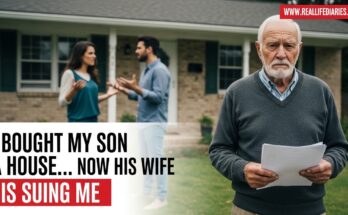
I BOUGHT MY SON A HOUSE. NOW HIS WIFE IS SUING ME.
I paid for everything. The down payment. The renovations.
The deal was simple: “Live there, pay the taxes, and keep it clean.”
They lived there for 8 years. I never charged a cent in rent.
Then my son filed for divorce.
Now his wife, who never worked a day, is claiming HALF THE HOUSE.
She’s suing me to force a sale so she can get a payout.
My lawyer just smiled. The deed is still in MY NAME.
I gave them 24 HOURS to pack their bags.
I worked 40 years for this. I’m 72.
AM I THE JERK for protecting my assets?
I didn’t sleep that night.
Not because I doubted my decision—but because I never imagined it would come to this.
My son called me around midnight. His voice was shaky.
“Dad… you can’t do this. We need time.”
We.
That word hit me harder than anything else.
I told him calmly, “You had eight years of time. Eight years of free living. I asked for one thing—respect.”
There was silence. Then he sighed.
“She has rights, you know. We built a life there.”
I clenched my jaw. “No—you lived in a house I paid for. There’s a difference.”
The next morning, I drove over.
The front yard was overgrown. Trash bins overflowing. The place didn’t look like the home I once proudly handed over.
Inside, it was worse.
Dirty dishes piled high. Walls scuffed. That “keep it clean” promise? Long forgotten.
His wife sat at the kitchen table, arms crossed like she owned the place.
“You can’t just throw us out,” she said coldly. “My lawyer says I’m entitled to half.”
I almost laughed.
“Your lawyer doesn’t own this house. I do.”
She smirked. “We’ll see about that.”
That’s when my son stepped in, avoiding my eyes.
“Dad… maybe we can work something out?”
Work something out.
After everything?
I looked at him—really looked. This wasn’t the boy I raised to be grateful. This was someone else. Someone who thought entitlement came easy.
I pulled out the papers. The deed. My name, clear as day.
“I already did,” I said. “You have until tomorrow.”
His wife scoffed, but I could see it—panic creeping in.
And for the first time, my son said nothing.
The next day came faster than I expected.
I pulled into the driveway just after sunrise.
A moving truck was already there.
For a moment, I thought—maybe they finally understood.
Then I saw her.
Standing on the porch, phone in hand, talking loudly—making sure I could hear.
“Yes, he’s here now. Don’t worry, we’ll handle it.”
I stepped out of the car slowly.
“Handle what?”
She hung up and smiled—too confident for someone being evicted.
“My lawyer filed an emergency motion,” she said. “You can’t force us out like this.”
I nodded, almost impressed.
“You’re right,” I said calmly. “I can’t force you out.”
Her smile widened.
Then I added, “But the court can.”
Right on cue, another car pulled up behind me.
My lawyer stepped out.
And behind him—two officers.
That’s when everything changed.
My son looked like the ground had dropped beneath him.
“Dad… what is this?”
I didn’t raise my voice.
“I told you. This house is mine. And now it’s time I take it back.”
My lawyer handed over the documents. The officers explained everything clearly—no shouting, no drama.
Just facts.
They had no legal claim. No lease. No ownership.
They were guests.
And their welcome had expired.
His wife’s confidence shattered instantly.
“This isn’t over!” she snapped. “I’ll take this to court!”
My lawyer smiled again—that same calm smile.
“You already did,” he said. “And you lost.”
Silence.
Heavy. Final.
My son finally looked at me—not angry this time, not defensive… just defeated.
“Dad… why didn’t you tell me it would go this far?”
I held his gaze.
“Because I didn’t think you’d push it this far.”
They packed the rest of their things in silence.
No arguments. No threats.
Just the sound of a life being boxed up.By noon, the house was empty.
Eight years… reduced to a few boxes and a quiet driveway.
I stood in the doorway, looking inside.
It didn’t feel like home anymore.
Not yet.
The walls were marked, the floors worn, the air heavy with everything that had just happened.
But underneath all of that… it was still mine.
My son lingered by the truck.
He looked smaller somehow. Not like the man who had argued with me the night before—but like the kid who used to run through this very yard.
“Dad…” he said, his voice low. “I messed up.”
I didn’t answer right away.
Because I knew this moment mattered more than anything else.
“I wasn’t thinking,” he continued. “I just… went along with everything. I thought it would work out.”
I nodded slowly.
“That’s the problem,” I said. “You stopped thinking for yourself.”
His eyes dropped.
“I never wanted it to be like this.”
“Neither did I.”
We stood there in silence for a long time.
Then he asked, almost like a child again, “Do you think… we can fix this?”
I looked at him—not at the situation, not at the mess—but at my son.
“You can fix your life,” I said. “But this… this is something you’re going to have to earn back.”
He swallowed hard and nodded.
No arguing this time. No excuses.
Just acceptance.
He climbed into the truck.
As they drove away, I felt something unexpected.
Not anger.
Not even relief.
Just… quiet.
Later that evening, I walked through the house alone.
Room by room.
Remembering what it used to be—and what it could be again.
I opened the windows, letting fresh air in.
For the first time in years, it felt like a new beginning.
Not just for the house.
But for me.A few weeks passed.
The house slowly came back to life.
Fresh paint. Clean floors. New locks.
It felt… peaceful again.
But quiet in a way I wasn’t used to.
Then one afternoon, there was a knock at the door.
I already knew who it was.
My son stood there, alone this time.
No anger. No entitlement. Just… tired.
“Can I come in?” he asked.
I stepped aside.
We sat at the kitchen table—the same one where everything had fallen apart.
“I moved into a small apartment,” he said. “It’s not much, but… it’s mine.”
I nodded. “That’s a start.”
He hesitated, then slid something across the table.
A folded piece of paper.
“I’ve been looking for work. And… I want to pay you back. Not just money… everything.”
I didn’t touch the paper right away.
“Why?” I asked.
He looked up at me, eyes clear for the first time in a long while.
“Because you were right,” he said. “I got comfortable. I let someone else fight my battles. And I forgot who I was.”
That hit harder than anything before.
“I don’t expect you to forgive me,” he added. “I just want the chance to make things right.”
I finally picked up the paper.
It wasn’t a contract.
It was a plan.
Budgets. Job applications. Steps.
Effort.
Real effort.
I leaned back in my chair and studied him.
“You’re not paying me back for the house,” I said.
His face fell slightly.
“You’re paying me back by becoming someone who would never let this happen again.”
He nodded slowly.
“I understand.”
We sat there for a while, not as opponents… but as father and son again.
Before he left, he paused at the door.
“Dad… thank you. For not giving in.”
I gave a small nod.
“Don’t thank me yet. Show me.”
A faint smile crossed his face.
“Yeah… I will.”
And as he walked away, I realized something:
I didn’t lose my son.
I just had to force him to find himself again.Months passed.
True to his word, my son kept showing up.
Not just with promises—but with proof.
A steady job. Rent paid on time. No shortcuts.
Sometimes he’d stop by just to help—fixing a cabinet, mowing the lawn, repainting a room I hadn’t gotten to yet.
No asking for anything in return.
Just… doing the work.
One evening, as the sun was setting, we sat on the porch together.
The same porch that had once been covered in neglect.
Now it was clean. Quiet.
Peaceful.
“You know,” he said, “I used to think you were being hard on me.”
I raised an eyebrow. “Used to?”
He smiled faintly.
“I get it now. You weren’t trying to take something away from me… you were trying to give me something I didn’t have.”
“And what’s that?” I asked.
He looked out toward the street.
“Responsibility.”
I nodded.
“That’s the only thing no one can take from you—once you earn it.”
He sat with that for a moment, then said quietly:
“I’m glad you didn’t let me stay.”
That was the first time I knew—for sure—that everything had been worth it.
Not the house.
Not the money.
But this.
The lesson.
The change.
The second chance.
As the sun dipped below the horizon, I realized something simple:
Sometimes the hardest thing you can do for someone you love…
is stop making things easy for them.