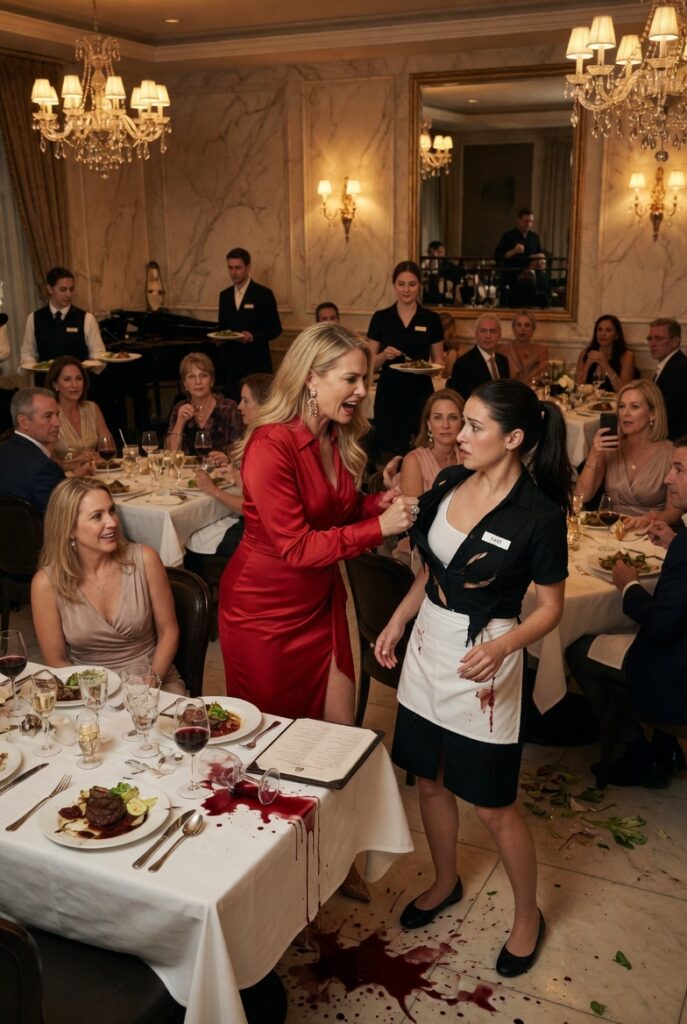
She Tore My Uniform In Front Of A Full Dining Room—And Thought I’d Be The One Leaving In Shame
“You pathetic little waitress.”
Her hand fisted in the front of my uniform, and the fabric gave way with a sharp, ugly sound that somehow cut through the entire room louder than the shattering glass had.
For a second, all I could hear was silk tearing, red wine dripping onto white linen, and fifty people deciding whether I was worth looking away from.
Part 1 — The Woman In Red Who Knew Too Much
The Golden Palm always looked its most beautiful just before disaster.
At seven-thirty, the dining room glowed like money. Amber light spilled from the sconces and softened the marble walls. Cut crystal glittered on every table. The low hum of conversation rose and fell over the piano in the corner, and the air carried butter, garlic, citrus, and the faint smoke of seared steak. It was the kind of room where people spoke quietly because everything else was already announcing status for them.
That night, I was wearing a black waitress uniform with a plain white apron and a name tag that said KATE.
No one in the room knew that Kate did not exist.
Three months earlier, if anyone had told me I would be carrying plates through my own restaurant while wearing cheap shoes and a fake ponytail, I would have laughed. I was Christina Stone, co-owner of one of the most exclusive restaurants in the city. My husband Daniel had built and sold two companies before he turned thirty-five, and his money had given us room to dream bigger than most people ever can. The Golden Palm was my dream. Not his. Mine.
I built it table by table, menu by menu, hiring people I trusted, designing the floor plan myself, obsessing over the lighting, the music, the spacing between chairs, the exact weight of the wine list in your hand.
And then the letters started.
The first one arrived on a Tuesday morning in a plain white envelope with no stamp and no return address. Someone had slipped it under my office door before opening. The handwriting was neat, almost elegant, which made the message feel even colder.
Your staff is suffering and you don’t even see it. Some of your customers are monsters. If you don’t stop it, someone else will.
I thought it was nonsense.
Or revenge from a former employee. Or a competitor trying to unsettle me. Restaurants make people dramatic. Money makes people petty. Anonymous threats usually mean less than they sound like.
Then a second letter came.
Then a third.
Each one described behavior I had supposedly allowed inside my own dining room—humiliation, intimidation, guests reducing servers to shaking hands and forced smiles while management looked away because the offenders spent enough money to buy permission. Every time I asked questions, my operations team told me the same thing: nothing unusual, no pattern, no problem big enough to alarm me.
But something about the letters bothered me. Not just the content. The accuracy of the details. Whoever wrote them knew our rhythms, our weak spots, the names of staff members who had quit abruptly in the last six months. That kind of knowledge did not come from a random enemy.
It came from someone watching.
Or someone who had been ignored.
That was when I made the decision Daniel called insane.
“I’m going undercover,” I told him over breakfast, sliding the third letter across the table.
He looked from the page to me, then back to the page again. Morning light was coming through the kitchen windows, catching the steam from his coffee. He wore a gray T-shirt and reading glasses, which made him look less like a billionaire and more like a man who had simply wandered into great wealth by accident.
“You own the place,” he said carefully. “Why would you pretend to work there?”
“Because people lie upward,” I said. “Managers lie to protect themselves. Staff lie because they’re afraid. Customers lie because they can. I want to see the room the way my employees see it.”
Daniel leaned back in his chair and studied me for a moment.
“You already know you’re not going to let this go, don’t you?”
“No.”
A slow smile touched his mouth. “Then at least let me help you do it properly.”
So for three weeks, I prepared.
I trained with Maria, one of our most efficient servers, without telling her who I was at first. I practiced balancing trays until my wrists ached. I memorized every dish, every allergy modification, every wine pairing, every table number. We created a false hiring file under the name Kate Morrison, a college student working nights to cover tuition. I darkened my hair, swapped my contacts, changed the way I held my shoulders, and learned how to make myself look a little smaller, a little less certain.
It is remarkable how quickly the world adjusts when it thinks you have less power than you actually do.
The first few days taught me more about my restaurant than six months of management reports ever had.
The work was hard in ways office people romanticize and never really understand. My feet throbbed by ten p.m. My back hurt from smiling through exhaustion. Customers interrupted while I was carrying six things at once and then acted offended when I could not answer instantly. Good staff worked like dancers in a fire—fast, graceful, alert, always one second from collision.
Most guests were fine. Pleasant, even. Some were generous in the casual way happy people often are.
But there were others.
The ones who snapped fingers instead of making eye contact. The ones who said “sweetheart” with contempt tucked inside it. The ones who believed the cost of a bottle entitled them to another human being’s dignity for two hours.
Still, nothing matched the violence in the letters.
Not until Jessica Patterson walked in.
I saw her before I heard her. Tall, blonde, expensive in a way that seemed rehearsed. She wore a red silk dress that moved like liquid and enough jewelry to make other women glance before pretending not to. Three women followed her in a cluster, smiling too brightly, talking too loudly, all of them arranged around her the way planets arrange themselves around a force field.
Maria saw my face and muttered under her breath, “Great. Her.”
“Who?”
“Trouble,” she said. “Try not to end up in her line of fire.”
Jessica requested a table in my section.
From the moment I introduced myself, something in her expression sharpened. She was not simply difficult. Difficult customers are easy to identify. They want control, attention, indulgence. Jessica wanted information.
“You’re new,” she said the first night, looking me over as if I had applied for membership somewhere private.
“Yes, ma’am.”
“Where did you work before this?”
I gave her the story. College. Part-time jobs. Tuition bills. A sick aunt in Ohio. Roommates. Financial pressure. All of it practiced.
Her smile barely moved. “And you like it here?”
“It’s a good place to work.”
“Is it?”
She asked the question lightly, but her eyes stayed on me too long.
That was the first strange thing.
The second was her patience. Most entitled women like Jessica lose interest quickly if you refuse to break. But she kept coming back. She requested my section, complained about imaginary mistakes, changed orders mid-course, sent food back untouched, questioned the bill, criticized my timing, my posture, my tone.
Other staff warned me.
“She gets girls fired,” Maria said one night while we were rolling silverware. “Or they quit before that. Three in the past few months.”
“Why hasn’t management banned her?”
Maria gave me a tired look. “Because she spends a fortune here, brings rich friends, and knows exactly how far to go without leaving marks that matter.”
That sentence stayed with me.
Without leaving marks that matter.
That was the real disease in places like mine. Not loud cruelty. Contained cruelty. Socially acceptable cruelty. The kind that bruises a person’s nervous system while never becoming dramatic enough for a formal complaint anyone wants to defend.
I started watching Jessica more closely.
She took photos of corners no ordinary guest would photograph. Asked odd questions about staffing schedules, supplier delays, turnover, security blind spots. Once, I saw her glance toward the private office hallway with a level of focus that had nothing to do with curiosity.
Then one Thursday night, while I was clearing a side station near the ladies’ room, I heard her on the phone.
She stood half-turned toward the wall, voice low, one hand around a champagne flute. I only caught fragments at first.
“…almost done…”
“…another one will quit…”
“…once service starts slipping, the valuation drops…”
I stopped breathing.
Jessica laughed softly, a sound without warmth.
“No,” she said into the phone. “Trust me. By the time I’m done with this place, they’ll be desperate.”
My pulse went hard and fast.
This was not random cruelty. It was structured. Measured. Strategic. She had not come to punish one waitress for entertainment. She was trying to poison the staff from the inside.
When she turned, I lowered my head and kept polishing forks.
She walked past me without a pause, perfume trailing behind her like a threat.
That night, I went upstairs after close and pulled three weeks of camera footage with Daniel.
The private office overlooked the dining room through smoked glass. The city outside was black and silver beyond the windows. Daniel stood with one hand on the desk while footage played across three monitors—Jessica entering, Jessica sitting, Jessica staring, Jessica asking for me by name, Jessica leaning in too close when I poured wine.
“She knows something,” Daniel said.
“Or she suspects.”
“About you?”
“Not exactly.” I watched Jessica freeze-frame on one screen, her expression turned slightly away from the camera. “I think she came here for the business first. I’m just useful to her now.”
Daniel was quiet for a moment.
“Do you want me to pull in legal?”
“Not yet.” I folded my arms. “I want the whole truth.”
He looked at me with that mixture of admiration and concern husbands often wear when their wives are about to do something inconveniently brave.
“Then I’m watching the cameras live from now on,” he said.
I nodded.
Down below, on the frozen screen, Jessica was smiling at me.
And I suddenly knew she was getting ready to make a much bigger move.
Part 2 — The Night She Thought The Room Belonged To Her
The night it happened, the restaurant was full enough that every mistake would echo.
A hedge fund dinner in the back room. A couple celebrating an anniversary at table twelve. A visiting actor trying to pretend he wasn’t being noticed. The piano low and elegant near the bar. Silver buckets sweating beside champagne bottles. The entire place tuned to that delicate edge between luxury and chaos where the best restaurants live every evening.
Jessica arrived twenty minutes late with the same three women and a mood so sharp it felt rehearsed.
She chose the center of the room this time.
Not a discreet corner. Not a private booth. A table positioned where everyone could see her without obviously staring. When someone plans a spectacle, location matters.
“Kate,” she said when I approached, drawing out the name like an inside joke. “There you are.”
Her smile was perfect.
Her eyes were not.
She ordered a bottle of red wine so expensive that most servers get nervous even touching it, then asked three separate questions she already knew the answers to, just to slow me down. By the time I returned with the bottle, the room had developed that late-evening shine of money and appetite. Glassware glinted. Voices swelled and softened. A server passed behind me carrying Dover sole. Someone at the bar laughed too loudly, then lowered his tone.
Jessica watched me pour.
Her hand moved before mine had fully straightened.
The wineglass tipped.
Ruby-colored wine spread across the white tablecloth and splashed the front of her red dress.
Gasps came quickly. A few chairs shifted.
Jessica rose so abruptly her chair legs scraped against the floor.
“You clumsy idiot!”
Her voice cut across the room like broken glass.
I stepped back at once. “I’m so sorry, ma’am. Let me get—”
“Don’t touch me.”
She looked down at the stain with theatrical outrage, then back at me with a rage so sharpened it no longer felt spontaneous. The room had already begun to reorganize around her. Diners falling silent. Servers freezing in peripheral motion. Management glancing over from the bar but not yet stepping in.
The social instinct to protect the loudest rich person in the room is faster than most people admit.
“Do you have any idea what this dress cost?” Jessica demanded.
There it was.
Not embarrassment. Not inconvenience. Price.
I kept my voice steady. “I understand you’re upset. Let me bring the manager and we’ll take care of the cleaning immediately.”
She laughed.
“Take care of it?” She looked around as though inviting witnesses. “This girl ruins my dress and thinks a manager is enough?”
I felt the room shift further. People were listening now. Not casually. Hungerly. The way strangers listen when they suspect humiliation is about to cross the line from discomfort to entertainment.
Maria stood near the service station with a bread basket in her hands, face pale.
One of the assistant managers took a half-step in our direction, then stopped when Jessica looked at him. I saw it happen. The tiny institutional surrender. He knew who she was. Knew what she spent. Knew what complaints from people like her could do to quarterly numbers.
That was the betrayal beneath the immediate one.
No one had to agree with her cruelty for it to win. They only had to hesitate.
Jessica took one step closer to me.
“I want her fired,” she said. “Now.”
“Jessica,” one of her friends murmured, with the helpless tone of a woman who did not approve but had no intention of crossing her.
“No.” Jessica kept her eyes on me. “No, actually, I want more than that.”
She pulled out her phone.
“I think it’s time I called the owner myself.”
My pulse jumped once.
Of course she thought she could.
That was the irony of the entire thing. She was standing in the business she was trying to destroy, threatening to call the woman whose restaurant she had spent weeks poisoning, never understanding the waitress in front of her and the owner upstairs were the same person.
I should have felt triumph already.
Instead, I felt cold.
Because I could see what she was really doing now. She was not just sabotaging morale. She was manufacturing an incident large enough to damage the restaurant publicly. One viral clip. One thread from the right account. One whisper to the right investor circle that The Golden Palm no longer controlled its service culture. That was how businesses bled without visible wounds.
I said quietly, “Please lower your voice.”
Her eyes flashed with delight.
There are people who become more dangerous the moment they realize you are trying to remain dignified.
She stepped forward, grabbed the front of my uniform, and yanked.
Buttons scattered.
Fabric tore.
The sound was raw and intimate and wrong in a way that made several people gasp at once.
For half a second, I did not move.
The room had gone absolutely still.
Her hand was still gripping the torn edge of my shirt.
She leaned in and hissed, loud enough for half the room to hear, “Look at you. Dressed in rags like the nobody you are.”
A woman at table eleven looked away.
A man near the bar stared openly.
No one intervened.
Later, people always ask why public humiliation feels so violent even when it leaves no bruise worth photographing.
It is because humiliation is theft.
It steals your control over your own body, your timing, your expression, the story in the room. It turns you into an object made of reaction.
Jessica wanted that reaction.
She wanted me crying. Or shouting. Or slapping her hand away. Anything messy enough to confirm the role she had assigned me.
But a person can endure quite a lot when they know the cameras are rolling and the truth is already climbing the stairs.
I straightened slowly.
Her hand slipped away from the torn uniform as I lifted my chin.
Then a man’s voice, calm and hard as cut stone, came from behind her.
“Is there a problem here?”
Jessica turned, irritated first, then confused.
Daniel was walking toward us from the main staircase.
He wore a navy suit and that unreadable expression he saves for boardrooms and emergencies. He did not move quickly. He didn’t need to. The room was making space for him without understanding why.
Jessica blinked.
“And who are you?” she snapped. “Another manager?”
Daniel stopped beside me and looked once at the torn fabric, once at the wine on the tablecloth, then at Jessica herself.
“Actually,” he said, “I’m Daniel Stone.”
I watched the name hit her. Not fully. Not yet.
Then he added, “And this is my wife.”
The silence that followed had weight.
Jessica looked at him. Then at me. Then back at him again, her face draining in slow disbelief.
“Your wife?”
Daniel nodded once. “Christina Stone. Owner of the Golden Palm.”
There is a particular expression people wear when class assumptions collapse in public. It is not simple surprise. It is panic mixed with embarrassment, because the revelation does not just alter the facts. It exposes what they believed entitled them to behave the way they did in the first place.
Jessica’s friends recoiled first.
One of them actually whispered, “Oh my God.”
I took off the name tag.
My fingers were steady.
“Still want to call the owner?” I asked.
Jessica opened her mouth, but nothing coherent came out.
Daniel’s tone stayed almost polite. “I’ve been upstairs watching the live security feed for the last fifteen minutes. Including the moment you knocked over your own wine. Including the moment you grabbed my wife’s clothing and tore it.”
Now the whispers exploded.
The room, which had been so eager to treat Jessica as the injured party, was reversing itself with the speed of a mob that senses its first story was unsafe. I saw heads turning. Phones lowered, then raised again for different reasons. The assistant manager who had hesitated now hurried forward, pale and sweating, as if motion itself might disguise his earlier failure.
Jessica recovered enough to become dangerous again.
Her shoulders squared. Her expression hardened into something uglier than entitlement.
“You think this changes anything?” she said, voice dropping low. “I know things about this place.”
I felt it then. The deeper layer under all of this.
Not just sabotage. Not just cruelty.
Revenge.
“Who are you working for?” I asked.
Jessica laughed once, a brittle sound. “Someone who has every reason to want this restaurant on its knees.”
Daniel took out his phone. “You should be careful what you say next.”
She ignored him. Or perhaps she was past caution now.
That is what arrogance does when exposed. It doesn’t retreat elegantly. It often lunges.
Her eyes locked on mine.
“This place destroyed my life,” she said.
The room quieted again.
Not sympathy this time. Curiosity.
“Robert Martinez,” she said. “Does that name mean anything to you?”
It did.
Of course it did.
Robert had been my early business partner. Smart with numbers, reckless in all the softer parts of his life. He had sold his stake two years earlier after a vicious divorce and a string of financial pressures that had nothing to do with me or Daniel. We had not ended as enemies, but we had not ended warmly either.
Jessica saw recognition cross my face and smiled with a kind of broken triumph.
“He was my husband.”
The room seemed to tilt slightly.
It was never just about service. Never just about humiliating staff for sport. She had been targeting the place because it was one of the last visible things Robert had helped build before he got out. She could no longer hurt him directly, so she chose the thing that carried some remnant of him—and everyone inside it.
“You terrorized my employees for months,” I said quietly.
Her eyes glistened, but there was nothing soft in them.
“He walked away,” she said. “He left me with nothing. Do you understand that? Nothing. While all of you kept serving truffle pasta and expensive wine like the world was fair.”
“And so you decided to make innocent people pay for his sins?”
She said nothing.
That was answer enough.
Daniel lifted his phone slightly. “The police are already on their way.”
For the first time, Jessica looked truly afraid.
And that was when I realized whatever came next was going to be bigger than one ruined dress, one torn uniform, one ugly scene in a crowded dining room.
Because revenge, once cornered, tends to tell the truth too quickly.
Part 3 — The Cameras Saw Everything, But The Worst Thing Was Already In The Room
By the time the police arrived, the restaurant had split into layers of silence.
Closest to us stood the staff, rigid and watchful, carrying the stillness of people long accustomed to absorbing someone else’s mood. Beyond them, the diners sat in a strange, suspended discomfort, caught between appetite and scandal, prestige and conscience. Crystal still shone under the pendant lights. Half-finished entrées cooled untouched. Somewhere in the back, an espresso machine hissed as though nothing at all had happened.
Jessica stood at the center of it all like a woman discovering, too late, that a room she believed she controlled had merely been indulging her.
Her friends had moved away from her first. Not dramatically. Just three careful steps backward, the distance of women who could already hear the version of the story they planned to tell tomorrow: We had no idea. She was always unstable. We were shocked.
Wealth has its own form of self-preservation. It sheds liability faster than loyalty.
Daniel stayed beside me, one hand light against my back, not possessive, not performative. Just there. Warm and steady and unmistakably real. The torn edge of my uniform still exposed part of my collarbone, and the cool air from the vents brushed against my skin. I could feel every eye on it.
The assistant manager offered me his jacket. I took it without looking at him.
I was too angry for gratitude.
Not just because he had hesitated earlier, but because I finally understood what the letters had been trying to tell me. My staff had not merely been dealing with difficult guests. They had been learning, over and over, that certain people could hurt them in public and the institution would pause before protecting them.
That pause had a cost.
It had cost me employees. It had cost other women the right to finish a shift without shaking. It had cost the room its honesty.
Jessica looked from me to Daniel to the two officers now approaching through the dining room.
“You’re overreacting,” she said, but her voice had begun to fray at the edges. “It was an argument. She spilled wine on me.”
“You tipped the glass yourself,” Daniel said.
“Can you prove that?”
He held up the phone in his hand, then glanced toward the ceiling. “Three cameras can.”
Something collapsed in her expression then, but not remorse. It was the terror of someone who had mistaken power for immunity.
One of the officers, a woman in her forties with a calm face and rain still darkening the shoulders of her uniform, stopped a few feet away.
“We received a call regarding an assault and property damage.”
Jessica straightened as though dignity were something she could put back on by force.
“This is absurd,” she said. “I’m the one who should be filing a complaint.”
The officer’s gaze moved over the torn uniform, the spilled wine, the scattered buttons on the floor, then to me.
“Ma’am?”
I met her eyes. “I’m Christina Stone. I own this restaurant. This woman has harassed my staff for months under multiple identities and physically grabbed me during service while I was working undercover in my own dining room.”
That got a reaction.
Not from the officer—she stayed admirably neutral—but from the guests. You could hear the murmur move through them again. Not because it mattered morally that I owned the restaurant. It should not have. But to rooms like this, hierarchy is the first language. My pain had become legible only once it came with title and ownership attached to it.
That fact disgusted me almost as much as Jessica did.
Daniel stepped forward and passed his phone to the officer. “There’s live-feed footage and audio in the upstairs office. We also have archived recordings from the last several weeks showing a pattern of targeted harassment toward staff members.”
Jessica’s head snapped toward him. “You were spying on me?”
“No,” I said. “We were protecting the people you thought no one would defend.”
The officer handed the phone to her partner, then looked back at Jessica. “I’m going to ask you to stay where you are.”
Jessica laughed once, high and strained. “Do you know who I am?”
There it was. The oldest refuge of the socially protected. Identity as shield. Reputation as argument.
The officer did not blink. “Tonight, I know exactly enough.”
That line would have satisfied me more if the rest of this had not already cost so many people so much.
Jessica’s composure broke by degrees.
First came indignation. Then bargaining. Then the brittle edge of confession disguised as self-justification. She looked at me like a woman who no longer cared what the room thought as long as someone finally understood her grievance.
“You think I enjoyed this?” she said. “You think any of this was random?”
I said nothing.
Her laugh came again, softer now and more damaged. “Robert built half this place and then sold it and moved on. Just moved on. New life. New women. New money. Everyone told me to be dignified. Everyone told me to let the lawyers handle it. And then I watched him walk away from everything we built together while people like you kept profiting.”
People like me.
The accusation landed strangely, because there was no precision in it. Only hurt looking for a target with a visible face.
“You wanted Robert to suffer,” I said. “And when you couldn’t reach him, you chose waitresses.”
“I chose weakness,” she snapped.
The room went still.
It was the ugliest truth she had said all night, and the most honest.
Not Robert. Not me. Weakness. Or what she thought was weakness. That was why she had targeted servers, hostesses, women on the floor who needed the job badly enough to endure the unendurable with a smile. It was not just revenge. It was selection.
Cruel people rarely attack at random. They study who can afford to object.
Maria was standing ten feet away with tears in her eyes.
I looked at Jessica and suddenly saw the entire machinery of her strategy with terrible clarity. The private grievances. The financial motive. The delight in breaking morale. The use of customer status as institutional protection. The way she had trained the room to doubt the people she wanted most vulnerable.
“You wanted them frightened enough to quit,” I said.
Her silence was confirmation.
I thought of the letters then. Someone from my staff, probably more than one person, desperate enough to risk everything just to tell me that the place was rotting in a way management reports would never show. Not because the food was bad or the profits were slipping. Because fear had been built into the shift schedule.
A restaurant can survive bad reviews.
It cannot survive contempt becoming policy.
The officers asked Jessica to turn around.
That was when she panicked for real.
“You can’t do this,” she said, stepping backward. “I have attorneys. I know people. My family—”
One of her former friends let out a short, involuntary sound, almost a laugh, almost disbelief. She covered it quickly, but the damage was done. The spell had fully broken.
That is another truth about socially protected people: once a room stops believing in them, they shrink fast.
Jessica turned back to me, desperate now, mascara gathering at the corners of her eyes.
“You don’t understand what it’s like to lose everything.”
My answer came more quietly than I expected.
“No. I understand exactly what it’s like to build something and watch people decide it matters less because they think you can survive the loss.”
Her face changed slightly.
Maybe because she realized too late that I had not lived my life untouched by injury. Just untouched by the particular permission structure she used to excuse her own cruelty.
The officers took her phone, read her the necessary words, and led her through the dining room.
She tried once to twist back toward me.
“This isn’t over.”
But it was.
Not because legal consequences solve the emotional architecture underneath a person like Jessica. They don’t. They simply stop her from turning private damage into public permission. That mattered.
What mattered more was what happened in the room after she was gone.
Silence sat there for three long seconds.
Then Maria stepped forward.
Not dramatically. Not with a speech prepared. Just one exhausted, brave step. She looked from me to the managers to the diners still pretending not to hear themselves breathe.
“We told you,” she said.
She was speaking to me.
Not cruelly. Not even angrily. That was the worst part.
Just plainly.
“We told management she was doing this. We told them she made girls cry in the restroom. We told them she waited until the busiest part of service because she knew nobody would help. We told them.”
The assistant manager opened his mouth, perhaps to defend himself, perhaps to explain what pressure from wealthy clientele does to judgment. I cut him off with a look.
“Not tonight.”
He closed it.
I looked at the room around me—the polished silver, the expensive coats draped over chairs, the half-eaten food, the faces still lit by the soft flattering glow I had designed myself. I had built this room to make people feel cared for. Safe. Impressed, yes, but also received.
And yet safety had been conditional here.
Not for customers.
For the people carrying the plates.
I climbed one step onto the raised edge near the piano so everyone could see me without craning. Daniel did not stop me. He knew that look on my face. It meant the decision was already made.
The jacket around my shoulders smelled faintly like cedar and Daniel’s cologne. Beneath it, my torn uniform scratched against my skin.
“I owe my staff an apology,” I said.
No one moved.
“I built a beautiful restaurant. I built a profitable one. I built one people fight to get reservations into. But I allowed a system to form where some customers believed money could purchase immunity, and some managers believed revenue justified delay.”
My voice did not rise.
It did not need to.
“You were right to write those letters,” I said, though I did not know who among them had done it. “Whoever you are—you were right.”
Maria lowered her eyes.
A hostess near the entrance began quietly crying.
I looked next at the managers.
“Starting tonight, any guest who degrades, intimidates, or harasses a member of this staff is removed immediately, no matter what they spend, no matter who they know, no matter who they threaten to call. If anyone in management hesitates to protect an employee because the table is expensive, they can leave with the customer.”
That landed.
Not in the sentimental way stories like this often pretend such moments land, but in the practical way policy lands. Heads lifting. Postures changing. One server covering her mouth. A bartender in the back standing straighter.
Then I turned to the diners.
The room suddenly found the tablecloths fascinating.
“Luxury without decency is just well-lit ugliness,” I said. “If you dine here, you will treat the people serving you like human beings. Not because I own the room. Because they are.”
Nobody applauded.
I was grateful for that.
Applause would have cheapened it.
Afterward, Daniel closed the restaurant early.
Guests left quietly, with the embarrassed speed of people who had consumed something they should have interrupted. Staff gathered in the back service corridor while the managers pulled footage, collected statements, and handed over records. The smell back there was completely different from the dining room—soap, coffee grounds, fryer oil, damp linen, human fatigue. Real work has a scent. So does relief.
Maria sat on an overturned crate while I changed back into my own clothes in the office upstairs. When I came down, she looked at me for a long moment and said, “I didn’t know if you’d really want to see it.”
“I didn’t,” I admitted.
That made her smile, faintly. “That’s probably why you needed to.”
The case against Jessica became stronger than even I expected.
The security footage was clean. The audio was better. More importantly, once she was no longer protected by atmosphere and intimidation, other evidence surfaced quickly. Former employees gave statements. Archived reservation notes showed how often she had requested specific sections. A private investigator tied her to attempts to gather information about our financial stress points. There were messages. Calls. Enough to show premeditation, not merely a bad temper in public.
Her attorneys tried to soften the story into emotional distress.
The recordings did not cooperate.
In the end, it wasn’t the dramatic parts that buried her. Not the torn uniform. Not even the public scene.
It was the pattern.
Patterns are what turn cruelty into liability.
The legal outcome came months later, slow and procedural in the way real consequences often do. She did not vanish in one cinematic moment. She lost things in stages. Access. Credibility. Friends. Invitations. The protective halo of being “difficult but connected.” Her name became inconvenient. Her story stopped sounding tragic once the details became public.
And the restaurant changed.
That was the part that mattered most.
We rewrote floor authority protocols within forty-eight hours. Any server could now flag a table and have a manager step in without explanation. Repeat offenders were banned. Incident logs became formalized, reviewed weekly, not buried. Maria was promoted within two months because she had already been doing the emotional labor of leadership for years without the title or pay.
The letters stopped coming.
One afternoon, several weeks after everything, I found a final note tucked beneath my office door.
Same neat handwriting.
Thank you for finally seeing us.
I sat with that note for a long time.
Not because it was dramatic. Because it wasn’t. No threats. No praise. Just relief. The kind that arrives only after someone has been believed.
Daniel came in around sunset that day and found me holding it.
He read it, set it back on the desk, then leaned against the window.
“You know,” he said, “you could have just installed a bigger complaints system like a normal owner.”
I looked up at him. “You hated the undercover plan.”
“I hated the part where you were carrying hot plates in shoes designed by sadists.” His mouth softened. “I never hated the reason.”
Outside, the city was turning gold. Inside, downstairs, I could hear service beginning again—the soft percussion of glasses, distant footsteps, the murmur of a room not yet fully awake for dinner.
“I thought I was protecting the business,” I said.
“And?”
I looked through the glass toward the dining room I had once loved mainly for how beautiful it was.
“I was protecting the wrong thing.”
He nodded once, as if that was the answer he had been waiting for.
The Golden Palm did not become gentler overnight. No serious place does. Restaurants remain hard, fast, imperfect places full of ego and fatigue and impossible timing. But the fear changed shape. It was no longer staff who feared the room. It was the room that finally understood there were limits.
That is what dignity looks like in practice.
Not speeches.
Structure.
Months later, when people asked me about the night Jessica Patterson tore my uniform in front of a full dining room, they wanted the dramatic version. The billionaire husband. The cameras. The reversal. The woman in red being led away while the truth stood under chandeliers.
That part was real.
But it wasn’t the whole story.
The real story was quieter and harder.
It was the moment I understood that a business can be exquisitely run and still be morally lazy. That people in uniforms are often asked to absorb the worst versions of other people’s power while calling it service. That leadership is not proven by how beautifully a place operates when everything is polished and profitable. It is proven by what happens when someone small is cornered in public and the institution has to decide whose discomfort matters more.
Jessica thought she had found the weakest person in the room.
What she really found was the weakest part of the system.
And once I saw it clearly, I could never unsee it.
She tore a uniform.
What she exposed was everything underneath it.