It had been a Norfolk kind of day, the sort that could drain the life out of a whole building without a single dramatic thing happening.
Corporal Emily Harris had spent ten hours moving from one stack of paper to another, first helping close out an inspection packet, then updating supply records, then correcting an inventory sheet that Major Whitaker had kicked back with red marks all over it.
Nobody had yelled.
Nobody had run.
Nobody had saluted the wrong person or lost a weapon or crashed a vehicle.
It was somehow more exhausting than any of those things.
By late afternoon, she felt hollowed out by fluorescent lights, printer toner, and the tight-jawed pressure that settled over the office whenever Whitaker decided a small mistake was proof of moral collapse.
By the time she signed out and drove off base, the sky had flattened into a gray sheet and the rain had started in earnest.
Cold coastal rain swept sideways across the windshield, making every stoplight glow in a watery halo.
She should have gone home.
She knew that.
But the thought of reheating leftovers in her apartment and listening to rain drum against the window felt lonelier than usual, so instead she turned into the parking lot of a diner just outside the gate.
The place was called the Anchor Grill, though everyone simply called it Linda’s because Linda had been carrying coffee pots there longer than some lieutenants had been alive.
The sign out front buzzed.
The front window fogged at the corners.
Inside, the booths were cracked, the coffee was strong enough to stand a spoon in, and every inch of the place smelled like bacon grease, wet jackets, and stories told a hundred times.
Marines stopped there after duty.
Sailors went there after mid-watch.
Retired chiefs treated it like a second kitchen.
Emily slid into a booth by the window, ordered coffee and meatloaf, and let the heat from the mug soak into her hands.
For the first time all day, no one needed a signature from her.
No one wanted a correction.
No one was asking why box three on line seven did not match the revised roster from the previous week.
The rain traced thin silver lines down the glass, and she almost felt herself unclench.
Then she noticed the man at the register.
He looked to be in his late fifties or early sixties, with close-cut gray hair and a faded Vietnam veteran cap pulled low over his brow.
His coat was damp at the shoulders.
Nothing about him was flashy.
He did not move like a man trying to be seen.
But he stood with an ease Emily had learned to recognize in service members who had worn rank for a long time.
Even age had not managed to erase the habit of balance and control from the way he carried himself.
Linda was speaking to him in the soft voice she used only when someone was embarrassed or grieving.
Emily caught the words a second later.
“Sir, I am sorry.
It looks like your card did not go through.”
The room did not go silent, exactly.
Forks still touched plates.
Coffee still poured.
But the sound dropped in that strange, unmistakable way public places do when everyone suddenly becomes interested in not looking at the center of a small humiliation.
The man frowned down at the card in his hand, as if the machine had made a clerical error.
Linda ran it again.
Same result.
He opened his wallet, counted the cash inside, and Emily could tell from three booths away that it would not cover the bill.
He did not protest.
He did not joke.
He just absorbed the moment with his jaw set, a man who had probably spent a lifetime refusing to make his discomfort anyone else’s problem.
Emily did not think very long about it.
She rose, walked to the register, and held out her card.
“Put his dinner on mine,” she said.
The man turned toward her.
Up close, his face was lined in a way that suggested years of weather and command, not just age.
His eyes were sharp, clear, and unexpectedly tired.
“You do not have to do that,” he said.
“It is all right, sir,” Emily replied.
“Please.”
Linda, wise enough to understand the value of speed in moments like that, swiped the card before either of them could turn it into a debate.
The receipt printed.
The old man looked at Emily for a second that felt longer than it should have, then asked whether she was a Marine.
“Yes, sir.”
He nodded once.
“Thank you.”
Emily shrugged.
“Veterans look out for us.
We look out for you.”
It was the truest answer she had.
Her father had worn a uniform.
Her grandfather had too.
She had grown up hearing that service did not end when a paycheck did.
It turned into a kind of debt paid forward in small ways, often when no one was keeping score.
She picked up her coffee to go and headed for the door, but before she reached it, the man called after her.
“Marine.”
She turned.
“What is your name?”
“Corporal Emily Harris, sir.”
Again that measured look, as if he were filing her away in a private ledger.
Then he said, “Good to meet you, Corporal Harris.”
That was all.
Emily stepped into the rain, drove home, and let the moment drift into the blur of ordinary duty days.
The next morning she was back at her desk by 0600.
Major Whitaker was in one of his moods by 0700.
By 0830 he had already kicked back two routing sheets and chewed out a lance corporal for a date typed in the European format.
The diner slipped behind the rest of the week.
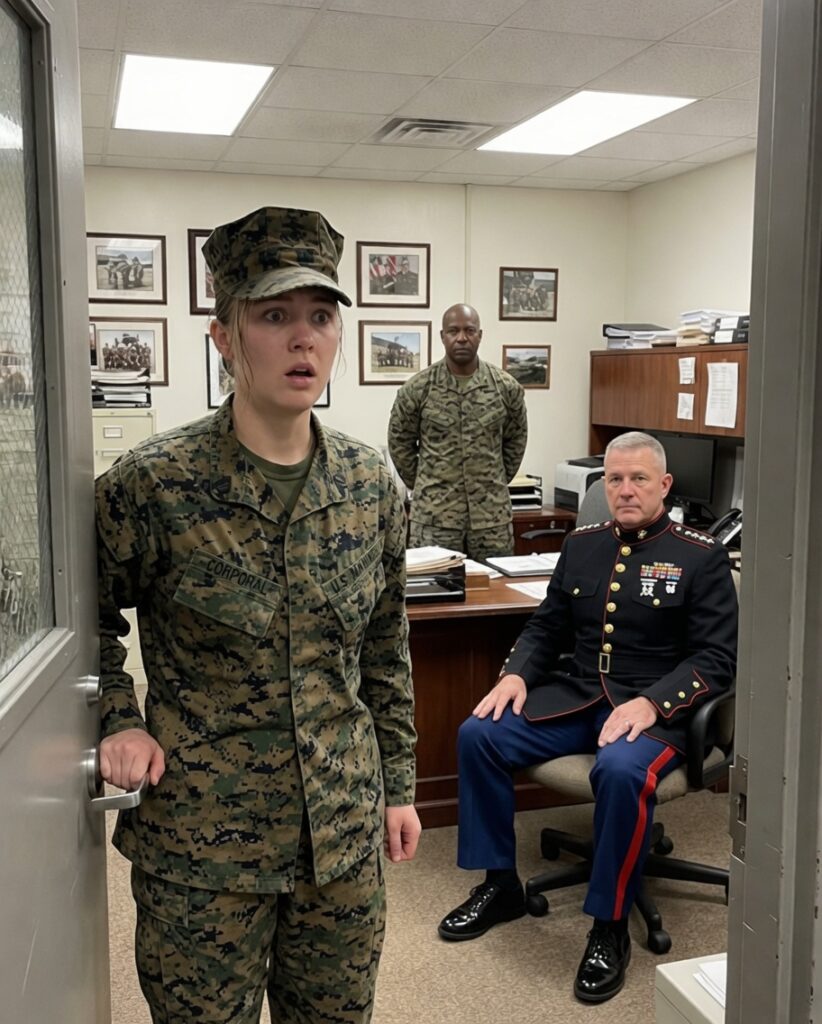
Two weeks later, a staff sergeant from headquarters appeared beside Emily’s desk and told her to report to Lieutenant Colonel Benson’s office at 1300 in the service uniform of the day.
No reason was given.
That was enough to tighten her stomach.
Headquarters did not summon corporals for fun.
And when a commanding officer wanted a junior Marine with no explanation attached, the possibilities usually leaned in one direction.
Emily’s first thought was that Whitaker had finally decided to make good on one of his threats and shove some administrative problem uphill with her name attached to it.
At 1258 she stood outside Benson’s office, palms damp inside her sleeves, and knocked.
“Enter.”
She stepped inside and nearly stopped breathing.
The man from the diner sat in a chair across from Benson’s desk, not in a damp coat and old veteran cap now, but in perfectly pressed Marine Corps dress blues.
Four silver stars rested on his shoulders.
His ribbons were immaculate.
His posture somehow made the entire office seem smaller.
Lieutenant Colonel Benson was standing.
Sergeant Major Ruiz stood near the bookshelf with his hands folded behind his back.
Both men had the controlled stillness people wear around very senior rank.
The older man looked at her with the same steady recognition she remembered from the diner.
“At ease, Corporal Harris,” he said.
His voice was calm, but it carried that unmistakable weight some people spend a career earning.
Benson made the introductions she was far too rattled to trust herself to hear properly.
“Corporal Harris, this is General William Sloane.”
Emily snapped a salute that felt half a beat late.
The general returned it, then motioned to the chair in front of the desk.
“Sit down,” he said.
“You are not in trouble.”
It was the first time all day she had breathed fully.
General Sloane studied her for a moment before speaking.
“I wanted to thank you properly for the other evening.
Not for paying a dinner bill.
For how you did it.
Quietly.
Without making a show of me.
At my age, public dignity is sometimes worth more than the money itself.”
Emily felt heat rise into her face.
“It was just dinner, sir.”
“Very few things are just anything,” Sloane said.
Then his expression changed, not hardening exactly, but turning more deliberate.
“That is not the only reason I asked for you.”
The room felt still again.
Sloane folded his hands over one knee.
“I have been on base this week reviewing readiness and command climate concerns for several subordinate units.
After the incident at the diner, I mentioned your name in passing to a liaison officer.
He knew who you were.
Said you were one of the strongest corporals in Benson’s command.
So I had a look at your record.
What I found interested me.”
Emily kept her back straight and said nothing.
“Your file shows solid marks from your noncommissioned officers, strong peer evaluations, and repeated notes about reliability,” Sloane continued.
“But in the last six months there are several negative counseling entries pushed by one officer that do not match the rest of the record.
Major Whitaker.”
Emily felt Benson shift almost imperceptibly behind the desk.
Sloane noticed it and did not care.
“I am not asking for gossip, Corporal.
I am asking whether the climate in your section reflects the leadership this uniform is supposed to represent.
You are under no obligation to protect anyone’s comfort in this room.
You are under orders to tell the truth.”
There are moments when the safest answer is obvious and still feels impossible to say.
Emily had lived for months in the narrow space beneath Whitaker’s authority.
He was not the kind of officer who screamed all the time.
In some ways that would have been easier.
Whitaker smiled when he cut.
He used paperwork the way other people used intimidation.
One delayed leave request, one poisoned counseling entry, one carefully placed comment to a board, and he could make a junior Marine’s life smaller without ever technically breaking his bearing.
Emily wet her lips.
“Sir, Major Whitaker expects good work.
Nobody has a problem with standards.
The problem is that the standards move depending on who he wants to pressure.
He writes people up for mistakes he tells others to ignore.
He changes deadlines after the fact.
He keeps Marines late for hours over corrections that do not affect readiness and then tells higher headquarters the delays were due to enlisted incompetence.”
Benson’s jaw tightened, but he did not interrupt.
Sloane nodded once.
“Examples.”
So Emily gave him examples.
She told him about Private First Class Alvarez, who had received a verified Red Cross message when his mother suffered a stroke in Texas.
Whitaker sat on the leave paperwork for nearly thirty-six hours because Alvarez had misspelled a routing code on an unrelated form the week before.
The battalion sergeant major only discovered the delay when Alvarez broke down in a supply closet and another Marine walked him upstairs.
She told him about a quarterly inventory during which Whitaker ordered clerks to backdate signatures after boxes were checked late, then blamed the discrepancy on junior Marines when inspectors noticed the sequence did not make sense.
Emily had refused to alter one document because the serial numbers were still unresolved.
Whitaker had written her up for “failure to support timely completion of mission-essential paperwork.”
She told him about Lance Corporal Price, publicly humiliated for losing a piece of serialized gear that was later found in a locked cabinet in Whitaker’s own office after he had pulled it for a briefing and forgotten to log it out.
Price received no apology.
He only received a speech about attention to detail.
The general listened without moving much at all, which somehow made the room feel even more serious.
When Emily finished, he asked a single question.
“Can any of this be documented?”
Emily hesitated, then answered carefully.
“Some of it already is, sir.
Not in the official file.
I kept copies.”
That was the moment Benson’s eyes snapped to her, surprised.
Emily had never intended to make a secret archive of her major’s conduct.
She had simply learned, after being blamed once for a late packet she had submitted on time, that survival sometimes required a paper trail.
She kept email printouts, time-stamped revisions, and notes on when routing chains changed.
She did not think of it as courage.
She thought of it as self-defense.
General Sloane glanced at Sergeant Major Ruiz.
“Have Corporal Harris’s desk folder brought here.
Personally.
No detours.”
Ruiz left and returned ten minutes later with a plain green folder held against his chest.
Emily recognized it immediately.
Sloane opened it on Benson’s desk and began reading.
The room was so quiet she could hear rain ticking against the office window.
Inside were email chains showing Whitaker had changed suspense dates after the fact.
There were printed drafts of inventory sheets proving that line items had been revised after junior Marines signed them.
There was a copy of Alvarez’s Red Cross verification message with a time stamp, plus the actual leave approval more than a day later.
There was even a note Whitaker had sent Emily ordering her to “adjust the correction time to match the expected inspection flow,” which in plain English meant alter the record so the timeline looked cleaner. Benson exhaled slowly as if somebody had reached inside his office and removed a floorboard.
General Sloane closed the folder.
“No one touches Corporal Harris’s record while this review is underway,” he said.
“No one counsels her, reassigns her, or speaks to her about this outside a formal interview process.
Is that understood?”
“Yes, sir,” Benson said.
Sloane looked back at Emily.
“You did the right thing by keeping facts instead of rumors.
I cannot promise this will be comfortable.
I can promise that what happens next will not depend on whether Major Whitaker likes being challenged.
You may return to duty.
Sergeant Major Ruiz will coordinate follow-up.”
Emily stood, saluted, and walked out of the office on legs that did not feel entirely reliable.
The hallway outside looked exactly the same as it had ten minutes earlier, but nothing under her skin felt the same.
For the rest of the day she typed mechanically and answered questions with as few words as possible.
By 1700 the rumor mill was already turning.
By the next morning, Whitaker was “in meetings” and unavailable.
Then the interviews began.
They were formal, orderly, and impossible to dismiss.
Marines from Emily’s section were spoken to one by one.
So were staff NCOs, clerks, supply chiefs, and the administrative officer Whitaker routinely bypassed.
What Emily learned very quickly was that she had not been carrying the whole story alone.
Others had kept notes too.
Others remembered dates.
Others had been waiting for someone high enough to make honesty safer than silence.
Within a week, the tone in the building shifted.
Not happy, exactly.
More like stunned relief.
Doors that usually stayed shut were left open.
Sergeant Major Ruiz spent hours walking the sections, not with a performative grin but with a legal pad, asking blunt questions and writing down answers.
Benson held a formation and admitted that standards meant nothing if they were used unevenly or punitively.
Nobody applauded.
Marines rarely trust speeches on the first day.
But they listened.
The official findings came down three weeks later.
Major Whitaker had falsified readiness-related paperwork, retaliated against junior Marines through counseling entries and leave delays, and directed subordinates to alter records after the fact.
He was relieved for cause pending further administrative action.
Because he was a field-grade officer, the details moved upward into channels Emily would never fully see, but the essential part was unmistakable: he was gone, and he was not coming back to supervise anyone there again.
The change after that was not magical, and Emily would have distrusted the story if it had been.
The work was still the work.
Inspections still happened.
Inventories still had to be right.
But the office no longer operated under the constant fear that one person’s ego might be disguised as discipline.
Alvarez got to take leave the next time his family needed him without running an obstacle course.
Price stopped flinching every time a serial-number sheet crossed his desk.
Young Marines started asking questions again instead of pretending confusion was safer.
Emily assumed the matter would end there.
She was wrong.
A month later, the battalion assembled in the small base auditorium for a leadership address.
General Sloane had returned before transferring to his next command, and everyone knew enough by then to understand that when a four-star general rearranged his schedule for a battalion-level visit, it was not a courtesy stop.
He spoke for twenty minutes without notes.
He talked about discipline, but not the cheap version people hide behind when they enjoy power.
He talked about stewardship.
About the obligation of seniors to make truth easier to tell, not harder.
About the difference between authority and character.
Then he told a story about a rainy diner outside Norfolk.
He never mentioned the amount of the bill.
He never dramatized his own embarrassment.
What he talked about instead was dignity.
He said rank often teaches people how to receive public respect but can accidentally make them forget the moral importance of giving it.
He said the Marine who helped him that night did not ask who he was, did not linger for credit, and did not transform a private discomfort into a performance.
“That,” he said into a room full of uniforms, “is leadership before rank recognizes it.”
Then he called Emily Harris to the stage.
Her pulse hammered so hard she barely heard her own name.
She walked up under the lights while half the battalion stared and tried not to.
General Sloane shook her hand, handed her a challenge coin, and presented a signed letter of commendation that cited integrity, composure, and moral courage.
More important than the paper itself was what he said quietly, too low for the room to hear.
“Do not waste this.
Good leaders are built the same way good records are built.
One decision at a time.”
The coin stayed in Emily’s pocket for months.
Not long after that, Sergeant Major Ruiz asked whether she would serve on a junior Marine advisory panel the command was forming to catch climate issues before they hardened into culture.
Emily almost laughed from the disbelief of it.
A few months earlier she had been wondering whether Whitaker would manage to poison her record badly enough to stall her career.
Now senior leaders were asking her what the command could do better.
She answered honestly.
Sometimes the changes were small.
Shift schedules published earlier.
Leave routing tracked visibly instead of disappearing into a black hole.
Counseling entries reviewed for fairness.
Small things, maybe, until you have lived without them.
At the next meritorious board, Emily was selected for promotion to sergeant.
She knew better than to pretend one dinner check had magically pinned stripes on her collar.
The truth was more useful than that.
The dinner had not created her character; it had revealed it.
The investigation had not manufactured her record; it had cleared the dirt somebody else had thrown on it.
When the board finally saw the whole picture, unwarped by Whitaker’s games, her work spoke for itself.
On the morning of her promotion, Lieutenant Colonel Benson pinned the new rank on her uniform alongside Sergeant Major Ruiz.
Benson had become a more careful commander since the investigation, less quick to trust tidy metrics when the people producing them left trails of fear behind.
Before the brief ceremony ended, he leaned close enough that only Emily could hear him.
“I should have seen it sooner,” he said.
“I am sorry I did not.”
It was not a dramatic apology.
It was not long.
But it was real, and from a commanding officer that mattered.
That evening the rain started again, soft at first, then steady, and Emily found herself driving back to the Anchor Grill.
Linda looked up from the counter and broke into a grin the second she saw the new chevrons.
“Well, look at you,” she said.
“I had a feeling that dinner was expensive in ways none of us expected.”
Emily laughed for the first time in a week, slid into the old booth by the window, and told Linda the whole story from beginning to end.
Linda slapped the counter at the part about the four stars and said she had known that old gentleman was somebody important the minute he said thank you like it was a complete sentence.
When Emily stood to leave, she noticed a young sailor near the register patting his pockets with the unmistakable expression of someone who had left a wallet somewhere inconvenient.
Before Linda could say a word, Emily handed over a few bills and asked her to cover it quietly.
The sailor never even saw who paid.
Outside, the parking lot shone under the streetlights exactly the way it had the night everything started.
Emily stood under the awning for a moment, listening to the rain and feeling the weight of the coin in her pocket and the new stripes on her sleeves.
The dinner had cost less than a tank of gas.
What it returned to her was harder to measure: the restoration of truth, the chance to serve under better leadership, and a permanent reminder that the smallest choices often reveal the deepest things about us.
She drove back toward base as Sergeant Emily Harris, not because a general had noticed her, but because when life offered a quiet chance to protect someone else’s dignity, she had taken it without asking who might be watching.
In the end, that was the real story.
Not luck.
Not fate.
Just character meeting its moment and being equal to it.