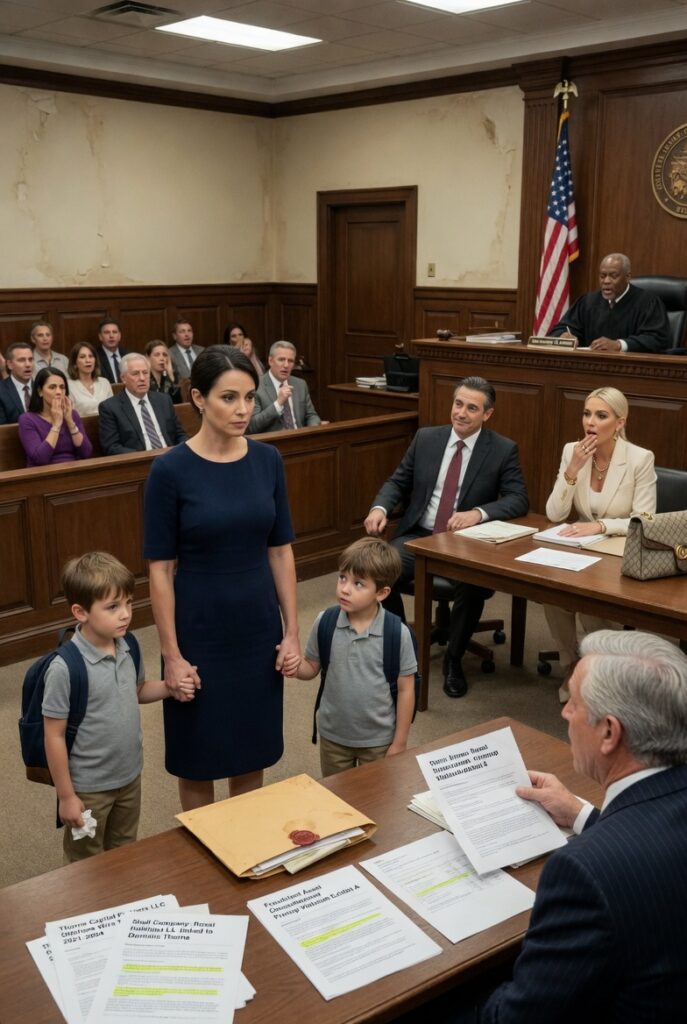
The courtroom was blanketed in a heavy, expectant silence that felt as though the very walls were waiting for a familiar tragedy to play out once again. Everyone present seemed to anticipate the same routine sight of a woman walking in defeated, already crushed by the weight of a world that had decided her fate long before she took her seat.
By nine-thirty, the gallery was packed with the silent observers of public ruin while a clerk with a weary expression moved files between disorganized stacks. Two law students in the back whispered over a legal pad, their faces bright with the hollow excitement of those who had never actually felt the sting of a real consequence.
A woman in a stiff blazer sat with her arms tightly folded, scanning the room with the sharp, judgmental eyes of someone who treated the suffering of others as a personal pastime. Near the front row, two reporters waited with practiced indifference, their phones flipped over and pens tucked away as they prepared to document a scandal the city would devour with its morning toast.
At the table on the right sat Dominic Thorne, looking polished and immensely expensive in a charcoal suit that broadcast the easy confidence of a man who confused good fortune with personal brilliance. He stretched one arm across the back of his chair and tapped a thick binder his legal team had meticulously prepared, looking less like a man in a crisis and more like a man annoyed by a scheduling conflict.
Beside him, though angled slightly away to maintain a thin veneer of respectability, sat Gianna Rossi. She had carefully crafted her appearance for the day, wearing a cream silk suit and delicate gold jewelry that whispered of wealth rather than shouting it.
Gianna’s hair was styled in a way that looked effortless despite clearly requiring hours of preparation, and her designer bag sat upright like a silent guard by her feet. She looked as though she were waiting for a gala to begin rather than a divorce hearing that would likely end with her becoming the next Mrs. Thorne by the end of the year.
Dominic’s lead attorney, Harrison Baxter, was a man who wore professional calm like a suit of armor, his silver tie perfectly knotted and his documents divided by pristine colored tabs. He had reviewed his opening statement until it felt like an inevitable truth, confident that a signed prenuptial agreement and a husband with vast resources would make for a very short morning.
Harrison viewed the wife as a mere obstacle, a woman with no family network and a murky past who had allowed the public to define her through years of silence. He had built a lucrative career by dismantling people exactly like her, and he saw no reason why today would be any different.
At nine-thirty-seven, the judge entered the room and the assembly rose in unison. Judge Lawrence Whitfield was not a man given to sentiment, having spent decades watching people hide their pettiness behind legal jargon and false tears.
He took his seat and adjusted his glasses, scanning the docket with an expression that suggested he was entirely immune to the prestige of the people standing before him. When he called the matter of Thorne versus Sinclair, the energy in the room shifted into a sharp, hungry focus.
“Your Honor, we are prepared to move forward,” Harrison Baxter said smoothly as he stood at his table. Judge Whitfield glanced toward the empty petitioner’s side and frowned, asking for the counsel representing Mrs. Sinclair.
When no one answered, Dominic let out a sharp exhale of irritation and tilted his head back as if his morning had been personally insulted. Gianna leaned toward him and whispered that perhaps the wife had simply changed her mind and given up.
“That would be the smartest thing she has done in a decade,” Dominic replied, his voice carrying just enough to be heard by the front row of the gallery. Judge Whitfield asked if the respondent had been properly notified, and the clerk confirmed that service had been executed weeks ago.
Just as the judge lifted his gavel to proceed in her absence, the heavy wooden doors at the back of the room swung open. The sound wasn’t loud, but in the sudden stillness of the chamber, it commanded every eye to turn toward the entrance.
She did not rush into the room or offer a frantic apology for her lateness. Instead, she stepped inside with a composed grace, her navy wool coat perfectly tailored and her hair pulled back into a sleek, professional knot.
In each hand, she held the small fingers of two identical boys who walked beside her in total silence, their dark blazers buttoned and their shoes polished to a high shine. The twins moved with an eerie stillness, their eyes taking in the courtroom with a maturity that seemed far beyond their young years.
A ripple of whispers broke out across the benches as people questioned why she would bring children into such a cold and technical environment. Gianna let out a soft, mocking laugh that traveled through the quiet air like a sharp blade.
Dominic didn’t bother to stand, instead leaning back to watch his wife approach with a smirk that was more of an insult than a greeting. “Still trying to make a scene, I see,” he muttered loud enough for the reporters to catch the jab.
The woman ignored him entirely, never once glancing at Gianna or the crowd that was already busy labeling her as desperate or theatrical. She walked to her table and stood behind it, her hand resting gently on the shoulders of the two boys who remained like silent sentinels by her side.
“Ma’am, you are late,” Judge Whitfield said, his voice measured but stern. She looked up at him with eyes that were clear and steady, showing no trace of the tears or panic that the gallery had been hoping to see.
“I am here now, Your Honor,” she said calmly. “And my children needed to be here to see this.”
Gianna laughed again, calling the situation ridiculous and asking who would bring kids to a hearing like this. Judge Whitfield’s gaze snapped to her with enough intensity to instantly wipe the smile from her face.
“One more interruption from you, Ms. Rossi, and you will be escorted out by the bailiff,” the judge warned before turning back to the case. Dominic’s jaw tightened at the public rebuke, but he remained silent as his attorney rose to speak.
Harrison Baxter began his presentation with practiced precision, arguing that the prenuptial agreement was ironclad and gave Dominic full control over all marital assets. He spoke about Dominic’s public credibility and the wife’s lack of independent income, painting a picture of a woman entirely dependent on her husband’s charity.
“We are requesting full legal and physical custody to ensure the stability these children require,” Harrison concluded, his voice echoing with the cold logic of a man who viewed families as balance sheets. The woman at the other table listened to every word without flinching or attempting to interrupt.
When the judge asked if she had legal representation, she informed him that she would be speaking on her own behalf. This prompted another smug look from Dominic, who clearly believed the lack of a high-priced lawyer was the final nail in her coffin.
“Very well, you may speak,” Judge Whitfield said, leaning forward to hear her response. She took a moment to look down at her sons before opening her leather bag and pulling out a single, pristine envelope.
“I signed that agreement because I trusted the man I married,” she began, her voice low but carrying to every corner of the room. Dominic rolled his eyes and leaned back, whispering that the court was about to hear a sob story about broken hearts.
“I signed it because when someone says they love you, you don’t expect every smile to be a hidden blade,” she continued, her gaze fixed on the judge rather than her husband. Harrison Baxter tried to intervene, stating that emotional grievances did not invalidate a signed legal contract.
“I am not contesting the signature,” she said, cutting through his objection with a sudden, chilling authority. “I am saying that there is vital information your client intentionally left out of his disclosures.”
Harrison frowned, insisting that all documentation had been provided, but the woman simply offered a faint, cold smile. She handed the envelope to the bailiff, who passed it up to the bench where the judge broke the seal.
Judge Whitfield’s face remained neutral at first, but then his eyes began to move faster across the pages. He stopped entirely, looking up at Dominic with an expression that had shifted from boredom to a deep, simmering suspicion.
“Mr. Thorne, are you aware of whose name appears on the original registration for Thorne Global?” the judge asked. Dominic gave an incredulous laugh and stated that the company was obviously his, but the woman shook her head.
“No, it isn’t,” she said firmly. She explained that while Dominic had been the face of the brand, she had designed the architecture and filed the initial paperwork through a private holding structure to keep her name out of the headlines.
Dominic scoffed and called it a work of fiction, but Judge Whitfield slammed his hand on the desk and told him to be silent. The judge confirmed that the formation records and intellectual property filings in the envelope showed a beneficial ownership chain that did not end with Dominic.
Harrison Baxter scrambled to see the documents, his face pale as he realized the ground was shifting beneath his feet. The judge then asked the woman why there was a discrepancy between the name in the file and the name listed in the divorce pleadings.
“My name is not Lydia Sinclair,” she said, and the silence in the room became so heavy it was almost difficult to breathe. She looked directly at her husband and revealed that her true name was Lydia Sterling.
The reaction was instantaneous as a collective gasp filled the courtroom, and Gianna’s hand visibly trembled as it slipped off her bag. The name Sterling was synonymous with ancient, untouchable wealth and a level of political influence that made Dominic’s tech fortune look like pocket change.
Dominic’s face didn’t just fall; it seemed to disintegrate as he realized the woman he had treated as a disposable dependent was actually a member of one of the most powerful families in the country. He had known her for years, but he had never truly seen the scale of the person standing across from him.
He had known the way she liked her coffee and the way she slept, but he had never understood that she was a woman who had chosen to live in the shadows of his ego. Judge Whitfield sat up straighter, asking if she was indeed the daughter of the Sterling estate.
“I am,” she replied, her voice filled with a steel that hadn’t been there moments before. Dominic stood up abruptly, calling it a stunt and accusing her of lying about her identity for their entire marriage.
“I used a simpler name because your world preferred women who were decorative,” she said, her eyes never leaving his. “It made your vanity easier to manage, and it made the business meetings move faster when you thought you were the one in charge.”
Judge Whitfield ordered Dominic to sit down, and for the first time in his life, the billionaire obeyed a command without a second thought. Lydia continued, explaining how she had coded the first platform from their kitchen and secured the initial investors through family contacts she had never disclosed to him.
“I stayed invisible because you told me we were a team,” she said, glancing down at her sons. “But then you decided that my invisibility made it easy for you to erase me entirely.”
Lydia reached into her bag once more and produced a small USB drive, setting it on the table with a decisive click. Dominic tried to laugh it off as edited footage, but the judge had already signaled for the court technician to plug it into the display system.
The screen at the front of the room flickered to life, showing a video of Dominic and Gianna in a penthouse three months earlier. They were drinking wine and discussing how to push Lydia out of the house and take the children, speaking as if they were discussing a business merger rather than a family.
“She has nothing, and she won’t see it coming until the locks are changed,” Dominic’s voice boomed through the speakers. The gallery watched in stunned silence as the man they admired was revealed to be a cold, calculating strategist.
The files then shifted to financial records, showing nearly two years of illicit transfers and offshore accounts. It became clear that Dominic had been siphoning company funds to pay for Gianna’s lifestyle and to make the business look weaker on paper before the divorce.
“You asked him in February if the transfer would clear before your designer’s invoice was due,” Lydia said, looking at Gianna as an email thread appeared on the screen. Gianna looked as though she wanted to disappear into the floorboards as the room witnessed her complicity in the fraud.
Judge Whitfield paused the recording and looked at Dominic with a gaze that could have frozen the air. “I believe we have seen enough to understand the intent and the conduct at play here,” the judge said.
The silence that followed was different than before, filled with the collective shame of a room that had realized they had cheered for the wrong side. Dominic no longer looked like a titan of industry; he looked like a cornered man whose mask had been stripped away in the most public way possible.
“Mr. Thorne, your request for custody is denied,” Judge Whitfield announced, his words carrying the weight of a final sentence. He added that the evidence of financial misconduct would be referred to the appropriate authorities for immediate criminal review.
Gianna made a small, broken sound, but no one in the courtroom looked her way. Lydia didn’t smile or celebrate; she simply knelt down and straightened the collars of her sons’ jackets before taking their hands.
“Are we going home now?” the taller twin asked softly. Lydia kissed his forehead and promised him that they were going somewhere safe, far away from the noise of the city.
As she turned to leave, Dominic’s voice cracked across the room, asking if she had planned this entire downfall from the start. Lydia paused at the door but didn’t turn around to face the man she had once loved.
“No, Dominic,” she said, her voice steady and final. “This is simply the harvest of the choices you made.”
She walked out of the courtroom and into a flurry of camera flashes, guiding her boys through the crowd with a protective grace. A black car was waiting at the curb, and once the doors were closed, she finally allowed herself to close her eyes and breathe.
“Mom, why was everyone so loud?” the smaller boy asked as the car pulled away. Lydia smoothed his hair and told him that sometimes adults get confused about what really belongs to them.
As the city blurred past the tinted windows, Lydia thought about how the name Lydia Sinclair had served its purpose. She had built a life, protected her children, and finally reclaimed the name that carried her true strength.
She knew the legal battle was far from over, but as she looked at her sons, she knew she had already won the only part of the war that mattered. The world now knew her name, but more importantly, her children knew that their mother was a woman who could never be erased.
THE END