My husband gave my luxury SUV to his sister without even asking my permission, and when I confronted him, he gave a cold smile and sneered, “What does a housewife need a car for?”
I didn’t scream, I didn’t cry, and I didn’t make a scene. I did one thing, silently. Now he keeps calling me, desperate, his voice breaking, begging me over and over again: “Please don’t sell the house.”
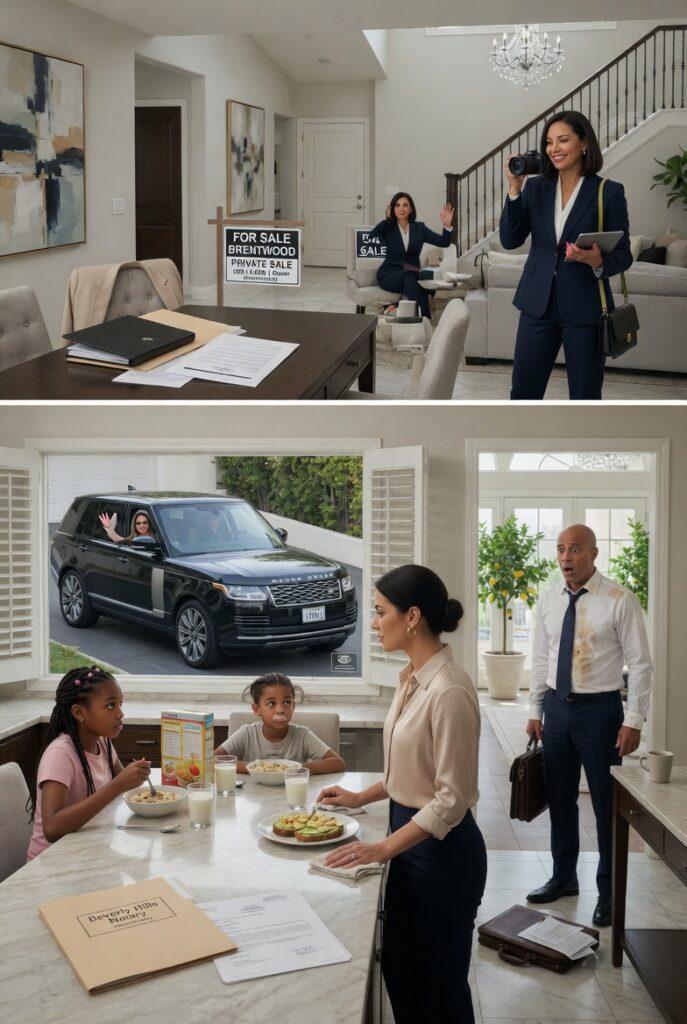
On Tuesday morning, while I was feeding my children breakfast in the kitchen, I saw through the window how my sister in law Tiffany was taking my car. It was a black Range Rover, paid for two years earlier with my grandmother’s inheritance, and it was registered and insured strictly in my name.
I thought maybe Harrison had lent it to her for an emergency, so I didn’t say anything initially. But when he came into the house looking so calm with his coffee in his hand and his tie askew, I asked him directly where my car was.
Harrison didn’t even look up from his phone. “I gave it to Tiffany. She needs it more than you do,” he replied.
I thought I had misheard him, so I asked for clarification. He finally looked at me with that tired half smile he used when he wanted to reduce me to a domestic exaggeration.
“Come on, Elena. You’re at home all day. What does a housewife need a luxury car for?” Harrison said in a low voice, almost mockingly, as if he were explaining something obvious to a clumsy child.
Caitlyn, my eldest daughter, put her spoon down on the plate while Lucas looked at me silently. I felt a sharp blow to my chest, not of anger, but of clarity.
Tiffany had been living off favors for years, starting with the apartment her mother paid for and moving on to a boutique Harrison helped finance that closed in less than a year. After that, it was credit cards, temporary loans, and midnight calls where Harrison solved her problems with money that wasn’t entirely his.
“Give me back the keys,” I said. Harrison just snorted and told me not to make a big deal out of it.
“I’m not doing anything. Give me back my car keys,” I repeated firmly.
“You’re unbelievable,” Harrison blurted out, before adding, “Seriously, you don’t bring in a salary and yet you act like you’re supporting this house.”
I didn’t answer him. I cleared the table, washed Lucas’s face, and combed Caitlyn’s hair for school with a serenity that even I found strange.
Harrison came out half an hour later, convinced he had won another argument by wearing me down. At eleven o’clock, I left the children with my neighbor Sarah for forty minutes.
I put on a navy blazer, took a folder from the bottom drawer of my desk, and drove the small sedan we almost never used to a notary’s office in Beverly Hills. Inside the folder were the deeds to the house, which was a home in the hills of Brentwood that my father had given me five years before I got married with an express clause stating it was my separate property.
I didn’t scream and I didn’t call Tiffany. Sitting across from the notary, I said in a firm voice that I wanted to put the house up for sale that very day.
That same afternoon, when Harrison arrived and saw a real estate agent photographing the living room, the color drained from his face. The agent’s name was Monica James, and she arrived with an efficient energy that contrasted sharply with the thick silence of the house.
Monica measured the spaces and checked the terrace while I followed behind her, answering precisely about usable square footage and kitchen remodeling. When Harrison opened the door and saw her framing the main staircase, he put his briefcase down on the floor.
“What’s going on here?” Harrison asked. Monica smiled professionally and explained that we were preparing the sales sheet for the property.
Harrison turned towards me with an expression somewhere between disbelief and offense. “Elena, tell her to leave,” he demanded.
“No,” I replied. Monica immediately understood that this wasn’t a real estate misunderstanding and continued working discreetly.
“No? Are you crazy?” Harrison took a step toward me. I told him that I wasn’t crazy, just tired.
“This house belongs to the family,” Harrison’s jaw tightened. I corrected him, stating clearly that the house belonged to me.
I saw in his eyes the exact moment he realized the deeds and my father’s donation meant the house was my separate property. “You’re married to me. You can’t make a decision like this without talking about it,” he said, lowering his voice.
“And you can give away my car without talking to me?” I countered. Harrison didn’t answer.
Monica continued photographing the dining room and then asked to see the master bedroom. Harrison glared at her, but she only raised her eyebrows politely.
“I will continue when I am told,” Monica said. “Continue,” I told her.
That’s what really threw Harrison off, because he was used to my attempts at negotiation or my sad silences. Alejandro was used to me keeping the peace for the children, but that afternoon I wasn’t arguing; I was taking action.
When Monica left, Harrison closed the door harder than necessary and told me I had lost my mind over a car. I told him it wasn’t about the car, and when he asked why, I looked at him for a few seconds.
We had been married for eleven years and I had been there through every business dinner, funeral, and sleepless night. I had held up his schedule and his image as a decisive man, yet he still saw me as someone who didn’t contribute.
“Because you’ve made it clear to me what my value is to you,” I explained. Harrison ran a hand through his hair and began pacing around the room.
“Look, Tiffany has problems. You know that. She just needed the car for a few weeks,” Harrison said. I told him that he should have lent her his own car instead
Harrison remained silent because he knew I was right. “Exactly,” I said, “but you didn’t give her yours. You gave her mine.”
His phone rang at that moment with Tiffany’s name on the screen, but he declined the call. Harrison told me we would sort it out and promised I would have my car back tomorrow.
“It’s no longer about returning keys,” I said. I took a copy of the deeds from the display case and placed it on the coffee table.
“I spoke with a lawyer this morning. The house is my separate property and I can sell it. I’ve also scheduled an appointment to review our assets,” I informed him.
Harrison’s face changed from indignation to a very real fear as he realized I had already consulted a lawyer. “You wouldn’t really do this,” he whispered. “I’m already doing it,” I replied.
That night he slept in the guest room, and early the next morning, I found my Range Rover parked in front of the house. Tiffany was sitting behind the wheel wearing sunglasses with her lips pressed tightly together.
Tiffany got out of the car and told me I had gone too far. “Give me back the keys and the papers,” I demanded.
“My brother was just trying to help me,” Tiffany insisted. I told her that he was helping her with something that didn’t belong to him.
Tiffany left the keys on the counter but didn’t move. She asked if I was really going to sell the house because of this.
Harrison appeared in the kitchen doorway, looking pale with his shirt half buttoned. For the first time, it was he who spoke with a breaking voice, begging me not to sell the house.
I didn’t answer right away while I finished getting the children ready for school. Harrison was still standing there while Tiffany watched the scene with a mixture of insolence and victimhood.
“The children go into school in twenty minutes. I’m not going to do this in front of them,” I said. Caitlyn understood more than a nine year old should, while Lucas only sensed the tension.
I took them in the small car and dropped them off at school. When I returned, Tiffany was gone, but Harrison was waiting in the living room with the documents.
“I spoke with an advisor. I know you can legally sell it,” Harrison blurted out. I told him I was glad he was finally taking an interest in the papers he signed.
Harrison lowered his gaze and looked like a man without a prepared speech. He told me he didn’t want it to come to this, and I told him I didn’t want my car given away either.
“It was a mistake,” Harrison said. “No. It was a habit of deciding for me,” I replied.
Harrison sat down slowly and asked what I wanted him to do. I told him I wanted him to listen without interrupting.
I explained with surgical calm how every bit of help Tiffany received came from family money without my consultation. I told him how I used my inheritance to remodel the house while he referred to it as the house he maintained.
I reminded him how he belittled my decision to be a stay at home mom and how he talked about me as if my life were worthless. Harrison didn’t deny the facts and finally admitted he had been an idiot.
I told him the house would remain for sale for now as an open reality rather than a threat. I had already received two requests to visit the property over the weekend.
“First, I want immediate separation of shared accounts except for the children. Second, I want a documented return of all money sent to Tiffany,” I stated.
I also demanded couples therapy and informed him that I was going back to work without asking for permission. Harrison asked if I would take the house off the market if he accepted.
“Then I’ll decide. If not, I’m selling it and taking the kids to an apartment,” I warned him. Harrison put his hands to his face and begged me to protect the home.
“Don’t ask me to protect what you put at risk,” I replied. For two weeks Harrison kept his word by limiting expenses and emailing Tiffany that he would never help her with marital assets again.
We attended our first therapy session in Santa Monica, and Harrison finally learned to listen. Tiffany tried to call and play the victim, but I deleted her messages without replying.
The third week, Monica called to say she had a serious offer. Harrison arrived an hour later and asked if an offer had been made.
I had thought a lot those days about whether there was still anything worth rebuilding. I called Monica in front of him and told her I was temporarily taking the house off the market.
Harrison closed his eyes in relief, but I warned him not to mistake it for forgiveness. “The house isn’t for sale today. That’s all,” I said.
Six months later, I was working part time at an interior design studio in Pasadena. I had my own accounts and my own keys in every sense of the word.
Harrison was still in therapy and had learned that asking for forgiveness means changing before losing someone. Tiffany disappeared from our decisions, and although I didn’t sell the house, Harrison understood that I never lacked power.
THE END.