She Thought We’d Hand Over the Keys at 10 A.M. Then I Mentioned the Call Recording—and Her Dad Snapped.
I had worked a hotel front desk long enough by then to understand something the wedding industry never puts in its glossy brochures: weddings do not create new personalities. They do not transform saints into monsters or monsters into saints. What they do is reach for the volume knob and crank whatever is already there until it rattles every window in the building. If someone is generous, a wedding can make them radiant. If someone is anxious, a wedding can make them vibrate like live wire. If someone is controlling, petty, sweet, manipulative, thoughtful, selfish, organized, passive-aggressive, or kind, a wedding week will take that quality, strip it bare, and make everybody standing nearby experience it at full volume. And the people standing nearest the speakers are usually not the fiancé, the maid of honor, or the mother of the bride. It is the staff. It is always the staff.
Five years ago I was the evening supervisor at Harborview Lodge, a midrange hotel just outside Milwaukee, the kind of place that would never be mistaken for luxury but also never gave anybody a reason to regret booking us. We were clean, consistent, and calm, and in the hotel business those three things are about as close to poetry as you get. We had free cookies in the lobby every afternoon at four, coffee in silver urns that was always just a little hotter than it needed to be, and a staff that could turn a room over so fast and so well it sometimes felt like a form of magic. We were not glamorous, but we were dependable, and dependence is underrated until you need it.
If you have never worked a front desk, there is a concept you learn early that should honestly be stitched into the uniform: guests treat time like something we keep in a drawer. They approach the desk with the same tone people use when asking for extra napkins. Could I just get into my room at nine in the morning? Could I just stay until two in the afternoon? Could you just hold the room for me until midnight? Could you move those people because my plans matter more than their plans? They say “just” the way magicians say “abracadabra,” as if the addition of one tiny word turns impossibility into policy. What they do not see is that a room is not a square on a screen. It is labor. It is sheets stripped, trash emptied, drains checked, amenities restocked, mirrors wiped, carpets vacuumed, and whatever mystery has been left behind under the bed dealt with by someone wearing practical shoes and making too little money.
Our official check-in time was three p.m. Checkout was noon. Those hours were not chosen by sadists. They existed because housekeeping needed a block of time to turn the building around. Maintenance needed a margin for surprises. Front desk needed a buffer so we were not promising access to rooms that did not yet exist in ready condition. A sold room is not really yours until the previous guest has vacated it, housekeeping has remade it, maintenance has not found a disaster, and someone in reservations has blessed the whole thing on a screen. That is the truth of it. We did not hide that truth. We said it every day in softer words.
By the time this story happened, I had been in hotels for seven years total and at Harborview Lodge for just under four. My name is Caroline Mercer, though on the phone I answered with such practiced neutrality that people rarely remembered the name itself. They remembered the voice. Calm, bright, impossible to rush. That was the goal, anyway. My general manager, Scott Daniels, used to tell new hires that front desk staff had to say no like a pillow: soft enough to be touched, firm enough to keep its shape. That line stayed with me because it was exactly right. A wall starts fights. A pillow can survive them.
Harborview sat near the water in a town that liked to tell visitors it was outside Milwaukee while privately believing it was better than Milwaukee. In summer we got families coming through on lake weekends, kids with sandy shoes and parents who smelled like sunscreen and stress. In fall and winter it was corporate travelers, small conferences, coaches with sports teams, sales reps, and wedding blocks. Weddings were their own ecosystem. They brought garment bags, curling irons, impossible timelines, cousins who asked strange questions, and enough hairspray to affect the local atmosphere. Most of the time they were manageable. A wedding weekend had its own rhythm: people arrived loaded with bags, nerves, and dresses that needed hanging immediately; they moved in groups but not useful groups; they asked where the ice machine was nineteen times; they filled trash cans with champagne corks and false eyelashes; then they vanished to ceremonies and returned louder, drunker, and either very grateful or very certain they had been wronged by something no one could identify.
The year before this happened, our ownership group had completed a remodel they were inappropriately proud of. In a glossy brochure they called the result “the mega suite.” Internally we called it Room Combo 217-219 because we had no patience for branding. It was a standard double-double next to a king suite at the end of a second-floor corridor. The rooms did not technically connect, but the little alcove at the end of the hall could be closed off with a hallway door, and that created the feeling of a private wing. Families loved it. One room for parents, one for kids, a contained zone where toddlers could be corralled and grandparents could pretend it was a European arrangement rather than a Midwestern hotel improvisation.
The suite side had a living room with a sofa bed, two oversized armchairs, a wet bar, a dining table, and a half bath right off the sitting area. The bedroom had the full bathroom, and that bathroom contained a clawfoot tub that looked like it had wandered in from a bridal magazine. It was dramatic and a little absurd, which made it perfect for photographs. Whoever had approved that tub knew exactly what sort of customer would go weak at the knees for it. Within a month, the mega suite stopped being a family retreat and became the most desired bridal hideout in the building. Brides loved the half bath for hair and makeup traffic. They loved the main bath for “getting ready” photos with champagne flutes and satin robes. They loved the sense of seclusion the hallway door created, as if the entire wing belonged to them. The room sold itself.
Most bridal parties were a predictable kind of chaos. Glitter. Steamers. Panicked searches for missing earrings. Somebody crying in a corner for reasons that usually had nothing to do with the wedding itself. A grandmother who could not find the right spanx. A mother who needed tea. A bridesmaid who always packed alcohol like she was preparing for the apocalypse. None of that bothered us. Chaos is manageable if it is honest chaos. What makes staff nervous is not disorganization. It is entitlement paired with imagination. A guest who believes that because they want something badly enough, the building itself ought to rearrange around their wish. That is when trouble begins.
The reservation came in under the name Tessa Hart.
Rachel Donnelly took the booking. Rachel was our daytime reservation queen, the best phone voice in the building and the only woman I have ever met who could explain cancellation policy in a way that made people thank her. She was fair-skinned, red-haired, and looked like a kindergarten teacher from a distance, which often caused callers to underestimate her until they realized she could shut down nonsense while still sounding cheerful. When Rachel told me later about the original call, she did it the way people recap storms that caused structural damage.
Tessa booked the mega suite and an additional double-double for a Saturday wedding in October. Before Rachel could even finish confirming the dates, Tessa cut in and said, “I need an early check-in.”
Rachel went into policy mode. “We can absolutely note that as a request, and we always try when we can, but it is only a request. We cannot guarantee early access, even for a wedding.”
Tessa did not like that answer. Rachel said she could hear the inhale on the line, sharp and disbelieving, like someone hearing a waiter say the kitchen had run out of truffle fries.
“So how do I guarantee it?” Tessa asked.
“There is only one guaranteed option,” Rachel said. “You can reserve the room for the night before as well. That way the room is yours, and you have access whenever you need it on wedding day.”
There was a pause. Then Tessa laughed, but there was nothing amused in it. “Pay for a whole extra night when I only need a few hours? That’s ridiculous.”
Rachel, because she always tried to help people make the choice that would save them later, added context. “A lot of our bridal parties do exactly that. It makes the day much easier. They come in the night before, settle, sleep, and nobody is rushing in the morning.”
Tessa’s tone sharpened. “Don’t bother. You’re just trying to scam me. I will get my early check-in.”
Rachel documented the call immediately. She put notes in the reservation in all caps because all caps help save your soul later: EARLY CHECK-IN REQUEST ONLY. NOT GUARANTEED. GUEST REFUSED TO BOOK PRIOR NIGHT FOR GUARANTEE. She also flagged the reservation for management because brides who call standard policy a scam usually return later claiming betrayal. Scott read the note, grunted in the way he did when trouble announced itself early, and told us to keep every conversation documented.
That should have been the end of it.
It was not the end of it. It was the prologue.
From that day until the wedding week, Tessa called at least once a week. Some weeks she called twice. A few weeks she called three times, each call somehow framed as though she were touching base about a favor everyone had already personally agreed to. “Hi, I’m just making sure my note is there.” “I’m checking that housekeeping understands the room needs to be ready by ten.” “I wanted to verify that no one else is going to be in there when I arrive.” “Can you move people around if necessary?” “I’ve called about this before.” “This is for my wedding, so I need some flexibility.”
There is a type of guest who believes that repetition is negotiation. Tessa belonged to that church. If one person said no, she would hang up and call back later hoping for a more pliable voice. She tried Rachel, me, the overnight clerk, Scott, our assistant manager Linda, and once, somehow, even Lou in maintenance because he had answered the house phone while front desk was knee-deep in a bus check-in. Lou told her, in the flattest Wisconsin accent imaginable, “Ma’am, I fix toilets, not time,” and transferred her back to us.
Every single time, the answer was identical. We have your request documented. We always do our best. Early check-in is based on availability. It cannot be guaranteed. The only guaranteed option is to reserve the night before.
Every single time, Tessa acted as though she were hearing this information for the first time and being personally wounded by it. There are guests who hear policy and adjust. Then there are guests who hear policy and interpret it as emotional violence. Tessa was the second kind. She called us lazy. She said we did not understand weddings. She implied we were choosing not to help because nobody there appreciated how important her day was. One time she said, in a tone usually reserved for legal threats and personal betrayal, “If you ruin this for me, I will blast this hotel everywhere.”
The wildest thing about wedding guests is that they frequently believe a hotel is conspiring against them. A family traveling for a funeral might be exhausted, sad, stretched thin, and still manage to understand that the desk clerk is not operating from malice. A corporate traveler can be infuriating, but at least their demands are transactional. A bride under pressure, however, can look at a neutral logistics problem and decide it reflects the moral character of every employee in the building. Maybe that is what happens when an entire industry spends years telling women this will be the most important day of their lives and can be perfect if only every piece of reality submits on command.
Our staff developed a whole private vocabulary around wedding bookings. There were easy brides, who asked smart questions and built contingency plans. There were nervous brides, who were fundamentally decent but called to hear reassurance in a human voice. There were bride-adjacent disasters, like mothers who thought the hotel ballroom carpet reflected on the family name or groomsmen who wanted to “pre-party” in a standard king. And then there were what Rachel called pressure brides, the ones who treated every uncertainty like a hole in the side of a boat. Tessa was pressure from the first call.
About a month before her wedding, something happened that made the entire situation much worse in a way that was completely ordinary. A family booked the mega suite and the adjacent double-double for Friday night, with a Saturday checkout. It was exactly the kind of booking those rooms had originally been designed for: parents, kids, privacy, cartoons, early bedtime, the whole thing. Their reservation was prepaid and nonrefundable. Totally legitimate. Nothing about their stay had anything to do with Tessa.
Because we believed in being transparent before problems became explosions, I called Tessa when I saw the occupancy picture settle. I told her the truth. “I want to let you know now,” I said, “that the rooms you reserved are occupied the night before your arrival. The current guests will have them until noon on Saturday. We will absolutely try to turn them as quickly as possible, but a ten a.m. early check-in is extremely unlikely.”
She did not even let me finish before declaring, “They’ll leave early.”
“Maybe,” I said, “but checkout is noon. They are not required to leave before then.”
“Send housekeeping the second they walk out,” she ordered. “I need that suite spotless.”
What I wanted to say was that housekeeping was not a pack of greyhounds waiting at a gate for her starting pistol. What I actually said was, “Housekeeping follows a set route and schedule. They’ll service the room as soon as they can after the guests depart.”
There was a hard exhale on the line. “This is unacceptable.”
“We have a forty-eight-hour cancellation window,” I reminded her. “If you need a guaranteed early space, you may want to explore another property or reserve the previous night somewhere. We understand completely.”
This is the part that always fascinates me in retrospect. She had options. Real options. She could have paid for the prior night. She could have moved to a property with available inventory the night before. She could have rented a salon suite. She could have arranged hair and makeup at a family member’s house. She could have asked a bridesmaid to host. She could have built a backup plan like any adult who has met weather, traffic, or other human beings. She did none of that. She chose to continue believing that insistence would eventually overpower reality.
By the final week before the wedding, all of us knew her voice instantly. Rachel could tell it was her by the inhale before she spoke. DeAndre at breakfast knew because she always opened with, “I know you probably can’t help me, but—” Lou knew because she once asked if maintenance could “check whether the previous guests really needed both rooms.” Linda knew because Tessa tried to flatter and threaten her in the same breath. Scott knew because when he took one call and gave her the exact same answer, she accused him of “hiding behind policy.” After that, he told us not to indulge any fantasy language. No “we’ll see.” No “probably.” No vague softeners that could be twisted later. “State it like math,” he said. “If she chooses to misunderstand math, that’s on her.”
The wedding day landed on a bright, crisp Saturday in October, the kind that makes Midwestern people believe the state can be romantic if you catch it on the right weekend. The air was cool enough to wake you up, the sky a hard clear blue. Red and gold trees lined the road outside the property, and every other guest who passed through the lobby said some version of, “Perfect weather for a wedding.” Perfect weather, incidentally, solves very little indoors.
I came in at seven that morning for a split shift because we were heavy with arrivals, a youth hockey team, a modest pharmaceutical conference, and Tessa’s wedding block. The lobby smelled like waffle batter, coffee, syrup, and the slightly metallic heat of the toaster. A dad in a Packers hoodie argued with his son about whether the kid had packed his mouth guard. A sales rep asked if we had a printer, as if hotels stored them for sport. An elderly couple wanted extra towels, a feather-free pillow, and directions to a chapel. In other words, normal.
Up on the second floor, our Friday-night family in the mega suite was still very much in possession of their space, also normal. They had until noon. They were entitled to use every one of those minutes. We had no right, legal or moral, to pressure them to leave because a bride elsewhere had confused desire with entitlement. That was the foundation under everything that followed.
At ten o’clock on the dot, Tessa arrived.
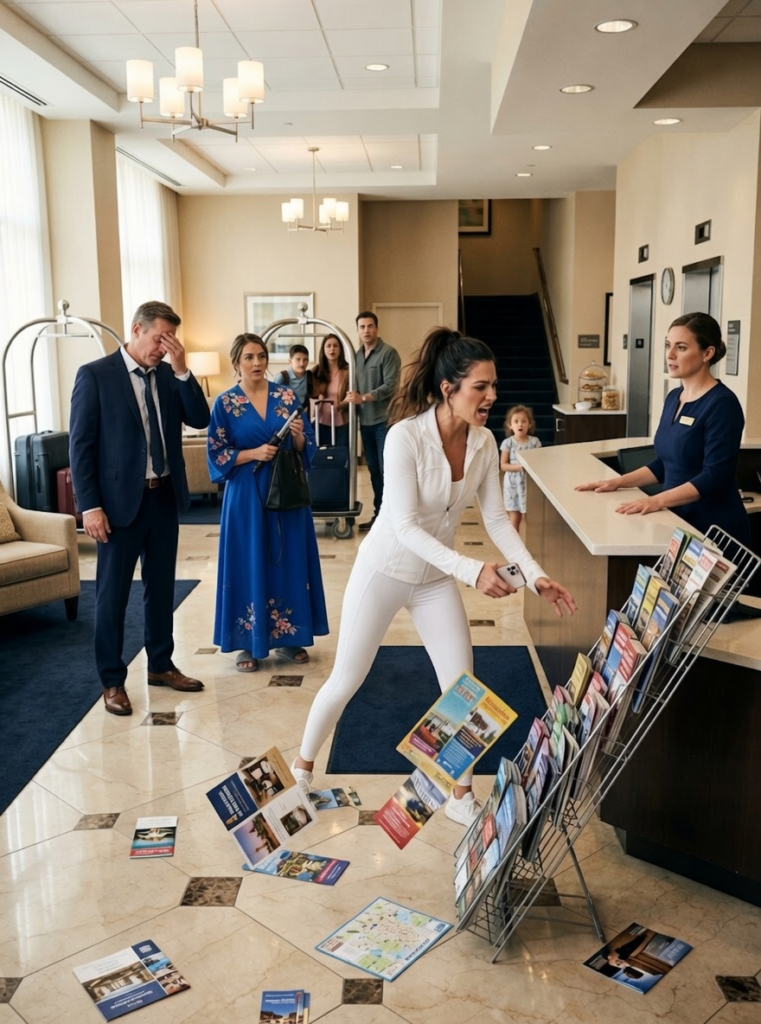
I recognized her instantly, though I had never seen her before. Some people simply look exactly like they sound. She wore expensive white athleisure, not bridal-white but aspirational-white, the kind that says, I am already the main event. Her blonde hair was pulled into a severe ponytail. Her tote bag was oversized and full. Her phone was in her hand the way some people carry knives—not because they are using it yet, but because they want you to know it is there. Her face had the pinched brightness of someone who had slept badly and believed the world owed her compensation for it.
She came straight to the desk and announced, not asked, “Checking in.”
I pulled up the reservation. I could probably have recited it from memory at that point. “Good morning, Ms. Hart. Welcome to Harborview. Your reservation begins at three p.m. The mega suite is currently still occupied. We do have your early check-in request documented, but the room is not available.”
Her smile appeared and vanished in one motion, like a knife flashing. “No,” she said. “I’m checking in now. Hair and makeup are arriving at eleven. I need to shower. I need to get ready.”
“I understand,” I said. “But the room is still occupied by another guest.”
That was when she tilted her head and gave me a look I had seen before from school-board bullies and managers who enjoy humiliating interns. It was the look of a person deciding whether to handle you like you were slow.
“I called over and over about this,” she said, each word separated and sharpened. “You had my request.”
“Yes, ma’am. We had your request.”
“So do what I requested.”
Behind her, a couple waiting to ask for extra pillows instantly stopped making eye contact with the desk. A little boy at the cookie stand stared with that open child expression that says, Are adults allowed to act like this?
“We documented the request,” I said. “We never guaranteed it.”
Tessa whipped her phone up and dialed somebody, not moving from the desk. “The room is not ready,” she announced loudly into the lobby, as if narrating a hostage situation. “They’re refusing to let me in. I swear to God, if they ruin this—”
The person she called must have been close, because barely a minute later another woman hustled through the sliding doors carrying a rolling makeup case and looking already overwhelmed. She was around Tessa’s age, brunette, wearing black leggings and a navy zip-up, the uniform of the competent friend who gets conscripted into everyone else’s crisis. Her name, I later learned, was Kelly Reardon, maid of honor, schedule manager, emotional sandbag, and possibly the only adult on Tessa’s side who had entertained a contingency plan at any point in the previous six months.
Kelly came to the desk with a smile that looked painfully assembled. “Hi,” she said. “Can you tell me what the issue is?”
I explained the situation in the same neutral tone. Reservation begins at three. Request noted. No guarantee. Room occupied.
Kelly’s eyes widened. “But the wedding starts at three,” she said.
“Yes,” I said gently.
It is a rare and almost tragic pleasure to watch the exact second someone realizes another person has lied to them in order to keep a fantasy intact. Kelly’s whole face changed. Her jaw tightened. She looked over at Tessa, then back at me, then at the clock. “What can we do?” she asked, and unlike Tessa, it was a real question.
“We can store luggage,” I said. “We can call you immediately the moment the room is turned. We can also see if there’s another space on property where you can start staging hair and makeup.”
Kelly nodded slowly, absorbing information instead of fighting it. “Okay,” she said. “Okay. Let me go talk to her.”
She returned to Tessa, and they began a hissed argument just far enough away that they clearly believed it was private. It was not private. That is another thing people do in hotel lobbies—they mistake distance for soundproofing. I could not hear every word, but I caught enough. “They didn’t promise.” “You told me you had it handled.” “Why didn’t you book Friday?” “Because it was a waste.” “This is insane.” “No, they’re being difficult.” Kelly’s hands moved in the precise, angry gestures of a woman doing mental math around a bad decision.
Then Tessa’s father entered the scene.
You could spot him as father of the bride on sight because he had the specific look those men acquire about four hours before a wedding: he was dressed expensively, carrying invisible lists in his head, and managing his expression as if he understood his day would be spent solving problems nobody had prevented. He was tall, silver-haired, clearly well-off, and moving fast enough that the automatic doors barely finished opening before he was already inside. His suit jacket was immaculate, his tie loosened a fraction, his jaw tired. Later I learned his name was Robert Hart. In my mind, for the first ten minutes, he was simply Bride’s Father, capital letters included.
Tessa shot toward him before he reached the desk. “Dad, tell them to let me into my room.”
He looked from her to me with the face of a man prepared to spend money but not prepared to hear stupidity. “What’s going on?”
I gave him the summary, crisp and complete. “Your daughter reserved the mega suite and a second room for tonight. Check-in starts at three. She requested early access. We documented the request but explained multiple times that it was not guaranteed. The room is still occupied by the prior guest.”
He frowned immediately. “That’s not what she said.”
I had heard that sentence a thousand times in different forms. A guest hears boundaries, goes home, retells the story in a way that protects their self-image, and later some bewildered relative arrives believing the hotel reneged on a promise. This is why documentation matters. Not because it makes you feel righteous. Because it keeps someone else’s fiction from becoming your written record.
“What did she tell you?” I asked.
“That you promised to have the suite ready in the morning.”
“No, sir,” I said. “We did not promise that. We have recordings of the calls, and we have notes on the reservation from the first conversation onward.”
There is something about the word recordings that changes a room. It turns emotion into evidence. It suggests not debate but playback. Robert Hart’s face changed. He did not get louder. He went still, which was much worse for Tessa.
He turned and looked at her. “You told me they promised.”
“They basically did,” she snapped. “I called so many times.”
Kelly, to her credit, muttered, “No, they didn’t.”
Robert’s expression hardened into something I recognized from every exhausted parent who had ever reached the point where protecting a child’s pride felt less urgent than preventing public disaster. “You let your whole timeline depend on a maybe?”
“It wasn’t a maybe,” Tessa insisted. “They said they would try.”
“That is the definition of a maybe.”
What happened next unfolded in that terrible public-private mode families sometimes enter when they forget where they are. Robert lowered his voice, but not enough. “You should have booked the night before.”
“It was a whole extra night,” Tessa said. “For just a few hours. That’s insane.”
“No,” Robert said. “What’s insane is gambling the most time-sensitive part of the day because you didn’t want to pay for certainty.”
He looked like he had been holding this argument in some form for weeks. Then he delivered the line that detonated the lobby.
“And because you were being stubborn about the rooms,” he said, “your brother slept in his car last night.”
There are moments when sound drains out of a public space even though nobody actually stops moving. That was one of them. A bell from the elevator dinged. Somewhere a suitcase wheel rattled over tile. But all of it felt remote. Kelly’s face went pale. Tessa looked murderous, not embarrassed. The couple waiting behind her stared with their whole bodies. Even DeAndre, who had emerged from the breakfast room with a tray of creamers, slowed down like a man watching a car skid on black ice.
“Don’t you dare say that here,” Tessa hissed.
Robert did not back off. “You refused to book the extra night. You refused to let anyone else use the room arrangement. Ethan had nowhere to go and slept in the parking lot because you said your day was more important than his sleep. So yes, I’m saying it here.”
There is a quality of shame-adjacent rage that turns people feral because what they feel is not remorse but exposure. Tessa pivoted back to me so fast her tote bag smacked the counter. “Give me my key now.”
“We cannot issue a key to an occupied room,” I said.
Her face went bright red. “It’s my room.”
“It will be your room at check-in.”
That was the last step before motion. She lunged sideways and hit the brochure stand beside the desk with enough force to send it toppling. Pamphlets exploded across the tile in a paper storm: lakefront maps, museum flyers, local dining guides, coupons for a cheese festival, a stack of Harley museum brochures, a children’s zoo pamphlet that slapped face-down under the bench. The sound of the stand hitting the floor made half the lobby jump.
Then Tessa turned and ran for the stairwell.
I came out from behind the desk on instinct. “Ma’am!”
She was already pushing through the stairwell door, shouting over her shoulder, “I’m going to my room!”
People think of hotel staff as stationary because they most often see us standing. In reality, a bad shift turns you into a sprinter. I grabbed the radio, told Lou to head to second floor immediately, and called the extension for the currently occupied suite while moving. The mother in the room answered on the third ring sounding tired but pleasant. I identified myself and said, “I’m so sorry to bother you. We have a guest who may be coming up to that hallway in error. Please keep your door latched. We’re on our way.”
There was a small silence. Then the mom said, in that flat universal tone of adult women coping with nonsense, “Of course there is.”
By the time I got to the stairwell landing, I could hear pounding from farther down the hall and Tessa’s voice ricocheting off the walls. She was not even at the right door. In her fury she had apparently run to the alcove and started banging on the first room she saw, demanding to be let in “with housekeeping and front desk,” as though the hotel were an extension of her wedding planner. Later the guests inside—a couple from Madison there for an anniversary weekend—told us they thought someone was trying to break in.
Lou reached the floor at almost the same time I did. Lou was in his late fifties, broad through the shoulders, with the kind of face that could express disappointment more effectively than most people could express threat. He wore the maintenance uniform like it had been invented for him. Without raising his voice, he stepped into the hallway sightline and said, “Ma’am, away from the door.”
Tessa turned, wild-eyed. “This is my suite.”
“No,” I said. “This hallway belongs to several paying guests, and this room is not yours. Come with us.”
She looked around as if expecting the building to side with her. When it did not, she made a sound halfway between a scream and a sob. The anniversary couple cracked their door enough to peer out, saw the whole tableau, and immediately shut it again. Smart people.
I am often asked why we did not call the police. The honest answer is that in the moment you triage for de-escalation, not punishment. If we could get her off the floor without harming another guest or ourselves, that was preferable to a squad car at a wedding. If she had tried to force a door, threatened violence, or refused to return downstairs, that calculation might have changed. But at that point we still had a chance to contain the damage.
What saved us was not authority. It was logistics and family embarrassment.
Kelly came up behind Robert, out of breath from the stairs, and hissed, “We have to get started. The stylist is here. The makeup artist is setting up. We’re wasting time.”
Robert went to Tessa not like a father comforting a daughter but like a man physically steering a vehicle off a ditch edge. “You are done,” he said. “Come downstairs.”
“I need my suite,” she cried.
“You need to stop screaming at strangers.”
He took her by the upper arm. Not violently. Not gently, either. With the pure practical firmness of someone moving an active problem. Between Robert, Kelly, and the visible possibility of becoming the kind of bride people tell stories about for years, Tessa let herself be guided back toward the stairwell, though not without continuing to protest.
Downstairs, with the lobby still buzzing from what it had just witnessed, Kelly came back to the desk as if choosing the only stable point in the building. “You said there might be another space?”
We did have another space. Off the lobby was a small conference room we rented for board meetings and bereavement luncheons. It seated maybe twelve around a laminate table and had a private restroom attached. It was not romantic. It had fluorescent lighting and carpet patterned in the 1990s style of geometric optimism. But it was empty, private, and large enough for ring lights, curling irons, and controlled panic.
“Yes,” I said. “We can open it for you right now.”
Kelly’s shoulders dropped a solid inch. “Please.”
We set them up in there on the spot. Linda unlocked it. I had Bellman Trey move their luggage to the side wall. DeAndre brought extra bottled water without being asked because he had a soft spot for bridesmaids who looked near tears. The makeup artist wheeled in two cases and immediately claimed the corner nearest the outlets. The stylist found the best natural light and cursed softly because there wasn’t enough of it. Garment bags went up on the coat hooks. Somebody laid out snacks on the conference table with the determination of people treating blood sugar as a safety issue, which in wedding circles it absolutely is.
Tessa, still furious, was deposited into a chair like unstable cargo.
Hair and makeup vendors are among the unsung diplomats of the wedding industry. They arrive carrying enough product to stucco a farmhouse and immediately start soothing rooms full of people whose interpersonal issues they did not cause. This team was no exception. The makeup artist, a woman in her forties named Angela with the dead eyes of someone who had seen everything, took one look at Tessa and said in a voice smooth as lotion, “Okay, sweetheart, let’s take a breath. If the face goes first, we’ll catch up the hair.”
It was brilliant. It was also probably the twentieth fire she had put out that year.
Meanwhile, Tessa kept circling back to the same complaint. “I wasn’t going to pay for a whole extra night when I just needed a few hours.” She said it to the room, to Kelly, to the mirror, to no one. Each repetition sounded less like logic and more like a child defending the same bad decision to an ever-shrinking jury.
Robert stood in the doorway, one hand on the frame, looking exhausted in a way that reached his bones. At one point, after hearing her say the line again, he muttered, with no theatricality at all, “I cannot wait for this day to be over. Maybe then I’ll get my daughter back. And if not, she’s somebody else’s problem now.”
People think the worst moments in public are always loud. That one was not loud. It was quiet, which made it devastating. Kelly stared at the floor. Angela pretended to adjust a brush. The hairstylist looked very hard at a can of spray. Tessa’s expression fractured for a split second, and I thought, maybe now. Maybe this is where remorse enters. But it did not. Not then. What entered instead was a fresh wave of self-pity.
By noon the family in the mega suite checked out exactly on time, cheerful and entirely innocent in the larger drama. They came through the lobby pushing a stroller and dragging a tiny dinosaur suitcase. The mother, the one I had called earlier, paused at the desk and said, “You folks okay?” in the gentle, Midwestern way that manages to be both polite and knowing. I smiled and said, “We are now.” She patted the counter like she was blessing a farm animal and moved on.
Then housekeeping did what housekeeping always did. Maria Lopez, our executive housekeeper, sent Carmen and Felicia to the end-of-hall rooms when their board turned over. No shortcuts, no panic, no special drama because someone with lash extensions had yelled. Housekeeping at Harborview operated on pride more than praise. Maria used to say, “We are not fast because people rush us. We are fast because we know what we are doing.” Carmen stripped beds with the efficiency of a woman who could have disassembled a battleship. Felicia had a gift for bathrooms. Between them they turned those rooms like surgeons. The clawfoot tub gleamed. The mirrors sparkled. The half bath smelled like citrus. The throw pillows were squared so perfectly I’m convinced one of them used a ruler. At two-thirty, Maria radioed down: mega suite inspected and released.
I went up myself and walked it, partly because of Tessa and partly because if a guest has threatened to “take pictures,” you want the room to look like the catalog. It did. Not a fingerprint on the chrome. Not a stray hair on the floor. Whatever else could be said about that day, nobody could accuse Harborview housekeeping of not showing up like professionals.
At three sharp I assigned the room, encoded the keys, and slipped them into an envelope. I wrote one sentence on the outside in neat block letters: YOUR SUITE IS READY. No exclamation point. No apology for the existence of time. I knocked on the conference room door and handed it to Kelly rather than Tessa, which was an act of both strategy and mercy.
Kelly exhaled like a woman hearing a verdict. “Thank you,” she said, and then, because she was decent and overwhelmed and had spent all day absorbing ricochet, she added, “I’m sorry.”
“You do not have to apologize for another adult,” I said.
Her eyes went wet for a moment. “Still.”
If you spend enough time around wedding parties, you learn who is actually carrying the emotional freight. It is often not the bride. It is the maid of honor who brought stain remover, backup bobby pins, safety pins, blister pads, and snacks. It is the sister who keeps checking the florist. It is the aunt quietly paying for extra chairs. It is the father signing one more slip while pretending money has no emotional weather. Tessa was not carrying the day. She was sitting atop it like a queen on an unstable float while everyone else pushed from below.
My shift ended at four. By then the bridal party had migrated to the suite, the lobby had restabilized, and the brochure stand had been set upright though not fully restocked. I clocked out, went home, took off my shoes, and told my husband Mark, “If I ever get remarried, drag me into a lake before I speak to staff that way.” He said, “Copy that,” the way only a husband who has heard twelve years of hotel stories can.
I came back the next morning expecting fallout. In hotel terms, fallout means complaints emailed to management, refund demands, social media threats, vague accusations of rudeness, or all of the above. We braced for it because people who implode publicly often try to restore themselves later by rewriting the incident. Scott had already asked me to print the reservation notes and flag the call recordings “just in case.”
Instead, I walked into a grinning overnight clerk named Manny who said, “You missed the weirdest possible ending.”
Manny was twenty-three, six foot two, and too naturally cheerful for the hospitality industry, though maybe that was why guests loved him. He slid the night audit packet across the desk and said, “Bridal party came back around eleven-thirty. Completely hammered. But quiet. Not rowdy-quiet. Just can’t-work-keycards quiet.”
“Define hammered,” I said.
“Like new foals on ice,” Manny said. “The groom looked confused by his own feet.”
The groom was a man I had barely registered amid the wedding storm. His name, according to the block list, was Daniel Mercer. I had seen him once in the lobby that afternoon, tux half-buttoned, carrying garment bags and looking like someone who had accidentally wandered into an event he was expected to headline. Grooms vary wildly. Some are logistical partners. Some are decorative. Daniel struck me, from the one glimpse I got, as a decent man in danger of being outpaced by the machinery around him.
Manny kept going. “We have that honeymoon amenity setup, right? Champagne and chocolate-covered strawberries for the bride and groom when they get back. Room service took it up. Everybody expected zero tip and possible attitude.”
“And?”
“And they tipped. Well. And the bride started crying.”
I blinked. “Crying?”
“Full tears,” Manny said. “Server said she kept saying how nice everyone here is. Like over and over. ‘It’s so nice that you’re all so nice here.’ Apparently she hugged him, which he did not love, but still. Groom looked embarrassed and grateful at the same time.”
That was not the ending I had predicted.
People are often less consistent than their worst moment. That is one of the reasons hospitality is exhausting. A guest can spend eight hours being appalling and then tip your houseman fifty bucks because some switch flipped. It does not erase the earlier harm, but it does complicate the story. I have never found it useful to flatten people into villains when what actually happened is harder and more human. Tessa had still terrified guests, screamed at staff, knocked over property, and treated policy like an insult. But apparently once she was dressed, married, fed, photographed, toasted, and delivered back to the suite with a flute of champagne in hand, some pressure valve inside her finally burst in a different direction.
I checked the room-service ticket. The tip was real. More than decent, actually. I checked the folio. No complaint posted. No adjustment requested. No manager note demanding satisfaction. Nothing. Just a standard checkout note and a minibar charge for sparkling water and two small whiskeys.
Late that morning I knelt by the brochure stand and properly restocked it. I smoothed the bent corners on the museum maps, restacked the lake cruises, reinserted a flyer for the Milwaukee Public Market, and found two cheese-festival pamphlets under the bench. One Harley museum brochure was crushed enough to be unsalvageable. I tossed it and thought, with the kind of tired dark humor that hotel workers cultivate for self-defense, that at least the casualty count was low.
Rachel came in at noon and made me recount the whole thing from the beginning, though she already knew half from texts. DeAndre hovered with coffee. Lou pretended not to listen from the maintenance closet and failed. By one o’clock the story had entered our staff mythology, and like all good staff mythology it immediately gained repeated details that stayed because they were true enough: the father’s face when I said we had recordings, Kelly’s expression when she realized there had never been a guarantee, Tessa running for the stairwell like she was breaching a compound, the line about her brother sleeping in his car, Angela the makeup artist rescuing civilization with contour and setting spray.
In the break room later, while somebody reheated pasta and somebody else hunted for the good creamer, the conversation broadened the way it always did. Wedding stories invite other wedding stories. They create that effect in hospitality people where one disaster unlocks three more. Rachel brought up a bride from the previous summer who had cried because her flower girl sneezed on the monogrammed napkins. Linda remembered a mother of the groom who tried to reserve the lobby fireplace as if common areas could become private by force of personality. DeAndre told us about his cousin’s wedding where the officiant had fainted and the bride somehow blamed the florist.
And then there were the internet stories, which we all collected like folklore. Somebody had printed out a post about a bride furious that her sister, who was not engaged, had selected dusty rose fabric swatches because the bride considered that “her” future wedding color. Rachel read it aloud one lunch break as though narrating Shakespeare. Another one was an email allegedly from a wedding coordinator that went viral because it sounded like satire and yet was written with complete sincerity. Guests were instructed to arrive twenty minutes early, wear nothing remotely close to white, avoid “full glam” because only the bride was allowed to be glamorous, refrain from taking photos unless approved, use the designated hashtag but do not post before the bride, avoid speaking to the bride directly unless spoken to, and bring a gift worth no less than seventy-five dollars or “admittance may be denied.” It was riddled with typos, which somehow made the authoritarianism feel more American.
There was another story about a woman eviscerating her future stepmother-in-law for planning to sew her own dress, calling it cheap and tacky like craftsmanship itself were embarrassing. Linda, who sewed, took that one personally for a week. Another involved a girlfriend snooping in her boyfriend’s nightstand and then going online asking strangers to roast what she found there, only to be absolutely flayed in the comments for invading his privacy in the first place. And then there was the one that made even the most cynical among us wince: a bride melting down because her guest count dropped from fifty to sixteen after her future husband’s grandfather began dying in Florida and family members chose to go say goodbye to a hundred-five-year-old man instead of staying home to preserve perfect seating charts. “I’m not happy about it,” she had written, as if death were bad timing rather than the end of a life. The internet had responded with unified moral violence, which was, for once, deserved.
The reason those stories circulated among hotel staff was not merely because they were entertaining. It was because they helped us identify a pattern. Weddings are logistics wrapped in identity. They are money, timing, family history, social expectations, public performance, private fear, childhood fantasies, unresolved resentments, seating charts, weather apps, and the terror of being witnessed in a dress that cost more than your monthly car payment. Most people cope with that cocktail by becoming more flexible than usual or more fragile than usual. A smaller but unforgettable number cope by becoming dictators. Tessa fell squarely in that category, at least until the ceremony was over.
Weeks passed. No bad review appeared. No chargeback came through. Scott actually joked that maybe matrimony had performed an exorcism. We laughed, but the whole thing stayed with me in a way some guest incidents do and most don’t. There was something almost instructive in the shape of it. Tessa had not actually been angry about the room. Not really. The room was the visible pressure point. Underneath it was the panic of a woman trying to hold an entire day inside her fist and discovering that other people had legally reserved pieces of it first.
One reason I remember that day so clearly is because it happened at a point in my life when I was trying to understand control as a survival style. Mark and I were newly married then, a year in, and my younger sister Beth was planning her own wedding at a pace that made us all nervous. Beth was not a monster, not even close, but she was the kind of person who could mistake thoroughness for safety. She had spreadsheets with contingency tabs. She had color-coded envelope batches. She had opinions on chair sashes that made me fear for humanity. Watching Tessa implode gave me language I later used with Beth. I told her, “Build a day that can survive disappointment.” She laughed at the time. Months later, after rain shoved half her photos indoors and the cake arrived with the wrong flowers, she called me from her honeymoon and said, “You were right. The trick is not getting the perfect day. The trick is making sure imperfection doesn’t become a moral crisis.”
Hotels teach you strange philosophy that way.
About three months after Tessa’s wedding, a thank-you card arrived addressed to “the front desk team at Harborview Lodge.” We assumed it was from some conference organizer because those sometimes sent holiday cards. Inside was a note written in sharp, elegant handwriting on expensive cream stationery.
It said: Thank you for handling a difficult day with more professionalism and patience than I deserved. You were honest with me from the beginning, even when I chose not to hear it. The room was beautiful, the staff was kind, and I appreciate more now what went into making everything work. Please also thank housekeeping. The clawfoot tub photos were stunning. Sincerely, Tessa Hart Mercer.
I read it twice because I did not entirely trust my own eyes. Then I handed it to Rachel, who read it once, looked at me, and said, “Well, I’ll be damned.”
It did not make me love Tessa. Gratitude after the fact is not an eraser. But it mattered. It meant she had looked back and understood, at least partially, that nobody had wronged her. That is more self-awareness than many people ever manage. Scott taped the card to the inside of the staff-office cabinet door for a month because, as he put it, “Miracles should be documented too.”
Over time that incident became one of the stories we used to train new desk agents. Not officially. Official training covered software, brand standards, emergency procedures, credit-card authorization, when to comp breakfast, how to say “I’m sorry, that isn’t something I can do” without sounding like a robot. The real training happened at the back counter during slow hours. That was where we taught the surviving truths. Document every notable call. Never promise what you do not control. Do not let someone’s urgency reclassify your policies as optional. Offer alternatives when you can. Protect housekeeping from being treated like a military strike team. And remember that a request is not a guarantee no matter how many times somebody says “but it’s my wedding.”
I ended up leaving Harborview two years later for a corporate training role with a regional hotel group, which sounds fancier than it felt. Mostly it meant I spent more time in conference rooms teaching younger versions of myself how not to absorb abuse as personal truth. When I taught early check-in policy, I used that story in anonymized form. I told them about a bride who refused to pay for certainty, then expected certainty anyway. I told them about the importance of reservation notes. I told them about the moment the father learned we had recordings. Every room of trainees reacted the same way. Some laughed. Some winced. Somebody always said, “People are insane.” And I would say, “People are stressed, scared, entitled, exhausted, and under-practiced at hearing no. Insane is less useful than specific.”
What I wanted them to understand was this: you cannot prevent every explosion, but you can make sure the explosion does not rewrite reality. That is the job. Hospitality is often misdefined as the endless granting of wishes. It is not. Hospitality is the skill of making people feel cared for while remaining loyal to what is actually possible. It is empathy with guardrails. It is kindness that does not volunteer to be devoured. It is telling the truth before someone can turn your silence into a promise.