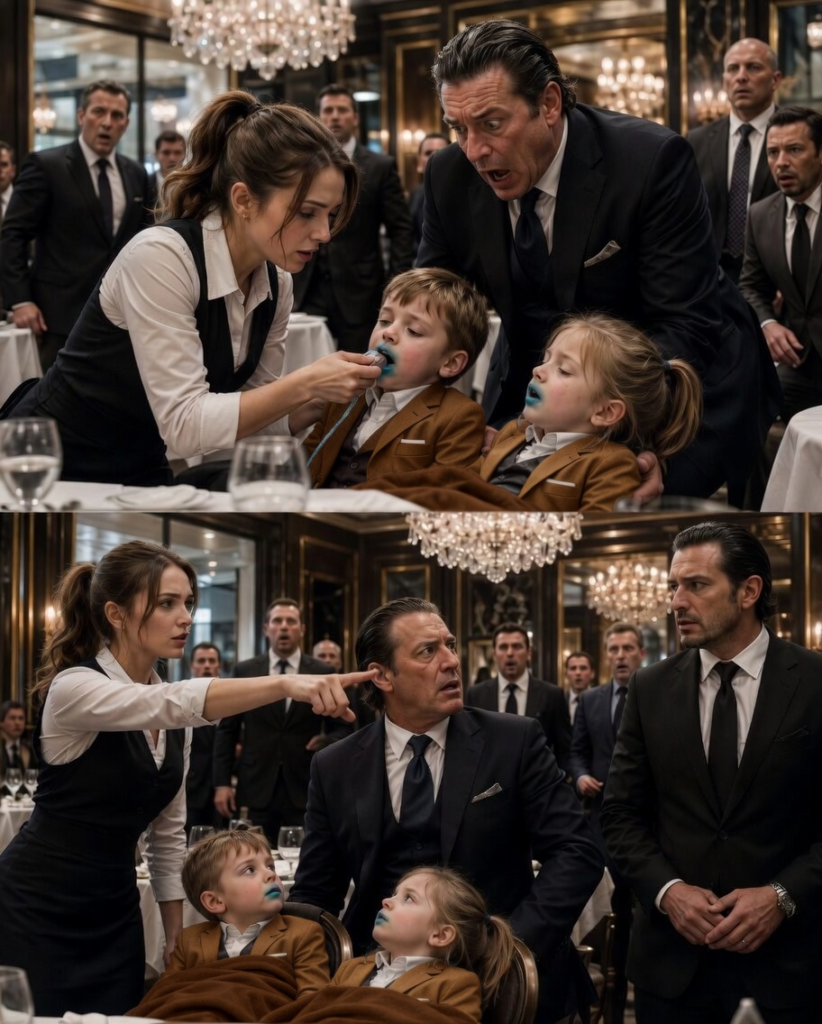
Ellie looked at the twins. Their lashes rested against their cheeks. One had a faint dimple in his chin. The other kept one tiny fist curled near his mouth.
“I was a neurologic music therapist,” she said. “Mostly pediatrics. NICU follow-up, developmental trauma, sensory processing issues.”
“Was?”
The question landed exactly where she did not want it.
She thought of a hospital room painted with cartoon clouds. A five-year-old girl named Lily who had loved yellow maracas. A code alarm. A mother screaming in the hallway. Ellie’s own hands shaking so badly afterward that she could not touch a keyboard for months.
“Life got complicated,” she said.
Damien watched her for a long moment, and she had the uneasy feeling that he heard more than she had said.
“Their mother died four months ago,” he said. “Officially, overdose complications. Unofficially, people whisper because whispering is safer than asking me.”
Ellie said nothing.
“They were born dependent,” he continued, his voice turning rough at the edges. “They shake. They scream. They stiffen until they can’t breathe right. Specialists come and go. Nannies quit. Doctors give me charts and medicines and words. Nobody makes it stop.”
“It won’t stop in one day,” Ellie said gently. “They need routine, low stimulation, safe touch, predictable sound, and a caregiver who doesn’t panic every time their bodies remember what they’ve survived.”
His eyes narrowed. “You think I panic?”
“I think you love them and don’t know what to do with terror except turn it into orders.”
A guard shifted outside the door.
Damien did not look away from her.
Most people, Ellie suspected, would have apologized. She did not. Something about those babies had dragged the honest part of her out from under years of fear and debt.
Finally Damien reached into his jacket, took out his phone, and typed. He turned the screen toward her.
A salary appeared.
$280,000 a year.
Housing included.Most people, Ellie suspected, would have apologized. She did not. Something about those babies had dragged the honest part of her out from under years of fear and debt.
Finally Damien reached into his jacket, took out his phone, and typed. He turned the screen toward her.
A salary appeared.
$280,000 a year.
Housing included.
Medical benefits.
Debt payoff negotiable.
Ellie stared at it until the numbers blurred.
“What is this?”
“A job,” Damien said. “You move into my home tonight. You help my sons. You teach me what you know.”
“No.”
His expression did not change, but the room seemed to lose heat.
“No?” he repeated.
“I’m not moving into a mob boss’s penthouse because he waved money at me after one emergency.”
A faint smile touched his mouth. “You know who I am.”
“Everyone in Chicago knows who you are. Most just pretend they don’t.”
“And you’re still saying no?”
“I’m saying there are conditions.”
His smile sharpened. “Name them.”
“I need full authority over the nursery environment. No weapons near the babies. No staff changes without telling me. No threatening me to get compliance. And if I stay, it’s because I choose to stay. Not because you bought me.”
Damien studied her the way a man might study a locked door he was considering breaking down. Then one of the twins stirred, making a small broken sound in his sleep.
His face changed.
Not much. Just enough.
“Done,” he said.
Ellie should have run. A sensible woman would have gone home, packed her thrift-store suitcase, and left Chicago before midnight.
Instead, she thought about the eviction notice in her purse. She thought about Lily’s mother crying in that hospital hallway. She thought about two blue-lipped babies borrowing rhythm from a waitress because no one else knew how to reach them.
“I’ll need a piano,” she said.
Damien stood and offered his hand.
Ellie took it.
His grip was warm, calloused, and terrifyingly steady.
“Welcome to my home, Ellie Hart.”
She looked at the sleeping twins and told herself she was doing this for them.
She had no idea she had just walked into a war.
The Moretti penthouse occupied the top three floors of a tower overlooking Lake Michigan. The elevator required a key card, a thumbprint, and a code Damien entered with his body angled so Ellie could not see.
When the doors opened, she stepped into a place that looked less like a home than a museum designed by someone who trusted no one. Black stone floors. Dark wood. Floor-to-ceiling windows. Art that looked expensive enough to make museums nervous. No family photos. No toys. No shoes by the door.
No evidence children lived there except for the sound of one twin fussing in the stroller.
“This way,” Damien said.
The nursery was at the end of a corridor guarded by two men. The door was steel under a layer of painted wood. Damien unlocked it with a code.
Ellie stepped inside and stopped.
The room was white.
Not soft white. Surgical white. The windows were bulletproof. The cribs were centered under cameras. Medical monitors blinked beside them. There were no mobiles, no blankets except hospital-grade swaddles, no color except the red standby lights on the security panel.
“You keep them in here?” she asked.
“This room is safe.”
“This room is a panic attack with a deadbolt.”
Damien’s face hardened. “Careful.”
“No. You hired me to tell you why they’re suffering. This is why.” Ellie walked to the wall and pressed her palm against the cold paint. “Babies don’t understand bulletproof glass. They understand warmth, pattern, smell, voice, touch. You built them a vault and wondered why their bodies keep screaming.”
“There are people who would cut my sons apart to send me a message.”
His voice was quiet, but the words struck like stones.
Ellie turned back to him. “Then protect them without teaching them that the world is only fear.”
For a moment, neither of them spoke.
Then Damien reached beneath his jacket.
Ellie saw the gun before it cleared the holster.
She moved between him and the cribs.
“Absolutely not.”
Damien froze. “Excuse me?”
“You do not pull a firearm within ten feet of those babies. Ever.”
His eyes went dark. “This is my house.”
“And this is my job.”
The silence stretched thin enough to cut.
One guard outside the door glanced in and immediately looked away.
Damien slowly lowered the gun, then slid it back into its holster.
“What else, Miss Hart?”
“Blue walls. Soft lamps. Blackout curtains. Textured blankets. A rocking chair that doesn’t look like it belongs in an interrogation room. White noise. And a place for me to work with them musically.”
“You make a lot of demands for someone I met two hours ago.”
“And you hired me because two hours ago I did something nobody in your empire could do.”
That landed.
Damien looked at the cribs. Both twins were awake now, watching the adults with solemn, exhausted eyes.
“Their names are Noah and Caleb,” he said.
He said the names carefully, almost painfully.
Ellie’s anger softened.
“They deserve a room that knows their names,” she said.
Damien turned and walked out. At the door, he paused.
“Buy whatever you need.”
Then he was gone.
By midnight, Ellie had ordered half a nursery from three different stores, argued with a security consultant about fabric safety, and convinced Damien’s household manager that a rocking chair was not a national security threat.
By three in the morning, Noah woke screaming.
Ellie found Damien in the hallway, fully dressed, standing outside the nursery door like a man facing a firing squad.
“You going in?” she asked.
“I make it worse.”
“You make it worse because you believe you make it worse.”
He looked at her. “That supposed to be therapy?”
“That’s supposed to be truth.”
She opened the nursery door and lifted Noah from his crib. He arched in her arms, trembling. Ellie tucked him close, pressed one hand firmly between his shoulder blades, and tapped.
One-two.
One-two.
Sixty beats per minute.
A resting heart.
Noah’s cries thinned. His little body resisted the rhythm for half a minute, then surrendered to it. His breathing slowed. His fist opened against Ellie’s shirt.
Damien stood in the doorway, staring.
“Show me,” he said.
Ellie looked up.
“Please,” he added, and the word seemed to cost him something.
She sat in the new rocking chair and nodded toward the ottoman. “Sit.”
He obeyed.
She transferred Noah into his father’s arms. Damien went rigid instantly, his shoulders squared as if he were holding an explosive.
Noah whimpered.
“Relax,” Ellie said.
“I am relaxed.”
“You’re holding him like a bomb.”
Damien looked down, jaw tight. “He feels too small.”
“He is small. That doesn’t mean he’s fragile beyond repair.” Ellie moved closer and placed her hand over Damien’s. “Here. Not patting. Tapping. Steady pressure. Let your hand say what your face doesn’t know how to.”
“My face?”
“You look like you’re negotiating with death.”
For the first time, something almost like humor crossed his eyes.
Ellie guided his hand.
One-two.
One-two.
At first, Damien’s rhythm was uneven. Too hard, too fast. Then he matched her. Noah settled against him with a soft sigh that seemed to empty the room of its ghosts.
Damien stopped breathing.
“He’s asleep,” Ellie whispered.
“I know.”
“No, you don’t. You’re still afraid to believe it.”
His fingers closed lightly over hers before she could move away. Not trapping. Asking.
“My wife never let me hold them long,” he said. “Serena said I frightened them. After she died, every time I picked them up, they screamed until someone took them away. I thought they knew.”
“Knew what?”
His gaze stayed on Noah. “That everything near me gets destroyed.”
Ellie’s throat tightened.
“That isn’t how babies work.”
“Isn’t it?”
“No. Babies know warmth. Breath. Rhythm. They know who keeps coming back.”
Damien turned his head. They were too close now. Close enough that Ellie could see exhaustion carved beneath his eyes.
“And what do you know, Ellie Hart?”
She should have pulled her hand away.
Instead, she told the truth.
“I know grief lies. It tells you the worst thing that happened is the only thing that will ever happen again.”
Something moved across his face, raw and unguarded.
Then Caleb cried from the other crib, saving them both from whatever might have happened next.
Ellie stood quickly.
“Your turn,” she said.
Damien looked down at Noah, sleeping against him, and nodded.
For the next two weeks, the penthouse changed by inches.
Blue paint replaced the white walls. Curtains softened the bulletproof glass. The cribs gained safe blankets, the shelves gained board books, and the music room Ellie requested became a place where the twins learned to track sound from left to right while Damien sat nearby pretending not to listen.
He failed at pretending.
He listened to everything.
He listened when Ellie explained neonatal withdrawal and sensory overload. He listened when she showed him how to lower his own heart rate before picking up the babies. He listened when she told him that children did not become strong by being denied tenderness.
In return, Ellie learned the rhythms of his world.
The guards changed shifts at six and midnight. Damien left before dawn some days and returned with bruised knuckles he did not explain. His underboss, Vincent Rourke, came and went with the confidence of a man who had spent twelve years being trusted.
Vincent was broad, blond, and polite in a way that felt sharpened.
He never raised his voice. He never insulted Ellie directly. He simply looked at her as if she were a temporary inconvenience Damien would eventually outgrow.
One night, Ellie went to the kitchen for warm milk after Caleb woke fussy from a storm rolling over the lake. She was passing Damien’s office when she heard Vincent’s voice through a cracked door.
“The girl is the weakness.”
Ellie stopped.
Another man answered. “Moretti won’t move against the Volkovs while the babies are here.”
“He will if the Volkovs take them.”
Ellie’s hand tightened around the bottle.
Vincent continued, calm as a weather report. “Saturday night, Damien meets the commission in Oak Brook. Cameras go down at eight-thirty. Service elevator opens at eight-forty. The Volkov crew takes the twins. Damien goes to war. We wipe out the Russians, consolidate the lakefront, and remind everyone what the Moretti name means.”
“And the babies?” the other man asked.
A pause.
“They were born damaged,” Vincent said. “Damien needs heirs, not liabilities. If they survive, fine. If not, grief will make him useful again.”
Ellie pressed a hand over her mouth.
The floor creaked under her bare foot.
The voices stopped.
She ran.
She reached the nursery, locked the door, and stood over Noah and Caleb while her mind tore through impossible options. Call the police? And say what? That a mob underboss was planning to stage a kidnapping inside a fortress? Tell Damien? Vincent had twelve years of loyalty. Ellie had two weeks and a paycheck that made her look bought.
Still, morning came, and fear became useless.
She found Damien in the music room, sitting at the piano after everyone else had gone quiet. He was not playing. Just staring at the keys.
“We need to talk,” she said.
He turned immediately. “What happened?”
“Vincent is planning to betray you.”
The room changed.
Not visibly, but Ellie felt it. Damien’s body went still in a way she had learned meant danger.
“Choose your next words carefully.”
She did. She told him everything. Saturday. The commission meeting. The cameras. The service elevator. The Volkovs. The twins.
By the time she finished, Damien’s face was unreadable.
“Vincent took a bullet meant for me in Cicero,” he said. “He buried my father beside me. He has held this family together through three wars.”
“I know what I heard.”
“You were outside my office in the middle of the night.”
“I was getting milk for Caleb.”
“You expect me to believe my brother in everything but blood would hand my sons to my enemies?”
“Yes.”
The answer hurt him. Ellie saw it before he buried it.
The door opened.
Vincent stepped in carrying a clear plastic evidence bag.
“Boss,” he said. “We have a problem.”
Ellie’s stomach dropped.
Vincent placed the bag on the piano. Inside were pills. Blue tablets. White capsules. Enough to make a story look convincing.
“Found these in Miss Hart’s room during security sweep.”
“That’s not mine,” Ellie said.
Vincent did not look at her. “Oxycodone. Benzodiazepines. Mixed bag. Hidden behind sheet music.”
Damien’s eyes flicked to her.
Ellie felt the fragile bridge between them crack.
“He planted them,” she said. “He knew I would tell you.”
Vincent sighed, almost sadly. “She worked at Northwestern Children’s until eight months ago. Left after a sealed incident involving a pediatric patient death. Three doctors wrote controlled prescriptions connected to her name afterward. I was going to bring it to you privately, but given the accusation she just made, you needed to know.”
Ellie’s face went cold.
Those prescriptions had been for Lily’s palliative care, managed through her mother, mishandled in a hospital audit that had ruined Ellie’s reputation even after she was cleared. Vincent had found the ugliest version of the truth and dressed it like guilt.
“Damien,” she said. “Look at me. Have I ever seemed impaired? Have I missed one feeding? Have I put your sons in danger once?”
Damien’s hand closed around the evidence bag.
Vincent’s voice stayed mild. “Addicts can be functional until they aren’t.”
“I’m not an addict.”
“Then why did you run from medicine into waitressing?”
Ellie flinched.
Damien saw it.
That was enough.
His expression hardened, but the pain underneath made it worse.
“Take her to her room,” he said.
“No,” Ellie whispered.
“Lock the door from outside. No contact with the twins until I know what’s true.”
“They need me.”
“My sons need safety.”
She stepped toward him. “Saturday night, when the cameras die and Vincent opens that elevator, remember that I begged you to listen.”
Vincent took her arm.
Ellie did not fight. Fighting would only make her look unstable. She let him lead her down the hall and lock her inside the guest room that had never felt like hers.
The bolt slid into place.
Ellie sat on the bed and cried for exactly three minutes.
Then she wiped her face, stood, and began looking for a way out.
The twins started screaming at midnight.
Ellie heard them through two walls.
Not ordinary crying. Not hunger. It was the raw, spiraling cry of infants whose bodies had lost the map back to calm.
She pounded on the door until her palms bruised.
“Let me out! They need the rhythm!”
No one came.
The crying went on for forty-seven minutes. Then an hour. Then longer. Ellie pressed her forehead to the door and forced herself to breathe, because panic would waste the only tool she had left: her mind.
If Damien was with them, and they were still screaming, it meant his fear had overwhelmed the method. He could copy her hands, but not her nervous system. The babies were not refusing him. They were reflecting him.
At 1:18 a.m., the bolt scraped.
Damien stood outside, shirt wrinkled, hair disheveled, eyes bloodshot.
“Show me again,” he said.
Ellie did not move. “Unlock the door completely. No guard. No condition. Either you trust me or you don’t.”
He stepped back. “Done.”
She ran to the nursery.
Noah and Caleb were red-faced, trembling, exhausted past crying and still unable to settle. Ellie lifted them one at a time, tucked them against her chest, and began tapping a dual rhythm with both hands.
One-two.
One-two.
Their breathing slowly followed.
Damien stood near the wall like a man watching a locked gate open.
“I did what you showed me,” he said. “It didn’t work.”
“You were terrified,” Ellie said.
“I wasn’t.”
“You were. They felt it. Rhythm isn’t just timing. It’s the body behind it.”
His face twisted. “Vincent showed me evidence.”
“Did you see him find it?”
Damien went silent.
Ellie adjusted Caleb against her shoulder. “The bag was cut open with a serrated tactical blade. The same kind Vincent carries on his belt. Look at the top seam. Evidence bags tear rough when opened by hand. That one is sliced clean.”
Damien pulled the bag from his pocket and examined it.
She watched the moment his doubt changed shape.
“Also,” she said, “ask yourself why a man worried about pills near infants carried those pills through the entire penthouse instead of calling you to my room.”
Damien’s jaw tightened.
“If I’m lying,” Ellie continued, “then fire me tomorrow. Send me away. But if I’m telling the truth, your sons have less than forty-eight hours.”
He looked at the sleeping twins in her arms.
Then he took out his phone.
“What are you doing?” she asked.
“Canceling the commission meeting,” he said. “And telling Vincent I want him here Saturday night to personally review nursery security.”
“He’ll know.”
Damien’s smile was cold enough to frost glass.
“Good.”
Saturday arrived like a storm that had been hiding behind sunshine.
By afternoon, Damien had doubled the guards, changed the elevator codes, and moved Ellie and the twins into the music room two doors from the nursery. It was windowless, sound-treated, and reinforced behind the walls. A panic room disguised as a place for lullabies.
At 8:41 p.m., the power went out.
Emergency lights flooded the hallway red.
Damien appeared in the music room doorway with a gun in his hand and murder in his eyes.
“Vincent’s gone,” he said. “Three guards aren’t answering. Service elevator opened from inside.”
Ellie lifted Noah from the padded mat. “How many?”
“Enough.”
He handed her a phone. “If I don’t come back, press one. It calls a man who owes me more than his life. He’ll get you and the boys out.”
“Damien—”
He cupped her face, fast and fierce, his thumb brushing her cheek. “Keep them quiet. Whatever you hear, keep the rhythm.”
Then he locked her inside.
For three minutes, there was nothing but emergency light under the door and the soft weight of the twins against her body.
Then gunfire tore through the penthouse.
The sound was muffled by the walls, but the vibration carried through the floor. Noah stiffened. Caleb whimpered.
Ellie sat with her back against the piano and tapped.
One-two.
One-two.
She hummed low, letting the sound vibrate through her chest into theirs.
There were shouts. More gunfire. Something heavy crashed against the wall outside. A man screamed once and stopped.
Ellie kept the rhythm.
A body hit the music room door hard enough to shake the frame.
The handle moved.
Ellie stopped humming.
A voice outside said, “Wrong room.”
Two shots followed.
Then Damien’s voice, flat and deadly: “Keep moving.”
Footsteps retreated.
Ellie breathed again.
But the relief lasted only seconds.
Behind her, the hidden service panel inside the music room clicked.
She turned.
Vincent Rourke stepped out from behind the acoustic wall with a pistol in his hand.
He had known about the panic room.
Of course he had.
“That’s the trouble with loyal men,” he said. “They know where all the locks are.”
Ellie moved in front of the twins.
Vincent looked at them with mild disgust. “All this chaos for two broken babies.”
“They’re not broken.”
“No. Damien is.” He angled the gun toward her. “And you made it worse. He was useful when he had nothing soft left.”
Ellie’s hand touched the piano bench behind her. Inside it were tuning forks, small percussion tools, and the emergency phone.
“You killed Serena,” she said.
Vincent smiled faintly. “Smart girl.”
Ellie’s blood went cold.
“She found out,” Vincent continued. “Found messages between me and the Volkovs. Planned to run to federal protection with the twins. I gave her enough fentanyl to make the story believable. Grieving addict wife. Tragic rich family. Very clean.”
Ellie pressed the phone button inside the bench without looking down.
Speed dial one.
Vincent did not notice. He was too busy enjoying confession.
“Damien would have burned the city if he knew,” he said. “Instead, he blamed himself. Better for everyone.”
The line connected silently.
Ellie raised her chin. “Not everyone.”
Vincent’s eyes narrowed as he realized her hand was inside the bench.
He raised the gun.
Ellie struck the largest tuning fork against the piano frame and jammed its base against the pickup microphone connected to the room’s speaker system.
A piercing feedback scream exploded through the music room.
Vincent cursed, staggering as the sound sliced through the air. Ellie grabbed the twins’ padded floor wedge and shoved it over them like a shield, then swung the piano bench with both hands.
It hit Vincent’s wrist.
The gun fired into the ceiling.
He lunged and caught her shoulder with the edge of a knife she had not seen him draw. Pain flashed white-hot down her arm. She fell hard, still reaching for the twins.
The music room door burst open.
Damien came through it like wrath given human shape.
Vincent turned.
For one second, the two men stared at each other. Twelve years of loyalty. Four months of grief. One truth too ugly to survive.
“You killed my wife,” Damien said.
Vincent’s eyes flicked toward the phone in the open piano bench.
He understood then.
Someone else had heard him say it.
Damien did not shoot him.
That was the first miracle.
He crossed the room, disarmed him with brutal efficiency, and drove him to the floor. Vincent fought like a man who had no future, but Damien fought like a father who had almost lost his past and present in the same night.
When it was over, Vincent was alive, barely conscious, and bound with his own belt.
Ellie pressed a cloth to her bleeding shoulder.
“You didn’t kill him,” she said.
Damien knelt beside her, his hands shaking as he checked her wound.
“I wanted to.”
“I know.”
His eyes met hers. “But my sons were watching.”
Behind him, Noah began to cry.
Damien turned, lifted him carefully, and pressed the baby to his chest.
One-two.
One-two.
His rhythm was uneven at first, but he steadied it.
Caleb fussed, and Ellie, despite the pain, gave a breathless laugh. “You’d better pick him up too.”
Damien looked at her, blood on his shirt and tears in his eyes.
“I can’t lose you,” he said.
“You didn’t.”
“You don’t know that.”
“I’m still talking, aren’t I?”
The corner of his mouth broke, not quite a smile, but close enough to make her heart ache.
Sirens sounded far below.
Damien glanced toward the windowless wall.
“Who did that phone call reach?” Ellie asked.
“A federal prosecutor,” Damien said. “One Serena trusted. One I should have trusted before pride buried us all.”
Ellie stared at him.
He looked down at his sons. “This ends tonight.”
It did not end cleanly. Nothing built on fear ever does.
Vincent’s confession, captured on the emergency line, opened doors that had been sealed for years. The Volkov crew was arrested before dawn. Several Moretti captains disappeared from Chicago rather than answer questions. Damien spent three months negotiating with federal authorities, not as an innocent man, but as a father finally willing to trade power for a future his children could survive.
People called it weakness.
Damien called it inheritance.
Six months later, Ellie stood in a small blue nursery in a house outside Traverse City, Michigan, watching snow fall beyond windows that were not bulletproof.
The twins were on the rug, both sitting without support. Noah slapped a wooden block against the floor. Caleb laughed every time he did it, as if his brother had invented comedy.
They still startled at loud noises. They still needed rhythm when storms rolled in. Healing did not erase history, and Ellie knew better than to demand miracles from children who had already fought so hard to stay alive.
But their hands no longer trembled every morning.
They smiled when Damien entered the room.
That was miracle enough.
He came in carrying two mugs of coffee and wearing jeans instead of a suit. The scar through his eyebrow remained. So did the darkness behind his eyes, though it no longer ruled the room.
“I have something for you,” he said.
“If it’s another therapy swing, we’re out of ceiling beams.”
“It’s not a swing.”
He set the mugs down and handed her a folder.
Inside was a deed.
The house.
A trust for the boys.
And a signed document forgiving every dollar of Ellie’s medical debt.
She looked up slowly. “Damien.”
“No contract,” he said. “No salary tied to staying. No cage made out of gratitude.”
Her throat tightened.
He reached into his pocket and took out a small velvet box.
Ellie stopped breathing.
“I was going to ask dramatically,” he said, “but Noah tried to eat the ring box this morning, so I’m adapting.”
Despite herself, she laughed.
Damien opened the box. The ring was simple, a platinum band with one small diamond. Beautiful without being loud.
“I love you,” he said. “Not because you saved my sons, though you did. Not because you saved me, though God knows you did that too. I love you because you tell the truth when it would be safer not to. Because you made my house a home before I understood the difference. Because when I was ready to become a monster again, you reminded me two little boys were watching.”
Ellie’s eyes filled.
“I’m not asking you to belong to my world,” he continued. “I’m asking if you’ll build a new one with me. One where my sons grow up knowing music before gunfire. Morning pancakes before security codes. Love before fear.”
Noah chose that moment to bang the block again.
Caleb shrieked with laughter.
Ellie wiped her cheeks. “They’re making it very hard to give a serious answer.”
“I’m using every advantage I have,” Damien said softly.
She looked at him—the man who had once held blue-lipped babies in a restaurant like rage could bargain with death, the man who had learned to slow his breathing so his children could borrow calm from his body, the man who had chosen not to kill because his sons were watching.
Then she looked at Noah and Caleb, alive and laughing on a rug in a warm room.
“Yes,” she whispered. “I’ll build it with you.”
Damien slid the ring onto her finger with hands that trembled only a little.
Then he kissed her, not like a man claiming something, but like a man finally coming home.
Behind them, Noah tapped his block against the floor.
One-two.
One-two.
Caleb followed with both hands, delighted by the sound.
Ellie laughed against Damien’s shoulder as the rhythm filled the room—not a warning, not a rescue signal, not a desperate metronome against fear.
A family heartbeat.
Steady.
Human.
Alive.
THE END