Part 2: The Door Left Open
Fashion accessories
For a moment, I did not move, because my body seemed to forget that it belonged to me.
My hand stayed on the doorframe, fingers pressed so hard against the wood that my knuckles turned pale.
Inside the classroom, the other children were silent, not because they understood cruelty, but because they felt fear.
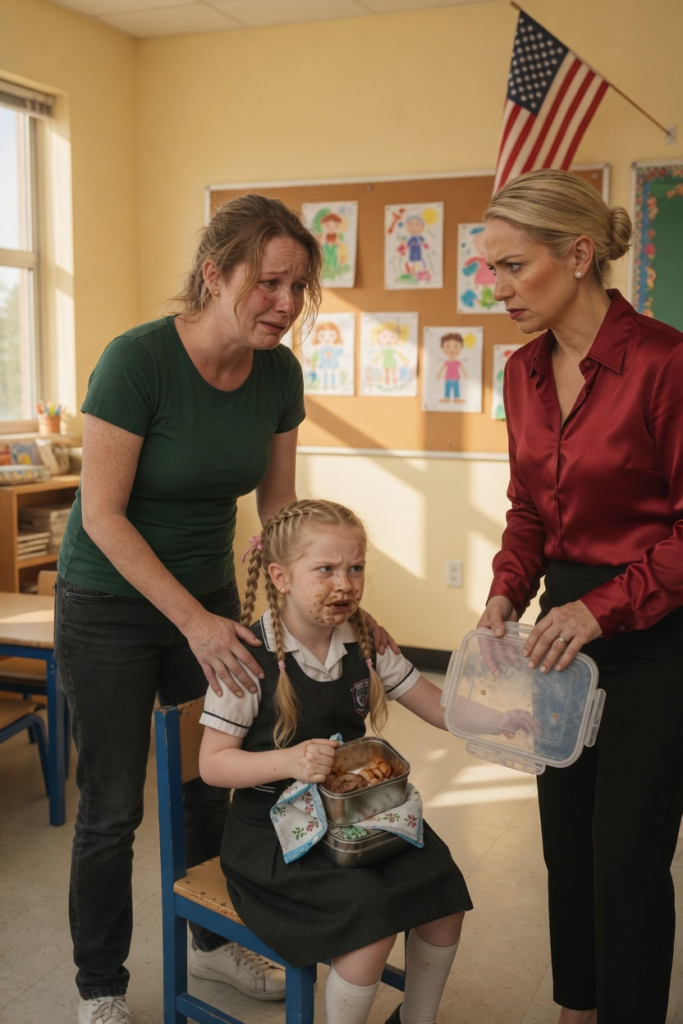
Sofía stood beside her desk, her small hands hanging uselessly at her sides, as if even reaching had become dangerous.
Miss Valeria wiped her fingers with a tissue, though she had not touched anything dirty except my daughter’s dignity.
The smell of adobo still lingered faintly in the room, warm and familiar, mixed with the sharp plastic scent of trash.
I remembered Sofía standing on a little stool that morning, watching me stir the sauce with serious, careful eyes.
“Make extra, Mommy,” she had whispered, “because when food tastes like home, my stomach feels brave.”
That sentence returned to me so suddenly that I almost stepped into the room screaming her name.
But then Sofía looked toward the door, and her eyes found mine through the narrow opening.
She did not call for me, did not run, did not point at the teacher with childish outrage.
She simply looked ashamed, as if somehow she believed I had caught her doing something wrong.
That was the first thing that broke me, not the thrown lunch, not even the teacher’s hateful words.
It was my daughter lowering her eyes because an adult had taught her humiliation faster than any lesson.
I took one slow breath, then another, because rage can make a person careless, and carelessness has consequences.
If I stormed in as the owner, every adult in that building would bow, apologize, and protect themselves.
If I entered as Sofía’s mother, I would see the truth before anyone had time to hide it.
So I pushed the door open quietly, and the hinges made a small sound that froze the whole classroom.
Miss Valeria turned first, irritated, already preparing the face people use when they expect someone beneath them.
Her expression changed when she saw my clothes, my worn jeans, my plain sneakers, my hair tied carelessly back.
“Yes?” she said, with the same disgust she had poured over my daughter’s lunch. “Can I help you?”
Sofía’s lips trembled, and she clutched the edge of her desk like she wanted to disappear behind it.
I walked toward her slowly, not toward the teacher, because Sofía needed to know she mattered first.
I knelt beside my daughter, lowered my voice, and asked, “Are you hungry, mi amor?”
She nodded once, but her eyes flicked toward Miss Valeria, asking permission even to answer her own mother.
That little glance told me this was not the first time fear had sat beside her in that classroom.
I opened the container I had brought, the second portion of chicken in adobo, still warm against my palms.
The room filled again with the smell Miss Valeria had called poverty, and several children looked at it hungrily.
Sofía stared at the food, then at me, caught between wanting comfort and fearing punishment for accepting it.
“You can eat,” I said softly. “No one gets to decide that your hunger is something to be ashamed of.”
Miss Valeria gave a dry laugh, but it came out uncertain, as if my calm bothered her more than shouting.
“Ma’am, this school has standards,” she said. “Perhaps if you read the handbook, you would understand appropriate meals.”
I stood slowly, keeping one hand on Sofía’s shoulder, feeling how tightly her little body was holding itself together.
“I know the handbook,” I said. “There is nothing in it that forbids homemade food.”
Her eyes narrowed, and for the first time she studied me instead of dismissing me.
Parents like me, in clothes like mine, were not supposed to speak with quiet certainty in expensive schools.
“They disturb the environment,” she replied. “Some families pay a great deal so their children are not exposed to this.”
Several children looked down at their desks, and one little boy pushed his untouched sandwich slightly toward Sofía.
Miss Valeria noticed the movement and snapped her fingers once, sharp enough to make him pull back.
That tiny sound told me more than her words, because the children already knew how to obey her cruelty.
I wanted to reveal everything then, to let my name fall like glass across the polished floor.
But Sofía’s hand found mine under the desk, and her fingers were cold, trembling, desperate.
If I made this about power, she might learn only that her mother could win because she was rich.
I needed her to learn something harder, that dignity should not depend on money, surname, or hidden ownership.
“Who else has been spoken to this way?” I asked, turning toward the children, but keeping my voice gentle.
No one answered, yet the silence moved through the room like a thing with weight.
A girl with braids touched the lid of her lunchbox, then quickly folded her hands when Miss Valeria looked over.
I saw fear traveling from desk to desk, familiar and practiced, like an old routine.
Miss Valeria stepped closer to me, lowering her voice so the children would not hear every word.
“You are embarrassing your daughter,” she whispered. “Poor children suffer most when their mothers pretend they belong somewhere higher.”
For a second, the room blurred around me, and I heard my father’s voice from many years ago.
“Never answer an insult while your wound is fresh, Elena. People listen better when you do not bleed in public.”
He had said it when bankers laughed at our first small school, when investors called our dream sentimental.
I had built an empire by staying calm in rooms where men expected my anger to make me smaller.
But this was not a boardroom, and the person bleeding in silence was six years old.
Sofía took a tiny bite of the chicken, chewing carefully, as if food itself had become an act of disobedience.
That small bite decided something inside me, though I did not yet know how far it would go.
I looked at Miss Valeria and asked, “Would you repeat what you told my daughter, with the principal present?”
Her face stiffened, but only slightly, because she still believed I was simply a troublesome mother.
“I have nothing to hide,” she said, too quickly. “I enforce discipline where certain families fail to teach manners.”
I nodded, then took out my phone and called the principal’s office without moving from Sofía’s side.
The receptionist recognized my voice at once, but I cut her off before she could say my name.
“Please ask Principal Robles to come to Classroom 1B immediately,” I said. “And tell him not to announce who called.”
There was a pause, small but full of alarm, before she answered that he was on his way.
Miss Valeria’s confidence flickered when she heard the receptionist’s tone through the speaker.
Outside, children’s laughter drifted from the playground, ordinary and bright, making the room feel even colder.
Sofía ate two more bites, then stopped, pushing the container toward the boy who had tried to help her.
He looked at Miss Valeria first, then at me, and that hesitation felt like another accusation against every adult there.
“You may share if you want,” I told Sofía. “Kindness is not against any handbook either.”
The boy accepted a small piece with both hands, his face serious, almost ceremonial.
Miss Valeria opened her mouth, then closed it when footsteps approached the hallway.
Principal Robles appeared at the door, his tie slightly crooked, his face pale the moment he saw me.
He knew my plain clothes meant nothing, and that my silence usually meant something worse than anger.
“Señora Valdés,” he said before he could stop himself, and the classroom changed in a single breath.
Miss Valeria turned toward him slowly, as if the name had entered her body before her mind understood it.
The children did not understand everything, but they understood enough to look from him to me with wide eyes.
Sofía stopped chewing, and I felt her hand tighten around the container in her lap.
I wished, suddenly and painfully, that she had never had to learn who I was this way.
Principal Robles swallowed. “I’m sorry. I mean, Mrs. Elena, what happened here?”
There it was, the moment when I could choose the easy truth, the clean truth, the powerful truth.
I could say I owned the school, expose Valeria, protect Sofía, and let everyone understand the cost of touching my child.
But another truth sat beside it, quieter and less satisfying.
If this had happened to a child without my surname, without a hidden mother behind the door, would anyone have come?
Miss Valeria’s face had gone white, but not with remorse; it was the color of someone calculating danger.
“I didn’t know,” she whispered, and those three words entered me more sharply than any apology.
She did not say she was wrong, did not say she was sorry, did not say Sofía deserved better.
She only said she had not known, meaning the cruelty would have been acceptable if my daughter were ordinary.
Principal Robles looked at me, waiting for instructions, waiting to learn which version of me had entered his school.
The billionaire could destroy a career with one sentence, and part of me wanted exactly that.
The mother wanted to take Sofía home, wash her face, feed her slowly, and never return to that classroom.
But the owner knew there were other lunchboxes, other trembling hands, other children learning shame in silence.
I looked at the trash can, where the food I had made that morning lay under paper towels and pencil shavings.
The sight was small, almost ridiculous compared with everything I owned, yet it felt impossible to ignore.
“Sofía,” I said quietly, bending down so only she could hear me clearly.
She looked at me with wet eyes, and I saw the question inside them before she spoke it.
“Are we in trouble, Mommy?” she whispered, and the room seemed to shrink around that one sentence.
I closed my eyes for half a second, because every choice suddenly had a cost.
If I told the truth fully, her school life would change forever, and children might treat her differently.
If I stayed silent, I would be teaching her that peace is worth more than her own dignity.
When I opened my eyes, Sofía was still waiting, trusting me to decide what truth could fit in her small hands.
“No,” I said. “We are not in trouble. But something wrong happened, and we are not going to pretend it didn’t.”
Her shoulders loosened just a little, and that small movement gave me the strength to stand.
I turned to Principal Robles, but I made sure every adult and child could hear my next words.
“Please bring the school counselor, the classroom assistant, and the parents’ conduct reports for this class.”
Miss Valeria took one step back. “This is unnecessary. It was only a lunch issue.”
I looked at her then, really looked, and saw not a monster, but something more ordinary and frightening.
A woman who had confused expensive polish with worth, and obedience with education.
“That is exactly why it is necessary,” I said. “Because you think a child’s hunger is a small issue.”
The hallway seemed quieter now, as if even the building were listening.
Principal Robles nodded quickly and left, but not before I saw shame cross his face.
He had protected my secret, but perhaps in doing so, he had stopped looking closely at everything else.
Miss Valeria stood alone at the front of the room, surrounded by the children she had trained to fear her moods.
For the first time, none of them looked at her for permission.
Sofía leaned against my leg, warm and small, still holding the container with both hands.
I placed my palm over her hair and felt the fragile rhythm of her breathing begin to settle.
Then I looked at the trash can again, at the ruined food, at the proof no one could polish away.
I knew then that the choice ahead would not be between revenge and forgiveness.
It would be between protecting my daughter quietly, or protecting every child loudly enough that nothing stayed hidden.
And as Principal Robles returned with files pressed against his chest, I finally understood which truth I could live with.
Part 3: What We Chose to Keep
Principal Robles placed the files on the nearest desk, but his hands did not leave them immediately.
For a moment, he looked less like a principal and more like a man realizing what silence had cost.
The counselor arrived behind him, a young woman named Mariana, with concern already written across her face.
She knelt near Sofía first, not too close, not forcing comfort, only offering a clean napkin and water.
Sofía accepted the water with both hands, and I noticed she whispered thank you without looking up.
That small courtesy hurt more than tears, because even wounded, my daughter was still trying to be good.
Miss Valeria stood by the board, arms crossed, but her fingers kept tightening around her sleeves.
No one yelled, and somehow that made the room heavier, because every quiet second asked for an answer.
Principal Robles opened the first folder and cleared his throat, avoiding Valeria’s eyes as he spoke.
“There have been complaints,” he admitted. “Small ones, mostly about tone, favoritism, food comments, clothing remarks.”
“Small ones,” I repeated, and the words sounded strange after what I had just watched happen.
He lowered his head, and for the first time, he did not try to defend the school.
“We treated them as misunderstandings,” he said. “Parents did not want conflict. Staff said she was strict.”
Mariana looked toward the children, then back at him, and her silence felt sharper than accusation.
Miss Valeria let out a breath, almost a laugh, but it broke before becoming anything confident.
“So now everyone is pretending I abused them because one wealthy mother is offended?” she said.
The word wealthy landed between us, ugly and desperate, because she still could not see the wound.
I looked at Sofía, who had stopped eating again, her spoon resting against the edge of the container.
She was listening, even when we wished children could stop hearing adults fail each other.
So I chose my next words carefully, because truth can become another burden when spoken without tenderness.
“This is not about wealth,” I said. “It is about what you allowed yourself to do when you thought no one powerful was watching.”
Valeria’s eyes filled with tears, but they were angry tears, the kind people shed when their image cracks.
She looked at Principal Robles, expecting rescue, perhaps because she had been rescued by excuses before.
But he did not rescue her this time, and that became his first honest act of the afternoon.
“You will leave the classroom now,” he said quietly. “You are suspended while we investigate every complaint.”
Valeria’s mouth opened, then closed, and I saw the exact second she understood the room had changed.
She picked up her handbag from behind the desk, moving stiffly, as though every child’s gaze weighed something.
At the door, she turned to Sofía, and I almost hoped she would say the one sentence my daughter deserved.
But she only said, “I didn’t know who you were,” in a voice that made the apology smaller than silence.
Sofía blinked once, confused, then looked at me as if asking why that mattered.
“It doesn’t,” I whispered, and I felt her fingers relax inside mine.
After Valeria left, the classroom did not become happy. Real harm does not disappear when the person leaves.
The children stayed quiet, watching the adults, unsure whether this was punishment, rescue, or another lesson.
Mariana asked them to draw anything they wanted while she spoke to each child one by one.
A few reached for crayons quickly, grateful for something simple to hold in their hands.
One little girl drew a lunchbox with a lock on it, then covered the lock with yellow.
The boy who had accepted Sofía’s food drew two plates side by side, very carefully, without looking up.
I stood in the corner with Principal Robles, and he did not ask what I intended to do.
He already knew consequences were coming, not the cruel kind, but the kind institutions need when they have drifted.
By evening, every parent in Sofía’s class received a message about an urgent review of classroom conduct.
By the next morning, three families came forward with stories they had dismissed as discomfort or exaggeration.
One mother cried in my office, ashamed that her son had begged to change classes for months.
A father admitted he had told his daughter to “be tougher,” not realizing toughness should never mean swallowing humiliation.
Each account was ordinary, almost dull in its details, and that made it worse.
A lunch mocked, a sweater criticized, an accent corrected too harshly, a child moved away from “better families.”
No single detail looked enormous alone, but together they made a room where children learned their place through shame.
Miss Valeria never returned to Sofía’s class. The investigation ended with her dismissal and mandatory reporting to the board.
Some parents said it was too much. Others said it had taken too long.
Both were true in different ways, and I had to live with that uncomfortable balance.
Principal Robles offered his resignation, written in careful formal language, with no excuses tucked between the lines.
I did not accept it immediately. I asked him to sit across from me and explain what he had stopped seeing.
He spoke of reputation, donors, demanding parents, and the pressure to keep expensive families comfortable.