My neighbor said four words to me that changed the architecture of my entire life.
“Get in. Don’t talk.”
It was seven o’clock in the morning on my daughter’s wedding day. I was standing on the covered porch of my home in Oak Ridge, clutching a lukewarm cup of black coffee, watching the rain slick the driveway. Eleanor Patton’s silver Buick was idling by the curb, a thin ribbon of exhaust curling into the damp November air.
Eleanor had lived next door to me for thirty years. She was the widow of a logistics officer, a woman who had sat silently beside me holding my hand at my own husband’s funeral just fourteen months ago. She did not startle easily. She did not deal in neighborhood gossip, and she certainly did not panic.
So, when I saw her standing by the passenger door in her heavy wool coat, her face drained of all ordinary color, my heart gave a strange, hard thud against my ribs.
I am Dr. Elena Vance. Before I retired, I was a Colonel and a Senior Surgical Coordinator for the US Army. I have stood in field hospitals in the middle of mortar fire, triaging shattered soldiers without letting my hands shake. I believe in vital signs, in measurable data, and in staying perfectly calm when the world bleeds.
But as I walked down the porch steps, a cold dread pooled in my stomach.
“Eleanor?” I asked.
“Get in the car, Elena,” she said again, her voice softer this time, but strung tight as piano wire. “Please. There is something you have to see before this wedding happens.”
My first instinct was tactical irritation. Claire’s ceremony was at noon. The florist was due at the church by eight-thirty. Upstairs, my daughter was sleeping her last hour as a single woman, finally finding a semblance of peace after a year of agonizing grief.
My late husband, Dr. Arthur Vance, had been a legendary figure in oncology. He had spent his life developing a groundbreaking Immunotherapy Patent—a proprietary treatment protocol worth tens of millions—before a sudden, massive coronary took him from us. Claire had withered away in the aftermath, hollowed out by the loss, until Dr. Julian Thorne arrived.
Julian was Arthur’s protégé. A brilliant, charismatic thoracic surgeon, Julian had stepped into our shattered lives with an impossibly steady hand. He managed the probate lawyers. He brought Claire her favorite teas. He spoke of Arthur with a reverence that brought the color back to my daughter’s cheeks.
But for eight months, I had been suppressing a dark, clinical instinct. Julian was too perfect. His timing was too precise. Every now and then, when Claire wasn’t looking, I would catch a cold, calculating shift in his eyes—the look of a man evaluating assets rather than a man in love. I had convinced myself I was just a paranoid, grieving widow.
“Eleanor,” I said, gripping my coffee mug. “I have to be dressed. Claire is—”
She crossed the wet asphalt in two strides and grabbed my wrist.
“I know what time the ceremony is. That is exactly why we have to leave right now.”
I looked into her eyes and saw the raw, unmistakable terror of a woman who knows she is holding a live grenade. Without another word, I set my mug on the hood of the car and climbed into the back seat.
Eleanor handed me a thick, wool blanket. “Lie down across the seats. Cover yourself. We cannot be seen where we are going.”
The car smelled faintly of peppermint and old leather. I lay flat, watching the gray morning sky slide past the windows, my pulse hammering a frantic, abnormal rhythm against my throat. We drove away from the manicured lawns of our neighborhood, crossing into an older, tired section of town, and with every mile, the illusion of my daughter’s happy ending began to unravel.
We drove for twenty minutes before the Buick slowed and idled by a cracked curb.
“Stay down,” Eleanor whispered from the front seat. “Just watch the side door of that cream-colored bungalow.”
I pulled the blanket down just enough to peer out the window. The street was quiet, lined with chain-link fences and forgotten tricycles. Two houses down, sitting in a cracked driveway, was Julian’s navy pickup truck. It was the same truck he had supposedly left parked at the hospital for “early morning surgical rounds” before the wedding.
At exactly 8:15 a.m., the side door of the bungalow opened.
A woman stepped out. She was wearing blue nursing scrubs, her dark hair pulled back in a messy ponytail, a battered canvas tote slung over her shoulder. I recognized her instantly. It was Diane Greer, a surgical nurse from the county hospital where Julian operated.
Before my mind could process her presence, a little boy burst out of the house. He was about six years old, running with the uninhibited, chaotic energy of childhood, bouncing a basketball against the concrete.
And then, Julian stepped out into the morning air.
He was not wearing his pristine surgeon’s coat, nor his custom-tailored wedding tuxedo. He wore an old flannel shirt and faded jeans. He walked down the steps with a relaxed, practiced ease. He caught the basketball underhand, ruffled the boy’s hair, and lifted him clean off the ground.
“Daddy, will you be back before dinner?” the boy shouted, his voice ringing clear across the damp lawns.
Julian smiled—the exact same warm, reassuring smile he had used to disarm my daughter. “I’ll be back before sunset, Noah. I promise.”
Then, Julian turned to Diane. He kissed her cheek. It wasn’t a polite, rushed peck. It was the deeply familiar, unthinking gesture of a man kissing the woman he has built a life alongside.
My breath caught in my throat like a shard of glass. Daddy. I reached for the door handle, a blind surge of maternal violence flooding my veins, but Eleanor reached back and grabbed my shoulder.
“Not yet, Elena,” she pleaded, her voice cracking. “Look at this first.”
She dropped a heavy, manila envelope onto the floorboard next to my head. “I hired a private investigator three weeks ago when I saw his truck parked here. I didn’t want to ruin Claire’s life over a misunderstanding.”
I sat up slightly, my hands trembling as I tore the envelope open.
Inside was a copy of a birth certificate for Noah Raymond Thorne. Father: Julian Thorne. Mother: Diane Greer.
There were bank statements detailing monthly transfers from Julian’s private accounts to Diane, spanning six years. But as I flipped to the second section of the dossier, the infidelity became the least of his sins.
The next pages were confidential medical board filings and financial ledgers. Four months ago, Julian had botched a highly complex thoracic surgery on a wealthy patient. He had been distracted, negligent. Facing the total loss of his medical license and a ruinous malpractice lawsuit, Julian had orchestrated a secret, multi-million-dollar out-of-court settlement. Diane Greer had been the attending nurse; she had helped him alter the surgical logs to hide his negligence.
Julian was utterly bankrupt. He was drowning in debt, leveraged to the brink of professional and personal annihilation.
And clipped to the very back was a drafted, unsigned contract with a massive pharmaceutical conglomerate. It was an agreement to sell Arthur’s Immunotherapy Patent for eighteen million dollars. The contract explicitly noted that Julian would have “spousal custodial control” over Claire’s trust assets immediately following the marriage.
Julian hadn’t found my daughter in her grief. He had targeted her inside it. He needed the Vance name to launder his destroyed reputation, and he needed Arthur’s life’s work to pay off his malpractice debts.
He had prescribed himself my daughter’s inheritance as the cure for his own fatal mistakes.
“Take me home, Eleanor,” I commanded, the military coldness finally snapping into place over my shock. “Drive fast.”
“Are you going to tell her?” Eleanor asked, throwing the car into gear.
I stared down at the drafted contract, the blueprint of my daughter’s destruction. If I told Claire now, in the privacy of her bedroom, Julian would find a way to manipulate the symptoms. He would use medical jargon, he would cry, he would gaslight her into believing I was a paranoid widow having a psychotic break.
The wedding wasn’t a celebration. It was a hostile takeover. And to stop it, I was going to have to perform a public execution.
When I stepped back into my house, the air felt offensively normal. It smelled of hot hairspray, expensive floral arrangements, and the nervous, bubbling anticipation of a wedding morning.
I walked upstairs, clutching the envelope tightly against my side. I paused outside Claire’s bedroom door.
She was standing in front of the full-length mirror, enveloped in white silk and tulle. One bridesmaid was adjusting the train, while another carefully pinned a delicate diamond comb into her hair. Claire looked at her own reflection with a fragile, almost disbelieving wonder.
She looked like a woman who had spent a year wandering through a graveyard, only to finally find the sunlight again.
“Mom,” Claire said, catching my reflection in the mirror. She turned, her eyes bright with unshed tears. “Tell me the truth. Do I look like someone who gets to be happy?”
The question was a physical blow to my chest. I had to swallow the bile rising in my throat. You look like a casualty who doesn’t know she’s bleeding out yet.
“You look breathtaking, Claire,” I said, stepping into the room. I reached out and gently adjusted a stray curl near her cheek, my fingers brushing her warm skin.
“I know you’ve never been entirely sold on him,” she whispered, leaning into my touch so the bridesmaids wouldn’t hear. “But he saved me, Mom. When Dad died, I thought I was going to stop breathing permanently. Julian… Julian anchored me. I feel Dad in him.”
That was the ultimate, unforgivable cruelty. Julian hadn’t just stolen her future; he had weaponized the memory of her father to do it. He had studied Arthur’s mannerisms, his medical philosophies, his exact tone of voice, mimicking the ghost of the man Claire loved most just to gain access to the vault.
Every fiber of my being screamed to lock the door, hand her the dossier, and let her fall apart in the safety of her childhood bedroom. But my mind flashed to the drafted patent sale. Julian was a sociopath. If I gave him an inch of private shadow, he would rebuild his lies in the dark. He needed to be dragged into the blinding, sterile light of the operating room.
“Your father would be so fiercely proud of the woman you are today,” I told her, my voice perfectly steady. “I love you, Claire. More than my own life.”
She smiled, a pure, innocent expression that shattered the last of my hesitation. “I love you too, Mom. I’ll see you at the church.”
I went to my master bedroom. I did not put on the pastel mother-of-the-bride dress we had picked out together. Instead, I pulled a sharp, tailored navy-blue suit from the back of my closet. I pinned Arthur’s gold medical insignia to the lapel. I took the manila envelope, folded it carefully, and slid it into my structured handbag.
I looked at Arthur’s framed photograph on my nightstand.
I am going to break her heart to save her life, Arthur, I thought. Forgive me.
The drive to the church was a blur of gray rain and relentless ticking in my head. When I arrived, the sanctuary was already filling with guests. Half the state’s medical board was there. Chief surgeons, hospital administrators, venture capitalists—everyone who mattered in Arthur’s world had come to witness his protégé marry his daughter.
I took my seat in the front pew. The organ music swelled, a rich, haunting melody that vibrated through the floorboards.
The heavy oak doors at the back of the church opened.
Julian was standing at the altar. He wore a bespoke black tuxedo, his posture impeccable, his hands clasped respectfully in front of him. As Claire began her slow walk down the aisle, Julian’s face arranged itself into an expression of profound, overwhelming love.
It was a masterful performance. He looked exactly like a savior. He had no idea the surgeon was already in the room, holding the scalpel, ready to make the first cut.
The sanctuary held its collective breath as Claire reached the altar. She handed her bouquet to her maid of honor and took Julian’s hands. He smiled down at her, a picture of absolute devotion, while the medical elite of the city watched with approving nods.
The minister, an old friend of Arthur’s, stepped forward. He spoke of love, of healing, of two brilliant legacies intertwining to carry on a great man’s work. Every word felt like a drop of acid.
Then came the ceremonial pause. The archaic tradition that no one ever actually expects to be utilized.
“If anyone here knows any lawful reason why these two should not be joined in holy matrimony, speak now, or forever hold your peace.”
The church was completely silent. Just the soft rustle of silk and the patter of rain against the stained glass.
I picked up my handbag. I stood up.
The sound of my heels against the hardwood floor echoed like a gunshot.
“I have reason,” I said.
My voice was not hysterical. It was not shaking. It was the flat, authoritative command of an officer issuing a triage order.
The reaction was a violent ripple of shock. Four hundred guests gasped. Claire’s head snapped toward me, her veil swaying. Julian’s perfect, loving smile slipped for a microsecond, revealing the panicked, calculating predator underneath, before he smoothed his features back into concerned composure.
“Elena,” Julian said, his voice dripping with condescending gentleness. He took a step toward me, holding his hand out as if calming a psychiatric patient. “Elena, please. I know the anniversary of Arthur’s death has been incredibly hard on you. You’re overwhelmed—”
“Do not diagnose me, Julian,” I cut him off, stepping out of the pew and into the center aisle. I unclasped my handbag and pulled out the thick manila envelope. “This contract has a systemic failure.”
Claire let go of Julian’s hands. “Mom? What are you doing?”
I looked directly into my daughter’s terrified eyes. “I am saving your life, Claire. And I am protecting your father’s legacy.”
I turned my gaze to the congregation, locking eyes with the Chief of Surgery sitting in the third row.
“Two months ago,” I announced, my voice carrying to the vaulted ceiling, “Dr. Julian Thorne committed gross medical negligence during a thoracic bypass. To avoid losing his license, he paid a multi-million dollar secret settlement. He is utterly bankrupt.”
The sanctuary erupted into panicked murmurs. Julian’s face flushed a deep, furious crimson.
“This is insane!” Julian shouted, dropping the gentle facade. “She’s having a psychotic break! Security, please—”
“He didn’t choose you out of love, Claire,” I continued ruthlessly, turning back to the altar. I pulled the drafted contract from the envelope and held it up. “This is a drafted sale agreement with Omni-Pharm. The moment you say ‘I do,’ Julian gains spousal custodial control over Arthur’s Immunotherapy Patent. He plans to liquidate your father’s life work for eighteen million dollars to pay off his malpractice debts.”
Claire stumbled backward, her hand flying to her mouth. She looked at Julian, begging him to deny it.
“It’s a lie, Claire!” Julian scrambled, reaching for her. “She forged that! She’s always hated me, you know that! She’s trying to destroy us because she can’t let go of Arthur!”
He was good. He was so incredibly good at finding the exact emotional nerve to press. For a second, I saw Claire hesitate, the desperate desire to believe him warring with the truth in my hands.
But I hadn’t come to the operating room without my final instrument.
At the back of the church, the heavy oak doors swung open with a resounding creak.
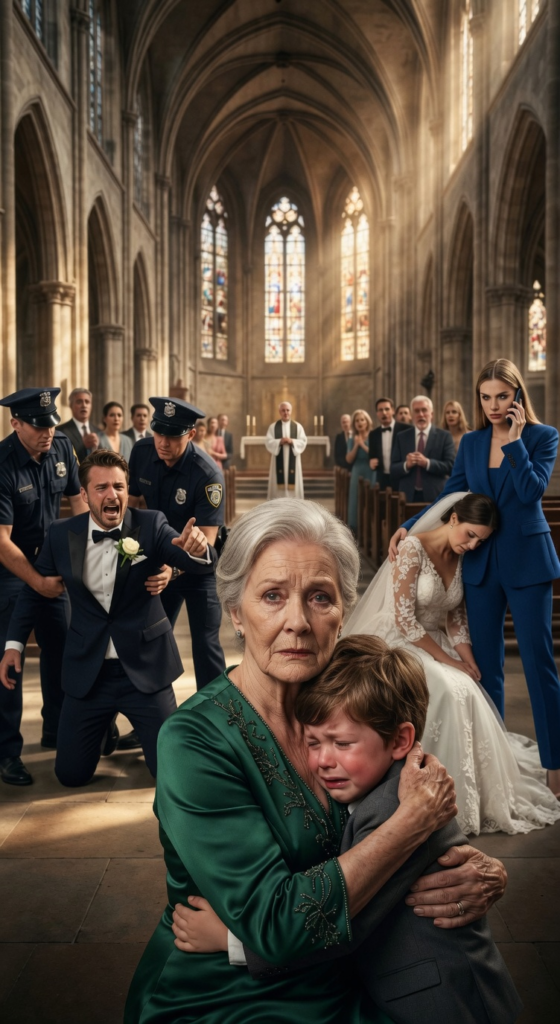
Eleanor stood in the entryway. Beside her was Diane Greer, wearing a simple gray trench coat, looking exhausted and terrified but resolute. And holding Diane’s hand was six-year-old Noah.
Noah’s eyes scanned the massive, crowded room until they landed on the man in the tuxedo at the altar.
The little boy’s face lit up with pure, unadulterated joy.
“Daddy!” Noah yelled, his voice echoing off the stone walls.
He broke away from his mother and ran full-speed down the red carpeted aisle.
The silence that fell over the church was absolute. It was the silence of a fatal flatline.
Noah collided with Julian’s legs. Julian froze, paralyzed by the sudden, catastrophic collision of his two hidden lives. Instinctively, reflexively, his hands dropped to catch the child.
In that single, devastating motion, Julian Thorne’s empire crumbled into dust.
Claire stared at the little boy hugging the man she was about to marry. Her bouquet of white roses slipped from her trembling fingers. It hit the hardwood floor with a heavy, sickening thud.
She looked up at Julian, her eyes entirely hollowed out.
“How long?” she whispered.
Julian opened his mouth, but no words came out. The sirens of the police cars I had called ten minutes earlier began to wail in the distance, screaming toward the church to investigate the financial fraud I had reported. The operation was over. The tumor had been excised. Now came the bleeding.
The aftermath of a public execution is never clean. It is chaotic, humiliating, and brutally bureaucratic.
The police arrived just as the guests were fleeing the sanctuary in horrified droves. They didn’t arrest Julian dramatically at the altar, but they escorted him to a squad car for questioning regarding the fraudulent financial disclosures and the illegal medical cover-up. The Chief of Surgery was already on his phone in the parking lot, initiating an emergency board review. Julian’s medical license was as good as dead.
Claire refused to look at him as he was led away. She walked out the side door, her wedding dress dragging through the mud, and got into my car without a word.
The first three days in our house were unbearable. Claire moved like a ghost, wearing Arthur’s old medical school sweatshirt, drinking tea she never finished. She didn’t cry. She just stared at the walls.
On the fourth day, I was standing in the kitchen, washing dishes, when she finally spoke.
“You should have told me in my bedroom,” she said. Her voice was flat, devoid of emotion. “You should have shown me the papers before I put on the dress. Before I let half the city look at me like a pathetic, gullible fool.”
I turned off the faucet. I dried my hands carefully.
“If I had told you in your bedroom,” I said, turning to face her, “he would have manipulated you. He would have explained away the documents. He would have told you I was a bitter, aging woman trying to ruin your happiness. And because you wanted so desperately to be saved from your grief, Claire, you would have believed him. You would have walked down that aisle, and by tomorrow morning, he would have owned your father’s legacy.”
She squeezed her eyes shut, a single tear escaping down her cheek. “I had to stand there while that little boy called him Daddy. In my wedding shoes, Mom. I had to be humiliated.”
“I would rather have you hate me in this kitchen for a year,” I told her fiercely, “than have you thank me from a bankruptcy courtroom ten years from now, after he had stripped you of your father, your fortune, and your sanity.”
Claire stared at me. Her chest heaved. And then, finally, the dam broke. She collapsed into one of the kitchen chairs and began to sob. It wasn’t the pretty, polite crying of a bride. It was the deep, ugly, necessary sobbing of a survivor cleaning out a wound.
I crossed the room and pulled her into my arms, holding her tightly against my chest.
“I miss Dad,” she wept into my shoulder.
“I know, baby,” I whispered, kissing her hair. “I know.”
The legal fallout took months. Diane Greer, realizing she had been nothing but a pawn in Julian’s pathological game, fully cooperated with the authorities. She testified about the altered surgical logs and the financial manipulation. In exchange for her testimony, she avoided jail time. Julian did not. He lost his license, his reputation, and was sentenced to four years in federal prison for fraud and extortion.
Claire did not shatter. She is a Vance, after all.
She returned to her therapy practice, focusing her work on patients recovering from narcissistic abuse. The immunotherapy patent remained secure in the trust, continuing to save lives across the globe, just as Arthur had intended.
A year later, on a crisp November morning, Claire came into the kitchen while I was making coffee. She looked healthy. The shadows under her eyes were gone.
“I saw Diane at the grocery store yesterday,” Claire said casually, pouring herself a mug.
I paused. “How was that?”
“It was fine,” Claire smiled softly. “Noah is getting tall. I told him he had a good throwing arm with that basketball.”
I looked at my daughter, marveling at the sheer resilience of the human spirit. She had taken the worst day of her life and built a fortress out of the wreckage.
When people in our town talk about that day, they usually frame it as a scandal. They say I was ruthless. They say I was cold.
They don’t understand that love is not always a warm blanket. Sometimes, love is the willingness to become the villain in your child’s story for just a moment, so they don’t become a victim in someone else’s forever.
I am a mother. I am a surgeon of circumstance. I cut out the rot so the body could survive. And looking at my daughter now, whole and thriving in the morning light, I would pick up the scalpel and do it all again.