PART 2 — The Perfect Mother’s Last Video
And in that moment, the world went white at the edges.
I had seen broken bones at car crashes. I had held pressure on wounds while strangers screamed. I had carried children out of wrecked vehicles and kept my voice steady while their parents fell apart beside me.
But nothing in twelve years as a paramedic prepared me for the sight of my own daughter’s arms.
I did not scream.
I wanted to.
I wanted to tear the house apart with my bare hands. I wanted to run down the hallway, find my wife, and demand how a mother could do that to a child over a juice box and a white rug.
But Chloe was watching me.
Her little face was pale. Her lips trembled. Her eyes were locked on mine, searching for the answer to a question no child should ever have to ask.
Are you angry at me too?
So I forced my face to stay calm.
I forced my hands not to shake.
I swallowed the fire in my throat and became what Chloe needed first.
Not a furious husband.
Not a betrayed man.
A father.
A medic.
A safe place.
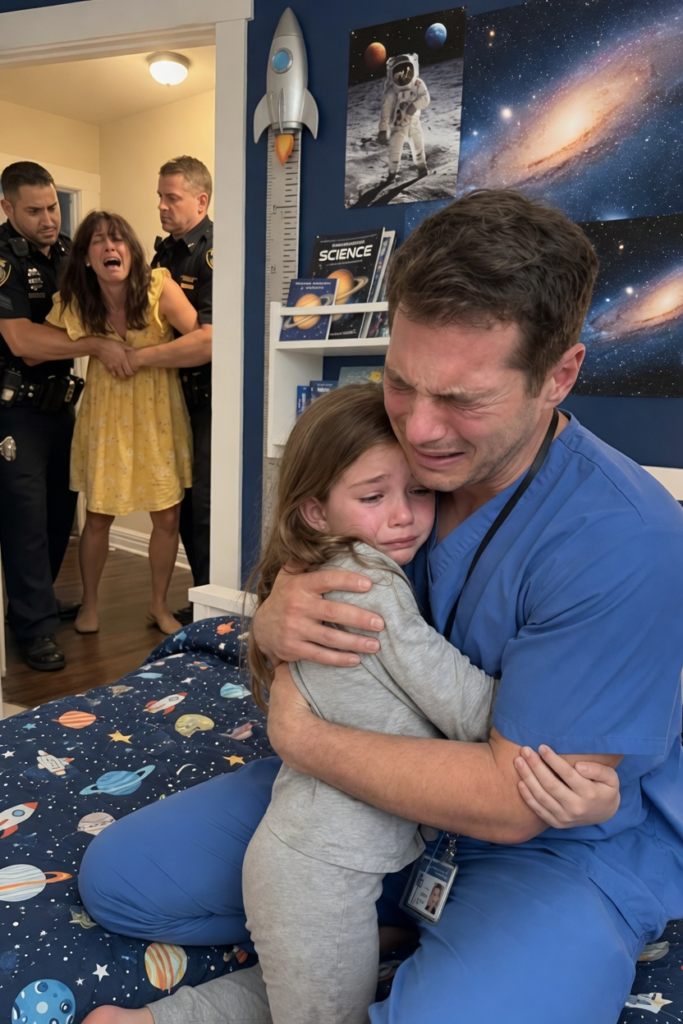
“Okay,” I whispered. “Okay, sweetheart. I see it.”
Her breath hitched. “Am I in trouble?”
“No.” My voice nearly broke on the word. I steadied it. “You are not in trouble. You did nothing wrong.”
She stared at me as if I had spoken in another language.
That was when I understood the damage went deeper than what I could see.
The injuries on her arms were bad enough. Bruising. Tender swelling. Marks that told a story I wished I could unread. But the way she kept apologizing, the way she folded herself small inside that closet, the way she flinched before anyone touched her—that told me this had not started yesterday.
Yesterday was only when I finally came home in time to hear the truth.
“Can I check your breathing?” I asked gently. “Just like when you play patient for me.”
She nodded, barely.
I took my stethoscope from my work bag because I had not even unpacked yet. I warmed the chest piece between my palms, the way I always did for children. Chloe used to giggle when I did that. She used to call it “Daddy’s magic circle.”
This time she did not giggle.
I listened to her lungs. Shallow but clear. Her pulse was fast. Too fast, but fear could do that. Pain could do that. The body remembers danger even after the room goes quiet.
“Does it hurt anywhere else?” I asked.
She looked down.
That was enough.
My stomach dropped.
“Chloe.”
She shook her head quickly. “I don’t want Mom to get mad.”
“Mom is not here right now.”
“She’ll know.”
“How?”
“She always knows.”
The words came out with such certainty that I had to close my eyes for half a second.
Our house had cameras. That had been Marissa’s idea. Marissa Vale Miller, lifestyle creator, parenting influencer, woman of clean counters, soft voiceovers, linen dresses, and captions about “gentle motherhood in a noisy world.”
Hundreds of thousands of followers watched her make homemade muffins and braid Chloe’s hair. They called her inspiring. They asked her for advice about patience. They sent messages saying they wished they could be half the mother she was.
They saw the kitchen island with flowers.
They saw Chloe smiling in matching dresses.
They saw the edited version.
I was starting to realize I had lived inside the edited version too.
“Are the cameras on?” I asked.
Chloe’s face changed.
She whispered, “Mom turns them off when she’s mad.”
My heart went cold.
“Where else does it hurt?”
Her fingers tightened around the hem of her pajama shirt.
“My shoulder. And my side. A little.”
I nodded slowly. “I need to look, okay? Only where you say I can. You are in charge.”
https://googleads.g.doubleclick.net/pagead/ads?gdpr=0&client=ca-pub-3052636440995168&output=html&h=280&num_ads=1&adk=3749756227&adf=3386941246&w=745&fwrn=4&fwrnh=100&lmt=1777537990&rafmt=1&armr=3&sem=mc&pwprc=8355013782&ad_type=text_image&format=745×280&url=https%3A%2F%2Fwomen.thuviencntt.com%2Ftan5%2Fdad-my-arms-hurt-so-much%2F%3Ffbclid%3DIwY2xjawRf8jlleHRuA2FlbQIxMABicmlkETEycHplaGZQQmxkM2Q3UUtyc3J0YwZhcHBfaWQQMjIyMDM5MTc4ODIwMDg5MgABHs2LDyhmTTm7ro7J45r8L4MPa1QX92PdwlM-h4w0FvG5GEGGbhaUD8bHsEx9_aem_CN2HnFQX15msnh_gclmkDA%23goog_rewarded&fwr=0&pra=3&rh=187&rw=745&rpe=1&resp_fmts=3&asro=0&aiapmid=0.0001&aiactd=0&aicctd=0&ailctd=0&aimartd=4&aieuf=1&aicrs=1&fa=27&uach=WyJXaW5kb3dzIiwiMTAuMC4wIiwieDg2IiwiIiwiMTQ3LjAuMzkxMi44NiIsbnVsbCwwLG51bGwsIjY0IixbWyJNaWNyb3NvZnQgRWRnZSIsIjE0Ny4wLjM5MTIuODYiXSxbIk5vdC5BL0JyYW5kIiwiOC4wLjAuMCJdLFsiQ2hyb21pdW0iLCIxNDcuMC43NzI3LjExOCJdXSwwXQ..&abgtt=6&dt=1777537854912&bpp=1&bdt=1729&idt=1&shv=r20260428&mjsv=m202604240101&ptt=9&saldr=aa&abxe=1&cookie=ID%3Da99ec7c89a8ddbb5%3AT%3D1777143312%3ART%3D1777537771%3AS%3DALNI_MbPf9qbnGJEXENRzKnmJNq_66eoDA&gpic=UID%3D000013e442f28051%3AT%3D1777143312%3ART%3D1777537771%3AS%3DALNI_MZ91bspySeHY2lS2o_RxQcs9RbG3w&eo_id_str=ID%3D1599060b9eb30b81%3AT%3D1777143312%3ART%3D1777537771%3AS%3DAA-AfjY2tHcblVxoakXeVN5qdkKB&prev_fmts=0x0%2C745x280%2C1200x280%2C745x280%2C745x280%2C745x280%2C1912x966%2C745x280%2C745x280%2C745x280%2C745x280%2C745x280&nras=12&correlator=2238624048106&frm=20&pv=1&u_tz=-420&u_his=3&u_h=1080&u_w=1920&u_ah=1050&u_aw=1920&u_cd=32&u_sd=1&dmc=32&adx=379&ady=7240&biw=1897&bih=966&scr_x=0&scr_y=3407&eid=95373849%2C95387779%2C95389222%2C95389572%2C95340253%2C95340255&oid=2&pvsid=1995076634877480&tmod=815203404&uas=3&nvt=1&ref=https%3A%2F%2Fl.facebook.com%2F&fc=1408&brdim=0%2C0%2C0%2C0%2C1920%2C0%2C1920%2C1050%2C1912%2C966&vis=1&rsz=%7C%7Cs%7C&abl=NS&fu=128&bc=31&plas=307x763_l%7C307x763_r&bz=1&pgls=CAEaBTYuOS40&ifi=20&uci=a!k&btvi=10&fsb=1&dtd=M
Her eyes filled.
“Really?”
That single word nearly destroyed me.
“Really,” I said. “Nobody touches you without asking. Not me. Not anyone.”
One tear slipped down her cheek. She wiped it away quickly, like tears were evidence.
I helped her out of the closet inch by inch. She moved like an old woman, stiff and careful. I wanted to carry her, but I didn’t. I let her walk because she needed to feel control over her own body again.
I brought her to the bed and sat on the floor in front of her so I would not tower over her. I checked what she allowed me to check. I asked before every movement. I kept my voice quiet.
Then I took out my phone.
Chloe stiffened.
“No, Dad. Please don’t send it to Mom.”
“I’m not sending anything to Mom,” I said. “I need to document what I’m seeing so a doctor can help you. This is to protect you.”
She looked terrified.
“Will everyone see?”
“No. Not everyone. Only the people who need to keep you safe.”
I took photos carefully. Not sensational. Not cruel. Evidence. As much as my hands wanted to tremble, I made them steady. I photographed the bruising with timestamps, angles, and context the way I had been trained to document injuries at a scene.
Then I called my partner.
Not Marissa.
Not a friend.
Not my parents.
My paramedic partner, Jonah Reed, a man who had seen me covered in blood, smoke, rain, and exhaustion, and had never once heard panic in my voice.
He answered on the second ring.
“Evan? You alive, man? You just got off shift.”
“I need you,” I said.
Silence.
Then his voice changed. “What happened?”
“It’s Chloe.”
“I’m on my way.”
“No sirens. Come as yourself. Bring your kit. And Jonah?”
“Yeah?”
“I may need a witness.”
He did not ask another question.
“I’ll be there in twelve minutes.”
After I hung up, Chloe whispered, “Is Uncle Jonah mad?”
“No. He’s coming to help.”
“Mom says people will hate us if they know.”
I looked at my daughter, sitting on the edge of a pink bed beneath a wall of framed photos where she smiled like a child in an advertisement.
“No, baby,” I said. “People will hate what happened to you. That is not the same as hating you.”
She did not look convinced.
Downstairs, something chimed.
The front door.
I froze.
Too soon for Jonah.
Then my phone lit up.
Marissa.
Her photo filled the screen: golden hair, white sweater, sunlit smile. Under her name, the word Wife looked suddenly strange, like a title from a life that belonged to someone else.
I let it ring.
It stopped.
Then came a text.
Where are you? I saw your car. I’m at Target. Don’t let Chloe eat anything before dinner. I’m filming the bedtime routine tonight.
Another text.
And please don’t mess up the kitchen. I just cleaned for tomorrow’s brand shoot.
Chloe saw her mother’s name on the screen and folded inward.
That was when my decision became final.
I was not going to confront Marissa first.
I was not going to give her time to cry, explain, manipulate, delete, edit, post, erase, or perform.
I was going to protect my child.
Everything else could burn.
I texted back one sentence.
Chloe and I are upstairs. We need to talk when you get home.
Three dots appeared immediately.
Then disappeared.
Then appeared again.
Talk about what?
I did not answer.
Five minutes later, Jonah arrived.
When I opened the door, he took one look at my face and did not say hello.
“Where is she?”
“Upstairs.”
He followed me quietly. Chloe liked Jonah. He had once brought her a stuffed dalmatian from a firehouse charity event. He always let her press the button on his flashlight. But when he entered her room, she still pulled the blanket up to her chin.
“Hey, kiddo,” Jonah said gently. “I heard your arms are giving you trouble.”
She nodded.
“Your dad asked me to take a look. Is that okay?”
She looked at me.
“You can say no,” I told her.
After a moment, she whispered, “Okay.”
Jonah examined her with the same care I had. He asked short questions. He did not react visibly when he saw the injuries, but I knew him. I saw the muscle move in his jaw. I saw his eyes flick once to mine.
Afterward, he stepped into the hallway with me.
His voice was low.
“You need to take her to the hospital now.”
“I know.”
“And call it in.”
“I know.”
He held my stare. “Evan. You know what this is.”
I nodded.
But knowing professionally and accepting personally are two different things.
“My wife did this,” I said.
Jonah did not soften it for me.
“Then your wife is not the person you need to protect right now.”
The words landed like a command.
Behind us, Chloe sat quietly on her bed, holding the stuffed dalmatian Jonah had brought months ago. She was watching me again. Waiting to see who I would choose.
I walked back into the room and knelt in front of her.
“Chloe, we’re going to the hospital.”
Her eyes widened. “No. Mom said if doctors see, they’ll take me away.”
I felt sick.
“She said that?”
Chloe nodded.
Jonah looked down at the floor.
I took my daughter’s hands carefully in mine, touching only her fingers.
“Listen to me. Doctors help children. They don’t punish them. Nobody is taking you away because you told the truth.”
“Will Mom come?”
“No.”
“Will she be mad?”
“Yes,” I said honestly. “She might be. But her feelings are not more important than your safety.”
Chloe stared at me.
I think that was the first time anyone had ever told her that.
We were halfway down the stairs when the front door opened.
Marissa came in carrying two white shopping bags and wearing the face her followers loved. Soft makeup. Loose cream cardigan. Hair curled perfectly around her shoulders. She smelled like vanilla perfume and cold air.
Then she saw Jonah.
Then she saw Chloe wrapped in a blanket at my side.
Her perfect face changed for one fraction of a second.
Not guilt.
Calculation.
“What’s going on?” she asked.
“We’re taking Chloe to the hospital.”
The shopping bags slipped slightly in her hands.
“Why?”
I looked at her.
She already knew why.
But she wanted me to say it first.
“Because she’s hurt.”
Marissa’s laugh was light and false. I had heard that laugh in videos when something went wrong and she wanted viewers to think everything was adorable.
“She’s fine. She bumped herself yesterday. She’s been dramatic all day.”
Chloe pressed herself against my leg.
Marissa’s eyes moved to her.
“Chloe,” she said sweetly. “Tell Daddy you’re fine.”
My daughter started shaking.
That was it.
Jonah stepped forward. “Ma’am, don’t coach her.”
Marissa’s eyes snapped to him. “Excuse me?”
“She needs medical evaluation,” he said.
Marissa looked back at me. “Evan, can I speak to you in the kitchen?”
“No.”
Her face tightened.
“Privately.”
“No.”
She blinked, and for the first time since I had known her, she looked genuinely stunned that the world had not rearranged itself around her tone.
“You’re embarrassing me,” she whispered.
I almost laughed.
Our daughter was shaking beside me, wrapped in a blanket because her arms hurt too badly to put on a jacket, and Marissa was embarrassed.
I took Chloe’s coat from the hall closet.
Marissa stepped in front of the door.
“Absolutely not,” she said. “You are not taking my child anywhere with him.”
Jonah’s voice sharpened. “Move away from the door.”
Marissa lifted her chin. “This is my house.”
I said, “Not if you block me from getting medical care for my child.”
For a second, she looked at me with pure hatred.
Then she changed masks.
Her eyes filled instantly. Her lower lip trembled. She set the shopping bags down and reached toward Chloe.
“Oh, sweetheart,” she said, voice soft and broken. “Did Daddy scare you? Come here.”
Chloe whimpered.
I stepped between them.
Marissa’s eyes went flat.
“You’re making a mistake,” she said quietly.
“No,” I said. “I made the mistake of believing the videos.”
We walked out.
Marissa followed us onto the porch, still barefoot, still beautiful, still performing even though the only audience was a wet driveway and one witness who did not believe her.
“You can’t just take her!” she shouted.
I turned back.
“I can. I’m her father.”
At the hospital, I became two people.
One was a paramedic who understood every question, every form, every expression exchanged between nurses.
The other was a father sitting beside his daughter’s bed, holding a paper cup of water she barely drank, listening as she answered questions in a tiny voice.
A pediatric nurse named Carla examined her first. She was calm, warm, and careful. Then came a doctor. Then came a social worker.
I knew the process.
I had stood on the other side of it many times.
Suspected child abuse.
Mandatory reporting.
Documentation.
Safety plan.
Law enforcement.
But when the social worker asked Chloe, “Do you feel safe going home with your mother tonight?” and Chloe looked at me with terror in her eyes before whispering, “No,” I had to grip the side of the chair until my fingers hurt.
The doctor confirmed that Chloe’s injuries were consistent with being forcefully grabbed and restrained. There were older marks too. Less obvious. Healing. Layered under the new ones like history.
“Some are several days old,” the doctor told me privately.
I stared at the white hospital wall.
“How did I miss it?”
She did not give me an easy answer.
“Children hide things when they are afraid,” she said. “And abusive parents often build very convincing public lives.”
I thought of Marissa arranging fruit bowls under a ring light.
Marissa kissing Chloe’s forehead for a sponsored pajama ad.
Marissa telling the camera, “The secret to raising emotionally secure children is making home their safe place.”
I bent forward and put my head in my hands.
Jonah stayed until nearly midnight. He brought bad coffee and said little. That was what I needed.
A police officer arrived. Then another. They took my statement. They took Chloe’s, gently, with the social worker present. They photographed the injuries again. They asked if there were cameras in the house.
“Yes,” I said. “Several.”
“Who controls them?”
“My wife.”
The officer’s expression changed.
“Do you have access?”
“I think so.”
I opened the security app on my phone.
Most of the cameras showed current live feeds. Front door. Kitchen. Living room. Playroom.
But when I checked the previous afternoon—the time Chloe said the sponsored video was being recorded—there was a gap.
Camera offline.
Kitchen camera offline.
Living room camera offline.
Playroom camera offline.
For exactly forty-three minutes.
Then the feeds returned.
In the first video after the gap, Chloe stood near the stairs, crying silently, both arms held close to her body. Marissa appeared two minutes later, adjusting her hair, breathing hard, looking toward the camera.
Then she smiled.
Not at Chloe.
At the lens.
She walked into frame, picked up a white rug from the floor, and carried it away.
The officer watched beside me.
“Save that,” he said.
I exported everything I could.
At 1:16 a.m., Marissa called me eighteen times.
I did not answer.
Then the texts started.
You’re overreacting.
She bruises easily.
You know how dramatic she is.
Don’t let strangers fill her head.
This could ruin my career.
Think about our family.
Family
Then, after a pause:
I forgive you for panicking. Bring her home and we’ll talk.
I showed the messages to the officer.
He read them without expression.
“Do not respond,” he said.
“I wasn’t planning to.”
At 2:03 a.m., she posted online.
I knew because my phone began vibrating with notifications from people I barely knew.
Her video was already spreading.
She sat on our living room couch with no makeup, hair loose, eyes red. She looked destroyed in exactly the right lighting.
“I don’t usually share private family struggles,” she began, voice trembling. “But tonight my husband, who is exhausted from work and not himself, took our daughter from our home after a misunderstanding. Please pray for us. Please pray that people stop attacking mothers who are doing their best.”
She never said what happened.
She did not mention Chloe’s injuries.
She did not mention the hospital.
She did not mention the police.
But her followers filled in the blanks the way she trained them to.
Poor Marissa.
Mothers are always blamed.
Paramedics see trauma and become paranoid.
Children exaggerate.
The comments came like insects.
I turned off my phone.
The social worker helped me file for an emergency protective order that night. Chloe was discharged into my care under a safety plan: no contact with Marissa, no unsupervised access, immediate follow-up with a child advocacy center.
We did not go home.
Jonah’s sister owned a small furnished rental over her garage. By dawn, Chloe and I were there with two backpacks, hospital paperwork, and the stuffed dalmatian.
She fell asleep in the car and woke when I carried her inside.
“Where are we?” she whispered.
“Somewhere safe.”
“Will Mom find us?”
“No.”
“Promise?”
I looked at her face, pale in the soft morning light.
“I promise I will do everything in my power to keep you safe.”
She thought about that.
Then she asked, “Can I sleep with the light on?”
“Every light in the house, if you want.”
She fell asleep on the bed with her shoes still on.
I sat on the floor beside her until the sun came up.
The next morning, I received the first call from a reporter.
Then another.
Then a message from Marissa’s manager.
Then one from a brand representative asking whether “the current family conflict” would affect upcoming content deliverables.
Family
I stared at the words.
Current family conflict.
That was what they called my daughter’s bruises.
I forwarded everything to my lawyer.
By noon, the emergency order was granted.
Marissa was prohibited from contacting Chloe or coming near us. Police served it at our house. According to the officer who called me afterward, she cried, denied everything, and asked if they could wait until after she finished a livestream.
They did not.
That evening, her tone online changed.
The tearful victim disappeared.
The righteous mother arrived.
She posted a long statement about “false allegations,” “parental alienation,” and “the danger of believing every emotional story without evidence.” She said Chloe was safe. She said I was unstable from years of emergency work. She said she had always supported me, always protected Chloe, always sacrificed.
And for a while, people believed her.
Some always will, if the lie is pretty enough.
But the truth had something Marissa did not expect.
A trail.
The sponsored brand asked for raw footage from the day of the incident because they were worried about liability. Marissa claimed the files were corrupted. But she had uploaded drafts to a cloud drive she shared with her assistant, and the assistant, frightened by the police investigation, turned over access.
The footage did not show everything.
But it showed enough.
It showed Marissa recording a bright, cheerful segment in the living room. Chloe stood beside her in a new white dress, holding a juice box because the brand wanted “relatable after-school energy.” Marissa smiled into the camera.
Then Chloe’s elbow bumped the glass pitcher on the table.
Juice spilled across the rug.
The video cut off four seconds later.
But the audio kept recording for nearly two minutes.
No one outside the investigation heard it then.
I heard it weeks later in a small interview room with my attorney beside me, and I will never forget the sound of my wife’s voice changing.
The sweetness vanished.
What replaced it was cold, sharp, and terrifying.
Not a mother losing patience.
A performer enraged because the prop had ruined the scene.
Chloe’s small apologies came through the speakers.
Then crying.
Then Marissa’s voice, low and furious.
Do you know how much this costs?
Do you know what you just did?
Stop crying. Stop it. Stop acting like I hurt you.
I stood up before the recording ended.
My attorney said my name.
“I need a minute,” I said.
In the hallway, I put both hands against the wall and tried to breathe.
I had pulled strangers from burning cars. I had heard final words over sirens. But hearing my daughter beg inside a recording while my wife told her to stop acting hurt nearly brought me to my knees.
When I returned, I listened to the rest.
Because Chloe had lived it.
The least I could do was not look away.
The case moved quickly after that.
Marissa’s public world began to collapse slower than I wanted but faster than she expected.
First, one brand paused the partnership.
Then another.
Then a parenting podcast quietly removed her episode.
Then her assistant gave a statement describing “rage episodes” when content did not go perfectly. She said Chloe was often forced to repeat scenes until she smiled correctly. She said Marissa sometimes pinched Chloe under the table during live videos if she answered “wrong.” She said she had wanted to quit for months but was afraid Marissa would destroy her reputation.
Then a former nanny came forward.
Then another.
Each story carried the same pattern.
Perfect on camera.
Punishment off camera.
By then, I had stopped reading comments. I cared about one audience only.
Chloe.
And Chloe was not healing in a straight line.
Some days she played with Legos on the rental floor and sang to herself under her breath.
Some days she refused to eat anything red because it reminded her of juice.
Some nights she woke screaming that she was sorry, she was sorry, she was sorry.
I learned that healing a frightened child is not about grand speeches.
It is about repetition.
You are safe.
You did nothing wrong.
You can say no.
You don’t have to smile.
You don’t have to perform.
You don’t have to forgive anyone today.
I took family leave from work. My captain approved it without hesitation. Jonah organized meals without telling me because he knew I would say we were fine. My mother flew in from Oregon and cried in the bathroom where Chloe could not hear. My father, a retired mechanic who barely spoke about emotions, spent three days assembling a bookshelf for Chloe’s room and labeling every shelf with masking tape.
Family
Art supplies.
Books.
Stuffed animals.
Things that belong to Chloe.
That label mattered to her.
Things that belong to Chloe.
At the child advocacy center, a therapist named Dr. Elena Morris began working with her. The first session, Chloe did not speak. She arranged tiny animal figures in a circle and put a plastic tiger outside the door.
Dr. Morris did not force her.
By the fourth session, Chloe put the tiger in a cage.
By the seventh, she gave the rabbit a door.
I sat in the waiting room during those sessions, learning how to sit with helplessness without letting it become rage.
Because rage was easy.
Rage had energy.
Rage gave me something to hold.
But Chloe did not need a father consumed by revenge. She needed one steady enough to make breakfast, sign school forms, remember therapy appointments, and sit through bedtime without checking the locks twelve times.
So I went to therapy too.
I did not want to.
I thought I could handle it.
That was the old lie men in my profession tell themselves right before they become impossible to live with.
In my first session, I said, “I should have known.”
The therapist asked, “What did your wife do to make sure you didn’t?”
I hated that question.
Then I answered it.
“She scheduled filming when I was at work. She controlled the cameras. She trained Chloe not to tell. She made everyone believe she was gentle. Including me.”
“And now?”
“Now I know.”
“What will you do with that?”
I thought about Chloe’s face in the closet.
“I’ll never let her be alone with someone who makes her smaller.”
That became the line I lived by.
The custody hearing came six weeks later.
Marissa arrived in a pale blue dress, no wedding ring, hair pinned softly at the neck. She looked like a grieving saint. Her attorney argued that she had been overwhelmed, that online pressure had created an impossible environment, that one “disciplinary mistake” should not destroy a mother-child bond.
One disciplinary mistake.
My attorney placed Chloe’s medical records into evidence.
Then the messages.
Then the security gaps.
Then the audio.
Marissa stared straight ahead while it played.
For the first time, there was no filter between her and the room.
No ring light.
No caption.
No soft music.
Just her voice, stripped bare.
The judge’s face did not change, but his pen stopped moving.
When the audio ended, the courtroom was silent.
Marissa’s attorney asked for reunification therapy.
The judge asked Marissa a simple question.
“Do you accept responsibility for physically injuring your daughter?”
Marissa cried.
She said she loved Chloe more than life.
She said motherhood was hard.
She said people were twisting the story.
She said I had always been absent because of work.
She said Chloe was sensitive.
She said the internet had judged her unfairly.
She said many things.
She did not say yes.
The judge granted me temporary sole physical and legal custody. Marissa was allowed no direct contact. Any future contact would require therapeutic recommendation, court approval, and demonstrated accountability.
When the gavel came down, I did not feel victory.
I felt oxygen.
Outside the courtroom, Marissa tried to approach me.
A deputy stopped her.
Her eyes locked on mine.
“You ruined me,” she said.
For months, I had imagined what I would say if she said something like that.
Something sharp.
Something devastating.
Something that would make her feel even a fraction of what Chloe felt.
But when the moment came, I only felt tired.
“No,” I said. “You hurt our daughter. I believed her. That’s what ruined you.”
Then I walked away.
The criminal case ended before trial.
Marissa accepted a plea to child endangerment and assault-related charges. She was sentenced to probation, mandatory treatment, community service, no unsupervised contact with minors, and a long-term protective order for Chloe. Some people thought she deserved prison. Some thought she deserved nothing because she was pretty and cried convincingly.
I stopped caring what strangers thought.
The internet moved on eventually. It always does.
Another scandal.
Another perfect family.
Family
Another apology video.
But not before Marissa posted one final video.
She was not supposed to mention Chloe by name, but she spoke in vague enough language that everyone knew.
“I was broken,” she said. “I was under pressure. I became someone I didn’t recognize.”
I watched thirty seconds before closing it.
Because that was another lie.
She recognized herself perfectly.
That had always been the problem.
Three months after the closet, we went back to the house with a police escort so Chloe could choose what she wanted from her room.
I had expected her to be afraid.
She was.
But she also surprised me.
She stood in the doorway for a long time, looking at the pink bedspread, the framed photos, the shelves of carefully curated toys Marissa had arranged by color for videos.
Then she walked to the wall where a framed print said:
HAPPY GIRLS MAKE HAPPY HOMES.
She took it down.
“Can we throw this away?” she asked.
“Yes.”
She carried it outside herself and placed it in the trash bin.
Then she went back in and picked up only what mattered.
Her stuffed animals.
A box of drawings.
The old flashlight Jonah had given her.
A blue sweater she loved that Marissa had called “ugly for photos.”
At the bottom of her closet, she found a small notebook.
She hesitated.
“What is it?” I asked.
“My secret book.”
“You don’t have to show me.”
She looked at me for a long moment.
Then she handed it over.
Inside were drawings.
Some were normal child drawings: suns, dogs, crooked houses, stick figures with big hands.
Others made my chest ache.
A little girl under a table.
A woman with a giant camera for a face.
A man in a paramedic uniform standing far away under a moon.
On the last page, drawn in purple marker, was a closet with a tiny door open.
Outside the door was a man kneeling.
Above him she had written:
Dad came home.
I sat on the floor and cried.
Not loudly. Not dramatically.
Just enough for Chloe to see that grown-ups can cry without making children responsible for fixing them.
She sat beside me and leaned her head against my shoulder.
“I was scared you’d be mad,” she whispered.
“I am mad,” I said softly. “But not at you.”
“At Mom?”
“At what Mom did.”
She considered that.
“Do I have to hate her?”
“No.”
“Do I have to miss her?”
“No.”
“Do I have to love her?”
I closed my eyes.
This was the question no court order could answer for her.
“You don’t have to force your heart to do anything,” I said. “Your only job is to be safe and tell the truth about how you feel.”
She nodded.
Then she said, “I feel sad.”
“I know.”
“And free.”
I put my arm around her gently.
“Both can be true.”
We moved to a smaller house two towns over, close to Chloe’s new school and my parents. It had no white rugs. No ring lights. No brand packages stacked by the door. No rooms designed for strangers to admire.
Chloe chose yellow curtains and a green comforter. She taped her drawings wherever she wanted. Some were crooked. I left them crooked.
In our kitchen, spills became ordinary again.
The first time she knocked over a glass of orange juice, the room froze.
She looked at the spreading puddle like it was a loaded gun.
I moved slowly.
Then I took a towel from the counter and placed it on the floor.
“Looks like the floor was thirsty,” I said.
She stared at me.
Then, for the first time in months, she laughed.
It was small.
Rusty.
Uncertain.
But it was real.
I knelt beside her and handed her another towel.
We cleaned it together.
No shouting.
No grabbing.
No punishment.
Just juice, tile, towels, and a child learning that accidents are not crimes.
A year later, Chloe stood on a stage at her school spring concert wearing the blue sweater Marissa had hated.
She sang quietly at first. Then louder.
I sat in the second row with my parents on one side and Jonah on the other. When Chloe found me in the audience, I gave her our signal: two fingers over my heart.
Safe.
She smiled and kept singing.
After the concert, she ran to me.
Actually ran.
No hesitation. No flinch.
She crashed into my arms and squeezed me around the waist.
“Did you hear me?” she asked.
“Every word.”
“I messed up one line.”
“I didn’t notice.”
She grinned. “You’re lying.”
“A little.”
She laughed again.
That sound became my favorite thing in the world.
Marissa sent letters through her attorney twice that year. The first was full of explanations. The second contained something closer to an apology, though still wrapped in self-pity. Chloe’s therapist read them first, then asked Chloe if she wanted to know what they said.
Chloe said no.
Not forever.
Just no.
That was enough.
On the anniversary of the night I found her, Chloe asked if we could do something “not sad.”
So we made pancakes for dinner. We wore pajamas at six o’clock. We watched a movie with a talking dog. Then she asked if we could light a candle.
“For what?” I asked.
She shrugged. “For the girl in the closet.”
So we lit one.
A small lavender candle on the kitchen table.
Chloe looked at the flame for a long time.
Then she said, “She was brave.”
I could barely speak.
“Yes,” I said. “She was.”
“She told.”
“She did.”
“And you came.”
I looked at my daughter, now nine years old, stronger in ways no child should have to become, softer in ways I had feared the world might steal from her.
“I will always come,” I said.
She leaned against me.
“I know now.”
That was the ending Marissa never filmed.
No perfect lighting.
No caption.
No sponsored blanket.
Just a father and daughter in a small kitchen, with pancake batter on the counter and one candle burning for the child who had survived the silence.
Months later, the court made the custody order permanent.
Sole custody to me.
Therapeutic contact only if Chloe requested it when she was ready.
No public use of Chloe’s image.
No monetization of her name, likeness, trauma, childhood, or story.
That last clause mattered to me.
It meant my daughter was no longer content.
She was a child.
A private child.
A protected child.
A free child.
After the final hearing, Chloe and I drove to the ocean. It was cold and windy, and she insisted on taking off her shoes even though the sand was freezing. She ran ahead, laughing when the water chased her ankles.
I stood back and watched.
For years, I had saved strangers.
I had arrived at wrecks, fires, overdoses, and accidents. I had heard people say, “Thank God you’re here,” and I had always understood my job.
But that night, coming home exhausted after forty-eight hours, I had almost walked past the quiet.
Almost believed the silence.
Almost missed the tiny voice from the closet.
I know now that rescue does not always begin with sirens.
Sometimes it begins with a whisper.
Dad… my arms hurt.
Sometimes it begins with a father kneeling on a bedroom floor, choosing to stay calm when his world breaks.
Sometimes it begins when a child tells the truth she was forbidden to tell.
Chloe turned back from the shoreline and waved both arms over her head.
“Dad! Look!”
She held up a shell, small and white and chipped along one edge.
“It’s broken,” she said when I reached her. “But it’s still pretty.”
I took it carefully from her palm.
The edge was cracked. The surface was worn. But inside, it caught the light.
“Yes,” I said. “It is.”
She slipped her hand into mine.
We walked along the water until the sun dropped low and the sky turned gold.
Behind us, our footprints filled slowly with seawater and disappeared.
Ahead of us, there was only open beach.
And for the first time since the night I found my daughter in that closet, I let myself believe what Chloe had already begun to understand.
The worst thing that happened to her was not the end of her story.
It was the place where the truth finally broke through.
And from that truth, we built a life no camera could fake.