For twenty years, Eleanor’s world was a white hospital room where time no longer moved.
Morning light filtered through the window in soft shades of orange, yet for her, every moment felt like the same endless night—deep silence, breath borrowed from machines, a body that had forgotten how to speak the language of life.
Doctors rotated in and out. Nurses adjusted IVs. Monitors blinked and beeped. That steady rhythm became the only clock in a story no one dared to tell with hope anymore.
For Julian, her husband, those twenty years were a silent war. He was a millionaire—owner of companies, properties, accounts that kept growing even as his heart grew smaller. He had built his life on buying solutions, demanding answers, paying for speed.
But beside Eleanor’s bed, money became meaningless. He brought in the best specialists, installed cutting-edge machines, funded research, even donated entire hospital wings—and still, Eleanor remained motionless, eyes closed, as if she had gone somewhere no one could follow.
Over time, people stopped asking. Some relatives drifted away. Others repeated tired phrases: “Life goes on.” “You have to let go.” “It’s been too long.” Julian nodded politely.
But in private, he leaned close and spoke to her as if she could hear—sharing small updates, describing the sky, apologizing for not saving her, begging her to come back. Some nights, he fell asleep in a chair, holding her hand like it was the last thread tying him to hope.
In that same hospital existed a very different world—one never mentioned in meetings or reports. Anna, the janitor, moved through hallways that smelled of disinfectant and effort. Her shoes were worn. Her hands rough from bleach.
She polished floors that reflected cold light, emptied bins for people who would never know her name. To everyone else, Anna was invisible—someone who passed by unnoticed.
That morning, Anna left home before sunrise with worry sitting heavy in her chest. She had no one to watch her seven-year-old son, Daniel. The neighbor who sometimes helped was sick, and missing work wasn’t an option. Some weeks, her paycheck barely covered rent and food.
“You’re coming with me,” she told Daniel, fastening his coat. “But you have to behave, okay?”
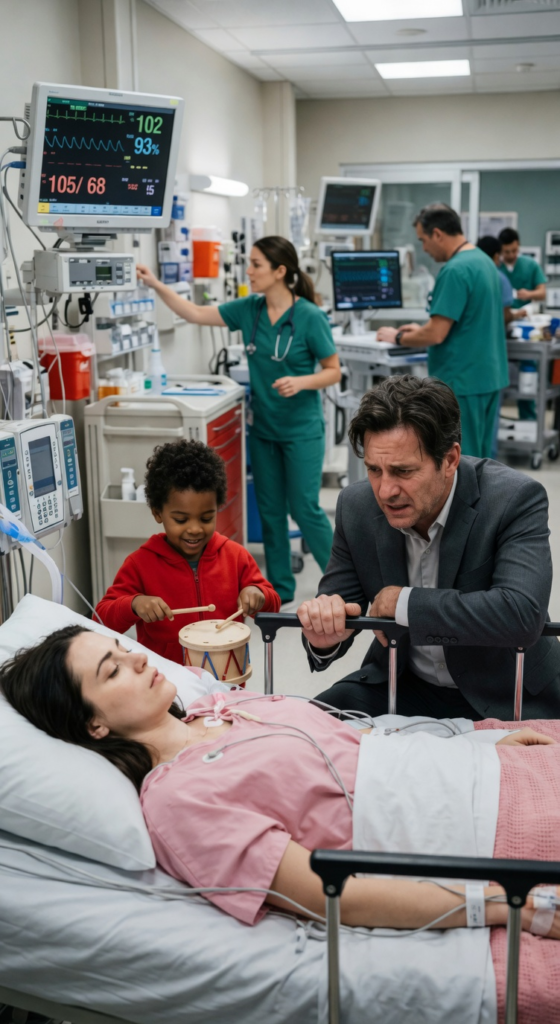
Daniel nodded with a seriousness only children can carry. He was thin, wide-eyed, and wore a small toy drum around his neck—plastic, scratched, hanging from an old strap. It wasn’t much, but it was his treasure, the only gift Anna could afford one birthday. Every tap was pure joy.
The hospital greeted them with cold air, the scent of antiseptic, and quiet footsteps. Anna pushed her cart. Daniel walked beside her, gripping her hand as if the place were a maze. Nurses glanced their way—children were rare—but no one objected. In a hospital, people have too much to handle to question small things.
Anna worked hallway by hallway. The floors gleamed like glass. Daniel observed everything—the signs, elevators, stretchers rushing past, doors opening and closing like tired mouths. Now and then, Anna reminded him: don’t touch, don’t run, tell me if anyone talks to you.
By midday, sunlight flooded the windows. Anna was exhausted. Her arms ached. She saw Daniel shifting, clutching his drum, itching to play. She recognized that look—the moment before trouble. Near a quiet corridor stood a door that was almost always closed. The stillest room in the building. Eleanor’s room.
Anna had heard the stories. The millionaire’s wife. Twenty years. No response. He never gives up. People debated why—love, guilt, pride. No one really knew. Only that time moved differently there, like it was careful not to make a sound.
Anna needed to finish one more task. She knelt beside Daniel.
“Sit here by the door, sweetheart. Just a moment. Don’t move, okay? I’ll be right back.”
Daniel nodded and sat. Anna pushed her cart away, glancing back once—like someone leaving something fragile behind.
And then, as always happens when a child is told not to move—the world became irresistible.
Daniel looked at the door. White. Plain. But peaceful, almost inviting. He stood. Took two small steps. The door wasn’t fully closed. He peeked inside.
The room was quieter than anywhere else. Machines blinked softly. A woman lay pale on the bed, like she was made of paper.
Daniel didn’t understand comas or time. He only saw someone very still. And when children don’t know how to face silence, they try to fill it.
He walked in.
He sat near the foot of the bed, careful not to touch anything. The drum rested against his chest like another heartbeat. He lifted the sticks.
Tap… tap… tap…
An uneven, childish rhythm. Not a melody. Just a child exploring sound. The drum’s soft beats blended with the monitor’s steady beeping. Daniel smiled and continued, slow and curious.
In the hallway, Nurse Laura heard it. She frowned. Noise wasn’t allowed there—especially not a drum.
“What is that?” she muttered, hurrying toward the room.
She pushed the door open, ready to scold. Then she froze.
A small boy, back turned, tapping a drum beside Eleanor’s bed. Laura inhaled to shout—then stopped.
Eleanor’s lips… moved.
Laura blinked. Stepped closer. Checked the monitor. Looked again. There it was—a tiny movement, fragile but real, like life remembering its way back.
“No… that’s impossible,” she whispered.
Daniel kept playing.
Tap-tap… tap…
Laura ran to find Dr. Ramirez, a man seasoned by years of difficult cases.
“Doctor, you need to come. Now.”
He sighed, skeptical. “We’ve checked that patient hundreds of times.”
“I know. But please.”
Golden afternoon light filled the hallway as they returned. The drum continued. The doctor studied the monitor. A change. Small—but undeniable. He leaned in.
“Who is that child?”
“I don’t know,” Laura replied.
At that moment, Eleanor’s lips moved again.
Dr. Ramirez went still. “This… doesn’t make sense.”
Word spread through the hospital like a held breath. When Anna returned, searching frantically for Daniel, she found the room crowded.
“Daniel!” she cried.
Dr. Ramirez raised a hand. “Ma’am… your son is doing what medicine couldn’t for twenty years.”
Anna looked—and saw it. Eleanor’s fingers twitching, clumsy but alive.
Then someone whispered, “Her husband is here.”
Julian rushed in, pale, eyes burning with fear and hope. He saw Eleanor—fragile, but changed. Alive.
“Eleanor,” he said.
Daniel kept playing.
Slowly, painfully, Eleanor opened her eyes.
Julian dropped to his knees, clutching her hand. Anna cried quietly, holding Daniel close. The doctor stood speechless.
“How long…?” Eleanor whispered.
Julian couldn’t answer.
Morning arrived bright. The city buzzed. Headlines called it a miracle. To the world, it was news. To Julian, it was a second life.
He found Anna in the chaos and took her hand.
“Thank you,” he said. “Because of your son, my wife lives.”
Recovery was slow. Difficult. But there was progress—something absent for twenty years. And often, Daniel was there, tapping gently, building a bridge between silence and life.
One evening, Eleanor told Anna softly, “It wasn’t the drum. It was love.”
That night, under a sky full of stars, Julian watched Daniel play.
“You gave me back what mattered most,” he said, embracing the boy.
Then he turned to Anna. “I’ll take care of his education. Everything he needs.”
It wasn’t charity.
It was gratitude.
And every time Daniel tapped his drum, the hospital remembered the impossible day—when science fell silent, and a child’s rhythm awakened a sleeping soul.