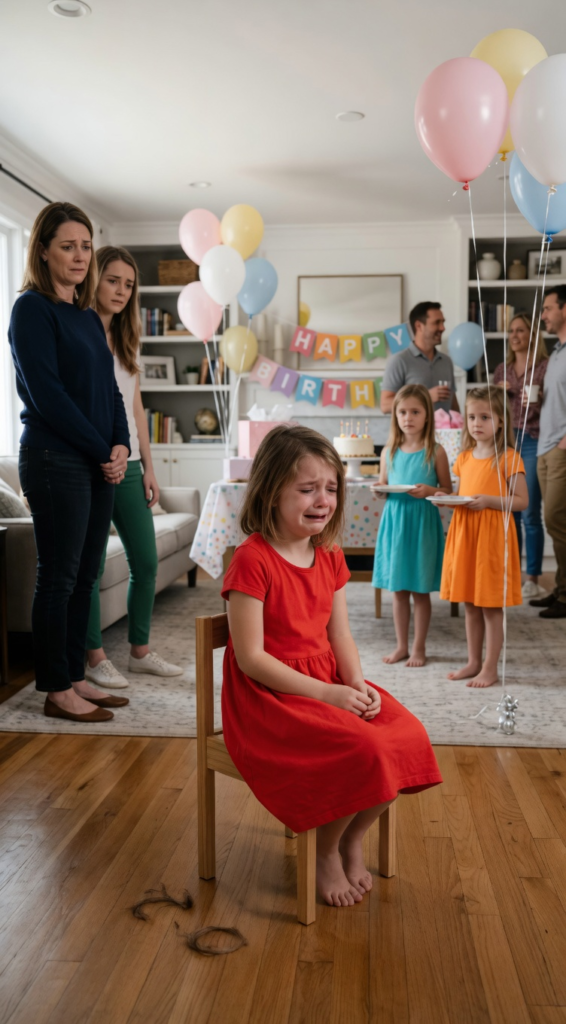
The Birthday Party Where She Quietly Asked to Wait — But What Happened Next Made Her Mother Realize Something Wasn’t Right
When I pulled up outside my sister’s house that evening, I expected laughter.
I expected music, leftover cake, and my daughter running toward me with stories she couldn’t wait to tell.
Instead, Nora stood near the doorway, unusually quiet.
She wasn’t crying anymore, but something about her felt… different.
It wasn’t just the way she held her hands together or how she avoided eye contact.
It was the way she stood there, as if she wasn’t sure how to explain what had happened.
And then I noticed her hair.
That morning, her curls had fallen neatly past her shoulders, carefully styled with a small braid and soft clips she had chosen herself.
Now, her hair looked shorter. Uneven in places. Not terrible—but clearly not something she had planned.
I walked closer, keeping my voice gentle.
“Hey… what happened, sweetheart?”
She hesitated before answering.
“They changed it a little.”
Behind her, the house was still full of people. Plates were being cleared. Conversations continued as if everything was normal.
But nothing felt normal anymore.
A Morning That Started With Joy
Earlier that day, Nora had been excited in the way only an eleven-year-old can be.
She had woken up early, stood in front of the mirror, and asked me the same question at least three times.
“Do I look okay?”
I smiled each time.
“You look more than okay.”
She wore a soft yellow dress and carried a small handmade gift—a box filled with bracelets she had spent days creating.
She wanted her cousin Ava to feel special.
That was always Nora.
Thoughtful. Careful. Kind.
I had to work a long shift, but my sister Brynn assured me everything would be fine.
So I trusted her.
Because that’s what you do with family.
The Moment Something Felt Off
Back at the house, I stepped inside, still holding Nora’s hand.
I looked around.
Everyone seemed calm. Too calm.
“Can someone tell me what happened earlier?” I asked.
Brynn shrugged slightly.
“It was just a small adjustment. Ava got a little emotional, and we tried to balance things out.”
My mother added gently,
“We didn’t want any tension at the party.”
I listened carefully, but something didn’t sit right.
So I didn’t argue.
I simply nodded, thanked them for hosting, and took Nora home.
Because sometimes, you don’t get the truth in a crowded room.
You get it in the quiet afterward.
What She Said When It Was Just Us
That night, sitting at the kitchen table, Nora wrapped her hands around a warm cup of tea.
For a while, she didn’t say anything.
Then she spoke softly.
“I asked if we could wait until you came.”
I looked at her.
“Wait for what?”
She traced the edge of the cup with her finger.
“They wanted to fix my hair. I didn’t feel ready. I said I wanted to call you first.”
She paused.
“But things moved really fast.”
I took a slow breath.
Not because I was angry.
But because I wanted to understand everything before reacting.
“How did you feel?” I asked.
She thought about it.
“Confused… I guess. And a little… invisible.”
That word stayed with me.
Invisible.
A Small Moment That Meant More Than It Seemed
Later, Nora mentioned something else.
“Mason had his tablet. I think he recorded a short part of it.”
I didn’t react immediately.
I just nodded.
“Would you want to see it?”
She hesitated… then nodded back.
When the video arrived, it was brief. Only a few seconds.
It showed Nora sitting still, looking unsure, saying she wanted to wait.
Adults around her were talking, trying to keep the mood light, moving quickly through the moment.
Nothing dramatic.
But enough to understand.
Enough to see that she had asked for time.
And that time wasn’t given.
When the video ended, Nora looked at me.
“I just didn’t want them to say I agreed.”
I reached for her hand.
“You did nothing wrong.”
Choosing to Speak Up Calmly
The next day, I didn’t react with anger.
I reached out for guidance.
I wanted to understand how to handle a situation where a child’s voice had been overlooked, even unintentionally.
We spoke with someone trained to listen carefully—someone who made Nora feel safe enough to explain what she experienced.
“I said I wanted to wait,” Nora explained quietly.
“I just wanted someone to hear me.”
That was the heart of it.
Not the hair.
Not the party.
Being heard.
When Stories Start to Change
Soon after, different versions of the story began to circulate within the family.
Some said it had been harmless.
Some said Nora had been fine.
Some said it was all being misunderstood.
I read those messages, then showed them to Nora.
She didn’t get upset.
She just looked at me and said,
“That’s not how it felt.”
So I asked her one simple question.
“What would you like people to understand?”
She thought for a moment.
Then she said,
“That I asked them to wait.”
So we shared that.
Calmly. Clearly. Without anger.
Just the truth.
The Shift That Followed
Once people saw that small moment—the hesitation, the request to wait—the conversation changed.
Not dramatically.
But enough.
People began to understand that it wasn’t about appearance.
It was about timing. Respect. Listening.
Some reached out with support.
Some stayed quiet.
And that was okay.
Because this wasn’t about convincing everyone.
It was about standing beside Nora.
A New Beginning in the Mirror
A few days later, I took Nora to a salon.
She was nervous at first, but the stylist greeted her with kindness.
“We’re not fixing anything,” she said gently.
“We’re just helping you feel like yourself again.”
That made all the difference.
This time, Nora chose what she wanted.
She looked at styles, asked questions, and took her time.
When it was done, she stared at her reflection.
For a moment, she said nothing.
Then she smiled—small, but real.
“I like this… because I chose it.”
And that was everything.
What This Taught Me
People often say that small moments don’t matter.
That children forget quickly.
That things like this pass.
But I’ve learned something different.
Children remember how they felt when they weren’t heard.
And they remember even more clearly who stood beside them afterward.
This wasn’t about a hairstyle.
It was about a voice.
And making sure that voice is never ignored again.
Ten Messages That Matter More Than We Think
Sometimes the quietest moments in a child’s life carry the deepest meaning, especially when they are trying to express something important in a room full of adults.
When a child asks for time, even in something small, that request deserves patience, because it teaches them their voice has value.
Family gatherings should be places of comfort, not moments where a child feels unsure about whether their feelings matter.
Children don’t always need big protection; sometimes they simply need someone to pause and listen before moving forward.
Respect is not about grand gestures, but about small decisions made in real time, especially when a child says they are not ready.
A child’s confidence is built not only by praise, but by being heard when they gently say “wait.”
There is a quiet strength in a parent who chooses calm understanding over reaction, and that strength creates lasting safety.
Moments of misunderstanding can become moments of growth when handled with care and reflection.
The most meaningful support we can give children is not control, but the space to feel seen and respected.
And sometimes, the most powerful thing a parent can do is stand beside their child and say, “I hear you.”