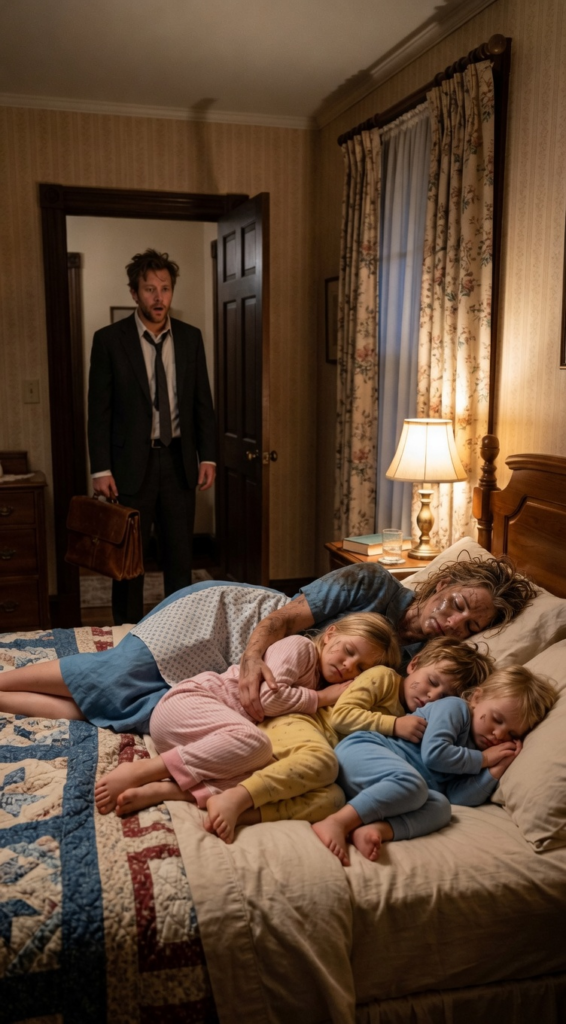
“What are you doing in my bed?”
Daniel Wright’s voice cut sharply through the room as he froze in the bedroom doorway, his travel-worn suit creased, his briefcase slipping from his hand.
On his bed lay Hannah Lewis, the housekeeper. Curled beside her—sleeping more peacefully than they had in six months—were his three sons.
Hannah’s eyes opened slowly. Calm. Unshaken.
“Mr. Wright,” she said gently. “I can explain.”
He didn’t wait. His face tightened. “You’re fired. Leave. Now.”
Hannah didn’t protest. She carefully slipped out from between the boys without disturbing them. She smoothed Noah’s hair, tucked Eli’s blanket closer, whispered something into Lucas’s ear. Then she walked past Daniel, shoes in hand, head held steady.
Downstairs, Mrs. Ramirez stopped when she saw Hannah’s expression—composed, but wounded.
“It’s alright,” Hannah said softly. “Goodbye.”
The door shut behind her. Hannah Lewis stepped alone into the freezing New York night. Upstairs, Daniel stood over his sons. They were asleep. Truly asleep. After twenty-two nannies, specialists, and therapists, something impossible had finally happened.
On the nightstand sat a folded note.
“They were afraid to be alone in the dark. Sometimes that’s all a child needs.”
Shame hit him hard. He hadn’t asked a single question. He had seen a Black woman in his bed with his white children, and his mind had gone exactly where he’d been conditioned to let it go.
By morning, the house was breaking apart. Crying. Panic. Lucas screamed for Hannah. Noah rocked in silence. Eli stood frozen, tears running down his face.
“You made her leave!” Lucas shouted. “She didn’t do anything wrong!”
Mrs. Ramirez gently pulled Daniel aside. “Do you know what happened last night?” she asked. “The boys locked themselves in your room. Hannah calmed them for twenty minutes before they opened the door. She’s been helping them for weeks.”
She showed him photos. Hannah cleaning Noah’s scraped knee. Reading to them. Then another.
“Last month, Noah choked. Hannah saved him. She didn’t want to alarm you.”
“Who is she?” Daniel whispered.
“A pediatric nurse. Five years at Riverside Children’s Hospital. She quit after losing her daughter.”
Daniel found Hannah two days later at a Brooklyn shelter, serving food to mothers and children.
“I was wrong,” he said. “About everything.”
“That doesn’t erase what happened,” Hannah replied without turning. “I crossed a line, remember?”
“You crossed no line,” he said. “I did—when I didn’t stay.”
She finally faced him. “The moment I cared too much, I became a problem. We both know why.”
He nodded. “I saw what I was taught to fear. I’m sorry.” She didn’t forgive him yet. Three days later, Hannah returned—not as staff, but walking through the front door. The boys ran to her like they had been holding their breath.
Later, she set her terms. She wasn’t a maid. She would have authority in decisions about the boys. Mandatory therapy. Proper pay. And if he ever raised his voice at her again, she would leave permanently. Daniel agreed.
The house changed. Shared meals. Bedtime routines. Naming feelings. Daniel learned to stay. Then the custody petition arrived.
Neglect. Instability. And worst of all—her daughter’s death used against her.
“They’ll use me against you,” Hannah said quietly.
“We fight together,” Daniel said. In court, they tried to break her. Forced her to relive her loss. Painted her as dangerous.
Daniel stood when he wasn’t meant to. “She saved my children,” he said. “You’re punishing her for it.”
The judge spoke with the boys privately.
“She stays,” Lucas said simply. “Everyone else left.”
The petition was denied. Therapy mandated. Oversight required. Hannah would complete trauma certification.
The story became public. Accusations spread. So did support.
Daniel held a press conference. He told the truth—his failure, his bias, and Hannah.
“Children don’t care about skin color,” he said. “They care about who stays.”
Months passed. Hannah returned to nursing. Rebuilt her career. Reconnected with her sister. Re-earned her license.
Daniel legally made her co-guardian. “Not as staff,” he said. “As family.”
One year later, the house was full of life. Off-key singing. Blanket forts. Laughter.
Hannah shared that the hospital had named a trauma-care program after her.
Later, they stood together at her daughter’s grave. The boys held her hands.
“We’ll take care of her,” Eli whispered.
That night, under a sky full of stars, Daniel said quietly, “Broken things repaired with gold become stronger.”
Hannah smiled. Inside, the three boys slept peacefully.
And for the first time, no one feared the dark.