A Poor Young Girl Let A Strange Man And His Son Stay For One Night, Not Knowing He Was A CEO Who…
The knock came at the exact hour when fear sounds louder than reason.
Outside, the storm had already swallowed the mountain.
Not the pretty kind of winter people post online with string lights and hot chocolate and captions about coziness. This was real mountain weather — hard, white, and merciless. Snow didn’t fall so much as attack. It drove sideways into the cabin windows and pressed against the old wood siding in thick, furious waves. The wind moved around the small house like something alive, rattling the eaves, scraping tree branches against the roof, forcing itself into every crack it could find.
Inside, the power had been out for nearly an hour.
The fireplace was doing what it could.
The flames rose and fell in the stone hearth, throwing amber light over the living room and just enough heat to keep the cold from claiming the corners entirely. Beyond that little pool of warmth, the cabin had already begun to feel like a place the storm intended to win back.
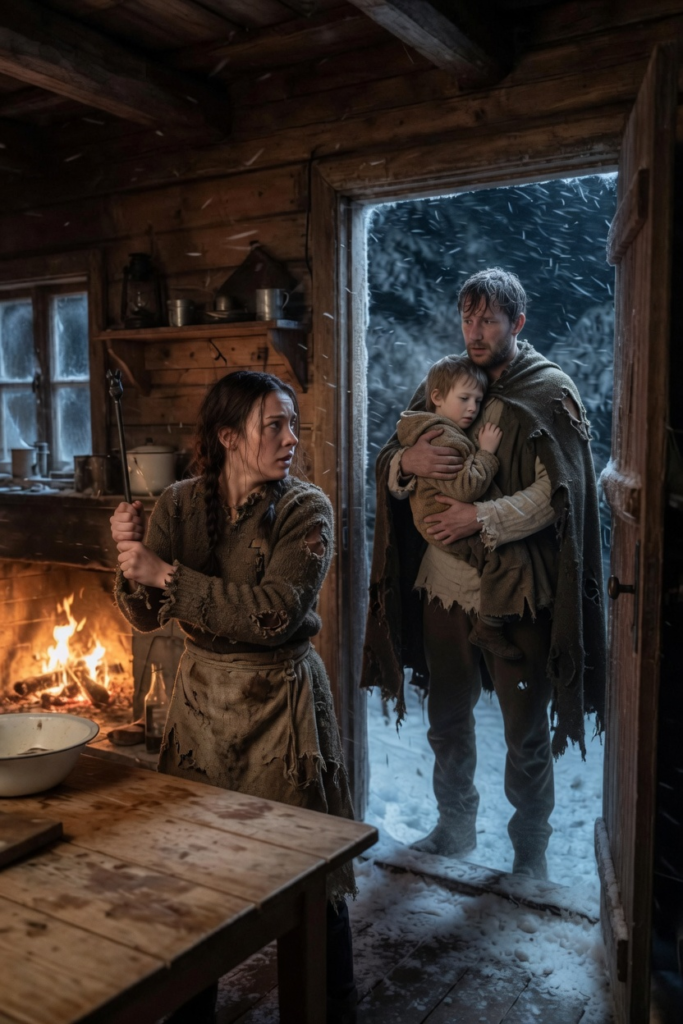
Leia Thompson stood frozen in the middle of her living room when she heard the knock again.
Three sharp hits against old wood.
Not polite.
Not violent.
Urgent.
Her hand tightened around the iron fire poker she had lifted without even realizing it. Both hands, actually. She held it the way a person holds the last thing between themselves and the unknown.
“Get away from the door!” she shouted, her voice sharper than she intended, edged with real fear. “I mean it.”
For one second there was only wind.
Then a man’s voice came through the wood, muffled but clear enough.
“Please. I’m not here to hurt anyone. I just need a safe place for my son.”
That word — *son* — changed the shape of the moment, but not enough to erase the danger of it.
Leia’s heart beat harder.
She took one careful step toward the door, then another, keeping the poker raised. The old cabin had no reliable security system, no nearby neighbors, no cell service in storms like this, and no one coming up that road tonight unless they were desperate or dangerous.
And she had learned the hard way that sometimes those two things wore the same face.
A year earlier, she had opened the door to someone else who looked tired and harmless and in need. She had believed the softness in his voice, the apology in his eyes, the story about car trouble and needing a phone. By the time she realized he was lying, her grandmother’s silver was gone, half her cash savings had disappeared, and the sense of safety she used to feel inside her own home had been peeled out of her so cleanly it took months to understand what exactly had been stolen.
People always talk about losing money like that’s the main injury.
It isn’t.
The real theft is trust.
So now here she was again.
Storm outside. Darkness pressing at the windows. A stranger on the other side of the door asking for one thing too many.
“I don’t let strangers in,” she said. “Especially not men.”
Silence.
Then the same voice, quieter now. No argument in it. No anger. Just exhaustion.
“I understand.”
A pause.
“I wouldn’t ask if I had any other choice.”
Another pause, and then:
“He’s sick. He’s freezing. We just need one night.”
Leia moved toward the peephole and forced herself to look.
At first she saw only drifting white and the dim shape of a man standing close enough to block some of the wind from whatever he was holding in his arms. Then he shifted, and she caught a clearer glimpse.
Tall. Broad-shouldered. Wet from head to boots. Dark hair plastered to his forehead. Coat soaked through.
And in his arms, wrapped into his chest, was a little boy no older than six or seven, curled inward from cold. The child coughed — a harsh, painful sound that cut through the storm and through Leia’s last firm instinct to keep the door shut.
Her grip on the poker changed.
Not loosened.
Reconsidered.
She looked around the little cabin as if the walls themselves might advise her. Old couch. Firelight. Two candles. A chipped mug in the sink. No signal on her phone. No one coming if things went wrong.
Just her.
And now them.
The child coughed again.
That decided it.
She unlocked the door and pulled it inward.
Wind rushed in instantly, carrying snow across the floorboards and around her ankles through her socks. The man stepped only as far as necessary for her to see him clearly.
He looked even worse up close.
His face was pale from cold. His jaw tight with fatigue. His coat was nearly useless with wet. The little boy in his arms had his face buried against the man’s chest, body shaking in uneven bursts.
“Inside,” Leia muttered, stepping back. “Quickly.”
The man nodded once. “Thank you.”
He did not crowd her.
Did not take advantage of the opening.
He just moved inside with the practiced speed of someone who understood that hesitation in this weather could become dangerous in minutes.
Leia shut the door fast and locked it again.
“By the fire,” she said. “And don’t touch anything else.”
He obeyed immediately, carrying the child to the old sofa and kneeling beside it rather than dropping into it himself. He took off his own coat and wrapped the boy in it before looking around the room only once, quickly, as if to orient rather than inspect.
Leia stayed several feet away.
Still holding the poker.
“Your name?”
“David.”
He glanced down at the boy and brushed damp hair off the child’s forehead.
“And this is Eli. He’s six.”
The boy coughed again, weakly.
“He has a cough,” David added. “Probably the flu.”
Leia let out a short breath that was almost a scoff.
“You think?”
He didn’t argue.
That, too, she noticed.
“You’re walking through a snowstorm with a sick child,” she said. “That’s not just unlucky. That’s reckless.”
David kept one hand lightly on Eli’s shoulder through the coat.
“We had nowhere else to go.”
There was something about the way he said it that made it difficult to dismiss as performance. No dramatic phrasing. No attempt to manipulate. Just a simple sentence from a man too tired to decorate the truth.
Leia looked at the child again.
Then at the man.
Then toward the little kitchen.
“I have dry towels,” she said finally. “And instant soup. That’s all.”
David closed his eyes for half a second, like gratitude had briefly outweighed exhaustion.
“That’s more than enough.”
She disappeared into the kitchen and came back with two towels, one small bowl of water, and the cheapest chicken soup packets she owned. She set the towels down near David, but not close enough to force contact.
He took them carefully.
“Thank you.”
Then, with a gentleness so immediate it almost unsettled her, he began drying Eli’s hair and face. Not clumsy. Not distracted. Not like a man improvising care because he had no choice. Like someone who had done this before. Many times. Quietly. Without expecting praise for it.
Leia noticed more than she wanted to.
The way he checked the boy’s breathing between movements.
The way he warmed the towel near the fire before touching it to Eli’s neck.
The way his voice lowered when he spoke to the child, even though Eli was barely conscious enough to respond.
It would have been easier if he had been arrogant.
Easier if he had barked requests or assumed entitlement the way some men do when they enter any room and instinctively act like the room is already theirs.
Instead, he seemed determined to take up as little threat-space as possible.
That made her guard more complicated.
“Why are you out here anyway?” she asked, standing near the kitchen doorway with her arms crossed over herself. “There’s almost nothing for miles. The storm warnings were all over the radio.”
David looked up.
His eyes were dark, tired, and carrying something she couldn’t read yet.
“I was trying to get Eli to his grandmother’s house,” he said. “Two towns over. Roads closed behind us. The car died about a mile back.”
“You walked a mile in this?”
“I carried him.”
Again, no performance.
Just fact.
Leia looked at Eli’s small face, flushed and damp with fever.
Then she went back into the kitchen and filled a pot.
“Chicken noodle,” she muttered. “Not instant.”
David didn’t answer at first.
Then softly:
“Thank you.”
Minutes later she brought two steaming mugs and set them near the fire. She handed Eli’s directly to David so he could help the boy take a few careful sips when he woke enough. Then she sat at the far side of the room on the old armchair she always used when storms made the cabin feel too loud.
The silence that settled after that was not comfortable exactly.
But it wasn’t hostile either.
Just full.
The wind against the walls.
The fire shifting.
Spoon against ceramic.
A child coughing, then quieting.
The sort of silence strangers share when they both know too much can go wrong if they misread the room.
“You don’t have to be afraid,” David said after a long while.
Leia gave him a look sharp enough to cut.
“I’m not afraid.”
Even she could hear the thin crack in the lie.
He didn’t challenge her.
He only said, “You let two strangers into your home during a storm. That’s not fear.”
“It might be stupidity.”
A faint smile touched the corner of his mouth.
“Maybe.”
That was the first moment the room grew warmer in any way unrelated to fire.
“One night,” Leia said. “That’s all.”
David nodded immediately.
“One night.”
She looked at the little boy asleep again, this time with his head tipped against David’s leg under two blankets and a wet coat.
Then she looked at David.
At his hands. Large, capable, careful.
At the exhaustion beneath his control.
At the father-shaped ache around him.
For the first time in longer than she liked to admit, Leia had the dangerous, impossible thought that maybe opening the door had not been a mistake.
Or maybe, she thought, it was a mistake she would have made again anyway.
The storm deepened through the night.
By the time true darkness settled around the cabin, the power was fully gone and not coming back. Leia found two old candles in a kitchen drawer and set them on the table, their trembling light joining the fire’s glow and making the room look older, softer, almost unreal.
Eli managed a few more sips of soup before sleep pulled him under again.
His breathing remained rough, but the frantic edge had softened. The heat was helping. The stillness was helping. The fact that he was no longer outside with snow on his lashes and cold inside his lungs was certainly helping.
Leia sat on the floor near the hearth eventually, her back resting lightly against the sofa, hands around a chipped mug she had owned since college. David sat opposite her, one knee bent, one arm draped protectively behind Eli.
Firelight changes faces.
It erases some distances and invents others.
In it, David no longer looked imposing so much as worn thin. The broadness was still there. The size. But under the candlelight and exhaustion, he looked less like a stranger arriving out of the storm and more like a man who had carried too much for too long.
“He loves chicken noodle,” David said at last, glancing down at his son.
Then he gave a quiet, apologetic half-laugh.
“Sorry. Habit.”
Leia looked up.
“Habit?”
“His mother used to make it whenever he got sick. After she…” He stopped, adjusted. “After she passed, I kept doing it. I always told him it was what she would have done.”
Leia’s face changed almost without her permission.
Subtly. But enough.
“He lost his mom?”
“Three years ago.”
“How?”
David stared into the fire.
“Complications after surgery.”
The sentence fell gently into the room and stayed there.
Leia did not say *I’m sorry* immediately.
Some losses deserve a beat of silence before language reaches for them.
When she did say it, it came out soft.
“I’m sorry.”
He looked at her then, really looked.
“Thank you.”
A bridge built itself then. Not fully. Not safely. But a first plank laid across dark water.
Leia stood after a while and went down the narrow hall to the linen closet.
At the very top of the folded stack sat her best blanket. White with tiny blue flowers embroidered across the edges. Handmade. Old. Her grandmother’s. The one she never offered guests because guests rarely stayed long enough or meant enough to trust with memory.
She stared at it.
Then pulled it down.
When she came back into the living room, she stopped in the doorway.
David hadn’t noticed her.
He was sitting on the floor beside Eli now, not on the couch. A small bowl of water on the table near him. One of her clean white hand towels folded over his hand. He dipped it, wrung it carefully, pressed it to the child’s forehead, then spoke so quietly she couldn’t hear the words.
There was no performance in it.
No knowing audience.
No attempt to appear good.
And when he finished, he stood, carried the towel to the sink, washed it thoroughly, wrung it, folded it neatly, and returned it exactly where she kept the clean cloths.
That detail went through her like a pin.
Because manners are one thing.
Care is another.
Attention to how someone keeps their life — that is intimacy’s first language, even when it arrives in silence.
Leia stepped fully into the room.
“Here.”
He turned, surprised, and took the blanket from her.
“This is beautiful,” he said.
“It’s warm,” she answered. “And clean.”
His fingers brushed hers for a fraction of a second.
“Thank you.”
This time she didn’t sit as far away.
Not close.
But closer.
The room no longer felt like a place under siege.
It felt inhabited.
That is different.
There are nights when warmth is not measured by temperature alone. It is measured by the way one human being lowers their shoulders in the presence of another and realizes, however briefly, they are not bracing against everything.
Neither of them said much after that.
The fire cracked. Candles bent and recovered in the draft. Eli slept deeper.
Outside, the storm kept trying to erase the world.
Inside, warmth won by inches.
Morning did not bring escape.
If anything, the storm looked worse.
Leia opened the door just enough to gauge the damage and was met with a world turned white beyond recognition. The road had vanished. The trees bowed under heavy snow. Even the old tire tracks from yesterday were gone.
“They won’t clear the county roads today,” she said when she came back in, stamping snow from her boots. “Maybe tomorrow if we’re lucky.”
David looked up from where he was coaxing Eli through more warm soup.
“Then we’re stuck.”
Leia nodded.
“Another night.”
He opened his mouth to apologize.
She cut him off with a tired little shrug.
“Let’s survive it first.”
That day, the cabin developed a rhythm none of them had planned.
David offered to cut more firewood after breakfast.
Leia nearly laughed in his face at first — half because she didn’t trust him with the axe, half because she wasn’t accustomed to men volunteering work before asking for more coffee. But then she watched him through the kitchen window and saw the clean, efficient way he swung. No wasted motion. No macho theatrics. Just strength used correctly.
He stacked the split wood neatly after. Another detail she noticed and pretended not to.
Inside, she kneaded dough for biscuits while a pot of proper chicken soup simmered on the stove. Garlic. Thyme. Onion. The little cabin filled with the kind of smell that can make people believe, for one hour, that life is not as cruel as it often proves to be.
When he came back in, cold clinging to his sweater and snow melting off his boots, he immediately noticed the leak near the back door she had been meaning to fix for weeks and asked if he could borrow a screwdriver.
Then he repaired the loose hinge on the bedroom door.
Then the coat hook by the entrance.
Then the loose cabinet latch over the sink.
“You’re good with your hands,” Leia said eventually, trying not to sound impressed.
David glanced up from the hinge.
“Years of fixing what I couldn’t afford to replace.”
Again, just fact.
Again, no bragging.
Eli’s fever rose by afternoon.
Leia checked his forehead and frowned before she could hide it. The skin was too warm. His cough had moved deeper, wetter, the kind that makes adults stand more carefully around children because suddenly the room feels less casual than it did an hour ago.
Without asking permission, she moved into action.
Water heated.
Honey and ginger tea cooled to the right temperature.
A fresh cloth at the ready.
She sat on the floor beside the couch and held the mug while Eli took tiny sips. When he shivered, she tucked the blanket around him more firmly. When he started to cry from the strange discomfort of being sick in a strange place, she disappeared down the hall and returned with an old teddy bear from a storage box in her bedroom.
It was faded and soft with age, one ear slightly flattened from years of being loved by someone else once upon a time.
“Here,” she whispered, handing it to him.
Eli took it with the seriousness children reserve for genuine gifts.
“What’s his name?” he asked, voice rough from coughing.
Leia blinked.
“I never named him.”
Eli looked at the bear. Thought for half a second. “Moose.”
“All right,” she said solemnly. “Then Moose is on duty.”
Eli smiled weakly.
David, standing in the kitchen doorway, said nothing.
But something in his face tightened and softened at the same time.
Because he had spent years being everything at once for his son — provider, protector, comfort, schedule, structure, medicine, lunchbox, bad dream solution, winter coat zipper, birthday memory, and grief buffer. Men who parent alone often learn to function without help so completely they forget what it feels like to witness tenderness arriving from outside their own effort.
So when he saw Leia kneeling on that hard floor, humming under her breath while she pressed a cool cloth to Eli’s forehead with one hand and held the child’s fingers in the other, something in him shifted that he could not easily name.
It wasn’t gratitude anymore.
Not only that.
It was recognition of a kind more dangerous and more beautiful.
The evening passed in stories.
Because that is what kind people do when they cannot fix everything: they give shape to the waiting.
Leia told Eli a fairy tale about a brave girl who lived in the mountains and calmed a snowstorm by refusing to be afraid of anything except unkindness. Eli laughed at the wrong places and clapped when the ending arrived. David tried folding paper animals out of an old receipt pad from her kitchen drawer and produced something that may once have intended to be a fox but more closely resembled a wind-damaged shoe.
Eli thought it was magnificent.
Then the boy drew.
Children do this when words fail them. They make evidence.
Leia found him her old colored pencils. He lay on his stomach under the quilt, tongue peeking from the corner of his mouth in concentration, and worked until finally he tore out the page and presented it to them both with sleepy pride.
It was simple and perfect.
A cabin under snow.
A small golden-haired woman opening the door.
A tall dark-haired man and a child outside in the storm.
Warm yellow light flooding outward.
“This is my second home,” Eli declared.
Leia stared at the page.
Then at the boy.
Then at David.
David did not look away from her this time.
There are moments that do not become dramatic because they are too true for that. The room went still around the drawing. Firelight moved. Wind hit the shutters. And in that tiny cabin, none of them pretending anymore, something settled into place that had not existed the day before.
Not love yet.
But the first shape of belonging.
The storm finally broke the next morning.
Not all at once, but enough.
The sky softened from brutal white to silver-gray. The wind dropped. The silence after so much weather felt almost holy. The roads, if not safe, would at least eventually be visible.
Leia woke early.
Her shift at the diner in town had already been missed twice that week. She couldn’t miss another. Money had been thin before the storm. After it, everything felt tighter.
She dressed quietly, added wood to the fire, left more by the hearth, and wrote a note on a scrap of paper from the drawer by the sink.
*Back by four. Make yourselves at home.*
She stood for a second beside the couch before leaving.
David and Eli were still asleep, curled together under the quilt and blankets. Eli’s fever had eased. His breathing was easier now. David had one arm around him even in sleep, protective on instinct, as if fatherhood had rewired his body into permanent vigilance.
Leia wanted, absurdly and suddenly, to wake them both.
To say something.
To ask if they’d still be there when she got back.
To offer another night even if the road cleared.
But fear has strange timing. She had opened the door in a blizzard. Yet this smaller, softer vulnerability — asking someone not to disappear — felt harder.
So she left without saying it.
At the diner, she moved through her shift like someone wearing the wrong skin.
Coffee poured. Orders written. Plates carried. Smiles offered. The bell above the front door jangled all day, and every time it did she looked up too fast, half expecting to see David with Eli beside him, cheeks red from cold, saying they had come into town to find her.
It never happened.
By the time the shuttle brought her back up the mountain road, sunset was already turning the snow orange and gray.
The porch looked still.
Too still.
No fresh footprints.
No sign of movement behind the curtains.
Leia’s stomach dropped in a way so sudden and sharp it left her breathless.
She pushed open the door.
The fire was low but alive.
The blankets were folded.
The dishes in the sink were clean and set to dry.
The room had been put back together with such care it almost looked untouched.
They were gone.
For one ridiculous second she just stood there with her hand on the door, as if maybe her body had not yet relayed the information fully to the rest of her.
Then the emptiness landed.
Not relief.
Not reclaimed privacy.
Loss.
Clean and immediate and much too large for people she had known only through one storm.
On the table lay a folded piece of paper held down by something black and rectangular.
Leia walked toward it slowly.
The note was brief.
*Thank you for the warmth. For the kindness. For reminding me that people like you still exist in the world. I won’t forget this night.*
Below it, in smaller handwriting, a second line:
*You helped more than you know.*
Beside the note lay the card.
Black.
Heavier than any ordinary bank card.
No visible bank name. No company logo. Just a small metallic chip and the kind of minimalist design that somehow signaled more money than decoration ever could.
Leia picked it up and turned it over once.
The object itself confused her less than the implication.
David had not been what he seemed.
Or rather, he had been what he seemed — a father, a tired man, someone cold and desperate and grateful — but not *only* that.
He had also been something else.
Someone with access to the kind of financial instrument most people only hear about in articles written about other people’s impossible lives.
A black card.
The kind associated with private accounts, limitless purchasing power, and worlds so far from her own she could barely picture them clearly.
Her first emotion was confusion.
Then disbelief.
Then, worst of all, pain.
Because now the night in the cabin rearranged itself in memory. Not into a lie, exactly. But into a scene with hidden architecture she had not been allowed to understand while living inside it.
She sat slowly on the couch where David had sat with Eli the night before.
The note trembled in her hand.
And to her own humiliation, her eyes filled.
She had not expected this to hurt.
She had expected relief maybe. Closure. The return of order. Her cabin back to herself. No more unknown variables.
Instead what she felt was the sudden ache of an opening inside her life that had shut before she knew how much she wanted it to remain.
That night, Leia cried.
Not the old kind.
Not the kind that comes from betrayal or exhaustion or fear.
This was different.
It was the grief of almost.
Of a warmth that had arrived unexpectedly, made her believe in its reality, and then vanished before morning without asking what its absence might cost.
The next day she went to the bank.
Not because she intended to use the card.
She had already decided she would not.
But she needed to understand what had been left in her house by a man who had told her almost nothing and somehow still revealed more about himself in three quiet days than most people did in three years.
The bank teller’s expression changed when she entered the numbers.
Professional restraint first.
Then mild alarm.
Then the careful politeness people use around anything they suspect belongs to extraordinary wealth.
“This is a private account,” the teller said. “I’m not authorized to disclose ownership details.”
“I don’t want access,” Leia said quickly. “I just needed to know if it was real.”
The teller looked at the card again.
“It’s real.”
Leia swallowed.
“Can you tell me why someone would leave it?”
The woman gave her a long, unreadable look.
“No.”
Then, after a pause:
“But whoever gave it to you must trust you very much.”
That answer followed Leia all the way home.
Trust.
Not payment?
Not charity?
Not debt?
Trust?
She locked the card in a kitchen drawer and never used it.
Days turned to weeks.
Snow softened.
The roads thawed.
Her ordinary life resumed, if ordinary was the right word for a life held together by part-time work, careful budgeting, and more solitude than most people would choose if offered options.
She worked two jobs when both were available — the diner and the library branch two days a week.
She fixed what she could around the cabin.
Stacked wood.
Patched drafty window frames.
Cooked modest meals.
Pretended not to glance at the door whenever wind hit it in a certain rhythm.
She tried, in other words, to return to the shape of the life she had before David and Eli arrived.
But some encounters do not fit back into memory as neatly as they leave.
She would wash a mug and remember David folding the hand towel exactly as she had stored it.
She would shake out the blue-flowered quilt and see Eli’s flushed face under it.
She would hear laughter at the diner and think of paper animals and a child declaring her cabin his second home.
The cabin itself felt altered too.
Not haunted.
Witnessed.
Then, because life often stacks hardship without consulting emotional timing, the library closed.
Just like that.
Corporate cuts. Budget realignment. Rural branch deemed nonessential.
A paper sign on the door. Her boss inside packing books into boxes with eyes that couldn’t quite meet Leia’s.
She walked home in the kind of numb silence that only financial fear can produce.
Her savings were already thin.
Her woodpile shrinking.
Her refrigerator half-empty more often than full.
By the end of the week, she had less than $$20$$ in her account.
She tried selling crafts online.
Tried listing an old typewriter.
Picked up extra diner shifts where she could.
Nothing stretched far enough.
The black card stayed in the drawer.
Untouched.
Because if she used it, she feared the shape of herself might change in ways she could not forgive later.
And then, on a Wednesday, a thick light-yellow envelope slid under her door.
The paper was good quality.
Her name was written in neat, careful print.
Inside was a letter.
Formal.
Precise.
Invitation to interview.
A new community outreach initiative under **Arin Holdings**.
Travel arrangements included.
Position based on “rare character, strong values, and demonstrated kindness.”
Personally recommended.
Signed:
**David R. — Chief Executive Officer**
She read the letter once.
Then again.
Then sat down because her knees had forgotten how to hold certainty.
David.
Chief Executive Officer.
Arin Holdings.
The same man who had sat on her couch in wet boots with a feverish child in his arms and thanked her for soup in a candlelit room with no power.
He had found her again.
The interview took place in a building so polished it seemed made of distance.
Glass. Marble. Quiet money. The kind of lobby where everyone moves with efficient softness and no one looks surprised by anything.
Leia arrived in her best coat, boots still marked from mountain slush, invitation clutched in one hand.
The receptionist didn’t hesitate.
“We’ve been expecting you, Miss Thompson.”
The elevator carried her upward through floor after floor of corporate altitude while her heartbeat kept time with every remembered image from that storm — the knock, Eli’s cough, David at the fire, the black card in the drawer.
When the doors opened on the thirty-second floor, a woman led her into a glass-walled office flooded with city light.
David stood by the window.
No wet coat.
No storm.
No exhaustion dragging at his posture.
Dark suit. Clean lines. Total composure. A man fully at home in the kind of power the black card had only hinted at.
And yet when he turned, his eyes were the same.
Warm. Tired in a deeper way. Quietly relieved.
“Leia.”
The sound of her name in his voice did something complicated to her chest.
“David.”
He smiled — not the public smile of a CEO greeting a candidate, but the private one of a man seeing someone he had thought about far more often than he had perhaps intended.
He gestured toward the chairs.
She sat.
He handed her a folder.
Inside was Eli’s drawing.
The cabin. The snow. The door opening. The yellow light.
“You kept it,” she whispered.
David took the seat across from her.
“I took it because I knew Eli would want me to. He talked about that night for weeks.”
Leia traced the edge of the paper with one finger.
Then looked up.
“You left without saying goodbye.”
His face changed.
“I know.”
“Why?”
He exhaled slowly.
“Because if I had stayed any longer, I wouldn’t have left cleanly. And you had already done too much for us without understanding what complications might come with my life.”
Not the answer she wanted.
Too careful. Too controlled.
He must have seen that.
So he dropped the corporate tone and told her more.
That he hadn’t revealed who he was because he didn’t trust what happened to people when money entered a room before humanity did.
That the night in her cabin had stripped away his usual protections — title, staff, driver, schedule, distance — and left him standing exactly as he was: a father in trouble, dependent on someone else’s kindness.
That he had not expected the person opening the door to be her.
Not in the sense of beauty or charm.
In the sense of moral force.
“You didn’t treat us like an inconvenience,” he said. “And you didn’t treat us like an opportunity. You treated us like people.”
Then he told her what the invitation really meant.
After that night, he had launched a new initiative inside Arin Holdings focused on community outreach, rural aid, shelter programs, job training, and child-centered support systems.
Not because he wanted a press-friendly act of generosity.
Because her cabin had exposed something in him he could no longer ignore: all the power in the world means very little if it never bends low enough to become shelter.
“I want you to lead it,” he said.
Leia stared.
“Me?”
“You.”
“I’ve never run anything like that.”
“You’ve lived what most executives only study in reports.”
He leaned forward.
“You understand what it means to give with dignity. To help without humiliating. To open a door without demanding something in return.”
Her throat tightened.
“This isn’t charity.”
“No.”
“This isn’t guilt.”
“No.”
“What is it then?”
He held her gaze.
“Recognition.”
There are moments when an entire life can pivot not because the world suddenly becomes easier, but because someone with real power finally sees the exact thing in you that you had been struggling to preserve alone.
That was what this was.
Not rescue.
Recognition.
Leia said yes.
What followed over the coming months was not a fairy tale.
It was work.
Difficult, necessary, often exhausting work.
And that is precisely why it mattered.
The program became known as the **Open Door Initiative**, a name David insisted on after Eli described the drawing to him again one afternoon and said, “That’s when everything got better. When she opened the door.”
The initiative focused on transitional housing, workforce support, emergency child care, rural transport assistance, and practical infrastructure for people whom traditional systems either overlooked or treated as paperwork before personhood.
Leia was extraordinary at it.
Not because she was polished.
Because she was real.
She remembered details.
Noticed discomfort before others named it.
Protected dignity with a kind of instinctive fierceness that startled even board members used to polished advocacy rather than lived urgency.
David was strategic, results-driven, good at scale.
Leia was relational, exacting, unwilling to sacrifice human nuance to presentation.
They clashed sometimes.
Hard.
Especially when David’s executive instincts moved too fast toward efficiency and Leia pushed back for humanity.
But they listened to each other.
That became their rhythm.
Morning coffee appeared on her desk exactly how she liked it. Two sugars. No cream. Cinnamon dusted lightly on top.
He never commented on it.
She noticed every single time.
Late nights blurred into grant reviews, site visits, policy drafts, fundraising calls, and long drives to inspect properties the company intended to convert into real shelter rather than symbolic press material.
Some nights he walked her to her car without saying much at all.
Some nights their shoulders brushed and neither of them stepped farther away.
Still no explicit declaration.
Still no recklessness.
But the silence between them had become occupied now — by respect, by memory, by a tension gentler than fear and far more difficult to manage.
The gala happened in early fall.
Public event. Press. Donors. Nonprofit partners. City officials. Cameras. The whole polished machinery of philanthropy and corporate storytelling.
Leia wore a dark blue dress simple enough not to feel like costume. David wore a suit he inhabited more comfortably now than she had expected, perhaps because she had already seen the man underneath it and could no longer be intimidated by tailoring alone.
When she took the stage, she did not speak in grand abstract language about transformation metrics or community alignment.
She spoke about a storm.
About a door.
About warmth given without conditions.
She did not use David’s name.
She didn’t need to.
Anyone listening carefully could feel the origin point of the entire program hidden inside the story.
When she stepped down, one reporter stopped her near the side of the room.
“Some people are saying your rise at Arin Holdings is due to a personal relationship with Mr. Rivera,” he said, voice pleasant in the way sharp knives can gleam pleasantly before cutting. “Would you like to respond?”
The room narrowed.
Leia felt it immediately — that old hot flash of humiliation, the gendered reduction so many women know too well. Work dismissed. Competence trivialized. Kindness turned into currency someone assumes must have been exchanged for advancement.
She opened her mouth.
Nothing useful came.
Then David was there.
Calm.
Precise.
Not angry in a showy way.
Resolved.
“If I may,” he said.
He stepped beside her and, without performance, rested one hand lightly against the center of her back.
Then, just as simply, he took her hand.
The room quieted.
“The woman standing beside me changed the direction of my life,” he said.
No one moved.
He didn’t look at the reporter first. He looked at Leia.
“When I had nothing to offer her,” he continued, “no title, no explanation, no reason for her to trust me, she let me and my son into her home during a storm and asked for nothing in return.”
Now he turned to the room.
“She saw two people in need and opened the door. Everything we’ve built here began in that moment. If this company has done anything meaningful since, it is because she reminded me what meaningful looks like.”
It was not a speech.
It was witness.
And because it was true, the room had no good defense against it.
Applause rose slowly, then all at once.
Leia stared at their joined hands.
At the warmth of them.
At the fact that the thing she had been afraid to name now existed in public, not as scandal, not as favoritism, but as honor.
Later, long after the guests were gone and the event staff had begun stacking chairs in distant parts of the building, they stood alone in the transformed warehouse space that had become one of the initiative’s first shelters.
“You didn’t have to say all that,” she said quietly.
“Yes,” David answered. “I did.”
And this time, neither of them pretended that the hand he still held meant nothing more than reassurance.
Winter returned softly.
Not as violence this time, but as memory.
Snow gathered in the trees. The roads whitened. The cabin waited at the end of the mountain road like a promise that had kept breathing while everything else changed.
David invited Leia and Eli for the weekend.
He did not tell her where they were going until the final turn.
When she saw the cabin again, she stopped breathing for a second.
It was the same.
And not the same.
Restored. Cared for. The porch repaired. The windows sealed better. The chimney cleaned. The place still simple, still honest, still itself — only now it looked like someone had loved it with patience rather than merely survived inside it.
Inside, the old familiar scents met her first.
Pine.
Cinnamon.
Woodsmoke.
And above the fireplace, framed carefully in glass, hung Eli’s drawing.
The cabin.
The snow.
The open door.
“You kept it,” she whispered again, almost as if the first time hadn’t been enough.
David smiled.
“It was the first place Eli called home after a very long time.”
The weekend unfolded with the kind of tenderness that only feels effortless after people have already done the hard work of becoming safe for one another.
They cooked together in the small kitchen.
Music drifted from speakers David had installed discreetly.
Eli ran from room to room with the proprietary joy children reserve for places where they have decided they belong.
He asked if they could stay forever.
No one corrected him too quickly.
That night, after dinner, Eli fell asleep on the couch under the same quilt she had once wrapped around him when he was shivering and feverish.
Leia stepped outside onto the porch.
Snow fell gently now, not as threat but as hush.
David joined her a moment later.
No words at first.
Then:
“Come with me.”
He led her down to the porch steps.
To the exact place where, one year earlier, she had stood with a fire poker in shaking hands and opened the door to a stranger.
He reached into his coat pocket.
And then he knelt.
Not in a ballroom.
Not under chandeliers.
Not inside a room full of cameras or applause.
On the snowy steps of a mountain cabin where everything had started.
The ring he held was simple. Silver. Elegant in restraint.
Inside the band, engraved in small precise letters, were six words:
**Thank you for opening the door.**
When he spoke, his voice carried none of the polished control of the CEO and all of the vulnerability of the father who had once stood in her storm begging for one safe night.
“I used to think I didn’t deserve a family,” he said. “That what I lost was gone for good. That some doors only close once.”
Snow gathered softly on his shoulders.
“But you changed that.”
Her eyes filled.
“You made room for us when you had every reason not to. You gave us warmth before you had proof we’d earned it. And everything since — the work, Eli, this… us — it all begins there.”
His hand trembled once, barely.
“I can’t promise life will always be easy,” he said. “But I can promise this: I will always keep the door open for you.”
Then, quieter:
“For Eli. For whatever we build together.”
He lifted the ring slightly.
“Will you open it one more time? This time for a lifetime.”
Leia did not answer with some perfect cinematic line.
She did what people do when language becomes too small.
She knelt beside him.
Wrapped her arms around him.
Held on.
A small sleepy voice broke the moment from the doorway.
“Miss Leia?”
They both looked up.
Eli stood there rubbing his eyes, hair messy from sleep, blanket half-dragging behind him.
“You made Dad smile like the first night,” he said.
David laughed then — a real laugh, open and helpless.
Leia laughed through tears.
And there in the snow, outside the cabin where she had once chosen compassion over fear with no idea what it would cost or return, the story completed its circle.
No crowd.
No flashbulbs.
No giant diamond or choreographed spectacle.
Just a woman, a man, a child, one old cabin, and a door that had once been opened in a storm and never truly closed again.
That is why stories like this go viral when they are told right.
Not because people crave fantasy.
Because they recognize emotional truth.
They know what it means to be afraid and open the door anyway.
They know what it means to be helped at your most reduced — not polished, not impressive, not protected by status — and never forget the person who made dignity possible in that moment.
They know that love rarely arrives looking like certainty.
Often it arrives looking like inconvenience.
Like wet boots.
Like a child with a fever.
Like a note left on a table.
Like an opportunity you almost mistrust because it comes wrapped in grace and you’ve lived too long without expecting grace to be real.
This story also works because it honors something modern audiences ache for: kindness without humiliation.
Leia did not save David because he was rich.
She didn’t know he was rich.
She helped him because he was cold and his son was sick.
David did not elevate Leia as repayment or romantic compensation.
He recognized her strength. He built with it. He gave it institutional shape.
That matters.
Because the most beautiful version of love is not “I rescued you.”
It is “I saw who you already were, and I built a future where that could flourish.”
In SEO language, this is a story about unexpected love, rich CEO romance, winter storm rescue, single father kindness, second chances, small cabin romance, and emotional healing after hardship.
In human language, it is simpler.
A woman opened the door when she was scared.
A man never forgot it.
A child turned one night into a home.
And all three of them found the life they were supposed to have because no one in that cabin chose cruelty when fear would have made cruelty easy.
That is the real hook.
That is the reason readers stay.
Because deep down, everyone wants to believe that one ordinary act of decency can still rearrange fate.
And maybe, sometimes, it can.