PART 2
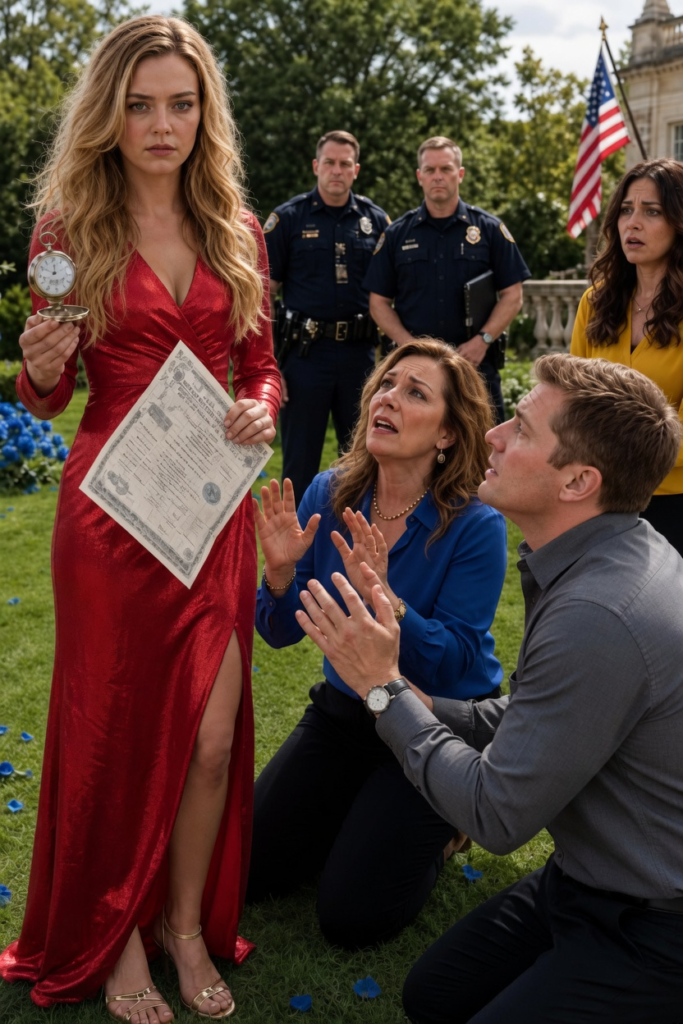
The engraving inside Grandpa’s pocket watch seemed to burn in my hand.
She was never adopted. She was stolen.
For a moment, the whole restaurant became a photograph.
Ryan stood frozen with his mouth slightly open.
My mother’s chair lay on its side behind her.
Aunt Diane gripped her sweet tea glass so tightly I thought it might crack.
Cousin Madison’s smirk had disappeared.
Mr. Caldwell, Grandpa’s attorney, was the only person who looked like he had been waiting for this exact explosion.
One police officer stood by the door, one hand resting near his belt. The other officer, a woman with dark hair pulled back in a low bun, stepped into the room with a calmness that made the air feel even more dangerous.
She looked at my mother.
“Mrs. Whitaker,” she said again, “we need to ask you about the infant reported missing from St. Agnes Hospital twenty-two years ago.”
My mother’s lips moved, but nothing came out.
Ryan recovered first.
“This is insane,” he snapped. “She’s grieving. We all are. You can’t just walk into a memorial lunch and accuse people because some old watch popped open.”
The female officer turned to him.
“And you are?”
Ryan lifted his chin. “Ryan Whitaker. Her brother.”
The officer’s eyes moved to me.
Then to the birth certificate in my hand.
Then back to Ryan.
“No,” she said. “According to that document, you are not her brother.”
The room went colder.
Ryan’s face went red.
“That paper is fake.”
Mr. Caldwell stepped forward. “It is not.”
My mother finally found her voice.
“Sam,” she whispered to Mr. Caldwell, “you promised.”
His expression did not soften.
“No, Patricia. I promised Thomas.”
Thomas.
Not Grandpa.
Thomas Whitaker.
The name on my birth certificate.
The man I had called Grandpa my entire life.
The man who taught me how to skip stones.
The man who saved the burnt edges of pie crust because I liked the crispy parts.
The man who put a blanket around my shoulders when everyone else forgot I was sitting alone on the porch.
My father.
The word entered my mind and nearly knocked me down.
Father.
Ryan laughed again, but it sounded desperate now.
“You people are disgusting. Grandpa is dead and you’re trying to turn his funeral into a circus.”
The female officer stepped closer.
“Mr. Whitaker, sit down.”
“I’m not sitting down.”
The male officer moved.
Ryan sat.
My mother was staring at me like I had become a stranger in front of her.
Not because she didn’t recognize me.
Because she did.
Maybe for the first time.
I looked at the birth certificate again.
Name: Emily Grace Whitaker.
Mother: Lillian Price.
Father: Thomas Whitaker.
Date of birth: June 14.
St. Agnes Hospital.
My birthday was June 16.
At least, that was what they had told me.
Two stolen days.
Even my birthday had been part of the lie.
I looked up slowly.
“Who is Lillian Price?”
My mother flinched as if I had slapped her.
Aunt Diane made a small, sharp sound.
Madison whispered, “Mom?”
But Aunt Diane did not answer.
Mr. Caldwell removed his glasses and rubbed the bridge of his nose.
“Emily,” he said gently, “not here.”
I almost laughed.
Not here?
They had humiliated me here.
Ryan had dangled Grandpa’s watch in front of the whole restaurant and called me greedy here.
My family had laughed at me here.
Family
They had made my entire life feel like a borrowed seat at someone else’s table.
So no.
If the lie could live here, the truth could breathe here too.
I held up the paper.
“Who is Lillian Price?”
Nobody answered.
The female officer did.
“Lillian Price was a twenty-four-year-old patient at St. Agnes Hospital. She gave birth to a baby girl twenty-two years ago. The baby disappeared from the nursery before dawn. Ms. Price was told her daughter had died.”
The room blurred.
I grabbed the back of a chair.
“Died?”
The officer’s voice was careful.
“Yes.”
My mother covered her mouth.
Ryan stared at the table.
Mr. Caldwell closed his eyes.
My whole life rearranged itself in one sentence.
Somewhere, a woman had been told I was dead.
Somewhere, my mother had buried a baby who was still breathing.
And I had grown up three towns away, eating birthday cake under the wrong name, being told I should be grateful they let me stay.
The officer took another step.
“My name is Detective Mara Ellis. Emily, we’re going to need that document and the watch, but not before we photograph them in your possession. Mr. Caldwell has already provided a sworn statement from Thomas Whitaker, signed before his death.”
My mother’s head snapped toward him.
“Sam.”
He looked at her coldly.
“You should have told the truth while he was alive.”
Ryan slammed his hand on the table.
“He was sick. He didn’t know what he was saying.”
Detective Ellis turned to him.
“Mr. Whitaker, Thomas Whitaker gave that statement six months ago. According to his doctors, he was of sound mind.”
Ryan’s confidence broke a little more.
Six months ago.
Grandpa had known six months ago.
Maybe longer.
He had watched me bring him soup, watched me help him into his recliner, watched me read his mail when his eyes got weak.
He had held my hand two days before he died and whispered, “Don’t let them make you small.”
I thought he meant grief.
He meant blood.
I looked at Mr. Caldwell.
“You knew?”
His face tightened.
“I knew what Thomas could prove. I did not know everything.”
“What does that mean?”
“It means your grandfather—”
He stopped himself.
A painful silence opened between us.
Then he corrected it.
“Thomas believed you were his daughter. He believed you had been taken from St. Agnes and hidden inside his own family. But he needed proof strong enough that Patricia and Ryan could not bury it again.”
Family
My mother sank back into her chair.
Ryan whispered, “Shut up.”
Mr. Caldwell did not.
“Thomas told me he put the first piece where greed would find it.”
His eyes moved to Ryan.
“The watch.”
Ryan’s face went white again.
That was when I understood.
Grandpa had not simply left the watch to me because he loved me.
He had known Ryan would take it.
He had known my family would make a scene.
He had known they would show everyone exactly who they were.
Even dead, Thomas Whitaker had set the trap.
And Ryan had walked right into it.
Detective Ellis asked everyone to remain seated while the officers separated the room.
The restaurant manager kept apologizing in whispers, as if the disappearance of a baby twenty-two years ago had inconvenienced the lunch reservation.
One officer photographed the watch in my hand.
Another photographed the birth certificate.
Detective Ellis placed both in evidence sleeves, but before she took the watch away, she let me look at it one more time.
The scratched silver cover.
The small crack across the glass.
The engraved sentence inside.
She was never adopted. She was stolen.
My fingers did not want to let go.
Detective Ellis noticed.
“We’ll return it if we can,” she said.
“If?”
“If it becomes evidence in a criminal proceeding, it may take time.”
Criminal proceeding.
The words sounded too official for the pain in my chest.
I looked at the woman I had called Mom my whole life.
Patricia Whitaker.
She would not look at me.
“Did you steal me?” I asked.
The room heard it.
Every relative.
Every cousin.
Every person who had laughed when Ryan called me greedy.
My mother’s face crumpled.
“I raised you.”
“That is not what I asked.”
Her eyes filled with tears.
“I fed you. I clothed you. I took you to school.”
“You told me I was lucky to have a roof.”
Her lips trembled.
“I was angry.”
“At a child?”
She looked down.
I stepped closer.
“Did you steal me from Lillian Price?”
Ryan stood again.
“Don’t answer that.”
Detective Ellis snapped, “Sit down, Mr. Whitaker.”
He did, but his eyes stayed locked on Patricia.
Warning her.
Still controlling the lie.
Still trying to keep the room arranged around him.
My mother saw him looking.
And for the first time in my life, I watched fear cross her face because of him, not me.
That was when I realized Ryan hadn’t just been cruel because he hated me.
He had been guarding something.
A secret older than both of us.
Detective Ellis looked at Patricia.
“Mrs. Whitaker, we can continue this at the station. You are not under arrest at this moment, but I strongly advise you to cooperate.”
“At this moment?” Ryan barked.
Detective Ellis ignored him.
Mr. Caldwell turned to me.
“Emily, I’ll drive you. You should not leave with your family.”
Family
My family.
I looked around the room.
At Aunt Diane, who had suddenly become fascinated by the ice melting in her glass.
At Madison, who was pale now, her perfect lipstick trembling.
At Ryan, who looked at me like I had ruined his life by existing.
At Patricia, who had called herself my mother but could not answer the simplest question.
Did you steal me?
For twenty-two years, I had tried to earn my place in that family.
I washed dishes at Thanksgiving while Madison took selfies.
I wrapped Christmas gifts that never had my name on them.
I worked two jobs in college because Patricia said family money was for “real emergencies.”
I sent birthday cards to people who never called me unless they needed something.
And all that time, I thought the problem was that I had been taken in.
But I had been taken.
There is a difference.
A terrible one.
I picked up my purse from the floor.
Nobody stopped me.
Not even Ryan.
As I walked past him, he muttered, “You have no idea what you’re starting.”
I stopped.
Then I turned back.
“No, Ryan,” I said. “I think I’m finally finding out what you finished.”
His jaw tightened.
But he did not answer.
Outside, the afternoon sun was too bright.
It felt wrong.
The world should have gone dark.
Cars moved along the street. A woman pushed a stroller past the steakhouse. A man in a Cubs hat argued into his phone. Life continued, careless and ordinary, while mine cracked open on the sidewalk.
Mr. Caldwell guided me toward his black sedan.
I stopped beside the passenger door.
“Did he know all my life?”
He did not pretend not to understand.
“Thomas?”
I nodded.
Mr. Caldwell looked back at the restaurant window.
“I think he suspected all your life. I think he knew for certain in the last year.”
“Why didn’t he tell me?”
Pain moved through his face.
“Because he was afraid he would die before he could protect you from what came next.”
I laughed, but there was no humor in it.
“Protect me? Everyone in there has been hurting me for years.”
“I know.”
“No, you don’t.”
His silence said he did.
That made me angrier.
“How many people knew?”
“Enough to make him careful.”
My stomach turned.
Enough.
That word was a knife.
At the police station, Detective Ellis placed me in a small interview room with beige walls, a metal table, and a box of tissues nobody touched.
Mr. Caldwell sat beside me.
Not across from me.
That mattered.
Detective Ellis came in carrying a folder thick enough to hold a life.
Mine, apparently.
She sat down and opened it.
“Emily, I want to be clear. You are not in trouble.”
“I know that.”
“Sometimes victims of family concealment feel guilty, as if uncovering the truth is betraying the people who raised them.”
Family
I looked at her.
“They raised me to feel guilty for breathing too loud.”
She nodded once.
“Then I’ll speak plainly.”
“Please do.”
She slid a photocopy across the table.
It was a missing infant report.
St. Agnes Hospital.
June 15.
Female newborn.
Mother: Lillian Price.
Presumed abduction.
My eyes caught on the baby’s name.
Grace.
Not Emily.
Grace Price.
That was the first name anyone ever gave me.
My throat closed.
Detective Ellis watched me read it.
“Lillian named her daughter Grace. The hospital records later listed the infant as deceased due to respiratory complications. That record was false. The original missing infant report was buried, then reopened years later after a retired nurse gave a statement.”
“Who buried it?”
Detective Ellis paused.
“That is part of what we’re investigating.”
I looked at Mr. Caldwell.
He was staring at the folder, his face grim.
Detective Ellis continued.
“Thomas Whitaker gave us reason to believe several members of his family knew the infant survived. He also alleged that documents were altered, money changed hands, and your identity was intentionally obscured.”
“Why?” I whispered.
“Because Thomas intended to acknowledge you as his daughter.”
The room tilted.
I pressed my palm flat against the table.
Detective Ellis waited.
She had probably seen people break apart in ugly rooms before.
She knew not to rush the collapse.
Mr. Caldwell spoke softly.
“Thomas changed his estate plan before his death.”
I turned to him.
“What?”
“He left most of his personal estate in trust. Not to Ryan. Not to Patricia. Not to Diane. To you.”
I stared at him.
“That’s why Ryan took the watch.”
“Yes.”
“He knew.”
“I don’t know how much he knew. But he knew the watch mattered.”
Detective Ellis looked at me.
“Ryan was eleven when Grace Price disappeared. Too young to orchestrate it, but old enough to remember things. Thomas believed Ryan overheard adults discussing the baby and later used that knowledge to pressure Patricia.”
I thought of Ryan’s face when the officer mentioned St. Agnes.
White.
Not confused.
Terrified.
“What adults?”
Detective Ellis slid another paper forward.
A photocopy of a hospital visitor log.
Three names were circled.
Patricia Whitaker.
Diane Whitaker.
Ellen Whitaker.
I looked up.
“Ellen?”
Mr. Caldwell answered quietly.
“Thomas’s wife.”
My grandmother.
The woman everyone told me had died before I could remember her.
The woman whose photograph hung in Patricia’s hallway for years: pearl necklace, stiff smile, eyes like winter.
“She was alive when I was born?”
“Yes,” Mr. Caldwell said.
My voice became small.
“Then why did I call Thomas Grandpa?”
Detective Ellis folded her hands.
“Because everyone made you.”
It was such a simple answer that it hurt more than anything else.
Because everyone made you.
They made me small.
They made me grateful.
They made me other.
They made my own father hold me at arm’s length in public while loving me in secret, because the truth threatened every lie the family had built.
Family
I looked down at the missing infant report.
Grace Price.
“What happened to Lillian?”
Detective Ellis did not answer immediately.
That told me the answer was not simple.
“She disappeared from public records four years after the abduction. Before that, she filed several complaints. She insisted her baby had not died. She accused St. Agnes of covering up the truth. She also tried to contact Thomas Whitaker repeatedly.”
“Did he know?”
Mr. Caldwell leaned forward.
“Thomas told me he never received her letters.”
“Of course he didn’t,” I said.
My voice sounded flat.
As if someone else were speaking through me.
Detective Ellis opened another section of the folder.
“We found copies of two letters in Thomas’s safe. They were not opened until after his death. He believed someone in his house intercepted the originals and later returned copies to the safe to frighten him.”
She slid one letter toward me.
The handwriting was slanted and desperate.
Thomas,
They told me she died, but I heard her cry after they said she was gone. Someone took her. I know you think I’m unstable, but I am not. Your family came to the hospital. Your wife looked at me like I was dirt. Please ask questions. Please. Her name is Grace. She has your chin.
Lillian.
I touched the edge of the paper.
My biological mother had fought.
She had written.
She had begged.
And someone made sure nobody listened.
A sob rose in my throat, but I swallowed it down because I was afraid if I started crying, I would never stop.
Detective Ellis said, “We are trying to locate Lillian Price.”
I looked up fast.
“Trying?”
“She may still be alive.”
Everything stopped.
The air.
The room.
My heart.
Alive.
My mother might be alive.
Not Patricia.
Not the woman who looked down at her napkin while Ryan humiliated me.
The woman who named me Grace.
The woman who heard me cry after they said I was dead.
The woman who wrote letters no one answered.
“Where is she?” I asked.
“We’re not sure yet.”
“But you said—”
“We found a possible record under another name. It’s not confirmed.”
“What name?”
Detective Ellis hesitated.
Mr. Caldwell said, “Mara.”
She exhaled.
“Lillian Vale. A residential care facility outside Rockford. We do not know if it’s her.”
Residential care facility.
A living grave.
My hands curled into fists under the table.
“Did my family put her there?”
Family
“We don’t know.”
But her eyes said they suspected.
The door opened.
A uniformed officer leaned in and whispered to Detective Ellis.
Her expression changed.
“What?” I asked.
She closed the folder.
“Patricia Whitaker has agreed to give a statement.”
Mr. Caldwell went still.
“What kind of statement?”
Detective Ellis stood.
“The kind people give when they realize someone else is about to talk first.”
I waited in that beige room for almost an hour.
Every minute felt like a year.
Mr. Caldwell brought me water. I didn’t drink it.
I kept staring at the photocopy of Lillian’s letter.
Her name is Grace.
I wondered if that name would feel like mine if someone said it gently enough.
Emily had been the name they gave me after the theft.
Grace was the name my mother whispered over me before the world took me away.
Could a person have two names and still know who she was?
Or did the lie own one of them forever?
Finally, Detective Ellis returned.
She did not sit.
“Emily, Patricia says she wants to speak to you.”
“No.”
The word came out before she finished.
Mr. Caldwell nodded once, approving.
Detective Ellis did too.
“That is your right. I told her no unless you requested it.”
“What did she say?”
Detective Ellis looked at Mr. Caldwell, then back at me.
“She says Thomas brought you home.”
My stomach dropped.
“What?”
“She claims Thomas arrived at the Whitaker house with you when you were three days old and said your mother could not care for you. Patricia says the family agreed to raise you quietly to avoid scandal.”
Family
Mr. Caldwell’s jaw tightened.
“That contradicts Thomas’s sworn statement.”
Detective Ellis said, “Yes.”
“What did Thomas say?”
Mr. Caldwell reached into his briefcase.
“I was going to wait until the formal reading of the will, but you deserve this now.”
He took out a sealed envelope.
My name was written across it.
Emily.
Not Grace.
Not daughter.
Emily.
His handwriting.
Mr. Caldwell broke the seal and unfolded a letter.
“May I read it?”
I nodded because I didn’t trust my hands.
He began.
My dearest Emily,
If you are hearing this from Sam, then I failed to tell you while I was alive. I have no excuse that will make that failure clean. Fear is not noble just because it wears a suit and says it is protecting someone.
I believed, for many years, that you were a child Patricia had taken in from a woman who died. That was what I was told. I loved you before I suspected anything, and I loved you more after.
The first time I wondered if you were mine, you were seven. You sat beside me at the lake and hummed a song Lillian used to hum when she was nervous. I told myself it was coincidence.
The second time, you were twelve. You asked why my old watch had the initials T.W. and L.P. carved inside the chain clasp. Patricia heard you and threw the chain away that night.
The third time, you were seventeen. You brought me a shoebox of papers from the attic because you said something smelled like mildew. In that box was one page from St. Agnes. Your footprint. Not under Emily Whitaker. Under Grace Price.
I should have gone to the police that day. I did not. Patricia said if I did, they would take you away. She said you would hate me for ruining the only home you knew. She said Lillian was dead. She lied.
I spent my last years trying to gather proof. I left the watch because I knew Ryan’s greed would expose what my cowardice had hidden.
Emily, you were never charity. You were never less than blood. You were my daughter, whether the world let me say it or not.
Forgive me only if forgiveness gives you peace. Do not forgive me because the dead are easier to love.
Find Lillian if you can.
Find yourself first.
With all the love I was too weak to name,
Thomas.
By the time Mr. Caldwell finished, I was crying without making a sound.
The tears slid down my face, hot and humiliating, but I did not wipe them away.
Thomas had loved me.
My father had loved me.
But he had also failed me.
Both things were true.
And maybe truth was cruel because it did not let grief stay simple.
Mr. Caldwell folded the letter.
“I’m sorry,” he said.
I looked at him through tears.
“Did he suffer?”
“Yes.”
“Good.”
Mr. Caldwell blinked.
Then he nodded.
“Fair.”
I stood up.
Detective Ellis watched me carefully.
“I want to hear Patricia’s statement,” I said.
Mr. Caldwell frowned. “Emily—”
“Not in the room with her. But I want to know what she says.”
Detective Ellis nodded.
“I can summarize what is legally shareable at this stage.”
“Then summarize.”
She sat back down.
“Patricia claims Ellen Whitaker, Thomas’s wife, discovered Lillian’s pregnancy and believed the baby would destroy the family’s reputation and inheritance structure. Patricia says Ellen arranged with someone at St. Agnes to falsify records after the birth.”
Family
My skin went cold.
“Ellen stole me?”
“Patricia says Ellen had the baby removed from the nursery. She claims the plan was to place the baby through a private adoption out of state.”
“But I ended up with them.”
“Yes. Patricia claims Thomas found out there had been a baby, but not the full truth. Ellen allegedly panicked and told Patricia to present the child as an orphan from a dead acquaintance, so Thomas could keep you near without understanding why.”
“That makes no sense.”
“It may be partially false.”
“Partially?”
“People confess in layers.”
I looked at Mr. Caldwell.
He looked older than he had that morning.
“Where is Ellen now?” I asked.
“Dead,” he said. “Eight years ago.”
Of course.
The easiest villain was already buried.
The dead cannot be handcuffed.
But the living can hide behind them.
“What about Diane?”
Detective Ellis’s mouth tightened.
“Patricia says Diane knew where some documents were kept. She also says Diane received money from Ellen’s estate after agreeing never to discuss St. Agnes.”
Aunt Diane.
Sweet tea.
Lowered glass.
Silent eyes.
“What about Ryan?”
“Patricia claims Ryan found the truth when he was a teenager and used it to control her.”
I laughed once.
“That sounds like him.”
“She says he threatened to tell you only enough to make you hate her, unless she helped him pressure Thomas about the estate.”
The pieces turned.
Ryan hadn’t taken the watch because he thought it was an antique.
He took it because he was afraid of what it might contain.
He humiliated me because humiliation had always worked.
Make Emily shrink.
Make Emily doubt herself.
Make Emily too embarrassed to ask questions.
But this time, I had not shrunk.
And the watch had opened.
“What happens now?” I asked.
Detective Ellis closed the folder.
“Now we verify. We compare Patricia’s statement against Thomas’s affidavit, hospital archives, DNA, bank records, and any living witnesses.”
“DNA?”
“We’ll ask for yours. Voluntarily.”
“You can have it.”
Mr. Caldwell said, “Emily, I’ll arrange an independent test as well.”
“Good.”
I looked at Detective Ellis.
“And Lillian?”
“We have a detective going to Rockford.”
“I’m going.”
“No.”
“Yes.”
Detective Ellis’s voice softened but stayed firm.
“Emily, if this woman is Lillian Price, she has lived twenty-two years believing her child was dead. We do not know her medical condition. We do not know what she remembers. We do not know whether your sudden arrival could harm the investigation or her well-being.”
I hated that she was right.
I hated every reasonable word.
“So I just wait?”
“For now.”
I laughed bitterly.
“I’ve been waiting my whole life and didn’t even know it.”
Detective Ellis did not answer.
That evening, I did not go home.
Home was Patricia’s house.
And Patricia was no longer my mother in any way I understood.
Mr. Caldwell booked me a room at a small hotel near the courthouse. He insisted on paying. I refused. He said Thomas had created an emergency fund for me. I refused again. He said, “Then let your father buy you one night of safety.”
That time, I had no answer.
The hotel room smelled like lemon cleaner and old carpet. I sat on the edge of the bed in my black memorial dress, holding Thomas’s letter in both hands.
My phone would not stop vibrating.
Madison: Are you okay?
Aunt Diane: Please don’t believe everything they say.
Unknown number: You’re making a mistake.
Ryan: Pick up.
Ryan: You don’t know what Caldwell wants.
Ryan: Grandpa was confused.
Ryan: You think they’ll love you now? They won’t.
Ryan: You were better off not knowing.
That last message stayed on the screen.
You were better off not knowing.
I stared at it until the words turned blurry.
Then I typed back:
No. You were.
He didn’t reply.
At 11:43 p.m., someone knocked on my hotel door.
I froze.
The room seemed to shrink around me.
Another knock.
Soft.
Then a voice.
“Emily? It’s Sam Caldwell.”
I checked the peephole.
It was him.
I opened the door with the chain still on.
He held up both hands.
“I’m sorry. I wouldn’t come this late unless it mattered.”
“What happened?”
He glanced down the hallway.
“May I come in?”
I hesitated.
Then unlatched the chain.
He stepped inside carrying a small brown envelope.
“Thomas left this in my office safe. He instructed me to give it to you only if the police became involved before the will reading.”
“That seems specific.”
“Thomas knew his family.”
Family
He handed me the envelope.
Family
Inside was a small brass key and a photograph.
The photo was old, slightly faded.
A young woman sat on a picnic blanket near the lake.
Dark curly hair. Wide smile. One hand resting on her pregnant belly.
Beside her sat Thomas, younger, laughing at something outside the frame.
On the back, in Thomas’s handwriting:
Lillian and Grace. Before they stole our future.
My knees weakened.
I sat on the bed.
For the first time, I saw her.
My mother.
Not as a file.
Not as a victim report.
Not as a name.
As a woman in sunlight, laughing beside the man I had called Grandpa.
She was beautiful.
Not polished. Not stiff like Ellen’s portrait.
Alive.
Warm.
Her smile looked like mine.
I touched the picture carefully.
“What is the key?”
Mr. Caldwell sat in the chair near the desk.
“A safe deposit box. Thomas opened it under a private trust name.”
“What’s inside?”
“I don’t know.”
“When can we open it?”
“Tomorrow morning.”
I looked at him.
“Why didn’t he just give everything to the police?”
“Because he didn’t know who had helped bury the first report.”
That made sense.
And it terrified me.
“You think police were involved?”
“I think St. Agnes was influential, the Whitakers had money, and a missing baby report vanished for two decades. That usually takes more than one frightened grandmother.”
I looked back at the photo.
“Was Ellen my grandmother?”
Mr. Caldwell’s eyes softened.
“Legally, she was Thomas’s wife.”
“That’s not what I asked.”
“No,” he said. “She was not your grandmother. Not in any way that counts.”
I appreciated that he did not lie.
The next morning, the bank manager tried to pretend he was not nervous.
He failed.
Mr. Caldwell presented documents. I presented identification. Detective Ellis came too, which made the manager’s hands shake as he led us into a private viewing room.
The safe deposit box was long and black.
The brass key fit.
Inside were three sealed packets.
One labeled EMILY.
One labeled LILLIAN.
One labeled IF THEY LIED AGAIN.
Detective Ellis photographed everything before we touched it.
Mr. Caldwell looked at me.
“Your choice.”
I picked up the packet labeled EMILY.
Inside was a hospital bracelet.
Tiny.
Plastic.
Yellowed with age.
PRICE, BABY GIRL.
There was also a footprint card.
Grace Price.
A lock of dark baby hair in a small envelope.
And another letter from Thomas.
Emily,
If you are holding these, then I was right, and I am sorry that being right means your life has been broken open.
These were given to me by Nurse Helen Morris, the retired St. Agnes nurse who found me after seeing your photograph in Patricia’s Christmas card. She said she recognized the baby she had failed to protect.
Helen told me your mother screamed for three days that you were alive. She was sedated. Then transferred. Then discredited.
I tried to find Lillian. Every path ended in sealed records and lies.
Do not trust Patricia’s tears.
Do not trust Diane’s silence.
Do not trust Ryan’s anger.
And if anyone tells you Ellen acted alone, ask who drove the car.
I stopped breathing.
Ask who drove the car.
Detective Ellis leaned closer.
“May I?”
I handed her the letter.
Her eyes sharpened as she read.
“Car,” she said quietly.
Mr. Caldwell opened the packet labeled LILLIAN.
Inside were letters.
Dozens of them.
Some addressed to Thomas.
Some addressed to Baby Grace.
None had stamps.
None had been mailed.
Lillian had written to a daughter she thought was dead.
My Sweet Grace,
Today you would be one month old. The nurse told me to stop counting, but I won’t. A mother knows the shape of her own child’s cry. They say grief makes women imagine things. I did not imagine you.
My Grace,
You would be five today. I bought a little blue ribbon because I dreamed your hair was dark like mine. If heaven lets babies grow, maybe you wore a ribbon today.
Grace,
You would be thirteen. I wonder if you are shy. I wonder if you like books. I wonder if you hate peas. Your father liked fishing. Maybe you would have liked the lake.
My hands shook so hard the pages rattled.
There are pains that stab.
And then there are pains that hollow.
This one hollowed me.
Detective Ellis opened the third packet only after photographing the seal.
IF THEY LIED AGAIN.
Inside was a cassette tape, a typed affidavit from Nurse Helen Morris, and a list of names.
Patricia Whitaker.
Diane Whitaker.
Ellen Whitaker.
Dr. Arthur Bell.
Nurse Clara Hensley.
Officer Richard Voss.
And one name that made Mr. Caldwell inhale sharply.
Judge Warren P. Caldwell.
I looked at him.
“Caldwell?”
His face had gone gray.
“My father.”
The room changed.
Detective Ellis immediately straightened.
Mr. Caldwell took a step back from the table.
“I didn’t know,” he said.
Detective Ellis looked at him with professional caution.
“Mr. Caldwell, I’m going to need you not to touch anything else.”
He nodded slowly.
For the first time since the restaurant, he looked truly shaken.
“My father handled probate matters for the Whitakers years ago,” he said. “He died when I was in law school.”
Detective Ellis did not respond.
I stared at the list.
The lie was not a family secret.
Family
It was a network.
Hospital.
Police.
Law.
Money.
My birth had been buried under respectable names.
Detective Ellis’s phone rang.
She stepped out.
Through the glass door, I watched her answer, listen, and turn very still.
When she came back in, her face had changed.
“What?” I asked.
She looked at me.
“The woman in Rockford is Lillian Price.”
My hand went to my mouth.
“She’s alive?”
“Yes.”
The word struck me so hard I had to sit.
Alive.
My mother was alive.
Detective Ellis continued.
“She is under the name Lillian Vale. She has been in residential care for sixteen years. Her records list a history of trauma, institutional transfers, and no known living children.”
No known living children.
I was standing in a bank vault holding twenty-two years of her letters.
“I want to see her.”
Detective Ellis’s eyes softened.
“I know.”
“When?”
“She has agreed to speak with me. She has not yet been told about you.”
“Why not?”
“Because this must be handled carefully.”
I stood.
“No. Carefully is what everyone said while they lied. Carefully is how they kept me quiet. Carefully is how they told her I was dead.”
Mr. Caldwell spoke softly.
“Emily.”
I turned on him.
“Your father’s name is on that list.”
He flinched.
“I know.”
“So don’t tell me to be careful.”
He lowered his gaze.
“You’re right.”
That stopped me.
I expected defense.
Not surrender.
Detective Ellis closed the box.
“I will not keep you from her longer than necessary. But I also won’t risk harming a woman who has been wounded by this case for twenty-two years.”
I hated it.
I understood it.
That combination felt like swallowing glass.
By sunset, the story had begun to leak.
Not my name, not fully.
But enough.
Cold Case Infant Abduction Linked to Prominent Whitaker Family.
Memorial Lunch Leads to Break in 22-Year Mystery.
Old Pocket Watch Reveals Hidden Birth Certificate.
Ryan called me fourteen times.
I blocked him.
Patricia called once.
I let it ring.
Aunt Diane sent one text.
I didn’t know she was alive.
I stared at that message for a long time.
Then I wrote back:
You knew I was.
She did not answer.
Two days later, Patricia was arrested.
Not for kidnapping.
Not yet.
For obstruction, document concealment, and making false statements.
Diane was brought in for questioning.
Ryan held a press conference on the sidewalk outside his lawyer’s office.
I watched it from the hotel room because apparently pain is not satisfied until it learns how to stream live.
Ryan stood in a navy suit, looking wounded and righteous.
“Our family is being targeted by sensational accusations during a time of grief,” he said. “My sister Emily has been manipulated by opportunists seeking Grandpa’s estate.”
Family
My sister.
He said it smoothly.
After a lifetime of reminding me I barely belonged, he called me sister in front of cameras because it served him.
Then a reporter asked, “Were you aware Emily Whitaker may be Thomas Whitaker’s biological daughter?”
Ryan’s jaw twitched.
“No comment.”
Another reporter shouted, “Did you take the pocket watch from her at the memorial lunch?”
His lawyer pulled him away.
I turned off the television.
A minute later, my phone rang from an unknown number.
I almost ignored it.
Then something made me answer.
No one spoke at first.
“Hello?” I said.
Breathing.
Then a woman’s voice, thin and old but not weak.
“Is this Emily?”
My heart stopped.
“Who is this?”
A pause.
“Someone told me not to call.”
My fingers tightened around the phone.
“Who is this?”
The woman inhaled shakily.
“My name is Helen Morris. I was a nurse at St. Agnes.”
I sat down slowly.
Nurse Helen Morris.
The retired nurse.
The one who gave Thomas the bracelet.
The one who said she failed to protect me.
“I know who you are,” I whispered.
“I doubt that,” she said, and there was old pain in her voice. “But I know who you are.”
I couldn’t breathe.
She continued.
“You need to listen carefully. The police will find some of the truth. Not all of it.”
“Why are you calling me?”
“Because Thomas is dead. Lillian has been hidden. And the people who arranged this are not all gone.”
I stood.
“Who drove the car?”
Silence.
Then Helen made a small sound.
“So you found that letter.”
“Who drove the car?”
“I can’t say on the phone.”
“Then tell Detective Ellis.”
“I already tried. Years ago.”
“What happened?”
“My husband lost his pension. My son was arrested on a charge that disappeared after I stopped talking.”
A chill moved over my skin.
“This wasn’t just Ellen.”
“No.”
“Was Patricia there?”
“Yes.”
My eyes closed.
“Was Diane?”
“Yes.”
“Ryan?”
“He was a boy. But boys hear things. Some grow up decent despite it.”
“And some grow up Ryan.”
Helen gave a sad little laugh.
“Yes.”
“Who drove the car?”
Another pause.
Then she whispered, “Ask Sam Caldwell why his father sealed the adoption file for a child who was never adopted.”
The line went dead.
I stared at the phone.
Then I grabbed my coat.
Mr. Caldwell was in the hotel lobby speaking with Detective Ellis when I came out of the elevator.
He looked up and immediately knew something had happened.
“What is it?”
I walked straight toward him.
“Did your father seal my adoption file?”
His face drained.
Detective Ellis turned to him slowly.
“Sam?”
He looked between us.
“There was no adoption file.”
“That’s not what Helen Morris just said.”
Detective Ellis’s expression sharpened.
“Helen called you?”
“Yes.”
“What did she say?”
I kept my eyes on Mr. Caldwell.
“She said to ask Sam why his father sealed an adoption file for a child who was never adopted.”
Mr. Caldwell gripped the back of a lobby chair.
“My father was a judge. He sealed many records.”
“Mine?”
“I don’t know.”
“Find out.”
He looked wounded.
I did not care.
“Emily,” he said, “I have tried to help you.”
“And maybe your family helped them.”
Family
That landed hard.
For a moment, he looked almost angry.
Then the anger died.
“You’re right to ask.”
Detective Ellis said, “Mr. Caldwell, from this point forward, I need to treat you as potentially conflicted.”
“I understand.”
His voice was flat.
But his hands were shaking.
That night, I dreamed of a nursery.
Rows of bassinets.
Tiny bracelets.
A woman screaming behind glass.
A man’s pocket watch ticking louder and louder until it became a heart.
When I woke, there was a message from Detective Ellis.
We’re going to Rockford today. Lillian has agreed to meet with investigators. She has also agreed to meet you if you still want that.
If I still wanted that.
I sat on the edge of the bed and laughed until I cried.
The drive to Rockford took two hours.
Detective Ellis drove.
I sat in the passenger seat with Thomas’s letter folded in my purse, Lillian’s photograph tucked inside the same envelope.
The residential care facility was not a hospital, not exactly.
It was a low brick building surrounded by winter-bare trees, with a small chapel on one side and a courtyard full of empty benches.
Inside smelled like antiseptic, soup, and old flowers.
A social worker met us at the front desk.
She spoke gently to Detective Ellis, then looked at me with careful eyes.
“She knows you’re coming,” she said.
My legs nearly failed.
“She knows who I am?”
“She knows there is a possibility.”
A possibility.
My whole existence reduced to something cautious enough not to break her.
We walked down a hall with pale green walls.
Room 214.
The social worker knocked softly.
A voice inside said, “Come in.”
Lillian Price sat by the window.
Her hair was streaked with silver, still curly. Her hands were thin. A knitted blanket covered her lap.
But her eyes—
My eyes.
I stopped in the doorway.
She looked at me.
The room disappeared.
Her mouth opened slightly.
One hand lifted to her chest.
Detective Ellis said softly, “Lillian, this is Emily Whitaker.”
Lillian stared at me.
Then she whispered, “No.”
My heart cracked.
“No?” I repeated.
Tears filled her eyes.
“No,” she said again, but this time it sounded like disbelief, not rejection.
She reached toward the small table beside her and picked up a blue ribbon.
Old.
Faded.
Carefully kept.
“My Grace had dark hair,” she whispered.
I stepped forward.
“I did.”
Her hand began to shake.
Detective Ellis looked at me.
I took the photograph from my purse and held it out.
Lillian looked at it.
Her face collapsed.
“That was the lake,” she said.
Her voice became younger for one second.
“Thomas said we’d go back after she was born.”
I knelt in front of her chair.
“I’m sorry.”
It was a ridiculous thing to say.
I had not stolen myself.
I had not hidden the letters.
I had not sedated her or silenced her or changed records.
But I was sorry.
Sorry she lost me.
Sorry I lived close enough to be found and no one let her find me.
Sorry I had been taught to call someone else Mother while she wrote letters to a grave that never held me.
Lillian reached out.
Her fingers hovered near my face, afraid to touch.
“May I?”
I nodded.
She touched my cheek like I was made of smoke.
Then she sobbed once.
Not loudly.
Not dramatically.
Just one broken sound from a place too deep for performance.
“My baby.”
I closed my eyes.
Nobody had ever said those words to me like that.
Not as obligation.
Not as possession.
As recognition.
My baby.
I leaned forward, and she pulled me into her arms.
She was fragile.
I was careful.
But her grip was fierce.
Behind me, I heard Detective Ellis step out into the hall.
For a while, there was no investigation.
No Whitaker estate.
No watch.
No police file.
There was only a mother holding the daughter she had been told was dead.
When Lillian finally let go, she kept both hands around mine.
“They called you Emily?”
“Yes.”
She smiled through tears.
“That’s pretty.”
“You named me Grace.”
“I did.”
“I found your letters.”
Her face changed.
“You did?”
I nodded.
“They kept them.”
Her eyes hardened in a way that made me see the woman in the photograph.
Young.
Alive.
Furious.
“I wrote every year.”
“I know.”
“I tried to find Thomas.”
“He said he never got the letters.”
Lillian looked toward the window.
“I believe that.”
“You do?”
“He was weak,” she said quietly. “But not cruel.”
That was perhaps the most honest sentence anyone had said about him.
I looked down at her hands.
“Do you know who took me?”
Her grip tightened.
The warmth drained from her face.
“Yes.”
My pulse slammed.
“Who?”
She looked toward the hallway.
“Where is the detective?”
I stood quickly and opened the door.
Detective Ellis returned.
Lillian sat straighter.
For the first time, she looked less like a patient and more like a witness.
“Mrs. Price,” Detective Ellis said, “are you comfortable continuing?”
Lillian nodded.
“I remember more than they think.”
Detective Ellis took out her recorder.
Lillian looked at me.
“I saw Patricia that night. I saw Diane too. Ellen came into my room earlier and told me I had made a terrible mistake. She said Thomas would never claim a child born out of shame.”
Her mouth twisted.
“I told her Thomas had already signed the papers.”
Detective Ellis leaned in.
“What papers?”
“Paternity acknowledgment. A trust amendment. He wanted Grace protected.”
My breath caught.
Lillian continued.
“Later, they gave me something. I woke up and my baby was gone. They told me she had died.”
Her voice trembled, but she forced the words out.
“I screamed until they tied my hands.”
I covered my mouth.
Detective Ellis said, “Did you see who removed the baby?”
Lillian closed her eyes.
“I saw a nurse carry her. Clara Hensley. I heard Ellen say the car was waiting.”
“Who was driving?”
Lillian opened her eyes.
And looked at me.
“Thomas.”
The word hit the room like a gunshot.
I stepped back.
“No.”
Lillian reached for me.
“No, listen—”
“No.”
Detective Ellis’s expression had gone completely still.
“Mrs. Price, are you saying Thomas Whitaker drove the car used to remove the infant from St. Agnes?”
Lillian shook her head, crying now.
“I heard his name. I heard Ellen say, ‘Thomas is waiting by the west entrance.’ I thought—”
She broke off.
“You thought he took me?”
“For years.”
The floor seemed to vanish beneath me.
Thomas’s letter.
Thomas’s guilt.
His silence.
His fear.
Had it all been regret not for cowardice, but participation?
“No,” I said again, but it came out weaker.
Lillian gripped my hand.
“When I saw your picture in the paper after his death, I knew. I knew he must have found you. But I don’t know if he saved you or stole you first.”
Detective Ellis turned off the recorder.
For several seconds, nobody spoke.
Then there was a knock at the open door.
A nurse stood there holding a padded envelope.
“Ms. Price? This arrived for you this morning. No return address.”
Detective Ellis moved fast.
“Don’t touch it.”
But Lillian had already taken it.
The nurse’s face went pale.
Detective Ellis pulled gloves from her pocket and took the envelope carefully.
It was addressed in block letters.
LILLIAN PRICE / ROOM 214.
Detective Ellis opened it with controlled precision.
Inside was a photograph.
She laid it on the table.
I stared.
It showed St. Agnes Hospital at night, twenty-two years ago.
A grainy security still.
A west entrance.
A car.
A man in a dark coat holding a bundle.
The face was blurred, but the pocket watch chain was visible against his vest.
Thomas’s watch chain.
Beside the photograph was a note.
Only one sentence.
Ask Emily why her father lied too.
Lillian made a small sound.
Detective Ellis grabbed the note.
I backed away until my shoulders hit the wall.
For two days, I had believed Thomas was the man who loved me too late.
Now the room spun with a worse possibility.
Maybe he had not found the lie.
Maybe he had helped begin it.
My phone buzzed in my coat pocket.
I pulled it out with numb fingers.
Unknown number.
A text.
There are two sides to every theft, Grace.
Then a second message arrived.
Your father did not save you.
A third.
He chose who got to keep you.
Attached was a photo.
Fresh.
Taken from outside the care facility.
Through the window.
Lillian and me.
Embracing.
My blood turned to ice.
Detective Ellis saw my face.
“Emily?”
I handed her the phone.
She read the messages.
Then she looked toward the window.
Outside, in the parking lot, a black SUV pulled away from the curb.
Fast.
Detective Ellis ran into the hall, shouting for security.
Lillian reached for me.
But I could not move.
I stared at the parking lot until the SUV disappeared beyond the trees.
For twenty-two years, everyone had told me I was lucky to be taken in.
Then the watch told me I had been stolen.
Then Thomas told me he had failed me.
Then Lillian told me he might have been there the night I disappeared.
And now someone was watching.
Someone who knew my first name.
Grace.
Behind me, Lillian whispered, “Emily?”
I turned.
She looked terrified, not of me, but for me.
On the table between us lay the old photograph, the threatening note, and the open envelope with no return address.
Detective Ellis came back breathless.
“They’re gone,” she said.
“Who?” I asked.
She didn’t answer.
Because none of us knew.
Not yet.
I looked down at Thomas’s pocket watch, sealed in an evidence bag Detective Ellis had brought for Lillian to identify.
The cracked glass caught the pale afternoon light.
For the first time, I noticed something I had missed at the restaurant.
A second engraving.
So small it had been hidden under the hinge.
Not the sentence I already knew.
Another one.
A date.
And three initials.
T.W. — L.P. — E.W.
Thomas Whitaker.
Lillian Price.
Ellen Whitaker.
All carved together beneath the cover of the watch.
Not two names.
Three.
Lillian saw it too.
Her face went white.
“That isn’t his handwriting,” she whispered.
Detective Ellis leaned closer.
“Whose is it?”
Lillian looked at me.
Then at the window.
Then back at the watch.
“Ellen’s.”
The room went silent.
And somewhere outside, beyond the bare trees and the locked doors and the truth we thought we had finally found, someone who knew exactly what happened twenty-two years ago was still free.
My phone buzzed one more time.
A final message.
Stop digging, Grace.
Or the next grave they open will be Thomas’s.
PART 3
Stop digging, Grace.
Or the next grave they open will be Thomas’s.
The message glowed on my phone like a threat carved into bone.
For a few seconds, nobody in Lillian Price’s room moved.
Not Detective Ellis.
Not the nurse standing frozen in the doorway.
Not Lillian, who sat in her chair by the window with both hands pressed to her mouth.
Not me.
I stared at the words until they blurred.
Grace.
That name had belonged to me for only three days before someone buried it under another life.
Now the person threatening me knew it.
They knew where I was.
They knew I had found Lillian.
They knew about Thomas’s grave.
And worst of all, they knew enough to make me doubt the only man in that family who had ever loved me.
Family
Detective Ellis took my phone from my hand and read the message again. Her jaw tightened.
“Everybody away from the window,” she said.
The command snapped the room back into motion.
The nurse backed into the hall. Detective Ellis stepped to the window and pulled the curtain halfway closed with two fingers, careful not to stand directly in front of the glass.
Lillian reached for me.
“Emily.”
I went to her.
Her fingers were cold around mine.
“They found me,” she whispered.
I looked down at her face.
My mother’s face.
Not Patricia Whitaker, who had raised me with resentment and called it duty.
This woman.
Lillian Price.
The woman who had named me Grace.
The woman who had written birthday letters to a baby she was told had died.
The woman who had looked at me once and known.
“They won’t take me again,” I said.
My voice sounded stronger than I felt.
Lillian squeezed my hand.
“No,” she said. “This time they’re not taking either of us.”
Detective Ellis turned from the window.
“I’m moving both of you to a secure location.”
Lillian’s eyes sharpened.
“I’ve been moved enough in my life.”
“I understand.”
“No,” Lillian said, and something old and fierce woke inside her voice. “You don’t. Every time they moved me, they said it was for my own good. First from the hospital. Then to a clinic. Then to a facility. Then to another one. They buried me alive by changing the address every few years.”
Detective Ellis softened, but she did not back down.
“Mrs. Price, whoever sent that message just proved they are close enough to watch this building. Staying here tonight is not safe.”
Lillian looked at me.
“What do you want to do?”
No one had asked me that in the Whitaker house.
Not once.
Not when I was little and they told me not to touch the crystal cabinet because I wasn’t careful like family.
Family
Not when Ryan took the front seat, the last slice of cake, the bigger room, the praise.
Not when Patricia corrected me for calling Thomas “Grandpa” too loudly in public, as if affection itself was embarrassing.
No one had asked what I wanted.
Now my real mother did.
I looked at Detective Ellis.
“Move us,” I said. “But I want to know who sent that text.”
Detective Ellis held up my phone.
“I intend to find out.”
The next hour happened in pieces.
Security swept the parking lot. The black SUV was gone. The care facility director apologized with the frightened politeness of someone realizing their quiet building had become part of a criminal investigation. Detective Ellis called for another unit. Lillian packed one small bag: a cardigan, a comb, a worn Bible, and a blue ribbon folded inside a handkerchief.
I kept staring at that ribbon.
When she saw me looking, she touched it gently.
“I bought it for your fifth birthday,” she said. “I didn’t know where to send it.”
The sentence cracked something open in me.
A birthday ribbon for a child she had been told was dead.
I had spent my fifth birthday in the Whitaker backyard while Ryan shoved my face too close to the cake and everyone laughed because “Emily gets scared so easily.”
Lillian had spent that same day buying a blue ribbon for a ghost.
I wanted to hate the whole world for that.
Instead, I zipped her bag.
Detective Ellis drove us away from the care facility in an unmarked car.
I sat in the back with Lillian.
She kept looking at me like she was afraid I would vanish if she turned away too long.
Finally, I said, “You can stare.”
She looked embarrassed. “I’m sorry.”
“I would stare too.”
A small laugh escaped her. It was shaky, but real.
“You look like him,” she said.
“Thomas?”
“Yes. Around the eyes. But your mouth is mine.”
I touched my lips without thinking.
Patricia used to say my mouth made me look stubborn.
Lillian looked at it like it was proof of a miracle.
“Did he love you?” I asked.
She looked out the window at the dark trees rushing past.
“Yes.”
The answer hurt.
Not because I wanted her to hate him.
Because love had not saved us.
“What happened between you?”
Lillian was quiet long enough that I thought she might refuse.
Then she said, “Thomas was lonely in a house full of people who treated him like a bank. Ellen loved his name, his money, his place in town. Patricia wanted approval. Diane wanted inheritance. Ryan wanted whatever anyone else had. I met him at the library fundraiser. I was catering.”
“You were a caterer?”
“I was a baker. Lemon cakes, wedding cookies, pies. Nothing fancy, but people liked them.”
“You baked?”
She smiled faintly. “All the time.”
A strange warmth moved through me.
Thomas had taught me to make blackberry cobbler when I was ten.
He said, “Some people measure with spoons. Some people measure with memory.”
Maybe that had come from her.
Lillian continued, “Thomas came back to the kitchen because he said the dining room was full of people pretending to be interesting. I told him kitchens were full of people too tired to pretend.”
Despite everything, I smiled.
“That sounds like something you would say.”
“You don’t know me yet.”
“No. But I want to.”
Her eyes filled.
She turned her hand over on the seat between us.
I took it.
Detective Ellis watched us in the rearview mirror but said nothing.
Lillian drew a breath.
“I didn’t know who he was at first. Not really. I knew the Whitaker name, of course. Everyone did. But he didn’t act rich with me. He acted relieved. We became friends before we became anything else.”
“Did you know he was married?”
“Yes.”
The answer came clean.
No excuse.
No shrinking.
“I’m not proud of that,” she said. “I loved him anyway. I was young enough to think love made cowards brave.”
I looked at her.
“Did it?”
“No,” she said softly. “Not always.”
The car went silent.
Then she added, “But he was happy when I told him about you.”
I looked down.
“Was he?”
“He cried.” Her voice trembled. “He said he had wasted too much of his life letting Ellen decide what was acceptable. He said he was going to acknowledge you. He signed papers. He made promises. He talked about a little house near the lake.”
The lake.
My chest tightened.
Thomas had taken me to the lake every Sunday.
Had that been guilt?
Love?
Memory?
All three?
“What changed?” I asked.
Lillian stared ahead.
“Ellen found out.”
Detective Ellis drove us to a small county-owned guest house used for protected witnesses. It sat behind a sheriff’s training property, surrounded by chain-link fencing and winter trees. It was not beautiful, but it had locks, cameras, and two deputies outside.
For the first time since the restaurant, I felt like the walls were on my side.
Detective Ellis set the photograph, the note, and my phone on the kitchen table in evidence sleeves.
The photo from the envelope showed Thomas at the hospital’s west entrance holding a bundle.
The watch chain was visible.
The image was grainy, but the damage was clear.
If Thomas had carried me out, then the story was no longer simple.
Lillian sat at the table with a blanket around her shoulders.
“I need to tell you everything I remember,” she said.
Detective Ellis turned on her recorder.
I sat beside Lillian, close enough for our arms to touch.
She began at St. Agnes.
The night I was born.
She remembered rain against the window. She remembered a nurse with red nails. She remembered Thomas visiting after midnight, wearing a dark coat and smelling like cold air. He held me carefully, like he was afraid newborn bones could break under too much love.
“He said, ‘Grace,’” Lillian whispered. “He said your name like he had been waiting all his life to hear it.”
I pressed my hands together under the table.
Lillian continued.
“He told me he had spoken to an attorney. Not Sam. Someone older. He said he had documents prepared. He said Ellen would be furious, but she could not erase a child.”
Detective Ellis asked, “Did he say which attorney?”
Lillian nodded slowly.
“Judge Caldwell. Before he was a judge. Warren Caldwell. Thomas said Warren had handled Whitaker family documents for years.”
Family
Detective Ellis glanced at me.
Sam Caldwell’s father.
The name from the list.
Lillian’s voice weakened.
“Then Ellen came.”
Even the kitchen seemed to listen.
“She came in wearing pearls. At two in the morning. I remember thinking rich women must wear pearls even to hell.”
A laugh almost escaped me, but it died quickly.
“She looked at Grace. Then at me. She said, ‘This is not a family. This is evidence.’”
My stomach turned.
Lillian swallowed.
“I told her to leave. She smiled and said I would leave first. She said no judge would give a waitress’s bastard child anything over his lawful wife and daughters.”
Detective Ellis said, “Patricia and Diane were there?”
“Not in the room then. Later. I saw Patricia crying in the hall. Diane looked angry. Not shocked. Angry.”
“Did Thomas know Ellen came?”
“I don’t know.”
Lillian’s fingers tightened around mine.
“After Ellen left, Nurse Clara gave me something in my IV. She said it was for pain. I told her I didn’t want it. She said the doctor ordered it. Everything went heavy. I heard Grace crying. I tried to move, but my body wouldn’t listen.”
She stopped.
I felt her shaking.
“You don’t have to—”
“Yes,” she said fiercely. “I do.”
Detective Ellis waited.
Lillian forced herself on.
“I heard Ellen say, ‘The car is waiting.’ Then Diane said, ‘What about Thomas?’ Ellen said, ‘Thomas is at the west entrance. Let him carry his own shame.’”
My blood went cold.
Let him carry his own shame.
That sounded like Ellen’s engraving.
T.W. — L.P. — E.W.
Not a memory.
A claim.
A wound she had carved into metal.
“I thought Thomas had agreed,” Lillian whispered. “For years, I thought he took you from me because he chose them.”
I looked at the photograph.
Thomas holding a bundle at the west entrance.
“What if he didn’t know?” I said.
Lillian turned to me.
“What?”
“What if Ellen made him think something else? What if she called him there and he thought he was saving me?”
Detective Ellis leaned back.
“That is possible.”
Lillian’s eyes searched my face.
“You want him to be innocent.”
“I want the truth.”
But that was not entirely true.
Part of me did want him innocent.
Not because the dead deserve softness.
Because I needed at least one piece of my childhood that wasn’t poisoned.
Detective Ellis tapped the photo sleeve.
“We need the original hospital security logs. Not copies. Not photographs. The full tape if it exists.”
“The hospital closed,” I said.
“St. Agnes merged with Mercy North nine years ago,” Detective Ellis said. “Some archives are stored off-site. Some were moved into a diocesan records facility. Some may have been destroyed.”
Lillian’s face changed.
“Helen.”
“What about Helen Morris?” Detective Ellis asked.
“She kept things.”
Detective Ellis sat forward.
“What things?”
“Helen told me once, years ago, that proof was safest when everyone thought it had been thrown away.”
I remembered the nurse’s phone call.
The police will find some of the truth. Not all of it.
“Where is Helen?” I asked.
Detective Ellis looked at me.
“We’re going to find out.”
Helen Morris did not answer her phone that night.
By morning, her house was empty.
Not abandoned.
Empty in a way that looked sudden.
A mug in the sink.
A chair knocked sideways.
Back door unlocked.
Her car still in the garage.
Detective Ellis found a smear of blood on the kitchen tile.
Small.
Not enough to prove anything.
Enough to make the room go silent.
I was not there, but Detective Ellis told me because by then she had stopped treating me like a fragile bystander. Maybe because I asked directly. Maybe because she knew lies had done more damage than truth ever could.
When she called the guest house, Lillian was asleep in the bedroom.
I stood in the kitchen staring at the coffee maker while Detective Ellis spoke.
“We’re treating Helen Morris as missing.”
My hand closed around the edge of the counter.
“Was it them?”
“We don’t know.”
“You do know.”
“We suspect it’s connected.”
“Ryan?”
“Possibly. But I need you to listen carefully. Diane Whitaker withdrew forty thousand dollars in cash yesterday morning. Her vehicle matches the general description of the SUV seen outside the Rockford facility, but the plates were obscured.”
Aunt Diane.
The woman who lowered her sweet tea at Grandpa’s memorial lunch and said nothing while Ryan called me greedy.
The woman who had sat there with the face of a concerned relative while the police asked about a stolen baby.
The woman Lillian remembered in the hospital hall, angry that I existed.
“What about Patricia?”
“Patricia is talking,” Detective Ellis said. “Not enough yet. But enough to scare someone.”
“What did she say?”
A pause.
Then Detective Ellis said, “She says Diane drove the car.”
The words did not surprise me.
But they still landed hard.
“Did Thomas know?”
“She claims Thomas did not know the plan before the baby was taken.”
I closed my eyes.
“And after?”
“She says Ellen called Thomas and told him Lillian had become unstable and the baby was in danger. She told him to come to the west entrance. When he arrived, Nurse Clara handed him the baby. Thomas believed he was taking you somewhere safe for the night.”
I leaned against the counter.
The photograph shifted in my mind.
Not proof of theft.
Proof of a trap.
Detective Ellis continued.
“Patricia says by the time Thomas realized the hospital record had been falsified, Ellen had already involved Judge Caldwell. There was a sealed emergency guardianship order. Completely improper, possibly forged, but enough to terrify Thomas. Ellen told him that if he went public, Lillian would be committed permanently, Patricia and Diane would swear he arranged the removal, and the baby would disappear into the system.”
“And he believed her.”
“He may have.”
“He kept me anyway.”
“Yes.”
“He let Lillian think I was dead.”
“Yes.”
The word hurt more than the explanation.
Thomas had been trapped.
Thomas had been afraid.
Thomas had loved me.
Thomas had failed.
All those truths stood together without canceling each other out.
“What about Helen?” I asked.
“We’re searching.”
“What can I do?”
“Stay where you are.”
I laughed bitterly.
“I’m tired of being hidden.”
“I know.”
“No, Detective. You don’t. I was hidden for twenty-two years.”
Her voice softened.
“Then stay alive long enough to step out in daylight.”
That stopped me.
After we hung up, I stood in the kitchen for a long time.
Then Lillian appeared in the doorway, wearing her cardigan over a borrowed nightgown.
“Helen is missing,” she said.
It was not a question.
I nodded.
Lillian gripped the doorframe.
“She saved what she could.”
“What do you mean?”
“She was the one who slipped my letters out. Not all of them. Some. She couldn’t mail them. She said the mail was watched. But she copied them. She told me, ‘One day, paper survives where people don’t.’”
I looked at her.
“Did she tell you where she kept the proof?”
Lillian’s brow furrowed.
“She said something strange once.”
“What?”
“She said, ‘When St. Agnes died, they buried her heart under saints.’”
I repeated it slowly.
“When St. Agnes died, they buried her heart under saints.”
Lillian nodded.
“I thought it was grief. She loved that hospital before she knew what it had done.”
I grabbed my phone and called Detective Ellis back.
She answered on the second ring.
“I think Lillian knows where Helen hid the records,” I said.
Twenty minutes later, Detective Ellis was at the guest house with a map of old St. Agnes Hospital.
The hospital had closed nine years earlier and was now partially demolished, partially converted into storage for the county medical system and the diocese. The chapel still stood, untouched because of preservation rules.
Under saints.
Detective Ellis pointed to the old chapel.
“There’s a basement archive beneath the sacristy.”
Lillian nodded slowly.
“Helen said St. Agnes had too many saints watching and not enough people telling the truth.”
Detective Ellis looked at the map.
“The heart of the hospital could mean the chapel. Or records. Or both.”
“I’m coming,” I said.
“No.”
“Yes.”
“Emily.”
“No,” I said. “Don’t do that. Don’t say my name like I’m a child. If there is proof about my life under that chapel, I’m not sitting behind a locked door while everyone else decides what I’m allowed to know.”
Detective Ellis looked at Lillian, maybe expecting her to help.
Lillian surprised her.
“She goes,” my mother said.
Detective Ellis exhaled.
“This is an active investigation.”
“And I am living evidence,” I said.
That made her go quiet.
Finally, she said, “You stay in the car unless I say otherwise.”
I lied.
“Fine.”
Old St. Agnes stood on the edge of town like a body no one had finished burying.
The main building had boarded windows. The brick was blackened in places by weather. Half the parking lot was cracked with weeds. But the chapel remained intact, its small steeple cutting into the gray sky.
Two deputies met us outside.
Detective Ellis made me wait in the car with Lillian.
At first, I obeyed.
We watched Ellis and the deputies enter the chapel side door.
Lillian held my hand so tightly our fingers hurt.
“Do you believe Thomas?” she asked suddenly.
I looked at her.
“I don’t know.”
She nodded.
“I don’t either.”
That honesty felt like mercy.
“I want to,” I admitted.
“So do I.”
“Are you angry at him?”
“Yes.”
“Do you still love him?”
She looked through the windshield at the chapel.
“Yes.”
I understood that more than I wanted to.
Love did not clean the wound.
But sometimes it sat beside it.
Ten minutes passed.
Then fifteen.
Then my phone buzzed.
Unknown number.
Not again.
I looked down.
A photo appeared.
Helen Morris.
Tied to a chair.
Alive.
Her face bruised.
Behind her was a wall of cracked white tile.
A second message followed.
The chapel is bait.
My blood went cold.
Then another message.
Tell Detective Ellis to leave the basement, or the old nurse stops breathing.
I shoved the phone toward Lillian.
She gasped.
I called Detective Ellis.
No answer.
Again.
No answer.
I looked at the chapel.
Then at the photo.
Cracked white tile.
Not the chapel.
A hospital room.
An old operating room.
Or a records washroom.
I opened the car door.
Lillian grabbed my wrist.
“Grace.”
It was the first time she had called me that in fear.
I looked back at her.
“I can’t leave Helen.”
“You can’t run into a trap.”
“She kept proof of me alive.”
“And I just found you.”
That sentence nearly stopped me.
Then another text came in.
Alone, Grace. West wing. Room B-12. No police.
Of course.
Always west.
West entrance.
West wing.
The place where everything had gone wrong.
I looked toward the chapel. No movement.
Then I made the reckless decision that every person in my life would later yell at me for.
I ran.
The west wing door was chained but not locked properly. The chain had been cut and looped back to look secure.
Inside, the air smelled like mold and old disinfectant.
My shoes echoed on cracked tile.
Room numbers faded on the walls.
B-8.
B-9.
B-10.
My phone buzzed.
Keep walking.
I stopped.
There had to be a camera.
I looked up.
In the corner, taped near a broken exit sign, was a small black device.
Not professional.
A cheap camera.
Someone was watching.
I forced myself forward.
B-12.
The door was ajar.
I pushed it open.
Helen Morris sat tied to a chair in the center of the room.
Her face was bruised, but her eyes were clear.
“Don’t come in,” she whispered.
Too late.
The door slammed behind me.
Aunt Diane stepped out from behind it holding a gun.
She looked nothing like the woman from the memorial lunch.
No pearls.
No sweet tea.
No soft family mask.
Family
Her hair was pulled back harshly. Her eyes were wild. Mud stained the hem of her coat.
“You never could follow instructions,” she said.
My heart hammered so hard I could hear it.
“Let Helen go.”
Diane laughed.
“Listen to you. Three days ago you were crying over a watch. Now you think you’re the heroine of a police drama.”
Helen’s voice shook.
“Diane, it’s over.”
Diane swung the gun toward her.
“Shut up.”
I lifted both hands.
“Don’t hurt her.”
Diane turned back to me.
“There it is. That same pathetic need to be good. That’s why Thomas loved you. Even when you were little, you looked at people like they could still become better.”
Her mouth twisted.
“Do you know how insulting that was?”
I stared at her.
“You hated me because I was a baby?”
“No,” she snapped. “I hated what you meant.”
“A child?”
“A replacement.”
The word rang in the dead room.
Diane stepped closer.
“My father spent his whole life making excuses for weakness. Ellen was hard, yes. Cold, yes. But she understood family. She understood legacy. Then he humiliated us with Lillian Price, and suddenly there was going to be a new daughter. A new trust. A new house by the lake. A new little miracle while Patricia and I were expected to smile.”
“You were grown women.”
“We were his daughters.”
“So was I.”
Her face went white with rage.
“You were a mistake.”
The words should have hurt.
Maybe they would have once.
But after Lillian’s arms, after Thomas’s letter, after the truth carved into the watch, Diane’s cruelty felt smaller than it wanted to be.
“No,” I said. “I was inconvenient.”
Her grip tightened on the gun.
Behind her, Helen’s eyes flicked toward my coat pocket.
My phone.
I had called Detective Ellis before I ran, but she hadn’t answered.
Had I accidentally left the line open?
No. I remembered the call failing.
My stomach sank.
I was alone.
Diane followed my glance.
“Don’t bother. I took the police into the chapel basement with a false call. By the time they search the wrong archive, this will be finished.”
“What will?”
She smiled.
“You wanted Thomas’s grave opened. Fine. We’ll open it properly.”
I tried to keep her talking.
“Why did you threaten his grave?”
“Because that old coward kept one final secret.”
“What secret?”
Diane’s eyes flashed.
“He recorded everything.”
Helen closed her eyes.
She knew.
Diane saw me notice.
“Yes. Nurse Morris here knew where it was.”
I looked at Helen.
She whispered, “I’m sorry.”
Diane laughed.
“She’s always sorry. Sorry she took the baby from the nursery. Sorry she copied records. Sorry she gave Thomas the bracelet. Sorry she didn’t save Lillian. Sorry, sorry, sorry. It’s amazing how useless guilt is until evidence appears.”
I took one slow breath.
“Where is the recording?”
Diane studied me.
Then she smiled with sudden ugliness.
“You don’t know.”
That was the first real mistake she made.
She thought ignorance made me powerless.
But Thomas had trained me better than he meant to.
At the lake, when I was nine, he once dropped his watch in the grass and let me search for it for twenty minutes. When I cried from frustration, he said, “Emily, people hide things where they think no one patient will look.”
No one patient.
I looked around the room.
Cracked tile.
Metal cabinet.
Old sink.
Broken wall clock.
Clock.
My eyes moved back.
The broken wall clock was stopped at 3:17.
But the glass was clean.
Too clean.
Helen’s breathing changed.
Diane noticed.
She turned.
I lunged.
Not at Diane.
At the old metal tray beside Helen.
I grabbed it and swung.
The gun went off.
The sound shattered the room.
Pain burned across my upper arm, hot and bright.
But the tray hit Diane’s wrist.
She screamed.
The gun skidded across the floor.
Helen kicked with both tied feet, catching Diane’s knee.
Diane fell hard.
I dove for the gun and shoved it under the cabinet.
Diane grabbed my hair.
Pain exploded across my scalp.
“You little thief,” she hissed. “You stole everything.”
I twisted, drove my elbow back, and heard her breath leave her body.
Then the door burst open.
Detective Ellis came in with two deputies, gun raised.
“Hands!”
Diane froze.
Blood ran down my arm.
Helen sobbed once in relief.
Diane looked from Ellis to me to the deputies.
Then, astonishingly, she laughed.
“You think this changes anything? Thomas carried her out. The photograph proves it.”
Detective Ellis stepped forward and cuffed her.
“No,” she said. “The recording proves why.”
Diane stopped laughing.
For the first time, true fear entered her face.
Detective Ellis looked at me.
“You called me.”
“I did?”
“You didn’t hang up after the second attempt. The line opened when you ran. We heard enough to track you.”
I almost collapsed.
Detective Ellis caught my shoulder.
“You’re hit.”
I looked down at my arm.
The wound was ugly but shallow.
“Is Helen—”
“I’m alive,” Helen said weakly. “No thanks to your sense of self-preservation.”
Despite everything, I laughed.
Then I looked at the wall clock.
“Helen,” I said. “Is it in there?”
Her eyes filled.
“Yes.”
A deputy removed the clock from the wall.
Behind it was a hole cut into the plaster.
Inside was a small metal box wrapped in plastic.
Detective Ellis opened it with gloves.
There was a flash drive.
A cassette tape.
A hospital ledger.
And a sealed envelope addressed in Thomas’s handwriting.
To Grace, when the truth needs more than love.
I sat on the floor because my legs finally gave out.
The recording was played two hours later in a secure interview room.
Not for the whole world.
Not yet.
Only for Detective Ellis, the prosecutor, Mr. Caldwell, Lillian, Helen, and me.
Diane had been taken into custody.
Ryan was picked up thirty minutes later after police traced the burner phones to a purchase made with Madison’s credit card and surveillance video showing Ryan handing one to Diane outside his lawyer’s office.
Patricia, confronted with Diane’s arrest and the recovered evidence, stopped protecting everyone.
The walls were falling.
The recording began with static.
Then Thomas’s voice.
Older than in my memories, but steady.
“My name is Thomas Edward Whitaker. I am recording this because I was a coward when courage was required, and because my daughter deserves the truth even if it condemns me.”
Lillian gripped my hand.
I gripped back.
Thomas continued.
“On June 15, twenty-two years ago, my wife Ellen called me and said Lillian Price had become hysterical, that the hospital intended to sedate her, and that my newborn daughter was unsafe. Ellen told me to come to the west entrance if I wanted the child protected from county custody.”
A pause.
“I believed enough to go. I did not ask the right questions. That is my first guilt.”
Lillian closed her eyes.
“When I arrived, Diane was driving. Patricia was crying in the passenger seat. Nurse Clara Hensley handed me the baby. My baby. Grace. She was wrapped in a white blanket with yellow stitching. She was alive. I asked where Lillian was. Ellen said Lillian had signed temporary custody papers and wanted nothing to do with me or the child.”
Thomas’s voice cracked.
“I knew Ellen was lying before the sun came up.”
The room was silent.
“I went back to St. Agnes. Dr. Bell told me Lillian had suffered a breakdown and the baby had died. When I demanded to see Lillian, Officer Voss threatened to arrest me for kidnapping. Warren Caldwell showed me a sealed emergency order naming Patricia temporary guardian of an unnamed infant under family protection status. He said if I challenged it, the order would disappear, Lillian would remain committed, and Grace would be placed where I would never find her.”
Family
Mr. Caldwell’s face was pale.
The sins of fathers do not die quietly.
Thomas continued.
“I brought Grace home because I was afraid of losing her completely. I told myself one night. Then one week. Then one month. Ellen said Patricia would raise her as a child taken in from a dead friend. Diane said if I spoke, she would swear I planned the removal. Patricia said she could not bear a scandal. I let them make my silence sound like protection.”
My tears came hot and silent.
“I loved Grace. We called her Emily because Ellen said the name Grace made Lillian too present in the house. Every time I said Emily, I knew I was participating in theft. Every time she called me Grandpa, I knew I had let a lie steal the word Father from both of us.”
Lillian sobbed into her hand.
“I searched for Lillian. Letters were intercepted. Records sealed. Doors closed. When I finally found Helen Morris, she gave me the bracelet, the footprint, and the old security still. She also told me Lillian was alive. By then my heart was failing, and I had already waited too long.”
His voice hardened.
“If this recording is found, know this: Ellen planned the abduction. Diane drove the car. Patricia raised Grace under false pretenses and concealed her identity. Judge Warren Caldwell created the illegal order. Dr. Bell and Nurse Clara falsified medical records. Officer Voss buried the missing infant report. Ryan learned the truth as a teenager and used it to control Patricia, pressure me, and threaten Grace’s inheritance.”
Ryan.
Even when he had been too young to start the crime, he had grown into it like a tailored suit.
Thomas coughed on the recording.
Then his voice lowered.
“As for me, I did not plan the theft. But I carried my daughter out of the hospital and then failed to carry her back to her mother. I cannot make that clean. I can only tell the truth now and leave her every tool I have to finish what I was too weak to finish.”
The tape clicked.
Then Thomas said one final thing.
“Grace, if you hear this, do not let anyone turn this into a story about money. The estate is not a prize. It is evidence of what they tried to keep from you. Take it. Use it. Live with it. And if you cannot forgive me, live anyway. That will be mercy enough.”
The recording ended.
No one spoke.
Not even Detective Ellis.
I stared at the recorder on the table.
My father was not innocent.
But he was not the monster they had tried to make him either.
He had been a man who arrived too late, believed too easily, feared too much, and loved me in the narrow space left by his own failure.
That did not free him.
But it freed me from having to decide whether he was all good or all bad.
He was Thomas.
My father.
The man who carried me away.
The man who kept me close.
The man who hid me.
The man who left me the truth.
Lillian wiped her tears and looked at me.
“I’m sorry,” she whispered.
I turned to her.
“For what?”
“For loving him still.”
I leaned my forehead against hers.
“I think I do too.”
The next six months were brutal.
Truth did not arrive like sunlight.
It arrived like demolition.
Wall by wall.
Lie by lie.
Name by name.
Diane was charged with kidnapping conspiracy, obstruction, witness intimidation, unlawful restraint of Helen Morris, and later, after Patricia’s full statement, conspiracy in the falsification of my identity.
Ryan was charged with witness intimidation, evidence tampering, extortion, and fraud related to Thomas’s estate. He had taken the watch at the memorial lunch because Patricia told him Thomas had hidden “something dangerous” in it. Ryan claimed he only wanted to protect the family.
Family
No one believed him.
Patricia accepted a plea agreement after admitting she had raised me knowing I was Thomas and Lillian’s daughter. She claimed she had been pressured by Ellen and then controlled by Ryan. Maybe that was partly true. But she had also looked at a stolen child every day and taught her to feel grateful for scraps.
A judge would decide what that was worth.
Dr. Bell was dead.
Nurse Clara Hensley was found in Arizona, living under her married name. She confessed after Detective Ellis played Thomas’s recording and showed her Helen’s ledger. She said Ellen Whitaker had paid her ten thousand dollars, and Dr. Bell had told her the baby would be “placed quietly where everyone benefited.”
Officer Voss was retired in Florida. He was brought back in cuffs.
And Judge Warren Caldwell’s sealed order, found in his private archive by his own son, became the document that broke the public face of the cover-up.
Sam Caldwell brought it to Detective Ellis himself.
He called me before he did.
“I found it,” he said.
His voice sounded ruined.
“My father signed it. No case number. No proper petition. No guardian ad litem. No hearing. Nothing. Just a signature dressed up as law.”
I sat beside Lillian on the porch of the safe house, watching rain fall through the trees.
“What are you going to do?” I asked.
“Turn it over.”
“You know what that means.”
“Yes.”
“Your father’s name will be destroyed.”
Sam was quiet.
Then he said, “Some names deserve to be.”
That was the day I stopped seeing him only as Thomas’s attorney.
Sam had inherited a lie too.
He chose not to keep it.
The DNA results came back in February.
I already knew.
Lillian already knew.
But paper has power when people have spent decades weaponizing paper against you.
The report confirmed:
Thomas Whitaker was my biological father.
Lillian Price was my biological mother.
I was Grace Price.
I was also Emily Whitaker.
Both names had survived, one hidden under the other.
When Detective Ellis handed me the report, Lillian cried.
I did not.
I thought I would, but I didn’t.
I just felt something settle.
Like a clock finally finding the correct hour.
The estate hearing took place on a cold morning with cameras outside the courthouse.
Reporters loved the pocket watch.
They loved the restaurant scene.
They loved the phrase “stolen heiress,” which made me want to throw a microphone into traffic.
I was not a stolen heiress.
I was a stolen daughter.
The money mattered only because it proved why they had done it.
Thomas’s final trust was read in a closed room.
Sam sat across from me with red-rimmed eyes and a clean copy of the documents.
Lillian sat on my left.
Detective Ellis was not required to be there, but she stood near the door because by then she understood that some legal rooms feel safer when truth has a witness.
Sam read Thomas’s instructions.
His personal estate, including the lake property, investment accounts, and family artifacts, would pass into the Grace-Lillian Restoration Trust.
Family
Its purpose was clear:
To provide lifetime care, housing, and medical support for Lillian Price.
To restore to Emily Grace Price-Whitaker all rights denied by concealment of her identity.
To fund legal action against any person who profited from the concealment.
To preserve evidence related to the St. Agnes abduction and assist other families affected by falsified records.
Patricia, Diane, and Ryan were disinherited under a misconduct clause.
Madison received nothing, but Thomas left her one sentence in the document:
The sins you inherit are not the sins you must keep.
When Sam read that, I thought of Madison’s text after the restaurant.
Are you okay?
I had not answered then.
Months later, she testified against Ryan after admitting he pressured her to buy one of the burner phones. She was not innocent, but she was young enough to still step away from the fire.
Sometimes that is the only mercy a family has left.
At the end of the estate hearing, Sam slid a small box across the table.
“The police released this.”
I knew before I opened it.
Thomas’s pocket watch lay inside.
Scratched.
Heavy.
Old-fashioned.
The cover still popped open too easily.
Inside was the engraving that had begun everything.
She was never adopted. She was stolen.
And under the hinge, the second engraving Ellen had carved:
T.W. — L.P. — E.W.
I touched the letters.
Ellen had carved herself into a love story she could not control.
But the watch was mine now.
Not Ryan’s.
Not Diane’s.
Not Patricia’s.
Not Ellen’s ghost.
Mine.
Sam said quietly, “There’s one more thing.”
I looked up.
He handed me a folded paper.
“Thomas wrote instructions for altering the engraving if you ever wanted to.”
“What did he want it to say?”
Sam swallowed.
“He said that was your choice.”
For weeks, I carried the watch without changing it.
I wanted to hate the sentence inside.
I wanted to melt the whole thing down and make it into something that had never belonged to the Whitakers.
But every time I held it, I remembered Thomas at the lake.
Not the coward.
Not the witness.
Not the man on the hospital security still.
The man who handed me a fishing pole and told me patience was not the same as waiting.
The man who said I listened better than anyone in the family.
Family
The man who left the watch where Ryan’s cruelty would expose it.
The watch was not clean.
Neither was the truth.
But it was mine.
In April, Patricia asked to see me.
Her attorney sent the request.
Lillian said she would support whatever I chose.
Detective Ellis said I owed Patricia nothing.
Sam said silence was also an answer.
For three days, I chose silence.
Then I went.
Not because Patricia deserved me.
Because I wanted to see whether her eyes still had power over me.
The county detention center smelled like bleach and vending machine coffee. Patricia came into the visitation room wearing gray, her hair pulled back, her face bare.
She looked smaller than I remembered.
But I knew better now.
Small people can still do enormous harm.
She sat across from me behind glass.
For a long moment, neither of us picked up the phone.
Then I lifted mine.
She lifted hers.
“Emily,” she said.
I flinched.
Not because the name was wrong.
Because in her mouth, it still sounded like something she had permission to use.
“My name is Emily Grace,” I said.
She nodded, crying already.
“Emily Grace.”
I waited.
She wiped her cheeks.
“I loved you.”
The words entered the room and sat there, unwanted.
I looked at her.
“No, Patricia. You needed me quiet.”
She shook her head.
“That isn’t true.”
“You resented feeding me. You resented clothing me. You resented every birthday candle. You made me feel like a debt with a face.”
Her mouth trembled.
“I was afraid.”
“Of Ellen?”
“At first.”
“And then?”
She looked down.
“Of losing everything.”
There it was.
Not love.
Not motherhood.
Possession.
“You did lose everything,” I said.
She closed her eyes.
“I know.”
“No. You lost me before you ever had me.”
That broke her.
She pressed a hand against the glass.
“I’m sorry.”
I looked at her hand.
For years, that hand signed school forms as my mother. It brushed my hair too roughly when I cried. It pushed birthday cards across the table without looking at me. It waved me away when Ryan mocked me.
I did not raise my hand to meet it.
“Do you know what Lillian did when she saw me?” I asked.
Patricia cried harder.
“She asked permission before touching my face.”
Patricia’s hand slid down the glass.
“She was always soft.”
“No,” I said. “She was robbed.”
Patricia nodded, shaking.
“I deserve that.”
“This isn’t about what you deserve.”
“Then why did you come?”
I looked at her for a long time.
“To give back something you gave me.”
Confusion crossed her face.
“What?”
“Shame.”
I set the phone down.
She kept speaking, but I could not hear her anymore.
Then I stood and walked out.
Outside, Lillian was waiting in the car.
She did not ask what happened.
She just opened her arms.
This time, I went to her easily.
Ryan’s sentencing happened in May.
He wore another navy suit.
He always dressed like fabric could testify for him.
When the judge allowed victim statements, Ryan looked bored until I stood.
Then his face changed.
Maybe because he expected anger.
Maybe because he expected tears.
I gave him neither.
I held Thomas’s watch in one hand and my statement in the other.
“Ryan Whitaker spent most of my life telling me I barely belonged in the family,” I said. “He called me greedy for holding the only object my father left me. He mocked me in a restaurant full of relatives because humiliation had always worked before.”
Family
Ryan stared at the table.
I continued.
“But the truth is, Ryan was never protecting family. He was protecting access. Access to money. Access to silence. Access to a lie that made him feel powerful.”
His jaw tightened.
“When he took that watch, he believed he was taking something from me. Instead, he gave me the first honest thing that family had ever handed me in public.”
The courtroom was silent.
“So I am not here to ask for revenge. Ryan has lived small enough already. I am here to ask that the court understand this was not one cruel lunch. It was part of a lifetime of control built on a crime that began before I could speak.”
I looked directly at him.
“You told me I didn’t deserve the watch. You were right about one thing. I deserved more. I deserved my name. I deserved my mother. I deserved my father telling the truth while he was alive. I deserved a family that did not make love feel like charity.”
Ryan looked up then.
For the first time, he looked almost human.
I ended with the only sentence that mattered.
“You did not make me less by lying. You only made the truth louder when it finally arrived.”
Ryan received prison time.
Not forever.
But enough.
Diane’s trial lasted longer.
She fought everything.
She blamed Ellen.
She blamed Thomas.
She blamed Patricia.
She blamed “family pressure,” “old misunderstandings,” “legal confusion,” and once, unbelievably, Lillian herself.
Then the prosecutor played the recording from Room B-12.
Diane’s own voice filled the courtroom.
I hated what you meant.
A replacement.
You were a mistake.
The jury heard her say Thomas recorded everything.
They heard her threaten Helen.
They heard the gunshot.
They saw the scar on my arm.
Diane stopped looking elegant after that.
She was convicted on every major charge.
When the verdict was read, Lillian gripped my hand under the bench.
Helen Morris, sitting behind us with a cane and a bruise still faint on her cheek, whispered, “Good.”
Officer Voss took a plea.
Nurse Clara took a plea.
The hospital system issued a public apology written by lawyers and polished until it barely resembled language. But the settlement funded a review of old infant death records, adoption irregularities, and sealed emergency orders tied to St. Agnes.
Three other families came forward.
Then seven.
Then twelve.
The lie that stole me had not stolen only me.
That realization changed what I did with Thomas’s money.
I kept enough to care for Lillian.
Enough to build a life.
Enough to restore the lake house he had once promised her.
The rest went into the Grace Price Foundation for families harmed by falsified hospital records and illegal private adoptions.
Reporters asked if I did it to redeem Thomas.
I said no.
I did it because mothers should not have to prove their babies existed.
By June, the lake house was ready.
It was smaller than I expected.
White porch.
Blue shutters.
A sloping yard that led down to the water.
Thomas had bought it years ago under a company name Ellen never found. Sam discovered the deed inside one of the trust files, along with a note:
For Lillian and Grace, if time ever becomes kind.
Time had not been kind.
But we took the house anyway.
On June 14, my real birthday, Lillian and I drove there together.
She wore a pale yellow dress and the blue ribbon pinned near her collar.
I wore a simple white blouse, jeans, and Thomas’s watch chain around my neck.
Not hidden.
Not tucked away.
Visible.
Detective Ellis came in the afternoon with a pie from a bakery because she admitted she could investigate a twenty-two-year crime but could not bake.
Helen Morris came with a stack of copied records and a lemon cake she claimed was “slightly dry,” though everyone ate two slices.
Sam Caldwell came last.
He stood awkwardly on the porch holding a box of legal files like a man who did not know how to attend a birthday party unless it had notarized documents.
Lillian laughed when she saw him.
“Put those down before you frighten the cake.”
He smiled for the first time in months.
Madison came too.
She stood at the edge of the yard for several minutes, unsure if she was welcome.
I walked to her.
She looked different without the smirk.
Younger.
“I’m sorry,” she said.
No defense.
No speech.
No “I didn’t know everything.”
Just sorry.
I studied her face.
“Did Ryan make you send the messages?”
“One burner,” she said. “Not the ones at Rockford. Diane did those. I didn’t know she had Helen. I swear.”
“I know.”
Detective Ellis had confirmed it.
Madison swallowed.
“I should have helped you sooner.”
“Yes.”
She nodded, accepting it.
“I don’t expect you to forgive me.”
“Good,” I said. “Expectations ruined this family.”
Family
For a second, she looked like she might cry.
Then I stepped aside.
“But you can have cake.”
Her face crumpled in relief.
It was not forgiveness.
Not exactly.
It was a chair at the edge of the table, far from the center, where trust could either grow slowly or not at all.
That was enough.
At sunset, Lillian and I walked down to the dock.
The water was gold.
Not the fake gold of inheritance.
Not the cold gold of watches and legal seals and money people kill truth to keep.
Real gold.
Light on water.
Lillian sat beside me with a blanket over her knees.
For a while, neither of us spoke.
Then she said, “May I call you Grace sometimes?”
I looked at the lake.
My whole life, names had been used on me.
Emily, when Patricia needed obedience.
Greedy, when Ryan wanted laughter.
Charity case, when relatives wanted distance.
Adopted, when they wanted me grateful.
Stolen, when the police found the truth.
Daughter, when Thomas finally wrote what he should have said.
Grace, when Lillian looked at me like prayer had become flesh.
I turned to her.
“Yes.”
Her eyes filled.
“But Emily too,” I said. “I lived as Emily. She survived.”
Lillian nodded.
“Emily Grace.”
I smiled.
“Emily Grace Price-Whitaker.”
She laughed softly.
“That’s a lot of name.”
“I have twenty-two years to make up for.”
She leaned her head on my shoulder.
From the porch came the sound of voices.
Helen scolding Sam about cutting cake too thin.
Detective Ellis saying she was off duty and refusing to answer procedural questions.
Madison laughing quietly at something, then stopping as if she still wasn’t sure she had permission.
A strange little group.
Not the family I was born into.
Family
Not the family that stole me.
Something else.
Something chosen after the truth burned the old house down.
I took Thomas’s watch from my pocket.
After the trials, I finally changed the engraving.
Not erased.
Changed.
The original line remained inside the cover:
She was never adopted. She was stolen.
Below it, in new letters, I had added:
And she came home.
Under the hinge, where Ellen had carved the three initials, I added one more line:
Truth outlives fear.
Lillian read it and pressed her hand over her heart.
“He would have liked that,” she said.
“Maybe.”
“Are you still angry at him?”
“Yes.”
“Do you forgive him?”
I watched the second hand move.
Tick.
Tick.
Tick.
“I don’t know,” I said. “But I don’t need to decide tonight.”
Lillian nodded.
“That is fair.”
A breeze moved across the lake.
For once, time did not feel stolen.
It felt open.
Later, after cake and candles, after everyone sang both names awkwardly because no one knew whether to say Emily or Grace, after I blew out the candles while Lillian held my hand, Sam gave me one final envelope.
“I found this in Thomas’s lake house desk,” he said. “It was addressed to both of you.”
Lillian and I opened it together.
Inside was a photograph I had never seen.
Thomas, younger, sitting on the dock.
Lillian beside him, pregnant, laughing into the wind.
On the back, Thomas had written:
This is what should have been.
Under it, in different ink, much later, he had added:
If they ever stand here together, then some part of it survived.
Lillian held the photograph against her chest.
I looked out at the lake.
The sun had almost disappeared.
The sky was violet and gold.
Behind us, the house glowed with warm windows.
For twenty-two years, people had lied about who I was.
They called me charity.
They called me greedy.
They called me barely family.
Family
They handed me a life built from silence and expected me to be thankful for the walls.
But the watch opened.
The paper fell out.
The police asked the question no one at that restaurant wanted answered.
Who had been lying for twenty-two years?
Now we knew.
Ellen had planned it.
Diane had driven.
Patricia had concealed.
Ryan had weaponized.
Doctors, nurses, officers, and judges had buried it.
Thomas had failed to stop it.
Lillian had never stopped looking.
And me?
I had survived long enough to hear my real name spoken with love.
That night, after everyone left, Lillian and I stayed on the porch.
The lake was dark now.
Crickets sang in the grass.
The pocket watch ticked in my palm.
Lillian looked at me.
“Happy birthday, Grace.”
I leaned against her shoulder.
“Happy birthday to us,” I said.
Because a mother is born too, the day her child comes back.
And for the first time in my life, I knew exactly where I belonged.
Not because a court said so.
Not because blood proved it.
Not because money restored it.
But because when the last lie finally died, love was still there, waiting by the water, with the porch light on.
I opened the watch one more time.
The hands moved steadily beneath the cracked glass.
Tick.
Tick.
Tick.
Not counting what had been stolen.
Not anymore.
Counting what remained.