1. The Transatlantic Terror
The heavy, soundproofed door of the Geneva conference room was designed to block out the bustling noise of the Swiss banking district below, but it couldn’t block out the sudden, violent vibration of my cell phone against the polished mahogany table.
It was 8:00 AM in Switzerland. I was in the middle of a high-stakes, highly technical presentation regarding European data compliance protocols for my firm. I usually ignored my phone during these meetings, but I saw the caller ID flash on the screen out of the corner of my eye.
Mrs. Gable – Oakwood Elementary.
My heart performed a sharp, erratic flutter. I excused myself abruptly, leaving my colleagues staring in confusion, and stepped out into the quiet, carpeted hallway.
“Hello, Mrs. Gable?” I answered, my voice tight. “Is everything alright? What time is it in Boston?”
“Mr. Mea,” the principal’s voice was remarkably calm, but beneath the professional veneer, I could hear a distinct, vibrating thread of absolute panic. “It is two o’clock in the morning here, Julian. I am calling you from my office.”
I stopped walking. “Two in the morning? Why are you at the school? Where is Ana?”
“Ana is here with me, Julian,” Mrs. Gable said softly.
The air vanished from my lungs. A jagged, freezing shard of ice slid violently down my throat, lodging in my chest.
“She just showed up at the school’s front entrance,” Mrs. Gable continued, her voice breaking slightly. “The night watchman found her banging on the glass doors. Julian… she is barefoot. She is bleeding from her feet. She is freezing cold, and she is in a severe state of shock. She refuses to speak. Her vocal cords seem completely locked.”
“Is she safe?!” I shouted into the phone, the professional data analyst evaporating, replaced instantly by a terrified father. “Did you call the police?!”
“The police are on their way, and I have a blanket around her,” Mrs. Gable reassured me quickly. “But Julian, she won’t talk. We gave her a notepad and a pen to see if she could tell us what happened. She just keeps writing the same sentence over and over again.”
“What did she write?” I demanded, my hands shaking so violently I almost dropped the phone.
Mrs. Gable took a shaky breath. “‘Grandpa hurt me.’”
The hallway spun. My seven-year-old daughter. My quiet, sweet, incredibly smart little girl had somehow fled her grandfather’s massive, highly secured suburban estate in the middle of the freezing night, run three miles barefoot over asphalt and gravel, and sought refuge at her elementary school.
I bolted back into the conference room, grabbed my laptop bag, and sprinted for the elevators without a word of explanation to my team.
As the elevator descended, my fingers fumbled frantically to dial my wife, Sarah. She was supposed to be staying at her father’s estate for the weekend with Ana while I was overseas.
Ring. Ring. Ring. “Hi, you’ve reached Sarah. Leave a message.”
Voicemail.
I cursed loudly, dialing her number again. Voicemail.
I pulled up the contact for my father-in-law, Arthur Vance. Arthur was a prominent, incredibly wealthy real estate developer in Boston. He was a man obsessed with appearances, control, and his own formidable legacy. He tolerated me because I made good money, but he clearly viewed my analytical, introverted nature as a weakness.
He answered on the second ring. His voice was smooth, deep, and entirely untroubled. He sounded like a man who had just woken from a very peaceful sleep.
“Julian,” Arthur rumbled. “It’s a bit early for international calls, isn’t it? Is everything alright?”
“Arthur! Where is Ana?!” I yelled, ignoring the pleasantries. “She walked to her school! She’s bleeding! The principal said she wrote—”
“Julian, stop,” Arthur interrupted.
His tone didn’t shift into panic. It didn’t elevate with concern. It dropped into a chilling, dismissive, and incredibly cold register. It was the voice of a CEO shutting down an annoying middle manager.
“I do not interfere in your parenting choices, Julian,” Arthur stated flatly. “And I certainly do not interfere with the dramatics of your marriage or your child. If the girl decided to wander off in the middle of the night to throw a tantrum, that is a reflection on you, not me. I will not have police cars showing up at my property over a child’s bad behavior. Handle it yourself.”
Click.
He hung up on me.
I stared at the phone as the elevator doors pinged open into the lobby.
A seven-year-old child had fled his house, bleeding into the freezing night, and he called it “dramatics.” He hadn’t asked if she was hurt. He hadn’t asked where she was. He was entirely unbothered by her absence.
I realized then, with a horrifying, absolute certainty, that my daughter hadn’t run away from a bad dream. She had run away from a monster.
2. The Second Sentence
I immediately called my older sister, Elena, who lived twenty minutes outside of Boston.
“Elena, wake up,” I commanded the second she answered, not giving her time to speak. “Get to Oakwood Elementary right now. Ana is there. She’s hurt. Do not, under any circumstances, let Sarah or Arthur near her until I get there. If they show up, you tell the police they are the primary suspects in an assault.”
“I’m on my way,” Elena said, the sleep instantly vanishing from her voice, replaced by fierce, protective instinct.
I hailed a taxi to the Geneva airport and booked the very first available flight out of Switzerland. It was a direct flight to Boston.
Ten hours.
Ten agonizing, claustrophobic hours trapped in a pressurized metal tube thirty thousand feet above the Atlantic Ocean. The plane did not have Wi-Fi. I had no cell service. I was entirely cut off from the world, my mind left alone in the dark to construct a thousand horrific, agonizing scenarios of exactly what Arthur Vance had done to my little girl. I pictured her crying. I pictured her bleeding. I pictured the absolute terror she must have felt running alone in the dark.
When the plane finally touched down at Logan International Airport, I sprinted through customs, abandoned my checked luggage, and threw myself into the back of a cab.
I burst through the front door of Elena’s suburban house like a man possessed.
“Ana!” I yelled, dropping my laptop bag.
Elena was sitting at the kitchen island, a mug of cold coffee in front of her. She looked up at me, her face pale and carved from stone. She didn’t stand up to hug me. She looked profoundly, deeply shaken.
“She’s sleeping, Julian,” Elena whispered, pointing toward the living room.
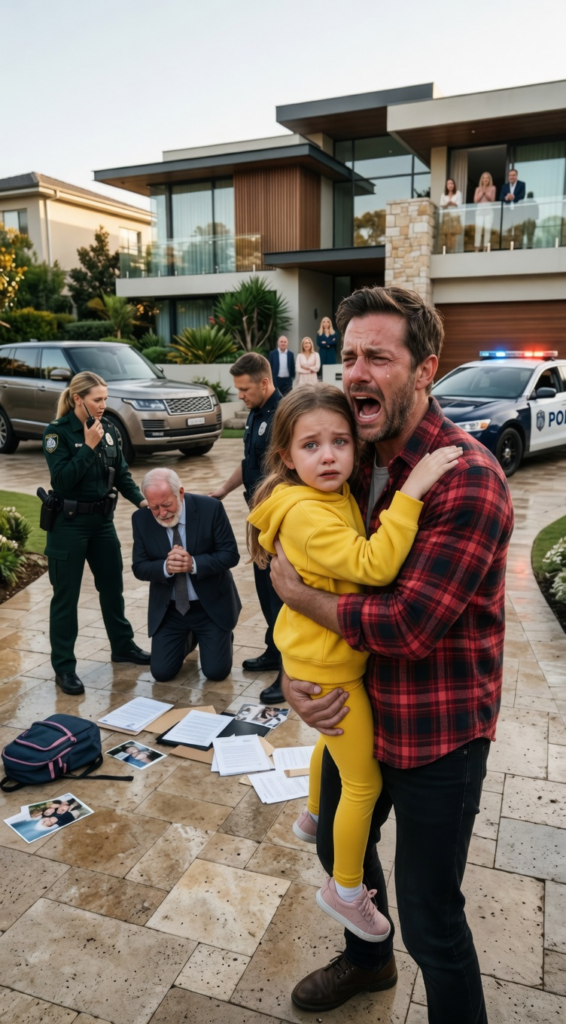
I walked slowly into the living room. On the plush sofa, wrapped tightly in two heavy blankets, Ana was curled into a tight, defensive knot. She was fast asleep, but her small body was still trembling slightly with residual adrenaline and trauma. Both of her small feet were heavily wrapped in thick, white medical bandages.
I dropped to my knees beside the couch, burying my face in the blanket near her shoulder, breathing in the scent of her hair, tears of profound relief finally spilling over my cheeks. She was alive. She was safe.
After a few minutes, I stood up and walked back into the kitchen.
“The hospital doctors cleaned her feet,” Elena said softly. “The glass and gravel cuts were deep. But Julian…”
Elena slid her smartphone across the granite counter toward me. “Look.”
I picked up the phone. Elena had taken photos of Ana’s injuries at the hospital before they wrapped her feet. The lacerations on her soles were horrific, but that wasn’t what made the blood freeze in my veins.
Above the cuts, ringing both of Ana’s delicate ankles, were deep, dark, jagged purple bruises. They were clearly defined. They were the unmistakable, violent shape of adult fingers. Someone had grabbed her by the ankles with immense, terrifying force, trying to drag her or hold her down.
“Has she said anything?” I choked out, my chest heaving as the reality of the physical violence hit me.
“Her vocal cords are completely locked. It’s a severe trauma response,” Elena whispered harshly. “She hasn’t spoken a single word since Mrs. Gable found her. But…”
Elena hesitated. She opened a drawer in the kitchen island.
“She wrote something else at the hospital, Julian,” Elena said, her voice dropping to a terrified whisper. “And this time, it’s not just about Arthur.”
Elena slid a crumpled, tear-stained piece of yellow notebook paper across the counter.
I stared at the paper. Ana’s shaky, uneven, child-like handwriting stared back at me in blue ink.
Mommy watched. Mommy locked the door.
The kitchen tilted violently on its axis. I gripped the edge of the granite counter to keep from collapsing.
Sarah. My wife. The woman I had loved for ten years.
She hadn’t been asleep. Her phone hadn’t just been off or out of battery. She had been awake. She had been in the room. She had stood there and watched her father violently assault our seven-year-old daughter, and instead of protecting her child, she had locked the door to trap Ana inside with the monster.
The betrayal was so absolute, so fundamentally unnatural, that it bypassed grief entirely and immediately crystallized into an icy, impenetrable wall of pure, unadulterated rage.
“Where is Sarah now?” I asked, my voice dropping to a dead, terrifying calm.
“She called my phone an hour ago,” Elena said, her eyes dark with disgust. “She said she was still at her father’s house. She claimed Ana had a ‘sleepwalking episode’ and got confused, and that Mrs. Gable and I were overreacting. She’s on her way here right now, Julian. She thinks she can just walk in, pick Ana up, and take her home to pretend nothing happened.”
I looked at the crumpled piece of paper on the counter. I looked at the photos of the bruises on my daughter’s ankles.
“Let her come,” I said, pulling my laptop out of my bag and setting it on the counter. “Because I’m going to make sure she never takes Ana anywhere, ever again.”
3. The Data Analyst’s War
I didn’t scream. I didn’t smash a hole in the drywall. I didn’t break down into a hysterical mess.
I opened my laptop, connected to Elena’s Wi-Fi, and went to work.
I was a senior data analyst for a global financial firm. I lived my entire professional life in the architecture of information. I understood databases, encryption protocols, and digital footprints better than I understood human emotion. And I knew one absolute, undeniable truth about criminals: liars always leave a digital trail.
Sarah was meticulous about her appearance, but she was fundamentally lazy about her cybersecurity.
A year ago, when she bought a new iPhone, she had asked me to set up her cloud backup. I had done so, linking it to a shared family administrative account to easily transfer photos. She had completely forgotten that I still retained full administrative privileges to her cloud storage.
I bypassed the two-factor authentication by routing the verification code to my master email. I accessed her cloud backup and downloaded the complete, unencrypted archive of her iMessage history.
I didn’t care about her conversations with her friends. I ran a targeted search for every message exchanged between Sarah and her father, Arthur Vance, over the last forty-eight hours.
The truth unspooled on my screen in a series of horrific, frantic, and damning text messages.
Arthur Vance wasn’t just a wealthy real estate patriarch. He was running a massive, highly illegal offshore embezzlement and money-laundering ring through his various property holding LLCs. And Sarah, who held a degree in finance, wasn’t just his daughter; she was acting as his primary, silent accountant, helping him cook the books to hide the illicit funds from the IRS.
As I read the texts timestamped from 1:15 AM the previous night, the horrifying narrative of Ana’s assault became crystal clear.
Ana hadn’t just woken up and wandered into the wrong room. She had woken up thirsty and gone to the kitchen for water. Arthur and Sarah had been working late in the home office, finalizing a massive, illegal wire transfer to a Cayman Island account.
Ana had accidentally stumbled into the office, startled them, and dropped her glass of water directly onto the external hard drive containing the unencrypted, master ledgers of Arthur’s entire criminal enterprise.
The texts revealed the aftermath.
Arthur, terrified of losing the data and facing federal prison, had exploded in a violent, uncontrollable rage. He had lunged at Ana, grabbing her violently by the ankles as she tried to run away in terror.
Sarah’s texts to Arthur later that night confirmed her complicity.
Sarah: Dad, you grabbed her too hard. She’s bruised. I locked the door like you said so she wouldn’t wake the staff, but she climbed out the window while we were trying to dry the drive.
Arthur: I don’t care about the bruises. If that drive is fried, we are both going to federal prison. Tell the school she sleepwalks. Do not let Julian see her feet.
Sarah had prioritized her inheritance, her lifestyle, and her fear of federal prosecution over the safety and life of her own child. She had actively aided in the assault and the subsequent cover-up.
I sat back in my chair, staring at the screen. The evidence was irrefutable. It wasn’t a he-said, she-said domestic dispute. It was documented, timestamped proof of felony child abuse and massive federal financial crimes.
“I have the texts,” I said to Elena, my voice a hollow, robotic monotone as I hit print. The printer in the corner of the kitchen hummed to life, churning out pages of their own damning words. “I have the IP addresses for the offshore accounts. I have the routing numbers for the embezzlement.”
I turned to my sister.
“Call Detective Miller at the precinct,” I instructed. Miller was a local detective Elena knew through her work as a family court advocate. “Tell him to meet us here immediately. Tell him to bring backup. The trap is set.”
4. The Confrontation of the Mother
At exactly 8:30 AM, the doorbell of Elena’s house rang.
I walked to the front window and peered through the blinds.
Sarah was standing on the front porch. She was dressed in a comfortable, maternal-looking sweater. She was holding a plush teddy bear and wearing a frantic, perfectly executed, performative mask of exhausted motherly concern. She was ready to play the victim of a stressful night, ready to gaslight me, ready to smooth over the “misunderstanding” and take her daughter back to the house of horrors.
She thought she was walking into an argument with her husband about her father’s temper.
She didn’t know she was walking into a federal indictment.
I unlocked the deadbolt and pulled the door open.
Sarah rushed in immediately, dropping the teddy bear onto the console table, reaching her hands out toward me.
“Julian! Thank God you’re home,” Sarah gasped, her voice trembling with fake emotion. “I was so worried! Elena wouldn’t answer my calls! Ana has been having these terrible, terrifying sleepwalking episodes lately. We didn’t want to worry you while you were in Geneva. My dad tried to stop her from leaving the house, but she just panicked and ran out the door before we could catch her! Is she okay?”
“Is that what happened?” I asked, my voice dangerously even, keeping my hands in my pockets.
“Yes! We were absolutely terrified!” Sarah insisted, her eyes wide, playing the role to perfection. She looked past me, toward the hallway leading to the living room. “Where is she? Let’s get her packed up. I need to take her home and get her to her own bed.”
She took a step forward.
I stepped smoothly into her path, my large frame completely blocking the hallway.
“She’s not going anywhere with you, Sarah,” I said flatly.
Sarah sighed, a harsh, irritated sound. The concerned mother facade slipped for a fraction of a second, revealing the manipulative, dismissive woman beneath. She crossed her arms over her chest.
“Julian, please don’t be dramatic,” Sarah scolded, using the exact same word her father had used on the phone. “I know you’re stressed because you flew all night, but she’s fine. It’s just a few scrapes on her feet from the pavement. We’ll put some Neosporin on it. You are overreacting.”
I reached into the pocket of my jeans. I pulled out the two pieces of notebook paper.
“She isn’t fine, Sarah,” I stated, holding the papers up so she could see them. “She is in a severe state of shock. She hasn’t spoken a single word since they found her. Her vocal cords are locked. But she did manage to write this.”
Sarah’s eyes darted to the first note. Grandpa hurt me.
She swallowed hard, her throat bobbing visibly. A genuine flicker of panic broke through her carefully constructed facade.
“She… she’s confused, Julian,” Sarah stammered, taking a small step backward. “She was sleepwalking. She tripped and Dad tried to catch her. She just doesn’t remember it right.”
I slowly lowered the first note and held up the second crumpled, tear-stained piece of paper.
Mommy watched. Mommy locked the door.
The blood drained completely, violently from Sarah’s face. She looked exactly like a ghost. Her mouth opened, but no sound came out. The air in the hallway became thick and suffocating.
“And before you try to tell me that a traumatized seven-year-old is lying to manipulate me,” I added, turning and grabbing the thick stack of freshly printed text messages from the console table. I slammed the papers against her chest, forcing her to take them.
“I accessed your cloud backup, Sarah,” I said, my voice dropping to a lethal, freezing whisper. “I read your texts to Arthur from 1:30 AM. I know about the water on the hard drive. I know about the offshore Caymen accounts. I know about the embezzlement.”
Sarah stared at the printed texts in her hands, her eyes wide with absolute, unadulterated terror.
“I know,” I continued relentlessly, “that you stood there and let your father violently beat our daughter because you were afraid of losing your inheritance and going to federal prison.”
5. The Arrest and the Excision
Sarah stumbled backward, her legs hitting the front door. The papers slipped from her trembling hands, scattering across the hardwood floor.
“Julian… Julian, you don’t understand!” Sarah shrieked, the panic finally, totally consuming her. The facade was entirely obliterated. “He was going to cut me off! If that drive was ruined, we would have lost everything! The business, the house, everything! It was just a bruise, Julian! She’s fine! You can’t ruin our lives over this!”
“She’s not fine,” a deep, authoritative voice echoed from the kitchen doorway.
Detective Miller stepped into the hallway, his badge prominently displayed on his belt. He was flanked by two large, uniformed police officers. They had been waiting in the kitchen the entire time, listening to her desperate, damning attempts to justify the abuse.
“And neither are you, Mrs. Mea,” Detective Miller stated coldly.
Sarah shrieked, pressing herself against the door as the two uniformed officers advanced on her.
“Sarah Mea,” Detective Miller said, pulling a pair of heavy steel handcuffs from his belt. “You are under arrest for felony child endangerment, conspiracy to commit financial fraud, and accessory to aggravated assault.”
“No! Julian, please!” Sarah wailed, struggling wildly as the officers grabbed her arms and forced them roughly behind her back. “I’m her mother! You can’t do this! Tell them to stop! I love her!”
I didn’t flinch. I didn’t feel a shred of pity. I looked at the woman who had prioritized a hard drive over the safety of our child.
“You stopped being her mother the exact second you locked that door,” I said, staring at her with absolute, profound disgust. “Enjoy federal prison, Sarah. I hear the Wi-Fi is terrible.”
The officers marched her out the front door, her hysterical sobs echoing down the quiet suburban street.
As they dragged her away, Detective Miller turned to me, his expression grim but respectful.
“We have a heavily armed tactical unit currently executing a no-knock warrant at Arthur Vance’s estate,” Miller informed me. “Between your data dump of the encrypted texts, the offshore routing numbers, and the child’s written statement, the DA is having a field day. Arthur is looking at twenty years in a federal penitentiary for the financial crimes alone, and that’s before we even add the assault charges on a minor.”
“Make sure he never gets out,” I said quietly.
“We will,” Miller promised.
I didn’t stay at the door to watch the squad cars pull away. I turned my back on the wreckage of my marriage and walked straight back into the living room.
Ana was awake.
She was sitting up on the couch, the heavy blankets pooling around her waist. She had heard the shouting. She was watching me with wide, terrified, incredibly vulnerable eyes.
I walked over to the couch. I didn’t say a word. I didn’t ask her to speak. I didn’t ask her to explain what had happened. I simply dropped to my knees on the floor in front of her, making myself as small as possible, and opened my arms wide.
Ana hesitated for a fraction of a second.
Then, she lunged forward. She threw her small body off the couch, burying her face deep into my shoulder. Her small, bandaged feet dangled in the air. Her hands gripped the fabric of my shirt with the desperate, crushing strength of a drowning victim holding onto a lifeline.
She began to cry.
It wasn’t a loud wail. It was a silent, violent, shaking sob that vibrated through her entire body, a release of pure, unadulterated terror and relief that broke my heart into a million pieces all over again.
“I’ve got you, baby,” I whispered fiercely into her hair, wrapping my arms tightly around her, shielding her from the world. “I’m right here. The monsters are gone. They are locked away. And they are never, ever coming back.”
6. The Sound of Safety
The next few months were a grueling, exhausting marathon of court dates, depositions, lawyers, and intense trauma therapy.
The criminal trials were swift and brutal. Faced with the overwhelming, irrefutable digital evidence I had harvested, and the horrific photos of Ana’s injuries, both Sarah and Arthur’s defense attorneys advised them to take plea deals to avoid the maximum sentences a jury would undoubtedly hand down.
Arthur Vance’s sprawling real estate empire was seized and liquidated by the federal government to pay massive restitution fines to the IRS. He was sentenced to twenty-five years in a federal penitentiary.
Sarah, for her role in the embezzlement and her active complicity in the assault, received twelve years. Her wealth, her status, and her freedom were utterly annihilated by the very data she had tried to hide.
I filed for divorce the day after her arrest. Given her felony conviction for child endangerment, the family court judge granted me sole, irrevocable, and permanent legal and physical custody of Ana. Sarah was stripped of all parental rights.
We didn’t stay in Boston. The city held too many ghosts, too many bad memories of a family that had proven to be a mirage.
I transferred to a remote position within my firm, packed our belongings, and moved us to a quiet, beautiful, sunlit house near the coast in Maine. It had a massive, fenced-in backyard, large windows that let in the ocean breeze, and absolutely no heavy oak doors with locks on the outside.
It was a sanctuary.
A year later, the harsh, bitter winter of our trauma had finally thawed into a warm, promising summer.
The intense therapy had worked wonders. The profound silence that had gripped Ana’s vocal cords for weeks after the assault had begun to crack. It started with soft whispers in the dark, then quiet, hesitant sentences, and eventually, the beautiful, loud, completely unobstructed sound of her real voice returned.
I was sitting on the wooden deck of our new house, a cup of coffee in my hand, the salty ocean breeze ruffling my hair.
I watched Ana running across the green grass of the backyard. She was chasing our newly adopted golden retriever puppy, laughing hysterically as the dog playfully nipped at her heels. Her feet were fully, perfectly healed. She was running barefoot against the warm, soft earth, entirely free of pain.
She stopped near the edge of the fence, picking up a brightly colored frisbee. She turned and looked back at me, a bright, brilliant, completely unburdened smile illuminating her face.
“Daddy! Look at him go!” Ana shouted, her voice ringing clear, strong, and incredibly loud across the yard as she threw the toy for the dog.
I smiled, a deep, profound sense of peace settling into my chest. I waved back at her.
As a data analyst, I had spent my entire adult life looking for patterns in numbers, analyzing trends, and believing that encrypted information was the ultimate, objective truth of the world.
But as I watched my daughter play in the sun, I realized how wrong I had been.
The most powerful, important, and devastating piece of data I had ever received in my entire life wasn’t on a spreadsheet. It wasn’t encrypted on a server. It was two shaky, terrified sentences written in blue ink on a piece of crumpled notebook paper by a seven-year-old girl in the middle of the night.
She had possessed the immense, unbelievable courage to write the truth when the adults in her life had tried to violently bury it.
I took a sip of my coffee, feeling the warm sun on my face, knowing with absolute, unshakeable certainty that I would spend the rest of my life ensuring she never, ever had to be silent again.