The first time my family had to say my name out loud in ten years, it happened in a marble lobby that smelled faintly of lemon polish and saltwater.
A front desk clerk with a tidy bun and a nervous smile stood behind a screen, glancing from my mother to my sister to the oversized suitcases lined up at their feet. She had no idea she was standing in the center of a fault line. She was just doing her job.
“I’m sorry,” she said again, polite and careful. “Are you on Miss Gellhorn’s guest list?”
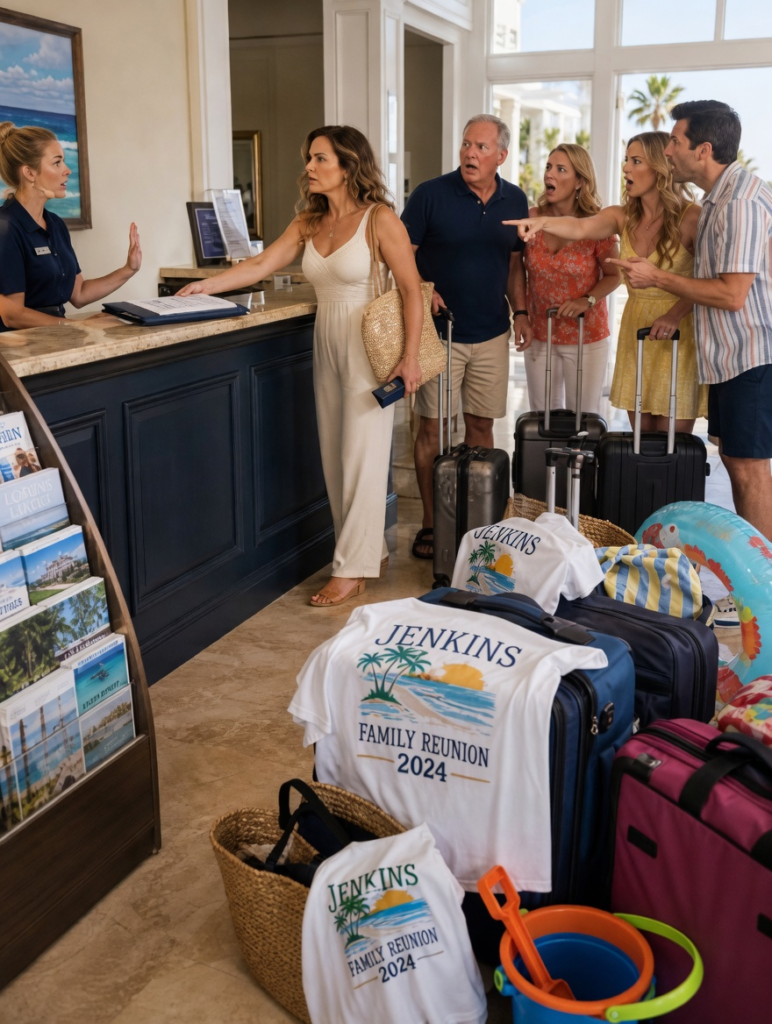
My sister Trinity blinked hard, as if the room itself had become unreliable. My mother, Iris, actually looked over her shoulder, as though perhaps some other Miss Gellhorn might emerge and save her from the inconvenience of saying my name. Nelson let out a laugh too loud to be natural. Cousin Bryce shifted from one foot to the other. Aunt Mel tightened her hand around her handbag. Four suitcases, two beach totes, one plastic bag full of pool toys, and a decade of pretending I did not exist all stood there with them.
The clerk smiled again, smaller this time. “I can’t authorize access without confirmation.”
None of them answered.
That was the thing about erasing someone slowly. You got used to the blank space. You stopped noticing the violence of it. You stopped hearing your own cruelty because silence made it look clean.
Ten years of edited photos, empty chairs, missed invitations, and carefully rehearsed excuses had led to that one question.
Are you on Miss Gellhorn’s guest list?
A week earlier, on a Monday morning that should have been ordinary, I had opened my inbox and found out exactly how far they were still willing to go to keep me out.
The subject line hit my screen at 8:14 a.m., bright and cheerful and cruel enough to make my stomach turn.
Brooks Family Beach Week 2025 — RSVP Now
I stopped breathing long enough for the cursor to blink three times.
Monday mornings were usually built from a predictable kind of exhaustion. Coffee poured, then forgotten. A protein bar opened, then abandoned after two bites. A screen full of emails marked important by people who had never once understood what the word meant. I worked in healthcare logistics for a consulting firm that liked to describe itself as “mission-driven” and “aggressively excellent,” which usually meant someone else’s emergency became my calendar. That morning I was halfway through untangling travel changes for a medical symposium in Chicago, headset on, legal pad full, second browser open to a budget sheet, when that subject line appeared and rearranged my entire body.
I clicked before I could talk myself out of it.
The email thread opened like a trap door. There they all were. Trinity at the top, using the bright, exclamation-happy tone she reserved for social charm and strategic cruelty.
Hi, loves! We locked in Beach Week! Same house, same sunset dinners, same chaos. RSVP by Friday so I can finalize rooms. Can’t wait to have everyone together again.
Below that, the replies stacked like evidence.
Bryce: I call the downstairs room this year. My back is too old for bunks.
Aunt Mel: I’m bringing lemon bars and cards. Someone keep Jack away from the tequila.
Nelson: Master suite or I riot.
Darren, who I had not seen since before my grandmother’s funeral: If there’s Wi-Fi, I’m in.
Trinity again, sending a photo of the fire pit at sunset from the previous summer, with the caption: Can’t wait to do this again with my people.
My people.
I read the CC line once. Then twice. Then a third time, because denial is stupid and stubborn and often wears the face of hope.
My name wasn’t there.
Not in the thread. Not in the original list. Not hidden in BCC. Not misspelled. Not forgotten by autocorrect. Not lost under an old address. Just absent, cleanly and intentionally, as if omission were a neutral act.
I scrolled lower, even though I already knew. Sometimes your body keeps reaching for the stove after your mind has learned the burn.
There was no follow-up email. No correction. No casual, Oh my God, Kaia, I used your old address. No private note saying, You know there’s always room for you. There was only the cheerful architecture of exclusion. Jokes. GIFs. Shared memories from last summer. Room debates. Someone mentioning the bonfire playlist. Someone else asking whether the kids could have the bunk room again.
The fire pit photo sat there in the middle of the screen, and in an instant I was eight years old again, barefoot on that beach, roasting a marshmallow that kept catching fire because I held it too close and refused to ask for help. My father laughing. My grandmother wrapping a towel around my shoulders because I was shivering and pretending I wasn’t. Trinity already older and more practiced at being seen. The house behind us all lit up from the inside, every window glowing, every room full.
Back then I still believed glowing houses meant glowing hearts.
I stared at the email until the words blurred. My office, all glass and steel and coastal light, suddenly felt too sterile to breathe in. My degree on the wall looked like a prop. The Santa Monica skyline outside my window seemed indecently bright. I became aware, all at once, of the small humiliations of the morning: the coffee gone cold by my elbow, the half-opened packet of almonds, the headset slipping from one ear, the fact that somewhere in the hall a group of junior associates were laughing at something that had nothing to do with me.
I closed the email, reopened it, then closed it again.
Last year’s excuse came back in my mother’s voice so clearly I almost looked up.
It must have gone to spam, sweetheart. You know how tech can be.
She had laughed softly when she said it, as though the technology in question were a mischievous child and not a family system that kept swallowing me whole.
I pushed my chair back and turned toward the bookshelf behind my desk, not because I had any reason to, but because pain has habits. On the second shelf, tucked behind old industry manuals and a drooping jade plant I kept forgetting to water, sat a turquoise glass seashell.
I had owned it since I was ten.
My mother had given it to me on a birthday that now felt like a rumor. We had been driving back from a softball tournament of Trinity’s when we passed a roadside antique store with a hand-painted sign and a yard full of rusting metal chairs. Mom had gone in for five minutes and come out twenty later with that shell wrapped in newspaper.
“It looked special,” she had said, placing it in my lap. “For my special girl.”
That had been before Trinity became her pride in public and her shield in private. Before she started introducing me to people as “our youngest, the one who’s always so busy with work,” in the same tone some people used for weather or tax forms. Before I learned that being the youngest in our family did not mean being cherished longer. It meant being useful longer.
“You okay?”
I jumped.
Remington stood in my doorway holding his usual mug of over-steeped green tea, tie loosened, brow furrowed in the cautious way of a person who knew enough not to ask the wrong question too brightly. He was one of the few men in the firm who could sit through a meeting without trying to turn it into a TED Talk. That alone made him worth tolerating.
“Yeah,” I said too quickly. “Just a weird email.”
He glanced at the closed laptop, then at my face. “From them again?”
I should have been offended that it showed. Instead I just let out a thin breath and shrugged.
“That obvious?”
“Only if someone knows what you look like when you’re pretending not to care.”
I looked down at the stack of symposium documents on my desk. “I’m fine.”
He held my gaze another second, then nodded once. “I’ll move the 11:30 if you need it.”
I didn’t say thank you until he’d already turned away.
When the door clicked shut behind him, the room went quiet again. I stared at the promotion packet sitting to the right of my keyboard. Senior Vice President. At thirty-eight, I was the youngest candidate the firm had ever put forward. It should have felt like triumph. I had spent fifteen years earning that folder—surviving men who confused volume with authority, clients who called me “sweetheart” in rooms where I controlled seven-figure contracts, and twelve-hour days stitched together by airport coffee and adrenaline. I had built a life so structurally sound it ought to have protected me.
It didn’t.
Because the skill set required to survive a boardroom and the wound of being unwanted by your own family lived in entirely different parts of the body.
My phone buzzed.
Savannah.
Saw the invite. Want to crash it just for laughs?
I stared at her message. Savannah was my cousin on my mother’s side, six months younger than me and somehow both less sentimental and more loyal than anyone else in the family. She had grown up watching the same machinery I had, though from a safer distance. Her mother, Aunt Mel, was too self-absorbed to be cruel with any real precision, which in our family counted as kindness.
My thumbs hovered over the keyboard.
Then I typed: Or maybe it’s time I did something smarter.
I opened a browser tab I had saved weeks earlier and told myself I had only kept for curiosity.
The listing loaded in less than two seconds.
Villa 404, Ocean Crest Club. Three stories. Wraparound deck. Six bedrooms. Private beach access. Managed services. Off-market inquiries welcome.
We still called it the beach house, because families prefer simple names for complicated things. Technically it wasn’t a stand-alone house anymore. Years earlier, the old Brooks place had been rebuilt and absorbed into a luxury coastal management community after storm damage nearly leveled the structure. My mother had loved the renovation because it allowed her to say “our beach house” while someone else handled the staff, the grounds, the bookings, the linens, the repairs. Ocean Crest had a reception desk, a service elevator, a discreet hospitality staff, and the kind of polished, moneyed quiet that made other people’s family drama look tasteful from the outside.
But beneath the new stucco and glass, it was still the same property. Same lot. Same view. Same wind off the water. Same porch line where my father used to read Steinbeck aloud when I was little and still believed books could explain people.
The photos on the listing made my chest tighten. The porch. The kitchen table. The upstairs deck where Trinity had taken her maternity photos in white linen, smiling out at a horizon I hadn’t even known she was standing in front of until the pictures were posted. The den where my parents had toasted their thirtieth anniversary while I sat in a hotel conference room in Minneapolis, wondering why no one had called me back all weekend.
The market had dipped. Oceanfront inventory had loosened. And, according to the discreet listing language, the owners were “motivated.”
I stared at the Contact Agent button until my heartbeat steadied into something cold and sharp.
Then I clicked it.
The confirmation email arrived before I had enough time to regret myself. I was still reading the realtor’s reply—Thank you for your interest, Ms. Gellhorn. I can meet tomorrow at 10:00—when my phone lit up with the ringtone I had assigned to my mother years ago and never bothered to change.
A string quartet passage she once loved.
The irony almost made me laugh.
I let it ring twice before answering. “Hi, Mom.”
There was the briefest pause, the sound of her rearranging herself into kindness.
“Kaia, dear.”
That voice. Soft at the edges. Sugar stirred into poison. She used it when she was about to ask for money, excuse a slight, or say something unforgivable while hoping her tone would do the laundering.
I leaned back in my chair. “Let me guess. Trinity’s kids need the bunk room again.”
Another pause.
“Well,” she said lightly, “you know how chaotic it gets with little ones.”
I closed my eyes.
“The house is just limited this year,” she continued. “And with everyone coming in from different places, we had to make some practical decisions. I didn’t want you hearing it secondhand and feeling blindsided.”
She said this as though I had not learned about it by being excluded from the RSVP thread she had clearly seen. As though forewarning and inclusion were cousins. As though I ought to appreciate the etiquette of being erased cleanly.
“So this is a courtesy call?” I asked.
“Don’t make it ugly.”
There it was. The family reflex. Pain became ugliness the moment I named it.
I swiveled in my chair and looked out at the city. “What exactly do you want me to say, Mom?”
“I want you to understand.”
Same line. Different summer. She had used it two years earlier when she called me the day before Beach Week to explain that the downstairs room had gone to Bryce and his girlfriend, the bunk room to Trinity’s boys, the guest room to Aunt Mel because of her hip, and the foldout sofa in the den “wouldn’t really be fair” to me since I was “used to better hotels.”
Before that, there had been the year Trinity forgot to send the dates until airfare tripled.
Before that, Nelson was “going through something” and needed space.
Before that, there had been no room because they’d invited friends.
Before that, a vague misunderstanding.
Before that, a mix-up.
Before that, silence.
I understood exactly. I just no longer mistook understanding for forgiveness.
“I understand perfectly,” I said. My voice surprised even me. It was calm. Not brittle. Not trembling. Just done. “Thanks for the heads-up.”
“Kaia—”
I ended the call.
For a long minute, I sat perfectly still.
No tears. No thrown phone. No dramatic collapse. I had exhausted those rituals years ago. Grief becomes efficient when it’s forced to repeat itself. I rose, walked to the office kitchenette, filled a glass with water, drank it slowly, and came back to my desk.
Then I opened a spreadsheet.
If my family had taught me anything useful, it was this: when emotion failed, numbers often told the truth.
My personal financial statement lived in a password-protected folder labeled boring for exactly this reason. Liquid accounts. Stock options. Bonus projections. Real estate equity. Discretionary assets. I scanned each line, not with panic, but with a kind of sharpening focus. The figures lined up the way loyal things do when they’ve never once pretended to love you.
My phone buzzed again before I could finish.
Savannah: Screenshot incoming.
She never sent a screenshot without warning. The one that loaded a second later came from a group chat I was not in and had apparently never been meant to see.
Core Brooks Only.
Even the title made me smile, though not kindly.
The most recent messages sat at the bottom.
Trinity: Don’t worry. Kaia said she’s not coming again. Wants to make it about herself as usual.
Nelson: LMAO.
Aunt Mel: Well… maybe it’s better this way.
Uncle Jack: That girl needs therapy.
Then, a little higher up, my mother.
Iris: She’s too busy being important to care about family. Don’t feel bad excluding her. She’s used to being alone.
I read that line twice, then once more, not because I doubted it, but because some part of me was still measuring the distance between what people did and what they admitted to themselves about why they did it.
Used to being alone.
There was an odd mercy in seeing the sentence written down. No more excuses. No more interpreting tone. No more trying to decide whether the cut had been deliberate. They weren’t just forgetting me. They were explaining my absence to one another as though it were a personality trait. Turning exclusion into proof that I had chosen solitude. Rewriting me in real time and calling it family narrative.
Under the numbness, something else arrived.
Not rage. Rage is hot and obvious and easy to misuse. What came instead was cooler, cleaner. Clarity.
I leaned back and let an old memory rise because I knew exactly why it was there.
The summer I turned ten, I spent an entire afternoon on that beach building a mermaid out of wet sand. She had a long tail curled toward the tide line, shell earrings, seaweed hair I braided in three sections, and a necklace made from tiny gray pebbles I dug out one by one. My fingers were raw by the time I finished. When the family came down from the house, they gathered around it in a loose half-circle.
Trinity stepped forward first.
“She’s incredible,” my mother said.
Trinity smiled for the camera, one hand resting on the mermaid’s head.
No one corrected her. Not Trinity. Not Mom. Not Dad. Not Aunt Mel, who took the photos. Not even me.
That night I cried into my pillow in the bunk room while downstairs they toasted Trinity’s creativity over white wine and grilled fish.
It was never one large betrayal. That would have been too visible. It was a thousand small edits. A hand on the wrong sculpture. A missing name in a caption. A “we assumed you were busy.” A family photo posted after my body had been cut from the frame.
Edited photos.
There had been so many of those.
At sixteen, I’d noticed my shoulder disappear from a Christmas card image because Trinity wanted more symmetry beside Nelson.
At twenty-two, my head was literally cropped out of a birthday post because, according to Trinity, “the composition was weird.”
At thirty-three, my entire presence at my father’s birthday dinner vanished online because “it was just a better shot without all the clutter in the background.”
The clutter had been me.
I looked back at the spreadsheet on my screen, then over at the real estate listing still open in the second window.
This time, I thought, I won’t beg for a seat.
I won’t cry into the phone.
I won’t ask why.
I picked up the pen lying beside my keyboard and tapped it once against the desk.
Then I whispered, to no one and myself alike, “Let’s play, then.”
The next morning I left work early and drove down the coast to Newport Beach for my appointment with the realtor.
Ocean Crest Club rose from the edge of the water like it had been designed by someone who understood both wealth and camouflage. Cream-colored walls, blue-glass windows, manicured grasses that looked effortlessly windblown, and enough understated security to keep everyone honest. The reception building sat between a surf boutique and a café selling seven-dollar espresso in ceramic cups thin as eggshells. Beyond it, the villas curved toward the water, each with private access but shared management—like a row of dignified secrets facing the sea.
I parked, took one look at my reflection in the rearview mirror, and decided I looked exactly like a woman doing something irreversible.
Inside, the real estate office smelled like white tea and fresh paper.
The woman who stood to greet me was in her late fifties, with graying curls pinned loosely at the nape of her neck and a lavender scarf tied at her collar. She had the sort of face that had probably spent years in rooms full of people lying politely about money.
“Ms. Gellhorn?” she asked.
“Yes.”
“I’m Celeste Hart. Thank you for coming.”
Her handshake was warm and firm. She led me past a wall of framed aerial coastal photos to a glass conference nook overlooking the water. When she opened the digital file on her tablet, Villa 404 bloomed across the screen in bright, immaculate detail.
“Beautiful property,” she said.
“It is.”
She looked at me over the edge of the tablet. “Your name sounded familiar when your inquiry came in. Are you related to the current owners?”
The sea beyond the glass flashed silver in the morning light. I held her gaze.
“Yes,” I said. “But maybe not for long.”
Something shifted in her face then. Not shock. Recognition. She had clearly seen enough family transactions to know when to stop pretending they were about granite countertops and square footage.
She slid a paper packet across the table. “There are some complications.”
“Financial?”
“And legal. Potentially.”
I opened the packet. Tax statements. Insurance notices. Maintenance arrears. Delinquency letters from the management company. A quiet notice of intent to market the property discreetly in order to settle outstanding obligations.
I read each page once, then again more slowly.
My parents hadn’t just decided to sell. They had let the place start sinking under its own upkeep before trying to offload it quietly. The beach house, our family shrine to tradition and belonging, was being treated like any other asset the moment it became inconvenient enough.
“I thought they would have told the family,” I said, surprising myself by saying it out loud.
Celeste gave me a look that was both professionally neutral and unmistakably human. “Families tend to tell each other the last thing that preserves control.”
I almost smiled.
She tapped one of the documents. “There’s also something unusual in the historical title chain. An earlier trust structure. I’d strongly advise you to speak with an estate attorney before you make an offer. This property may not move through a standard sale.”
My skin prickled.
“What kind of trust structure?”
She hesitated, then turned the tablet so I could see a note in the transfer history. Prior contingent rights reserved under Brooks Estate Trust. Review beneficiary clause before close.
Brooks Estate Trust.
My grandmother.
I hadn’t heard those words in years.
Celeste reached into the folder again and handed me the business card of a law firm. “McCarron and Wells handled several of the original estate documents. Arthur McCarron is still practicing. He’d know what this means.”
I looked from the card to the ocean, and something old and almost forgotten moved inside me.
My grandmother had never trusted smooth surfaces. She liked basements, attics, locked drawers, recipe cards with annotations in the margins, and backup copies of everything. “Always keep one truth where the liars won’t think to look,” she used to say while sliding important papers into labeled folders no one else in the house respected enough to read.
After I left Ocean Crest, I didn’t drive back to the office.
I drove inland instead, toward a storage facility in Costa Mesa I had been paying for on autopilot for five years.
The hallway smelled like dust, concrete, and stale summer. Unit 43B sat at the end under a flickering fluorescent light. I unlocked it, lifted the metal roll-up door, and stood there for a moment staring at the stacked remains of versions of myself I had outgrown.
A dining table from my first apartment.
Boxes labeled COLLEGE, WINTER CLOTHES, TAXES 2013-2015.
A crate of books I’d once believed would make me into the kind of adult who hosted dinner parties and quoted Joan Didion naturally.
And in the back corner, exactly where I remembered it, the cedar trunk that had belonged to my grandmother.
The lid creaked when I opened it. A faint breath of lavender rose from inside, and just like that I was twelve again in her guest room, watching her tuck dried sachets into dresser drawers because “moths love neglect and so do men.”
I laughed under my breath at the memory, then stopped when I saw the journal.
Ocean blue. Seashells glued unevenly to the corners in that lopsided, unapologetic way she had. I had made fun of it once when I was fifteen.
“They’ll fall off,” I’d said.
“Then glue them back,” she answered. “Truth doesn’t stop being true because the edges get ugly.”
Beneath the journal lay a sealed envelope.
My name was written across the front in her slanted, deliberate hand.
For Kaia. Open only when you stop looking for permission.
The storage unit went very quiet.
I sat cross-legged on the concrete floor with the envelope in my lap and did not immediately open it, because there are some things the body understands before the mind does. My hands already knew this was going to rearrange my life.
Inside was a letter, folded twice, and a sheaf of legal papers held together by an old brass clip.
I read the letter first.
My darling girl,
If you are reading this, then the silence has finally become loud enough.
I am sorry for every room in which you were made to feel temporary.
There are people who will only love what they can control. Learn them early and leave them hungry.
I set something aside for you because I knew one day they would mistake your quiet for surrender. It never was.
Use this when the time comes. Not to punish. To preserve.
Love does not always come from those who raise us. Sometimes it finds its way through the cracks.
Grandma
My throat tightened so fast it hurt.
I set the letter down with care that bordered on reverence and turned to the legal papers.
Even before I fully understood the wording, I knew what I was looking at.
The Brooks Estate Trust.
Property contingency clause.
Beneficiary: Kaia Elise Gellhorn.
The language was dense, old-fashioned, and exact. My grandmother had transferred the original property into a trust years before the rebuild, retaining a contingent reversionary right on the land itself. If the primary occupants—my parents—failed to maintain tax and insurance obligations, or attempted a sale while in delinquency, the named contingent beneficiary, me, could cure the defaults and execute a priority title transfer under pre-authorized trust terms.
I read the clause three times.
Then I laughed once, sharply, because it was either that or break open.
My grandmother had seen it coming.
Maybe not every detail. Maybe not the emails or the edited photos or the group chat called Core Brooks Only. But she had seen enough. She had seen the pattern. She had seen the way I was gradually being treated like a guest in a house built from my own bloodline. And because she was the kind of woman who salted her tomatoes, paid cash when she could, and prepared for storms before clouds gathered, she had left me a door hidden inside the walls.
By the time I left the storage unit, the sun had shifted west and my entire understanding of the week had changed.
At ten the next morning, I was sitting across from Arthur McCarron in an office lined with dark bookshelves and framed maps of California properties older than most of the buildings around them.
He was in his sixties, narrow-shouldered, silver-haired, with reading glasses perched low on his nose and a voice that suggested he had long ago lost interest in theatrics. When I handed him the trust documents, he read them without interruption, occasionally making a small sound in the back of his throat.
At last he set the papers down and looked at me.
“Your grandmother was formidable.”
“Yes,” I said, and it was the easiest answer I had given anyone in years.
He folded his hands. “This is enforceable.”
I felt the room tilt, not from surprise, but from the simple force of hearing the thing I most needed confirmed.
He tapped the key clause. “When the property was reconstructed and moved under the managed villa structure at Ocean Crest, the land rights and trust contingencies remained attached. Most people wouldn’t know what they were looking at unless they had reason to dig. Your parents appear to have defaulted on taxes and several required obligations, then initiated an off-market sale. That triggers your grandmother’s contingency.”
“So I can stop the sale.”
“You can do more than stop it.” His eyes sharpened. “If you cure the defaults and assume the transfer terms outlined here, title can pass directly to you. Not as a sentimental appeal. Not as a request. Legally.”
I sat back in the chair and let that settle where ten years of begging used to live.
Arthur slid another document toward me, this one newer, cleaner, clinical where my grandmother’s papers were intimate.
“There will almost certainly be pushback once they realize what’s happened,” he said. “But based on the paperwork, the delinquency record, and the trust language, they don’t have much ground. Your father’s signature is not the central issue. The default condition is.”
“My father,” I said slowly, “does he know any of this?”
Arthur’s expression softened, but only slightly. “I can’t answer that. I can tell you this: the notices were sent. Whether he saw them or was allowed to see them is another matter.”
Allowed.
In our family, control often wore the clothes of management.
I thought of my father after his fall two years earlier—hip fractured on the back steps, stubborn dignity cracked wider than the bone. Trinity flew in for a weekend and posted selfies from his hospital room. Nelson sent a fruit basket with the wrong last name on the card. I canceled a conference, stayed four days, handled his discharge instructions, argued with billing, and made sure his pain medication was actually filled. When I left, he had squeezed my hand and said, in a voice that sounded embarrassed by its own tenderness, “I always breathe easier when you’re here.”
It was one of the last honest things he ever gave me.
Arthur must have seen some part of that memory pass over my face, because his voice gentled.
“Ms. Gellhorn. If you want to do this, do it because it is yours to do. Not because you’re still trying to be chosen.”
That landed harder than any legal explanation.
I looked at the papers in front of me. Thought of my inbox. Thought of the group chat. Thought of my mother’s sentence—She’s used to being alone. Thought of my grandmother writing, Use this when the silence becomes unbearable.
Then I picked up the pen.
“Yes,” I said. “I want to do it.”
The transfer required money, but not more than I could handle. Years of choosing discipline over comfort had left me something no one in my family had ever bothered to understand: leverage. I paid the outstanding obligations, signed the petition, authorized the filings, and walked out of Arthur McCarron’s office with a folder under my arm and a pulse so steady it felt unfamiliar.
No shouting. No dramatic announcement. No family conference call. Just signatures, transfers, and truth.
By Friday afternoon the title process was officially in motion.
By Monday the management company acknowledged me as incoming controlling owner.
And by Tuesday, while Trinity was still sending room assignment emails to a family who thought the beach house belonged to tradition rather than paper, I had access to the owner portal for Villa 404.
I logged in from my kitchen table with a glass of red wine beside the laptop and watched the booking calendar open.
There it was: Beach Week blocked under a family use notation that had not yet been formalized into an approved guest list. Trinity had submitted preferred room assignments, meal notes, and service requests as if she were empress of the tides.
Master suite — Nelson (he insists, lol)
Bunk room — boys
Downstairs queen — Mel + Jack
Ocean double — Savannah if she comes
Old blue room — overflow
Old blue room.
My room.
The one with the brass desk, the crooked bookshelf my father had built when I was thirteen, and the quilt my grandmother made the winter I got pneumonia. My old room had apparently become overflow.
Something in me went very still.
Five minutes later, Savannah sent another screenshot.
This one from a side thread with Trinity and my mother.
Iris: Ask Savannah if she minds staying in Kaia’s old room.
Trinity: It’s just sitting there anyway.
Iris: Exactly.
Just sitting there anyway.
That was the thing about the erasure. They never thought of it as theft. They thought of it as efficient redistribution. If I wasn’t in the room, then the room became available. If I didn’t get the call, then the story changed shape around my silence.
I opened the owner booking tools and made one simple adjustment.
Reservation override.
Guest: Ms. Kaia Gellhorn.
Length of stay: four nights.
Suite: Master.
Additional access: none without owner approval.
Then I opened the guest authorization field and typed carefully.
No access to Villa 404 without explicit confirmation from owner or authorized property manager. If family members arrive claiming historical use, please direct them to reception and contact me before issuing keys.
In the notes section, I added, because precision has always calmed me:
Welcome setup requested. One bottle of Perrier-Jouët on ice. Cotton sheets. Firm pillows. Full privacy.
I hit submit.
The confirmation arrived instantly.
It wasn’t triumph I felt. Not yet. Triumph is loud. This was quieter and, in some ways, more devastating.
For the first time in ten years, the system contained my name where theirs expected blank space.
That weekend I drove east to the cemetery where my grandmother was buried.
The little ice cream parlor she loved was still there just off the main road, white clapboard and striped awning, unchanged enough to feel like a conspiracy against time. I bought a scoop of lavender honey in a sugar cone because she always said if you were going to eat sugar, it ought to remind you of something worth remembering.
The cemetery sat on a low hill edged with dry grass and pepper trees. Wind moved over the stones in small waves. My grandmother’s marker was modest, exactly as she would have wanted—name, dates, one carved sprig of rosemary because she said roses were too theatrical for the dead.
I sat in the grass beside her, knees bent, ice cream dripping down my thumb.
“Hey, Grandma,” I said.
The breeze answered first.
“They’re doing it again,” I told her. “Actually, no. That’s not true. They never stopped.”
A laugh broke out of me then, brief and rough.
“I think you knew that.”
I placed the cone wrapper beside the stone and brushed a bit of dirt from the carved rosemary leaf. I could almost hear her voice—dry, amused, practical.
Raise your value, not your voice.
She had said that to me the day I came home from college for Thanksgiving and realized Trinity had been introduced at dinner to one of my mother’s friends as “our creative daughter” while I was described as “the one with all the opinions.” I had cried angry tears in the downstairs bathroom, mascara all over my face, ready to march back out and set the table on fire with my mouth. Grandma had intercepted me in the hall, taken one look, and led me outside to the porch swing.
“Don’t shout your worth at people committed to misunderstanding you,” she said. “Raise it. Quietly. Until the room changes shape around your absence.”
At twenty, I had thought that sounded too passive.
At thirty-eight, sitting by her grave with title documents in my tote bag, I finally understood what she meant.
My phone buzzed while I was still there.
It was another family screenshot, this time from the main thread.
Nelson: Calling dibs on the master suite now. Feels good to be king again.
Under it, a spray of reactions. Laughing faces. Fire emojis. Aunt Mel saying, Typical. Trinity replying, Only if you behave.
I looked at the screen, then at the sky, then back at the screen.
I opened the chat for the first time in years.
My fingers moved without trembling.
That room is already reserved under my name.
I hit send.
The message appeared and sat there like a match in a dry field.
For one full minute, nothing happened.
Then the read receipts lit up one by one.
Trinity. Iris. Nelson. Aunt Mel. Bryce. Darren.
No one replied in the group.
My private messages, however, came alive almost immediately.
Trinity: What exactly are you trying to do?
I looked at her words, saw the assumption inside them—that I was still trying, still reaching, still explaining myself into their version of reason.
I typed back slowly.
I’m not trying. You just never took me seriously.
Her typing bubble appeared, vanished, reappeared, vanished again.
I muted the thread, locked my phone, and sat by my grandmother’s grave until the wind changed.
There is a kind of peace that does not feel gentle at first. It feels like the moment after a door finally latches.
The day they arrived, I drove to Ocean Crest early and parked on a bluff road overlooking the property. I had rented a small gray sedan rather than use my own car, not because I was hiding exactly, but because invisibility had taught me the value of watching before entering.
From that overlook I saw them come in pieces.
Trinity first, of course, in a white Audi with enough polished confidence to announce her half a mile ahead of her. She stepped out in oversized sunglasses and a linen set the color of expensive oatmeal, phone already in hand, expression arranged into the sort of smile women wear when they believe the world has been staffed for their convenience.
Nelson arrived next in a black SUV so aggressively large it looked like it had been designed by insecurity itself. He climbed out in boat shoes and mirrored shades, clapping some valet boy on the shoulder as if charm could still erase all the places he’d failed. Aunt Mel and Uncle Jack came separately, then Bryce, then a rented van with the kids and all the bulk of family leisure—coolers, pool floats, grocery bags, beach chairs strapped together with bungee cords.
My mother came last.
Her sedan looked older than I remembered. She got out slowly, one hand on the door frame, smoothing the front of her blouse with that old habit she had when she wanted the world to believe she was composed. Her hair had gone more silver than blond in the past two years. For a moment—a dangerous, human moment—my chest tightened with something like pity.
Then she smiled at Trinity, said something I couldn’t hear, and the others laughed together as luggage began to pile on the curb.
No one looked around for me.
Why would they? They had spent ten years training themselves not to.
I gave them enough time to gather at reception before starting the car.
By the time I walked into the Ocean Crest lobby, Trinity was already performing outrage.
“This is ridiculous,” she was saying to the clerk, one palm flat on the marble counter. “We’ve been coming here for more than twenty years.”
The clerk—young, polite, visibly trying not to drown in someone else’s inheritance drama—kept her smile fixed in place. “I understand, ma’am. But access to Villa 404 requires owner confirmation.”
“Owner confirmation?” Nelson barked out a laugh. “We are the owners.”
“No,” I said from the doorway. “You’re not.”
Seven heads turned.
If I live to be a hundred, I will never forget the look on Trinity’s face. It wasn’t pure anger. Not yet. It was the shock of a person discovering that the floor beneath their certainty had always been rented.
I took my time walking across the lobby. Heels on stone. One step, then another. The clerk’s eyes flicked to me and widened with relief.
“Ms. Gellhorn,” she said at once. “Welcome.”
That did it.
Trinity looked from the clerk to me so fast her sunglasses slid down her nose. “What is this?”
I stopped beside her. “A check-in issue, apparently.”
My mother found her voice first. “Kaia.”
Not sweetheart. Not dear. Just my name, sounding unfamiliar in her mouth.
I handed my ID to the clerk. “I’m here for my reservation.”
The clerk took it with both hands. “Of course. We have the master suite prepared.”
Nelson let out a sound halfway between a scoff and a laugh. “You’ve got to be kidding me.”
The clerk glanced uncertainly at the screen. “I’m sorry, sir, but access to the villa is restricted to guests on Miss Gellhorn’s authorization list.”
Trinity turned fully toward me then, eyes hard. “You made some kind of reservation under your name to prove a point?”
“No,” I said. “I made a reservation under my name because it’s my property.”
Silence.
Not the gentle kind. The violent kind. The kind that arrives when denial runs face-first into paperwork.
My mother stared at me. “What did you say?”
I kept my voice level. “The deed transferred three weeks ago. Villa 404 belongs to me now.”
Aunt Mel actually gasped. Bryce muttered, “Jesus.” Uncle Jack took a step back like the argument might have splash damage.
Trinity recovered first, because Trinity had spent a lifetime treating reality like a negotiation. “That’s impossible.”
I met her gaze. “It’s legal.”
“How?”
“Grandma’s trust. The default clause. The tax delinquency you all somehow forgot to mention while planning matching beach dinners.”
My mother’s face drained. For the first time since I had entered the lobby, she looked less offended than frightened.
Nelson leaned both hands on the counter. “You think you can just do this? You think because you’ve got money and some lawyer, you can lock family out of their own house?”
I turned to him slowly. “I think I can keep people out of my house when those people have spent ten years making sure I had no place in theirs.”
“You’re being dramatic.”
There it was. The old translation. If I stated facts, I was dramatic. If I objected to cruelty, I was sensitive. If I stopped absorbing harm quietly, I was unstable.
I looked at him until he shifted.
Then I faced the clerk again. “Please proceed with standard protocol. Anyone not on my guest list doesn’t get access.”
The clerk nodded at once, grateful for a clear instruction. “Of course.”
“Kaia.” My mother’s voice cracked on the second syllable of my name.
I turned.
She stood very straight, both hands wrapped around the handle of her purse, knuckles pale. For one suspended second I saw all the versions of her at once—the younger mother in cutoff shorts carrying watermelon to the porch, the woman who once brushed knots from my hair after swim lessons, the strategist who later learned how to use politeness as a blade, the aging matriarch still convinced injury counted as control if she delivered it gently enough.
“Why would you do this?” she asked.
I almost laughed at the question, not because it was funny, but because it was so complete in its blindness.
“Why would I do this?” I echoed. “You left me off every invitation. Every email. Every room assignment. You turned my absence into a joke and then into a character flaw. You offered away my old room like I had died.”
“That’s not what happened.”
“No?” I looked at Trinity. “Should I read the screenshots out loud? Or would that ruin the check-in ambiance?”
Color rose in Trinity’s neck. “Savannah had no right—”
“Savannah,” I cut in, “had the decency all of you misplaced.”
The clerk stood frozen behind the desk, computer screen glowing between us like a witness. Somewhere in the back office, a phone rang once and stopped. Through the glass doors, the ocean flashed in strips of blue light.
My mother swallowed. “You’re humiliating us.”
That one landed. Not because it was true, but because for a flicker of a second I saw how this would be told later. Poor Iris. Poor Trinity. They showed up for a family reunion and found themselves ambushed by the daughter who always made everything hard.
I took a breath.
“No,” I said quietly. “I’m interrupting a pattern. There’s a difference.”
Nelson slapped a hand on the counter. “I’ll call a lawyer.”
“You should,” I said. “Ask them to review the default notices and the trust language before you threaten me in a hotel lobby.”
Trinity took off her sunglasses then, exposing the full force of her contempt. “So this is revenge.”
There are accusations people make because they want to wound you. There are others they make because they want to rescue themselves from understanding you. Hers was the second kind.
I looked at her—the sister who had worn my achievements like accessories when useful and erased me when not. The sister who once borrowed my prom shoes and returned them scuffed, then cried to Mom when I mentioned it. The sister who knew exactly how much I wanted to belong and had spent half her life charging me admission.
“No,” I said. “Revenge would have been letting you get all the way to sunset before taking the keys. This is just boundaries with paperwork.”
The property manager, a brisk woman named Elena I had spoken with twice on the phone, appeared from the back then carrying a folder.
“Ms. Gellhorn,” she said to me, not them, “I have the updated ownership file and your access packet.”
“Thank you.”
Elena turned to the others with the polished neutrality of hospitality professionals who have seen enough money to know none of it improves behavior. “I’m afraid Villa 404 is under private owner control. We can assist you in locating alternate accommodations if desired.”
Aunt Mel gave a tiny, horrified laugh. “Alternate accommodations?”
Nelson swore under his breath.
Bryce looked at the luggage pile and then at the kids, who had begun to sense the adult energy turn dangerous.
My mother said my name again. This time it sounded older.
“Kaia,” she said, “do you hate us that much?”
The lobby seemed to contract around the question.
I let the silence sit long enough to become honest.
Then I answered the only way I could.
“I don’t hate you,” I said. “I just finally stopped hoping you’d change.”
No one had anything for that. Not a defense. Not a retort. Not a softer lie.
I took the access packet from Elena, signed the arrival form, and stepped toward the private elevator that led to the villa level.
Behind me, luggage wheels scraped the marble. Trinity began talking too fast to the property manager. Nelson’s voice rose, then was lowered by someone else. My mother said nothing.
As the elevator doors slid shut, I caught one last glimpse of them all standing together in the bright, expensive lobby, not ruined, not broken, just forced for the first time to confront the shape of the space they had kept carving around me.
The elevator rose.
My pulse didn’t quicken. It slowed.
Not relief. Not triumph.
Readiness.
Because I knew my family.
And I knew this wasn’t the end of the story.
It was only the first scene they hadn’t been allowed to direct.
The villa was quiet when I entered, too quiet for a place that held that many years of noise.
Ocean Crest’s staff had done exactly what I asked. The master suite was opened, the champagne waiting on ice, the sheets crisp, the lights turned low in the late-afternoon haze. From the deck, the Pacific stretched out in long steel-blue bands under the falling sun. The same view. The same air. Different owner.
I stood in the foyer and let memory strike where it pleased.
The hallway still carried the faint scent of cedar from the built-ins. The kitchen island had been replaced during the renovation, but in the same place the old butcher-block had stood when my father used to cut peaches there in summer. The den fireplace had sleek new stonework, but the proportions were familiar enough to hurt. Upstairs, the blue room—my room—was exactly where I had left it and not where I had left it at all. Fresh paint. Updated drapes. A new rug. Yet there, in the corner by the window, was the brass desk. And on the shelf above it, tucked between two hardcovers, my grandmother’s tiny ceramic gull still perched with one chipped wing.
They had left pieces of me in the room while pretending the room was empty.
I set my bag down and stood in the doorway until the anger passed through me and turned into something duller. Sadness, maybe. Or recognition.
There were framed photographs throughout the house. Trinity’s boys in matching rash guards. Nelson holding a fish too small for the pride on his face. My parents at some anniversary dinner, candlelit and composed. In none of them did I appear.
For one uncharitable moment I considered turning every frame facedown.
Instead I walked past them all.
I had barely opened the champagne when my phone started vibrating.
Three missed calls from Nelson.
Two from my mother.
One from Trinity.
Then texts.
Trinity: You’ve made your point. Give us access before the kids get upset.
Nelson: This won’t stand.
Mom: Please don’t do this in front of everyone.
Please don’t do this in front of everyone.
As if the location were the problem. As if the wound only counted when witnesses appeared.
I set the phone face down and took my glass outside.
Sunset at Ocean Crest always arrived in layers. First the water flattened into silver. Then the sky bruised lavender near the horizon. Then all at once the villas glowed gold and the edges of everything softened, as though the day were trying to forgive the people living in it.
I sat on the deck until the light disappeared.
That night, sometime after ten, there was another knock—not at the door, but on the glass facing the beach. I turned and saw nothing but my own reflection at first. Then headlights swung across the sand path and a camera flash lit the windows.
By the time I reached the front door, two local news vans were idling below.
A reporter with carefully distressed hair stood at the gate, microphone in hand, a cameraman behind him adjusting focus. Another woman from a second outlet spoke urgently into her phone while glancing toward the house.
I didn’t open the door.
I didn’t need to hear the first question to know exactly how the story had been packaged.
My phone filled in the rest a minute later.
A text from Remington first.
Saw something online. Tell me you’re okay.
Then Savannah.
They leaked it. Trinity’s saying you coerced your dad and stole the house.
My stomach dropped, not because it surprised me, but because the speed of it did.
An email from Arthur McCarron landed next.
We’ve been served with a temporary injunction request. Their counsel is alleging elder exploitation and unlawful transfer. Do not engage publicly tonight.
Another message from Savannah arrived, this time a screenshot of Trinity’s Facebook post.
A woman who turns on her own family was never raised with love to begin with. Pray for us.
Under it, the comments multiplied like flies.
So sorry you’re going through this.
Some people will do anything for money.
Praying the truth comes out.
Protect your parents.
Protect your parents.
I sat down on the edge of the sofa and stared at the words until they lost meaning. Outside, waves kept breaking in the dark with the complete indifference of natural things.
They had moved fast.
Of course they had. Shame hates sunlight. It seeks narrative immediately.
There are injuries so old you think they can no longer surprise you. Then someone drags them into public and dresses them up as proof of your villainy, and suddenly you realize there are still fresh nerves under the scar tissue.
For the first time since the lobby, I cried.
Not dramatically. Not loudly. Just a quiet, exhausted leaking of grief I had postponed too many times to count. I cried for the email. For the room assignments. For the edited photos. For the child who built the mermaid and watched someone else receive the praise. For the adult woman who could negotiate international conference contracts but still felt eight years old when her mother said there wasn’t enough space.
When the tears stopped, the house was still silent except for the ocean.
I got up and wandered because staying still felt dangerous.
In the den, I ran my fingers over the built-in bookshelves. The lower shelves held glossy travel books and decorative coral. Higher up, behind a row of old paperbacks my father used to keep—Steinbeck, Michener, a water-stained copy of Moby-Dick—my hand brushed something small and smooth.
I pulled it free.
A shell.
Pale ivory with a faint blue stripe down one side.
For a moment I could not place it. Then the memory arrived whole.
I was seven, waist-deep in cold water, shrieking because the waves felt like knives. My father had waded beside me, laughing, and later, when I refused to go back in after swallowing a mouthful of salt, he walked the shoreline with me until he found that shell.
“Look,” he had said, placing it in my palm. “Proof the ocean gives good things back.”
I had carried it all day, opening my fist every few minutes to make sure it was still there.
That night, as he tucked me into the top bunk, he pressed the shell into my hand again and said, “You deserve everything good this world can give you, Kaia. Don’t ever let anyone teach you smaller.”
I sat on the floor now with the shell in my palm and let the contradiction of him break over me.
Because he had said that once.
He had meant it.
And then life had happened the way it does in some families—slowly, then all at once. My father became quieter. My mother became more strategic. Trinity became the axis around which most rooms turned. Nelson became the family emergency everyone kept financing. And I, because I was competent and self-correcting and too proud to keep bleeding in public, became the person they worried about least and used most.
He had not fought hard enough for me. That was true.
But there had been a version of him who saw me clearly.
That was true too.
The next message from Savannah arrived at 12:17 a.m.
They wanted war. Start with truth.
Attached were files.
So many files.
Screenshots from group chats going back years. Email threads. Private side comments. My mother forwarding dates while saying “Don’t send to Kaia yet, she’ll make it weird.” Trinity joking that if I came, someone should hide the good wine because I’d “bring corporate energy to the beach.” Nelson asking whether they could tell me there was no room “before she starts acting abandoned.” Aunt Mel saying I probably preferred hotels anyway. My mother answering, “She prefers feeling superior.”
I read them all.
Each one hurt less than the first, not because they were kinder, but because repetition removes the privilege of doubt.
And then, buried in a folder Savannah labeled IMPORTANT, was something else.
A video file.
No context. No explanation. Just a date from eight months earlier.
I pressed play.
The image shook for a second, then steadied. My father sat on the upstairs porch of the villa in a navy sweater, coffee mug in hand, ocean bright behind him. He looked older than I remembered, but clear-eyed. Present.
Savannah’s voice came from behind the camera. “Say it again, Uncle Dan. I didn’t catch the first part.”
He huffed a laugh. “Nosy.”
“Documenting. Different thing.”
He shook his head and looked out toward the water before speaking.
“If anything happens with this place,” he said, “it should go to Kaia.”
My breath stopped.
He went on.
“She’s the only one who’s ever treated the house like it mattered because people lived in it. The others use it like a stage.”
Savannah said, quieter now, “You know they won’t like hearing that.”
“I know.” He took a sip of coffee. “But I’m tired of pretending I don’t see what’s been happening. They always make her feel like a guest. And she never was.”
My vision blurred.
On the screen, he turned then and looked directly toward the camera. His voice changed. Less like confession. More like apology.
“If she ever has to fight for this place,” he said, “tell her not to ask. Tell her to take what’s hers.”
The video ended.
I sat on the floor until nearly two in the morning, the shell in one hand and my phone in the other, listening to the waves and trying to understand what it meant to be vindicated by a man who had failed you and loved you anyway.
The hearing was scheduled fast, because family money likes urgency when ownership is involved.
The morning of it, the sky was a hard uncommitted gray, not stormy, not clear, just flat enough to make the world feel provisional. I dressed in a navy sheath dress my grandmother once called “steel-willed blue,” pulled my hair back, and carried my folder myself.
Arthur had offered to have an associate meet me at the courthouse steps. I declined. I was tired of arriving to my own life through other people’s hands.
The courthouse smelled like old paper, floor polish, and nerves.
I saw them before they saw me.
My mother sat in the second row, posture rigid, pearl earrings in place, hands folded over a leather handbag she treated like a prop of civilization. Trinity was beside her in a white pantsuit so immaculate it looked chosen for innocence. Nelson had finally appeared, jaw shadowed, tie crooked, eyes swollen in the specific way they got when he drank too much and slept too little. Aunt Mel was there too, because of course she was—grief, weddings, legal threats, she never missed an audience.
No one spoke to me.
Good.
Arthur met me near counsel table. “We’re ready,” he said quietly.
“Are they?”
He gave the slightest glance toward the opposing side. “They think narrative counts as evidence.”
The judge entered, an older woman with sharp glasses and an expression that suggested she had no interest in becoming a character in anyone’s family mythology. The clerk called the matter. Papers shuffled. Chairs scraped. Everyone stood, then sat.
Trinity’s attorney rose first.
He was young enough to still mistake polish for credibility, handsome in a way that probably photographed well for firm websites, with the smooth voice of someone accustomed to presenting bad behavior in softened language.
“Your Honor,” he began, “the petitioners contend that Ms. Kaia Gellhorn took advantage of her elderly father during a period of declining capacity, using obscure trust language to effectuate an improper transfer of a cherished family property.”
Cherished family property.
Interesting phrase from people who had quietly listed it for sale.
He went on. Words like undue influence. Confusion. Emotional estrangement. Opportunism. I listened without reacting, because one of the great pleasures of finally knowing the truth is that performance becomes easier to recognize from a distance.
When he finished, the judge turned to Arthur.
“Counsel?”
Arthur stood. “Your Honor, the petition is not supported by the documents, the transfer record, or the factual history. We have evidence of delinquency, trust authority, independent counsel, and voluntary statements from the alleged victim that directly contradict the petitioners’ claims.”
He handed up the first set of records.
Tax notices. Management delinquencies. Insurance lapse warnings. The off-market sale initiation. My grandmother’s trust clause. The cure and transfer paperwork.
The judge read in silence for longer than anyone in the room seemed comfortable with.
Then she looked up. “This appears straightforward.”
Trinity’s attorney smiled tightly. “There are family context issues, Your Honor.”
Arthur’s tone stayed dry. “Indeed. We have those too.”
He glanced at me once.
I stood when he nodded.
“With the court’s permission,” I said, “I’d like to submit two recordings relevant to both intent and family pattern.”
The judge gave a short nod. “Proceed.”
The courtroom lights dimmed slightly as the first video played.
My father appeared on the screen, porch behind him, coffee in hand. His voice filled the room.
“If anything happens with this place, it should go to Kaia.”
No one moved.
“She’s the only one who’s ever treated the house like it mattered because people lived in it.”
I did not look at my mother. I kept my eyes on the screen.
“They always make her feel like a guest. And she never was.”
A change passed through the room then, subtle but undeniable. Not sympathy exactly. Recognition. Truth has a different texture than accusation. Even before it is processed, people feel the grain of it.
When the video ended, the judge leaned back in her chair.
“That appears to be a fairly clear statement of intent,” she said.
Trinity’s attorney shifted. “Respectfully, we don’t know the full context of that clip—”
“You’ll have a chance to address it,” the judge said. “Go on, Ms. Gellhorn.”
My hands were steady when I queued the next recording.
This one was audio only.
Trinity’s voice came first, unmistakable.
“Let her rot in her condo. She was never really part of this family.”
A rustle, then laughter from someone else. Nelson, I thought.
Trinity again, sharper now. “If she wanted in, she should’ve been easier to control.”
There are silences and there are detonations. That one was the second kind.
I heard Aunt Mel inhale. My mother closed her eyes.
I didn’t turn toward them. I had spent too much of my life measuring my own pain against their faces. Not anymore.
Arthur supplemented the recordings with the screenshots Savannah had provided. My mother’s messages. Trinity’s exclusions. Room assignments. The “just sitting there anyway” line about my old room. A neat timeline emerged, not of sudden family disagreement, but of deliberate, repeated marginalization.
When Trinity’s attorney finally stood again, the smoothness had left him.
He attempted context. Family tensions. Misunderstandings. Casual language in private threads. Misinterpreted joking.
The judge let him finish.
Then she removed her glasses, set them on the bench, and looked first at him, then at my family, then at me.
“This court is not a therapist,” she said. “Nor is it a tool for laundering family cruelty into property claims.”
No one moved.
“The documentary evidence establishes a valid contingent transfer under the trust. The financial record establishes default. The recordings establish both the father’s clarity and a longstanding pattern of exclusion directed at Ms. Gellhorn. There is no basis for this injunction.”
My pulse did not spike. It deepened.
The judge continued. “Petition denied. The transfer stands.”
She paused, then added in a tone colder than anger.
“And I would advise all parties to reconsider the wisdom of using legal process to punish the family member you treated as disposable until she possessed something you wanted.”
The clerk announced the matter concluded.
Just like that.
No swelling music. No cinematic collapse. No miraculous apology. Real life rarely offers such indulgence. There was only movement. Papers gathered. Chairs pushed back. My mother sitting very still. Nelson muttering something under his breath. Trinity turning toward her attorney with the stunned fury of a woman unused to being told the mirror was accurate.
I stood, closed my folder, and left.
Outside, reporters clustered at the foot of the courthouse steps like gulls around a dropped sandwich.
“Ms. Gellhorn!”
“Any comment on the ruling?”
“Did you manipulate your father?”
“What do you say to claims you broke up your own family over real estate?”
I stopped once, because silence had been misused on me enough, and I was done surrendering language to louder people.
I faced the cameras.
“Sometimes,” I said, “the only way to end a cycle is to stop volunteering for the role they wrote for you. The court had the documents. I had the truth. That’s all.”
Then I walked on.
No one followed me past the parking lot.
By the time I got back to Ocean Crest that evening, the sky had cleared.
The villa stood open and sunlit, not triumphant, just waiting. Ownership felt different after court than it had in the lobby. Less like leverage. More like responsibility. A thing can become yours legally in a moment; becoming yours emotionally takes longer. It requires your nervous system to stop expecting eviction.
I unlocked the door and stepped inside slowly.
They had left in more of a hurry than I realized. A water glass sat half-full on the kitchen counter. A folded beach towel lay draped over the stair rail. One of Trinity’s sons had apparently abandoned a neon-green flip-flop in the den. In the upstairs bathroom, a bottle of expensive shampoo sat uncapped beside the sink like a sentence cut off in the middle.
The first thing I did was open every window.
Salt air moved through the house in a cool rush, carrying out the stale remains of argument and television and other people’s assumptions. I tied my hair up, pulled old cotton gloves from a kitchen drawer, and started with the hallway frames.
Not by taking them down. By looking at them.
That mattered to me for reasons I couldn’t yet explain. I wanted to see the architecture of my absence clearly before I changed anything. Here was Trinity and her boys at the fire pit. Here my parents on the deck at Christmas, sweaters coordinated, smiles public. Here Nelson on the paddleboard he bought with money he never repaid me. Here Bryce and Darren with beers in the surf. A whole museum of belonging curated around the one person who had spent years trying hardest to belong.
When I finally took them down, I did it carefully.
No smashing. No dramatic gestures. Just one frame after another lifted from the wall, wrapped in newspaper, set in a box labeled FAMILY ARCHIVE. Not denial. Documentation.
Upstairs, I opened the blue room and stood there until memory and present stopped fighting.
The old mural on the closet wall was still faintly visible beneath the repaint—a line of waves my grandmother helped me stencil when I was twelve because she believed children deserved to live inside their favorite metaphors. The brass desk remained. The bookshelf remained. Even the small notch in the window trim where I once dropped a hammer during an ill-advised attempt to hang my own curtain rod remained.
I touched the desk and remembered writing my college essay there.
Not because anyone in the family had made a ceremony of it. Quite the opposite. Trinity had been planning a birthday dinner for herself that same night, and the house had been full of chatter and wineglasses and last-minute cake drama. I wrote in the blue room with the door shut, hearing laughter downstairs while I tried to explain to admissions officers why systems fail people quietly. When I finished, I brought the draft to my grandmother. She read it under the lamp by the bed and said, “They’d be fools not to take you.”
My mother never asked what I wrote about. Trinity asked if I could steam her dress.
I sat at that same desk now and opened the top drawer.
Inside, beneath a stack of faded stationery, I found a length of blue cord tangled with small shells.
The wind chime.
My grandmother and I had made it one summer when a storm canceled our beach day and she decided bad weather was no excuse not to make noise. We drilled tiny holes into shells, tied them to driftwood, painted our initials on two of them. Mine had been a messy K. Hers a patient J. When we hung it from the porch outside the kitchen, she said, “There. Now the house will remember us even when people pretend not to.”
The cord was frayed now. Several shells cracked. One had fallen entirely free.
I took it downstairs and laid it on the table.
That evening Savannah arrived with a bottle of wine under one arm and a grocery bag full of paper towels, olives, and more practical loyalty than my family had ever deserved from either of us.
She came in without ceremony, looked around once, and said, “Well. It still smells like their entitlement.”
I laughed so hard I had to set down the shell I was holding.
She hugged me next, fiercely and without asking permission. “I watched the hearing clip online,” she said into my shoulder. “You were terrifying. I’m deeply proud.”
“You sold me out to the media as a dragon?”
“No,” she said, pulling back. “As a woman with documents. Which is worse.”
We opened the wine. Then, because action has always been easier for me than decompression, we cleaned.
Not like people preparing a rental. Like people reclaiming a site.
We wiped down the counter where Trinity once arranged cheese boards and compliments with equal calculation. We emptied the refrigerator of condiments no one had checked dates on. We hauled the box of framed photos into the downstairs storage closet. Savannah found three monogrammed napkins embroidered with Trinity’s initials and suggested a small ceremonial fire. I suggested a donation bin. We compromised by laughing until neither option felt urgent.
At sunset we took our glasses to the porch.
The ocean had gone rose-gold in the lowering light. Pelicans skimmed low over the water, prehistoric and elegant and utterly unconcerned with human melodrama.
Savannah tucked one leg beneath her and looked at me for a long time.
“You know this isn’t about the house,” she said finally.
“I know.”
“You know you already won before the lobby.”
I watched a wave collapse into bright foam, then smooth itself back into the whole.
“I don’t think I won,” I said. “I think I stopped losing.”
She considered that. “Fair.”
We sat in companionable quiet until the gate buzzer sounded.
I stiffened before I could stop myself.
Savannah glanced toward the drive. “Want me to get rid of them?”
But it wasn’t them.
At the gate stood Mrs. Donnelly from two houses down, holding a tin wrapped in a dishtowel. Her cheeks were wind-reddened and her silver hair was pinned up in the same practical style she had worn for as long as I could remember.
I hadn’t seen her in years. She had once lived beside the original beach house year-round and possessed the valuable neighborhood skill of noticing everything while commenting on almost nothing.
“Sorry to intrude,” she said when I opened the gate. “I heard you were back.”
She held out the tin.
“Lemon bars.”
I took it with both hands. “That’s kind of you.”
She peered past me toward the porch, then back at my face. “Thought I ought to say welcome home.”
Something in my throat tightened.
“Thank you,” I said.
She hesitated, then added, “Your father used to talk about you, you know.”
I blinked. “He did?”
“Oh, yes.” She smiled, small and knowing. “More than the others, honestly. Said you were the only one who cared about the tide charts when you were little. ‘That girl thinks in tides,’ he told me once. ‘She understands things that come back.’”
I looked down at the lemon bars because suddenly the expression on my own face felt too private to display.
Mrs. Donnelly patted my wrist once. “People fail each other in all kinds of ugly ways,” she said. “Doesn’t mean they never knew what was precious.”
Then she turned and made her steady way back down the path.
After she left, I stood for a long moment with the tin in my hands and the ocean sounding off beyond the dunes.
That night, after Savannah went home, I finished repairing the wind chime.
Not perfectly. Some shells were still cracked. One had to be restrung entirely. The original blue cord in two places had become too weak to trust, so I spliced in new line and tied the knots with patient fingers. When I was done, I carried it out to the porch and hung it from the old hook near the kitchen door.
The breeze caught it at once.
A soft clatter. Then another. Small, irregular, unmistakably alive.
I stood there listening.
Maybe my mother would never apologize. Maybe Trinity would tell the story of that week until she died as proof that I had always been impossible. Maybe Nelson would forever describe me as cold. Maybe the family group chats would continue without me and call that peace. Maybe some cousins would quietly take my side while still showing up to their barbecues. Maybe there would never be a single dinner table moment where anyone cleared their throat and said, You were right. We were cruel. We are sorry.
But the older I got, the less interested I became in apologies that required an audience.
What I wanted now was simpler and harder.
I wanted a life that did not bend around their refusal to see me.
I wanted rooms that did not go vacant the moment someone stronger entered them.
I wanted to stop translating neglect into practicality and start calling it what it was.
I wanted to belong to myself so thoroughly that anyone wishing to erase me would first have to confront the fact that I was no longer standing where they left me.
The house could not give me that by itself. Neither could the ruling. Neither could the front desk scene, delicious though it had been. Ownership was not salvation. Vindication was not healing. They were only doors.
Walking through them would still be my work.
The next morning I woke before sunrise and made coffee in the kitchen while the sky was still the color of wet slate. The house felt different then—less like contested territory, more like a place learning my footsteps. I carried the mug outside wrapped in a sweater and sat on the porch as the first light spread over the water.
The wind chime stirred above me.
Far down the beach, someone ran with a dog. A gull landed on the rail, eyed me suspiciously, and took off again. Somewhere below, waves folded themselves endlessly into shore.
I thought of all the ways I had spent years trying to be included. The careful gifts. The holiday calls timed around everyone else’s moods. The flights booked late. The dinners rearranged. The self-editing. The swallowing. The rehearsed lightness. The way I would enter a room already prepared to forgive whatever happened next if it only meant staying.
And I thought of the week just passed, the week in which I had finally stopped mistaking access for love.
The difference was not that I had become cruel.
The difference was that I had become unwilling to collaborate in my own diminishment.
When the sun lifted fully over the horizon, the water flashed bright enough to hurt.
I went back inside and opened every curtain.
Room by room, the villa filled with morning.
In the blue room, I cleared the shelf and placed the turquoise glass shell in the center. Beside it, I set the ivory shell my father had once given me. Different gifts. Different eras. Same sea.
In the den, I moved the furniture by inches until the room felt less staged and more lived in. In the kitchen, I wrote a grocery list and tucked it under a magnet shaped like a lighthouse. In the downstairs hall, I replaced the family photo wall with three black-and-white prints of the coastline from before the renovation—dune grass, driftwood, tide line. No people. Just the place itself, unassigned.
By afternoon I was barefoot, hair up, music low, carrying a stack of fresh linens upstairs when my phone lit up with a number I almost didn’t recognize.
My mother.
I stood in the hall with the folded sheets against my hip and watched it ring.
Once.
Twice.
Three times.
Then I answered.
“Hello.”
For a second all I heard was breath.
Then, “I won’t ask for the house back.”
I leaned against the wall, surprised not by the statement, but by the fact that it had arrived without preface.
“Okay,” I said.
“She loved you very much,” my mother said.
I closed my eyes.
It would have been easier if she had been cruel. Easier if she had called to accuse or threaten or resume the old choreography. Instead her voice sounded tired in a way I had never heard from her before.
“She loved all of us,” I said.
“Yes.” A pause. “But she saw you.”
The sentence lodged somewhere deep.
My grip tightened on the sheets. “Why didn’t you?”
Silence.
Long enough that I thought perhaps she would hang up.
When she finally spoke, her voice had changed. Not softer. Just less arranged.
“Because you needed so little from me,” she said. “At least that’s what I told myself. Trinity needed managing. Nelson needed rescuing. You… you kept getting up. You kept doing well. Every time I assumed you were fine.”
I almost laughed, but grief got there first.
“Fine?” I said. “Mom, I spent years begging to be invited to my own family.”
“I know.”
“You knew.”
Another silence.
“Yes.”
There are moments when anger returns so fast it feels like clarity. This was one of them. I pressed my palm to the wall to steady myself.
“You knew,” I repeated. “And you let it happen.”
“I did.”
No excuses. No rewrite. No mention of logistics.
My throat burned.
“I don’t know what you want me to do with that,” I said.
“I don’t know either,” she answered. “I just know you should hear me say it plainly at least once.”
I stared out the hallway window at the line of sea beyond the dunes.
Plainly.
It was a start. It was nowhere near enough. It was more honest than most of what I had gotten before.
“I’m not ready for anything else,” I said.
“I understand.”
This time, when she used the phrase, it did not sound like a demand.
We ended the call a minute later. No reconciliation. No plans. No promise of future holidays. Just two women finally speaking in sentences that did not hide behind manners.
I carried the linens the rest of the way upstairs and made the bed in the master suite with hands that shook only once.
By evening the house looked less like a memory and more like a decision.
I made pasta. I answered three emails from work and ignored twelve others. I texted Remington that I was alive and not currently trending for felony theft. He replied with a thumbs-up and a note that my promotion packet had survived the week and so should I. Savannah sent a picture of herself holding a lemon bar and the caption: Healing is buttery. I laughed out loud.
After dinner I took my plate to the sink, turned off the kitchen light, and walked from room to room as dusk settled.
In the den, the new coastline prints held the last gray of evening.
In the blue room, the shells on the shelf caught the fading light and glowed faintly.
On the porch, the wind chime rang again—soft, uneven, impossible to ignore if you were listening.
At the front door I paused with my hand on the lock.
For years I had lived as though belonging were something granted by a committee. As though family could withhold my name often enough that I would disappear. As though love, even when inconsistent and manipulative and rationed, was still worth contorting myself to receive.
But houses remember what happens inside them.
So do bodies.
And now, standing in a home I had once been taught to approach like a guest, I understood something I should have learned much earlier and maybe could only learn this way:
I did not need them to set a place for me.
I did not need an invitation rewritten after the fact.
I did not need my old room handed back with a smile and a revised story.
I had spent too long mistaking endurance for loyalty and silence for grace.
No more.
I turned off the last lamp in the hall.
Then I closed the front door slowly, gently, from the inside.
And this time, every room in the house knew my name.