The doorknob lowered one slow inch.
Hotelmarketing strategies
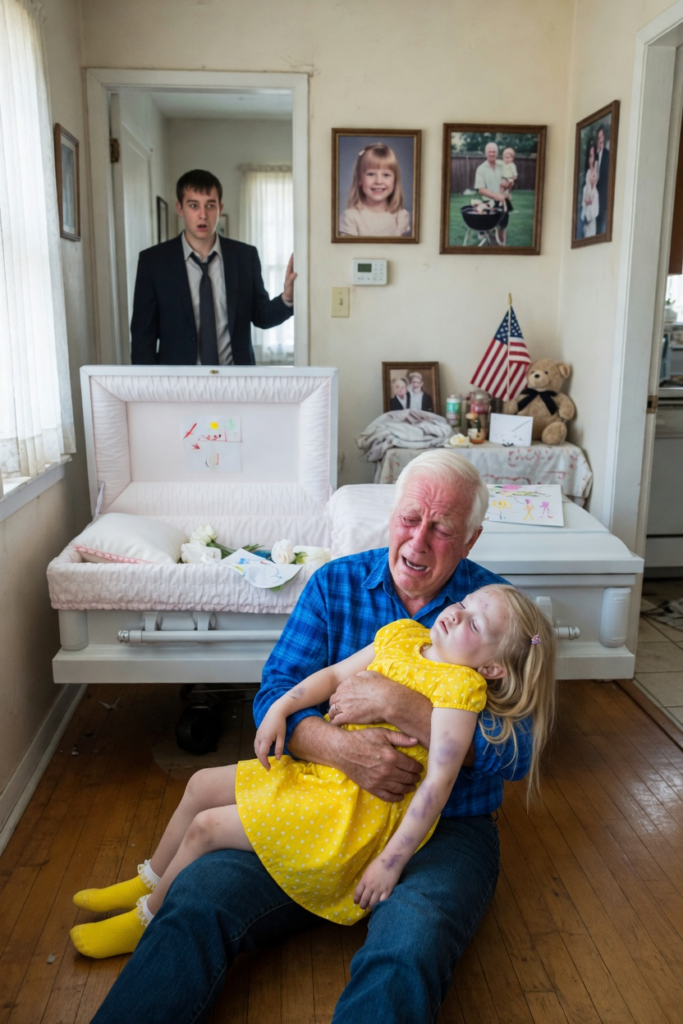
Mara’s fingers dug into my shirt. Her breath came in thin little pulls against my chest, hot at first, then shaky. I could smell medicine on her lips, candle wax on my hands, and the old dust of the hall closet where the landline receiver lay open beside a stack of Christmas tins.
The 911 operator was still there.
I could hear her breathing through the receiver.
I did not answer her. I was looking at the door.
Marcus stood on the other side of it, my son, Mara’s father, the man who had spent the afternoon accepting casseroles and handshakes beside a coffin he had forbidden anyone to open.
“Dad?” he called again.
His voice did not shake. That was what made my thumb press harder into the RECORD button on my late wife’s old flip phone.
He sounded patient.
He sounded inconvenienced.
“Open the door,” Marcus said. “You’re upsetting people.”
Mara’s face disappeared deeper into my coat. One of her socks had slipped halfway off. Her toes were curled tight, pale against the black wool. I pulled the coat around her and took one step back from the door.
“I’m praying,” I said.
The doorknob stopped moving.
On the other side, Marcus gave a soft laugh through his nose.
“You never prayed this long when Mom was dying.”
The old boards under his shoes creaked. Downstairs, somebody laughed over a cup of coffee. A woman’s bracelet clinked against a plate. Life continued below us as if a child had not just been lifted out of her own coffin.
Then Marcus said, lower, “Do not embarrass me tonight.”
The operator’s voice came through the receiver again, careful and firm.
“Officers are close. Keep him talking if you can.”
I looked at the pillow inside the coffin.
The tiny key lay there beside the folded note.
Do not open before 9:00 a.m.
The handwriting was my son’s. I had seen that same slant on birthday cards, rent checks, school forms, and the envelope he had handed me three hours earlier with the funeral program inside.
My mouth was dry. My tongue touched the back of my teeth.
“Why nine?” I asked through the door.
Silence.
Only the fan clicked in the window.
Then Marcus answered, still polite.
“Because the funeral director comes at nine.”
“No,” I said. “Why could no one open it before nine?”
A long breath passed under the door.
“Dad,” he said, “you’re old, you’re tired, and grief makes people strange.”
Mara shook once in my arms. Not crying. Not making a sound. Just one sharp tremor that ran from her shoulders to her knees.
I lowered my face to her hair.
“Breathe through your nose, sweetheart,” I whispered.
Marcus heard me.
The door handle jerked.
Not slowly now.
Hard.
“Who are you talking to?” he asked.
I stepped sideways and put my back against the closet wall. My hip brushed the shelf. The landline cord swung. The flip phone stayed open in my palm, recording every word.
“No one,” I said.
The lock on the door was old. It had been there since before my wife and I moved in. A small brass latch, not meant to hold back much more than a draft.
Marcus struck the door with his shoulder.
Mara’s nails scraped my neck.
Downstairs, the room went quieter.
Another hit came. The doorframe gave a flat wooden crack.
“Open it,” Marcus said. “Now.”
That was the first time his voice lost its polish.
I heard the operator say something to someone else, away from the phone. A radio crackled faintly on her end.
Then I heard sirens.
Not loud at first. Just a thin sound somewhere beyond the apartment windows, cutting through traffic, rising over the street.
Marcus heard them too.
The pressure on the door vanished.
For two seconds, everything froze.
Then he spoke so softly I almost missed it.
“What did you do?”
I looked down at Mara. Her eyes were open. She was staring at the door as if it were a live animal.
“I opened what you told me not to touch,” I said.
The next sound was Marcus running.
His shoes hit the hallway, then the stairs. I lifted Mara and moved as fast as my knees allowed. The apartment spun in small pieces: candlelight, white lilies, the open coffin, the silver butterfly pin on the satin, the funeral bill on the table, $4,900 circled in blue ink.
I grabbed the note and key from the pillow and shoved both into my shirt pocket.
Mara’s head rolled against my collarbone.
“Stay awake,” I whispered. “Look at me.”
Her eyelashes fluttered.
“I was good,” she said again.
Those three words nearly took my legs from under me.
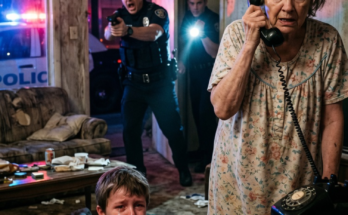
I carried her into the living room just as the first police lights flashed across the ceiling. Red, blue, red, blue. They slid over framed family photos, over my wife’s old china cabinet, over the coffin Marcus had wanted closed until morning.
Downstairs, Marcus was speaking quickly.
“You don’t understand,” he was saying. “My father has dementia symptoms. He’s been unstable all week.”
The first officer came up the stairs two at a time.
She was young, maybe thirty, with a tight bun and rain on her shoulders. Behind her came another officer and two paramedics carrying a small trauma bag.
Marcus followed them, one hand raised, acting like a host whose evening had been interrupted by a misunderstanding.
“Officer, please,” he said. “He’s grieving. My daughter passed. He won’t accept it.”
The female officer looked past him.
Her eyes landed on Mara in my arms.
Her face changed.
Not dramatically. She did not gasp. She did not shout.
Her jaw set, and her right hand moved Marcus back without looking at him.
“Sir, step away from the child.”
Marcus smiled once.
“She’s heavily medicated. This is a family matter.”
The second officer turned his body toward Marcus.
“No, sir. It is not.”
The paramedic touched Mara’s forehead, then her wrist. He looked at his partner.
“Pulse present. Weak. Fever. Possible sedation.”
Marcus’s polite face cracked around the mouth.
“That’s impossible,” he said.
The female officer looked at him then.
“Why would that be impossible?”
He blinked.
The living room smelled of lilies and old coffee. The candles had burned low, leaving blackened wicks and puddles of wax on the saucers. Neighbors gathered in the doorway and on the stairs, their mouths open, their plates forgotten in their hands.
I handed the note to the officer.
My fingers shook so badly she had to take it from between my knuckles.
She unfolded it.
Her eyes moved over the words.
Do not open before 9:00 a.m.
Then I gave her the key.
“It was taped under the coffin pillow,” I said.
The second officer moved to the coffin. He lifted the satin carefully with gloved hands. He did not speak for several seconds.
Then he said, “There are restraints attached underneath.”
A neighbor made a small choking sound.
Marcus looked at the coffin, then at me, then at the officer.
“That was for transport,” he said.
The paramedic stopped cutting the sleeve of Mara’s dress and looked up.
“For transport?” he repeated.
Marcus adjusted his cuff.
His cuff.
While his daughter lay wrapped in my coat with an oxygen mask being fitted to her face, he adjusted his cuff.
“The funeral home required it,” he said.
The female officer turned her head toward him.
“Name of the funeral director?”
Marcus opened his mouth.
No answer came.
The hallway filled with more boots, more radio noise, more authority than that apartment had ever held.
One officer began moving the neighbors back. Another took photographs of the coffin, the pillow, the straps, the taped spot where the key had been hidden.
The old flip phone was still in my palm.
I had forgotten I was holding it.
It beeped once, battery low.
The officer heard it.
“What is that?” she asked.
“My wife’s phone,” I said. “It was recording.”
Marcus’s head snapped toward me.
For the first time that evening, he looked frightened.
Not sad. Not confused. Frightened.
The officer held out her hand.
I gave her the phone.
The room stayed still while she pressed playback.
At first, only static.
Then Marcus’s voice filled the apartment.
You never prayed this long when Mom was dying.
A few neighbors turned toward him.
Then came my question.
Why could no one open it before nine?
Marcus’s recorded answer followed, smooth and clean.
Because the funeral director comes at nine.
The officer did not move.
The recording continued.
Dad, you’re old, you’re tired, and grief makes people strange.
Then my whisper to Mara.
Breathe through your nose, sweetheart.
Then Marcus’s voice, sharp now.
Who are you talking to?
The female officer stopped the playback.
She looked at Marcus.
“Turn around.”
He laughed once.
It was too short to be real.
“You’re arresting me based on a confused old man and a child who—”
“Turn around,” she repeated.
The second officer stepped behind him.
Marcus looked toward the stairs, where neighbors blocked the landing. He looked toward the window, where red and blue light kept washing the walls. He looked at the coffin, open now, empty except for the satin lining and the silver butterfly pin.
Then his face went blank.
The cuffs clicked at 7:18 p.m.
Mara heard the sound.
Her eyes opened behind the oxygen mask. She was on a stretcher now, wrapped in a thermal blanket, the black coat folded under her head. One paramedic had placed a small stuffed bear from the ambulance beside her hand.
She looked at me.
I bent close.
“Grandpa?” she whispered through the mask.
“I’m here.”
“Can he take me?”
The female officer stepped closer before I could answer.
“No,” she said. “He cannot.”
Mara’s fingers loosened for the first time.
At the hospital, they placed her in a pediatric room with glass doors and a nurse posted outside. I sat in a chair that smelled faintly of disinfectant and vinyl, my coat across my lap, my shirt collar scratched where her nails had held on.
A detective arrived at 9:06 p.m.
He was older, with silver at his temples and a small notebook already open. He did not ask me to tell the story fast. He let the silence sit between questions.
He asked about the funeral bill.
He asked who signed the forms.
He asked who declared Mara gone.
That was when the second piece of evidence came out.
Inside Marcus’s jacket pocket, officers had found an envelope from a private cremation service. Not the funeral home on the bill. A different company. A different time.
Pickup requested: 9:15 a.m.
Paid in advance.
No viewing.
No delay.
The detective placed a photocopy on the small hospital table. The paper made a thin sliding sound against the plastic surface.
My eyes fixed on the time.
9:15 a.m.
The note had said not to open before 9:00.
Fifteen minutes.
That was all the space he had left between discovery and disappearance.
My hands folded around my wife’s old phone until the plastic edges pressed into my skin.
The detective saw it.
“You made the difference,” he said.
I did not feel brave. My knees still hurt from striking the coffin bench. My mouth still tasted like copper and coffee. My hands still smelled of wax.
“I almost went downstairs,” I said.
He closed his notebook.
“But you didn’t.”
Mara stayed in the hospital for four days. The doctors used careful words around me: dehydration, sedatives, restraint marks, stress response. They spoke like people placing dishes quietly on a table after something had broken.
She slept with one hand curled around my sleeve.
Every time a door clicked, her eyes opened.
On the fifth morning, a child welfare worker arrived with a temporary order. A judge had signed it at 8:32 a.m. Marcus would have no contact. Not by phone, not by letter, not through relatives.
The worker handed me a folder and a list of things Mara would need.
Socks. Pajamas. Soft foods. Therapy appointments. A nightlight.
Ordinary words.
Beautiful words.
At 10:40 a.m., I returned to the apartment with two officers to collect her clothes. The coffin was gone. The candles were gone. The lilies had browned at the edges and bent their heads over the table.
But the silver butterfly pin was still there.
It lay near the place where the pillow had been.
I picked it up with two fingers and put it in my pocket beside the copy of the court order.
That evening, Mara sat on my sofa wearing blue pajamas too big for her and eating applesauce in tiny spoonfuls. The old landline sat on the side table, its cord twisted, its plastic yellowed with age.
She looked at it for a long time.
“Daddy said that phone was junk,” she whispered.
I touched the silver butterfly pin in my pocket.
“Sometimes junk is what saves you,” I said.
She leaned against my arm. Her hair smelled of hospital shampoo. Outside, traffic moved below the windows. Somewhere in the building, a dog barked, a faucet ran, a television laughed too loudly.
Mara closed her eyes.
This time, no coffin lid covered her.
This time, when her fingers found my sleeve, nobody told her to stay quiet.