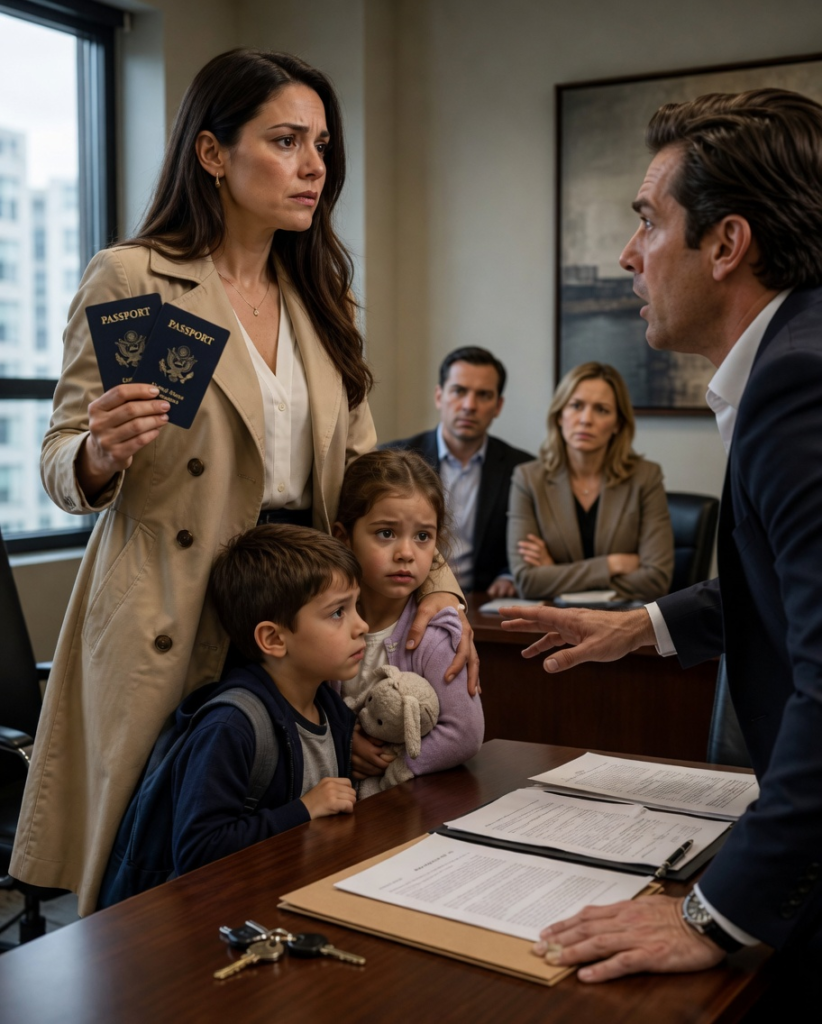
You walk out of the mediator’s office with Mateo’s hand in yours and Lucía asleep against your shoulder, and for the first time in months, you do not look back. Behind you, Rodrigo is still shouting your name like a man who just realized the door he slammed was locked from the other side. Patricia’s heels click after him, frantic now, no longer elegant.
The elevator doors close before they can reach you.
Mateo looks up at you with wide, worried eyes. He is seven, old enough to understand that something has broken, but still too young to understand why adults break things and then blame children for the sound. “Mom,” he whispers, “is Dad mad?”
You kiss the top of his head.
“Your dad is confused,” you say. “But we are safe.”
That word matters.
Safe.
Not happy yet. Not healed. Not free from pain. But safe enough to keep walking.
Downstairs, the black SUV waits at the curb. Your driver, Héctor, takes the small suitcase from your hand and opens the back door. He does not ask questions. He has worked for your attorney long enough to know that some women leave buildings carrying children and silence because silence is the only thing keeping them standing.
As you buckle Lucía into her seat, your phone starts vibrating.
Rodrigo.
Then Rodrigo again.
Then Patricia.
Then your ex-mother-in-law, Cecilia.
You turn the phone face down on your lap.
Mateo notices. “Aren’t you going to answer?”
“No.”
“Because Dad is confused?”
You look out the window as the city moves past: traffic, street vendors, office towers, people carrying flowers, people carrying nothing. Life continues rudely even when yours is splitting in half.
“Because sometimes confused people say hurtful things,” you tell him. “And today we need quiet.”
Mateo nods like he understands more than he should.
At the airport, Licenciado Esteban is waiting near the private check-in desk with a leather folder under his arm. He is not your family lawyer. Not anymore. He is your escape architect, the man who spent six weeks turning Rodrigo’s arrogance into signed documents.
He greets the children first.
“Mateo, Lucía, ready for Madrid?”
Lucía wakes enough to whisper, “Does Madrid have churros?”
Esteban smiles. “The best ones.”
That earns him a sleepy nod of approval.
Then he looks at you, and his expression softens in the way professional men try to hide when they know a woman has just walked through fire without screaming.
“Everything is ready,” he says. “Travel authorization, custody agreement, school letters, housing contract, and the court filing for international relocation. Rodrigo signed more than he understood.”
“He usually does when he thinks he’s winning,” you say.
Esteban closes the folder.
“His mistake.”
You glance toward the entrance, half expecting Rodrigo to storm through security and make one last scene. But he is not there. Of course he is not. He is on his way to the clinic with his mother, his sister, his mistress, and the whole family circus ready to celebrate the baby they believe will erase you.
The “heir.”
That word still makes your stomach turn.
Not because you care about Rodrigo having another child. You stopped belonging to him the first time you saw Fernanda’s perfume receipt in his jacket. No, the word hurts because of Mateo.
Your son, who still saves drawings for a father who forgets to come home.
Your son, who was treated like a practice child because he was too gentle, too sensitive, too much like you.
When the boarding pass prints, Esteban hands it to you.
“You know the clinic appointment starts in twenty minutes,” he says quietly.
“I know.”
“Are you sure you don’t want to stay and use what you know?”
You look at Mateo, who is helping Lucía arrange her stuffed bunny inside her backpack.
“No,” you say. “I already used what I know. I got my children out first.”
Esteban nods.
That was the one thing you promised yourself.
You would not fight Rodrigo in the middle of his family’s celebration. You would not scream in a clinic waiting room while your children watched their mother turn pain into performance. You would not let your humiliation become entertainment for the people who helped create it.
You would leave.
Then the truth could do its work without you.
On the plane, Mateo takes the window seat. Lucía falls asleep before takeoff, clutching your sleeve. You sit between them and finally let yourself breathe when the plane begins to move.
Your phone is in airplane mode now.
The silence feels unreal.
For months, your life had been noise: Rodrigo’s lies, Patricia’s insults, Cecilia’s prayers for a grandson, Fernanda’s social media hints, lawyers, documents, custody forms, school transfers, late-night crying in the bathroom with the shower running so the children would not hear.
Now there is only the soft hum of the plane and your children’s warm bodies leaning into you.
As Mexico City grows smaller beneath the clouds, you close your eyes.
And you remember the moment you first knew the baby was not Rodrigo’s.
It was not dramatic.
No lipstick on a collar. No hotel receipt. No screaming confrontation.
It was a calendar.
Three weeks earlier, Rodrigo had left his tablet charging in the kitchen while he showered. You were packing Lucía’s lunch when a notification appeared from Fernanda.
Tomorrow at 5. Don’t be late. We’ll finally hear his heartbeat. Your mom is so excited.
You should have looked away.
You did not.
By then, Rodrigo was barely hiding anything. He wore guilt like expensive cologne, strong enough for everyone to smell, but still convinced people would call it confidence. Fernanda posted flowers without naming him. Cecilia started talking about “fresh starts.” Patricia stopped pretending to respect you.
So you opened the calendar.
The appointment was there.
Clínica Santa Aurelia. Obstetrics. First extended ultrasound.
Then you saw another entry, saved by mistake under Rodrigo’s shared business calendar.
Fernanda — 18 weeks? Confirm due date.
Eighteen weeks.
You stood in the kitchen with Lucía’s sandwich in your hand, staring at those two words until the room tilted.
Rodrigo had told everyone Fernanda was ten weeks pregnant. Ten weeks fit the story. Ten weeks made it his miracle baby after he “finally chose happiness.” Ten weeks made the betrayal ugly, but simple.
Eighteen weeks made it impossible.
Because eighteen weeks earlier, Rodrigo had been in Madrid with you and the children for Mateo’s emergency asthma treatment. Not one day. Not one weekend. Two full weeks. You still had the hospital discharge papers, the hotel receipts, the flight records, the photos of Rodrigo asleep in a chair beside Mateo’s bed because, back then, you still believed there was a father inside him worth saving.
Fernanda had not been in Madrid.
But someone else had been in Mexico City.
Miguel.
Patricia’s husband.
You did not suspect him immediately. You were not that cruel yet. But when you started looking, the truth practically raised its hand.
A restaurant receipt for two under Miguel’s card. A parking ticket near Fernanda’s apartment. A message Patricia accidentally sent you complaining that Miguel had been “working late” too often. Then the final proof: a photo from Fernanda’s private story, saved before she deleted it, showing a man’s hand on her thigh.
The wedding ring was visible.
Miguel’s ring.
You did not confront anyone.
Instead, you called Esteban.
You told him you wanted a divorce finalized before the appointment. You wanted travel authorization. You wanted custody protected. You wanted everything Rodrigo had been too distracted to read converted into your children’s exit door.
Esteban asked if you were sure.
You said yes.
Because by then, you understood the truth about your marriage: Rodrigo had not only betrayed you with Fernanda. He had betrayed his children by letting his family replace them in his imagination.
That was unforgivable.
Somewhere over the Atlantic, while Lucía sleeps with her bunny under her chin, your phone holds a storm you cannot yet see.
Back in Mexico City, Rodrigo walks into Clínica Santa Aurelia like a prince arriving for his coronation. You know this because Patricia later sends the video to the wrong family chat before deleting it too late. In the video, Cecilia carries blue balloons. Patricia holds a tiny pair of baby shoes. Fernanda wears white, one hand pressed to her belly, smiling like a woman who believes a lie becomes real if enough people applaud it.
Rodrigo kisses Fernanda’s forehead in front of everyone.
Cecilia cries.
“My grandson,” she says.
Fernanda smiles wider.
Miguel stands behind Patricia, pale and silent.
That is the part you would replay later.
The only man not smiling was the only one who already knew the truth.
Inside the exam room, the doctor begins normally. He greets them, dims the lights, applies gel, moves the ultrasound wand over Fernanda’s belly. The screen fills with gray movement, a small body turning in liquid darkness.
For one moment, everyone forgets the mess.
Even Rodrigo.
Because whatever adults have done, the child on the screen is innocent.
Then the doctor pauses.
At first, no one notices.
Cecilia is crying too loudly. Patricia is filming. Rodrigo is holding Fernanda’s hand, staring at the monitor with the expression of a man trying on fatherhood in front of an audience.
The doctor measures again.
Then again.
His smile fades.
“Doctor?” Rodrigo asks. “Is something wrong?”
The doctor clears his throat.
“The baby’s heartbeat is strong.”
Cecilia presses a hand to her chest. “Thank God.”
“But,” the doctor says carefully, “the dates do not match what you gave us.”
Fernanda’s fingers tighten around the paper sheet beneath her.
Rodrigo frowns.
“What does that mean?”
The doctor turns the monitor slightly.
“According to the measurements, this pregnancy is closer to eighteen weeks. Not ten.”
The room goes silent.
You would learn later that Patricia stopped recording at that exact second.
Not because she wanted privacy.
Because instinct told her the family was about to become evidence.
Rodrigo laughs once.
“No. That’s not possible.”
The doctor remains professional.
“Ultrasound dating can vary slightly, but not by that much at this stage.”
Cecilia looks at Fernanda.
“Fernanda?”
Fernanda’s face drains of color.
“It must be wrong.”
The doctor says gently, “We can repeat the measurements, but all markers are consistent.”
Rodrigo pulls his hand away.
“Eighteen weeks?”
Fernanda sits up slightly.
“Rodrigo, calm down.”
He looks at the doctor.
“What would the conception window be?”
The doctor hesitates.
“That is a sensitive question.”
“What would it be?” Rodrigo snaps.
The doctor gives a range.
And the room breaks.
Because every person there knows exactly where Rodrigo was during that range. He was in Madrid with you, sitting beside Mateo’s hospital bed, posting nothing because he did not want Fernanda to know how much time he was spending with his family.
Patricia turns slowly toward Miguel.
That is when Fernanda starts crying.
Not soft tears. Not innocent tears. Panic tears.
“Rodrigo, I can explain.”
Four words no guilty person should ever say in a room full of relatives.
Rodrigo steps back like she has burned him.
Cecilia’s balloons hit the ceiling.
Miguel whispers, “Fernanda…”
Patricia hears him.
Everyone hears him.
The doctor quietly excuses himself, because medical school does not prepare a man to referee a family dynasty collapsing beside an ultrasound machine.
The first voicemail from Rodrigo arrives while your plane is still over the ocean.
You do not hear it until Madrid.
By then, the truth has already detonated through his family.
When you land, Mateo presses his face to the window and whispers, “We’re really here.”
“Yes,” you say.
“Is Dad coming?”
You hold your breath.
“Not today.”
Lucía wakes up and asks again about churros.
You laugh for the first time in what feels like a year.
At baggage claim, your phone reconnects to the world.
It almost catches fire.
Forty-three missed calls.
Nineteen voicemails.
Dozens of messages.
Rodrigo’s first message is rage.
What did you know? Call me now.
His second is panic.
Valeria, where are you? Don’t get on that plane. We need to talk about the kids.
His third is worse.
You planned this. You knew. You set me up.
You stare at that one for a long time.
He took his mistress to a clinic with his family to celebrate replacing you, and somehow, in his mind, you had set him up.
That was Rodrigo’s true gift: turning his own choices into other people’s crimes.
Esteban meets you outside arrivals with a second lawyer based in Madrid. Her name is Ana Torres, and she looks like a woman who wins arguments before breakfast. She bends to greet the children, then turns to you.
“Welcome,” she says. “Your apartment is ready. The school interviews are scheduled. Your temporary residency paperwork has been filed.”
You nod, but your eyes are on the phone.
Ana sees your face.
“Bad news?”
“No,” you say. “Delayed truth.”
In the car, Mateo falls asleep against the window. Lucía sings softly to her bunny. Madrid passes outside in golden afternoon light, strange and beautiful and terrifying.
You open the voicemail.
Rodrigo’s voice fills your ear, low and shaking.
“Valeria, answer me. The doctor said Fernanda is eighteen weeks. Eighteen. You knew, didn’t you? You knew before I signed. Tell me what you know.”
You delete it.
Not because you are cruel.
Because your children are in the car, and you refuse to let his chaos cross another ocean with them.
The next morning, Madrid smells like coffee, rain, and unfamiliar freedom.
Your apartment is smaller than the Polanco home, but the windows face a quiet street lined with trees. The children’s room has two narrow beds, a shelf for books, and sunlight on the floor. Lucía declares it “not fancy but nice.” Mateo asks if he can put his soccer poster above the desk.
You say yes to both.
While the children eat toast with jam, Esteban calls.
“You should know what happened after the clinic.”
You step onto the balcony and close the door behind you.
“Tell me.”
He exhales.
“Rodrigo confronted Fernanda in the hallway. Patricia confronted Miguel. Cecilia fainted. Security was called. Someone leaked a short video of the balloons and the shouting, but not the ultrasound.”
You close your eyes.
“Did Rodrigo call the court?”
“He tried.”
“And?”
“He was reminded that he signed full travel authorization and agreed not to contest your primary custody. He can request scheduled calls through the proper process.”
You look through the glass at Mateo helping Lucía pour juice.
“Good.”
“There is more.”
Of course there is.
Esteban’s voice changes.
“Rodrigo’s family is demanding a paternity test. Fernanda is refusing unless Rodrigo pays for her apartment and medical expenses.”
You almost laugh.
“She still thinks she has leverage?”
“She has scandal. In families like that, scandal is leverage.”
He is right.
Rodrigo’s family had spent years polishing their name. The Villaseñor family did not solve problems; they smothered them in money, lawyers, and baptisms. They were not angry because Fernanda lied. They were angry because the lie had witnesses.
Over the next two weeks, the story reaches you in pieces.
Patricia leaves Miguel, then takes him back for two days, then throws him out again after finding more messages. Cecilia stops speaking to Fernanda publicly but sends her lawyer privately. Rodrigo posts nothing, which tells everyone he is drowning.
Fernanda’s social media disappears.
Miguel moves into a hotel.
Patricia sends you one message.
You destroyed my family.
You read it while sitting in Mateo’s new school lobby.
Then you type back:
No. I simply stopped letting yours destroy mine.
She does not answer.
Rodrigo finally gets his first video call with the children one week after you arrive.
You set it up in the living room with Ana present off-camera. Not because you want to punish him, but because Rodrigo has never understood boundaries unless a witness holds them in place.
Mateo sits stiffly beside Lucía.
Rodrigo appears on the screen looking tired, unshaven, older than he did at the divorce office. For one second, your heart remembers the man you married before your mind stops it.
“Hey, champ,” he says.
Mateo does not smile.
“Hi, Dad.”
Lucía waves her bunny silently.
Rodrigo’s eyes fill.
“How is Madrid?”
“Good,” Mateo says.
Lucía says, “There are churros.”
Rodrigo laughs weakly.
Then he looks at you.
You shake your head once.
Not in front of them.
He understands, or at least he obeys.
The call lasts fifteen minutes. He asks about school, the apartment, the weather. Mateo gives short answers. Lucía shows him her drawing of a cat eating churros. For once, Rodrigo does not mention babies, heirs, or family names.
When the call ends, Mateo turns to you.
“Is Dad sad because the baby isn’t his?”
You freeze.
Children always find the locked door.
You sit beside him.
“Who told you that?”