Chapter 1: The Architecture of a Nightmare
There is a specific, suffocating illusion woven into the fabric of affluent suburbia. It is the belief that manicured lawns, pristine colonial facades, and neighborhood association meetings are impenetrable shields against human depravity. Margaret Hayes knew this illusion better than anyone. As a federal prosecutor for over thirty years, she had built her career tearing down the facades of corrupt politicians, cartel financiers, and white-collar sociopaths. She knew that the darkest evils rarely hide in alleys; they hide behind freshly painted oak doors and double-paned glass.
Yet, even with decades of exposure to the absolute worst of humanity, nothing could have prepared Margaret for the horrors hiding in the basement of her own son’s home.
The air at the bottom of the stairs was thick, tasting of copper, mildew, and raw, visceral terror. The only illumination came from a single, bare yellow bulb swinging slightly from a frayed wire on the ceiling. Margaret’s breath hitched in her chest. She dropped to her knees on the freezing, damp concrete, her designer slacks soaking up the moisture, her eyes wide with a shock so profound it temporarily paralyzed her vocal cords.
“Mason,” she breathed.
Her four-year-old grandson was curled into a tight, shivering ball on a filthy piece of cardboard tucked beneath the exposed plumbing. He was wearing nothing but a soiled, oversized t-shirt. His tiny, delicate cheeks were hollowed out by malnutrition. The pale skin of his arms and legs was painted in a sickening mosaic of mottled purple, yellow, and deep black bruises.
But it was the sound that broke Margaret’s soul—the heavy, metallic clink of steel scraping against concrete.
Secured around Mason’s fragile, bruised left ankle was a thick, industrial-grade iron chain. It was fastened with a heavy brass padlock, the other end bolted directly to the main water pipe protruding from the foundational wall.
Margaret crawled forward, her hands shaking violently. She reached out to touch his face, her heart shattering into a thousand jagged pieces. Mason flinched violently at her touch, curling tighter into himself, throwing his little arms up to protect his head.
“No, no, baby, it’s Grandma. It’s Grandma Maggie,” she wept, her voice cracking.
Mason slowly lowered his arms. His large, sunken blue eyes looked at her with a profound, unnatural emptiness that no child should ever possess. “Mommy said I’m bad,” Mason whispered, his voice dry and raspy from dehydration. “Daddy said don’t make her angry. The dark is for bad boys.”
A wave of nausea, followed instantly by a surge of white-hot, blinding rage, washed over Margaret. Her biological son, Ryan, and his new wife, Nicole, had done this. While Margaret had been traveling through Europe for the past two months, thinking her grandson was safe in the care of his father, they had turned this suburban basement into a torture chamber.
Margaret fumbled for her phone with trembling, icy fingers. She dialed 911, screaming the address to the dispatcher, demanding immediate police and medical assistance. Once the call was placed, she frantically searched the dim basement. Finding a heavy, rusted claw-hammer on a nearby workbench, she marched up the wooden stairs and violently smashed the interior deadbolt that locked the basement door from the outside, ensuring the police could enter unimpeded. She ran to the front door, threw it open to the rainy night, and rushed back down into the dark, wrapping her cashmere coat tightly around Mason’s shivering body.
“They’re coming, sweetheart,” she sobbed, rocking him against her chest, the heavy chain biting into her own leg. “The police are coming. You are safe now.”
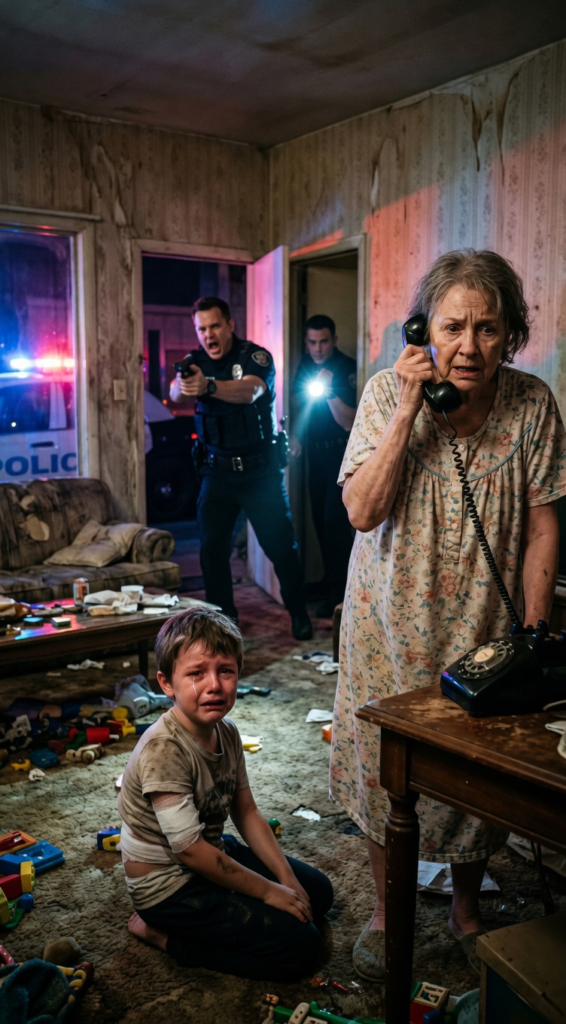
Ten agonizing minutes later, the heavy thud of tactical boots echoed on the hardwood floor above. Flashlight beams sliced through the darkness of the stairwell.
“Down here! Hurry! He needs an ambulance!” Margaret screamed, holding Mason tighter.
Officer Bell, a tall, broad-shouldered local patrolman, walked down the stairs. His hand rested casually on his utility belt. But as he stepped into the weak yellow light, something was horribly wrong. He didn’t rush toward the chained, bruised child. He didn’t call for the paramedics waiting outside.
Instead, Officer Bell stopped at the bottom of the stairs. He looked at the shattered deadbolt on the door frame. He looked at the hammer Margaret had dropped. Then, he looked directly at Margaret, his face hardening into a cold, practiced, emotionless mask.
“Margaret Hayes,” Officer Bell stated, drawing his handcuffs. “You are under arrest.”
Margaret froze. The words made absolutely no sense. Her brilliant, legal mind short-circuited. “What? Officer, look at him! He is chained to a pipe! My son did this! Call the paramedics!”
“Stand up and put your hands behind your back, ma’am,” Bell ordered, stepping forward, his tone aggressive and unyielding.
From the top of the stairs, a shadow shifted. Nicole, Margaret’s daughter-in-law, slowly descended the wooden steps. She was dressed in a pristine silk robe, her hair perfectly styled, her makeup flawless. Her eyes were completely dry, but as she looked at Officer Bell, she contorted her face into an expression of theatrical, trembling fear.
“Thank God you’re here, Officer,” Nicole lied, her voice smooth and chillingly steady. “She broke into our house. She’s been having a psychotic break. She kidnapped my stepson, dragged him down here, and… and she hurt him. We tried to stop her.”
“That is an insane lie!” Margaret screamed, clutching Mason. “She is the monster! Look at the padlock! Look at his bruises!”
Officer Bell didn’t look at Mason. He lunged forward, violently ripping Margaret away from her grandson. Margaret fought, but the officer was far too strong. He slammed her against the cold concrete wall, twisting her arms behind her back with brutal, unnecessary force. The cold steel of the handcuffs ratcheted tightly around her wrists, biting into her skin.
“Mason!” Margaret shrieked as Bell dragged her backward toward the stairs.
She looked back. Nicole was standing over the cardboard mat. She wasn’t comforting the child. Nicole was smiling. It was a terrifying, predatory, victorious smile. She looked at Margaret, gave a subtle, mocking wave, and stepped into the shadows, leaving Mason shivering in the dark.
As Margaret was hauled up the stairs and shoved out the front door into the pouring rain, surrounded by the flashing red and blue lights of the police cruisers, a freezing, absolute clarity washed over her. The police had not come to rescue Mason. They were part of it. They had come to ensure he never escaped.
And as the squad car door slammed shut, locking her in the cage, Margaret Hayes realized that she was no longer a grandmother waiting for justice. She had just become a prisoner in a war she hadn’t known she was fighting.
Chapter 2: The Holding Cell and the Death of a Mother
The holding cell at the municipal precinct was a sterile, unforgiving box of cinderblock and stainless steel. It smelled of bleach, stale sweat, and institutional apathy. Margaret sat rigidly on the metal bench, her wrists bruised, her clothes damp from the rain.
For the first hour, the trauma threatened to drown her. The image of Mason chained to that pipe, his hollow eyes, and his terrified flinch played on a horrific, agonizing loop in her mind. She wanted to scream. She wanted to shatter the reinforced glass of the cell door. She wanted to weep for the son she had raised, a boy who had somehow grown into a monster capable of standing by while his child was tortured.
But Margaret Hayes was not an ordinary woman. She had spent thirty years dismantling the most complex, violent criminal syndicates on the Eastern Seaboard. She knew that panic was the enemy of justice. Emotion was a liability. She closed her eyes, took a long, shuddering breath, and mentally locked her grief inside an impenetrable vault. When she opened her eyes, the panicked grandmother was dead. The federal prosecutor had taken the wheel.
She analyzed the board. A corrupt local cop. A forged break-in. A fabricated kidnapping charge. This was not a spontaneous lie told by a panicked abuser; this was a premeditated, highly coordinated frame-up.
When a desk sergeant finally approached to offer her one phone call, Margaret did not call her son, Ryan. She did not call a bail bondsman. She dialed a memorized Washington D.C. area code.
Arthur Sterling answered on the second ring. Arthur was a ruthless, high-powered defense attorney, a former FBI Deputy Director, and Margaret’s oldest friend. She spoke for exactly three minutes, outlining the address, the officer’s badge number, the condition of the child, and the immediate legal maneuvers required.
“I’m on the company jet, Maggie. I’ll be there in three hours. Don’t say a damn word to anyone,” Arthur said before hanging up.
Margaret sat back down. Two hours passed. The heavy steel door of the cell block buzzed and echoed as it swung open. Margaret expected Arthur. Instead, heavy footsteps approached her cell.
It was Officer Bell. And walking casually beside him, escorted privately into a restricted holding area as if she owned the precinct, was Nicole.
Bell unlocked the outer privacy door but kept the iron bars locked. He crossed his arms and stood back, playing the role of a silent, imposing bodyguard. Nicole stepped up to the bars. She was wearing a tailored designer coat, looking utterly immaculate and entirely out of place in the grim surroundings.
“Hello, Margaret,” Nicole whispered, her voice dripping with poisonous, condescending sweetness.
Margaret didn’t stand. She didn’t approach the bars. She looked at her daughter-in-law with eyes as cold and flat as the concrete floor. “What do you want, Nicole?”
Nicole smiled, clearly intoxicated by her perceived power. She leaned against the iron bars. “I want to explain your new reality to you. You see, Ryan and I are very reasonable people. But you’ve always been so… overbearing. Always checking in on Mason. Always questioning our parenting. So, here is the deal.”
Nicole pulled a folded legal document from her coat pocket and slid it through the bars. It fell onto the floor.
“You are going to sign over the deed to your estate, your investment portfolios, and your liquid assets to us to cover our ‘severe emotional damages’ from your terrifying home invasion,” Nicole explained smoothly. “In exchange, you will plead guilty to aggravated child endangerment and accept a ten-year prison sentence. Ryan will graciously ask the judge for leniency.”
Margaret looked at the paper on the floor, then back at Nicole. “And if I don’t?”
Nicole’s smile vanished, replaced by a mask of pure, sociopathic malice. “If you fight this, Margaret, Ryan and I will implement plan B. We will have Mason committed to the Crestview Psychiatric Ward by Friday. We have already paid… excuse me, consulted… a private psychiatrist who will testify that Mason is a violently psychotic, self-harming schizophrenic who requires permanent, heavily medicated institutionalization. He will be strapped to a bed. He’ll be a drooling vegetable in a year.”
Margaret’s heart stopped. Crestview. It was a notoriously corrupt private asylum on the state border. But why? Why go to such elaborate, horrific lengths to torture and institutionalize a four-year-old boy?
Then, the prosecutor’s mind connected the dots. The motive illuminated itself like a flare in the dark.
“The trust fund,” Margaret whispered.
Nicole’s eyes flashed with triumphant validation. “Exactly. Mason’s biological mother left him an eight-million-dollar trust when she died in that car crash. Ryan and I can’t touch the principal until Mason is eighteen. Unless, of course, Mason is declared profoundly, permanently mentally incompetent. Then, Ryan becomes the permanent conservator of the estate, and the funds are released for the child’s ‘ongoing medical care.’ Care that we control.”
Nicole stepped back, adjusting her coat. “So, you see, Margaret. You have no moves. Sign the papers, go to prison, and we will let Mason live quietly with us. Fight us, and the boy disappears into a padded cell forever.”
Nicole waited for the great Margaret Hayes to break. She waited for the grandmother to fall to her knees, to weep, to beg for mercy.
Instead, Margaret slowly stood up. The silence in the cell was absolute. She walked to the bars, stopping inches from Nicole’s face. The panic, the shock, the grief—it was all entirely gone. In its place was a terrifying, ancient, and completely dead calm.
“You made one miscalculation, Nicole,” Margaret whispered back, her voice carrying a frequency that made Officer Bell instinctively shift his weight in discomfort.
“And what is that?” Nicole scoffed.
“You left me breathing.”
Nicole rolled her eyes, turning on her heel. “Have fun in prison, Maggie. I’ll make sure Mason forgets your name.” She walked away, Officer Bell following closely behind, the heavy door slamming shut behind them.
Margaret stood at the bars for a long time. In that dark, quiet cell, the last, lingering thread of unconditional maternal love she held for her son, Ryan, snapped. He was not her son anymore. He was an accomplice to the torture of an innocent child.
Thirty minutes later, Arthur arrived. He was a tempest of legal fury in a bespoke suit. He slammed a bail release order onto the desk sergeant’s counter and marched to Margaret’s cell, sliding a thick manila envelope through the bars.
“Bail is posted. You’re out,” Arthur said, his jaw clenched. “I pulled the police report Bell filed.”
Margaret opened the envelope. She read the heavily redacted, entirely fabricated timeline. It stated Margaret had broken in through a window, subdued Ryan with pepper spray, and dragged Mason to the basement.
As she read the lies, a cold, predatory smile finally touched her lips.
“They committed federal perjury on an official document,” Margaret said quietly, handing the paper back to Arthur. “Arthur, I want a team. I want forensic accountants. I want cyber-investigators. And I want them off the books.”
“What’s the play, Maggie?” Arthur asked, recognizing the lethal tone in his old friend’s voice.
“We are going to build a RICO case,” Margaret replied, stepping out of the cell into the fluorescent light. “And then, I am going to bury them alive.”
Chapter 3: The Shadow War
For three agonizing days, the curtains of Margaret’s sprawling, ivy-covered brick estate remained tightly drawn. To the outside world, and more importantly to Ryan and Nicole, it appeared as though the disgraced, terrified grandmother was hiding in shame.
Margaret fueled the illusion. She formally resigned from the board of directors of her three favorite local charities, citing “personal family health crises.” She ignored her ringing phone. She did not attempt to visit Ryan’s house. She allowed Nicole to text her daily, abusive reminders: “Bring the signed estate transfer to the house tonight at 11 PM, or the boy leaves for Crestview forever.”
Nicole believed she had broken the great Margaret Hayes. She believed Margaret was sitting in the dark, weeping over legal documents, preparing to surrender her fortune and her freedom.
What Nicole didn’t know was that Margaret’s elegant, mahogany-paneled formal dining room had been completely gutted and converted into a high-tech, federal-grade command center.
The heavy oak dining table was buried under stacks of financial disclosures, property deeds, and psychiatric facility licensing records. Four massive monitors glowed brightly against the far wall. The room was occupied by Arthur and three incredibly quiet, fiercely intelligent men and women—elite private investigators and forensic accountants handpicked from Arthur’s former FBI cyber-crime unit.
They had bypassed the corrupt local police precinct entirely.
Margaret stood at the head of the table, wearing a crisp, dark blazer, a pair of reading glasses perched on her nose. She was holding a laser pointer, dissecting a sprawling web of digital transactions projected on the main screen.
“Look at the shell companies,” Margaret instructed, tapping the red beam against a series of LLCs registered in the Cayman Islands. “Nicole isn’t just greedy; she’s sloppy. Ryan’s so-called ‘real estate investment firm’ has been operating at a massive deficit for three years due to his sports gambling addiction. They are four million dollars in the red with offshore bookies.”
“And here is the bridge,” a female forensic accountant said, typing rapidly on her laptop. Another window popped up on the screen. “Over the last six months, they have been illegally siphoning micro-transactions out of Mason’s trust fund—just under the ten-thousand-dollar reporting threshold—using forged medical expense invoices signed by the psychiatrist they bribed.”
Arthur crossed his arms, looking at another monitor. “We have the money trail. It’s federal wire fraud, embezzlement, and conspiracy. But what about the local muscle?”
Margaret clicked a remote, and a video file began to play on the fourth screen. It was black-and-white, slightly grainy, but unmistakable. It was dash-cam footage from a private security vehicle stationed in an underground parking garage downtown.
The video showed Officer Bell in uniform, standing next to his personal truck. A moment later, Ryan walked into the frame, looking nervously over his shoulder. Ryan handed Bell a thick, brown paper bag.
“Twenty thousand dollars in cash,” Margaret stated coldly. “Withdrawn from Ryan’s secondary checking account exactly two hours before that video was recorded. We have the bank teller’s sworn affidavit confirming the withdrawal.”
Arthur looked at his watch. His expression was grim. “Maggie, we have enough to put them away for decades. But we have a tactical problem. I just intercepted an encrypted email between Nicole and the Crestview Asylum administrator.”
Margaret’s blood turned to ice. “Show me.”
Arthur pulled the email onto the screen. “Timeline moved up. Margaret is stalling. The package is too noisy. Sending the transport tonight at midnight. Have the intake sedatives ready.”
“They aren’t waiting until Friday,” Arthur said softly. “The transport van Nicole hired to take Mason away is a ghost operation—unlicensed mercenaries who specialize in legally disappearing difficult dependents. If they get Mason across state lines and through the doors of that facility, he falls under medical conservatorship jurisdiction. It will take us months to legally extract him. He won’t survive months in there, Maggie.”
Margaret stared at the email. The image of Mason chained to the pipe, his hollow, terrified eyes, flashed in her mind. Her grandson was out of time.
She walked over to a heavy, biometric steel safe hidden behind a bookshelf. She pressed her thumb to the scanner. The heavy door clicked open. Margaret reached inside and pulled out a licensed, compact Sig Sauer 9mm pistol.
She expertly checked the chamber, loaded a fresh magazine, and slid the weapon into the interior holster of her black trench coat.
“They aren’t taking him anywhere,” Margaret said, her voice devoid of all warmth, vibrating with a lethal, terrifying authority. She turned to Arthur. “Call the Director of the FBI field office. Send him the entire data package. Tell him the bait is set, the trap is armed, and I want a Hostage Rescue Team at my son’s address in exactly three hours.”
Chapter 4: The Breach and the Padlock
The rain was falling in relentless, driving sheets, turning the quiet, tree-lined streets of the affluent suburb into a dark, blurred canvas.
At 11:45 PM, a black, unmarked medical transport van without license plates slowly turned into the expansive driveway of Ryan and Nicole’s pristine colonial home. The headlights cut through the deluge, illuminating the manicured lawn and the grand, white-columned porch. The van’s engine idled low, a sinister, rumbling purr.
Inside the house, the atmosphere was suffocating with frantic, vicious energy.
Nicole was standing in the living room, wearing a cashmere sweater and designer jeans, frantically packing a small duffel bag with a few of Mason’s cheap clothes to make the transport look legitimate.
“Where is she?!” Nicole hissed, pacing toward the window and peering through the blinds at the rain. “Margaret was supposed to be here at eleven to sign the papers! If she doesn’t show, we’re doing this the hard way. I’m not waiting for that old witch to ruin my life.”
Ryan was pacing near the fireplace, sweating profusely, chewing on his thumbnail. He looked pale, weak, and entirely consumed by cowardice. “Nicole, maybe we should wait. If my mother goes to the police—”
“Your mother is a terrified old woman who doesn’t want to die in a prison cell!” Nicole snapped, walking over and grabbing Ryan’s face roughly. “You saw her in the cell. She’s broken. Get it together, Ryan. We hand the kid over to the transport, the psychiatrist signs the incompetence papers in the morning, and the eight million is ours. We pay off the bookies, and we move to St. Barts. Now go get the boy.”
Ryan swallowed hard, nodding obediently. He walked to the basement door, unlocked it, and disappeared into the dark.
A few minutes later, he returned. He was dragging Mason by the collar of his shirt. The four-year-old was sobbing, a pathetic, breathless, silent weeping. He was barefoot, shivering violently, clutching a small, filthy stuffed bear to his chest.
“Shut him up,” Nicole sneered, grabbing her purse. “The van is here.”
Nicole walked toward the heavy, mahogany front door. “Just sign the transfer papers when she eventually gets here,” Nicole instructed Ryan. “I’m handing him over to the driver.”
Nicole reached out and grabbed the brass handle of the front door.
She never got the chance to turn it.
The front door did not open. It was violently, explosively battered entirely off its reinforced hinges. The heavy mahogany slab flew backward, crashing onto the hardwood floor with a deafening, structural boom.
Simultaneously, the massive bay windows on either side of the living room shattered inward in a terrifying cascade of broken glass. Two flashbang grenades vaulted through the shattered frames, detonating in the center of the room with a blinding, concussive flash of white light and a roar that shook the foundation of the house.
Before the smoke could even begin to clear, the nightmare descended.
It was not Officer Bell. It was not the local police.
A dozen heavily armored, black-clad FBI tactical agents swarmed through the shattered doorway and windows like a synchronized, lethal swarm of hornets. The red beams of their laser sights immediately painted Ryan and Nicole’s chests, heads, and legs.
“FEDERAL AGENTS! FBI! DROP THE CHILD! GET ON THE GROUND! SHOW ME YOUR HANDS!” the lead agent roared, his voice amplified, drowning out the pouring rain.
Nicole shrieked, a primal, terrified sound. She instinctively threw her hands in the air, dropping her purse, dropping to her knees amid the shattered glass. Ryan didn’t even scream; his legs simply gave out, and he collapsed onto his stomach, weeping instantly, covering his head with his hands.
Mason, terrified by the noise, scrambled backward, hiding underneath a heavy oak coffee table, clutching his bear, squeezing his eyes shut.
The agents moved with brutal efficiency. Two agents grabbed Nicole, slamming her face-first into the hardwood floor, wrenching her arms behind her back, and securing her with heavy zip-ties. Two more agents descended on Ryan, placing a knee heavily on his spine as they handcuffed him.
“Clear! First floor clear!” an agent yelled.
“Basement clear! We’ve got the chains!” another agent shouted from the stairwell.
Through the thick, acrid smoke of the flashbangs, a figure walked slowly through the shattered doorway, stepping over the ruined mahogany door.
It was Margaret.
She was wearing her black trench coat, entirely untouched by the rain. She did not look panicked. She did not look like a grieving grandmother. She looked like the wrath of God.
She walked past the tactical agents, who parted slightly to let her through. She stopped in the center of the ruined living room. She looked down at Nicole, who was writhing on the floor, her face pressed into the glass, screaming obscenities and demanding a lawyer.
Then, Margaret looked down at her son.
Ryan was pinned to the floor, his cheek pressed against the wood. He looked up and saw his mother’s pristine black shoes. He craned his neck, tears streaming down his face, his eyes wide with desperate, pathetic hope.
“Mom! Mom, please!” Ryan wailed, his voice cracking. “They’re making a mistake! Nicole made me do it! She manipulated me! Mom, please help me! Tell them who you are! Tell them to let me go!”
Margaret stood over him. She looked at his weeping face. She remembered the little boy she had held in her arms thirty years ago. She remembered teaching him how to ride a bike. And then, she remembered the hollow, bruised face of her grandson chained to a pipe in the dark.
Margaret reached into the deep pocket of her trench coat. She pulled her hand out and held it over Ryan’s face.
She opened her fingers.
The heavy, brass padlock—the exact padlock she had smashed off Mason’s ankle with a hammer three days ago—fell from her hand. It hit the hardwood floor mere inches from Ryan’s nose with a heavy, damning, metallic thud.
Ryan stared at the padlock, his breath hitching, the realization of his absolute doom finally settling over him.
“I am not your mother anymore, Ryan,” Margaret said. Her voice was barely above a whisper, but it possessed a cold, terrifying finality that silenced the entire room. “I am the prosecution.”
She turned her back on him, dismissing his existence entirely.
Margaret dropped to her knees, ignoring the shattered glass cutting into her coat. She crawled slowly toward the oak coffee table. She reached out her hands, her face softening into a mask of pure, infinite love.
“Mason,” she whispered softly. “It’s Grandma Maggie. The monsters are gone, sweetheart. They’re gone forever.”
A tiny, trembling hand reached out from the shadows, grasping her fingers tightly. Margaret pulled her grandson into her arms, burying her face in his hair as the FBI medics rushed in with blankets, finally letting the tears she had held back for three days fall freely.
Chapter 5: The Fortress of Light
Six months later.
The television in Margaret’s mahogany-paneled study quietly broadcast the evening news. The anchor’s voice was professional, detailing the dramatic conclusion of a trial that had captivated the state.
“…In a stunning verdict today, federal judge Harrison sentenced Ryan Hayes and Nicole Hayes to thirty-five years in a maximum-security federal penitentiary, with absolutely no possibility of parole. The couple was found guilty on a litany of charges, including aggravated kidnapping, wire fraud, conspiracy to commit medical fraud, and severe child endangerment. In a related proceeding, former local police officer David Bell pleaded guilty to corruption, evidence tampering, and accepting bribes, receiving a ten-year federal sentence…”
Margaret sat at her desk, holding a cup of Earl Grey tea. She reached out and muted the television. She didn’t feel a surge of triumph. There is no true victory when your own flesh and blood chooses to become a monster. There is only the grim satisfaction of a tumor successfully excised to save the host.
She stood up, walked out of the study, and moved down the wide, sunlit hallway of her sprawling estate.
She stopped at the open doorway of a room that had been completely transformed. It was brightly lit, painted in soft, calming shades of oceanic blue. Sunlight streamed through large windows that overlooked a vibrant, blooming garden. There were no chains here. There was no damp concrete. There was no darkness.
Sitting on a plush, thick rug in the center of the room was Mason.
The transformation in the four-year-old was nothing short of miraculous. He had gained a healthy amount of weight; the terrifying hollows in his cheeks were completely gone, replaced by the soft, flush curves of a healthy childhood. His skin was clear, the horrific mosaic of bruises having faded away months ago, leaving only a faint, thin white scar around his left ankle—a permanent, physical reminder of what he had survived.
Mason was surrounded by a massive pile of wooden building blocks. He was humming a quiet, happy tune to himself as he carefully placed a triangular block on top of a highly complex, towering structure.
Margaret leaned against the doorframe, watching him, a profound, physical ache of love swelling in her chest. The healing process had not been easy. There had been agonizing weeks of night terrors, panic attacks whenever a door was closed too quickly, and an intense, heartbreaking fear of small spaces. But Margaret had met every tear with infinite patience. She had slept in a chair next to his bed for two months. She had hired the best pediatric trauma therapists in the country. She had smothered the darkness with relentless, unconditional light.
Mason looked up, sensing her presence. His large blue eyes were bright, clear, and filled with a warmth that completely erased the haunting emptiness she had seen in the basement.
“Look, Grandma Maggie!” Mason beamed, pointing a chubby finger at his wooden creation. “I built a fortress.”
Margaret walked into the room, sitting down on the rug beside him. She examined the wooden blocks carefully. “It is a magnificent fortress, Mason. Very strong walls.”
“It has to be strong,” Mason explained seriously, his brow furrowing slightly. “So nothing bad can get inside. The bad things have to stay outside in the rain.”
Margaret reached out, running a gentle hand through his clean, soft, golden hair. “You’re exactly right, my love. But you don’t have to worry about the bad things anymore. Your fortress is perfectly safe.”
Mason leaned his head against Margaret’s shoulder, a gesture of absolute, unshakeable trust. He looked toward the large window, where the late afternoon sun was beginning to dip, casting long shadows across the garden. He watched the shadows for a moment, a brief flicker of a memory crossing his face.
“Are the monsters gone forever, Grandma?” Mason asked, his voice small, vulnerable, but remarkably brave.
Margaret wrapped her arm securely around his shoulders, pulling him tight against her side. She rested her chin on the top of his head, breathing in the scent of his baby shampoo. She looked out the window, her eyes hardening for a fraction of a second with the fierce, indestructible promise of a guardian who had already proven what she was capable of.
“Yes, Mason,” Margaret whispered softly, kissing his forehead. “The monsters are gone forever. And if they ever try to come back, Grandma will always be right here waiting for them.”
Chapter 6: The Unbroken Chain
Ten years later.
The crisp, autumn air carried the smell of roasted peanuts, hot cocoa, and the distinct, metallic scent of artificial turf. Margaret, now seventy-five years old, sat in the middle tier of the bleachers at the local high school football stadium. She wore a thick, elegant wool coat and a stylish cashmere scarf, her posture as perfect and unyielding as it had been the day she stood in the federal courtroom. Her eyes, though framed by deeper lines, remained sharp and fiercely intelligent.
The stadium lights glared brilliantly against the dark night sky. On the field below, the home team was driving toward the end zone in the final two minutes of the fourth quarter.
“Set! Hike!” the quarterback yelled over the roar of the crowd.
A tall, broad-shouldered fourteen-year-old boy exploded off the line of scrimmage. He wore the number 88 on his jersey. He moved with incredible grace, cutting sharply across the middle of the field, leaving two defenders scrambling behind him. The quarterback launched a perfect spiral. The boy leaped into the air, extending his hands, and snatched the football out of the sky, landing firmly with both feet in the end zone.
The crowd erupted into deafening cheers. The referee threw his arms up. Touchdown.
Margaret stood up, clapping enthusiastically, a radiant, genuine smile breaking across her face. Down on the field, Mason Hayes spiked the football, took off his helmet, and pumped his fist in the air. He was a handsome, vibrant, deeply compassionate teenager. He was an honor roll student, a loyal friend, and entirely, miraculously free from the shadows of his past. The chains had not broken him; they had simply made him appreciate the sky.
As the game ended and the players began to celebrate on the field, Margaret reached into her designer handbag to grab a tissue.
Her fingers brushed against a thick, crumpled envelope hidden in the side pocket.
It was postmarked from the United States Penitentiary, Florence High. The return address bore the name Ryan Hayes and an inmate identification number.
The letter had arrived three days ago. It was not the first. Over the past ten years, Ryan had sent dozens of letters, alternating between pathetic apologies, desperate pleas for money for his commissary account, and begging to speak to his son.
Margaret pulled the envelope out of her bag. The seal was unbroken.
She looked at the erratic, desperate handwriting. She didn’t feel anger. She didn’t feel a lingering sense of loss. She didn’t wonder if her biological son had truly rehabilitated himself behind bars. To Margaret, the man who wrote this letter had died the night he allowed his son to be chained to a pipe.
Without a second thought, her thumb traced the edge of the paper for a fraction of a second before she casually dropped the unopened envelope into a large metal trash can sitting next to the bleachers. It landed among discarded hot dog wrappers and empty soda cups—exactly where it belonged. She felt absolutely nothing.
“Grandma!”
Margaret turned. Mason was running up the metal steps of the bleachers, his uniform covered in turf stains, his face flushed with adrenaline and pure joy. He practically tackled her, wrapping his long arms around her in a massive, crushing hug that lifted her slightly off her feet.
“We won, Grandma! Did you see the catch?!” Mason laughed, setting her down gently.
“I saw it, sweetheart. It was a magnificent catch. I am so incredibly proud of you,” Margaret said, adjusting her scarf and beaming up at the young man he had become.
“I couldn’t have done it without you cheering me on,” Mason said, his smile softening into a look of profound, deeply understood gratitude. He slung his heavy equipment bag over his shoulder and offered her his arm. “Come on, let’s go get some pizza. I’m starving.”
Margaret took his arm, leaning on him slightly as they walked together down the bleachers. She felt the sheer, unstoppable life force of the boy she had saved from the dark.
As they walked toward the parking lot, bathed in the bright, protective glow of the stadium lights, Margaret smiled into the autumn night.
She realized, with a deep, settling peace in her soul, that the greatest verdict she had ever delivered in her entire, illustrious legal career had not been handed down from a judge’s bench. It hadn’t been written in a federal indictment.
The greatest verdict she ever delivered was forged in a dark, damp basement, the moment she decided that the only chains left in her family would be the ones holding the monsters down. She had destroyed the abusers, but more importantly, she had saved the boy. And looking at Mason laugh as they walked to the car, Margaret knew, beyond a shadow of a doubt, that she had won the only case that ever truly mattered.