Under her name, the nurse had highlighted one line with her thumb.
Patient spouse listed as Adrian Cole.
Six words.
That was all it took.
Six words.
That was all it took.
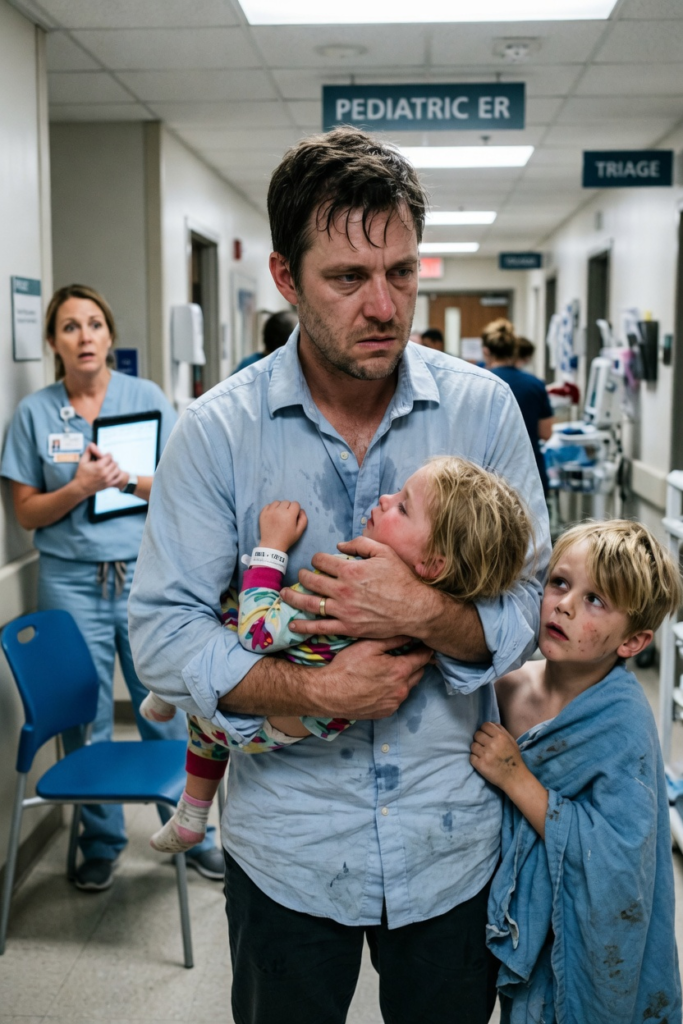
The pediatric ER smelled like antiseptic and warmed plastic. A vent above us pushed out air so cold it lifted the hair at my wrist. Somewhere down the hall a monitor kept up a steady electronic chirp, and every time the automatic doors opened, a blade of outside air cut across the polished floor and carried in the smell of rain off concrete.
Doors & Windows
Micah was wrapped in a navy hospital blanket in a molded plastic chair, too small for his sneakers to touch the tile. Elsie had already disappeared behind a curtain with two nurses and a resident. The paper band they had snapped around her wrist had left a faint red mark on her skin.
“Who is Adrian Cole?” I asked.
The nurse’s mouth tightened. She glanced once toward Micah, then back at me.
“A social worker is on her way down,” she said. “Please stay here.”
Stay here.
Like my body had any intention of doing anything else.
There are betrayals that arrive loud. A slammed door. A lipstick mark. A bank alert at midnight.
This one came with hospital light and a stranger’s last name.
When Delaney and I first met, she used to laugh with her whole head tipped back, like the ceiling had told her something funny before I got there. We were twenty-six, broke enough to split one burrito from the food truck outside a music bar on Demonbreun, stupid enough to think sleep was optional and love was enough to cover everything else.
Our first apartment had a rattling window unit and one burner on the stove that worked only if you twisted the knob with a butter knife. Delaney used to make pancakes on Sunday mornings in one of my old T-shirts. Micah wasn’t even a thought yet. It was just the sound of batter hitting the pan, coffee too strong for either of us, and her bare feet crossing cold linoleum while an old country station whispered through a speaker with a cracked corner.
She wasn’t careless then.
That is the part that kept scraping at me while I stood in that hospital corridor.
Because people like to believe the cruel version of someone was there from the beginning. It makes the ending cleaner.
Ours wasn’t clean.
Micah was born during a thunderstorm in June. Delaney held him against her chest and cried so hard she shook. Two years later, when Elsie came along with her fist curled under her chin like she owned the room, Delaney painted tiny yellow stars above the crib because she said white ceilings made nurseries look temporary.
For a while, we were one of those families people envy from a distance. Farmers market on Saturdays. Matching Christmas pajamas we pretended to hate. Her singing in the kitchen while Micah pushed toy cars through the dog bowl water. My work got heavier. Her patience got shorter. Then everything small started cutting deeper than it should have. Money. Sleep. Resentment. Whose career bent first. Who got to leave the house. Who was still carrying the invisible weight when the dishes were done and the lights went out.
By the time we separated, the damage had stopped being dramatic and turned organized.
Shared calendar. Alternating weeks. School pickup notes. Pediatrician logins. A tone of voice so polite it made strangers think we were doing well.
That was the version of us I had been protecting in my head while Micah sat beside a starving little girl and waited for me to answer an unknown number.
A resident came through the curtain and gave me numbers in the careful voice doctors use when they know one sentence is going to change the temperature of the room.
Elsie’s fever was 103.8. She was dehydrated. Her blood sugar was low enough that they were starting fluids right away.
“She should recover,” he said. “But this didn’t happen in one afternoon.”
He left the rest unsaid.
He didn’t need to say it.
Micah had been trying not to cry for so long that his face had settled into a stiff, careful stillness that belonged on a man three times his age.
I knelt in front of him and touched the blanket at his shoulder.
“Buddy, listen to me. You did exactly right.”
His eyes lifted to mine. Red at the rims. Dry now.
“I gave her the last crackers,” he whispered.
The words were so quiet I almost missed them.
He looked down at his own hands when he said it, like he was ashamed of how little he had been able to do.
There is a physical weight to guilt when it lands properly. It settles behind the ribs and makes your breath feel borrowed. Mine sat there while I pictured that empty cereal box again. The half bottle of ketchup. The old juice glued to the bottom of the cup. My son measuring out stale crackers like he was the last adult in the house.
A woman in charcoal slacks and a hospital badge introduced herself as Dana from social work. She guided me a few steps away from Micah, toward a quieter corner near a vending machine humming beside a locked supply door.
“Because your daughter was brought in with signs of neglect and the children were alone, we had to verify where their mother was,” she said. “She was admitted upstairs this morning through Women’s Services under the name Delaney Shaw. That’s her maiden name.”
My throat worked once. Nothing came out.
Dana kept going.
“The chart also lists Adrian Cole as spouse. We’ve already opened a report because two minors were unsupervised and one required emergency care. I need to ask you a few questions.”
So she did.
Had Delaney ever left them alone before?
Did she have a substance problem?
Was there anyone else staying in the house?
That last question slid under my skin because Micah had gone still the second she said it.
I turned toward him.
“Micah. Was someone there with Mom?”
He worried the edge of the blanket between two fingers. Looked at the floor. Then nodded.
“A man came twice,” he said. “He had a blue truck. Mom said to stay in my room when he was there. Yesterday he said cartoons were too loud.”
Dana and I looked at each other.
“Did you know his name?” I asked.
Micah swallowed.
“She called him Ade sometimes.”
That tiny nickname hit harder than it should have.
Not because it was intimate.
Because it had been casual. Practiced. Used around my children like this second life had already gotten comfortable.
While Dana took her notes, I opened my banking app with hands that wouldn’t stay steady. Three charges I hadn’t recognized over the last month were still sitting there because I’d been too busy to do more than frown at them. A boutique hotel in Franklin. A women’s imaging center. A florist on West End.
All on the joint account Delaney had sworn she used only for groceries and the kids.
There was one more thing.
At 10:14 the night before, our Ring camera at the old house had caught the porch in a slice of weak yellow light. Delaney leaving in a camel coat. A dark pickup in the driveway. No car seats in the back. No children with her. She’d been gone for hours before Micah called me.
Dana looked at the screen and exhaled through her nose.
“Can you email that to me right now?”
I did.
Then I asked the question that had been building like pressure behind my eyes.
“Where is she?”
Dana hesitated. Only for a second.
“Room 512. But I’m going with you.”
The women’s floor was quieter than the ER. Carpet under our shoes. Soft lighting that pretended nothing ugly ever happened there. The hall smelled faintly of bleach, flowers past their best, and whatever lotion hospitals use to make illness seem more expensive than it is.
At Room 512, the door stood cracked open three inches.
That was enough.
Adrian Cole was sitting beside Delaney’s bed in a quarter-zip sweater the color of wet stone. One of his hands covered hers on top of the blanket. On the tray table sat a paper cup, a silver foil wrapper, and a strip of black-and-white ultrasound images turned partly toward him.
Delaney looked pale, but not dying. Hair brushed. Phone charging. Visitor sticker on the rail.
Comfortable.
That was the word that made my teeth lock.
Comfortable while my son rationed crackers.
Her eyes moved to the doorway and widened.
Not with shame.
With irritation.
“What are you doing here?” she said.
Dana stepped in first. “Ms. Shaw, your children were brought to the emergency department alone. One of them is being treated now.”
Delaney’s head turned toward me so fast the charger cord brushed the bed rail.
“What?”
“Micah called me from a stranger’s phone,” I said. “Elsie was burning up on your couch. There was no food in the house.”
Adrian half rose from the chair. “Maybe we should all calm down.”
My eyes went to him.
“Sit back down,” I said.
He stopped.
That part surprised him.
Delaney pushed herself higher against the pillow, face sharpening by the second.
“They were sleeping,” she said. “I was gone a few hours. Micah exaggerates when he gets anxious.”
Dana’s pen stopped moving.
I took one step into the room and held up my phone.
First photo: the refrigerator.
Second: the shutoff notice.
Third: the Ring clip timestamped 10:14 p.m.
“A few hours?”
She looked at the screen and then away from it.
“Rowan, lower your voice.”
That almost made me laugh.
Not because anything was funny.
Because her instinct, even now, was embarrassment. Tone. Appearances. Volume.
On the tray beside Adrian’s elbow, the ultrasound strip had one image circled in blue ink. 11W4D.
Eleven weeks, four days.
Two years earlier, after Elsie, I’d had a vasectomy.
Delaney saw my eyes land on the image and reached for it too late.
Adrian turned toward her. Slowly.
“You told me they were with their dad all weekend,” he said.
She said nothing.
Dana stepped closer to the bed rail. “Hospital security has already been notified, and Child Protective Services has been contacted. Until this is sorted out, you will not be discharging to those minors.”
That was the first crack.
The second came from Adrian.
He stood fully this time and took one step back from the bed, like he’d suddenly noticed the room had gotten smaller.
“You said he knew,” he said to Delaney.
Still nothing.
He looked at me then. Really looked. At my shirt still creased from work. At my son’s dirt on my sleeve where I had held him. At the phone in my hand full of proof.
“I didn’t know about the kids being alone,” he said.
“Get out,” I told him.
He opened his mouth like he wanted to salvage some version of himself. Couldn’t find one. Then he grabbed his jacket off the chair and left with his visitor sticker still on his chest.
Delaney watched the door close behind him.
The room changed after that.
Not softer.
Just stripped down.
“You brought him around my children,” I said.
“We’re separated.”
“You left them hungry.”
Her nostrils flared. “I was bleeding.”
“Then call me. Call 911. Call your mother. Call anybody. You don’t leave a six-year-old in charge of a sick child and vanish into a private room under another name.”
For the first time since I’d walked in, her mouth trembled.
Not from remorse.
From losing control of the arrangement.
Dana spoke before Delaney could spin it into something cleaner.
“Mr. Mercer, I’ll meet you downstairs after I finish here. I strongly recommend you contact your attorney tonight.”
“Already done,” I said.
That was true.
I’d texted him from the elevator up.
The next day moved with the efficiency of systems that had finally been handed enough evidence to stop hesitating.
At 8:10 a.m., my attorney filed an emergency custody petition.
By 11:47, a judge in Davidson County had granted temporary sole custody pending investigation.
A CPS worker met me at the house with a clipboard, a body camera, and the flat patience of someone who had seen too many refrigerators like Delaney’s. She photographed the kitchen. The empty pantry. The medicine cabinet with two adult prescriptions and no children’s fever reducer anywhere. The couch where Elsie had been lying. The pile of takeout receipts on the counter from places Delaney could afford because the grocery money had been going somewhere else.
Micah stood in the doorway of his room clutching a stuffed raccoon by the tail while strangers documented the shape of his weekend.
By afternoon, supervised visitation only.
No overnight access.
No unscheduled pickups from school.
No contact except through the parenting app and attorneys.
Delaney called thirteen times from a blocked number before sunset.
I listened to one voicemail.
Her voice was thin and sharp.
“You’re blowing this up to punish me.”
I deleted it before the message finished.
At 6:22 p.m., Adrian texted once.
I’m sorry about your kids. I didn’t know.
No defense. No threat. No second message.
That told me everything I needed to know about how fast his version of their future had collapsed once it touched daylight.
Three days later, Elsie came home with a bottle of antibiotics, a purple dinosaur sticker on her shirt, and the kind of limp trust small children still give adults even after adults have failed them.
She wanted applesauce and the yellow blanket from the dryer.
Micah wanted to know if he was allowed to open the refrigerator whenever he wanted now.
The question sat in the kitchen between us.
Allowed.
Like food had become a permission issue.
I filled the shelves that night until the crisper drawer squeaked when it shut. Milk. Yogurt tubes. Strawberries. Bread. Peanut butter. String cheese. Soup. Crackers in two different boxes because the old word had turned sharp in this house.
After they were asleep, I stood alone at the sink with the overhead light throwing a hard white circle over everything. The house was quiet in that uneasy way homes get after children have cried themselves empty and finally gone under.
On the counter sat the things I had brought back from the hospital in a plastic belongings bag.
Elsie’s paper wristband.
Micah’s blanket sticker.
My visitor pass from the women’s floor.
And Delaney’s spare key, the one she had left on the tray in Room 512 when Dana told her she wouldn’t be going home to the kids.
I picked up the key and turned it once between my fingers. Metal against skin. Cool. Light. Ordinary.
Then I set it down beside the wristband and left it there.
At dawn, the kitchen windows turned from black to smoke gray. The first light slid across the counter and caught on the white plastic band with Elsie’s name printed in tiny block letters. Beyond it sat a full bowl of clementines, a loaf of bread still twisted shut, and a fresh box of crackers no one had needed to count.
The key stayed where I left it.
By breakfast, the sun had reached everything except that.