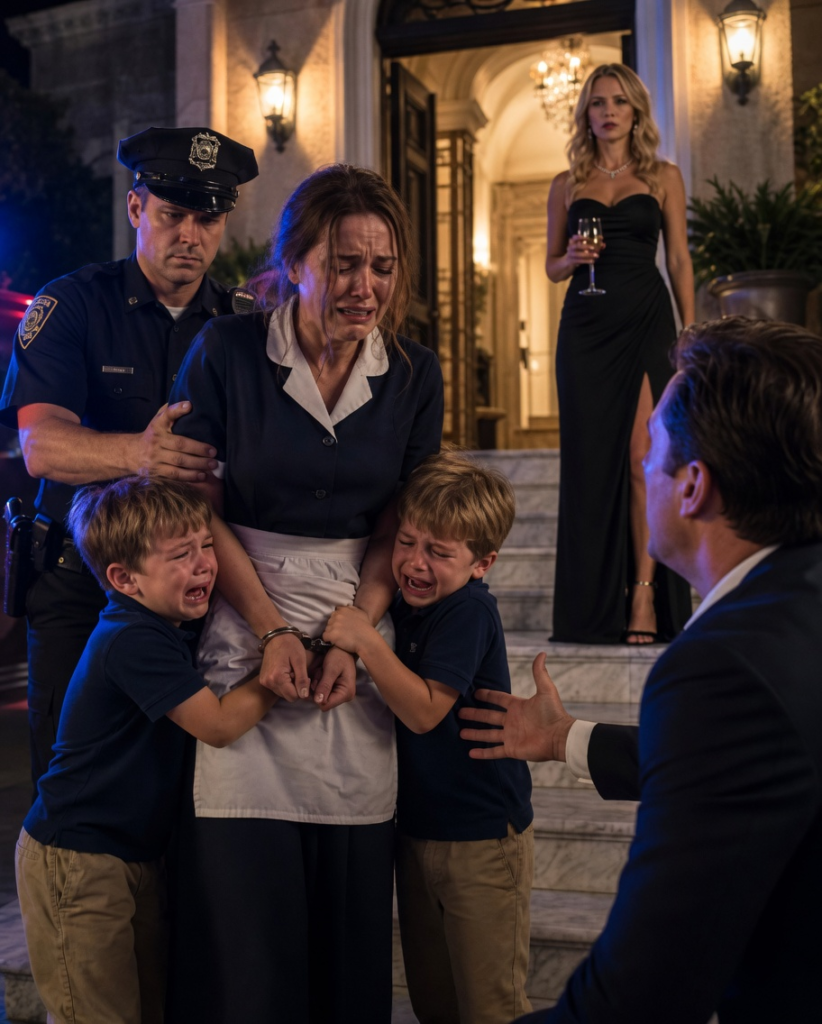
You froze the video at 14:12 and leaned closer to the monitor.
At first, your mind refused to understand what your eyes were seeing. The hallway camera showed Paulina, your wife, walking toward the laundry room with the missing diamond bracelet in her hand.
She was not frantic.
She was not searching.
She was calm.
Too calm.
You watched as she looked left, looked right, then opened Rosalía’s market bag and slipped the bracelet deep between a folded sweater and a cloth pouch. After that, she stepped back, fixed her hair, and walked away like she had just placed flowers in a vase.
For a few seconds, you couldn’t move.
The room felt colder than the marble floors outside. Your hands rested on the edge of the desk, but your fingers had gone numb.
Rosalía had been telling the truth.
And Paulina had framed her.
You rewound the clip.
You watched it again.
Then again.
Each time, the truth became uglier.
You had known your marriage was not warm. You had known Paulina loved status more than tenderness, appearances more than family dinners, photographs more than real memories. But this was different.
This was not vanity.
This was cruelty.
You opened the other camera angles from the same time. Camera 7 showed Paulina entering the master closet at 14:04. Camera 8 showed her opening the jewelry drawer. Camera 3 showed her walking downstairs with her hand closed around something bright.
Then Camera 11 showed her planting it.
Your throat tightened.
Down the hall, Santi and Mati were asleep after crying until their little bodies gave up. They had begged you to bring Rosalía back. You had promised them you would find out the truth, but even then, some terrible part of you had wondered if the evidence would break their hearts.
Now the evidence had broken yours.
You saved the clip.
Then you backed it up twice.
Then you sent a copy to your private attorney, Gabriel Núñez, with one line:
Call me immediately.
Your phone rang less than two minutes later.
Gabriel’s voice was low and alert.
“Héctor, tell me this is not what it looks like.”
“It’s exactly what it looks like.”
A silence followed.
Then Gabriel said, “Do not confront her yet.”
You looked at the frozen image of your wife standing over Rosalía’s bag.
“Gabriel, she had an innocent woman arrested.”
“I know,” he said. “That is why you need to be smarter than your anger.”
Your jaw tightened.
Rosalía was probably sitting in a cold holding room somewhere, terrified, humiliated, thinking no one believed her. Your sons had cried themselves sick. And Paulina was upstairs, sleeping under Egyptian cotton sheets in a house paid for by the man she had deceived.
“Get Rosalía out,” you said.
“I’ll start now.”
“And Gabriel?”
“Yes?”
“I want to know why.”
He paused.
“Then keep watching.”
So you did.
For the next hour, you sat alone in your office and followed the trail backward.
You checked the cameras from the morning. Paulina had breakfast on the terrace while Rosalía fed the twins in the kitchen. At 9:38, Paulina snapped at Mati for spilling juice, then walked away while Rosalía knelt to comfort him.
At 10:16, Rosalía took the boys to the garden.
At 11:02, Paulina entered your office.
Your office.
You leaned closer.
The camera inside your office showed her moving quickly toward the locked cabinet behind your desk. She opened it with a key you didn’t know she had. Inside that cabinet were not jewelry boxes or cash.
They were your personal files.
Property documents.
Trust agreements.
Insurance policies.
Your sons’ education fund papers.
You felt your stomach turn.
Paulina removed a folder labeled Children’s Trust — Santi and Mati and photographed several pages with her phone. Then she placed everything back exactly as it had been and locked the cabinet.
You sat back slowly.
The bracelet was not the whole secret.
It was the cover.
You kept watching.
At 11:47, camera 5 showed Rosalía standing near the study door with a basket of folded towels in her arms. She paused, looking inside. Paulina came out seconds later and nearly crashed into her.
There was no audio on that camera.
But body language does not need audio.
Rosalía stepped back.
Paulina’s face sharpened.
Rosalía said something.
Paulina leaned close and pointed one finger at her chest.
Then Rosalía lowered her eyes and walked away, frightened.
Your pulse began to pound.
Rosalía had seen something.
That was why Paulina framed her.
Not because of a bracelet.
Because Rosalía had caught your wife inside your private files.
You switched to camera 2, the one near the east hallway. It captured part of the sound from the adjacent foyer.
You turned up the volume.
Paulina’s voice came through, cold and clear.
“You didn’t see anything.”
Rosalía’s voice trembled.
“Señora, those are the children’s papers. The señor should know.”
Paulina laughed softly.
“The señor knows what I decide he knows.”
“Please, señora. I don’t want trouble.”
“Then don’t create it.”
There was a pause.
Then Paulina said the sentence that made your blood go cold.
“If you open your mouth, I’ll make sure everyone believes you came here to steal from us.”
You stopped the video.
For one second, you couldn’t breathe.
She had warned Rosalía before doing it.
She had planned every step.
You heard movement outside your office and quickly minimized the screen. Paulina opened the door without knocking, wearing a silk robe and a sleep mask pushed up into her hair. She looked annoyed, not guilty.
“You’re still awake?” she asked.
You turned in your chair.
“Yes.”
She walked in and glanced toward the monitors.
“Why are you watching the cameras?”
“To understand what happened.”
Her mouth tightened for half a second.
Then she sighed dramatically.
“Héctor, I know you liked her, but some people are very good at pretending. That woman fooled all of us.”
All of us.
You nearly laughed.
Instead, you leaned back.
“Did she?”
Paulina crossed her arms.
“Don’t start. I had a horrible day. Your sons screamed like animals, the police were here, and now you’re acting like I did something wrong.”
Your sons.
Not our sons.
You noticed that too.
“You didn’t comfort them,” you said.
She rolled her eyes.
“They were being hysterical.”
“They watched the woman who raised them get taken away in handcuffs.”
“She is an employee, Héctor.”
“She is family to them.”
Paulina’s face hardened.
“That is exactly the problem. You let servants become too comfortable. Now the children think that woman matters more than their own mother.”
You stared at her.
There it was.
Not just contempt.
Jealousy.
Rosalía loved the boys with the patience Paulina never had. She knew which twin hated peas, which one had nightmares after thunderstorms, which one pretended to be brave when he was scared. She knew the songs that calmed them and the stories that made them laugh.
Paulina knew how to dress them for Christmas photos.
And that was not the same thing.
“You should sleep,” you said.
Her eyes narrowed.
“That’s it?”
“For tonight.”
She studied you, suspicious.
Then she turned and walked toward the door.
Before leaving, she looked back.
“Don’t become sentimental over a maid.”
Your hand tightened into a fist under the desk.
But you let her go.
Because Gabriel was right.
Anger would give her time to lie.
Evidence would give Rosalía freedom.
At 3:20 in the morning, Gabriel called again.
“I found her,” he said. “Rosalía is still at the station. I’m sending one of our criminal attorneys there now.”
You closed your eyes.
“Thank you.”
“Héctor, there’s something else.”
Your stomach tightened.
“What?”
“The officer who handled the arrest said your wife insisted on pressing charges immediately. She also requested that Rosalía be barred from contacting the children.”
You opened your eyes.
Of course.
Paulina didn’t just want Rosalía humiliated.
She wanted her removed from Santi and Mati’s lives.
Gabriel continued.
“And she made a statement that Rosalía had been acting ‘unstable’ around the boys.”
You stood.
“She said what?”
“She’s building a story.”
You looked toward the ceiling, toward the room where your sons slept.
“No,” you said. “She’s been building one for a while.”
By morning, you had not slept.
You showered, changed, and went to the twins’ room before sunrise. Santi was curled on one side of the bed, Mati on the other, both still wearing the clothes they had cried in.
Santi woke first.
His eyes were swollen.
“Daddy,” he whispered, “is Nana in jail?”
You sat on the edge of the bed.
“For now, but I’m helping her.”
“She didn’t steal.”
“I know.”
Mati opened his eyes immediately.
“You know?”
You looked at both boys.
“Yes.”
Santi sat up.
“Then bring her back.”
The simplicity of children can be merciless.
They do not understand police reports, legal timing, forged accusations, or adult strategy. They understand only that someone they loved was taken while adults stood by.
“I’m trying,” you said.
Mati’s chin trembled.
“Mom said Nana lied.”
You took a breath.
Your instinct was to protect them from the truth.
But another instinct, stronger now, told you that protecting Paulina’s image would cost your children their trust in you.
“Your mom was wrong,” you said carefully.
Santi stared at you.
“Did she make the police take Nana?”
You did not answer fast enough.
That was answer enough for him.
He turned his face into the pillow and began to cry again.
You placed a hand on his back and felt something inside you harden.
Not against your sons.
For them.
At 8:00, Paulina came downstairs dressed for brunch.
Brunch.
A white linen dress, gold earrings, nude heels, and sunglasses perched on her head. She entered the dining room as if the house had not been torn apart twelve hours earlier.
The twins sat silently at the table.
They did not look at her.
That irritated her immediately.
“What is this mood?” she asked. “We are not having another dramatic morning.”
Santi’s spoon clinked against his bowl.
Mati whispered, “We want Nana.”
Paulina’s face turned icy.
“She is gone.”
Mati looked up.
“Daddy said she didn’t steal.”
The silence that followed was lethal.
Paulina turned to you slowly.
“What did you say to them?”
“The truth.”
Her eyes flashed.
“You have no idea what the truth is.”
You looked at her carefully.
“I’m learning.”
She stood straighter.
“Héctor, may I speak with you in private?”
“No.”
Her lips parted.
“Excuse me?”
“Anything you have to say about Rosalía or the boys can be said here.”
The twins looked between you both, scared but watching.
Paulina understood the danger.
Children remember.
She forced a smile so tight it looked painful.
“Boys, go upstairs.”
“No,” you said.
Paulina’s head snapped toward you.
“They stay,” you said. “They’ve seen enough adults making decisions around them.”
Her hands trembled slightly.
Then her phone rang.
She looked at the screen, and for the first time, real panic crossed her face.
You saw the name before she turned it away.
Rafa.
Not a friend you knew.
Not family.
Not a business associate.
Paulina rejected the call.
Five seconds later, a message appeared on her lock screen.
Did he find the trust documents? We need to move before he freezes everything.
You saw it.
She saw that you saw it.
The dining room became completely still.
Paulina grabbed the phone and put it in her bag.
“You’re invading my privacy.”
You stood slowly.
“Who is Rafa?”
“No one.”
“That’s an interesting message from no one.”
Her voice dropped.
“Not in front of the children.”
You looked at Santi and Mati.
Their faces were pale.
You called your housekeeper, Elena, who had arrived early and was standing frozen in the kitchen doorway.
“Elena, please take the boys to the playroom.”
Paulina exhaled with relief.
You added, “Stay with them. Do not let anyone else in.”
Elena nodded quickly.
The boys hesitated.
Santi whispered, “Are you bringing Nana back?”
You knelt.
“Yes.”
He searched your face.
This time, he believed you enough to go.
When the children were gone, Paulina’s mask shattered.
“You are making a mistake.”
“No,” you said. “I made one when I married someone I didn’t know.”
She laughed sharply.
“That’s rich. You didn’t want a wife. You wanted someone decorative while you built your empire.”
“I wanted a family.”
“You wanted heirs,” she snapped. “Everyone like you wants heirs.”
You stared at her.
The word hit the room strangely.
Because you remembered the trust documents.
The children’s trust.
Rafa’s message.
The false arrest.
The attempt to remove Rosalía.
This was bigger than jealousy.
“What were you planning to move?” you asked.
She looked away.
“What did Rafa mean?”
“Nothing.”
You stepped closer.
“Paulina.”
She lifted her chin.
“I’m entitled to security.”
“You have security.”
“Because you allow it,” she said. “Because your lawyers designed everything so that if you ever decide I’m inconvenient, I leave with scraps.”
There it was.
Not fear.
Greed wrapped as victimhood.
“You framed Rosalía over money?”
“I did not frame anyone.”
You walked to the dining room console, picked up the remote, and turned on the large wall screen connected to the security system.
Then you played the clip.
Paulina watched herself walk into the laundry room with the bracelet.
You watched her face.
At first, denial.
Then calculation.
Then rage.
You paused the video at the exact moment her hand disappeared into Rosalía’s bag.
“Explain.”
She stared at the screen.
Then she turned to you.
“You have no idea what that woman was doing.”
You almost admired her.
Even in front of the video, she tried to bend reality.
“She saw you in my office,” you said.
Paulina’s face went still.
“She saw you photographing the trust documents,” you continued. “You threatened her. Then you planted the bracelet and called the police.”
Her breathing changed.
Behind you, one of the house phones rang.
Neither of you moved.
“Where are the documents, Paulina?”
She smiled.
Small.
Ugly.
“You’re too late.”
Your blood ran cold.
Then the front door opened.
Rafa walked in like he had done it before.
He was tall, tanned, expensively dressed, and far too comfortable entering your home without permission. His eyes moved from Paulina to you, then to the screen.
He understood immediately.
“Paulina,” he said slowly, “what did you do?”
You turned toward him.
“Who are you?”
He tried to smile.
“Rafael Aranda. Financial consultant.”
You looked at Paulina.
She avoided your eyes.
“Consultant for whom?”
Rafa did not answer.
So you answered for him.
“For my wife.”
Rafa held up both hands.
“I don’t want problems.”
“Then you shouldn’t have walked into my house.”
He glanced toward the door.
Two of your private security guards had already stepped inside. You had pressed the silent alert under the dining table the moment Rafa entered.
Paulina’s face changed.
“You called security?”
“No,” you said. “I activated it.”
Rafa swallowed.
Smart men recognize when a room has turned against them.
You pointed to the nearest chair.
“Sit.”
He looked at the guards.
Then he sat.
Paulina exploded.
“You can’t interrogate us like criminals.”
You looked at the screen, where her own hand was still frozen inside Rosalía’s bag.
“No, Paulina. I’m documenting.”
Gabriel arrived thirty minutes later with two attorneys and a private forensic technician. By then, Rafa had stopped pretending to be brave. Paulina sat in the living room with her arms crossed, silent and furious.
Your sons remained upstairs with Elena.
You hated that they were in the house while this happened.
But you hated more that this had been happening around them for months without you seeing it.
The technician secured the camera footage, copied the system logs, and pulled access records from the doors.
That was when another truth surfaced.
Rafa had entered the mansion twenty-seven times in the last six months.
Mostly when you were traveling.
Mostly through the east service entrance.
Using a temporary code assigned by Paulina.
You looked at her.
She stared back defiantly.
“You were never home.”
That was not an apology.
It was an accusation.
Gabriel pulled you aside.
“Héctor, we need to call the police again.”
You looked toward the staircase.
“What about the boys?”
“We get them out first.”
You nodded.
Elena took Santi and Mati to your mother’s house with two guards and no explanation beyond, “Daddy is fixing a grown-up problem.” Santi cried because he wanted Rosalía. Mati asked if Mommy was going to jail too.
No one answered.
Some questions are too heavy for six-year-olds.
When the police arrived, they were not the same officers who had dragged Rosalía away.
Gabriel made sure of that.
He presented the footage. The threat audio. The access logs. The message from Rafa. The video of Paulina planting the bracelet. The evidence of unauthorized access to your private files.
Paulina tried to laugh.
“You people are insane. That bracelet is mine. I can put it wherever I want.”
The lead investigator looked at her.
“Not when you use it to accuse someone else of theft.”
Rafa began sweating.
Good.
Sweat makes cowards honest faster than speeches.
The first officer asked Paulina if she wanted to make a statement.
She looked at you.
For one second, you saw the woman you married. Beautiful, proud, untouchable. The woman who had once held your hand at a gala and whispered that together you looked unstoppable.
Then you saw Rosalía in handcuffs.
Your sons screaming at her feet.
The illusion died completely.
Paulina said, “I want my lawyer.”
By sunset, Rosalía was released.
You went to the station yourself.
Not with cameras.
Not with press.
With Gabriel, your driver, and a guilt so heavy it felt physical.
Rosalía emerged from the back room wearing the same uniform from the day before. Her eyes were swollen. Her hair had come loose from its bun. She looked smaller than you remembered, as if humiliation had folded her inward.
When she saw you, she stopped.
“Señor.”
You walked toward her.
Then you did something you had never done in front of staff, lawyers, or police.
You bowed your head.
“Rosalía, forgive me.”
She began to cry instantly.
You continued.
“I should have protected you. I should have questioned it sooner. My children told me the truth before I was brave enough to see it.”
She covered her mouth.
“I told them I didn’t steal.”
“I know.”
You held out the printed court statement clearing her pending further proceedings, along with Gabriel’s formal notice that your family would cover all legal damages, lost wages, emotional harm, and public correction.
But papers were not enough.
Not for what had happened.
“Santi and Mati are waiting for you,” you said.
Her eyes broke open.
“They still want to see me?”
You almost couldn’t answer.
“They never stopped.”
At your mother’s house, the twins ran to Rosalía so hard she nearly fell backward.
Santi wrapped both arms around her waist.
Mati buried his face in her apron.
Rosalía sobbed openly.
“Mis niños, mis niños.”
Your mother stood nearby, wiping tears with a handkerchief. She had never liked Paulina, but she had been too polite to say it directly. Now her face said everything.
You watched the three of them holding each other and understood something that shamed you.
Family is not always the person with the wedding ring.
Sometimes family is the woman who sings to your children when they are afraid.
That night, you slept at your mother’s house too.
Or tried to.
The twins refused to sleep unless Rosalía stayed in the room until they were fully asleep. You allowed it. Then they refused to let you leave either.
So you sat on the floor between their beds like a guard dog.
At 2:00 in the morning, Mati whispered, “Daddy?”
“Yes?”
“Did Mommy lie?”
You stared into the dark.
“Yes.”
Santi’s voice came from the other bed.
“Did she hate Nana?”
You closed your eyes.
“I think she was angry at Nana.”
“Why?”
“Because Nana loved you very much.”
Mati was quiet.
Then he whispered, “Is loving us bad?”
You got up immediately and sat between them on the bed.
“No,” you said, voice breaking. “No, loving you is the best thing anyone can do.”
Santi reached for your hand.
“Then why didn’t Mommy do it like Nana?”
There is no fortune large enough to buy the answer to that question.
You simply held their hands until they fell asleep.
The next morning, the story reached the press.
Not because you leaked it.
Because Paulina did.
Or tried to.
She posted a statement claiming she was being framed by a jealous employee and an emotionally unstable husband who wanted to remove her from her children’s lives. She said Rosalía had manipulated the twins. She said you valued servants over your wife.
Within an hour, the internet had chosen sides.
By hour two, Gabriel released a carefully worded statement.
No insults.
No drama.
Just facts.
A former employee had been falsely accused. Evidence had been submitted to authorities. The children were safe. The family requested privacy. Legal proceedings were underway.
He did not release the video.
Not yet.
That restraint lasted until Paulina’s lawyer gave an interview calling Rosalía a “domestic worker with suspicious access to valuables.”
That was when you gave permission.
The clip of Paulina planting the bracelet spread across the country before lunch.
There are images people understand instantly.
A rich woman placing diamonds inside a poor woman’s bag is one of them.
By evening, Paulina’s name was everywhere.
Not as a socialite.
As a villain.
Brands removed her photos. Charity boards distanced themselves. Friends who once begged for dinner invitations suddenly became unavailable. Even the women from her social circle began posting vague quotes about integrity.
You did not enjoy it.
Not really.
Public humiliation can feel satisfying for five seconds.
Then you remember your children share her last name in their birth certificates.
And the satisfaction turns to ash.
The financial investigation moved slower, but it moved.
Rafa broke first.
He admitted Paulina had been planning to challenge the terms of your marriage agreement. She believed the twins’ trust funds were too protected, your assets too shielded, and her allowance too dependent on your discretion. Rafa claimed she wanted “independence.”
But independence did not require stealing trust documents.
It did not require planting jewelry.
It did not require destroying Rosalía.
Then came the ugliest part.
Rafa admitted Paulina had been preparing a custody strategy.
Your stomach turned when Gabriel explained it.
“She wanted Rosalía removed because Rosalía could testify about who actually cared for the boys,” he said.
You sat in your office, now stripped of every old code and lock.
“Why would custody matter?”
Gabriel looked at you carefully.
“Because if she left you and positioned herself as the primary mother, she could use the children as leverage.”
You gripped the armrest.
“But she barely spends time with them.”
“That’s why Rosalía had to disappear.”
You stood and walked to the window.
Outside, the garden was quiet.
Too quiet.
“She was going to use my sons as bargaining chips.”
Gabriel did not soften it.
“Yes.”
You thought of Paulina sitting above the stairs while the boys screamed for Rosalía.
She had not comforted them because their pain was part of the strategy.
A mother who truly loved her children would not let them suffer like that.
But a woman planning leverage might.
You filed for emergency custody that afternoon.
Paulina’s lawyers fought hard.
They argued reputation. They argued misunderstanding. They argued that a mother should not be separated from her children over one “domestic incident.” They tried to paint Rosalía as manipulative and you as controlling.
Then the court saw the footage.
Not just the bracelet.
The office.
The threat.
The phone message.
The access logs.
The repeated entry of Rafa through the service door.
The judge granted you temporary primary custody and ordered supervised visitation for Paulina pending further evaluation.
When Paulina heard the decision, she turned to you in the courthouse hallway.
“You bought this.”
You looked at her.
“No. You recorded it.”
Her face twisted.
“I am their mother.”
You stepped closer.
“Then start acting like that instead of acting like their owner.”
She slapped you.
Again, in public.
This time, cameras saw it.
Her lawyer closed his eyes like a man watching a building collapse he had warned people to evacuate.
Paulina was escorted away before she could make it worse.
Though somehow, she still tried.
Months passed.
The mansion changed.
At first, everything reminded the boys of the night Rosalía was taken. Santi avoided the front entrance. Mati refused to go near the laundry room. Both boys cried if a police siren passed outside.
So you changed the house.
Not the marble or the walls.
The life inside it.
You moved the playroom downstairs, closer to the kitchen where Rosalía liked to hum while cooking. You turned the formal sitting room, the one Paulina used for cold charity photos, into a reading room with beanbags, shelves, and a messy art table. You opened the curtains every morning.
Rosalía returned to work only after you offered her something different.
Not the same old uniform.
Not the same hidden role.
You gave her a formal position as household director for the children’s care, with benefits, legal protection, a salary she cried when she saw, and the clear right to say no.
She tried refusing.
“Señor, I don’t need so much.”
“Yes,” you said. “You do.”
She shook her head.
“I only want the boys to be okay.”
“And I want them to learn that love should never be exploited.”
She accepted.
The twins healed slowly.
Children do not recover because adults decide the crisis is over. They recover through repetition. Safe mornings. Safe nights. Adults who come back when they say they will.
You reduced travel.
Your board complained.
You ignored them.
For years, you had believed being a good father meant building an empire large enough to secure your sons’ futures. But the future had nearly been stolen inside your own house while you were signing contracts in another city.
Now you attended school drop-offs.
You learned which twin liked dinosaur socks and which one pretended not to need a night-light. You sat through swimming lessons. You burned pancakes. You read bedtime stories badly, doing the villain voices too loud until Rosalía scolded you from the hallway.
The boys began laughing again.
That sound became your real fortune.
Paulina’s supervised visits began two months later.
The first visit lasted twenty minutes.
She arrived wearing soft colors, no jewelry, and the expression of a woman trying to look humbled without knowing how humility worked. Santi stood behind your leg. Mati held Rosalía’s hand.
Paulina’s eyes flickered with irritation when she saw Rosalía.
The supervisor noticed.
So did you.
Paulina knelt.
“Mis amores.”
Neither boy moved.
Her face trembled.
“I missed you.”
Santi asked, “Did you put Nana in jail?”
The supervisor inhaled quietly.
Paulina looked at you, furious that the question existed.
Then she turned back to Santi.
“I made a mistake.”
Mati frowned.
“On purpose?”
Paulina’s lips parted.
She could not answer.
The visit ended early because Mati began crying.
Afterward, Paulina told the supervisor that Rosalía had turned the boys against her. The supervisor wrote down exactly what was said. Reports can be merciless when they contain only truth.
The divorce proceedings became brutal.
Paulina wanted money.
Then more money.
Then custody.
Then reputation.
Then revenge.
But each time she reached, the evidence pulled her back.
Rafa settled with prosecutors in exchange for testimony. He admitted he and Paulina had discussed accessing trust structures and pressuring you through custody. He insisted their relationship was “financial and emotional,” which was a coward’s way of saying affair without saying affair.
You stopped caring what they called it.
Affair.
Fraud.
Conspiracy.
All of it meant the same thing.
She had invited a stranger into your home and trusted him more than the children sleeping upstairs.
One afternoon, Gabriel called you into his office.
“There’s an offer,” he said.
You sat across from him.
“From Paulina?”
“Yes. She will agree to limited custody, drop several financial claims, and issue a private apology to Rosalía in exchange for no further public release of evidence.”
You laughed.
“No.”
Gabriel waited.
You leaned forward.
“Rosalía’s apology will not be private. The accusation was public. The humiliation was public. The correction will be public.”
“She won’t like that.”
“She should have thought of that before the handcuffs.”
Gabriel nodded slowly.
“I thought you’d say that.”
The public apology happened in a courthouse conference room with cameras outside and a written statement filed into record.
Paulina sat stiffly at the table.
Rosalía sat beside you, hands folded tightly in her lap. She wore a simple blue blouse instead of a uniform. Your sons were not present. They did not need to witness adults cleaning up damage that should never have reached them.
Paulina read from the paper.
“I acknowledge that my accusation against Rosalía Martínez was false. I acknowledge that she did not steal my bracelet. I acknowledge that my actions caused her legal harm, emotional distress, and damage to her dignity and reputation.”
Her voice cracked at the word dignity.
Good.
Some words should burn.
Rosalía listened without crying.
When Paulina finished, everyone waited.
Rosalía looked at her and said quietly, “I hope one day your sons don’t remember you only for this.”
Paulina’s face crumpled.
That was the one punishment no court could improve.
The divorce finalized nearly a year after the night of the cameras.
You kept primary custody.
Paulina received supervised visitation with a path toward expansion only if therapists approved. She received a settlement far smaller than what she had imagined and far larger than what your anger wanted. Gabriel called it strategic peace.
You called it buying distance.
Rafa disappeared from the social circuit.
Paulina moved into an apartment in a neighborhood that was still luxurious by any reasonable standard but, to her old friends, looked like exile. She posted less. Appeared less. Smiled less.
The world moved on.
But inside your home, the real ending took longer.
One rainy Sunday, Santi found an old photo album.
In one picture, Paulina held both twins as babies. She looked tired, beautiful, almost tender. Santi brought the photo to you.
“Was Mommy nice then?”
You took the album carefully.
You wanted to say yes.
You wanted to say no.
The truth was harder.
“She had good moments,” you said.
Mati climbed onto the sofa.
“Did she love us?”
You looked at both boys.
“Yes,” you said slowly. “But sometimes people love badly. And when love hurts people, adults have to stop it.”
Santi looked at the photo.
“Do we have to hate her?”
“No.”
“Does Nana hate her?”
From the kitchen, Rosalía answered before you could.
“No, mi niño. Hate makes the heart sick.”
Santi thought about that.
“Then I’m just mad.”
Rosalía smiled sadly.
“That is allowed.”
You met her eyes across the room.
That woman, who had every reason to be bitter, was helping your children carry pain without becoming cruel.
You would spend the rest of your life grateful for that.
Two years later, the mansion no longer felt like Paulina’s museum.
It felt like a home.
There were soccer shoes by the door. Drawings taped to the fridge. A chipped mug you refused to throw away because Mati painted it at school. A dog named Capitán who slept on rugs more expensive than most furniture and shed fur like revenge.
Rosalía still came every morning, but not before sunrise.
Never before sunrise.
She had Sundays off, paid vacations, and a framed photo in the hallway from the twins’ eighth birthday. In the picture, Santi and Mati stood on either side of her, each kissing one cheek while she laughed with her eyes closed.
Visitors sometimes asked if she was family.
The boys always answered first.
“Yes.”
No explanation.
Just yes.
Paulina eventually earned longer visits.
Not because she deserved them automatically.
Because the boys wanted to try.
She went to therapy. She apologized more than once. Sometimes sincerely. Sometimes defensively. Healing was not a straight road, and you no longer demanded that it look beautiful.
But she never again entered the house without permission.
She never again spoke Rosalía’s name with contempt.
She never again called workers “this people” in front of your sons.
The first time Mati corrected someone else for doing it, you nearly cried.
A guest at a school fundraiser complained that “maids always exaggerate.”
Mati, eight years old and holding a juice box, looked up and said, “People who help families are people too.”
The woman laughed awkwardly.
You did not.
You placed a hand on your son’s shoulder and felt something inside you settle.
He had learned the right lesson.
Not fear.
Not bitterness.
Dignity.
On the twins’ ninth birthday, they asked for a party in the garden.
No circus.
No luxury theme.
Just tacos, a soccer goal, a magician, and a cake shaped like Capitán. Rosalía helped organize it, though this time she sat with the guests, not behind the kitchen island.
At the end of the afternoon, Santi asked for everyone’s attention.
You froze, wondering what chaos was about to unfold.
He held up a small wrapped box and handed it to Rosalía.
“This is for Nana,” he said.
Rosalía blinked.
“For me?”
Mati nodded.
“Because birthdays are for people who love us too.”
She opened the box with trembling hands.
Inside was a bracelet.
Not diamonds.
Colored beads.
The boys had made it themselves.
Rosalía pressed it to her chest and began to cry. You looked away, pretending to check the grill, because some emotions are too large for a grown man to show casually at a children’s party.
Then Santi shouted, “Group hug!”
The twins ran into Rosalía’s arms.
You joined because they pulled you in.
For one perfect second, the world felt repaired.
Not erased.
Repaired.
That night, after everyone left, you sat alone in your office.
The 16-camera security system still existed, upgraded and secured. The footage from that terrible night remained archived in three legal locations. You had not watched it in over a year.
But you opened the folder one final time.
Not the clip of Paulina.
The clip after.
The front entrance camera showing Rosalía in handcuffs, the twins screaming, you arriving too late.
You watched only ten seconds.
Then you stopped.
You did not need the video anymore to remember the lesson.
A mansion can hide rot behind marble.
A diamond bracelet can become a weapon.
A lie can wear designer clothes and speak with perfect grammar.
And sometimes the person everyone looks down on is the only one in the house with a clean heart.
You closed the file.
Then you locked it away.
Outside your office, you heard the twins laughing with Capitán in the hallway. Rosalía’s voice followed, scolding them not to run near the stairs. The sound filled the house in a way money never had.
You stood and opened the door.
Santi crashed into your leg.
Mati shouted, “Dad, Capitán stole a taco!”
Rosalía appeared behind them, breathless.
“He did not steal. Your sons gave it to him.”
The boys looked guilty.
You raised an eyebrow.
“Is that true?”
Santi whispered, “Maybe.”
Mati whispered, “Allegedly.”
Rosalía laughed so hard she had to hold the wall.
You looked at your sons, at the woman who had loved them when their own mother forgot how, at the messy hallway of the home you almost lost to lies.
And you understood something no fortune had ever taught you.
Protection is not hiring guards.
Protection is paying attention.
The night you came home and saw the police taking Rosalía away, you thought you were witnessing a theft.
You were.
But the stolen thing was not a bracelet.
It was trust.
It was innocence.
It was the dignity of a woman who had given your children more love than anyone had paid her for.
Paulina had believed money would make her untouchable.
She believed class would make Rosalía unbelievable.
She believed your love for appearances would be stronger than your love for truth.
She was wrong.
Because 16 cameras saw what she thought the world would ignore.
And when you finally looked closely, you didn’t just find the thief.
You found the mother your children had chosen.
You found the lie inside your marriage.
And most importantly, you found the father you should have been before the sirens ever reached your door.