The moment I opened my eyes, my husband was crying beautifully.
Not honestly. Beautifully.
His face hovered above mine under the harsh, blinding white lights of the emergency room. His features were twisted into a performance of grief so utterly perfect, so deeply moving, that a stranger walking past the doorway might have forgiven him for absolutely anything.
“My pregnant wife fell down the stairs,” Julian said, his voice cracking with just the right amount of manufactured tremor. He was gripping my hand, his fingers digging into my knuckles hard enough to leave a fresh ring of bruises by morning. “She’s five months along and she’s always so clumsy. I turned my back for one second. Please, doctor, you have to help her. You have to save our baby.”
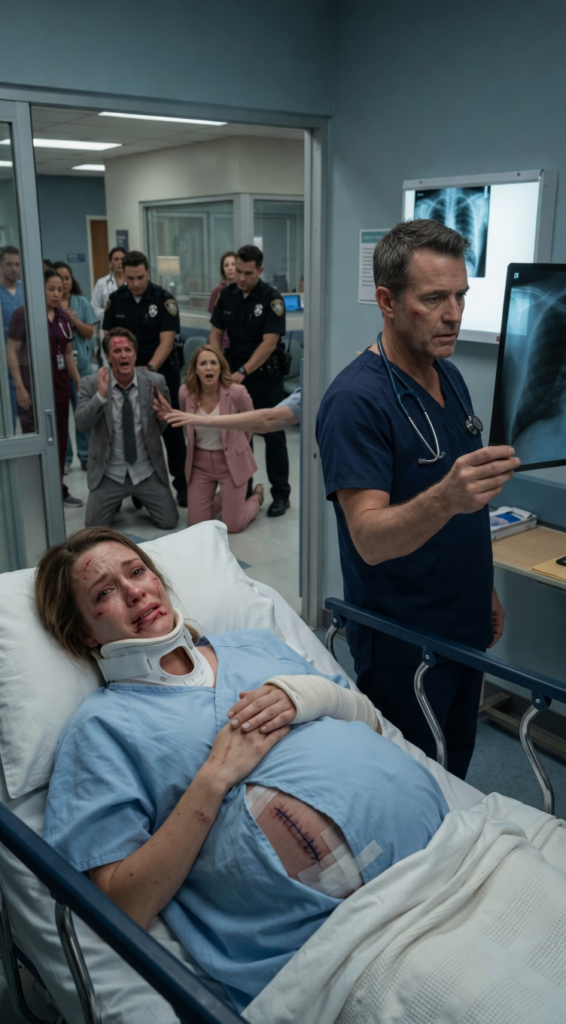
I couldn’t speak. My mouth tasted like rust and metallic copper. My ribs burned with a white-hot agony every time I tried to draw a breath, and my hands instinctively curled protectively over my swollen belly. Somewhere in the sterile background, fetal monitors and heart machines beeped in a steady, detached rhythm, sounding like distant bombs counting down.
Julian leaned closer, brushing a stray lock of hair from my sweaty forehead. The absolute second the triage nurse turned her back to prep an IV, his tears miraculously vanished. His eyes, usually a warm hazel, went completely dead.
“Remember,” he whispered, his breath hot against my ear. “Stairs.”
That was our marriage encapsulated in a single, terrifying word.
Stairs. Heavy oak doors I had supposedly “walked into.” Open kitchen cabinets I had “hit my head against.” A crystal wineglass I had mysteriously “broken with my own face.” Every wound came with a carefully crafted narrative, and every narrative was delivered with his charming, devastating smile.
At home, in our sprawling, gated suburban mansion, Julian controlled every atom of my existence. He controlled the passcode to my phone, the clothes hanging in my closet, the limit on my bank cards, and the exact minute I was allowed to leave the house. He even controlled the volume of my voice. He called this suffocating cage “love.”
His mother, Eleanor, called it “discipline.”
“You are incredibly lucky he keeps you around, Maya, especially now that you’re carrying his heir,” Eleanor used to say, casually sipping Earl Grey tea in my pristine kitchen while I stood by the sink, trying to hide a split lip. “A fragile, anxious woman like you would be absolutely nothing out there alone. You’d be unfit to raise a child by yourself.”
Fragile. That word followed me like an iron chain dragging against concrete. Julian believed it. His wealthy, golfing friends believed it. His mother adored it. They looked at me and saw a soft, scared, entirely dependent creature. They saw a woman who visibly flinched when the sound of keys turned in the front door lock.
But they never saw what I did after midnight, when the house was dead silent. They never knew that before Julian convinced his social circle I was too “mentally fragile” to hold a job, I had been a senior forensic accountant for a top-tier firm. I was a woman who specialized in finding money that powerful people had tried to bury.
I had been building a trap for years, planning my escape. But tonight, when he lost his temper and shoved me near the staircase, knowing I was carrying our child, he crossed the ultimate line. Tonight was the night the trap had to snap shut.
A new doctor stepped into the curtained cubicle. He looked to be in his mid-forties, with calm, perceptive eyes and a badge clipped perfectly straight to his white coat. Dr. Samuel Hayes.
Julian immediately rushed toward him, running a hand through his perfectly styled hair. “Doctor, thank God. She fell. I told the paramedics. She’s so careless, she lost her footing on the landing. Is the baby okay?”
Dr. Hayes didn’t look at Julian first. He didn’t offer a sympathetic nod.
Instead, his eyes dropped directly to Julian’s hand, which was still wrapped aggressively around my wrist like a vice. Then, Dr. Hayes looked at the fading, yellowish bruise peeking out from above my hospital gown. Finally, his gaze traced the distinct, crescent-shaped fingernail marks dug into my forearm.
His expression changed by a fraction of an inch. A micro-expression of pure, clinical recognition.
Julian, so absorbed in his own performance, didn’t notice.
“She just needs some pain medication and rest,” Julian said smoothly, stepping between me and the doctor. “I’ll take her home as soon as she’s patched up. Hospitals make her prenatal anxiety act up.”
Dr. Hayes looked straight at him, his face an unreadable mask.
“I’m afraid that won’t be possible right now, sir,” Dr. Hayes said, his voice polite but carrying an underlying steel. “Given the trauma of the fall and the fact that your wife is in her second trimester, we need to initiate an emergency fetal distress protocol. I need to move her to the secure Radiology and Ultrasound wing immediately to check for placental abruption and internal bleeding.”
Julian’s jaw tightened. “I’ll come with her.”
“Hospital protocol strictly prohibits non-medical personnel in the emergency imaging suites,” Dr. Hayes replied without missing a beat. “You will have to wait in the family reception area. It could take up to an hour.”
Julian looked down at me, his eyes flashing with a silent, terrifying warning. He squeezed my wrist one last time, a promise of what would happen if I dared to speak.
“Fine,” Julian clipped. “I’ll be right outside the doors, Maya. Don’t worry. I’m not going anywhere.”
As the orderlies unlocked my bed and began to wheel me down the long, fluorescent-lit corridor toward the heavy, lead-lined doors of the emergency imaging department, my heart hammered against my ribs. I knew Julian. He would be pacing the hallway like a caged wolf.
And as the heavy metal doors hissed shut, sealing me inside with the doctor, I realized this was the only window of opportunity I would ever get to save myself and my unborn child.
The sudden silence inside the secure imaging room was deafening. The thick, lead-lined walls blocked out the frantic beeping of the ER, the chatter of nurses, and, most importantly, the looming, suffocating presence of my husband.
The orderlies parked my bed next to the massive ultrasound machine and quietly exited through a side door. I was alone with Dr. Hayes.
I braced myself, waiting for the cold, clinical instructions to lie still. I waited for him to treat me like just another tragic, clumsy pregnant woman.
Instead, Dr. Hayes walked over to the heavy double doors and locked them with a loud, definitive click. He turned around, pulled a rolling stool to the side of my bed, grabbed the ultrasound wand, and squirted warm gel onto my belly.
He didn’t look at the medical charts. He looked directly into my eyes.
“Maya,” Dr. Hayes said, his voice dropping to a gentle, steady murmur as he moved the wand. “You are in a secure room. Your husband cannot get through those doors, and he cannot hear us. I have locked us in. I also want you to know that there are two uniformed police officers currently standing by the rear ambulance exit.”
I stared at him, my breath catching in my throat.
Suddenly, a fast, strong thump-thump-thump filled the room. It was the baby’s heartbeat. Strong. Unharmed.
A sob of pure, unadulterated relief broke free from my chest. Tears streamed down my face.
“The baby is perfectly fine,” Dr. Hayes smiled gently, handing me a tissue before his face grew serious again. “I have been an ER attending for fifteen years. I know what a fall down a staircase looks like. And I know what defensive wounds look like. I know the difference between a clumsy accident and a handprint.”
For seven years, I had been drowning in plain sight, screaming underwater while Julian’s wealthy friends smiled and drank our wine. This man, a complete stranger, had seen the truth in less than sixty seconds.
“He’s waiting out there,” I rasped, my voice barely a whisper. My throat was raw. “He’ll never let me leave. He told me if I ever tried to take his child, he would destroy me. He has my ID, my phone, my cards. He controls everything.”
“He doesn’t control this hospital,” Dr. Hayes said firmly. “I am placing you under a mandatory medical hold. You are not leaving with him tonight. But I need you to talk to me. I need you to tell me the truth so I can let those officers outside know what we are dealing with.”
I closed my eyes. Fragile. That was the word they loved so much.
I opened my eyes, and the fragility evaporated.
“I don’t just have a statement, Dr. Hayes,” I said, my voice suddenly losing its tremor. I pushed myself up slightly against the pillows, ignoring the searing pain in my ribs. “I have proof.”
I reached up to my neck. My fingers found the heavy, vintage gold locket that Julian had locked around my throat on our wedding day. A symbol of our unbreakable bond, he had called it. He never let me take it off.
With a sudden, violent yank, I pulled. The thick gold chain snapped, biting into the back of my neck, but I didn’t care. I held the heavy locket in my trembling hands. I pressed a specific sequence on the ornate floral engravings—a mechanical trick I had discovered years ago.
The locket popped open.
Inside, there was no romantic portrait. There was no lock of hair.
Nestled perfectly inside the hollowed-out gold casing was a tiny, high-capacity, encrypted micro-SD card.
Dr. Hayes looked at the tiny black chip, his professional calm slipping into visible shock. “What is that?”
“It is seven years of patience,” I whispered, holding the chip out to him. “It is audio recordings of his abuse. It is timestamped photographs of every bruise. But more importantly, it is a complete, forensic financial audit. I was an accountant before he trapped me. He thinks I’m stupid. But every night, while he slept, I tracked every single dollar he stole from my late father’s estate. I was waiting until I had everything, but when he pushed me tonight… when he risked my baby…”
I placed a protective hand over my stomach. “I ran out of time. The trap has to close tonight.”
Dr. Hayes nodded slowly, taking the chip as if it were a live explosive, wrapping it securely in a piece of sterile gauze. “I’ll bring the officers in through the back.”
Suddenly, a loud, aggressive pounding echoed from the heavy lead doors.
BANG. BANG. BANG.
“Open this door!” a woman’s voice shrieked, muffled but sharp enough to cut glass. It wasn’t Julian.
It was Eleanor.
My blood ran cold.
Dr. Hayes frowned, standing up. “Stay here,” he ordered quietly. He walked over and unsealed the door, opening it just a crack.
Through the narrow opening, I saw her. Eleanor stood in the hallway, dripping in pearls and expensive perfume. But she wasn’t alone. Standing right beside her, holding a sleek leather briefcase, was Richard Vance, the family’s incredibly ruthless defense attorney.
“Step aside, Doctor,” Eleanor demanded, her voice dripping with aristocratic venom. “We are transferring my daughter-in-law immediately. And if you try to stop us, we will sue this hospital into the ground.”
Dr. Hayes didn’t move an inch. He stood blocking the doorway, his broad shoulders shielding me from their view.
“Mrs. Maya Julian is currently undergoing critical medical evaluation regarding her pregnancy,” Dr. Hayes said, his voice a wall of professional ice. “She is in no condition to be discharged, let alone transported. As her attending physician, I am denying release.”
Richard Vance, the slick family lawyer, stepped forward. He pulled a thick, official-looking document from his leather briefcase and shoved it toward Dr. Hayes’s chest.
“You don’t have a choice, Doctor,” Vance said smoothly. “My client, Julian, has full Medical Power of Attorney. Furthermore, due to Maya’s well-documented history of severe psychiatric instability, prenatal psychosis, and clinical anxiety, Julian has been granted emergency conservatorship to protect the unborn child. We have a private ambulance waiting outside to transfer her to the Crestview Private Clinic, where her actual doctors can manage her.”
Crestview. I knew exactly what that place was. It was an ultra-exclusive, heavily guarded private psychiatric facility notorious for keeping wealthy families’ secrets buried. If Eleanor and Julian got me inside those walls, they would induce labor early, take my baby, and keep me heavily sedated for the rest of my life.
Julian appeared behind his mother, his face a mask of faux-anguish. “Please, Doctor. My wife is not in her right mind. The pregnancy hormones have made her manic. She hurts herself when she has these episodes. I just want to get the mother of my child to a safe place.”
“This document,” Dr. Hayes said, glancing at the paper, “appears to be highly irregular. I will need the hospital’s legal department to review it. Until then, the patient stays.”
“You don’t have the time,” Eleanor snapped, her pearl necklace trembling against her throat. She looked at Dr. Hayes with cold disgust. “My son has endured years of her dramatic, unstable behavior. We have kept meticulous records of her mental decline. We are leaving with her and my grandchild right now, or I will have your medical license revoked by morning.”
“Records?” a new voice interrupted.
Two uniformed police officers stepped out from the adjacent hallway, their radios crackling softly in the tense silence. They had been standing quietly in the shadows, listening to the entire exchange.
Julian’s confidence visibly faltered, but he quickly recovered, smoothing his expression back into the victimized husband. “Yes, officers,” he said, turning to them with a tragic sigh. “Texts. Notes she leaves around the house. She apologizes after these manic episodes. I have all the text messages on my phone.”
I almost laughed out loud from my hospital bed.
Of course I apologized. He wrote those messages himself, typing them out from my phone while I sat bleeding and terrified on the bathroom floor beside him, holding my stomach. He was building a paper trail of my “insanity” so he could take full custody.
“May we see those text messages, sir?” the older officer asked, his hand resting casually near his duty belt.
Julian hesitated. It was only for half a second. But to anyone paying attention, that half-second was the first, monumental crack in his flawless armor.
“I… I left my phone in the car,” Julian lied smoothly. “In the panic of the accident, I must have dropped it.”
Dr. Hayes stepped back, opening the lead door fully, allowing the police officers to see me sitting up in the hospital bed, holding my swollen belly.
“That’s perfectly fine, Julian,” I said, my voice echoing clearly into the hallway.
Eleanor gasped, her eyes widening as she saw me. I didn’t look like a trembling, broken bird. I was sitting upright, my posture straight, my eyes fiercely protective.
“Because my phone isn’t the issue,” I continued, looking directly at the police officers. “Dr. Hayes has something he needs to give you.”
Dr. Hayes reached into his white coat pocket and pulled out the piece of sterile gauze. He carefully unwrapped it, revealing the tiny, black micro-SD card, and handed it to the lead officer.
“What is that?” Julian demanded, his voice suddenly spiking an octave. The cool, collected mask was violently slipping.
“That,” I said, looking right into my husband’s terrified eyes, “is a little piece of jewelry you made me wear for seven years. You really should have checked the inside.”
Eleanor’s face drained of all color. She looked like a ghost. She turned to her lawyer, panic setting in. “Richard, do something! This is an illegal seizure! That’s our property!”
“Officer,” I said, ignoring her shrieks. “Do you have a laptop in your cruiser?”
“We do, ma’am,” the officer replied, eyeing the tiny chip.
“Plug it in,” I instructed. “Open the folder labeled Grocery Lists. And then, I highly suggest you read my husband his rights.”
The lawyer, realizing the situation had spectacularly backfired, took a physical step away from Eleanor. Julian lunged forward, trying to grab the chip from the officer’s hand, but the second cop was faster. He grabbed Julian by the shoulder and slammed him hard against the hallway wall, pulling out a pair of steel handcuffs.
“Hey! Let go of me! I’m her husband!” Julian screamed, struggling wildly. “She’s lying! She’s crazy!”
“Julian,” I called out from the room, my voice ringing with a cold, terrifying clarity. “I was quiet. I was never crazy.”
The police didn’t just find a few incriminating photos on that chip. They found a meticulously organized, expertly categorized digital vault that laid bare a sprawling criminal enterprise.
Julian had vastly underestimated the intelligence of the woman he had married. He had believed that because I flinched when he yelled, my brain had stopped working. He didn’t understand that fear does not erase a mother’s instinct to protect her child; it merely sharpens it into a deadly weapon of survival.
When the detectives plugged the chip into their encrypted laptop at the precinct, they found the audio files first.
Hours of pristine, horrific audio. Recordings of Julian shouting, “If you ever try to leave, Maya, the courts will give the baby to me! Look at you, you’re pathetic! You’ll never see this child!” Recordings of Eleanor, sipping tea in my kitchen, casually advising her son: “Break her confidence first. Make sure she signs over the trust before the baby is born. Bruises fade, Julian. Assets don’t.”
But the audio was just the appetizer. The main course was the financial data.
Before Julian had isolated me from the world, I had been brilliant at my job. And in the dead of night, while he slept off his expensive scotch, I had used my old skills to hack into his home office network.
I traced the complex web of offshore accounts he had set up. I documented exactly how he had forged my signature on legal documents, systematically draining my late father’s multi-million dollar inheritance. But I didn’t stop there. I followed the money trail directly to Eleanor. I found the shell company—Vance Holdings LLC—registered under Eleanor’s maiden name, which they were using to launder the stolen money.
I provided the police with scanned hospital reports from previous “accidents,” cross-referenced with timestamps, IP addresses, and banking wire transfers. It was a perfectly wrapped, indisputable package of coercive control, aggravated assault on a pregnant woman, grand larceny, and corporate fraud.
By dawn, Julian was sitting in a holding cell, stripped of his tailored suit and his arrogance.
By noon, the District Attorney’s office had formally frozen every single bank account associated with Julian and Eleanor.
By the evening, my scheduled emails—the ones I had programmed to send automatically if I didn’t log into a secure server every 24 hours—had deployed. They went to my new lawyer, to the DA’s domestic violence unit, and directly to the board of directors of Julian’s real estate firm.
The fallout was apocalyptic.
Julian tried to bargain first, offering to return the money if I dropped the charges. When I refused, he tried to threaten me through his lawyer. When that failed, he wept, begging for mercy.
Four months later, heavily pregnant and glowing with newfound peace, I sat in the courtroom.
Julian sat at the defense table wearing a cheap gray suit. Eleanor sat behind him in the gallery, her chin held high, as if pure arrogance could act as a valid legal defense.
She stared at me from across the courtroom. For seven years, she had looked at me as if I were a piece of ugly furniture. Now, she looked at me like a locked door she realized she could never open.
My lawyer stood before the judge and played the recordings. The jury listened in stunned, horrified silence.
The judge’s face hardened into a mask of pure disgust. Julian stared a hole into the table.
“Your Honor,” the prosecutor announced, “the digital evidence provided by the victim demonstrates a chilling, calculated pattern of coercive control, physical assault on an expectant mother, witness intimidation, and massive financial exploitation. The defendants operated a criminal conspiracy within the walls of a marriage.”
Men like Julian do not fear prison as much as they fear humiliation. And he received his humiliation on the most public stage possible.
His company issued a public statement severing all ties with him. His wealthy, golfing friends stopped answering his calls.
Eleanor’s downfall was even more spectacular. The IRS seized the sprawling estate she had decorated using my stolen inheritance. Her beloved pearl necklaces disappeared first, auctioned off to pay legal fees. Then her luxury cars were repossessed.
Julian, realizing he had absolutely no defense against the digital breadcrumbs I had collected, was forced to take a plea deal.
Eight years in a federal penitentiary. Full financial restitution. And a permanent, lifetime protection order covering both me and my unborn child.
The day the judge read the final sentence, Julian turned around and looked at me one last time before the bailiffs led him away.
He didn’t look at me with love. He didn’t look at me with anger.
He looked at me with absolute, profound disbelief. He still could not comprehend how a “fragile” woman had systematically destroyed his entire life without ever raising her voice.
Three years later, the air smells of salt and blooming jasmine.
I live in a small, beautiful house perched on a rugged cliff overlooking the sea. The house has a long set of wooden stairs leading down to the private beach. They are sunlit, sturdy, and most importantly, they are mine.
I am working again. I opened a private consultancy firm, specifically helping women recover hidden assets and stolen money from men who thought fear made their crimes invisible. Sometimes, new clients sit across the desk in my bright, airy office. Their hands tremble, and they quietly apologize for crying, ashamed of their own tears.
I slide a box of tissues across the desk, look them in the eye, and tell them the absolute truth.
“You are not weak because someone hurt you,” I say, my voice steady and warm. “And you are not crazy because someone tried to convince you that you were.”
Outside my office window, the ocean waves crash violently against the sharp, jagged rocks. The water shatters into a million white droplets, but it always gathers itself and returns, stronger and more relentless than before.
Suddenly, the sound of tiny, rapidly pattering feet echoes from the hallway.
“Mama! Mama!”
My two-year-old son, Leo, bursts into the office, his bright eyes shining with joy, holding a seashell he found on the beach. I scoop him up into my arms, inhaling the sweet, innocent scent of his hair, burying my face in his neck as he giggles uncontrollably.
He is safe. He will never know the sound of raised voices, the fear of turning keys, or the suffocating weight of a locked door.
On quiet, peaceful mornings, before the world wakes up, I hold Leo’s tiny hand in mine. We walk barefoot out of my bedroom. We walk down my wooden staircase slowly.
I let my free hand trail lightly along the smooth banister. I touch the rail not out of terror, not out of the fear of being pushed, but out of simple, unadulterated pleasure.
I am not fragile. I am not nothing. I am a mother who burned an empire to the ground to save her child.
And every single step we take belongs to me.
If you want more stories like this, or if you’d like to share your thoughts about what you would have done in my situation, I’d love to hear from you. Your perspective helps these stories reach more people, so don’t be shy about commenting or sharing.