As soon as my parents heard my sister was bringing her kids over, my mother began ordering everyone to clean the house as if the entire future of the family depended on polished floors and folded towels.
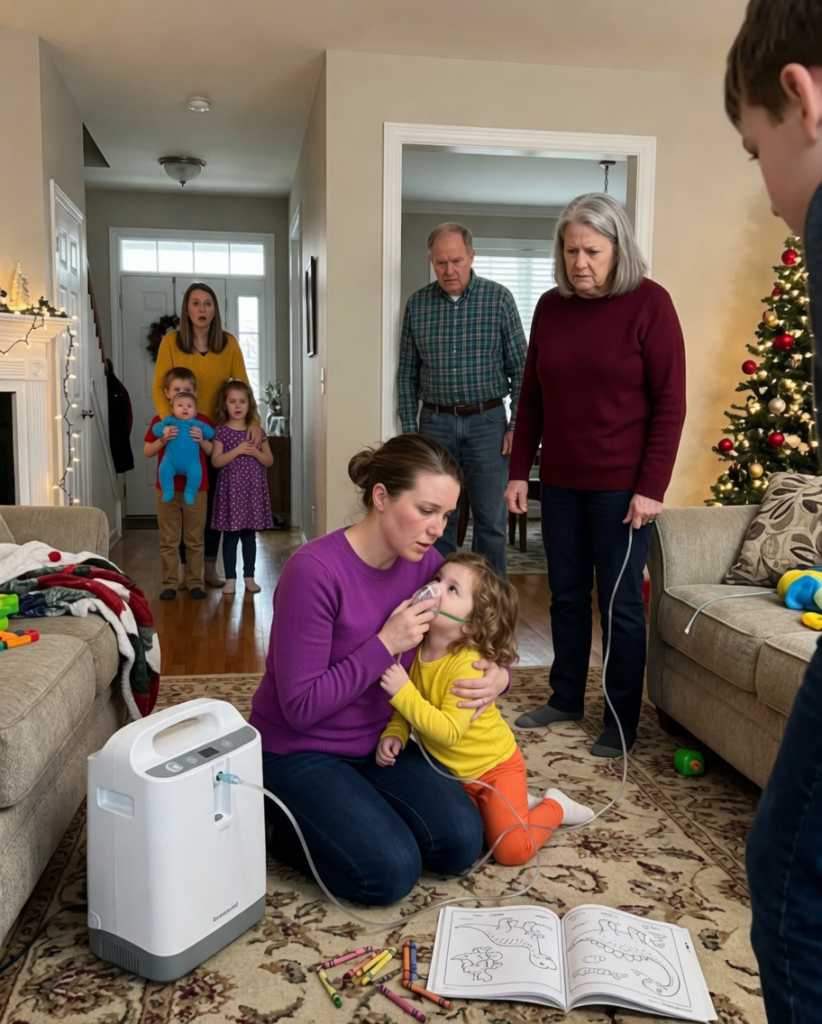
My four-year-old daughter, Lily, sat quietly on the living room rug with her supplemental oxygen in place, coloring a green dinosaur with a purple crown.
She was not making noise.
She was not leaving toys everywhere.
She was not asking for attention.
She was breathing.
Then my mother crossed the room, snatched the oxygen from Lily’s face, and shouted, “Start cleaning now.”
For one second, my body forgot how to move.
Lily’s little hand flew to her face.
Her eyes went huge and wet, and the sound that came out of her was not a cry.
It was a thin, broken gasp.
I rushed toward them.
“Give it back.
Right now.”
My mother held the tubing out of reach like she had taken away a doll instead of the one thing keeping my child stable.
“She is old enough to help.
Your sister’s children will be here any minute.”
“She cannot breathe without it,” I said.
My father came in from the hallway with a dish towel in one hand and irritation already carved into his face.
He did not look at Lily first.
He looked at my mother, then at me, as if I were the problem.
“What now?” he snapped.
“Mom took Lily’s oxygen,” I said.
“Dad, look at her.
She needs it back.”
Lily’s chest was working too hard.
Her lips were losing their soft pink color.
I knew that shade because every mother of a medically fragile child knows the color fear wears.
I had seen it under fluorescent hospital lights.
I had seen it in the rearview mirror during emergency drives.
I had seen it in nightmares that left me sitting upright in bed with my heart pounding.
“She could pass out,” I said, reaching for the tubing.
“She could die.”
My father’s expression hardened at that word, not with alarm, but anger.
His hand struck my face so suddenly that the room tilted.
Pain flashed hot across my cheek.
I stumbled backward into the coffee table, and a metallic taste filled my mouth where my teeth cut the inside of my lip.
“Stand down,” he said.
I stared at him, stunned.
Not because my father had never been cruel.
He had been cold my whole life.
He had been dismissive.
He had been the kind of man who believed volume mattered more than truth.
But he had never struck me while my child was gasping for air three feet away.
My mother stood with Lily’s oxygen still in her hand, her mouth pressed into a satisfied line.
“Some children need to learn family priorities,” she said.
That sentence did something to me.
It cut through years of excuses.
Years of telling myself they did not understand.
Years of hoping they would soften.
Years of bringing Lily into rooms where she was treated like an inconvenience because I wanted her to have grandparents.
In that moment, I finally understood.
They were not confused.
They were choosing this.
My name is Grace.
I was twenty-nine years old then, a single mother working full time and sleeping badly because Lily’s
oxygen monitor trained my nerves to wake at the smallest sound.
Lily was born at twenty-eight weeks, so tiny I could fit almost her whole body along my forearm.
Doctors told me her lungs were fragile, and for months, I lived beside her incubator, learning every beep and number like a second language.
Her diagnosis, severe bronchopulmonary dysplasia, was not something my parents ever tried to understand.
To them, it was a complication that made holidays less convenient.
Her tubing was unsightly.
Her portable concentrator was noisy.
Her medical bags ruined the look of a room.
My mother, Dorothy, had always cared most about what other people saw.
Her house was a museum of appearances: polished wood, framed portraits, seasonal wreaths, candles arranged as if a magazine crew might knock at any moment.
My father, Kenneth, supported her version of reality because it was easier than questioning it.
My older sister, Vanessa, fit perfectly into that world.
She had a husband with a law degree, a big house in a good neighborhood, three healthy children, and holiday pictures that made my mother tear up with pride.
Vanessa’s family was the family my parents wanted to display.
Lily and I were the shadow in the corner of the frame.
When Lily took her first steps at three after months of physical therapy, my mother said, “That’s nice,” without putting down her coffee.
When Lily spent four days in the hospital with a respiratory infection, my father asked whether I had considered that maybe I was “too attached to crisis.” When I brought Lily to Sunday dinner with her portable oxygen, my mother asked if I could “tuck that machine somewhere less noticeable.”
I should have stopped going.
But loneliness makes people negotiate with pain.
I wanted my daughter to know cousins, grandparents, Christmas tables, birthday cakes with too many voices singing around them.
I wanted to believe family could grow into love if given enough chances.
That Christmas morning proved how dangerous hope can be.
Vanessa was coming with her husband, Mark, and their children.
My mother had been preparing for days, wiping shelves that were already clean and barking orders at anyone within reach.
She called me three times that morning, saying I needed to come early and help because “everyone had a role.”
Lily woke up tired.
Her breathing was shallow, her body heavy against mine when I lifted her from bed.
Her oxygen numbers were lower than I liked, not emergency low, but low enough that I planned a quiet day.
“Can we stay home?” she whispered.
I looked at her small face, at the cannula under her nose, at the curls stuck to her forehead.
I should have said yes.
Instead, I let guilt steer me.
My mother’s voice echoed in my head about responsibility and family and how I always made everything difficult.
I packed Lily’s supplies, double-checked her backup tubing, and drove to my parents’ house with my stomach already tight.
The house smelled like bleach, cinnamon, and panic.
My mother barely greeted us before pointing toward the living room and telling me to dust.
Lily settled onto the rug near the coffee table, her concentrator humming beside her, and opened her coloring book.
She was quiet, careful, trying to be good in the way children become when they sense adults are waiting for them to be a problem.
For almost twenty minutes, nothing happened.
Then my mother came in and saw Lily sitting.
“Why is she not helping?” she asked.
I said, “She’s having a rough day.
She needs to rest.”
My mother stared at Lily’s oxygen tubing as if it offended her personally.
“She can hold a cloth.
Vanessa’s children help around the house.”
“Vanessa’s children are not on oxygen.”
Her eyes snapped to mine.
“Do not use that tone with me.”
“I’m not using a tone.
I’m telling you no.”
That was all it took.
She walked over and pulled the oxygen from Lily’s face.
The seconds after that are burned into me.
Lily’s crayon dropped.
Her little shoulders lifted as she tried to draw air.
My mother told her to start cleaning.
I moved toward them, and my father came in.
I begged.
My mother accused Lily of being dramatic.
My father told me to calm down.
Then he slapped me.
And everything changed.
I did not scream.
I did not argue.
The part of me that had wasted years seeking approval went silent.
I stepped around him.
“Do not,” he warned.
I ignored him and reached for the tubing.
My mother tried to pull it back, but I gripped it hard enough that the plastic bit into my fingers.
“Let go,” I said.
She blinked.
Maybe she heard something in my voice she had never heard before.
Maybe she understood that the daughter she could shame and corner was gone.
Her fingers loosened.
I dropped to my knees and placed the mask back over Lily’s face.
Her hands clutched my sweater as she sucked in air too quickly.
I held the mask steady and tried to slow my own breathing so she could follow me.
“In and out,” I whispered.
“Look at me, baby.
Stay with me.”
Lily’s eyes locked on mine.
Tears ran down her cheeks, but she tried.
She always tried.
Behind me, my father said, “You will not embarrass this family today.”
The front door opened before I could answer.
Vanessa’s voice floated in from the entryway, bright and polished.
“Merry Christmas! We brought cookies!”
Her children came rushing in first, then stopped so suddenly the youngest bumped into the older one.
Vanessa appeared behind them, holding a tray covered in foil.
Her husband, Mark, followed with gift bags in both hands.
No one spoke.
I was on the floor with Lily shaking in my arms.
My cheek was swelling.
Blood marked the corner of my mouth.
The oxygen tubing stretched from the machine to my daughter’s face, and my mother was standing over us with her hands still half-raised, caught in the aftermath of what she had done.
Vanessa’s smile collapsed.
“What happened?” she asked.
My mother recovered first.
“Grace had one of her episodes.
Lily was being difficult, and she overreacted.”
I felt Lily flinch against me.
My father added, “Everything is fine.
Take the kids to the kitchen.”
But Vanessa did not move.
Her eyes traveled from my cheek to Lily’s mask, then to the red mark blooming on my face.
“Grace,” she said quietly, “what happened?”
I opened my mouth, but Lily answered first.
Her voice was tiny under the mask.
“Grandma took my air.”
The room went utterly still.
Vanessa’s oldest child, Emma, who was eight, started crying.
Mark set the gift bags down slowly, like sudden movement might break something.
My mother snapped, “That is not what happened.”
Lily shrank into me.
I looked at Vanessa and said, “She took Lily’s oxygen because she wanted her to clean.
Dad hit me when I tried to get it back.”
My father’s face turned red.
“You watch your mouth.”
Mark stepped between him and us before I could react.
He was not a large man, but his voice changed in a way I had never heard before.
“Do not come closer to them.”
My father stared at him.
“This is my house.”
“And that is a child who was denied medical equipment,” Mark said.
“You need to stop talking.”
Vanessa looked like someone had pulled the floor out from under her.
For years, she had been the golden child, praised and protected, kept separate from the worst of my parents’ cruelty because she gave them something to brag about.
I had resented her for it.
But in that moment, I saw the shock on her face and realized she had never believed they could go this far.
“Mom,” she whispered.
“Tell me you didn’t.”
My mother’s answer was not an apology.
She lifted her chin and said, “That child has been allowed to control this family for long enough.”
Vanessa recoiled as if she had been slapped too.
“She is four.”
“She is manipulative,” my mother said.
“Grace has made her weak.
Always with the machines, always with the excuses.
I will not have my grandchildren walking into a house where one child is treated like the center of the universe because her mother wants sympathy.”
Lily whimpered.
Something in Vanessa’s face hardened.
“My children are leaving,” she said.
My mother’s expression flickered.
“Don’t be ridiculous.
Dinner is almost ready.”
“My children are leaving,” Vanessa repeated.
“And so are Grace and Lily.”
My father laughed once, sharp and ugly.
“You have no idea what you are talking about.
Grace has always twisted things.”
Mark turned to me.
“Do you want me to call emergency services?”
I looked down at Lily.
Her breathing was improving, but she was pale and trembling, and my own face throbbed with every heartbeat.
“Yes,” I said.
My mother gasped as if I had betrayed her.
“Grace, do not you dare bring outsiders into this family matter.”
That phrase almost made me laugh.
Family matter.
As if oxygen deprivation and being struck across the face were private inconveniences to be folded neatly and hidden in a drawer before guests arrived.
Mark called.
Vanessa gathered the children into the hallway, but Emma refused to move until she came to me.
She crouched beside Lily, crying silently.
“I’m sorry,” she whispered.
“I didn’t know Grandma was mean to you.”
Lily’s fingers tightened around mine.
The paramedics arrived quickly.
My mother tried to perform for them, smoothing her sweater, speaking in that sweet public voice she used at church and grocery stores.
“There was a misunderstanding,” she said.
“My daughter gets hysterical about the child’s condition.”
One paramedic knelt beside Lily and checked her oxygen levels.
The other looked at my swelling cheek and split lip.
“Who removed her oxygen?” he asked. My mother hesitated.
I said, “She did.”
My father barked, “That is not necessary.”
The paramedic looked at him once.
“Sir, I need you to step back.”
There it was again: the sound of someone finally telling my father no.
Police came after that because of the assault and the report that a child’s medical equipment had been intentionally removed.
My parents’ confidence began to crumble when they realized their version of respectability did not matter to people trained to recognize danger.
My father tried to say he had only tapped me because I was hysterical.
Vanessa interrupted him.
“He slapped her,” she said.
Her voice shook, but she did not look away.
“I saw the mark when I walked in.
Lily said Mom took her air.
Grace told the truth.”
My mother stared at her favorite daughter like she had never seen her before.
“You would choose them over your own mother?”
Vanessa’s eyes filled with tears.
“No.
I’m choosing the child you endangered.”
I was taken with Lily to the hospital for observation.
Vanessa rode with us while Mark stayed behind to handle the children and speak with officers.
In the ambulance, Lily finally fell asleep against me, exhausted, her mask secure, one small hand curled in my sleeve.
Vanessa sat across from us and cried without making a sound.
For a long time, I did not know what to say.
Part of me wanted to blame her for years of being adored while I was dismissed.
Part of me wanted to ask how she could not have seen it.
But when she finally spoke, her voice was so broken that my anger had nowhere clean to land.
“I thought Mom was hard on you,” she whispered.
“I didn’t know she hated you for needing help.”
I looked down at Lily’s sleeping face.
“She didn’t just hate me,” I said.
“She hated that Lily made the family look imperfect.”
At the hospital, the doctors confirmed Lily’s oxygen levels had dropped enough to put her at serious risk.
Hearing those words from a physician made Vanessa cover her mouth and turn away.
I signed reports.
I answered questions.
I let a nurse clean the cut inside my lip.
By evening, Vanessa had booked us a hotel suite near her house and told me I was not going back to our parents’ place for anything.
Mark retrieved Lily’s supplies from the house while police were still there.
My parents called repeatedly, then texted.
My mother’s first message said, “You have ruined Christmas.”
Her second said, “You always wanted attention.
Now you have it.”
My father’s said, “Drop this before you regret it.”
I saved every message.
The following weeks were brutal in a way I had not expected.
Not because I doubted myself, but because breaking away from family feels strange even when family is dangerous.
My mother left voicemails crying about betrayal.
My father sent relatives after me, telling them I had exaggerated a disagreement.
Some believed him at first.
Then Vanessa did something I never saw coming.
She posted the truth in the family group chat.
Not vague hints.
Not polite language.
The truth.
She wrote that our mother had removed Lily’s oxygen.
She wrote that our father had slapped me.
She wrote that emergency services had been called and that Lily had required medical evaluation.
She told everyone that anyone defending our parents was defending the endangerment of a four-year-old child.
The silence afterward was louder than any argument.
One aunt called me crying.
A cousin apologized for years of believing I was dramatic.
My parents left the group chat within an hour.
There were legal consequences.
My father faced an assault charge.
My mother was investigated for endangering Lily, and while the process was messy and emotionally exhausting, the most important outcome was immediate: they were not allowed near my daughter.
I obtained a protective order.
For the first time in years, my mother’s opinion had no authority over my life.
Vanessa and I did not magically become best friends.
Real damage does not disappear because someone finally sees it.
But she showed up.
She paid for a storage unit so I could move without asking my parents for access again.
Mark helped install shelves in our new apartment for Lily’s medical supplies.
Vanessa’s children learned to ask Lily about her oxygen with kindness instead of fear.
Months later, Lily was sitting on the floor of our new living room, wearing a princess dress over her pajamas, when she looked up and asked, “Grandma can’t take my air here, right?”
The question broke my heart so cleanly I had to sit beside her before answering.
“No, baby,” I said.
“No one can take your air here.”
She considered that seriously, then handed me a dinosaur sticker and said, “Good.
This one protects the castle.”
I stuck it on the side of her oxygen concentrator.
It is still there.
My parents never gave a real apology.
My mother sent one letter months later saying she was “sorry I misunderstood her intentions.” My father wrote nothing.
Vanessa cut contact with them after they tried to convince her children that I had destroyed the family out of jealousy.
Sometimes people ask if I regret calling emergency services.
They ask if I think the family could have healed privately.
They ask if one horrible moment should erase a lifetime of being related.
But that question always sounds different to me.
Because it was not one moment.
It was every ignored warning sign.
Every cruel comment.
Every time I taught myself to be smaller so my parents could stay comfortable.
Every time Lily was treated like a burden for needing help to live.
The day my mother took my daughter’s oxygen, she did not become dangerous.
She revealed that she already was.
And my father’s slap did not silence me.
It woke me up.
Now Lily breathes in a home where her machines are not hidden, her supplies are not shameful, and her life is not considered an inconvenience.
Our apartment is not perfect.
There are crayons under the sofa, medical tape in kitchen drawers, and dinosaur stickers on equipment that insurance companies probably never imagined decorating.
But it is safe.
And safe, I have learned, is worth more than any family photo where everyone is smiling for the camera while one child is quietly being taught she does not matter.
The hardest part was not walking away from my parents.
It was admitting I should have done it sooner.
Some people believe forgiveness is owed because of blood.
Others believe the moment someone endangers a child, blood stops being a shield.
I know which side I stand on now.