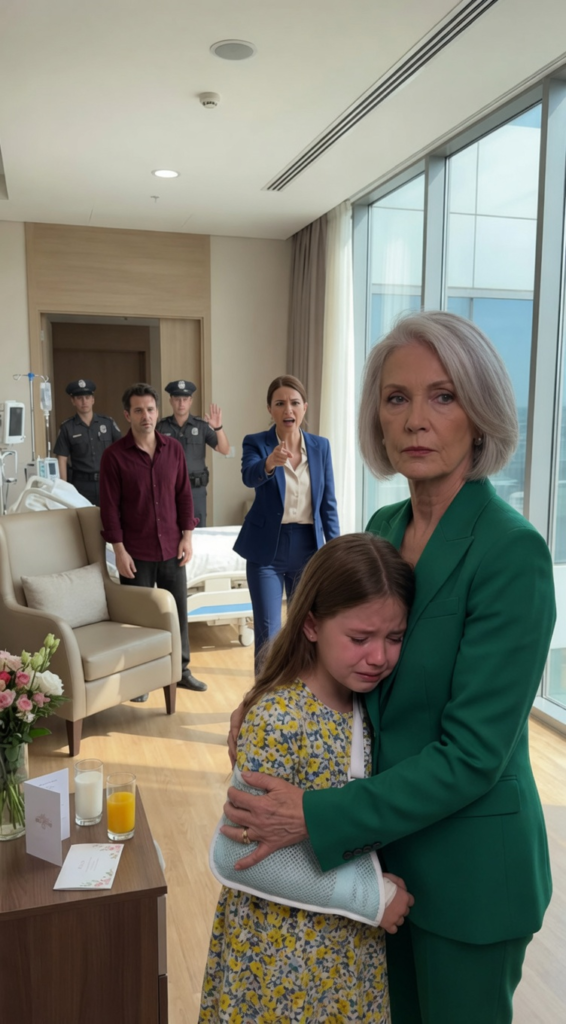
The Shadow Ledger
The call arrived at exactly 3:17 in the morning. My granddaughter’s name, Lily, flashed on the screen, illuminating the dark corners of my bedroom. I was sitting upright before the second pulse of the ringer finished.
In my sixty-three years, I’ve been jolted awake by a phone in the dead of night more times than I care to remember. For three decades, a call at that hour meant only one thing: someone was in deep trouble, and the window to fix it was closing fast. You don’t panic after thirty years of those calls; you simply stop being a person and start being a machine.
Her voice was low, brittle, and terrifyingly controlled—the sound of someone who had cried until the well was dry and all that remained was raw data.
“Grandma, I’m at the hospital,” she whispered. “She broke my wrist. She told the doctor I slipped in the tub. Dad… Dad is just standing there with her.”
I didn’t ask how it happened. I didn’t ask why Daniel wasn’t protecting her. I asked the only question that mattered. “Which hospital?”
“St. Augustine Medical Center.”
“The ER?”
“Yes.”
“I’m leaving now,” I said, my voice like iron. “Lily, listen to me. Do not say a single word to anyone until I am standing in front of you. Do you understand?”
“Okay,” she breathed.
I was dressed in four minutes. By 3:22, my keys were in the ignition. My name is Geraldine Oakes. I spent thirty years as a private investigator in Charleston, South Carolina, before the world told me I was too old for the hunt. I’ve spent my entire adult life reading people the way others read the morning news. I know the difference between a story someone tells and a story someone has meticulously prepared.
Lily is fifteen. She is also the reason I have a second phone line that no one in her house knows exists. I gave it to her eight months ago during a quiet lunch while her father, my son Daniel, was at work. I hadn’t explained why. I just slid the paper across the table. She hadn’t asked. She simply folded it and tucked it into the interior pocket of her jacket—the one hidden behind the lining.
She understood exactly what I was handing her. Tonight, she finally used it.
As I pulled out of my driveway, I knew that I wasn’t just driving to a hospital. I was driving to a war I had been prepping for since the day Natalie moved into my son’s house.
Chapter 1: The Inventory of Malice
Here is what you must understand: I didn’t walk into that hospital as a worried grandmother reacting to a crisis. I walked in as a woman who had been building a case for fourteen months.
I saw Natalie clearly the first time I met her. It was a dinner Daniel hosted to introduce her to the family. She arrived ten minutes late, breathless, with a story about a stalled elevator that was just a bit too detailed to be spontaneous. She pulled out Daniel’s chair before he could reach it, but her eyes weren’t on him. They were on the room, measuring the furniture, calculating the value of the silver, and assessing me.
Within the first twenty minutes, she asked me—framed as casual curiosity—whether I still kept my private investigator’s license active, whether I owned my Charleston cottage outright, and what my retirement portfolio looked like.
I’ve spent thirty years taking inventory of suspects. That night, I realized I was being inventoried. I didn’t say a word. She hadn’t done anything illegal yet, but I drove home and opened a new file in my mind.
By October, the inventory became a ledger.
Lily showed up at my door on a Sunday afternoon without calling. She had ridden her bike over, which I knew was an act of desperation, not exercise. She was wearing long sleeves despite the eighty-degree humidity. When she reached for a glass of water, her sleeve shifted.
I saw the bruise. I know the difference between a “fall” bruise and a “contact” bruise. A fall leaves a jagged, uneven mark. A contact bruise has a specific, rounded geometry—the shape of a thumb and fingers.
She told me she fell off her bike. She gave me the street corner. She gave me the crack in the sidewalk. She had rehearsed it.
“Oh, sweetheart,” I had said, my heart breaking while my brain stayed cold. “Let me get you some ice.”
After she left, I opened a hidden note on my phone. Entry 1: October 14th. Lily visit. Bruise on left forearm. Contact pattern. Narrative prepared. Rehearsed detail. Daniel absent.
Over the next eight months, I built the record with the methodical precision that had made me the best investigator in the state. No gaps. No emotional interpretation. Just the facts.
I noted November, when Lily barely spoke at Thanksgiving and Natalie answered every question directed at my son. I noted December, when Daniel told me Lily wouldn’t be staying with me for Christmas—a tradition we’d held since she was four. I heard the flat, hollow tone in my son’s voice. That was the sound of a man who had surrendered.
In February, I did two things. I gave Lily the secret phone, and I convinced Daniel to let me install a high-end dashcam in their family SUV. I told him it was for insurance purposes—an old woman’s paranoia. He let me do it.
I wasn’t being paranoid. I was installing a witness.
Chapter 2: The Four-Second Rule
I pulled into the St. Augustine parking structure at 3:39 a.m. I found a space on the second level, killed the engine, and sat in absolute silence for exactly four seconds.
In my line of work, those four seconds are the difference between being a victim of the chaos and being the master of it. It’s the time it takes to lock your emotions in a box and sharpen your focus until it’s a scalpel.
I stepped out of the car. I knew exactly what I was walking into.
Dr. Neil Greer saw me before I reached the nurse’s station. I’ve known Neil for twelve years. I worked a sensitive case for his family back when he was still a resident—a situation where the wrong people had the right paperwork. I had fixed it for him. He had never forgotten.
He was reviewing a chart when the automatic doors hissed open. He looked up, his eyes meeting mine, and I saw the recognition of a man who had been waiting for a professional to arrive.
“Give us the room,” Neil told the resident beside him.
He walked halfway across the linoleum floor to meet me. He looked like he had been carrying a heavy secret for two hours.
“Geraldine,” he said quietly.
“Neil. Tell me where she is and tell me what you’ve filed.”
“I haven’t filed the mandatory report yet,” he admitted. “The stepmother corroborated the ‘slip in the tub’ story. Lily refused treatment twice while Natalie was in the room. I suspected she was terrified, so I had my charge nurse let her use a personal phone about ninety minutes ago.”
“You did the right thing,” I said. “Where is she?”
“Bay four. I moved Daniel and Natalie to the family waiting area forty minutes ago.” He lowered his voice. “Geraldine, it’s a forced hyperextension fracture. It didn’t happen in a tub. And there’s more.”
“Tell me.”
“The X-rays show a healed fracture in the same arm. Distal ulna. It’s six to nine months old. It never received medical treatment. It just… fused on its own.”
I felt a cold rage settle into my marrow. My granddaughter had lived through a broken bone in silence, hiding the pain from me, from her teachers, from everyone.
“File the report, Neil,” I said, my voice a whisper of gravel. “Include the mechanism inconsistency and the old fracture. Complete, accurate, and final.”
“Already drafted,” he said. “I just needed to know she had someone.”
“She has me,” I said.
I walked toward bay four. Lily was huddled on the exam table, her left arm in a temporary splint. When she saw me, she didn’t cry. She just exhaled—a long, shuddering sound of a person who had finally been allowed to stop holding their breath.
I sat in the chair beside her, matching her height. “I’m here. You’re safe. No one enters this room without my permission.”
“Grandma,” she whispered. “I’m sorry.”
“You have nothing to be sorry for,” I said. “Now, I need you to tell me exactly what happened tonight. Don’t leave out a single detail. I need the truth to be our weapon.”
She talked for eleven minutes. I recorded every word. But as she finished, I heard a sharp, familiar voice shouting in the hallway—Natalie was coming for her.
Chapter 3: The Fortress of Bayesian Logic
Natalie didn’t make it past the curtain. Patricia Holt, the charge nurse, was a woman who stood six feet tall and had the temperament of a veteran drill sergeant. She intercepted Natalie with a grace that was purely clinical.
“Ma’am, you need to remain in the waiting area,” Patricia said.
“That is my daughter!” Natalie hissed. I could hear the forced desperation in her voice—the performance of a worried parent.
“She is in a clinical evaluation,” Patricia replied. “Sit down, or I will have security escort you to the street.”
I stepped out from behind the curtain. Natalie froze when she saw me. For a split second, the mask slipped, and I saw the pure, predatory instinct behind her eyes. Then, the “concerned stepmom” returned.
“Geraldine! Thank God you’re here. Lily had such a terrible fall—”
“Save it, Natalie,” I said, stepping closer until I was in her personal space. “I’m not Daniel. I don’t believe in coincidences, and I certainly don’t believe in you.”
I turned to my son, who was sitting in a plastic chair with his head in his hands. “Daniel, look at me.”
He looked up. His eyes were bloodshot, the eyes of a man who had been gaslit for so long he didn’t know which way was up.
“I have Lily’s secret phone,” I told him. “I have the medical report of a forced hyperextension. And I have the record of the broken arm she had to hide from us six months ago. If you want to be a father, you stay in this chair and you don’t say a word to anyone but the police. If you want to be a husband to that woman, you walk out those doors right now and never look back.”
Natalie tried to interject. “This is insane! You’re an old woman living in a spy novel—”
“I’m a woman who installed a dashcam in your SUV,” I interrupted.
The blood drained from Natalie’s face.
“I have the footage from tonight,” I lied—well, half-lied. I had the footage of them arriving, but I knew the threat of what could be on that camera was more powerful than the reality. “I have four minutes of you sitting in that car with her while she was in agony, telling her exactly what to say to the doctors.”
I turned my back on her and walked away. I had three calls to make.
The first was to Renata Vasquez, a social worker I’d worked with on a dozen child protection cases. She was the best in the state at navigating the bureaucracy of emergency custody.
The second was to Frances Aldridge, my attorney for fifteen years. Frances is a shark who drinks coffee like it’s fuel.
“Frances,” I said when she picked up. “I need an emergency temporary custody order. I have a medical report, a documented history of abuse going back eight months, and a social worker on the way. I need it by sunrise.”
“I’m already getting dressed,” Frances replied.
The third call was to Officer Stuart Mercer of the Charleston PD. I’d given him the information he needed to close a high-profile burglary case last year. He owed me.
“Stuart,” I said. “I’m at St. Augustine. I’ve got a fifteen-year-old with a felony assault injury. The suspect is in the waiting room. I need you here to take the statement.”
By 5:00 a.m., the hospital hallway was no longer a place of healing. It was a crime scene, and I was the lead investigator.
Chapter 4: The Dashcam Evidence
While I waited for the authorities to converge, I sat in the small conference room Patricia had cleared for us. I pulled up the dashcam footage on my laptop.
The timestamp was from tonight—3:05 a.m. The audio was muffled, but the visuals were damning. Natalie was driving. Lily was in the back, hunched over, clearly in shock. The car stopped two blocks from the hospital.
Natalie turned around in the seat. She wasn’t comforting her. She was pointing a finger, her face contorted in a silent snarl. She spoke for three minutes straight while Lily just nodded, shaking. Then, Natalie drove to the entrance, dropped her off, and circled the block before coming back in as if she had just arrived from home.
She had staged the arrival. She had staged the “worried phone call” to Daniel.
“She’s a narcissist,” Renata said, walking into the room and looking at the screen. “They always over-manage the optics. They think if they control the story, the facts will change to suit them.”
“She didn’t calculate for the grandma with thirty years of surveillance experience,” I said.
Officer Mercer arrived at 6:00 a.m. He was a man of few words, which I’ve always appreciated. He took the medical report from Dr. Greer. He took the statement from Renata. Then, he watched the dashcam footage.
“Mrs. Oakes,” Mercer said, looking at me. “Most families come to us with a feeling. You came to us with a prosecution.”
“I don’t play games with my granddaughter’s life,” I said.
By 7:30 a.m., the sun was beginning to bleed over the Charleston harbor. Frances arrived with a signed emergency order from a judge she’d woken up at 6:30.
I walked into the waiting room. Natalie was talking to a hospital administrator, her voice high and indignant. Daniel was still in the chair, a ghost of a man.
“Natalie,” I said, my voice cutting through her performance.
She turned, her face red. “I am calling my lawyer! This hospital is kidnapping my child—”
“She’s not your child,” I said, handing the legal papers to the officer standing behind her. “And as of eight minutes ago, she isn’t even in your house. This is a temporary custody order. You are prohibited from coming within five hundred feet of Lily. And these,” I signaled to Officer Mercer, “are the handcuffs you’ve been earning since October.”
Natalie started to scream. It was a hideous, shrill sound—the sound of a predator realizing the cage door has finally slammed shut. Mercer didn’t hesitate. He spun her around and clicked the metal shut.
I looked at my son. Daniel was staring at his wife as she was led away. He looked at me, his eyes searching for an answer I couldn’t give him.
“You let this happen, Daniel,” I said softly. “You chose the quiet of your home over the safety of your daughter. You’ll have to live with that.”
I walked back to Bay 4. It was time to take my girl home.
Chapter 5: The Resonance of Resilience
Lily moved into my cottage that morning.
The first few weeks were quiet. We didn’t talk about the hospital. We didn’t talk about the trial. We talked about her history projects. We talked about the garden. I watched her arm heal in a real cast, with real medicine and real love.
But the silence was temporary. Natalie was charged with two counts of felony assault and one count of child endangerment. The “healed fracture” from six months ago was the nail in her coffin. It proved a pattern of behavior—it turned an “accident” into a lifestyle.
Six weeks after the incident, Lily sat on the porch with me. She was looking at her cast, which was covered in signatures from her friends at school.
“Grandma?”
“Yes, sweetheart?”
“I decided I want to testify,” she said. Her voice was different now. It wasn’t the brittle, controlled sound from the ER. It was a solid, grounded tone. “I kept thinking that if I don’t say it out loud, then she still wins. She still gets to keep her version of the truth.”
“It won’t be easy,” I warned her. “They’ll try to say you’re lying. They’ll try to blame it on your imagination.”
“Let them try,” she said, looking at me with eyes that were suddenly thirty years older. “They don’t have your notes.”
I smiled. “No. They certainly don’t.”
The trial was a short affair. Narcissists don’t do well under cross-examination when there is physical evidence. When Frances played the dashcam audio—which I had managed to clean up with a specialist—the jury made up their minds in twenty minutes.
Natalie was sentenced to six years. Daniel was given a suspended sentence and mandatory counseling, but he lost his parental rights for three years. He has a long road to walk before I let him back into her life.
Yesterday, I was sitting on the porch when Lily came out, laughing at something on her phone. It was a real laugh—the kind that starts in the belly and has no fear in it.
I opened my phone and added one final entry to the ledger. Entry 47: Lily laughed today. The real kind. Case closed.
There are things I would do differently. I should have given her that phone in October, not February. I carry those four months of her pain in my heart every day. But I also know that I did what I had to do. I waited until I had enough to bury the monster so she could never crawl back out.
If you have a gut feeling about someone in your family, don’t ignore it. Don’t wait for a broken bone. Start your ledger. Document the whispers, the bruises, and the rehearsed stories. Because the people who need you are counting on you to be ready before the 3:00 a.m. call.
I was ready. And because of that, my girl is finally home.