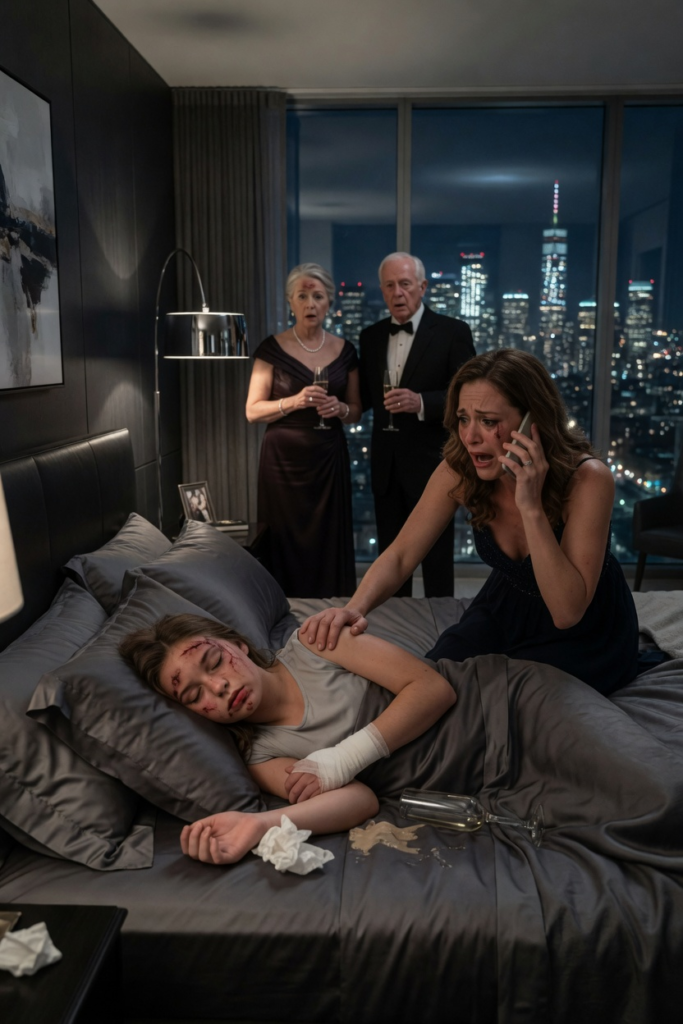
The Stuffed Rabbit Recording — The Birthday Party That Shattered a Family and Exposed a Hidden Truth
At precisely 2:16 p.m. in a polished Greenwich mansion, a six-year-old girl lay unresponsive upstairs while an eighteen-thousand-dollar birthday celebration unfolded downstairs with laughter, champagne, and carefully curated smiles.
The house looked like a magazine spread of privilege, white columns framing manicured hedges, pastel balloons tied in symmetrical pairs, and guests arriving dressed as if reputation itself required formal attire.
Inside, the air carried vanilla frosting and expensive perfume, while crystal glasses chimed softly over conversations that floated above anything resembling concern for the child missing from the celebration.
My daughter Lily had been quietly placed upstairs only minutes earlier, her yellow unicorn dress brushing against my leg as she whispered that she only wanted a short nap before returning to the party.
She clutched her worn stuffed rabbit tightly, its gray ears dragging against the marble floor as I led her up the grand staircase that gleamed under soft recessed lighting.
“Don’t let them sing without me,” she said in a voice so small it barely reached the hallway, and I promised her I would not let the moment happen without her.
At 1:42 p.m., I tucked her into the guest bedroom, pulled the blanket up to her chin, and closed the door gently, unaware that it would not remain the same when I returned.
By 2:19 p.m., the hallway camera feed on my phone abruptly went black, cutting off the only real-time view I had of the upstairs corridor where she slept alone.
That blackout was the first signal that something had shifted in ways I could not yet understand, though my instincts already began tightening in my chest.
Downstairs, guests laughed louder as champagne was poured, unaware or unwilling to notice the tension building beneath the polished surface of celebration.
Then my father raised his glass, tapping it lightly with a spoon, commanding attention with the ease of someone accustomed to being obeyed without question.
“Now,” he announced calmly, “she finally matches what she’s worth,” and the room responded not with shock, but with an uncomfortable silence that quickly dissolved into nervous laughter.
My mother lifted her glass beside him, smiling as though the comment were a joke meant to be appreciated rather than questioned by anyone present.
I stood frozen at the edge of the room, trying to understand how a child’s absence had become the centerpiece of an adult’s entertainment.
When I asked where Lily was, my mother barely glanced at me, replying that I always managed to make everything about her instead of the celebration.
My father stepped closer, adjusting his cuff links with deliberate calm, as though the situation were a minor inconvenience rather than a developing crisis.
“She needed a lesson,” he said evenly, “children should know their place in the order of things that matter.”
The words landed heavier than the crystal chandeliers above us, yet no one in the room moved to challenge them or even question their meaning.
My body reacted before my mind fully caught up, and I ran toward the staircase, ignoring the startled expressions of guests holding plates and champagne flutes.
At the top of the stairs, the guest room door was closed, though I distinctly remembered leaving it slightly open when I tucked her in earlier.
The hallway felt colder than before, the air shifting in a way that made every step toward that door feel increasingly unreal.
Inside the room, the curtains trembled softly from the air vent, and a faint metallic scent lingered beneath the perfume of old floral decorations.
Lily lay motionless against the pillow, her stuffed rabbit still pinned under one small arm, as if she had simply stopped mid-dream.
I touched her cheek and felt warmth, followed by a faint breath so fragile it seemed to exist between moments rather than within them.
Without hesitation, I dialed emergency services at 2:23 p.m., my voice breaking only slightly as I reported what I could barely process myself.
Downstairs, the birthday song had already begun, voices rising in cheerful unison as candles were lit for a child who was not mine.
I carried Lily down the stairs, her weight unsettlingly light, as guests turned their attention from cake to the unfolding disruption in confusion.
My mother immediately demanded that I take her somewhere private, insisting that her condition was inappropriate for the guests assembled to celebrate.
I looked at her pearls, perfectly aligned and reflecting chandelier light, and realized how far removed she was from anything resembling concern.
“You could have told me not to bring her,” I said, my voice quieter than expected, as though speaking too loudly might break something irreparable.
My mother responded by setting her glass down with precise control, stating that only her “real grandchild” mattered in that moment of celebration.
Something inside me shifted into a stillness that was not fear, not anger, but a focused clarity that felt dangerously irreversible.
Paramedics arrived at 2:31 p.m., followed shortly by police officers who moved through the mansion with professional urgency that contrasted sharply with the party atmosphere.
My father immediately began speaking in a composed tone, offering explanations that sounded rehearsed, carefully structured to preserve reputation rather than reveal truth.
“She fell,” he said simply, as though that explanation could neatly close the gap between upstairs silence and downstairs celebration.
I did not argue, because I was no longer focused on convincing them of anything, only on ensuring every detail was preserved accurately.
I reached for Lily’s stuffed rabbit, noticing for the first time that my mother’s gaze followed it with unusual intensity.
A detective standing nearby took the toy gently, noticing the zipper on its back that most guests would never have thought to examine.
Inside was a small safety recorder, discreetly sewn into place by a friend from Lily’s therapy center after earlier concerns had been dismissed.
The detective pressed a button, and the room fell into a silence so complete it felt as though even the chandeliers had stopped vibrating.
First came my father’s voice, calm and deliberate, followed by my mother’s laughter, neither of which matched the story they had just told authorities.
The detective looked up slowly and said there was indeed a recording, his tone shifting the atmosphere more than any physical movement in the room.
My father’s champagne glass stopped halfway to his mouth, frozen in an expression that revealed uncertainty for the first time that evening.
My mother whispered my name, but it sounded less like recognition and more like a warning that arrived too late to matter.
The recording continued, capturing words that no one in that room had expected to ever be heard outside those upstairs walls.
Guests began to shift uncomfortably, realizing that the polished narrative they had accepted minutes earlier was beginning to unravel in real time.
I watched as the detective listened without interruption, his expression remaining neutral while the truth unfolded through tiny speakers hidden inside a stuffed toy.
The mansion that had felt untouchable only hours earlier now seemed fragile, as though every surface could crack under the weight of what was being revealed.
My mother finally lowered herself into a chair, her posture collapsing in a way that suggested she understood consequences were no longer avoidable.
The party that had been designed to celebrate a child’s birthday was now being documented as something entirely different by law enforcement.
Outside, flashing lights reflected against the mansion’s polished windows, transforming the elegant façade into something resembling a stage set after collapse.
Inside, every guest became a witness rather than a participant, their earlier laughter replaced by the uncomfortable awareness of proximity to truth.
The detective signaled for additional statements, and my father attempted once more to speak, though his voice no longer carried the same authority.
My mother remained silent, her earlier composure replaced by a fixed stare directed toward the small stuffed rabbit resting on the table.
No one in that room spoke of celebration anymore, because the concept itself had been completely rewritten by what had just been revealed.
The recording had not ended yet, and everyone present understood that whatever came next would determine how this story would be remembered.
What would you do if the people who raised you became the ones standing between your child and the truth?
And more importantly, what happens when the evidence of that truth is hidden inside something as innocent as a child’s stuffed rabbit?