My Husband Locked Me in the Basement After I Caught Him With My Best Friend — But He Didn’t Know Who I Called in the Dark
The basement door did not open.
It exploded.
Wood splintered inward. The lock tore free from the frame and hit the concrete like a piece of bone. Light poured down the stairs so suddenly that your eyes burned.
For a second, you thought you were hallucinating.
Then you heard the voice you had not heard in twenty years.
“Mariana.”
Your father stood at the top of the stairs.
Ernesto Torres.
Older than the last time you saw him, broader in the shoulders, his hair now silver at the temples, dressed in a black coat thrown over what looked like a dinner suit. Behind him stood two men you did not know and one woman in a gray blazer holding a medical bag.
Your father did not move at first.
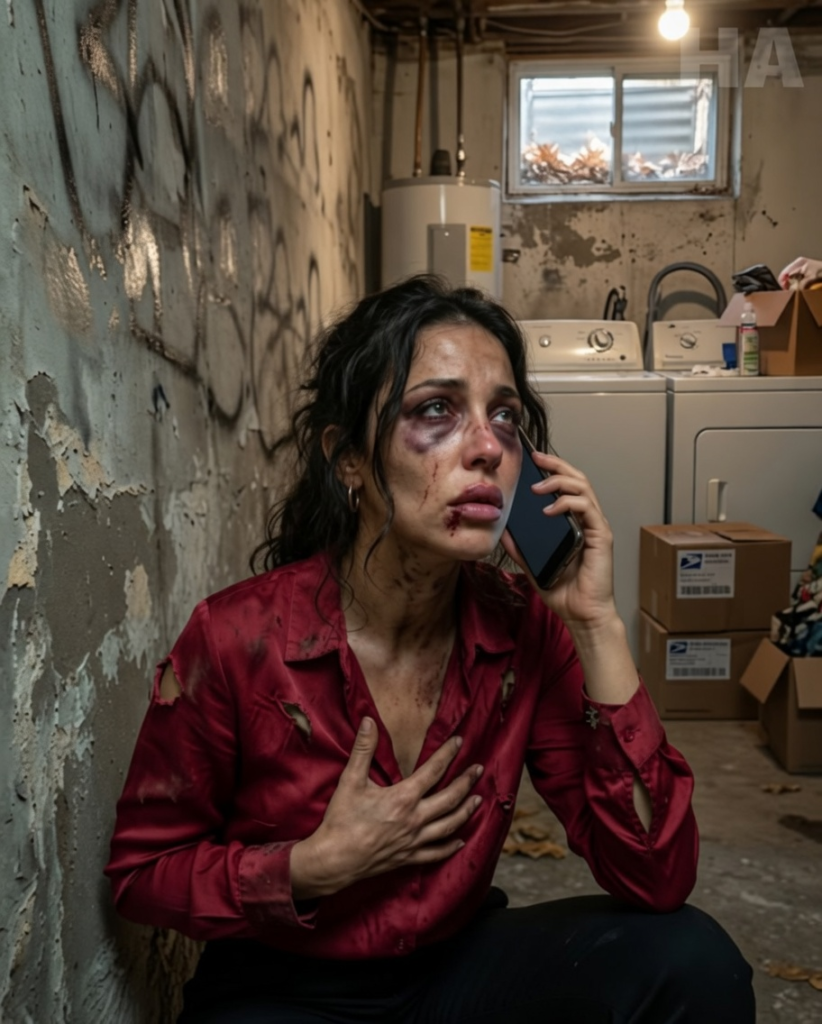
He saw you curled on the concrete, one arm wrapped around your ribs, face wet with tears, blood on your lip, your body shaking from pain and cold.
Something in his face died.
Then something worse took its place.
He came down the stairs slowly, like one wrong step might make him lose control.
“Don’t touch me,” you whispered automatically.
The words slipped out before you knew who you were speaking to.
Your father stopped.
The pain in his eyes nearly broke you.
“I won’t,” he said, voice rough. “Not unless you say I can.”
That kindness undid you.
Not the broken door.
Not the men behind him.
Not the power that had arrived in your basement like a storm.
That one sentence.
You nodded once.
He knelt beside you, careful, as if approaching a wounded animal.
“My girl,” he whispered.
You tried to answer, but breathing hurt too much. The woman with the medical bag came down next and crouched near you.
“I’m Dr. Salgado,” she said gently. “Your father called me. I need to check you before we move you.”
Your father looked at her.
“Is she safe to lift?”
The doctor examined you quickly, hands professional and light. When she pressed near your side, your vision went white and a scream tore out of you.
Your father turned his head away.
Not fast enough.
You saw murder in his face.
Then he forced it down.
“Ribs,” Dr. Salgado said. “Possible fracture. Maybe more than one. She needs imaging and hospital care.”
Your father nodded once.
“Do it.”
Above you, voices erupted in the house.
Alejandro shouting.
Valeria crying.
The maid sobbing.
One of your father’s men called up the stairs, calm but firm. “Stay where you are.”
Alejandro’s voice thundered back.
“Who the hell are you? This is my house!”
Your father looked up.
For the first time since entering the basement, he smiled.
It was not a warm smile.
“No,” he said softly. “It is not.”
The words confused you through the pain.
Your house?
Alejandro’s house?
The house you had paid for with years of designs while Alejandro told everyone he had built the firm from nothing?
Dr. Salgado gave you an injection for pain. It did not remove the agony, but it pushed it far enough away that you could think in broken pieces.
Your father took off his coat and wrapped it over you.
“Can you stand?”
You shook your head.
“That’s all right.”
Two paramedics entered then, carrying a stretcher. Not city paramedics. Private medical response. Your father had brought a hospital to a basement.
As they secured you, footsteps pounded above. Alejandro appeared at the top of the stairs wearing a shirt half-buttoned and fury barely disguised as panic.
“Mariana,” he said, performing concern badly. “What did you do? Why did you call these people?”
Your father stood.
You had forgotten how tall he was.
Or maybe you had spent too many years around men who only looked tall because they stood on your silence.
Alejandro looked him up and down.
“And you are?”
Your father climbed the stairs, stopping one step below him.
“Ernesto Torres.”
Alejandro’s face changed.
Only slightly.
But you saw it.
Recognition.
Fear.
The name your mother had taught you to avoid had entered your marriage like a key turning in a lock.
Alejandro swallowed. “This is a private marital matter.”
Your father’s voice stayed level.
“You broke my daughter’s ribs, pushed her into a basement, locked her in, and ordered the maid to deny her food and water.”
Alejandro looked toward the hallway, suddenly aware of the men behind Ernesto.
“She’s hysterical. She attacked my guest.”
Valeria appeared behind him, wrapped in a robe that belonged to you.
Your robe.
Your green silk robe from Milan, the one you bought after your first design award.
She was crying now.
Of course she was.
Women like Valeria always cried once the room stopped applauding them.
“I was scared,” she whimpered. “Mariana came in like a crazy person.”
You tried to sit up on the stretcher.
Pain stopped you.
Your father heard your breath catch and turned immediately.
“Don’t move.”
Alejandro seized the moment.
“See? She’s unstable. She has been under pressure. The conference, the firm, all of it. She came home and attacked Valeria.”
Your father looked back at him.
“And you defended your mistress by kicking your wife.”
Alejandro’s mouth opened.
Closed.
The maid, Rosa, stood near the kitchen doorway, trembling.
Your father turned to her.
“What did you see?”
Alejandro snapped, “Rosa, don’t you dare.”
Your father did not raise his voice.
“Rosa. You are safe to tell the truth.”
That sentence was all she needed.
The maid broke.
“He kicked her, señor. She fell. She could not breathe. He dragged her. He pushed her down the stairs. He told me no food, no water.”
Valeria sobbed louder. “That’s not what happened.”
Rosa turned on her with sudden fury.
“You were there.”
The house went silent.
Rosa’s hands shook, but her voice grew stronger.
“You told him, ‘What if she calls someone?’ And he said, ‘She has no one.’”
Those words reached you on the stretcher like another blow.
She has no one.
That was what Alejandro believed.
That was why he had become careless.
For years, you had accepted distance from your father as proof that you were decent, independent, free of the Torres shadow. Alejandro had mistaken that choice for loneliness. He thought no one would come.
He was wrong.
Your father looked at him.
“My daughter had someone before you learned her name.”
Alejandro’s face twisted.
“This is ridiculous. You can’t just break into my house.”
Your father’s lawyer arrived then.
You recognized her from old memories: Lucía Montalvo, your father’s legal advisor, sharp-eyed, always dressed like she was walking into court even at midnight.
She stepped through the broken doorway holding a tablet.
“Actually,” Lucía said, “the deed is under Mariana Torres’s name. Purchased before marriage through her private account. Your claim of exclusive ownership is inaccurate.”
Alejandro stared.
“What?”
You stared too.
Your private account.
You had forgotten that account existed beyond savings. Your father had set it up when you turned eighteen. You never touched most of it. When you bought the house, the notary handled the transfer so quickly Alejandro barely looked. He had assumed, as he always did, that whatever you had became his by proximity.
Lucía continued.
“And since Ms. Torres called for help while unlawfully confined and injured, entry was justified under emergency circumstances. The police are also on their way.”
Alejandro’s face drained.
“Police?”
Your father looked at him.
“You thought I brought men because I needed violence. No. I brought witnesses.”
That sentence shifted something inside you.
Your mother’s warnings returned from childhood.
Your father’s last name opens doors, but also graves.
Maybe she had believed that.
Maybe she had feared him.
Maybe she had feared what power does to men.
But tonight, Ernesto Torres had broken a door, brought a doctor, called a lawyer, summoned police, and asked before touching you.
That was not a grave.
That was rescue.
The stretcher moved.
As they carried you through the hallway, you passed Alejandro.
He tried to reach for your hand.
“Mariana, wait. Please. This got out of control.”
You looked at him.
The man who had once kissed your fingers after you drew your first building.
The man who said your mind was the sexiest thing about you.
The man who slowly learned to call that same mind “difficult,” “dramatic,” “too artistic,” “bad for business.”
The man who slept with your best friend in your bed and then kicked you hard enough to break bone.
“No,” you whispered. “You got seen.”
They carried you out.
The night air hit your face.
For the first time in hours, you breathed without basement dust.
It still hurt.
But it was air.
At the hospital, everything became light, pain, questions, and machines.
Two broken ribs.
One bruised rib.
A mild concussion from the fall.
Deep bruising on your arm where Alejandro dragged you.
No internal bleeding, thank God, but the doctor warned that healing would be slow and breathing would hurt for weeks.
Your father stayed outside the exam room until you asked for him.
When he entered, he looked smaller.
Not weak.
Just stripped of the terrifying control he wore like armor.
He sat beside your bed.
“I should have found you sooner.”
You closed your eyes.
“Don’t.”
“I let your mother take you from me.”
“I was seventeen. I went.”
“You were a child.”
“I was angry.”
“So was I.”
For a while, neither of you spoke.
The distance between you was not empty. It was crowded with old injuries, your parents’ divorce, your mother’s bitterness, your father’s pride, your own need to prove you could build a life without the Torres name.
Finally, he said, “When you called me Daddy, I almost died.”
Your throat tightened.
“I didn’t know who else to call.”
His eyes filled.
“That is the only good thing I have heard tonight.”
You almost laughed, but your ribs punished you immediately.
He leaned forward.
“Mariana, I need to ask something, and you can say no.”
“What?”
“Do you want me to handle this quietly or correctly?”
You opened your eyes.
“What’s the difference?”
His jaw tightened.
“Quietly means the old way. Pressure. Settlements. Men talking to men. Your name protected but the truth buried.”
You looked at the ceiling.
“And correctly?”
“Police report. Medical evidence. Civil protection order. Corporate audit. Divorce. Public consequences where necessary.”
You looked at him.
He held your gaze.
“I will not choose for you.”
That was when you cried.
Not because of Alejandro.
Not because of Valeria.
Because your father, the man you had been told would control everything if you let him near, was giving you a choice.
“Correctly,” you whispered.
He nodded.
Something final passed over his face.
“Then correctly.”
By morning, Alejandro was arrested.
Not dramatically.
Not with your father’s men dragging him into some dark car like your mother’s old stories would have suggested.
Police took him from the house in handcuffs while the neighbors watched through curtains.
Rosa gave her statement.
The broken basement door was photographed.
The stairs were photographed.
Your injuries were documented.
Valeria tried to leave before officers arrived, but your father’s lawyer had already requested preservation of the scene. She was questioned too.
By noon, your phone was full.
Alejandro: Please. I panicked.
Alejandro: Valeria means nothing.
Alejandro: Don’t let your father destroy me.
Alejandro: You know how dangerous he is.
That last message told you everything.
Even now, Alejandro thought the danger was Ernesto.
Not himself.
You did not reply.
Lucía Montalvo took your phone gently and said, “We preserve, we don’t engage.”
You nodded.
A phrase for your new life.
Preserve.
Don’t engage.
Your father arranged a private recovery apartment with a nurse, but you refused it.
“I don’t want to be hidden.”
He studied you.
“Where do you want to go?”
You hesitated.
“My studio.”
Your architecture studio was technically part of the firm, but everyone knew it was yours. A converted warehouse in Roma Norte with skylights, rough brick walls, drafting tables, and models of buildings Alejandro used to praise before he started taking credit for them.
Your father did not argue.
He simply said, “I’ll make it safe.”
By that evening, you were lying on a low couch in the studio, wrapped in blankets, ribs taped, pain medication close by. Your father slept in a chair near the door despite your protests.
At 3:00 a.m., you woke to find him awake.
“Do you ever sleep?” you whispered.
“Not well.”
“Because of me?”
He looked at you.
“Since the day you left.”
You swallowed.
“I thought you didn’t want me.”
His face twisted.
“Your mother told me you needed space.”
“She told me you chose business over us.”
“I chose badly often,” he said. “But never over you.”
The words sat between you.
You were too tired to sort them.
So you said the only thing you could.
“Stay until morning.”
He closed his eyes.
“Always.”
The next week became a war fought with documents.
Alejandro was released pending investigation, but a protective order barred him from contacting you or entering your properties. He immediately violated it by sending flowers.
Your father had them photographed, logged, and discarded.
Valeria posted an Instagram story about “women who weaponize victimhood when they lose a man.”
It stayed up eighteen minutes before Lucía’s legal notice landed.
Then the corporate betrayal began unfolding.
While you recovered, your father’s forensic accountants entered the firm.
You had expected infidelity.
Violence.
Humiliation.
You had not expected theft.
Alejandro had moved client contracts into shell entities under his control.
He had signed your designs under his name.
He had diluted your ownership interest through documents you never saw, using digital signatures copied from older agreements.
He had negotiated a sale of the firm’s largest sustainable housing project without listing you as principal architect.
The project in Querétaro.
Your project.
The one inspired by your grandmother’s village.
The one you had spent four years developing.
You stared at the audit report until the words blurred.
“He stole the firm,” you said.
Lucía sat across from you.
“He tried.”
Your father stood by the window, silent.
You looked at him.
“You knew?”
“No.”
“But you suspected something.”
“I suspected he was weak,” he said. “I did not know he was stupid.”
Despite the pain, you smiled.
Then the grief hit again.
Because you had loved a stupid, cruel man.
Worse, you had trusted him with your work.
Your drawings.
Your name.
Your future.
“Can we get it back?” you asked.
Lucía’s eyes sharpened.
“Yes.”
That one word became medicine.
The civil case filed against Alejandro was devastating.
Domestic violence.
Wrongful confinement.
Fraud.
Breach of fiduciary duty.
Misappropriation of intellectual property.
Forgery.
Corporate theft.
Your name appeared in legal documents not as Mrs. Rivas, not as Alejandro’s wife, not as the emotional designer behind his executive genius.
Mariana Torres.
Architect.
Founder.
Majority owner.
Victim.
Plaintiff.
The first time you saw it, you cried.
Victim was not a word you wanted.
But it was better than invisible.
Alejandro’s defense followed a predictable pattern.
You were unstable.
Your father was manipulating you.
The firm had always been his commercial creation.
You were creative but not practical.
The basement incident was a marital argument exaggerated by Torres money.
Then Rosa testified.
She described the kick.
The fall.
The basement.
The order.
No food. No water.
She described Valeria standing in the hallway wearing your robe.
She described Alejandro saying you had no one.
The judge’s face changed at that.
So did yours.
Because every time you heard it, the sentence lost power.
You had no one.
Wrong.
You had yourself.
You had a father you called in the dark.
You had a maid brave enough to speak.
You had evidence.
You had a name.
Valeria’s fall was less legal but more public.
Her own messages betrayed her.
She had sent Alejandro screenshots of your conference announcement with comments like:
Soon she’ll be famous enough to leave you. Better make sure the firm knows who really runs things.
And:
She thinks those drawings are hers? Cute.
And the worst one:
If she catches us, make her look crazy. Men always win when women scream first.
That message entered the record.
Valeria stopped posting.
Your best friend since college became a footnote in your lawsuit.
That hurt in a quieter way.
Friendship betrayal does not bruise the skin. It hollows the memories.
Every sleepover.
Every birthday.
Every time she called you sister.
Every time she sat at your table while secretly making herself comfortable in your life.
One afternoon, months later, she asked for a private meeting.
Lucía said no.
You said yes, but only with lawyers present.
Valeria arrived without makeup, eyes swollen, clothes modest. It was a costume, but not a good one.
“Mariana,” she said, “I’m sorry.”
You looked at her.
“For what?”
She blinked.
“For hurting you.”
“How?”
Her lawyer shifted.
Valeria swallowed.
“For sleeping with Alejandro.”
“And?”
“For being in your house.”
“And?”
Her mouth tightened.
You waited.
“For saying those things.”
“What things?”
Her eyes filled.
“Do you want me to humiliate myself?”
You almost laughed.
“There it is.”
She looked confused.
“You are not sorry you helped him erase me,” you said. “You are sorry I am making you name it.”
She began crying.
You felt nothing.
That frightened you for a second.
Then it freed you.
“You were my friend,” you said. “You knew what those designs meant to me. You knew what that bed meant. You knew what he was doing to my name. You did not just betray my marriage. You auditioned for my life.”
Valeria covered her face.
You stood slowly, ribs still stiff.
“You didn’t get it.”
You left.
That was the last conversation you ever had with her.
Recovery took longer than revenge.
People never mention that.
They love the part where the powerful father arrives, the husband falls, the mistress shakes, the lawsuit lands. They do not talk about sleeping propped up because breathing hurts. They do not talk about panic when doors close too loudly. They do not talk about standing at the top of stairs and remembering the basement.
They do not talk about shame.
You were ashamed that he had fooled you.
Ashamed that Rosa saw you dragged.
Ashamed that your father found you on concrete.
Your therapist corrected you gently.
“Shame belongs to the person who chose violence.”
You nodded.
You did not believe it at first.
Then you practiced.
Every time shame rose, you named the owner.
Alejandro kicked me.
Shame belongs to Alejandro.
Valeria mocked me.
Shame belongs to Valeria.
I called for help.
That was mine.
And it was not shame.
It was survival.
Your father became a strange, steady presence.
He did not try to move into your life all at once. He asked before visiting. He sent food but not staff unless you approved. He did not threaten Alejandro in dark alleys, though once you caught him staring at a wall with an expression that suggested he was imagining it.
“Correctly,” you reminded him.
He sighed.
“Unfortunately.”
You laughed so hard your ribs hurt.
That laugh saved something between you.
Months later, you finally asked about your mother.
He looked tired.
“She loved you. She hated me more.”
“That doesn’t answer anything.”
“No,” he said. “It explains too much.”
Your parents’ story was ugly in adult ways: business wars, emotional affairs, pride, custody threats, fear. Your mother had not lied about everything. Your father had not been innocent. But she had turned your love for him into fear, and he had let anger keep him from fighting gently enough for you to hear.
“I should have come for you,” he said.
“I might not have come.”
“I know.”
“You still should have tried.”
“Yes.”
The honesty hurt.
It also healed.
Not everything.
Enough.
A year after the basement, you returned to your old house.
Not to live.
To walk through it before the sale.
Your father offered to go with you.
You chose to go alone, with Lucía waiting outside.
The house smelled empty.
The red heels were gone.
The bed was gone.
The basement door had been repaired, but you had ordered it removed before the sale. No door. Just an open stairwell with lights installed all the way down.
You stood at the top of the stairs for a long time.
Then you walked down.
Slowly.
Each step hurt in memory, not body.
At the bottom, the concrete floor was clean. Boxes gone. Christmas ornaments gone. Broken furniture gone.
You stood where you had lain in the dark.
You took out your phone and called your father.
He answered instantly.
“Mariana?”
“I’m in the basement.”
Silence.
Then, controlled panic: “Do you need me?”
You looked around.
“No.”
A pause.
“Good.”
“I just wanted to hear the phone ring from here.”
His breath caught.
You remembered the first call.
Daddy, I am Mariana.
You remembered the chair falling.
You remembered the door breaking.
You said, “Thank you for answering.”
His voice broke.
“Always.”
You ended the call and walked upstairs.
The house sold two months later.
The firm did not.
You reclaimed it.
Not the old version.
That version had Alejandro’s fingerprints everywhere.
You dissolved the corrupted structure and founded a new studio under your own name: Torres Mariana Arquitectura.
Your first public statement was short.
For years, I allowed my work to be presented through another person’s voice. That ends now.
The architectural world noticed.
Some had always suspected Alejandro took too much credit. Others pretended surprise. A few men sent private messages saying they had “always respected your talent,” which was funny because they had somehow never said it loudly when Alejandro stood beside you.
You hired women who had been called difficult.
You hired young architects from public universities.
You hired Rosa’s niece as an administrative assistant because she was brilliant with numbers and terrified of rich offices.
You made contracts transparent.
Credit mandatory.
Signatures verified.
No one’s work disappeared inside another person’s ego.
The Querétaro project became yours again after a brutal legal fight. When the first building opened—a low-cost housing complex designed around courtyards, shade, rainwater capture, and community kitchens—you stood in front of reporters with a faint scar near your lip and your father in the back row.
Not beside you.
Not claiming you.
Just there.
You looked into the camera and said, “A building is not safe because its walls are strong. It is safe because people inside it are not trapped.”
That quote went everywhere.
You hated that.
Then you learned to accept it.
Alejandro took a plea in the criminal case and settled the civil case after the fraud evidence became impossible to deny. He lost his license to operate in several capacities, lost his ownership claims, lost the house, and lost the carefully polished image he had stolen partly from your shine.
At sentencing for the assault, he looked at you.
“I’m sorry,” he said.
You believed that he was sorry.
Sorry he was caught.
Sorry he lost power.
Sorry the world now saw the boot, not the charm.
You did not believe he understood love.
So you gave him only one sentence.
“You were right about one thing. I learned my place.”
His eyes lifted.
“My place is not under your foot.”
You walked out before he could answer.
Valeria moved away.
Some said Monterrey.
Some said Miami.
You did not care.
Indifference arrived slowly, then completely.
Two years after the basement, your father invited you to dinner at his house.
Not the mansion your mother had described like a villain’s castle, but a quiet home in San Ángel full of books, old photographs, and too many locked cabinets.
You saw a picture of yourself at six on his desk.
You froze.
“I thought you threw everything away.”
He looked at the photo.
“I kept copies.”
There were more.
You at a school recital.
You at twelve, scowling.
You at graduation, taken from far away.
Your chest tightened.
“You came?”
He looked ashamed.
“I stood where your mother wouldn’t see me.”
“That’s creepy.”
He laughed once.
“Yes.”
“You should have said something.”
“Yes.”
You picked up the graduation photo.
“I looked happy.”
“You looked lonely.”
You looked closer.
Maybe you did.
You placed it down.
“I was.”
He closed his eyes.
“I know.”
That night, you stayed for coffee.
Then dinner the next month.
Then Sunday breakfast.
Trust did not return like lightning.
It returned like a careful worker rebuilding a damaged wall, checking each stone before placing the next.
You were careful too.
He could be controlling. You called it out.
He could be ruthless. You reminded him of “correctly.”
He could be overprotective. You told him rescue was not ownership.
To your surprise, he listened.
Not always well.
But he tried.
That mattered more than perfection.
Five years later, you stood in a packed auditorium receiving the National Prize for Sustainable Design. Your firm had grown beyond what you imagined. The Querétaro project had become a model. Young architects quoted your essays. Developers feared your contracts.
You wore a black suit instead of a gown.
Your father sat in the front row.
Rosa sat beside him.
Yes, Rosa.
You had insisted.
When your name was announced, the applause rose like weather.
You walked to the microphone and looked out.
For a second, you saw another room.
Your bedroom.
Valeria’s smile.
Alejandro’s boot.
The basement stairs.
Then you saw the real room.
Your room.
Your work.
Your people.
You spoke without notes.
“I used to think buildings were made of concrete, steel, glass, wood. I was wrong. Buildings are made of decisions. Who gets a door. Who gets a window. Who gets credit. Who gets trapped. Who gets believed when they scream.”
The auditorium went still.
You continued.
“I once helped build a firm where my own name became smaller every year. I mistook partnership for permission. I mistook silence for peace. I will never make that mistake again.”
Your eyes found your father’s.
He was crying.
You smiled slightly.
“This award belongs to everyone who has ever had to rebuild from the foundation up. Check the beams. Name the cracks. Remove the rot. Begin again.”
The applause that followed did not feel like rescue.
It felt like recognition.
After the ceremony, your father hugged you in the lobby.
You let him.
Then he whispered, “Your mother called.”
You stiffened.
He pulled back.
“She saw the speech.”
You said nothing.
“She wants to write to you.”
Your first answer was no.
Your second was also no.
Then, after a long breath, you said, “She can write. I decide whether to read.”
He nodded.
“Correctly.”
You smiled.
“Correctly.”
Her letter arrived two weeks later.
It was not perfect.
It did not absolve her.
She admitted she had let bitterness shape your childhood. She admitted she had feared your father’s world and taught you to fear him too. She wrote that seeing you speak made her proud and ashamed at the same time.
You read it once.
Then again.
Then you placed it in a drawer.
You did not reply for six months.
When you did, your answer was simple.
I am willing to speak. I am not willing to rewrite the past to make it easier for either of us.
She accepted.
That was a beginning.
Not a reunion.
Not forgiveness wrapped in music.
A beginning.
Years passed.
The basement became a story people told incorrectly.
They said your mafia father rescued you.
He was not mafia.
He was powerful, complicated, feared, and flawed.
They said you destroyed Alejandro.
You did not.
You exposed what he built.
They said Valeria stole your husband.
No.
She revealed he was stealable.
They said you were lucky your father answered.
That part was true.
But luck was not the whole story.
You called.
That mattered.
You reached into the dark, found a number you had avoided for twenty years, and pressed call. You chose not to die quietly in the basement of a house you designed.
That was yours.
Never forget that.
One afternoon, ten years after the attack, you visited the old neighborhood where your first tiny apartment had been, the one you lived in before Alejandro, before the firm, before awards and lawsuits and broken ribs.
A young woman from your office walked with you, carrying site plans. Her name was Camila, and she reminded you of yourself at twenty-five: brilliant, exhausted, too ready to let louder people take credit.
She asked, “How did you know you could start over?”
You looked at an unfinished building across the street.
“I didn’t.”
She frowned.
“Then how did you do it?”
You thought of concrete under your cheek.
A phone screen glowing.
Your father’s voice.
Rosa’s testimony.
Lucía’s documents.
Your own name on the new firm’s door.
“I stopped waiting to feel ready,” you said. “I started with what was still standing.”
Camila looked down at the plans.
“What if nothing is?”
“Then you become the first wall.”
She wrote that down.
You laughed.
“Don’t quote me in meetings.”
She grinned.
“I absolutely will.”
That evening, you visited your father.
He was older now. Slower. Still dangerous when someone underestimated him, but mostly content to sit in his garden and criticize your building materials.
“You use too much glass,” he said.
“You know nothing about architecture.”
“I know glass breaks.”
“So do people.”
He looked at you.
“Yes. But sometimes they become sharper.”
You smiled.
“Are you calling me sharp?”
“I am calling you my daughter.”
The words landed softly after all those years.
No wound opened.
That was how you knew healing had happened somewhere quietly, without asking permission.
When he died years later, you stood at his funeral not as the estranged daughter, not as the rescued woman, not as the heir to a dangerous name.
Just as Mariana.
His daughter.
You gave no dramatic speech. Only one line.
“He answered when I called.”
That was enough.
In the end, the house in Lomas, the firm, the lawsuits, the scandal, the old rumors about your father, even Alejandro himself—all of it became architecture in your memory.
Some structures demolished.
Some restored.
Some sealed for safety.
Some rebuilt into something better.
But the basement remained different.
Not because it was where Alejandro tried to break you.
Because it was where you stopped believing isolation was noble.
You had spent twenty years thinking decency meant needing no one powerful, no one complicated, no one from the bloodline your mother feared.
But independence does not mean refusing every hand.
Sometimes independence means choosing whose hand to take.
In the dark, with broken ribs and dust in your mouth, you called the one person you had been told would bring ruin.
He brought a doctor.
A lawyer.
Witnesses.
A way out.
And after the door flew off its hinges, nothing in your life was ever locked the same way again.