You sit in your bedroom long after the laughter downstairs has died.
For the first time all night, the house is quiet enough for you to hear the refrigerator humming in the kitchen, the floorboards settling, and your own breathing moving slowly through your chest. The party decorations are still taped to the walls downstairs. The birthday cake you paid for is probably still sitting on the counter with one slice missing, because nobody at that table came to celebrate you.
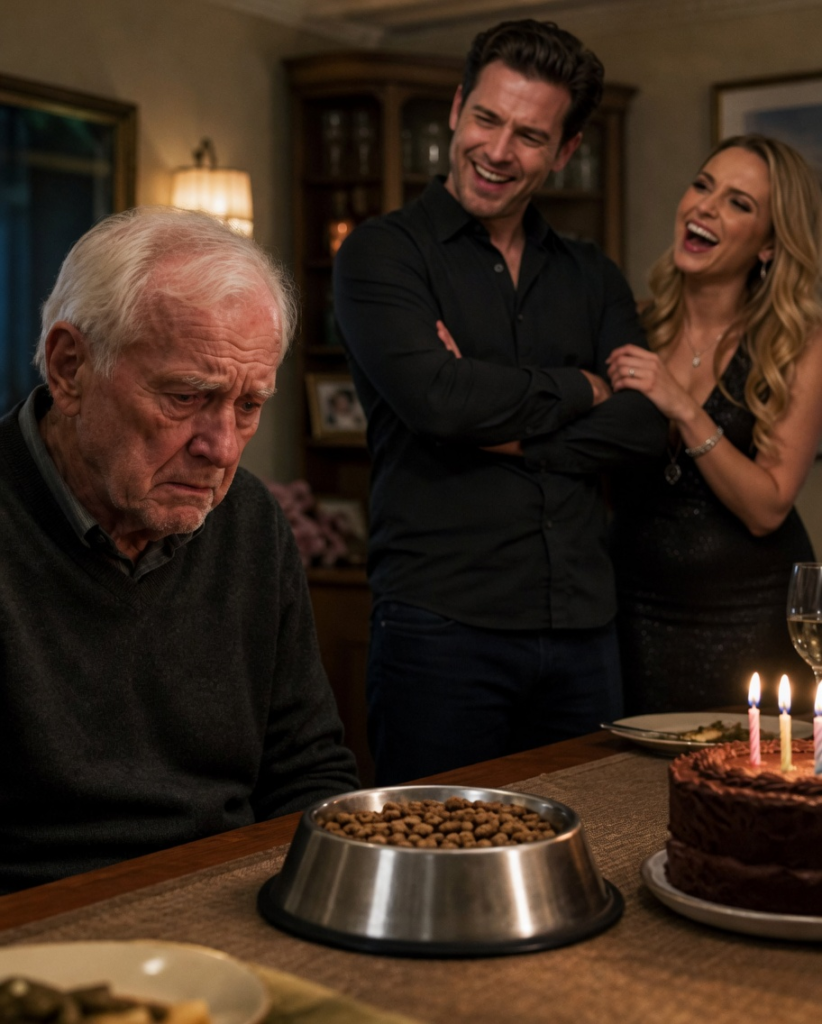
They came to eat your food, drink your liquor, and laugh while your only son set a dog bowl in front of you.
You stare at the computer screen.
The rejected charges are still there.
A liquor store.
A rideshare.
A maternity clinic.
And then the one that makes the blood drain from your face.
Golden Harbor Senior Living — Admission Deposit — Declined.
You read it once.
Then again.
Then a third time, because part of you is praying your eyes are wrong.
But they are not wrong. You spent forty years as an accountant. Numbers, dates, names, payments—those are your language. And right there, in clean digital letters, is the truth your son was not brave enough to say out loud.
Luis was planning to put you in a home.
Not someday.
Not later.
Now.
You push your chair back so slowly it barely makes a sound. Downstairs, somewhere near the kitchen, a glass clinks. Maybe Luis is still awake. Maybe Karla is pacing in her heels, angry that her card was declined in front of a cashier. Maybe they are whispering about you, calling you dramatic, stubborn, old.
You almost laugh.
Old.
That is what people call you when they forget you were young once. When they forget you built houses, raised children, buried a wife, signed checks, survived grief, and still woke up every morning with enough discipline to make coffee before sunrise.
They see gray hair and think weakness.
They see quiet and think permission.
They see generosity and think there is no bottom to it.
You click open the rejected charge.
The attempted deposit was $7,500.
Your hand freezes on the mouse.
Seven thousand five hundred dollars.
That is not an accident. That is not a mistake. That is not Luis casually browsing options for “someday.” That is paperwork already filled out. That is a plan already made. That is your son trying to use your own money to remove you from the home you paid for.
A home still in your name.
A home your late wife, Linda, decorated with her own hands.
Your Linda.
In the living room downstairs, she had once hung family photos along the staircase. Luis at five, missing his front tooth. Luis at ten, holding a baseball trophy. Luis at seventeen, standing beside you and Linda in his graduation gown, smiling like the world was waiting for him.
You stare toward the door.
Somewhere on the other side of it is the man that little boy became.
And for the first time, you stop asking yourself where you failed him.
You ask yourself where he learned he was allowed to fail you.
The answer comes quickly.
From you.
Every time you paid one more bill.
Every time you forgave one more lie.
Every time you said, “He’s just going through a hard time.”
Every time you let him turn your house into a waiting room for his next excuse.
You lean back, close your eyes, and see the dog bowl again.
Bright silver.
Placed carefully on the dining table between the roasted chicken, mashed potatoes, green beans, dinner rolls, and the chocolate cake with seventy candles.
Karla had giggled before Luis even said anything.
Your niece had looked away.
Your neighbor, Mrs. Coleman, had gone pale.
And Luis, your son, your only child, had smiled at you in front of twenty-two guests and said, “Since Dad is always begging for respect, maybe he should learn to sit first.”
Then he set the bowl in front of you.
Dog kibble.
Real dog kibble.
The kind he bought for Bruno, the golden retriever he had insisted on adopting and then left you to feed.
For two seconds, nobody breathed.
Then Karla laughed.
A sharp, ugly laugh that gave everyone else permission.
And you sat there with your napkin in your lap, your best shirt buttoned wrong at the collar because your fingers shook that morning, staring at a bowl of dog food on your seventieth birthday.
You remember one thought cutting through your chest.
Linda would have stood up.
Linda would have thrown that bowl across the room.
Linda would have looked Luis dead in the face and said, “You do not humiliate your father in my house.”
But Linda was gone.
And you had spent three years pretending that if you were patient enough, gentle enough, useful enough, your son would one day remember he loved you.
Now you know better.
Love does not make a man laugh while his father is humiliated.
Love does not hide a pregnancy while draining an old man’s bank account.
Love does not reserve a senior facility behind his back and try to pay the deposit with his money.
At 2:04 a.m., you stand.
Your knees ache, but they hold.
You walk to the closet and pull down an old fireproof box from the top shelf. It is heavier than you remember. Dust streaks your sleeve when you set it on the bed.
The key is in the second drawer of your nightstand, beneath Linda’s reading glasses and the birthday cards she saved from every year of your marriage.
You open the box.
Inside are documents Luis never asked about because he believed you were too sentimental, too trusting, too old-fashioned to protect yourself.
The deed to the house.
Linda’s life insurance papers.
Your retirement account summaries.
Old tax records.
A copy of your will.
And a sealed envelope with Linda’s handwriting across the front.
For the day you finally stop making excuses for him.
You stop breathing.
For a moment, the room tilts.
You had forgotten the envelope was there. Or maybe you had trained yourself not to remember. Linda gave it to you six months before she died, when her hands were thin and cold but her eyes were still sharp enough to cut through any lie.
“You won’t open it,” she had whispered.
You had tried to smile. “Then why give it to me?”
“Because one day,” she said, “he’ll go too far.”
You told her not to talk like that.
She squeezed your hand.
“Promise me, Ernesto. When that day comes, choose yourself.”
Now you sit on the edge of the bed, holding the envelope like it weighs more than the house.
Your name is not Ernesto anymore.
Not here.
Not in this new life where everything has shifted into cold American suburbs, credit limits, senior facilities with ocean-blue brochures, and family cruelty hidden behind birthday balloons.
Here, your name is Ernest Miller.
Your wife was Linda Miller.
Your son is Lucas Miller.
And the woman downstairs, the one who laughs too loudly and spends money that is not hers, is Carla Bennett.
You slide your thumb beneath the flap and open Linda’s letter.
The paper smells faintly of cedar and time.
Her handwriting wavers in places, but the words are clear.
My Ernie,
If you are reading this, it means our son has finally shown you what I was afraid he would become. I know you. You are probably blaming yourself. Stop it. A parent can plant love, but a grown child chooses whether to grow into gratitude or greed.
Your throat tightens.
You keep reading.
Lucas has been taking money from you longer than you know. Before my diagnosis, I found statements. Loans. Cash advances. A credit card in your name that you never opened. When I confronted him, he cried. He promised me it was over. I wanted to believe him because he was our boy. But I made copies. I put them in the blue folder.
You look into the fireproof box.
A blue folder lies beneath the will.
Your pulse begins to pound.
You open it.
Credit applications.
Bank statements.
A police report Linda never filed.
Emails printed and highlighted.
Your Social Security number written on forms you never signed.
And then, near the back, something worse.
A notarized document.
Your eyes move across the page, and every word feels like a door locking.
Durable Power of Attorney.
Your signature is at the bottom.
Except it is not your signature.
It is close. Very close. Whoever signed it had studied your hand carefully. But the “M” in Miller is wrong. The slope is wrong. The pressure is wrong.
You know your own name.
And you know you did not sign this.
Lucas had forged your signature.
Not this week.
Not this year.
Four years ago.
Before Linda died.
Your stomach twists so hard you press one hand against it.
For months, Lucas had been telling people he was “handling things” for you. Doctor appointments. Insurance forms. Bank questions. Property taxes. You thought he was finally being helpful. You thought maybe fatherhood had begun waking up inside him, even before he had a child of his own.
But this paper says something else.
This paper says Lucas had been building a cage around you for years.
Your phone buzzes on the desk.
A message from Lucas.
Dad, open the door. We need to talk like adults.
Another buzz.
Carla is pregnant. You’re going to ruin everything over a joke?
Another.
Don’t make me do something drastic.
You stare at the message until the screen dims.
Then you place Linda’s letter beside the forged power of attorney.
Now the dog bowl downstairs is no longer the worst thing that happened tonight.
It is the smallest thing.
At 7:12 the next morning, you are already dressed.
White shirt.
Navy cardigan.
Gray slacks.
The watch Linda gave you on your fortieth anniversary.
You shave carefully, even though your hands tremble once near your jaw. You make coffee. You toast one slice of bread. You feed Bruno, who sits beside you with soft brown eyes, unaware that his food was used as a weapon against you.
You kneel slowly and scratch behind his ears.
“At least you know loyalty,” you whisper.
Downstairs, the house looks like a battlefield after cowards fled.
Paper plates on the counter.
Empty bottles by the trash.
Cake smeared into the tablecloth.
A birthday banner sagging over the fireplace.
And there, still on the dining table, is the silver dog bowl.
Nobody moved it.
You stare at it for a long moment.
Then you take out your phone and photograph it.
One picture from the doorway.
One close-up.
One with the birthday cake visible behind it.
Evidence.
That word now follows you everywhere.
At 8:03, Lucas comes downstairs in sweatpants, hair messy, eyes red with anger more than sleep.
Carla follows him, wrapped in one of Linda’s old kitchen robes.
That nearly does it.
You look at the robe, pale blue with tiny white flowers, and something inside you goes quiet and sharp.
Carla notices your stare and pulls the robe tighter.
“What?” she says. “It was cold.”
You do not answer her.
Lucas rubs his face. “Dad, you made your point. Turn the cards back on.”
“No.”
His eyes narrow. “Excuse me?”
“No,” you repeat. “That is the full sentence.”
Carla laughs under her breath. “Oh my God. He watched one online therapy video and now he has boundaries.”
You look at her.
Not angrily.
Not loudly.
Just long enough for her smile to falter.
Then you turn back to Lucas.
“You tried to pay Golden Harbor Senior Living with my card.”
The kitchen goes silent.
Lucas does not move.
Carla looks at him too quickly.
That is how you know.
They both knew.
Lucas exhales hard. “Dad—”
“You also tried to pay a maternity clinic deposit.”
Carla’s hand moves to her stomach.
It is small, instinctive, and it tells you everything.
“So it’s true,” you say. “You’re pregnant.”
Her face hardens. “Not that it’s any of your business.”
You nod slowly. “My money was your business. My house was your business. My credit was your business. But your child was not.”
Lucas steps forward. “We were going to tell you.”
“When? After you moved me out?”
“That place is nice,” Carla snaps. “Don’t act like we were dumping you under a bridge.”
You look around the kitchen.
At Linda’s curtains.
At the scratches on the table from when Lucas did homework there as a boy.
At the measuring marks still penciled inside the pantry door, showing his height at six, seven, eight, nine.
Then you look back at Carla.
“This is my home.”
Lucas throws up his hands. “Nobody said it wasn’t.”
“You did,” you say. “With a $7,500 admission deposit.”
Lucas’s jaw tightens. He is cornered now, and cornered men who are used to being rescued often confuse panic with authority.
“You can’t live here alone forever,” he says. “You forget things. You move slow. You almost fell last month.”
“I slipped on the dog toy you left in the hallway.”
“You’re seventy.”
“And you’re thirty-nine,” you say. “Unemployed, in debt, living in your father’s house, using your father’s cards, planning to raise a baby in a nursery you expected me to fund after removing me from my own bedroom.”
Carla gasps as if you slapped her.
Lucas points at you. “Don’t talk to her like that.”
You almost smile.
There he is.
The protector.
Just not for you.
You walk to the counter and pick up the dog bowl.
Lucas’s eyes flick to it.
For half a second, shame crosses his face.
Then pride kills it.
“You’re really going to milk that forever?” he says.
You place the bowl in the sink.
“No,” you say. “I’m going to use it.”
That same morning, you call three people.
First, your bank.
You freeze every authorized user, flag suspicious transactions, request copies of statements, and schedule an appointment with the fraud department.
Second, your attorney, Margaret Ellis, a woman with silver hair, steel eyes, and a voice so calm it makes dangerous people nervous.
Third, your old friend Ray Dawson, retired police detective, widower, and the only man who still sends you a birthday card every year without needing a reminder.
By noon, you are sitting in Margaret’s office.
The blue folder lies open on her desk.
Margaret does not interrupt while you explain.
That is one thing you always liked about her. She listens the way accountants read ledgers. Not emotionally. Not coldly. Carefully.
When you finish, she removes her glasses.
“Ernest,” she says, “this power of attorney is a serious matter.”
“I didn’t sign it.”
“I believe you.”
Those three words nearly break you.
You look down.
Your hands, old but steady, rest on your knees.
Margaret taps the forged document. “If your son used this to access accounts, open credit, influence medical decisions, or attempt to place you in a care facility, we may be dealing with financial exploitation, fraud, elder abuse, and possibly identity theft.”
You swallow.
Hearing it out loud makes the room colder.
“My son served me dog food at my birthday,” you say quietly. “And somehow that’s not even the worst part.”
Margaret’s face softens, but only for a second.
“Do you want to protect the relationship,” she asks, “or protect yourself?”
Linda’s letter flashes in your mind.
Choose yourself.
You look up.
“Myself.”
Margaret nods once.
“Then we move fast.”
By evening, Lucas is no longer smiling.
He is standing in your living room while Margaret, Ray, and a mobile notary sit across from him at the coffee table.
Carla hovers behind him, arms crossed over her belly.
You stand beside the fireplace under the birthday banner no one bothered to remove.
Lucas looks from Margaret to Ray. “This is insane.”
Ray folds his hands. “Insane was last night. This is paperwork.”
Margaret opens a folder. “Mr. Miller, effective immediately, Ernest is revoking any power of attorney documents, alleged or otherwise, connected to you. He is also formally notifying financial institutions that you are not authorized to act on his behalf.”
Lucas lets out a laugh. “Dad, tell them to leave.”
You say nothing.
That frightens him more than yelling would have.
Margaret continues. “Additionally, you and Ms. Bennett have thirty days to vacate the property.”
Carla’s mouth falls open. “You can’t evict a pregnant woman.”
Margaret turns to her. “He can legally terminate the living arrangement of two adults who do not own the property, do not pay rent, and have financially exploited him. The pregnancy does not transfer ownership of his home.”
Lucas’s face reddens. “Dad, come on.”
There it is.
Not apology.
Not remorse.
Just come on.
The same phrase he used when he wanted gas money.
When he wanted you to co-sign a loan.
When he wanted you to ignore a late-night charge.
When he wanted you to pretend the woman wearing Linda’s robe was family.
“Come on,” he says again, softer now. “You’re going to throw out your grandchild?”
That word lands.
Grandchild.
For one painful second, you imagine a baby.
Tiny fingers.
Soft hair.
Linda’s eyes, maybe.
A little person who did not ask to be born into this greed.
Lucas sees your face change and steps closer.
“That’s right,” he says. “Your grandbaby. You really want your grandbaby homeless?”
Carla lowers her eyes, playing her part.
You feel the old instinct rise.
Protect.
Provide.
Forgive.
Then you look at Lucas’s hands.
No calluses.
No tremble.
No shame.
And you remember the dog bowl.
“I am not throwing out a baby,” you say. “I am throwing out two adults who tried to throw me away first.”
Lucas’s face twists.
“You selfish old man.”
Ray stands.
Not aggressively.
Just enough.
Lucas steps back.
Margaret slides papers across the table. “You have been served notice. I strongly advise you not to harass my client, threaten him, or attempt to access his accounts.”
Carla scoffs. “This is because of money.”
You look at her.
“No,” you say. “This is because money was the only part of me you respected.”
For three days, the house becomes a storm.
Lucas slams doors.
Carla cries loudly on phone calls, making sure you hear words like “abandoned” and “elderly rage” and “unsafe environment.”
Relatives call.
Your sister says you should be the bigger person.
Your nephew says Lucas made a mistake.
One cousin says, “Family is family.”
You ask that cousin if family serves an old man dog food at his birthday.
He hangs up.
Good.
Let the phone line go quiet.
You have spent years listening to people defend the cruel because confronting cruelty would inconvenience them.
On the fourth day, a woman from Golden Harbor Senior Living calls your phone.
“Mr. Miller,” she says warmly, “we wanted to follow up on your upcoming transition. Your son mentioned you may be resistant, which is completely normal.”
Your grip tightens.
“My upcoming transition?”
“Yes, sir. Lucas said the family had discussed it, and that you had memory concerns. We received preliminary documents, including a power of attorney.”
You close your eyes.
There it is.
The cage.
“What documents?” you ask.
She hesitates. “Sir, perhaps this is better discussed with your authorized representative.”
“I have no authorized representative.”
A pause.
Then her voice changes.
Less warm.
More careful.
“Mr. Miller, are you saying you did not consent to this placement?”
“I am saying my son attempted to admit me to your facility using a forged document and my credit card.”
The line goes silent.
When she speaks again, every word is polished.
“We take this very seriously.”
“So do I,” you say.
By the next morning, Margaret has the facility’s records.
Lucas submitted an intake form claiming you were “confused,” “combative,” “unable to manage finances,” and “at risk living independently.”
Combative.
Because you said no.
Confused.
Because you trusted him.
Unable to manage finances.
Because he drained them.
You read the form twice, and then you stop.
Some betrayals should not be read too many times.
They begin to carve grooves in the heart.
Margaret sends copies to the bank, the county elder protection office, and law enforcement.
Ray tells you not to warn Lucas.
“People like him,” Ray says over coffee, “tell the truth when they think nobody is listening.”
So you let Lucas talk.
You do not argue when he mutters in the hallway.
You do not answer when Carla calls you cruel.
You do not react when they whisper in the kitchen after midnight, thinking your hearing aids are on the charger.
But your phone is recording on the bookshelf.
Not hidden illegally in a bathroom or bedroom.
Just sitting in your own living room, capturing voices in your own home, where Margaret told you you were allowed to document threats and abuse.
And Lucas talks.
He talks because arrogance is louder than caution.
“He won’t go through with it,” he says one night.
Carla whispers, “The lawyer looked serious.”
“She’s trying to scare us.”
“You said the power thing was clean.”
“It was clean enough.”
Your heart stops.
Carla says, “What if they compare signatures?”
Lucas laughs.
“Dad signs like an old man. Nobody cares.”
You sit upstairs in the dark, one hand over your mouth.
Linda had known.
Linda had tried to protect you before she died.
And you had spent years protecting the person she feared.
Carla says, “What about the baby?”
Lucas answers, “The baby gets us sympathy. If he throws us out, we make him look like a monster.”
“And the house?”
A pause.
Then Lucas says the sentence that finishes him.
“Once he’s declared incompetent, the house is basically mine to manage.”
There are moments in life when love does not die all at once.
It dies like a power outage.
Room by room.
Light by light.
That sentence turns off the last room.
The next morning, you do something Lucas never expects.
You go downstairs and make breakfast.
Pancakes.
Eggs.
Coffee.
Bacon.
The smell fills the house like old Sundays.
Lucas comes in suspiciously. Carla follows, tired and pale.
You set two plates on the table.
For a moment, Lucas looks almost young again.
“Thanks,” he mutters.
You nod.
He eats fast.
Carla picks at her food.
You pour coffee into your mug and sit across from them.
“I’ve been thinking,” you say.
Lucas looks up.
Carla freezes.
You keep your voice gentle. “Maybe I reacted too strongly.”
Lucas’s eyes sharpen with hope.
Carla places a hand on her stomach.
“I don’t want my grandchild born into chaos,” you continue. “And I don’t want us fighting.”
Lucas sets down his fork. “Exactly. That’s all I’ve been saying.”
You nod.
“So I’d like us to have one family meeting. Everyone present. Your aunt. Your cousins. Mrs. Coleman, since she was here that night. Margaret too, just to keep everything clear.”
Lucas frowns. “Why Margaret?”
“Because if we’re discussing the house, money, and my future, I want my lawyer present.”
His jaw tightens.
You lean forward.
“And if you have nothing to hide, that shouldn’t bother you.”
Carla studies you.
She is smarter than Lucas in some ways. Greed has made him sloppy, but fear has made her observant.
“When?” she asks.
“Saturday.”
Lucas looks at Carla.
Then back at you.
“Fine,” he says. “But no drama.”
You almost smile.
“No drama.”
Saturday arrives cold and bright.
The living room is full by two o’clock.
Your sister Helen sits stiffly on the sofa, clutching her purse like a shield. Your nephew David stands near the window. Mrs. Coleman sits beside Ray, lips pressed tight. Margaret has a folder on her lap.
Lucas wears a button-down shirt, pretending responsibility.
Carla wears a soft cream sweater and no makeup, pretending innocence.
You let everyone settle.
Then you walk to the dining table and place the silver dog bowl in the center.
The room goes silent.
Lucas hisses, “Dad.”
You turn to the others.
“Before we discuss my future,” you say, “I want everyone to remember why we are here.”
Helen looks at the bowl, horrified.
“I thought people exaggerated,” she whispers.
Mrs. Coleman speaks softly. “They didn’t.”
Carla rolls her eyes. “It was a stupid joke. We already know that.”
“No,” you say. “A joke ends when the person laughed at starts hurting. What happened that night was a test. You wanted to see how much humiliation I would swallow before I fought back.”
Lucas stands. “I’m not doing this.”
Ray’s voice cuts across the room. “Sit down.”
Lucas does.
You look at your son.
“You told people I was confused.”
His expression shifts.
“You told Golden Harbor Senior Living I was unable to manage my money.”
Helen turns sharply. “What?”
You keep going.
“You submitted a forged power of attorney. You attempted to use my credit card to pay the admission deposit. And you planned to remove me from this house before your child was born.”
Carla says, “That is not true.”
Margaret opens the folder.
“It is.”
She distributes copies.
Nobody speaks while the papers move from hand to hand.
Helen’s face changes first. Annoyance becomes confusion. Confusion becomes shame. Shame becomes something close to horror.
David looks at Lucas. “Man, what did you do?”
Lucas grabs the papers. “This is private.”
You laugh once, quietly.
“That’s interesting,” you say. “My humiliation was public. Your fraud gets privacy?”
Lucas points at you. “You don’t know what you’re talking about.”
Margaret removes another sheet.
“We also have audio recordings of you discussing the forged document and your plan to have Ernest declared incompetent.”
Carla’s face goes white.
Lucas looks at you.
Not hurt.
Not sorry.
Furious.
“You recorded me?”
“In my house,” you say. “While you plotted to take it.”
Helen covers her mouth.
Mrs. Coleman begins to cry silently.
For years, your neighbors saw Lucas’s car in the driveway, saw deliveries arriving, saw you carrying groceries alone, saw Carla walking Bruno only when she wanted cute pictures. Maybe they guessed pieces. Maybe they did not want to interfere.
But now everything is in the open.
And the open air is merciless.
Lucas’s voice drops. “Dad, listen to me.”
You shake your head.
“No. You listen to me.”
The room stills.
You stand straighter than you have in years.
“I gave you this house when you needed shelter. I gave you credit when you needed help. I gave you food, gas, insurance, patience, and every excuse a father could invent. I buried your mother while still trying to save you from yourself.”
Lucas’s face flickers at the mention of Linda.
Good.
Let him feel that.
“You repaid me by calling me useless. By letting your girlfriend wear your mother’s robe. By serving me dog food on my seventieth birthday. By trying to put me away so you could make a nursery out of my bedroom.”
Carla snaps, “That is not fair.”
You turn to her.
“You are right,” you say. “It is not fair. Not to the child. That baby deserves better than two parents who treat an old man like an obstacle.”
Her mouth opens, then closes.
You look back at Lucas.
“As of today, the will has been changed. The house will not pass to you. My accounts will not pass to you. Anything left after my death will go into a trust for your child, controlled by a trustee who is not you.”
Lucas stares.
Carla stops breathing.
There it is.
The secret heart of the room.
Money.
Not reconciliation.
Not love.
Money.
Lucas steps forward. “You can’t do that.”
Margaret answers. “He already did.”
Your sister Helen whispers, “Ernest…”
You do not look away from Lucas.
“The eviction stands. The fraud investigation continues. If you cooperate, maybe the consequences will be lighter. If you threaten me, harass me, or try to manipulate me through the baby, I will press every charge available.”
Lucas’s eyes fill with tears.
For a second, you almost weaken.
Then he says, “Mom would hate you for this.”
The room freezes.
Even Carla looks shocked.
Slowly, you reach into your cardigan pocket and remove Linda’s letter.
“No,” you say. “Your mother warned me.”
Lucas’s face drains.
You unfold the letter with careful hands and read only the final line aloud.
When that day comes, choose yourself.
Nobody moves.
Lucas looks smaller suddenly.
Not like a boy.
Like a man stripped of the costume he had been wearing.
The meeting ends without shouting.
That surprises you.
Maybe truth, when it is heavy enough, does not need volume.
People leave quietly.
Helen hugs you at the door and sobs into your shoulder. You let her. Not because she defended you when it mattered, but because grief has too many rooms, and sometimes people find the right one late.
Mrs. Coleman squeezes your hand.
“I should have said something that night,” she whispers.
“You are saying something now,” you tell her.
Ray stays until everyone is gone.
Lucas and Carla retreat upstairs.
For once, they do not slam the door.
That night, you sleep for six straight hours.
It is the best sleep you have had in years.
The next weeks are ugly.
Freedom often is.
Lucas begs first.
Then he blames.
Then he threatens.
Then he cries.
Carla posts vague messages online about “toxic family” and “protecting your peace while pregnant.” For two days, relatives send you screenshots. On the third day, Mrs. Coleman comments under one post with one sentence.
Were you protecting your peace when you laughed at a dog bowl on his birthday?
The post disappears.
Golden Harbor cooperates with the investigation. The bank confirms multiple suspicious transactions. The forged power of attorney is examined. Margaret files everything properly, patiently, ruthlessly.
Lucas gets a job.
Not because he has become noble.
Because the cards are gone.
The house is no longer a free hotel.
And consequences have a way of teaching basic math.
Thirty days after the notice, Lucas and Carla move out.
They do not take Linda’s robe.
You make sure of it.
Carla stands on the porch while Lucas loads boxes into a rented truck.
For the first time, she looks less polished.
You open the door because you are not afraid of her anymore.
She looks at you for a long moment.
“I really am pregnant,” she says.
“I know.”
“It’s a girl.”
Something in your chest aches.
You grip the doorframe.
“Then I hope she is born healthy.”
Carla’s eyes shine, but she does not cry.
“We were scared,” she says.
You nod. “So was I.”
She looks down.
“I shouldn’t have laughed.”
No excuses.
No performance.
Just the sentence.
It is not enough.
But it is something.
“No,” you say. “You shouldn’t have.”
Lucas comes up behind her. His face is hard.
“Carla, let’s go.”
She turns away.
He does not apologize.
You realize then that some people would rather lose everything than admit they were cruel.
The truck pulls out of your driveway at 4:18 p.m.
You stand on the porch until it turns the corner.
Then you go inside.
The house is quiet.
Truly quiet.
Not lonely.
Not yet peaceful.
But yours.
You clean slowly over the next few days.
You wash the guest sheets.
You empty drawers.
You throw away expired food Carla bought with your money and never ate.
You repaint the bedroom they had been using.
Not for a nursery.
Not for storage.
For yourself.
You turn it into a study.
Linda’s photo goes on the desk.
The blue folder goes into a locked cabinet.
The dog bowl goes somewhere else.
Not in the trash.
Not back to Bruno.
You wash it, dry it, and place it on a shelf in the garage.
A reminder.
Not of humiliation.
Of the night you finally woke up.
Three months later, Lucas is charged with financial exploitation and fraud-related offenses. Margaret explains the legal terms, but you hear only the simple truth underneath them.
He lied.
He forged.
He took.
Now the world knows.
He takes a plea deal eventually. Restitution. Probation. Mandatory financial counseling. Community service. No contact with you except through attorneys regarding the child’s trust.
Some relatives say he got off easy.
Some say you were too harsh.
You stop collecting opinions from people who never paid the price.
Carla gives birth in early spring.
A girl.
Lily Grace Bennett.
Not Miller.
That surprises you.
A letter arrives from Carla two weeks later.
Inside is a photo.
A tiny baby wrapped in a yellow blanket.
On the back, Carla has written:
She deserves to know the truth someday. I am sorry for my part in what happened. I will not ask you for money. But if one day you want to meet her, I will not stop you.
You sit at the kitchen table for a long time with the photo in your hand.
You think of Linda.
You think of Lucas as a baby.
You think of the terrible distance between innocence and entitlement.
You do not call that day.
Or the next.
Healing is not a switch.
It is a door you approach slowly, checking the floorboards before each step.
But you place Lily’s photo on the refrigerator.
A month later, you receive another envelope.
This one is from Lucas.
No return address.
Inside is one page.
His handwriting is rushed, uneven.
Dad,
I don’t know how to fix what I did. I keep trying to write something that sounds right, but everything sounds like an excuse. I hated feeling like a failure, so I made you the enemy because you were the only person still standing there. That does not excuse it. I know that.
The dog bowl was cruel. The senior home was worse. The signature was unforgivable. I am not asking you to forgive me. I just wanted to write the words I should have said before everything broke.
I’m sorry.
Lucas
You read it once.
Then you fold it.
Then you place it in the fireproof box beside Linda’s letter.
Not because it fixes anything.
Because truth belongs with truth.
That summer, on a warm Saturday morning, you meet Lily.
Carla brings her to a public park with Margaret nearby, at your request. Not because you expect trouble, but because trust once shattered should not be rebuilt in the dark.
Lily is smaller than you imagined.
Round cheeks.
Dark hair.
A serious little frown that looks nothing like greed and everything like wonder.
Carla places her gently in your arms.
For a second, fear grips you.
You are seventy now.
Your hands are older.
Your heart is bruised.
But Lily settles against your chest with a tiny sigh.
And suddenly you remember something you thought betrayal had stolen.
You remember that love can still arrive without demanding your destruction.
You look down at your granddaughter.
“Hello, Lily,” you whisper. “I’m your grandpa Ernest.”
Carla wipes her cheek.
You do not pretend the past is gone.
You do not invite Carla back into your house.
You do not call Lucas.
But you hold the baby.
And for that moment, that is enough.
A year passes.
Your house changes.
Not dramatically.
Honestly.
You join a senior book club at the library after Mrs. Coleman bullies you into it. You start volunteering during tax season, helping low-income seniors understand forms that used to scare them. You take Bruno to the park every morning, where he becomes more popular than you.
You cook smaller meals.
You sleep better.
You stop flinching when your phone rings.
On your seventy-first birthday, you almost cancel the day entirely.
Then Mrs. Coleman shows up at noon carrying a chocolate cake and wearing the expression of a woman who does not accept nonsense.
By three o’clock, your kitchen is full.
Ray brings barbecue.
Helen brings flowers.
Margaret brings a bottle of sparkling cider and insists she is off duty.
Carla arrives with Lily, who is now crawling and deeply interested in Bruno’s tail.
Lucas is not invited.
Not yet.
Maybe not ever.
That is a decision for another season.
The birthday banner this time is simple.
No cruelty hiding under jokes.
No guests waiting to see how much pain you can swallow.
Just people who know what happened and came anyway.
At dinner, Helen raises a glass.
“To Ernest,” she says, voice trembling. “For surviving what should never have happened. And for teaching the rest of us that silence is not peace.”
Everyone drinks.
You look around the table.
There is an empty chair where Linda should be.
There will always be an empty chair.
But there is also Lily in a high chair, smashing sweet potato between her fingers. There is Bruno sleeping under the table. There is Mrs. Coleman laughing with Ray. There is Margaret cutting cake with frightening precision.
And there is you.
Still here.
Still in your house.
Still holding the pen.
After everyone leaves, you stand alone in the kitchen, washing the last plate.
Carla pauses at the door with Lily on her hip.
“She likes you,” Carla says softly.
You glance at Lily.
She is half asleep, cheek pressed to Carla’s shoulder.
“I like her too.”
Carla hesitates.
“Lucas asks about you.”
You turn off the faucet.
The room becomes very still.
“He should ask about himself first,” you say.
Carla nods.
No argument.
No pressure.
Growth, you have learned, is sometimes just a person not manipulating you when they could.
After she leaves, you walk to the garage.
The silver dog bowl is still on the shelf.
For one year, you have not touched it.
Tonight, you take it down.
You carry it to the backyard, where the evening air smells like cut grass and summer rain. Bruno follows you, curious.
You set the bowl on the patio table.
For a while, you simply look at it.
Then you pick it up and drop it into the trash bin.
The sound is loud.
Final.
Bruno tilts his head.
You smile.
“Don’t worry,” you tell him. “You’re getting a new one.”
Inside, the house glows warm through the windows.
Your house.
Your life.
Your name.
The next morning, you wake before sunrise.
You make coffee.
You open your laptop.
There are still accounts to monitor, legal updates to read, trust documents to review. You will never again be careless with your kindness. You will never again confuse being needed with being loved.
But your hands are steady.
The same hands that once counted payrolls.
The same hands that held Linda’s in a hospital room.
The same hands that canceled three cards at 12:23 a.m. and changed the course of everything.
You open a blank document.
At the top, you type:
For Lily, when she is old enough to understand.
You do not write about revenge.
You do not write about money.
You write about dignity.
You write that love without respect becomes hunger.
You write that family can be blood, but blood can still be taught boundaries.
You write that a person may spend years being devoured and still decide, in one quiet midnight moment, that the feast is over.
Then you stop.
You look at Linda’s photo.
And for the first time in a long time, you do not ask whether she would be proud.
You already know.
Because the house is quiet.
The bills are yours.
The door is locked.
The dog bowl is gone.
And nobody gets to call your survival a joke again.