Chapter 1: The Midnight Ultimatum
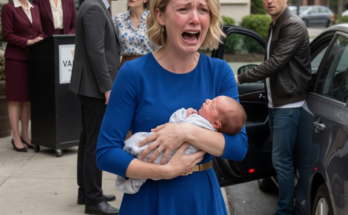
I was forty-one years old when the ghost of my sister’s past arrived in an emerald wrap dress, determined to repossess the son she had discarded nineteen years prior.
To understand the sheer audacity of that afternoon, you have to understand the soil we grew up in. Willow Creek, Ohio, was a town of roughly eleven thousand souls. It was the sort of claustrophobic municipality where the grocery clerk knew your grandmother’s bone density scan results before you did, and where a family’s reputation was guarded more fiercely than the gold at Fort Knox.
My name is Myra Summers. I am the older sister. In the taxonomy of our family tree, my sister, Vanessa, was the delicate orchid—the pretty one, the baby, the one who could illuminate a room simply by occupying it. I, on the other hand, was the root system. I was the one who scrubbed the baseboards, drove Vanessa to her Tuesday tap classes, and absorbed the ambient anxiety of our household so she wouldn’t have to. Our mother, Rita, operated on a singular, unyielding philosophy: Vanessa was fragile and required a shield. I was a workhorse, requiring nothing but a list of chores. Our father, Gerald, was a ghost who occupied a recliner. He agreed with whatever Rita decreed, present for dinner but absent from any conversation that carried emotional weight.
I loved Vanessa. I need to make that unequivocally clear. I loved her with that specific, abrasive tenderness that only older sisters understand—a love braided so tightly with chronic irritation that the two become indistinguishable.
The spring everything shattered, I was twenty-two. I had just collected my bachelor’s degree in education from Ohio State and secured a full-ride scholarship for a master’s program. I had a meticulously crafted five-year plan and a cramped studio apartment with a window overlooking a cracked asphalt parking lot. I thought that view was magnificent because it was entirely mine. Vanessa was sixteen, a high school sophomore dating a boy named Tyler who drove a loud Mustang and smelled of movie theater popcorn.
Then came a Tuesday in March. My landline screamed at two in the morning.
I drove the forty minutes back to Willow Creek with a cold dread coiling in my gut. When I pushed through the front door, the house was suffocatingly silent. Rita was anchored to the kitchen table, staring blankly at a mug of chamomile tea that had stopped steaming an hour ago. Gerald stood paralyzed by the refrigerator, his arms crossed, his gaze drilled into a scuff mark on the linoleum. From the floor above, I could hear the muffled, rhythmic sound of Vanessa sobbing into her mattress.
Rita didn’t lift her eyes when I pulled out a chair. Her hand, trembling slightly, slid a crumpled piece of thermal paper across the polished wood.
An ultrasound printout.
Four months. My sixteen-year-old sister had been carrying a secret for a third of a year, entirely alone. Tyler, I would later learn, had already peeled his Mustang out of her life the moment the plastic wand showed two pink lines.
But my mother’s first words weren’t about Vanessa’s terror. They weren’t about the baby’s health or the boy who had vanished.
“The neighbors cannot know,” Rita whispered, her voice brittle as dry leaves.
I remember the oppressive ticking of the wall clock. It was exactly eleven minutes past two. The neighbors. Rita laid out her battle plan with the cold precision of a military tactician. Adoption was the logical route, she mused, but an agency required legal filings, home visits, a paper trail. A paper trail meant whispers at the Methodist church. Keeping the infant was out of the question.
“It would ruin everything we have built,” Rita declared, her jaw locked tight, as if she had constructed an empire rather than a three-bedroom colonial and a country club membership.
She stood up abruptly, marched to the hallway linen closet, and returned with a small square of fabric. It was a baby blanket. Yellow cotton, threadbare at the corners, faded from two decades of dark storage.
“This was yours,” Rita said, shoving it into my hands.
It felt impossibly thin. It smelled of cedar wood and forgotten history. Rita sat back down and finally locked her icy blue eyes onto mine.
“You have to help,” she demanded. “You are her sister. If we keep it in the family, Vanessa can go back to school. We never have to speak of this mistake again.”
A mistake. “What about Vanessa?” I asked, my voice cracking in the sterile kitchen air. “Does she want to keep it?”
Rita waved her hand, swatting the question away like a gnat. “Vanessa is a child. She has no idea what she wants.”
I looked up at the ceiling, picturing my sister curled into a ball of panic. When Vanessa finally crept downstairs, wrapped in a gray hoodie three sizes too large, her mascara was smeared in dark rivers down her cheeks. She looked exactly like what she was: a terrified teenager trapped in a nightmare.
“Vanessa,” I said softly, ignoring my mother’s glare. “What do you want?”
She looked at Rita, then at me, her chest heaving. “I want it to go away,” she sobbed.
Rita pointed a manicured finger at my chest. “There. You heard her. She has school. She has her whole life ahead of her.”
She has school. I committed those three words to memory. I drove back to my apartment that night with the yellow blanket resting on my passenger seat. My mother had given me forty-eight hours. If I didn’t take the child, she would surrender it to the state. The silence in my car was deafening. I looked at the frayed yellow fabric illuminated by passing streetlights, entirely unaware that this fragile piece of cotton was about to become the epicenter of a war that would last nearly two decades.
Chapter 2: The Boy in the Fireproof Safe
The fluorescent lights of the delivery room hummed with a clinical indifference. Dylan entered the world on July 14th at 3:17 in the afternoon, screaming with enough force to strip the paint off the hospital walls. He weighed six pounds, nine ounces, and possessed a shock of jet-black hair.
Vanessa’s labor had been an eleven-hour marathon of agony. I stood by her bed, holding her hand, watching the innocence drain from her face with every contraction. Rita stood rigidly by the door, occasionally checking her watch as if this biological miracle was making her late for a hair appointment. Gerald paced the hallway, safely insulated from the blood and the noise.
When the pediatric nurse finally wiped Dylan clean and swaddled him in a striped receiving blanket, she turned to the room with a warm, expectant smile. “Who wants to hold him first?”
The silence that followed was suffocating.
Vanessa turned her face to the sterile beige wall, squeezing her eyes shut. Rita crossed her arms tighter over her chest, taking a physical half-step backward. The nurse’s smile faltered. She looked at me, confusion knitting her brow.
I stepped forward. I reached out and took the bundle.
The moment his weight settled against my chest, something fundamental shifted in the universe. Dylan’s eyes were squeezed shut against the harsh light, but his tiny, perfect fist reached out and curled tightly around my index finger. Instantly, his wailing ceased. He let out a soft, shuddering sigh, as if he had been waiting in the dark for the right person to catch him.
“Who is taking him home?” the nurse asked, her tone shifting to professional concern.
I didn’t even look at my mother. “I am.”
Three days later, I carried my nephew into my one-bedroom apartment on East Willow Street. I had a rickety crib borrowed from a sympathetic coworker, a bulk box of generic diapers, and the yellow cedar-scented blanket. I wrapped him in it that first night. It barely covered his tiny legs, but it was ours.
The first twelve months nearly broke my sanity into unrecoverable pieces.
Dylan had severe colic. Every evening, like clockwork, he screamed from eight o’clock until midnight. I paced the worn carpet of my living room for hours, holding him tight against my collarbone, humming off-key lullabies, my muscles screaming from exhaustion. I worked as a teaching assistant at Willow Creek Elementary from 7:45 AM to 3:30 PM, rushing home to relieve my neighbor so I could begin my second shift as a solo mother. I learned to survive on fragmented four-hour sleep cycles. I ate cold toast standing over the kitchen sink. I learned to shower in under three minutes because that was the maximum duration Dylan would tolerate his plastic bouncy seat.
One night in November, the exhaustion breached my walls. Standing in the kitchen in sweatpants stained with sour milk, listening to Dylan shriek in his crib, I broke down and dialed my mother’s number.
“Mom, please,” I wept into the receiver. “I just need help for one night. Let me sleep for four hours. Please.”
Rita’s voice was a block of ice. “You chose this, Myra. You wanted to play house. You are an adult. Figure it out.”
The line went dead.
Meanwhile, Vanessa had relocated to Boston. She was attending a prestigious private college, her tuition funded by a combination of academic scholarships and the very same parental savings account Rita claimed was “locked up” when I begged for help covering Dylan’s pediatrician co-pays. In October, during her sorority’s rush week, Vanessa faxed the voluntary relinquishment forms to the Franklin County Family Court.
I stored the finalized legal guardianship papers in a heavy, fireproof safe tucked under my bed. I laid the documents right next to the yellow blanket and Dylan’s plastic hospital bracelet. He was legally, entirely mine.
The years began to blur into a montage of quiet victories and silent indignities. Dylan’s first word wasn’t a babble; it was a sharp, efficient “Ma”. By three, he was drawing complex spaceships. By four, he was reading the nutritional labels on his cereal boxes, asking me to define ‘riboflavin’.
No one from the Summers family visited. Not once. When Dylan turned three, Gerald mailed a crisp fifty-dollar bill without an enclosed card. That Christmas, unable to afford wrapping paper, I wrapped a plastic fire truck in the Sunday comic strips. Dylan didn’t care; he thought the colorful newspaper was part of the magic.
When Dylan was six, my phone rang. The caller ID flashed a Boston area code.
“Myra, it’s Vanessa,” a polished, deeper voice echoed through the speaker. She sounded like a stranger who had taken elocution lessons.
My heart hammered against my ribs. Was she finally asking about him? Did she want to know if he liked dinosaurs or if his eyes were still that deep, impossible brown?
“I’m graduating next spring,” Vanessa continued breezily. “I need cash for a deposit on a new apartment. Is my old 2003 Camry still sitting in Mom and Dad’s garage?”
Forty-two seconds. That was the entirety of the phone call. She didn’t utter her son’s name.
When Dylan was eight, he shattered my heart and rebuilt it in a single evening. I was scrubbing dishes when he asked, his voice small and tentative over the rush of the faucet. “Aunt Myra, how come I don’t have a mom and dad like the other kids?”
A soapy plate slipped from my grip, clattering against the stainless steel. I dried my hands, sat across from him at the table, and looked into his perceptive, ancient eyes. I told him I loved him. I told him his birth mother loved him from afar, but that I was the one who was here, and I would never leave.
He studied my face, processing the gravity of my words. “I know,” he said softly. “I just… wanted to call you Mom instead of Aunt Myra. Is that okay?”
I hadn’t cried in years, but in that moment, the dam broke. He wrapped his small arms around my neck, smelling of grape juice and pencil shavings. “It’s okay, Mom,” he whispered.
That night, after he fell asleep, I opened the fireproof safe. I traced my fingers over the notarized ink of the guardianship papers. I felt the rough edges of the yellow blanket. Everything was secure. We were safe in our little bubble. But I didn’t know that my mother, sitting forty miles away, was quietly laying the groundwork for a betrayal that would detonate a decade later.
Chapter 3: The Architecture of Betrayal
I told Dylan the unvarnished truth when he was thirteen. We sat on the front porch on a humid Sunday afternoon, the air thick with the sound of cicadas. He had been circling the mystery of his origins for months, asking questions that brushed against the edges of the truth.
I didn’t editorialize. I didn’t paint Vanessa as a villain or Rita as a monster. I simply laid out the timeline: the 2 AM phone call, the ultimatum, the yellow blanket, the fax machine in the Boston sorority house. Dylan listened with a stillness that terrified me. When I finished, he stood up, retreated to his bedroom, and didn’t emerge for two days.
When he finally sat down at the kitchen table on Tuesday morning, he pushed his scrambled eggs around his plate and looked at me. “I’m not angry at her,” he said quietly. “I’m just sad for her. She missed everything.”
While I was raising a prodigy, Vanessa was collecting corporate titles and discarding husbands. She earned her MBA. She became a marketing director in Chicago with a corner office. She married a man named Brett, divorced him, and fourteen months later married a man named Marco, only to divorce him too. Each time her life hit a speed bump, Rita would call me with a strict directive: Do not contact your sister. She doesn’t need judgment right now.
I had stopped waiting for birthday cards for Dylan around year four. I had stopped expecting congratulations when I finally earned my own Master’s degree—achieved through four grueling years of night classes. My best friend, Clare Reeves, was the only one who cheered for me when I crossed the stage.
The fracture in the foundation finally cracked open during Dylan’s junior year of high school.
Dylan was a force of nature. Straight A’s, Debate Team Captain, AP classes stacked like bricks. His guidance counselor pulled me into a meeting to tell me he was on track to be Valedictorian. She slid a copy of his college admissions essay across her desk.
The title read: The Woman Who Chose Me.
I sat in my Honda Civic in the school parking lot and wept until I couldn’t breathe. He wrote about the newspaper wrapping paper. He wrote about me learning to cook. He wrote: “Biology is an accident of nature. Love is a conscious decision. My mother made that decision every single day for nineteen years, and she never once asked for applause.”
Two months later, the illusion of my family’s passive indifference was violently shattered.
Dylan walked into the kitchen after school, his jaw set tightly, and placed his iPhone face-up on the counter. “Mom. You need to read this.”
It was a family group text. Rita, Gerald, Vanessa, and an aunt and uncle. Someone—likely Rita, whose technological ineptitude was legendary—had accidentally added Dylan’s number to the thread. The history went back two full years.
I scrolled, my blood turning to ice water.
Rita (14 months ago): When Vanessa is finally settled and ready, she will take Dylan back. Myra is just keeping him for now. Vanessa: Give me a couple more years. I’m getting my life together. Uncle Dale: Myra should be grateful she got to experience having a kid at all.
My hands began to shake. For two years, they had been discussing my son as if he were a piece of furniture I was storing in my garage. A temporary loan. A babysitting gig that had stretched into a second decade.
“Why didn’t you show me this sooner?” I whispered, staring at the screen.
Dylan crossed his arms, looking at me with fierce, protective loyalty. “Because if you saw it, you would cut Grandma off. And I know you still want a mom. I didn’t want to be the reason you lost her.”
He was seventeen, and he was trying to protect me from the venom of my own bloodline. I didn’t scream. I didn’t throw a plate against the wall. I walked quietly into my bedroom, pulled the fireproof safe from beneath the bed, and ran my fingers over the raised notary seals on the guardianship documents. The paperwork was ironclad. Let them plot.
But the real ambush was yet to come.
Six weeks before graduation, my phone buzzed. It was Rita.
“Vanessa has met someone,” Rita announced, her voice vibrating with a sickening, triumphant energy. “His name is Harrison Whitfield. He’s in commercial real estate in Chicago. Very traditional. He wants a family, Myra.”
I leaned heavily against the kitchen counter. “And?”
“Vanessa told him about Dylan,” Rita continued, oblivious to the frost in my silence. “She told him how complicated our family dynamics were, and how she was forced to let you help raise him.”
Forced to let you help. The rewriting of history was so audacious it made me dizzy.
“Harrison is incredibly moved by her sacrifice,” Rita gushed. “He wants to meet the boy. Myra, this is Vanessa’s chance. Her chance to finally have the life she deserves. Do not ruin this for her.”
She wasn’t calling to celebrate my son’s graduation. She was calling to coordinate a photo op for her golden child’s new fiancé.
“Does Harrison know she signed away her parental rights from a sorority house?” I asked coldly.
The line went silent for a fraction of a second. “Do not make a scene, Myra,” Rita hissed, before hanging up.
Three weeks later, Dylan showed me an Instagram direct message. It was from Vanessa.
Hey handsome! I know this is out of the blue, but I’m your bio mom. I’ve thought about you every single day. I’m coming to town soon for graduation. Can’t wait to finally meet!
Nineteen years of absolute, echoing silence, broken by three red heart emojis.
Dylan didn’t react with anger. He typed back a sterile, clinical response: Hi. Thank you for reaching out. I appreciate it. He put his phone down and looked at me. The air in our small kitchen suddenly felt incredibly thin.
“She’s bringing a cake to the ceremony,” I told him, a bitter laugh escaping my throat. “Rita told me. She’s bringing Harrison, and she’s bringing a cake.”
Dylan’s eyes darkened, a storm gathering behind his calm exterior. He reached into his pocket and pulled out the frayed yellow baby blanket. He had asked me for it a week ago, claiming he wanted to keep it in his room.
He folded the yellow fabric meticulously, his fingers tracing the torn edges. “Let her bring the cake,” Dylan said, his voice dropping to a low, resolute register that sent a shiver down my spine. “Let her bring whoever she wants. Because on that stage, I’m going to end this.”
Chapter 4: The Fraud in the Emerald Dress
The morning of graduation, the air in Willow Creek tasted of cut grass and impending thunderstorms. I barely slept, my mind racing through thousands of worst-case scenarios.
Dylan came downstairs at 7:00 AM, sharp and immaculate in a white button-down and dark slacks. I had meticulously ironed his navy blue cap and gown the night before. As he stood in front of the hallway mirror adjusting his collar, I caught a flash of yellow. He was folding the threadbare baby blanket into a tight square and slipping it deeply into the inside breast pocket of his vest.
“For good luck,” he said, catching my eye in the mirror with a small, knowing smile.
The Willow Creek High School gymnasium was a cavern of polished hardwood and echoing bleachers, packed to its four-hundred-person capacity. The air conditioning struggled against the body heat of proud parents and restless siblings. My friend Clare and I found two folding chairs in the third row, left side, providing a perfect, unobstructed view of the wooden podium on the stage.
I smoothed the fabric of my navy blue dress, gripping my purse so tightly my knuckles turned white.
Then, the double doors at the rear of the gymnasium swung open.
Vanessa made her entrance like a celebrity arriving at a premiere. She wore a stunning emerald green wrap dress that clung perfectly to her frame. Her auburn hair cascaded in expensive, loose waves. Beside her walked Harrison Whitfield—a man wrapped in a bespoke gray suit, sporting a silver Rolex and the effortless, confident posture of a man accustomed to buying whatever room he walked into.
Trailing behind them like dutiful courtiers were Rita and Gerald. And in Rita’s hands, resting on a plastic tray lined with a paper doily, was the weapon.
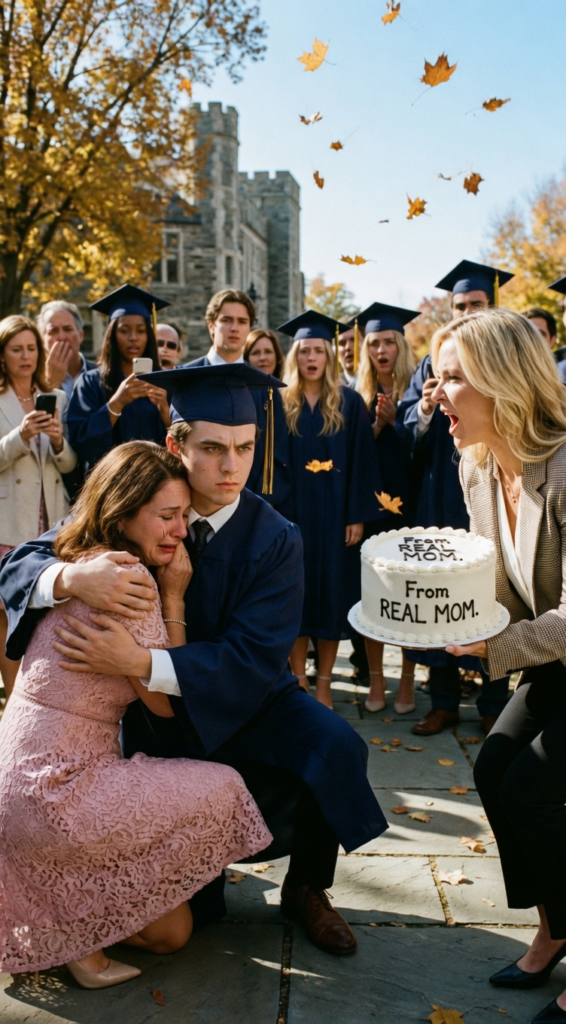
It was a sheet cake, smothered in pristine white frosting with garish pink cursive lettering. From three rows away, I could read the terrifying words: Congratulations from your REAL MOM.
A physical wave of nausea washed over me. Clare gasped, her hand flying to her mouth, before she grabbed my arm in a vice grip. My mother was parading down the center aisle of my town, carrying a confectionary billboard that declared my son belonged to a stranger.
Vanessa didn’t take her seat. Ignoring the usher, she marched directly toward the staging area where the graduates were lining up alphabetically. Through the crowd, I saw her spot Dylan. She threw her arms open and pulled his stiff, unyielding body into a theatrical embrace, tilting her head perfectly so Harrison—and anyone else watching—could witness the touching reunion of a mother and her lost child.
Dylan stood rigid as a board, his arms locked firmly at his sides.
Having secured her photo op, Vanessa turned on her designer heels and marched straight toward the third row. She stopped at the edge of the aisle, looking down at me with a smile so sharp it could cut glass. She leaned in, ensuring her voice carried to the parents sitting directly behind us.
“Myra,” Vanessa cooed, placing a manicured hand patronizingly on my shoulder. “Thank you so much for taking care of my son all these years. You have been a truly incredible babysitter.”
The word hung in the humid air. Babysitter. Nineteen years. Four thousand packed lunches. A master’s degree delayed. A social life sacrificed on the altar of colic and ear infections and parent-teacher conferences. Nineteen homemade birthday cakes because grocery store bakery orders were too expensive. Babysitter.
I didn’t scream. I didn’t slap her hand away. I looked past her shoulder, straight toward the staging area. Dylan was watching us. His jaw was clenched so tightly a muscle twitched in his cheek. He locked eyes with me, and the message in his dark gaze was unmistakable: Wait.
I swallowed the bile rising in my throat and folded my hands in my lap. Vanessa, looking thoroughly pleased with her territorial marking, sashayed to the second row to sit beside Harrison, directly in front of me. Rita sat beside them, guarding the cake on her lap like it was a crown jewel.
The ceremony began. The superintendent droned on for twelve minutes about the future. Name after name was called. Vanessa held her iPhone up, recording the stage, occasionally leaning over to whisper something in Harrison’s ear. He would nod, looking at her with a sickening adoration. He believed the narrative. He believed he was rescuing a tragic heroine.
“Dylan Summers.”
The gymnasium melted away. I couldn’t see the emerald dress in front of me. I couldn’t hear the polite applause. I just saw my boy—tall, steady, and majestic—striding across the stage. He accepted his diploma, turned toward the third row, and offered me a subtle, deliberate wink.
Then, he walked to the podium. It was time for the Valedictorian address.
Dylan adjusted the microphone. He unfolded a piece of paper and began smoothly, hitting the expected beats. He joked about the cafeteria food, thanked the janitorial staff, and spoke about community. Vanessa laughed too loudly at his jokes, her phone recording his every word, shifting in her seat to ensure Harrison was watching her brilliant biological offspring.
Dylan paused. He looked down at his printed speech. He stared at it for five agonizing seconds.
Then, with slow, deliberate precision, he folded the paper in half. He set it down on the podium. He gripped the edges of the wooden stand and leaned into the microphone.
“I’ve been planning this speech for six weeks,” Dylan’s voice echoed, devoid of the earlier humor, ringing with a profound, terrifying gravity. “But I just realized… the most important thing I need to say isn’t written on this page.”
Vanessa leaned forward, adjusting her phone. She thought her moment had arrived. She had no idea the executioner had just lifted the axe.
Chapter 5: The Weight of the Yellow Blanket
The gymnasium fell into a profound, suffocating silence. Four hundred people collectively held their breath.
“The person I need to thank most today,” Dylan said, his voice steady, carrying over the hum of the air conditioning, “is not a teacher, or a coach. It’s a woman who was twenty-two years old when she was handed a newborn baby and told, ‘This is your responsibility now.’“
Vanessa’s smile froze. The phone in her hand wavered slightly.
“She had just been accepted into a master’s program on a full scholarship,” Dylan continued, his eyes scanning the crowd before locking onto the third row. “She gave it up the very next morning. She moved into a tiny one-bedroom apartment. She survived on four hours of sleep. She wrapped my Christmas presents in the Sunday comics because she couldn’t afford wrapping paper.”
Somewhere in the back bleachers, a woman sniffled. The raw, unvarnished truth of poverty and sacrifice was cutting through the ceremonial pomp.
“She went back to school when I was five. Night classes for four years. And when she finally got her master’s degree, nobody from her family showed up to clap for her.” Dylan paused, letting the shame of that fact settle over the room. Clare squeezed my hand so hard my knuckles popped.
“She taught me how to iron a shirt. She came to every single parent-teacher conference alone. She never missed one.”
Vanessa slowly lowered her phone. The blood had drained entirely from her face, leaving her pale and drawn. She looked around, realizing that every parent within earshot was putting the pieces together. Harrison shifted uncomfortably beside her, his brow furrowing in deep confusion.
Dylan stepped back from the podium, his posture rigid. “She is not the woman who gave birth to me,” he declared, his voice ringing like a bell. “But she is the woman who chose me. Every single day for nineteen years, without complaining, without asking for applause. Her name is Myra Summers. And she is my mother.”
The eruption was instantaneous. The gymnasium exploded into a standing ovation. Two hundred strangers rose to their feet. Clare was weeping uncontrollably, screaming my name over the din. Even Principal Hendrix, standing near the stairs, had a hand pressed over her heart, tears shining on her cheeks.
I remained glued to my plastic chair, completely paralyzed, a river of hot tears tracking through my makeup.
Directly in front of me, Vanessa was physically shrinking into her seat. She wasn’t clapping. Harrison was staring at her, then up at Dylan, then back at Vanessa, his jaw tightening as the math finally calculated in his head. At the end of their row, Rita sat frozen. The cake resting on her knees—Congratulations from your REAL MOM—now looked like a grotesque, mocking prop.
Dylan looked directly at me through the chaos, and mouthed two words: Thank you.
The aftermath spilled out onto the sun-drenched lawn beside the parking lot. I was standing under the shade of a massive oak tree when Vanessa charged toward me, her emerald dress billowing, her mascara smeared into dark raccoon circles. Harrison was two steps behind her, his face a mask of cold fury.
“What did you do?!” Vanessa shrieked, ignoring the parents turning their heads. “You coached him! You turned my own son against me!”
Dylan appeared from the crowd, stepping smoothly between us. “Nobody coached me,” he said, his voice icy and calm. “I wrote that speech myself.”
“Baby, I am your mother!” Vanessa cried, reaching out for him. “I gave birth to you!”
“And then you signed a piece of paper and faxed it to a judge from a sorority house during rush week,” Dylan countered, not backing up an inch.
Vanessa’s mouth hung open, a fish gasping for air.
“Grandma told me once that you had to go because you had school,” Dylan continued, his words slicing like surgical steel. “And you went. For nineteen years. You went to Chicago, and to two marriages, and you built a career. And that is fine. But you do not get to walk into my graduation with a cake that says ‘Real Mom’ and pretend the woman who actually raised me is just a babysitter.”
Harrison stepped forward. The adoring fiancé from an hour ago was entirely gone. “Vanessa,” he said, his voice dangerously low. “You told me you were forced to give him up. Did you sign away your rights voluntarily?”
Vanessa panicked, looking frantically at Rita, who had just hurried over with Gerald in tow. “Harrison, it’s complicated, our family—”
“Did you sign them away voluntarily?” Harrison barked, his voice echoing across the lawn.
“Yes,” I answered for her, looking Harrison dead in the eye. “She did. And I raised him alone.”
Harrison didn’t look at Vanessa again. He buttoned his suit jacket, turned on his heel, and marched toward the parking lot. A minute later, the sleek engine of his luxury sedan roared to life, and he drove out of Willow Creek, leaving Vanessa standing alone in the grass, watching her future evaporate.
In the heavy silence that followed, Rita looked at Dylan. For a fleeting, microscopic second, I saw the fortress of her pride crack. Her lower lip trembled. Her eyes filled with tears. I thought, This is it. After nineteen years, she is finally going to apologize.
Then, the fortress slammed shut. Her face hardened back into stone.
“If you hadn’t poisoned him against his own blood, none of this would have happened,” Rita spat at me.
Dylan sighed, a sound of profound exhaustion. “No one poisoned me, Grandma. I have nineteen years of memories. Do you know how many you’re in? Seven Thanksgivings and a birthday card.” He pointed a finger at me. “She is in every single one.”
Dylan turned to Vanessa, who was quietly sobbing, wrapping her arms around her own waist. “If you want to know me, you can,” Dylan said softly, the anger draining from his voice. “But you have to start today. Not from a cake. You have to start by learning my favorite color, or what I’m allergic to.”
Vanessa looked up, confused. “What… what are you allergic to?”
“Tree nuts,” Dylan said. “Since I was four. Mom figured it out when my throat closed up. She drove ninety miles an hour to the ER and sat by my bed all night.”
He reached into his vest. From the deep pocket, he pulled out the folded square of faded yellow cotton. He held it up in the sunlight for a brief moment, letting the shadows of the oak tree dance across its frayed edges.
Then, he stepped past his biological mother, past his grandmother, and walked directly to me. He took my shaking hands and pressed the yellow blanket firmly into my palms.
“This is yours, Mom,” he whispered, kissing my forehead. “It was always yours.”
I held the thin, cedar-scented fabric against my chest. I watched Vanessa standing isolated on the manicured grass, a stranger in an emerald dress. I watched Rita and Gerald retreating to their car in bitter silence. They were walking away, but for the first time in my life, I didn’t feel the urge to chase them.
The fireproof safe under my bed was empty, but my arms were finally, undeniably full. Some families are built by blood and obligation. But the strongest ones, the ones that can withstand the fire, are built by choice. And looking at the extraordinary man standing beside me, I knew I would choose him again, every single time.