Mr. Halden’s voice rang through the church.
“My mother, Margaret Ellis.”
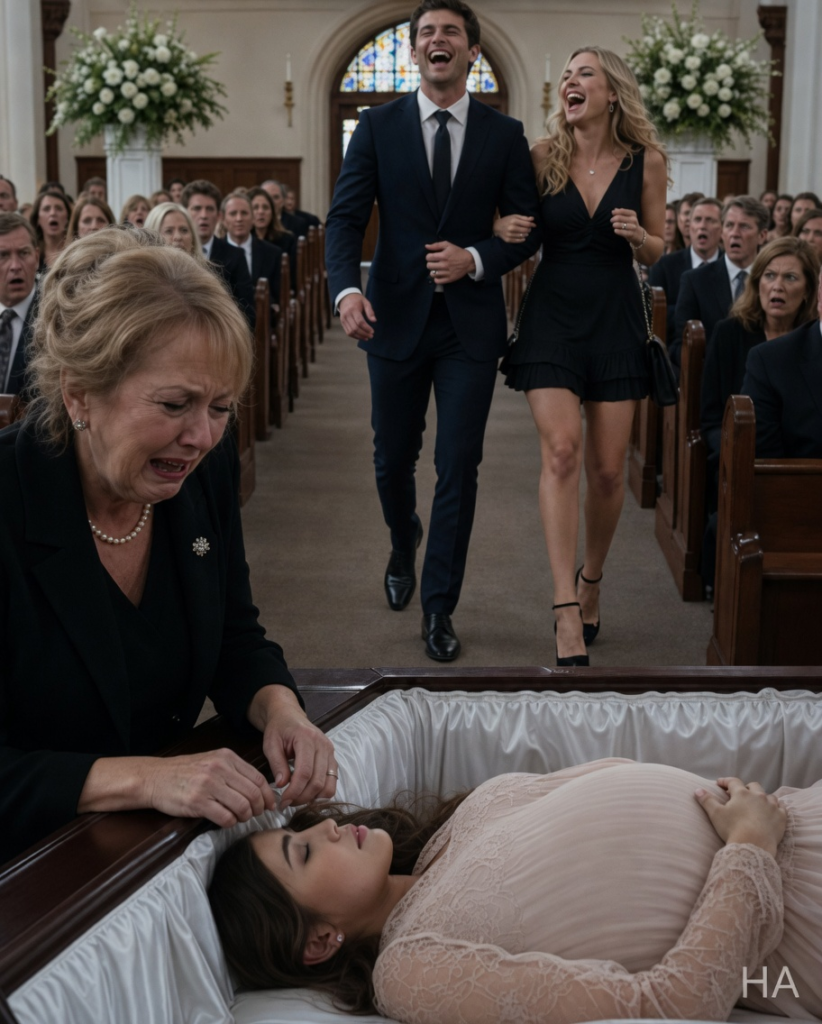
You felt every eye turn toward you.
Evan’s face changed first.
Not much.
Just enough.
The smug curve of his mouth loosened, and his hand slipped slightly from Celeste’s waist. He had walked into that church expecting to perform grief, collect sympathy, and bury the last woman standing between him and everything he wanted.
Instead, your daughter had spoken from inside a sealed envelope.
And she had spoken your name first.
Mr. Halden continued, his voice steady.
“To my mother, Margaret Ellis, I leave full authority over my personal estate, my medical records, my private journals, my digital accounts, and all documents concerning my marriage to Evan Vale.”
A murmur moved through the pews.
Evan’s eyes narrowed.
“Medical records?” he said.
Mr. Halden did not look at him.
“To my mother,” he read, “I also leave the house at 1147 Hawthorne Lane, purchased in my name before my marriage, including all land, furnishings, accounts attached to its upkeep, and the nursery prepared for my son.”
Celeste’s red lips parted.
Evan went pale.
For a moment, the church became so silent you could hear the rain tapping against the stained-glass windows.
The house.
That beautiful white house in suburban Boston with blue shutters, a wraparound porch, and the yellow nursery Emma had painted herself while seven months pregnant.
Evan had told everyone it was his.
He had called it “my home” at dinner parties.
He had stood in that kitchen, drinking your daughter’s coffee, while telling guests he had “given Emma stability.”
But the house had never been his.
Emma had bought it with money from her grandmother’s trust before the wedding.
Your daughter had been gentle, but she had not been foolish.
Evan took one step forward.
“This is inappropriate,” he said sharply. “We are in a church.”
Mr. Halden finally looked up.
“So was your wife.”
The sentence landed like a slap.
Someone in the second pew gasped.
Celeste shifted closer to Evan, but he barely noticed her now.
His eyes were fixed on the envelope.
On your daughter’s words.
On the dead woman he had underestimated.
Mr. Halden lowered his gaze and read again.
“To my husband, Evan Vale, I leave one dollar.”
The church erupted.
Whispers.
Gasps.
A woman crying softly.
Your sister’s hand tightened around your arm.
Celeste looked at Evan like she had just discovered the floor beneath her was glass.
Evan forced a laugh.
A small, ugly sound.
“She was angry,” he said. “Pregnancy made her emotional. Everyone knows that.”
You turned your head slowly.
Something in your face made him stop talking.
For years, you had been polite to that man.
You had served him dinner.
Bought him Christmas gifts.
Held your tongue when he interrupted Emma.
Stayed quiet when he corrected her in front of people.
You had done it because your daughter loved him.
Because mothers sometimes mistake silence for support when their daughters are trying to survive.
But your daughter was in a coffin.
Your grandson was in that coffin with her.
And Evan Vale had just blamed pregnancy for the final wishes of a dead woman.
Mr. Halden continued.
“To Celeste Arden, who will likely be standing too close to my husband when this is read, I leave nothing. Not my home. Not my clothes. Not my nursery. Not my forgiveness.”
Celeste inhaled sharply.
All around the church, heads turned.
Someone whispered, “Oh my God.”
Evan grabbed Celeste’s wrist.
“Don’t react.”
But Celeste was already reacting.
Her face had gone from beautiful to exposed.
The expensive black dress, the pearl earrings, the glossy hair, the funeral-appropriate veil—it all suddenly looked like costume jewelry on a thief caught under bright lights.
Mr. Halden held the letter a little higher.
“And to my unborn son, Noah Thomas Vale, I leave everything I owned in trust under the guardianship of my mother, Margaret Ellis, should he survive me.”
Your knees almost failed.
Noah.
She had named him.
You had not known.
Emma had been saving the name as a surprise.
Your hand flew to your mouth, but no sound came out.
Inside the coffin, beneath folded white satin, your grandson would never hear that name spoken by his mother.
Noah Thomas Vale.
Your daughter had carried him.
Protected him.
Loved him enough to name him before the world ever got to hold him.
Mr. Halden’s voice softened for the first time.
“Since my son has passed with me, all assets designated for him transfer to my mother, Margaret Ellis, to be used at her discretion for truth, burial, and justice.”
Truth.
Burial.
Justice.
The three words wrapped around your throat.
Evan’s face was no longer pale.
It had turned gray.
He looked at the coffin.
Not with grief.
With fear.
That was the first time you knew.
Not suspected.
Knew.
Whatever had happened to Emma that night, Evan was terrified of what she had left behind.
Mr. Halden folded the first page and removed another.
“There is an additional statement.”
Evan exploded.
“No.”
His voice cracked through the church.
Several people jumped.
He recovered quickly, but not quickly enough.
“I mean,” he said, smoothing his tie, “this is enough. My wife deserves dignity. Margaret, surely you agree.”
There it was.
The performance.
The warm voice.
The public appeal.
He wanted to pull you into his lie because he knew a grieving mother could be made to look unstable if she screamed in front of witnesses.
So you did not scream.
You looked at Mr. Halden.
“Read it.”
Evan stared at you.
“Margaret.”
You did not turn.
“Read it.”
Mr. Halden opened the second page.
“If this letter is being read before my burial, it means my mother is present, and Evan has survived me.”
The room went cold.
Celeste took a step back.
Evan’s hand shot out and caught her elbow.
This time, she pulled away.
Mr. Halden continued.
“I am writing this on April 3rd at 11:42 p.m. Evan is downstairs. He thinks I am asleep. Celeste is texting him again. I know because I saw the messages. I know about the hotel in Providence. I know about the life insurance policy he increased without telling me. I know about the argument he recorded and edited to make me sound unstable.”
Evan shouted, “This is a lie!”
The priest stood.
“Mr. Vale.”
But Evan was not looking at him.
He was looking at the coffin.
At Emma.
At the woman he thought could no longer defend herself.
Mr. Halden’s voice grew sharper.
“I am not suicidal. I am not careless. I am afraid.”
A sob broke from somewhere in the pews.
You could not move.
The world narrowed to that sentence.
I am afraid.
Your daughter had been afraid.
And you had not known.
You remembered her last phone call.
Her voice had been too cheerful.
She had said she was tired.
She had said pregnancy made her emotional.
She had said Evan was under pressure at work.
You had asked, “Are you safe, baby?”
There had been a pause.
Then Emma had laughed.
Too lightly.
“Of course, Mom.”
You had believed her because you wanted to.
Because the alternative was too terrifying.
Mr. Halden read on.
“If anything happens to me before Noah is born, my mother must request a full investigation. Not a polite one. Not a family one. A real one.”
The church doors opened suddenly.
Two police officers stepped inside.
Then a woman in a navy suit followed them.
Detective Carla Reyes.
You knew her.
You had met her two days earlier after Mr. Halden called you privately and said Emma had left instructions.
You had sat in a police station conference room with cold coffee in front of you while Detective Reyes asked if Emma had seemed scared.
You had told her the truth.
Yes.
No.
Maybe.
You did not know.
God help you, you did not know.
Now Detective Reyes stood near the back of the church with her hands folded in front of her.
She was not there for ceremony.
She was there for Evan.
He saw her.
His face changed again.
This time, everyone saw it.
Mr. Halden finished the page.
“Mom, if you are hearing this, I am sorry. I tried to protect you from my marriage because I did not want you to worry. But if I am gone, please do not let him make you polite. You taught me kindness. But you also taught me that kindness does not mean surrender.”
Your tears finally fell.
Not loud.
Not messy.
Just hot lines down your cheeks as your daughter reached out from death and reminded you who you were before grief tried to hollow you out.
Mr. Halden lowered the paper.
“There are attachments.”
Evan laughed once.
It sounded broken.
“What attachments?”
Detective Reyes walked forward.
“Mr. Vale, we can discuss that outside.”
Evan looked at her.
Then at you.
Then at the coffin.
“No,” he said. “This is insane. My wife fell. She fell down the stairs. That’s what happened. Everyone knows that.”
No one answered.
Because everyone suddenly understood something terrible.
He had said too much.
Detective Reyes stopped beside the front pew.
“Mr. Vale, we have additional questions regarding the death of Emma Vale and unborn child Noah Vale.”
The name hit him.
Noah.
Not fetus.
Not pregnancy.
Noah.
His son.
The son he had never deserved.
Celeste whispered, “Evan, what did you do?”
He turned on her.
“Shut up.”
That was when the mask fully cracked.
Not slipped.
Cracked.
The grieving husband disappeared.
In his place stood a man cornered by the dead.
Celeste stepped away from him.
“I didn’t know,” she said quickly.
Evan stared at her.
“You didn’t know what?”
She looked at Detective Reyes.
“I didn’t know he was going to hurt her.”
The church erupted.
Evan lunged toward her.
The officers moved faster.
One caught his arm.
The other blocked his path.
Evan shouted, “She’s lying!”
Celeste was crying now, mascara cutting black lines down her face.
“He told me they were separating,” she said. “He said Emma was unstable. He said she was using the baby to trap him.”
Detective Reyes said, “Ms. Arden, you need to stop speaking until we take a formal statement.”
But Celeste was unraveling.
“He told me she fell. He said she fell.”
Her voice broke.
“Then why did he ask me to delete everything?”
Evan stopped fighting.
Just for one second.
But it was enough.
You saw it.
Detective Reyes saw it.
Everyone saw it.
Mr. Halden quietly placed the envelope back into his folder.
The funeral had become something else.
Not a goodbye.
A reckoning.
Detective Reyes stepped closer to Evan.
“Mr. Vale, you are not under arrest at this moment, but you are being detained pending further questioning.”
Evan looked at you then.
Not with apology.
With hatred.
“You did this,” he said.
Your daughter lay dead between you.
Your grandson lay dead with her.
And this man still thought he was the victim.
You stepped close enough for him to hear you clearly.
“No,” you said. “Emma did.”
His face twisted.
The officers led him down the aisle.
The same aisle he had walked in laughing.
No one spoke as he passed.
No one reached for him.
No one comforted him.
Even Celeste stood frozen near the pew, shaking like a woman who had thought she was winning a game and discovered it was a crime scene.
The church doors closed behind Evan.
Only then did the priest whisper a prayer.
But you barely heard it.
You were looking at Emma.
At her still hands.
At the curve of her belly.
At the daughter who had been afraid and still brave enough to leave a trail of truth behind.
After the service, there was no burial right away.
The medical examiner’s office requested a delay.
The coffin was taken quietly, respectfully, under police supervision.
Your sister held you while you watched.
“You don’t have to be strong,” she whispered.
You looked at the hearse.
“I’m not being strong.”
“What are you being?”
You wiped your tears.
“A mother.”
The investigation moved slowly at first.
Then violently.
Emma’s attachments were not small.
She had copied emails, screenshots, insurance notices, prescription records, doorbell camera clips, and voice memos. She had taken photos of bruises on her wrists and upper arm. She had documented dates, arguments, threats, and the way Evan suddenly insisted she stop driving herself.
She had written everything down.
Not because she wanted revenge.
Because she wanted to survive.
Detective Reyes showed you only what she had to.
Even that was enough to haunt your sleep.
One recording broke you.
Emma’s voice, trembling but controlled.
“Evan, please move away from the stairs.”
Then his voice.
Low.
Cold.
“You always make everything dramatic.”
The audio ended there.
A second later, according to investigators, the home security system went offline.
Evan told police it had malfunctioned.
But the company logs showed someone had disabled it manually from his phone.
The fall happened twenty-two minutes later.
At first, Evan insisted Emma had tripped.
Then he claimed she was dizzy.
Then he said she had been emotional.
Then he blamed pregnancy.
Then Celeste turned over text messages.
That was the beginning of the end.
One message from Evan read:
After tonight, everything changes.
Another:
The policy pays out if it’s accidental. You need to trust me.
Celeste claimed she thought he meant divorce paperwork.
Nobody believed her completely.
But she talked.
People often do when prison becomes more real than vanity.
Three weeks after the funeral, Evan was arrested.
You watched it on the local news from your living room.
He wore a navy suit and no expression as officers escorted him from his attorney’s office in downtown Boston. Reporters shouted questions. Cameras flashed.
He kept his head high.
Performing until the last second.
But when a journalist yelled, “Did you kill your pregnant wife?” his face changed.
Only briefly.
But enough.
You turned off the television.
Your house was quiet.
Emma’s childhood photos lined the mantel.
First steps.
First day of school.
Prom night.
College graduation.
Wedding day.
You could not look at the wedding photo for long.
Not because of Evan.
Because of her smile.
She had believed she was walking into love.
She had been walking into a house with a locked room inside it.
Two months later, you went to Emma’s home for the first time since her death.
Hawthorne Lane was lined with maple trees and clean sidewalks.
The kind of neighborhood where people walked golden retrievers, watered flowers, and pretended horror could not happen behind white curtains.
The house looked exactly as you remembered.
Blue shutters.
White porch.
Yellow nursery upstairs.
Mr. Halden met you at the door.
“You don’t have to do this today,” he said.
“Yes,” you said. “I do.”
Inside, the air smelled stale.
Like closed windows and unfinished life.
Emma’s blue mug still sat near the sink.
A half-used bottle of prenatal vitamins stood beside the microwave.
In the living room, a folded baby blanket rested over the back of the couch.
Yellow and white.
You had knitted it.
Your knees weakened.
Mr. Halden stepped forward, but you lifted a hand.
No.
If you fell apart in this house, you would never leave it whole.
You climbed the stairs slowly.
The nursery door was closed.
Your hand hovered over the knob for a long time.
Then you opened it.
Yellow walls.
White crib.
A rocking chair by the window.
Tiny socks folded in a basket.
Wooden letters on the wall spelling:
NOAH
You made a sound you did not recognize.
Not a scream.
Not a sob.
Something older.
Animal.
A mother’s grief becoming a grandmother’s grief in the same breath.
You crossed the room and touched the crib.
Emma had sent you a picture after assembling it.
Look, Mom! Evan actually helped.
Now you knew he had probably complained the whole time.
But Emma had still tried to find goodness in him.
That was who she was.
Not weak.
Hopeful.
There is a difference.
On the rocking chair sat a sealed box with your name on it.
Mr. Halden had told you Emma left private items for you, but seeing the box in that room almost broke you.
You sat on the floor and opened it.
Inside were letters.
One for you.
One for Noah.
One marked If I Don’t Make It.
Your hands trembled.
You opened yours first.
Mom,
If you are reading this, I need you to know I tried. I tried to leave. I tried to protect Noah. I tried to protect you from knowing how bad it had gotten because I hated the idea of making you afraid every time your phone rang.
You pressed the letter to your chest.
Then forced yourself to continue.
You always told me love should feel like peace. I kept telling myself peace would come back. But it didn’t. I confused memories with promises. I confused apology with change. I confused fear with loyalty.
Tears dropped onto the paper.
If Evan hurt me, do not let anyone tell you I was careless. I wanted my son. I wanted my life. I wanted mornings with you in the kitchen while Noah threw cereal on the floor. I wanted Christmas pajamas. I wanted birthdays. I wanted to come home.
Your vision blurred completely.
Please make sure he knows I loved him, even if he never got to breathe outside me. And please, Mom, don’t let grief turn you into a ghost. I need you to live. For me. For Noah. For yourself.
You folded over the letter and wept in the nursery until the sunlight moved across the floor.
Mr. Halden waited outside the door.
He did not rush you.
Good men know when silence is respect.
The trial began eleven months later.
By then, Evan’s face had become familiar across Boston.
The charming husband.
The accused killer.
The man who walked into his pregnant wife’s funeral with his mistress.
News channels loved that part.
They replayed the church footage over and over, though you refused to watch it.
You had lived it once.
That was enough.
In court, Evan looked different.
Thinner.
Sharper.
His hair was still perfect, but the shine had gone out of him.
Celeste testified for the prosecution in exchange for reduced charges related to obstruction and evidence tampering. She wore a plain black dress and no red lipstick.
For once, she looked her age.
Young.
Scared.
Human.
When she took the stand, Evan would not look at her.
She told the jury about the affair.
The hotel.
The texts.
The insurance policy.
The night Emma died.
She admitted Evan called her forty minutes after the fall, not 911 first.
That detail made the courtroom go silent.
Your fingernails dug into your palm.
Forty minutes.
Your daughter had been at the bottom of those stairs.
Your grandson still inside her.
And Evan had called his mistress before he called for help.
The prosecutor asked, “What did Mr. Vale say on that call?”
Celeste cried before answering.
“He said, ‘It happened.’”
The words emptied the room.
Evan stared straight ahead.
His lawyer objected.
The judge overruled.
The truth sat there, ugly and breathing.
Then it was your turn.
You walked to the witness stand in a navy dress Emma had once said made you look “powerful but approachable.” The memory almost made you smile.
Almost.
The prosecutor asked about Emma.
Not just her death.
Her life.
You told them she loved lemon tea, hated scary movies, cried at dog commercials, and painted the nursery yellow because she wanted Noah to wake up in sunlight.
You told them she called every Sunday.
You told them she had sounded afraid but tried to hide it.
Then the prosecutor asked about the funeral.
You closed your eyes briefly.
When you opened them, you looked directly at the jury.
“He came in laughing,” you said.
Evan’s lawyer stood.
“Objection. Prejudicial.”
The judge allowed it.
You continued.
“He came into the church laughing with Celeste on his arm. My daughter was in a coffin. My grandson was in that coffin with her. And he walked in like he had already moved on.”
You turned your head slightly.
Evan looked down.
For the first time since the church, he could not meet your eyes.
The prosecutor handed you a copy of Emma’s letter.
“Can you read the highlighted section?”
Your throat tightened.
But you read.
I am not suicidal. I am not careless. I am afraid.
Several jurors wiped their eyes.
Evan’s lawyer tried to paint Emma as anxious.
Emotional.
Hormonal.
He used every soft weapon cruel men use against women who cannot defend themselves.
But Emma had prepared.
Her calendar.
Her doctor’s notes.
Her messages to friends.
Her secret recordings.
Her lawyer.
Her will.
Piece by piece, she walked back into the courtroom.
Not alive.
But undeniable.
The trial lasted three weeks.
The jury deliberated for nine hours.
You sat in the hallway with your sister on one side and Mr. Halden on the other.
You did not pray for vengeance.
That surprised you.
You prayed for truth to survive contact with twelve strangers.
When the bailiff opened the door and called everyone back, your legs felt wooden.
Evan stood at the defense table.
His face was empty.
Celeste sat in the back row, staring at her hands.
The jury foreman rose.
Count one.
Second-degree murder.
Guilty.
The courtroom gasped.
Your sister grabbed your hand.
Count two.
Unlawful killing of an unborn child.
Guilty.
Your breath left you.
Count three.
Insurance fraud.
Guilty.
Count four.
Evidence tampering.
Guilty.
Evan’s mother screamed.
You had almost forgotten she was there.
She shouted that her son was innocent, that Emma had ruined him, that you had poisoned everyone against him.
The judge ordered her removed.
Evan did not turn around.
He just stood there as the life he had tried to steal from your daughter closed around him.
At sentencing, the judge allowed victim impact statements.
You stood with Emma’s letter folded in your hand.
This time, you did not shake.
You looked at Evan.
“I used to wonder what I would say to you if this day came,” you began. “I thought I would scream. I thought I would curse you. I thought hatred would be big enough to fill the hole you left.”
Your voice was calm.
“But hatred is too small for Emma.”
Evan stared at the table.
You continued.
“My daughter was not your obstacle. She was not your inconvenience. She was not a policy payout or a problem to solve. She was a woman who loved deeply, hoped stubbornly, and carried a child who already had a name.”
You lifted the letter slightly.
“His name was Noah.”
The judge looked down.
So did half the courtroom.
“You took their future. You took birthday candles, first steps, bedtime stories, scraped knees, school pictures, and Christmas mornings. You took phone calls I will never receive. You took a daughter who still called me when she burned dinner. You took a grandson who never got to open his eyes.”
Evan’s jaw moved.
Still, he said nothing.
“But you did not take her voice,” you said. “Because she left it everywhere. In letters. In recordings. In legal documents. In every truth you thought grief would bury.”
For the first time, Evan looked up.
His eyes were wet.
Maybe regret.
Maybe fear.
Maybe simply the human response to consequences.
You no longer cared.
“You walked into her funeral laughing,” you said. “Now you will spend the rest of your life remembering that she had the final word.”
The judge sentenced him to life in prison with the possibility of parole only after decades.
By the time Evan was led away, you felt no joy.
Only a terrible release.
Justice did not bring Emma back.
It did not make Noah breathe.
It did not erase the image of Celeste leaning toward you in that church and whispering, Looks like I win.
But it did something.
It stopped the lie from becoming their legacy.
After the trial, Celeste approached you outside the courthouse.
Your sister stiffened, but you held up one hand.
Celeste looked thinner than she had at the funeral.
No glamour.
No victory.
Just a woman standing inside the ruins of choices she could not undo.
“Mrs. Ellis,” she said.
You waited.
“I know you hate me.”
You looked at her for a long time.
“No,” you said finally. “I don’t.”
She blinked.
“You don’t?”
“Hate requires carrying you. I won’t.”
Her mouth trembled.
“I didn’t know he would kill her.”
“But you knew she existed.”
Celeste looked down.
“Yes.”
“You knew she was pregnant.”
Tears fell.
“Yes.”
“You stood beside her coffin and told me you won.”
Celeste covered her mouth.
“I am sorry.”
The words were small.
Not enough.
But maybe true.
You stepped closer.
“You did not win. Evan did not win. Nobody won. My daughter is dead. My grandson is dead. And you get to live with the fact that you helped make cruelty comfortable.”
She sobbed.
You felt nothing.
Not because you were cruel.
Because Emma had asked you not to become a ghost.
And ghosts haunt.
You wanted to live.
So you walked away.
One year after Emma’s funeral, you returned to the church.
Not for death this time.
For light.
You had used part of Emma’s estate to create the Emma and Noah Foundation, a nonprofit supporting pregnant women escaping domestic abuse. Emergency housing. Legal aid. Medical advocacy. Phones. Transportation. Safety planning.
Practical things.
The things women need when people tell them to “just leave” without understanding how dangerous leaving can be.
The launch event was held in the church hall.
The same building where Evan had laughed.
You almost chose another place.
Then you decided no.
Some rooms should be reclaimed.
Photographs of Emma lined a table near the entrance.
Emma at five, missing two front teeth.
Emma at sixteen in a soccer uniform.
Emma on her wedding day, before truth caught up with hope.
Emma pregnant, standing in the yellow nursery, both hands under her belly.
Beside her photos sat a small framed card.
Noah Thomas Vale
Loved before birth. Remembered always.
Women came that night.
Survivors.
Advocates.
Nurses.
Lawyers.
Mothers.
Some cried quietly when you spoke.
Some held your hand afterward and said Emma’s story sounded like theirs.
One young woman named Rachel waited until almost everyone had left.
She was heavily pregnant, with a bruise fading near her jaw.
She approached you slowly.
“I called the number on the flyer,” she whispered.
Your chest tightened.
“And?”
“They got me out last night.”
You reached for her hands.
She let you take them.
“I didn’t know where to go,” Rachel said. “Then I saw the story about your daughter. I thought… if she left proof, maybe I could leave too.”
For a moment, you could not speak.
Then you looked toward Emma’s photo.
Your daughter had wanted mornings with cereal on the floor.
She had wanted Christmas pajamas.
She had wanted life.
But even in death, she had opened a door for another woman to walk through.
You squeezed Rachel’s hands.
“You are safe tonight,” you said.
She broke down crying.
You held her.
Not as a stranger.
As a mother.
As a grandmother.
As a woman carrying grief large enough to shelter someone else.
Later, when the hall was empty, you walked into the church sanctuary alone.
The lights were low.
The pews were still.
The aisle stretched ahead of you, no longer filled with Evan’s laughter or Celeste’s heels.
You stood in the place where Emma’s coffin had been.
For a long time, you said nothing.
Then you whispered, “We did it, baby.”
Your voice trembled.
“Not all of it. Not enough. Never enough. But we told the truth.”
You closed your eyes.
In your mind, Emma was not pale and still.
She was eight years old, running through sprinklers.
She was nineteen, calling from college because she had ruined laundry.
She was thirty, pregnant, laughing in the yellow nursery.
She was your daughter before she was a victim.
She was your Emma.
And Noah was not just the child Evan stole from the world.
He was a name.
A dream.
A life loved fully, even if briefly.
Six months later, you moved into Emma’s house.
People thought it would be too painful.
Maybe it was.
But pain was not always a warning to leave.
Sometimes it was proof love had lived there.
You kept the nursery yellow.
You could not turn it into an office.
Not yet.
Instead, you placed Emma’s letters in a white box on the shelf, beside Noah’s tiny socks and the blanket you had knitted.
Every morning, sunlight poured through the nursery window exactly the way Emma had wanted.
You would stand there with coffee in your hand and let it touch the walls.
The house changed slowly.
You planted lavender along the porch.
You painted the front door blue.
You donated Evan’s clothes, threw away his cologne, and replaced every lock.
In the kitchen, you hung a framed line from Emma’s letter.
Kindness does not mean surrender.
Women from the foundation came sometimes.
Not to stay forever.
Just long enough to breathe.
A mother with two children slept in the guest room for three nights before a shelter placement opened.
A college student used the kitchen phone to call a lawyer.
Rachel came back months later with a healthy baby girl named Hope.
When she placed that baby in your arms, something inside you healed and broke at the same time.
You looked down at Hope’s sleeping face and thought of Noah.
Not with the sharpness that used to cut through your ribs.
With tenderness.
With grief that had learned how to sit beside love without swallowing it whole.
On the second anniversary of Emma’s death, you visited the cemetery at sunrise.
Emma and Noah were buried together beneath a maple tree.
The headstone was simple.
Emma Grace Ellis Vale
Beloved Daughter
Noah Thomas Vale
Beloved Son
Their Voices Changed Lives
You placed white lilies for Emma.
A small blue wooden elephant for Noah.
Then you sat in the grass, even though it was damp.
“I miss you,” you said.
The wind moved through the leaves.
You smiled through tears.
“The foundation helped thirty-seven women this year. Twelve children too. Rachel’s baby is walking now. She drools on everything. You would love her.”
A bird landed near the tree, then flew away.
You took a breath.
“Evan wrote again.”
He had.
From prison.
A letter full of God, regret, loneliness, and carefully arranged remorse.
You had not answered.
You would never answer.
“I burned it,” you told Emma. “Not dramatically. Just in the sink. Very safely. You would have made fun of me.”
You laughed softly.
Then the laughter became tears.
“I still get angry,” you whispered. “Sometimes I wake up and feel like it happened yesterday. Sometimes I hear his laugh in my dreams. Sometimes I wonder if I should have known sooner.”
Your hand rested on the grass above your daughter.
“But I’m trying not to punish myself for trusting the world to be kinder than it was.”
The sun rose higher.
Warmth touched the stone.
You looked at their names.
“I love you both,” you said. “Every day.”
When you stood to leave, you felt something you had not expected.
Not closure.
Closure was too neat a word for this.
But steadiness.
A reason to keep walking.
As you reached the cemetery path, your phone buzzed.
A message from the foundation director.
Emergency placement needed. Pregnant mother. Can we use Hawthorne House tonight?
You looked back at Emma’s grave.
Then at Noah’s name.
You typed:
Yes. Always.
That evening, a young woman arrived at the house with one suitcase and fear in her eyes.
You opened the blue front door.
Warm light spilled onto the porch.
For one second, she stood there shaking, unsure if she was allowed to step inside a safe place.
You knew that look.
You had seen it in Emma’s letters.
You had seen it in every woman who had learned to apologize for needing rescue.
So you smiled gently and opened the door wider.
“Come in,” you said. “You’re safe here.”
Behind you, the yellow nursery glowed softly at the top of the stairs.
Not as a wound anymore.
As a promise.
Evan had walked into a church laughing because he thought death had made Emma silent.
He was wrong.
Emma’s voice had filled courtrooms.
Changed laws.
Opened doors.
Saved women.
Held children.
And every time someone crossed the threshold of Hawthorne House with trembling hands and walked out later with her head lifted, your daughter won again.
Not the way Celeste meant it.
Not with cruelty.
Not with possession.
Not with a man.
Emma won by becoming impossible to erase.
And you, the mother who swallowed her scream beside a coffin, finally understood what your daughter had left you.
Not just a house.
Not just evidence.
Not just grief.
A mission.
So you removed Evan’s name from every corner of her life.
You kept Emma’s.
You kept Noah’s.
And in the home where one man tried to end a story, you helped hundreds of women begin again.