PART 2
“Daddy said if the judge believes me, nobody will have to know what happened behind the basement door.”
For a second, I did not understand the sentence.
Not because the words were unclear.
Because my mind refused to let them become real.
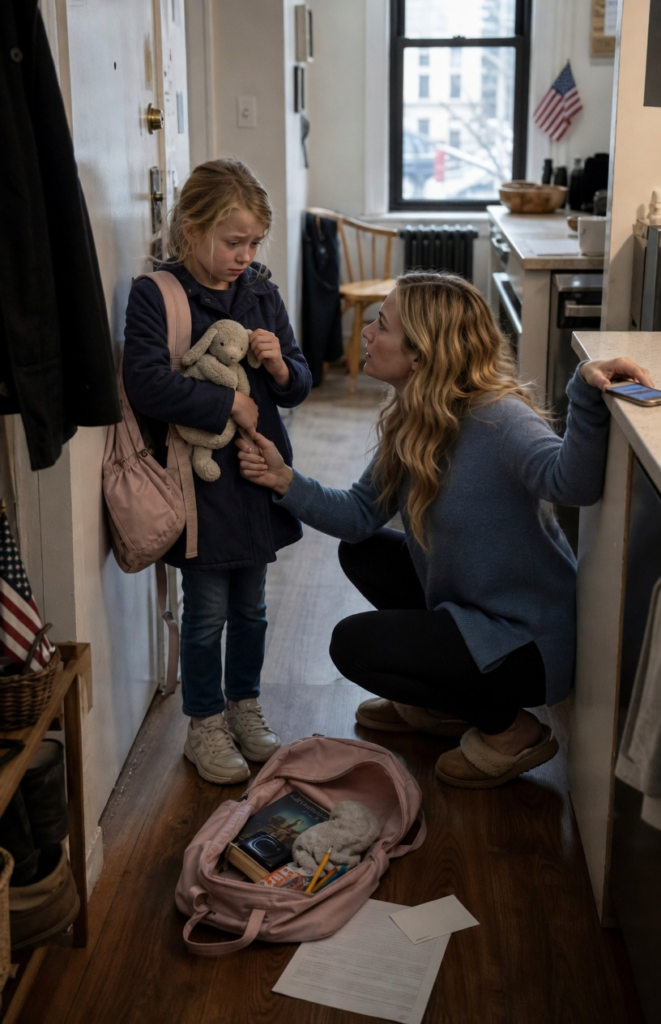
Andrea went completely silent on the speaker. Even the radiator seemed to stop hissing. Lila stayed curled against me, her small body trembling in the hollow between my shoulder and my ribs, as if she were trying to fold herself back into a place where none of this existed.
I looked at the folded custody schedule in my hand.
Tomorrow’s date circled in red.
ASK ABOUT THE BASEMENT DOOR.
“Nobody will have to know,” I repeated, but my voice did not sound like mine.
Lila pressed her face harder into my sweater.
Andrea’s voice came back, low and controlled. “Harper. Listen to me carefully. Do not ask her leading questions. Do not push. Do not say his name with anger in your voice. Put the paper down. Put the recorder somewhere safe. Then I want you to tell Lila she is not in trouble.”
“I know how to talk to my daughter,” I said.
“I know,” Andrea said. “But tomorrow morning, every word you say tonight may matter.”
That shut me up.
I set the paper on the kitchen counter as if it were something alive. Then I put my arms around Lila and breathed through the shaking in my own chest until I could speak without sounding broken.
“Baby,” I said, “you are not in trouble.”
She nodded, but not like she believed me.
“I’m not mad at you.”
Another tiny nod.
“You did nothing wrong.”
That time, she made a sound. Not a sob exactly. More like a breath getting trapped halfway out of her body.
Andrea said, “Good. Now ask her only this: is there anything she needs right now to feel safe?”
I repeated the question.
Lila thought about it in that terrible, careful way children think when they are used to adults turning their answers into weapons.
Then she whispered, “Can the bedroom door stay open?”
My throat burned.
“Yes,” I said. “Always.”
“And can you sit outside?”
“Yes.”
“And can Bunny come too?”
I looked down at the limp stuffed rabbit still clenched under her chin, its gray ear twisted almost backward.
“Bunny can come too.”
Andrea exhaled softly. “Harper, I’m going to file an emergency motion tonight. I need photos of everything you found. Do not alter the recorder. Do not try to listen to it yet unless I tell you. Put it in a zip bag if you have one. Photograph the index card, the custody schedule, the backpack, where you found each item. Time-stamp everything. Then I want you at Children’s Safe Harbor at six-thirty tomorrow morning.”
“Six-thirty?”
“I know it is early. It has to be before court. I’m calling a forensic interviewer I trust. If she can see Lila before the hearing, we may keep Nathan from taking control of the narrative.”
At the sound of his name, Lila flinched.
I felt it.
Andrea must have heard the shift in the room because she said, “And Harper?”
“Yes.”
“Do not sleep if you can avoid it.”
I let out something close to a laugh. “That won’t be a problem.”
“I don’t mean emotionally. I mean practically. If he realizes something went wrong, he may call, text, come by, or attempt to create evidence that you are unstable. Do not answer the door. Do not answer the phone. Save everything.”
I looked at the deadbolt.
Three locks. A chain. A peephole I had asked the landlord to replace after the divorce.
For the first time, they felt decorative.
Andrea continued. “Does Nathan have keys?”
“He used to. I changed the locks six months ago.”
“Good. Does he know your building code?”
“Yes.”
“Call management now and have it changed. Tell them there is an emergency protective concern involving a minor child. Use those words.”
“Okay.”
“And Harper?”
I closed my eyes.
“What?”
“There’s one more thing.”
The pause was too long.
“What?” I asked again.
“Nathan filed an amended petition Friday afternoon.”
My hand tightened around Lila’s coat.
“What amended petition?”
Andrea’s voice lowered another degree. “He’s requesting full physical custody, supervised visitation for you, and immediate suspension of your overnight parenting time pending psychological evaluation.”
The room did not tilt this time.
It narrowed.
“He filed that while she was with him,” I said.
“Yes.”
“He rehearsed her while his petition was already filed.”
“Yes.”
“So tomorrow was never a normal hearing.”
“No,” Andrea said. “Tomorrow was supposed to be your ambush.”
I looked at my daughter, at the red marks on her cheeks from crying, at the way she still had not taken off her shoes.
Then I understood the full shape of Nathan’s plan.
He had not been trying to hurt me in the old ways anymore. Not with late support payments. Not with snide emails copied to attorneys. Not with accusations that I was “overreactive,” “emotionally volatile,” “too enmeshed.”
Those were warm-up exercises.
This was the main event.
He was going to walk into court with a rehearsed child, a manipulated recording, and some story about a basement door I had never heard of, and he was going to use our daughter’s fear as the rope to hang me with.
For one clean second, rage made everything inside me very quiet.
Then Lila whispered, “Mommy?”
I came back.
“I’m here.”
“Did I mess it up?”
I knelt in front of her again. “What do you mean?”
“Daddy said if I didn’t say it right, you’d be mad because you’d know I didn’t love you enough to stay.”
That was the first moment I almost broke.
Not when she said the word judge.
Not when I found the recorder.
Not when Andrea told me about the petition.
That sentence did it.
Because there is a kind of cruelty that leaves marks, and there is a kind that teaches a child to mark herself. Nathan had put a courtroom inside my daughter’s head and made her believe love was testimony.
I took both her hands in mine.
“Lila Mercer,” I said, using the full name she loved when I made it sound official, “you do not have to earn living with me. You do not have to say the right thing to be loved. You do not have to choose. You are my daughter when you are happy. You are my daughter when you are scared. You are my daughter when you say everything perfectly, and you are my daughter when you cannot say anything at all.”
Her face collapsed.
This time, when she cried, she cried like an eight-year-old.
Loud.
Messy.
Alive.
I held her until her coat grew warm under my palms and her sobs slowed into hiccups. Then I helped her take off her shoes. I made toast she did not eat, poured water she barely touched, and guided her to my bedroom instead of hers because she asked if she could sleep where the walls did not make shadows.
I left the hallway light on.
The bedroom door open.
Bunny under her arm.
Then I sat on the floor outside the doorway with my laptop balanced on my knees and photographed every piece of evidence under Andrea’s instructions.
The index card.
The recorder.
The folded custody schedule.
The red circle.
The words about the basement door.
Then I called building management. Then my sister Maren. Then Safe Harbor. Then the police non-emergency line, which became the emergency line when I said my child had been coerced and recorded in connection with a custody hearing.
At 11:42 p.m., Nathan called.
His name lit up my phone like a threat.
I did not answer.
A voicemail appeared thirty seconds later.
Andrea told me not to listen alone, so I sent it to her.
She called back two minutes later.
“Do not react,” she said.
“What did he say?”
“He said he just wanted to make sure Lila got home okay. He sounds calm. Too calm. Then he says she seemed ‘confused’ when she left and that you should not ‘interrogate her’ because your anxiety tends to create stories.”
I stared at the dark hallway.
“He’s already building it.”
“Yes.”
Another call came in before she finished speaking.
Nathan again.
Then a text.
Please confirm Lila arrived. I am concerned about her emotional state after spending time in your home.
Then another.
Do not discuss court with her. You know the order.
Then another.
Harper, answer the phone. This is exactly the behavior my attorney warned me about.
Andrea read them as I forwarded them.
“Good,” she said.
“Good?”
“He’s nervous.”
At 12:18 a.m., someone buzzed from downstairs.
I did not move.
The buzzer sounded again.
Then my phone lit up.
I’m downstairs. I want to see my daughter.
I crawled on my hands and knees to the apartment door so my shadow would not cross the peephole.
Another buzz.
Then knocking from the hallway.
Not loud.
Worse.
Measured.
Three taps.
A pause.
Three taps again.
Like he was performing reasonableness for an invisible audience.
I looked through the peephole.
Nathan stood there in his charcoal overcoat, one hand in his pocket, the other holding his phone at chest level.
Recording.
Of course he was recording.
He had always known how to become a victim the moment anyone watched.
I backed away and called Andrea.
“He’s here,” I whispered.
“Do not open the door. Call 911.”
“He’s recording.”
“Good. Let him record himself violating boundaries at midnight before an emergency custody hearing.”
My hand shook as I dialed.
When the dispatcher answered, I made my voice plain.
“My ex-husband is outside my apartment door at midnight demanding access to our eight-year-old child after she disclosed coercive rehearsal for court. My attorney instructed me not to open the door. I need officers dispatched.”
Nathan knocked again.
“Harper,” he called through the door. “I know you’re there.”
Lila appeared in the bedroom doorway.
Barefoot.
Pale.
Bunny clutched to her chest.
I put one finger to my lips and crossed the hall to her.
“He’s here?” she whispered.
I nodded once.
Her face changed in a way I will never forgive him for.
Not surprise.
Recognition.
“Did I do bad?” she whispered.
I pulled her into the bedroom and shut us both inside.
“No,” I whispered back. “Adults are handling this.”
From the hallway, Nathan’s voice sharpened.
“You are making this worse for yourself.”
There it was.
The real man, slipping through the calm mask.
The police arrived fourteen minutes later.
By then Nathan had moved three steps away from the door and was speaking into his phone in a soft, wounded tone.
“I’m just trying to confirm my daughter is safe,” he told the officers. “My ex has a history of emotional escalation. We have court in the morning. I’m very concerned she’s coaching Lila.”
I stood behind the chain lock while one officer spoke to me through the gap. Her name was Officer Reyes. She had tired eyes and a voice that did not waste anything.
“Ma’am, is your daughter here?”
“Yes.”
“Is she safe?”
“Yes.”
“Do you have a court order requiring you to release her tonight?”
“No. His weekend ended at six.”
Nathan stepped closer. “Officer, I’m not asking to take her. I just want visual confirmation.”
Lila whimpered behind me.
Officer Reyes heard it.
Her eyes moved from my face to the dark apartment behind me.
“Sir,” she said without turning around, “step back.”
Nathan smiled with only half his mouth. “I’m trying to be cooperative.”
“Then cooperate from over there.”
The second officer moved him down the hall.
I showed Officer Reyes Andrea’s emergency filing draft, the photos, and the texts through the gap in the door. I did not hand her my phone. Andrea had warned me about that too. Evidence stayed with me unless there was a warrant or a formal report.
Officer Reyes read silently.
Her expression did not change until she saw the index card.
Then her jaw shifted.
“Is the child able to speak?”
“She’s frightened.”
“I won’t question her about facts,” Reyes said. “I just need to know whether she wants him to leave.”
I hesitated.
Behind me, Lila’s small voice said, “Yes.”
Officer Reyes looked past me.
“Did you hear that?” I asked.
“Yes, ma’am.”
Nathan heard it too.
His face hardened so fast even the hallway light seemed to catch on it.
“Lila,” he called. “Sweetheart, don’t be dramatic.”
Officer Reyes turned.
“Sir,” she said, “that is enough.”
He lifted both hands. “I’m her father.”
“And right now you are leaving.”
The second officer escorted him to the elevator.
Nathan went because men like Nathan often obey uniforms while pretending the obedience is their choice.
But before the elevator doors closed, he looked straight at my peephole and smiled.
Not angry.
Not defeated.
Promising.
At 6:11 a.m., Lila and I walked into Children’s Safe Harbor through a side entrance while the sky was still blue-black over the parking lot.
Andrea was already there.
She looked nothing like the polished courtroom photos on her website. Her hair was pulled into a severe knot. She wore sneakers with her suit pants and carried two coffees in one hand and a file box in the other.
Beside her stood a woman in a soft gray cardigan.
“This is Dr. Elaine Porter,” Andrea said. “She’s a licensed pediatric trauma specialist and forensic interviewer. She will speak with Lila only if Lila agrees.”
Lila pressed into my side.
Dr. Porter crouched, but not too close.
“Hi, Lila,” she said. “I’m Elaine. I have a room with beanbags, colored pencils, and a very ugly fish named Martin.”
Lila blinked.
“He’s not real,” Dr. Porter said. “Which is good, because he has terrible manners.”
For the first time since she came home, my daughter almost smiled.
Almost.
Dr. Porter did not ask about Daddy.
She did not ask about court.
She asked whether Bunny needed a chair.
Bunny did.
That was how my daughter walked into the interview room: not because four adults needed evidence, not because a judge was waiting, not because Nathan had built a trap around her words.
Because a fake fish had bad manners, and Bunny needed supervision.
The interview lasted forty-seven minutes.
I know because I stared at the wall clock the entire time.
Andrea sat beside me in the waiting room, reviewing Nathan’s amended petition. She showed me only parts of it. Enough to prepare me. Not enough to poison me.
The allegations were exactly what she expected.
I was unstable.
I shouted.
I left Lila alone for long periods.
I locked her in the basement as punishment.
That was the basement door.
I stared at the sentence until the words blurred.
“We don’t have a basement,” I said.
Andrea looked at me.
“What?”
“My building doesn’t have private basement access. There’s a laundry room downstairs, but tenants need a key fob. Lila’s never been there alone.”
Andrea’s pen stopped moving.
“Are you certain?”
“Andrea, I live on the fifth floor of a prewar apartment building. There is no basement door inside my apartment. There is no door I could lock her behind.”
Andrea’s face changed.
Not relief.
Focus.
“He may be using something from his house,” she said. “Reframing it as yours.”
I remembered the custody schedule.
ASK ABOUT THE BASEMENT DOOR.
“What if there is a basement door at his place?”
Andrea did not answer immediately.
Nathan’s house was not really Nathan’s house. It belonged to his mother’s trust, though he liked to call it “the family property” whenever he wanted to sound established. A renovated colonial at the edge of Millbrook, too large for one man, with hedges trimmed into hard lines and a finished lower level he had turned into a home gym, wine room, and media space.
During our marriage, I hated that basement.
Not because anything dramatic had happened there.
Because Nathan liked rooms without windows.
He liked being able to decide when light entered.
Andrea closed the file.
“If Dr. Porter gets anything about location, we’ll know more. Until then, we stay disciplined.”
At 7:26 a.m., Dr. Porter came out.
Lila was beside her, holding a sheet of paper with a drawing on it.
She looked tired, but not shattered.
That mattered.
Dr. Porter did not discuss details in front of her. She simply said, “Lila did very well. She has asked to sit with her mother now.”
My daughter crossed the room and climbed into my lap as if she were much younger than eight.
I held her.
Dr. Porter looked at Andrea.
“I’ll prepare a written summary for the court. I am also recommending temporary suspension of unsupervised contact pending full evaluation.”
Andrea nodded.
“And the recorder?” she asked.
Dr. Porter’s mouth tightened.
“I think you should listen before court.”
We listened in Andrea’s car.
Not in the waiting room.
Not near Lila.
Andrea sat in the driver’s seat. Dr. Porter stood outside the passenger door with her arms folded. I sat in the back because I knew if I sat in front I might grab the dashboard hard enough to crack something.
Andrea pressed play.
At first there was only static.
Then Nathan’s voice.
Warm.
Patient.
False.
“Okay, sweetheart. Let’s do it again.”
Lila’s voice came next, tiny and exhausted.
“I feel safe with Dad.”
“Good,” Nathan said. “But not like you’re reading. Say it like you mean it.”
A pause.
Then Lila again.
“I feel safe with Dad.”
“Better. Now what does Mommy do?”
“She yells.”
“What else?”
“She leaves me alone.”
“For how long?”
“I don’t know.”
“No, we practiced this. Remember?”
The audio rustled. Maybe he was moving closer. Maybe she was shifting away.
“For hours,” Lila whispered.
“That’s right. And where does she put you when you cry?”
Silence.
“Lila.”
“I don’t want to say it.”
“You’re not in trouble. We’re playing the truth game.”
“I don’t like this game.”
My hands went numb.
Nathan sighed.
Not angrily.
Disappointed.
That was worse.
“If you don’t tell the truth, the judge may make you stay with Mommy. Is that what you want?”
Lila began to cry.
“Daddy, please turn the light on.”
“In a minute. First answer.”
“I forgot.”
“No. You didn’t forget. Where does Mommy put you?”
Another rustle.
Then Lila whispered, “Behind the basement door.”
“And what does she say?”
“She says nobody will believe me.”
Nathan exhaled.
“There. See? That wasn’t hard.”
The recording clicked off.
No one spoke.
My hands were still numb. My mouth tasted like metal.
Andrea stared through the windshield at the pale morning light spreading over the parking lot.
Dr. Porter opened the passenger door and leaned in.
“That is not a spontaneous disclosure,” she said. “That is rehearsal under distress.”
Andrea nodded once. “Can you testify?”
“If the court permits it, yes.”
I could not move.
I could not cry.
The woman who wanted to call him, scream at him, tear his life into pieces, had gone somewhere far away.
In her place sat someone colder.
Someone who understood evidence.
At 8:43 a.m., we entered the courthouse.
Nathan was already there.
Of course he was.
He stood near the security checkpoint in a navy suit, speaking quietly to his attorney, Gregory Vance, a silver-haired man with courtroom posture and expensive glasses. Nathan looked rested. Clean. Injured in a tasteful way.
When he saw us, his eyes went first to Lila.
Then to Andrea.
Then to me.
He smiled as if we were late to a meeting he had arranged.
Lila stepped behind my coat.
Nathan’s smile flickered.
Gregory Vance noticed. His gaze moved, sharp and assessing.
Andrea leaned toward me. “Do not look at him.”
“I’m not.”
“You are.”
I turned away.
We waited outside Courtroom 3B while other families carried their private disasters past us in whispers. A teenage boy with headphones. A grandmother clutching a plastic folder. A man in work boots staring at the floor. A woman silently mouthing what looked like a prayer.
At 9:12 a.m., Gregory Vance approached.
“Andrea,” he said pleasantly.
“Gregory.”
He looked at me with professional sorrow. “Ms. Mercer.”
I said nothing.
His gaze dropped to Lila. “Good morning, Lila.”
Lila gripped my hand so hard her nails dug into my palm.
Andrea stepped in front of her.
“You will not address the child.”
Gregory’s eyebrows lifted. “I was being polite.”
“You were creating contact before a contested emergency hearing involving coercion allegations. Don’t do it again.”
The pleasantness drained from his face by one careful degree.
Nathan moved closer. “This is ridiculous. I’m her father.”
Lila whispered, “Mommy.”
One word.
Barely audible.
But Gregory heard it.
Andrea heard it.
Nathan heard it.
And for the first time that morning, Nathan made a mistake.
His eyes snapped to Lila, and in a voice too low for anyone but us, he said, “Remember what we practiced.”
The hallway changed.
Not physically.
But legally.
Andrea turned her head slowly.
Gregory Vance froze.
Nathan realized it half a second too late.
“What?” he said.
Andrea smiled.
It was not a happy smile.
It was the kind of smile a locked door gives when someone has brought the right key.
“Thank you, Mr. Mercer,” she said.
Gregory grabbed Nathan’s elbow and pulled him away.
At 9:30 a.m., we went inside.
Judge Marisol Keane presided over family court like someone who had seen every costume grief could wear and trusted none of them.
She was not warm.
That was good.
Warm people sometimes mistake tears for truth.
Judge Keane read the amended petition first. Then Nathan’s emergency affidavit. Then Andrea’s opposition, which had been filed at 3:08 a.m. along with photographs, police incident documentation, and a request for immediate suspension of Nathan’s unsupervised parenting time.
Her expression did not change when she read.
Nathan sat straight at the opposite table, hands folded, wedding ring gone, fatherhood face on.
I wondered how many times he had practiced that too.
Judge Keane looked up.
“Mr. Vance,” she said, “your client filed an amended petition Friday afternoon alleging severe emotional mistreatment and confinement of the minor child by Ms. Mercer. The child was then in your client’s care, correct?”
Gregory stood. “Yes, Your Honor.”
“The hearing was scheduled for Monday morning.”
“Yes, Your Honor.”
“And the child returned to Ms. Mercer Sunday evening.”
“Yes.”
Judge Keane turned a page.
“Ms. Bell alleges that during the weekend immediately preceding this hearing, Mr. Mercer rehearsed the minor child to provide specific testimony matching his amended petition.”
Gregory’s voice remained smooth. “Your Honor, my client strongly denies any improper coaching. He is a concerned father attempting to protect his daughter from a volatile household.”
Judge Keane looked at Andrea.
“Ms. Bell.”
Andrea stood.
“Your Honor, we have evidence that Mr. Mercer not only coached the child, but did so in a manner designed to cause fear, confusion, and testimonial compliance. We have an index card in his handwriting placed in the child’s backpack. We have a custody schedule with tomorrow’s hearing date circled and a written prompt regarding the ‘basement door.’ We have a digital recorder found in the child’s backpack. We have a midnight police response after Mr. Mercer appeared at Ms. Mercer’s apartment demanding access to the child while recording himself. And we have a forensic interviewer prepared to testify that the child’s statements are consistent with rehearsal under distress rather than spontaneous disclosure.”
Gregory rose. “Objection to characterization. We have not authenticated—”
“You will have an opportunity,” Judge Keane said.
He sat.
Judge Keane’s gaze moved to the recorder sealed in a clear evidence bag on Andrea’s table.
“Is there audio?”
“Yes, Your Honor,” Andrea said.
Nathan’s face did not move.
But his left thumb began rubbing the side of his index finger.
I knew that gesture.
He did it whenever numbers went wrong.
Judge Keane said, “Play it.”
Gregory stood quickly. “Your Honor, we object to the playing of any recording without proper foundation, chain of custody, or—”
“Mr. Vance,” Judge Keane said, “this is an emergency custody proceeding, not a criminal trial. I am determining immediate child safety. Sit down.”
Gregory sat.
Andrea played the recording.
The courtroom listened to my daughter beg her father to turn the light on.
No one coughed.
No papers moved.
Even the court reporter’s hands seemed quieter than before.
When Nathan’s recorded voice said, “There. See? That wasn’t hard,” Judge Keane closed her eyes for exactly one second.
Then the audio ended.
The silence afterward was not empty.
It was full of consequences.
Judge Keane looked at Nathan.
He stared back with the controlled sadness of a man who had already chosen his next mask.
“Mr. Mercer,” she said, “did you make that recording?”
Gregory stood. “Your Honor, I advise my client—”
“I did not ask you,” Judge Keane said.
Nathan cleared his throat. “I recorded a conversation with my daughter because I was concerned she would be too afraid to tell the truth in court.”
Judge Keane looked at him for a long moment.
“You turned off the lights?”
Nathan’s jaw tightened. “The room was dim. She exaggerates when anxious.”
From behind me, Dr. Porter shifted.
Judge Keane heard that too.
“And the index card?” the judge asked.
Nathan glanced at Gregory.
Gregory stood. “Your Honor, parents often help children organize their thoughts when—”
Judge Keane lifted one hand.
Gregory stopped.
The judge looked back at Nathan.
“Did you write the card?”
Nathan’s mouth opened.
Closed.
Then he said, “I wrote reminders.”
“Reminders,” Judge Keane repeated.
“Yes.”
“For an eight-year-old.”
“To help her.”
“To help her say her mother yells, leaves her alone, and that she feels safe with you.”
Nathan leaned forward slightly, earnest now. “Your Honor, Harper is very good at appearing calm in public. But behind closed doors, she is unstable. Lila has told me things for months.”
Judge Keane’s gaze moved to me.
“Ms. Mercer.”
I stood because Andrea touched my wrist.
“Yes, Your Honor.”
“Does your residence have a basement?”
“No, Your Honor.”
Nathan’s head turned sharply.
Judge Keane noticed.
“My apartment is on the fifth floor,” I continued. “There is a shared laundry room in the building basement, but no private basement door. Lila has never been confined there. She does not even have a key fob.”
Judge Keane looked at Andrea.
“Documentation?”
Andrea slid a folder forward. “Lease diagram, building statement from management obtained this morning, and access log showing Ms. Mercer’s fob has not opened the basement level in seventy-two days.”
I looked at her.
She had not told me about the access log.
Andrea did not look back.
Judge Keane reviewed the documents.
Nathan whispered something to Gregory.
Gregory’s face did not improve.
The judge said, “Mr. Mercer, does your residence have a basement?”
Nathan’s expression stilled.
“Yes.”
“Does it have a door?”
“All basements have doors.”
Judge Keane did not blink.
“Does it have a door that locks?”
Nathan laughed softly, the way people laugh when they want a question to seem beneath them.
“It has a standard interior lock.”
Andrea stood. “Your Honor, we request an immediate order preventing Mr. Mercer from returning to the residence with the child and preserving any rooms, devices, written materials, cameras, or recordings located in the lower level of his home.”
Gregory shot up. “This is outrageous. There is no allegation that anything happened in my client’s basement.”
Andrea turned to him. “Your client created the allegation.”
That landed.
Hard.
Because everyone in the courtroom understood it.
Nathan had invented a basement door to destroy me.
But he had chosen a detail from his own house.
And now that detail was opening backward.
Judge Keane called a recess.
Not because she was uncertain.
Because emergency hearings, when they begin to smell like criminal matters, require careful walls between what a family court can decide and what law enforcement may need to investigate.
We waited in a small conference room.
Lila colored at the far end of the table under Dr. Porter’s supervision. She drew Bunny standing beside a large yellow sun. No houses. No doors.
Andrea made three calls.
One to the guardian ad litem.
One to the county child protection intake supervisor.
One to Officer Reyes, who apparently had already written her report before breakfast.
At 10:41 a.m., Andrea hung up and looked at me.
“There’s something else.”
I almost laughed.
Because of course there was something else.
“What?”
“Nathan submitted an exhibit list with the amended petition.”
“I thought we already had that.”
“We had the filing. His attorney just gave us the intended exhibits in court.”
She opened a folder.
“There is supposed to be a video.”
My stomach dropped.
“Of what?”
“Lila allegedly saying she wants to live with him and that you locked her behind the basement door.”
I looked toward my daughter.
“She never said that.”
“She may have been made to say something close.”
The room narrowed again.
Andrea continued. “But the exhibit list says the video was recorded at 3:14 p.m. Saturday.”
“So?”
“So Dr. Porter asked Lila what time Daddy turned off the lights.”
I looked at her.
Andrea’s voice became very precise.
“Lila said it happened after dinner. When it was dark outside.”
I understood only half of it.
Andrea said, “If he has a video timestamped midafternoon of her making a statement about an event she describes as happening later, then either he staged more than one rehearsal, or the metadata was edited.”
At 11:03 a.m., court resumed.
Judge Keane had lost whatever patience she brought in with her.
She ordered Nathan to produce the video immediately.
Gregory objected.
Judge Keane overruled him.
Gregory said the file was on Nathan’s phone.
Judge Keane ordered Nathan to hand the phone to the bailiff for supervised transfer.
Nathan refused.
Not openly.
Men like Nathan rarely refuse openly.
He said his phone contained privileged communications with counsel. He said he needed time. He said he did not understand why Ms. Mercer could ambush him with unauthenticated materials while he was expected to produce private property on demand.
Judge Keane watched him talk.
Then she said, “Mr. Mercer, you listed the video as an exhibit you intended to use today. Produce it.”
Nathan’s face hardened.
“There are sensitive family matters on that device.”
“Yes,” Judge Keane said. “That is why everyone in this courtroom is still here.”
He looked at Gregory.
Gregory did not save him.
The phone went to the bailiff.
The video played on the courtroom monitor seven minutes later.
Lila sat on a couch in Nathan’s basement media room, hands in her lap. The lighting was dim, but not dark. She looked washed out. Small. Her hair had been brushed too neatly.
Nathan’s voice came from off camera.
“Tell the judge what you told me.”
Lila looked toward him.
“I want to live with Daddy.”
“Why?”
“Because Mommy scares me.”
“How does she scare you?”
Lila blinked slowly. Her lips parted.
Then, almost mechanically, she said, “She puts me behind the basement door.”
My breath stopped.
Not because the lie sounded convincing.
Because my daughter sounded absent.
Nathan’s recorded voice softened. “And what did Mommy say?”
Lila looked at something off camera.
A white index card.
I saw it.
Andrea saw it.
Judge Keane saw it.
Lila read, “Nobody will believe me.”
The video ended.
Nathan looked devastated.
He was good.
I will give him that.
He looked like a father forced to expose pain.
But Judge Keane was not watching him.
She was watching the frozen last frame on the monitor.
“Play the last five seconds again,” she said.
The clerk did.
There it was.
Reflected in the black glass of a framed movie poster behind Lila.
Nathan standing beside a tripod.
Holding an index card.
Gregory closed his eyes.
Just once.
Andrea said nothing.
She did not need to.
Judge Keane leaned back.
“Mr. Mercer,” she said, “did you direct the child to read from a card?”
Nathan swallowed.
“No.”
Judge Keane pointed to the screen.
“Then who is that?”
Nathan looked.
The courtroom waited.
“That reflection is distorted,” he said.
Judge Keane’s voice went cold.
“Distorted does not mean imaginary.”
Gregory stood slowly. “Your Honor, I need to request a brief opportunity to confer with my client.”
“No,” Judge Keane said.
Gregory froze.
“This child has been placed in the center of manufactured allegations immediately before a custody hearing. The court has heard audio of the child begging for light while being pressured to repeat claims. The court has viewed video in which the child appears to read from a prompt held by the petitioning parent. The court has received documentation that the alleged location does not exist in Ms. Mercer’s residence, while a substantially similar location does exist in Mr. Mercer’s residence.”
Nathan began, “Your Honor—”
“Stop speaking.”
He stopped.
Judge Keane looked at Andrea.
“Ms. Bell, requested relief?”
Andrea stood.
“Immediate temporary sole legal and physical custody to Ms. Mercer. Suspension of Mr. Mercer’s parenting time pending investigation. No contact directly or indirectly with the minor child except through therapeutic supervised visitation if recommended by the child’s treatment provider and approved by the court. Preservation order for Mr. Mercer’s residence, devices, cloud storage, recording equipment, written prompts, and communications regarding the child’s testimony. Appointment of a guardian ad litem. Referral to child protective services and the district attorney’s office for review. Attorney’s fees reserved.”
Judge Keane looked at Gregory.
“Response?”
Gregory stood.
For the first time all morning, he looked older.
“Your Honor, my client loves his daughter.”
Judge Keane’s face did not move.
“That is not a response.”
Gregory took off his glasses.
“We ask that any suspension be limited and that therapeutic reunification be considered after investigation.”
Judge Keane nodded once.
“Noted.”
Then she ruled.
The words were formal, but I heard them as oxygen.
Temporary sole physical custody to me.
Temporary sole legal decision-making to me for medical, therapeutic, and educational matters.
Nathan’s parenting time suspended.
No calls.
No texts.
No messages through relatives.
No showing up at school.
No approaching my residence.
No possession of Lila’s passport or records.
Preservation order issued.
Guardian ad litem appointed.
Emergency review hearing in fourteen days.
Referral made.
By the time Judge Keane finished, Nathan’s face had changed entirely.
The father mask was gone.
So was the victim.
What remained was the man I remembered from the last year of our marriage, when doors closed and his voice became quiet enough to be denied later.
He turned to look at me.
Not at Lila.
At me.
As if she were only the battlefield.
I held his stare for one second.
Then I looked away.
Not because I was afraid.
Because he no longer deserved to be the center of the room.
Outside the courthouse, Andrea told me to leave through the side exit.
Dr. Porter carried Lila’s drawing.
Officer Reyes was waiting near the security desk.
“I’m off shift,” she said. “But I wanted to make sure you got to your car.”
I did not know what to say.
So I said, “Thank you.”
She nodded.
Lila looked up at her. “Are you a real police officer?”
Reyes crouched. “Last time I checked.”
“Did you make him go away?”
“For now,” Reyes said. “But your mom helped. Your lawyer helped. And you helped by telling the truth.”
Lila looked uncertain.
“I didn’t tell it right.”
Officer Reyes shook her head.
“Truth doesn’t have to sound perfect.”
That sentence stayed with me.
For years.
The next fourteen days were not peaceful.
People like Nathan do not lose control and become quiet. They become procedural.
His mother called my mother.
His sister emailed the school.
A blocked number left a voicemail of silence at 2:00 a.m.
Someone reported me anonymously to child services for “possible emotional instability.” The investigator closed it in three days after speaking with Dr. Porter, Andrea, Lila’s teacher, and Officer Reyes.
Nathan’s attorney filed a motion accusing me of alienation.
Andrea filed the hallway statement: “Remember what we practiced.”
The guardian ad litem visited both homes.
At mine, Lila showed her Bunny collection, her math workbook, and the corner of my room where she had slept with the door open for five nights before deciding she wanted her own bed again.
At Nathan’s house, the guardian saw the basement.
The door had a lock.
The media room had a tripod.
The wine room had blackout shades.
And in a drawer beneath the built-in cabinets, investigators found twelve index cards.
Not one.
Twelve.
MOM YELLS.
MOM DOESN’T FEED ME.
MOM SAYS DAD WILL LEAVE.
MOM LOCKS THE DOOR.
MOM SAYS COURT IS A GAME.
I WANT TO LIVE WITH DAD.
There were also practice schedules.
Short sessions.
Ten minutes.
Break.
Repeat.
Reward after correct answer.
Reward.
That word made me physically ill.
As if my daughter were a dog being trained to sit.
The digital forensic report came later.
Nathan had recorded twenty-six clips over the course of two weekends.
Deleted nineteen.
Recovered eleven.
In some, Lila cried.
In one, she said, “But Mommy doesn’t do that.”
Nathan answered, “She does, you just don’t remember because you get confused.”
That clip changed everything.
Not in family court.
In criminal court.
Because the district attorney did review the referral.
And while emotional coercion in custody battles is often difficult to prosecute, Nathan had done what arrogant men often do.
He documented himself.
He documented the method.
He documented intent.
He documented repetition.
And then, because he believed he was smarter than everyone else, he submitted part of it to court.
Six weeks after the emergency hearing, Nathan was charged with offenses related to witness tampering, unlawful coercion involving a minor in a judicial proceeding, and obstruction. The exact language sounded sterile, almost too small for what he had done.
But the handcuffs were not sterile.
Neither was the look on his face when they came for him outside his office.
I was not there.
I did not need to be.
Andrea called me after.
“He was arrested this morning.”
I sat down on the kitchen floor.
Lila was at school.
The apartment was full of winter sunlight.
For the first time in weeks, the quiet did not feel dangerous.
“What happens now?” I asked.
“Now the criminal case proceeds separately. Our custody case becomes much simpler.”
“How simple?”
Andrea paused.
“Harper, I don’t want to overpromise.”
“Say it anyway.”
“He is not getting unsupervised access back anytime soon. Possibly ever.”
I closed my eyes.
There are sentences that free you.
Not dramatically.
Not all at once.
They loosen one knot in the body.
Then another.
That night, Lila asked for pancakes for dinner.
I made them badly. Burned the first two. Made the third too pale. The fourth looked like Florida.
She ate half of one and fed a corner to Bunny, then announced Bunny did not like syrup because it made his fur “emotionally sticky.”
I laughed.
Really laughed.
Lila watched me as if she had not heard that sound in a long time.
Then she laughed too.
Small at first.
Then bigger.
Then so hard she hiccuped.
We sat at the kitchen table with bad pancakes and too much syrup, and I realized healing was not going to arrive like a courtroom ruling.
It was going to arrive like this.
One ridiculous dinner at a time.
One open door.
One nightlight.
One school morning without fear.
One question answered without pressure.
One truth spoken without rehearsal.
Three months later, Judge Keane held the final custody review.
Nathan appeared in a gray suit, without a tie. His criminal attorney sat behind him. Gregory Vance no longer represented him; he had withdrawn two days after the forensic report.
Nathan’s new family attorney spoke carefully and said very little.
The guardian ad litem’s report was forty-two pages.
Its conclusion was one paragraph.
“The minor child demonstrates fear responses associated with coercive rehearsal by the father and reports emotional safety, routine stability, and secure attachment in the mother’s care. The father has not accepted responsibility for his conduct and continues to frame the child’s distress as maternal influence. It is the recommendation of this office that sole physical and legal custody remain with the mother, and that any future contact with the father occur only in a therapeutic setting upon recommendation of the child’s treatment provider.”
Judge Keane adopted the recommendation.
Sole custody.
No unsupervised visitation.
No direct contact.
Therapeutic contact only if Dr. Porter determined Lila was ready, and only after Nathan completed a psychological evaluation and accepted responsibility in writing.
Nathan stood when the ruling ended.
His face was calm again.
The old mask had been repaired.
“Your Honor,” he said, “may I say goodbye to my daughter?”
My body went cold.
Andrea began to object, but Judge Keane looked at Lila.
Not at Nathan.
At Lila.
My daughter sat beside me in a blue dress with tiny white stars on it, Bunny in her lap, her hair clipped back with a barrette she had chosen herself.
“You do not have to answer,” Judge Keane told her. “You are not responsible for anyone’s feelings in this courtroom.”
Lila looked at Nathan.
For the first time, she did not hide behind me.
She did not smile either.
She simply looked at him the way children look at a closed exhibit in a museum—something once frightening, now behind glass.
Then she said, “I don’t want to practice anymore.”
Nathan flinched.
It was small.
But I saw it.
So did Judge Keane.
“So no,” Lila said.
Judge Keane nodded.
“Request denied.”
And that was the end of it.
Not the end of everything.
Life is not that merciful.
There were therapy appointments. Nightmares. Questions in the grocery store. A school project about families that made Lila quiet for two days. There were bills, forms, security updates, blocked numbers, and days when I found myself standing too long outside her bedroom just to hear her breathing.
But there were also better things.
Lila joined art club.
She stopped twisting Bunny’s ear.
She began slamming the apartment door again when she came home, tossing her backpack by the chair with the careless violence of a child who trusted the world enough to make noise in it.
One evening in April, she came home with paint on her sleeve and announced she had drawn a house.
My heart tightened before I saw it.
But the house had no basement.
No locked door.
No courtroom.
It was yellow.
Crooked.
Wildly unrealistic.
There were flowers taller than the windows and a sun with sunglasses. Two stick figures stood in the yard. One was me. One was Lila. Bunny hovered beside us, apparently flying.
At the top, in purple marker, she had written:
HOME IS WHERE NOBODY MAKES YOU PRACTICE.
I framed it.
Not because it was beautiful.
Though it was.
I framed it because it was the first statement my daughter had made in months that belonged entirely to her.
A year later, Nathan took a plea.
He never admitted the full moral weight of what he had done. Men like him rarely do. His statement used words like “pressure,” “misjudgment,” and “custody stress.” But the court required no-contact conditions, continued treatment, and barred him from seeking modification without demonstrated compliance over time.
Andrea called it a good outcome.
I called it enough.
Because enough is underrated.
Enough meant Lila slept through the night.
Enough meant her teacher said she raised her hand again.
Enough meant I could hear footsteps in the hall without tasting metal.
Enough meant my daughter no longer asked whether she had messed everything up.
On the first anniversary of the emergency hearing, I picked Lila up from school early. I told her we were celebrating.
“What are we celebrating?” she asked.
I opened the passenger door.
“Us.”
She considered that. “Is there cake?”
“There can be cake.”
“Then I accept.”
We went to a small bakery two neighborhoods over and ordered chocolate cake with white frosting. The woman behind the counter asked what we wanted written on it.
Lila looked at me.
I looked at her.
Then she leaned over the glass case and said, “Write: We Tell The Truth Badly And Still Win.”
The baker blinked.
I coughed into my hand.
“Maybe just ‘Still Win,’” I said.
Lila shrugged. “Fine. But mine was better.”
It was.
We ate cake in the park with plastic forks while spring wind pushed pink petals across the path. Lila got frosting on her nose. I did not wipe it off right away.
I watched her chase a pigeon with Bunny tucked under one arm and thought about the night she came home whispering.
I thought about the door closing too softly.
The coat still on.
The red-rimmed eyes.
The sentence that split our life in two.
I didn’t like Daddy’s game.
For a long time, I believed that was the beginning of the horror.
But I was wrong.
That was the beginning of my daughter saving herself.
She did not have legal words.
She did not have evidence rules.
She did not have the power to stop a grown man from turning off the lights.
But she had one true sentence.
And she brought it home.
That was enough to open the door.
Not the basement door Nathan invented.
Not the courtroom door he thought he controlled.
The real one.
The door out.
Lila ran back to the bench, breathless and laughing.
“Mommy,” she said, “Bunny says pigeons are legally suspicious.”
I nodded gravely. “Bunny has excellent judgment.”
She climbed beside me, leaned her head on my shoulder, and looked at the cake between us.
“Can I ask something?”
“Always.”
“Was I brave?”
I put my fork down.
I wanted to say yes immediately. I wanted to cover the question in comfort. But children know when adults rush.
So I took a second.
Then I said, “Yes. But not because you weren’t scared.”
She looked up.
“You were brave because you were scared and still came home with the truth.”
Lila thought about that.
Then she nodded once, as if filing it somewhere important.
“Mom?”
“Yes?”
“Can we go home now?”
The word landed softly.
Home.
Not my apartment.
Not the temporary residence listed in court documents.
Not the place Nathan had tried to turn into an accusation.
Home.
I stood and held out my hand.
Lila took it.
We threw away the cake box, crossed the park, and walked toward the car under a clean blue sky.
That evening, when we reached our apartment, Lila opened the door first.
Not carefully.
Not quietly.
She pushed it wide, kicked off her sneakers, dropped her backpack by the chair, and yelled down the hall, “Bunny and I are home!”
The sound filled every room.
Big.
Messy.
Fearless.
I stood in the doorway for one extra second and listened.
Then I stepped inside and closed the door behind us.
Firmly.
Clearly.
Like a woman who knew exactly what was on the other side.
And exactly what would never be allowed through again.