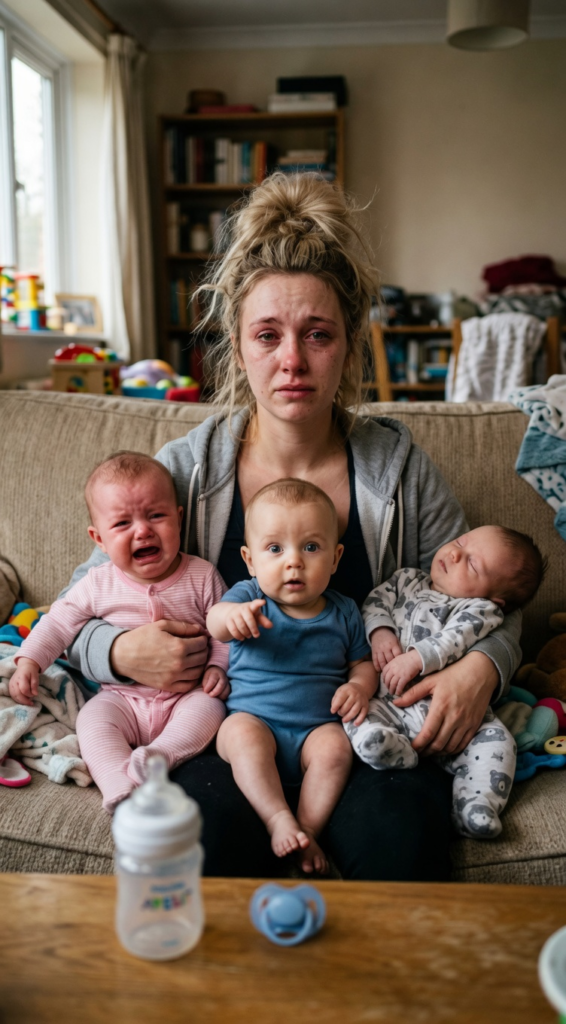
I did not become a mother by choice, by biology, or by careful planning. I became a mother because of a dark, rainy Tuesday, a social worker with tired eyes, and a single, overstuffed brown suitcase.
It was fifteen years ago. The earth over my sister-in-law Evelyn’s grave hadn’t even settled yet. Her death had been sudden, a cruel twist of fate that ripped the foundation out from under my brother, Arthur. At the funeral, Arthur had looked like a hollowed-out shell. He didn’t cry. He didn’t speak. He just stared at the mahogany casket as if he were trying to memorize the wood grain. I had held his hand, offering him my home, my time, anything he needed. He had simply nodded, kissed my cheek, and walked away into the rain.
Three days later, the doorbell rang.
I opened it to find a woman from Child Protective Services standing on my porch. Flanking her were three little girls, clutching each other like survivors of a shipwreck.
Chloe was eight. Maya was five. Lily was barely three.
“Ms. Eleanor?” the social worker asked, her voice carrying a heavy, practiced sympathy. “We’ve been trying to reach your brother for forty-eight hours. He’s gone. He left the girls with a neighbor and never returned. You are listed as his emergency contact.”
The world tilted on its axis. Gone? Arthur wouldn’t just leave. He was a devoted father. He was grieving, yes, but he loved these girls more than his own life.
“There must be a mistake,” I stammered, ushering them inside out of the cold.
But there was no mistake. That first night, my quiet, orderly house transformed into a purgatory of grief. The silence was deafening, broken only by the sounds of shattered childhoods. Lily, holding a worn-out stuffed rabbit, kept tugging at my shirt, asking with wide, innocent eyes when her mommy and daddy were coming to pick her up. I had to swallow the lump of razor blades in my throat to tell her they were delayed.
Maya cried for a solid week. It wasn’t a loud, throwing-tantrums kind of cry; it was a silent, hyperventilating weep that shook her tiny shoulders until she passed out from exhaustion. Then, one morning, she just stopped. She stopped crying, and she stopped talking about her parents entirely.
Chloe, the oldest, took a different route. She dragged that single, overfilled brown suitcase into the spare bedroom and sat on it. For a month, she refused to unpack. She wore wrinkled clothes, digging them out of the zippered compartments each morning.
“If I put them in the closet,” she told me one night, her eight-year-old voice chillingly flat, “it means we live here now. And we don’t. Dad is coming back.”
I kept telling myself the exact same thing. Arthur had to come back. People simply do not walk away from their own flesh and blood. I filed missing persons reports. I called every hospital, every friend, every distant relative. Nothing. He had vanished into thin air.
On the thirtieth day, I finally convinced Chloe to let me wash the clothes at the very bottom of the suitcase. As I pulled out a heavy winter coat, a small, folded piece of paper fluttered to the hardwood floor.
My heart hammered against my ribs as I picked it up. It was Arthur’s messy handwriting.
I unfolded it, my hands shaking violently, hoping for an explanation, an apology, a map of where to find him. Instead, what I read made my blood run entirely cold.
Eleanor. Do not look for me. If you love them, you will let me stay dead.
Weeks bled into months, and months dissolved into years.
Eventually, the agonizing act of waiting simply eroded. You cannot hold your breath forever; eventually, you have to exhale and keep living. So, I stopped waiting for the ghost of my brother to walk through the front door, and I became exactly what those three abandoned girls needed.
I traded my quiet, independent life for the beautiful, chaotic mess of motherhood. I learned to braid hair, a skill I was spectacularly bad at until Chloe patiently taught me. I packed thousands of lunches, forged signatures on permission slips because the school forms still asked for “Father’s Name,” and stayed awake through countless midnight fevers.
I learned the intricate, delicate maps of their hearts. I learned that Lily needed her eggs scrambled soft and couldn’t sleep without a nightlight until she was twelve. I learned that Maya processed pain through anger, slamming doors when she was actually desperate for a hug. I learned that Chloe, fiercely protective and overly analytical, needed to be reminded that she was a child, not a third parent.
Somewhere along that jagged, exhausting, beautiful journey, a quiet shift happened. They stopped being my brother’s abandoned daughters.
They became mine.
I was the one who cheered the loudest when Chloe graduated high school with honors. I was the one who held Maya while she sobbed over her first shattered heartbreak, wiping mascara off her cheeks. I was the one who taught Lily how to drive, gripping the dashboard in sheer terror.
We built a life over the crater Arthur had left behind. We went to therapy. We yelled, we cried, we laughed until our stomachs hurt. We survived.
Fifteen years passed. Chloe was now twenty-three, working in marketing. Maya was twenty, navigating college with a fierce independence. Lily was eighteen, in her senior year of high school, full of bright, untainted optimism.
It was a Tuesday evening in late autumn. The house smelled of roasting chicken and garlic. Maya was sitting at the kitchen island with her laptop, complaining about a sociology professor, while Lily was scrolling through her phone on the couch. Chloe was expected over for dinner any minute.
It was a perfectly normal, beautifully mundane evening. The kind of evening I had fought tooth and nail to give them.
Then, there was a knock at the front door.
It was a strange, hesitant sound. Not the energetic pounding of Chloe arriving, nor the quick tap of a delivery driver. It was a knock that sounded like it was afraid to be heard.
“I’ll get it!” Lily yelled, tossing her phone aside and bouncing up from the couch.
“No, sit down, I’ve got it,” I said, wiping my hands on a dish towel. A strange, primal knot tightened in my stomach. Call it a mother’s intuition, or perhaps the lingering trauma of the past, but something in the air felt suddenly heavy.
I walked to the front door, the hardwood floor creaking familiarly beneath my feet. I reached out, unlocked the deadbolt, and pulled the door open.
The porch light flickered, casting long, dramatic shadows.
A man stood on my welcome mat. He wore a heavy wool coat, his shoulders stooped, his hair entirely gray. His face was lined with deep, rugged valleys of exhaustion, worn down in a way that the mere passage of time cannot explain.
I stopped breathing. The dish towel slipped from my fingers, hitting the floor with a soft thud.
It was Arthur.
Before my brain could even process the reality of his face, a voice called out from behind me.
“Aunt El? Who is it?” Maya asked, her footsteps approaching the hallway.
Arthur’s eyes, filled with a terrifying mix of fear and desperate longing, darted from my face to the hallway behind me. He was about to see the daughter he abandoned fifteen years ago.
I moved with a speed I didn’t know I possessed. I stepped out onto the porch and pulled the heavy oak door firmly shut behind me, the lock clicking into place.
The cold autumn wind whipped around us, but I couldn’t feel it. I was burning from the inside out.
“Don’t,” I hissed, my voice trembling with a rage that had been fermenting for a decade and a half. “Do not let them see you.”
Arthur stood frozen. He looked at me like a man standing before a firing squad, unsure of when the bullets would hit. He looked older than his fifty-five years. He looked like a man who had walked through hell and barely crawled out the other side.
“Hi, Eleanor,” he whispered, his voice raspy, broken.
Fifteen years. Five thousand, four hundred and seventy-five days of agonizing silence, of picking up the shattered pieces of his children’s hearts, and that was what he brought me? Hi, Eleanor.
“You don’t get to say that,” I spat, stepping closer, wanting to hit him, wanting to scream until the police were called. “You don’t get to stand on my porch and say my name like you just went out for milk and got stuck in traffic. You are a ghost. Ghosts don’t get to say hello.”
Arthur didn’t flinch. He didn’t offer a defense. He simply nodded, absorbing my hatred as if he believed he deserved every ounce of it.
“I know,” he said softly. “I know I don’t have the right.”
“Then why are you here?” My voice cracked. “Why now? They are finally whole, Arthur. They are happy. Do you have any idea what it took to get them here? Do you know how many nights Maya cried for you? Do you know Chloe refused to unpack her bags for a month?”
Pain flashed across his gray eyes, a raw, visceral agony. He reached into the inner pocket of his heavy coat. For a terrifying second, I didn’t know what he was going to pull out.
His trembling hand produced a thick, sealed manila envelope. It looked heavy, official.
He held it out to me.
“Not in front of them,” Arthur said, his voice pleading, gesturing toward the closed door. “Just… read it. Please, El. That’s all I ask. If you tell me to walk away into the dark after you read it, I swear to God, I will never bother you or them again.”
I stared at the envelope as if it were a bomb. My hands shook as I reached out and took it from him.
“Stay right there,” I commanded, stepping back under the glow of the porch light.
I tore the thick paper open. Inside was a handwritten letter, clipped to a massive stack of legal and financial documents.
My eyes fell on the date at the top of the handwritten letter. It wasn’t written today. It was dated fifteen years ago. The exact day he disappeared.
Eleanor, the letter began, the ink slightly faded but the handwriting undeniably his.
If you are reading this, it means I survived. It means I fixed it.
I frowned, my eyes darting across the page, the wind howling around us. The letter explained the things he had taken to his supposed grave. After Evelyn’s sudden illness and death, Arthur’s life hadn’t just collapsed emotionally; it had collapsed financially, in the most dangerous way possible. He had borrowed money to pay for experimental treatments for Evelyn—money from people who did not operate within the bounds of the law.
When she died, the debt came due. The interest compounded. The threats began. Not just threats to break his legs, but threats involving three little girls with bright eyes and pigtails.
I was drowning, El, the letter read. They were going to take the house. They were going to hurt the girls. I couldn’t protect them. I was a failure as a husband, and a failure as a father. I realized the only way to keep them safe was to remove the target from their backs. Me. I had to become a ghost, draw the fire away, and leave them with the only person in the world who was strong enough to shield them. You.
I stopped reading, my lungs screaming for air. I looked up at the man shivering on my porch.
“Is this true?” I whispered. “Dangerous people?”
Arthur nodded, staring at his worn shoes. “It took me three years working off the grid in Alaska to pay off the principal and the interest to get those people off my back. But by then… I had been gone too long. How could I come back empty-handed? How could I look at them after abandoning them to save my own skin?”
I flipped to the legal documents attached behind the letter. They were recent. Stamped with official bank seals and legal insignias.
They were trust funds. Deeds to properties. Stock portfolios.
Everything cleared. Everything rebuilt from absolute scratch. He had spent the last twelve years working himself to the bone, living like a pauper, to amass a fortune.
And all of it, every single cent, was legally transferred and irrevocable.
In the names of Chloe, Maya, and Lily.
“I fixed it,” Arthur whispered into the cold night. “I secured their future. They’ll never have to worry. Not about college, not about houses, not about medical bills. I bought back what I stole from them.”
I stared at the millions of dollars represented on the paper in my hands, and a horrifying realization washed over me. He really thought this was redemption.
“You fool,” I breathed.
Before Arthur could respond, the front door behind me clicked, the hinges groaning as it swung open.
“Aunt El, seriously, the chicken is going to burn—”
Maya stepped out onto the porch, a spatula in her hand. Her words died in her throat.
She looked at me, pale and shaking, holding a stack of papers. Then, her eyes shifted to the old, gray-haired man standing on the welcome mat.
Maya froze. Her eyes widened. She had been five when he left, but the subconscious memory of a father’s face is a hard thing to erase.
“Who…” Maya whispered, the spatula dropping from her hand. “Who are you?”
The silence on the porch was so profound I could hear the leaves scraping across the concrete driveway.
Arthur looked at Maya. His jaw trembled. I watched fifteen years of agonizing absence flash through his eyes—the birthdays he missed, the first steps, the graduations, all culminating in this agonizing moment where his own flesh and blood looked at him like a stranger.
“Maya,” Arthur choked out, the name sounding foreign on his tongue.
Maya took a step backward, bumping into the doorframe. The color completely drained from her face. “No,” she whispered, shaking her head. “No. Aunt El, tell me that’s not him. Tell me.”
By now, the commotion had drawn the others. Lily appeared in the hallway behind Maya, peering over her sister’s shoulder, confusion painting her young features. A moment later, tires crunched in the driveway. Chloe’s car pulled up. She parked, stepped out in her professional work attire, and stopped dead in her tracks when she saw the tableau on the porch.
There was no hiding this. There was no soft version, no protective shield I could throw over them anymore. The ghost had materialized, and he brought a hurricane with him.
“Girls,” I said, my voice remarkably steady despite the earthquake in my chest. “Let’s go inside. All of us.”
I looked at Arthur. “You too. You don’t get to drop a bomb and run away this time.”
We moved into the living room. The warm smell of roasted chicken felt nauseatingly out of place. Arthur stood awkwardly near the fireplace, refusing to sit, keeping his hands stuffed deep in his pockets. He looked like a prisoner awaiting his sentence.
Chloe, Maya, and Lily stood shoulder-to-shoulder on the opposite side of the room. A united front. My girls.
“Who is he?” Lily asked, her voice small. She had no memory of him at all. To her, Arthur was just a mythological villain from a story I had tried my best to soften over the years.
“Lily, Maya, Chloe,” I began, taking a deep breath. I held up the manila envelope. “This is your father. Arthur.”
Chloe’s analytical mind processed the information first. Her eyes narrowed into dangerous slits. She dropped her purse on the floor. “Why is he here?”
I didn’t sugarcoat it. I couldn’t. I opened the envelope and placed the documents on the coffee table between them.
“He came to give you this,” I said. “He left fifteen years ago because he was in massive, dangerous debt. He claims he left to protect us from the people he owed. He spent the last decade and a half paying it off and building a fortune. These documents… they are trust funds. Millions of dollars. Everything he built, he put in your names.”
I looked at Arthur. “He thinks he fixed it.”
Arthur flinched at my wording, but he didn’t argue. He kept his eyes glued to the floor.
Maya stepped forward, her hands balled into tight fists. She didn’t look at the papers on the table. She didn’t even glance at them. She marched right up to Arthur, stopping mere inches from his chest.
“You think money fixes it?” Maya hissed, her voice vibrating with a rage so pure it made the air crackle. “You think you can buy your way out of abandoning us?”
“Maya, please, I—” Arthur started.
“Shut up!” Maya screamed, the sound tearing from her throat. “Do not speak! You don’t get to speak! Do you know how many Father’s Day cards I made in elementary school and threw in the trash? Do you know I used to sit by the window for hours hoping your car would pull up? I didn’t want a trust fund! I wanted a dad who loved me enough to stay!”
Arthur squeezed his eyes shut. Tears leaked down his weathered cheeks. “I thought I was saving you. I thought you were better off with Eleanor.”
“You don’t get to decide that!” Chloe’s voice cut through the room like a surgical scalpel. She stepped forward, standing beside Maya. “You didn’t leave to protect us. That’s a convenient lie you told yourself so you could sleep at night. You left because you were a coward. Because it was easier to run away and work in isolation than to look your daughters in the eyes and admit you failed.”
Arthur took the verbal blows like a man tied to a whipping post. “You’re right,” he whispered. “You are completely right. There is no excuse. There is no version of this story where I am the good guy. I am a coward.”
His complete lack of defense somehow made the anger in the room spike. When someone fights back, you have a target. When they surrender, the rage has nowhere to go.
“Then why come back?” Chloe demanded, her voice shaking with unshed tears. “If you know you’re a coward, why show up and ruin our peace? You handed over the money. Great. Thank you. Now leave. Go back to being dead.”
Arthur looked at Chloe, his oldest. The one who remembered him the most. The one who sat on the suitcase.
“Because,” Arthur said, his voice dropping to a desperate, broken whisper, “the money was just the excuse I needed to finally have the courage to knock on the door. I don’t want forgiveness. I know I don’t deserve it. But I couldn’t die without seeing your faces one last time.”
Lily, who had been completely silent the entire time, finally stepped out from behind her sisters. She looked at the man who was technically her father, her eyes wide and conflicted.
“Are you…” Lily hesitated, her voice trembling. “Are you going to leave again?”
The room held its collective breath.
Lily’s question hung in the air, a fragile, terrifying thing. It was the question that had defined our entire existence for fifteen years. Will he leave again? It was the fear that made Maya push people away, the fear that made Chloe over-plan every detail of her life, the fear that made Lily cling to me.
Arthur looked at his youngest daughter. He looked at the girl who had been a toddler with a stuffed rabbit when he last saw her, now a beautiful young woman on the verge of adulthood.
He slowly lowered himself, his knees popping, until he was sitting on the edge of the coffee table, putting himself physically lower than them. A posture of absolute submission.
“I will do whatever you want me to do,” Arthur said, looking directly into Lily’s eyes. “If you tell me to walk out that door right now, I will walk. I will get in my car, I will drive away, and you will never see my face again. I will not fight you. I will not harass you. You have my absolute word.”
He paused, his chest heaving with suppressed emotion.
“But,” he continued, his voice thick with tears, “if you are asking what I want to do? I want to stay. I want to sit on the porch across the street just to watch you guys leave for work. I want to know what your favorite books are. I want to spend the rest of my miserable life trying to earn a fraction of a percentage of the space I gave up. I am not asking to be your father. Eleanor is your mother, your father, your everything. I am just asking… to exist in the same world as you.”
Silence descended again. It wasn’t the chaotic, angry silence of betrayal; it was the heavy, contemplative silence of a jury weighing a verdict.
I stood by the kitchen doorway, my heart aching. I wanted to protect them. I wanted to grab Arthur by the collar and throw him onto the lawn. But I knew, looking at my girls, that this was no longer my battle to fight. I had raised them to be strong, independent, and capable of making their own choices.
This was their choice.
Maya crossed her arms tightly over her chest, looking away, her jaw clenched so hard I thought her teeth might crack. “You missed everything,” she muttered bitterly. “You missed my prom. You missed Chloe’s graduation. You missed Mom’s death anniversary every single year.”
“I know,” Arthur said. “I carry that every day.”
Chloe picked up one of the trust fund documents from the table. She looked at the staggering numbers printed on the page, then dropped it back down with disdain. “We don’t need your money, Arthur. Aunt El gave us everything we needed.”
Arthur looked at me, a deep, profound gratitude in his eyes. “I know she did. Thank God she did.”
“So why should we let you stay?” Chloe challenged, her eyes blazing. “Give me one logical, rational reason why we shouldn’t throw you out right now.”
Arthur looked down at his hands—rough, calloused, scarred from fifteen years of manual labor and penance.
“I don’t have a logical reason, Chloe,” Arthur admitted quietly. “Logically, you should throw me out. Logically, I am a terrible investment of your time and emotions. The only reason I can give you is selfish. It’s because I am broken, and you three are the only pieces of my heart that still exist in this world. And I am begging for mercy.”
It was the rawest, most stripped-down confession I had ever heard. There was no manipulation, no gaslighting, no attempting to turn himself into a tragic hero. He was a flawed, shattered man, laying his neck on the chopping block and handing them the axe.
Maya let out a frustrated, angry sound, running her hands through her hair. She turned her back on him, staring out the window into the dark yard. Chloe stared at the wall, her analytical mind short-circuiting in the face of raw emotion.
It was Lily who broke the stalemate.
She looked at the paperwork on the table. She looked at Maya’s shaking shoulders. She looked at Chloe’s conflicted face. Then, she looked at me, silently asking for permission.
I gave her a tiny, imperceptible nod. You decide.
Lily turned back to Arthur.
“The chicken is going to burn,” Lily said quietly.
Arthur blinked, confused. “What?”
“In the oven,” Lily said, her voice steadying. “Aunt El was making roasted chicken. It’s going to burn if we just stand here yelling.”
She looked at her sisters. Maya turned around, wiping a stray tear from her cheek, rolling her eyes in classic Maya fashion, but she didn’t argue. Chloe let out a long, exhausted sigh, the tension draining from her rigid posture.
Lily looked back at Arthur.
“We usually eat at seven,” she said, her tone cautious, protective, but not entirely closed off. “We should probably go make dinner.”
It wasn’t a movie ending.
There was no sudden, tearful embrace. There was no swelling orchestral music. Arthur didn’t pull them into a hug, and they didn’t magically call him “Dad.”
What happened was infinitely more real, and infinitely more awkward.
Arthur slowly stood up from the coffee table. He looked like he was afraid to breathe too loudly, afraid that any sudden movement would break the fragile, microscopic thread of grace Lily had just extended.
“Can I… can I help?” Arthur asked hesitantly.
“You can set the table,” Maya snapped, her voice still sharp, but she pointed toward the cabinet where the plates were kept. “Five plates. Aunt El sits at the head.”
Arthur nodded rapidly, a flicker of desperate relief washing over his face. “Five plates. Got it. Aunt El at the head.”
I watched them migrate toward the kitchen. The dynamic was completely foreign, like watching a new species try to integrate into an established ecosystem. Chloe immediately took charge of the vegetables, avoiding eye contact with Arthur. Maya aggressively chopped a salad, her anger still simmering just beneath the surface. Lily hovered near the oven, occasionally stealing glances at the gray-haired man carefully placing forks on napkins.
I needed a moment. The adrenaline was leaving my body, leaving me weak and trembling.
I stepped backward, slipping through the front door and out onto the porch. The crisp autumn air hit my face, shocking my system back to reality. I leaned against the wooden railing, staring up at the moon, trying to process the magnitude of the last hour.
A fortune on the coffee table. A ghost in my kitchen. My girls, navigating a minefield of trauma with a grace that took my breath away.
A few minutes later, the door creaked open.
Arthur stepped out onto the porch. He didn’t come close. He stood near the door, leaning against the brick wall, respecting the boundary between us.
We stood in silence for a long time, listening to the muffled sounds of the girls talking in the kitchen.
“Thank you,” Arthur finally said, his voice barely carrying over the wind.
I didn’t look at him. “Don’t thank me. Thank them. They have bigger hearts than you or I.”
“I know,” he said softly. “They are incredible, Eleanor. You did… you did an impossible job. You saved my world.”
I finally turned to look at him. The anger in my chest hadn’t vanished. It wouldn’t vanish for a very long time, maybe never entirely. But beneath the anger, there was a profound, exhaustion-laced understanding. We were both just damaged people trying to do our best in a brutal world. His best had been cowardly. Mine had been sacrificial. But the result was the three beautiful women in the kitchen.
“You are not off the hook, Arthur,” I said, my voice hard, unwavering.
“I don’t expect to be.”
“They are going to have a million questions. They are going to be angry. Maya is going to test you, Chloe is going to interrogate you, and Lily is going to watch your every move to see if you pack your bags.”
“I’m ready,” Arthur said. And for the first time, he didn’t look defeated. He looked resolute. He looked like a man who had finally found the battle he was meant to fight.
“If you hurt them again,” I warned, stepping closer, “I won’t need a social worker to make you disappear. I will do it myself.”
Arthur actually offered a small, broken smile. “I believe you, El.”
The front door opened slightly, and Lily poked her head out.
“Aunt El? Dinner’s ready,” she called out. She looked at Arthur. “You coming?”
Arthur swallowed hard, his eyes shining. “Yeah. I’m coming.”
I walked back inside, Arthur following a few steps behind.
As we sat down around the dining table—me at the head, the girls flanking the sides, and Arthur sitting awkwardly at the far end—I looked at the faces of the children I had raised.
This was not closure. Closure is a myth invented by storytellers to make endings feel neat and tidy. Life is not neat. It is messy, and chaotic, and full of jagged edges that cut you when you least expect it.
Arthur’s return didn’t magically erase the fifteen years of pain, and his millions of dollars wouldn’t buy back the memories he missed. Forgiveness, if it ever came, would be a grueling, uphill marathon, not a sudden sprint.
But as Arthur tentatively reached out to pass the bowl of potatoes to Maya, and Maya—after a tense, agonizing second—actually reached out and took it, I realized something important.
This wasn’t an ending at all.
For the first time in fifteen years, the deafening silence in our family was finally gone. The ghost was flesh and blood again. The suitcase was finally unpacked.
It was just a beginning. And for tonight, sitting around a table filled with the scars of the past and the terrifying hope of the future… somehow, that was enough.