Maren Calloway had a way of listening to the diner before she ever stepped inside. At that early hour, the place spoke in small, tired sounds: the old neon sign buzzing like it was done pretending to shine, the coffee machine coughing into life, the refrigerator humming with the patience of something that never got to sleep. The air carried its usual layers—decades of grease and never-ending coffee—like the room refused to let anyone drift off.
She tied her apron and looked over the empty booths. The vinyl seats were cracked in the same places they had been since she was a teenager. The checkerboard floor still wore stains older than some marriages.
At twenty-six, Maren felt older than she should—the kind of tired that comes from holding onto a dream too long.
Back home, an envelope waited on the counter beneath a lighthouse magnet. It had been there for three days. Maybe an acceptance. Maybe a rejection. She hadn’t opened it. Hope felt costly, and rent was already late.
Near the radiator, a glass jar held her savings—wrinkled bills, coins, long shifts turned into loose change. A couple hundred dollars. A small pile that still felt impossibly far from tuition.
Her mother, Gloria, slept most mornings now. Once, she wore crisp scrubs and came home smelling like antiseptic and mint gum. Now she needed medicine, quiet, and careful days. Maren’s world had narrowed to work, bills, and whatever strength was left in between.
That morning, she wiped the same table twice.
Rain tapped the windows. The neon sign painted the wet pavement pink, flickering like it wasn’t sure it could keep pretending.
At 4:17 a.m., the bell rang.
A man stepped in, looking like he’d been riding through storms without ever arriving.
He paused just inside, letting the warmth reach him.
His leather jacket hung loose, like it belonged to a better-rested version of himself. His hair was wet, his boots leaving small puddles behind him as he sat at the counter.
Maren recognized that kind of exhaustion—the quiet kind that doesn’t ask for attention.
He stared at the menu without reading.
“Just coffee,” he said.
She poured it. Steam curled upward.
He reached into his pocket, pulling out coins. He counted once. Then again. His jaw tightened. A third time, slower.
“Thirty cents short,” he muttered.
Maren glanced at his hands—scarred, worn, the hands of someone who fixed things because he had no other option.
She thought about her jar.
About hunger.
Without making it a moment, she opened the register and slid a couple coins toward him, close enough to blend into his pile. Then she set down a slice of apple pie.
“You’re fine,” she said lightly. “Coffee’s hot, and the pie shouldn’t be lonely.”
He looked up, surprised—like he hadn’t expected to be seen.
“I didn’t ask,” he said.
“I know,” she replied. “That’s why it’s easier.”
He studied the coins, the pie, then her.
“Thank you,” he said quietly, the words carrying more weight than thirty cents.
He ate slowly, like he wasn’t sure it would last.
Before leaving, he hesitated.
“You didn’t have to do that.”
Maren shrugged. “Sometimes people do.”
He nodded once.
“My name’s Cole,” he said. “If the world ever pays you back, I hope it does it loud.”
Then he left, stepping back into the rain.
Maren told herself it was just another morning.
She had no idea it was the start of everything.
By 7:30, the diner was alive.
Truckers tracked mud inside. Commuters filled booths. Orders flew across the kitchen.
Maren moved fast, efficient, invisible.
Then Brent Kline walked in.
He carried his clipboard like authority.
At the register, he scanned receipts. Maren’s stomach sank.
He lifted one slip.
“Maren.”
She stepped over. “Yes?”
He tapped the paper.
“Explain this. Coffee and pie—no full payment.”
Heat climbed her neck.
“He was short,” she said. “I covered it.”
“With what?”
“My own money.”
Brent gave a humorless laugh.
“That’s not the point. You don’t give things away. This is a business.”
“It was thirty cents,” she said. “The pie would’ve been thrown out.”
His face hardened.
“Rules exist for a reason. Take off your apron.”
Maren blinked. “You’re firing me for feeding someone?”
“I’m letting you go for violating policy.”
She untied her apron slowly.
Two years—gone over a receipt.
“Clean out your locker,” he said, already moving on.
Maren walked out with empty hands.
At home, the envelope still waited.
“Baby? You home?” Gloria called.
“Yeah, Mama,” Maren said, forcing a smile.
“How was work?”
“It was fine,” she lied.
Later, she counted her savings again.
Still the same.
Still not enough.
Evening came quietly. Maren sat on the porch, trying to think of how to tell her mother.
She thought about Cole.
Wondered if he was warm.
Then the ground began to hum.
At first, faint.
Then louder.
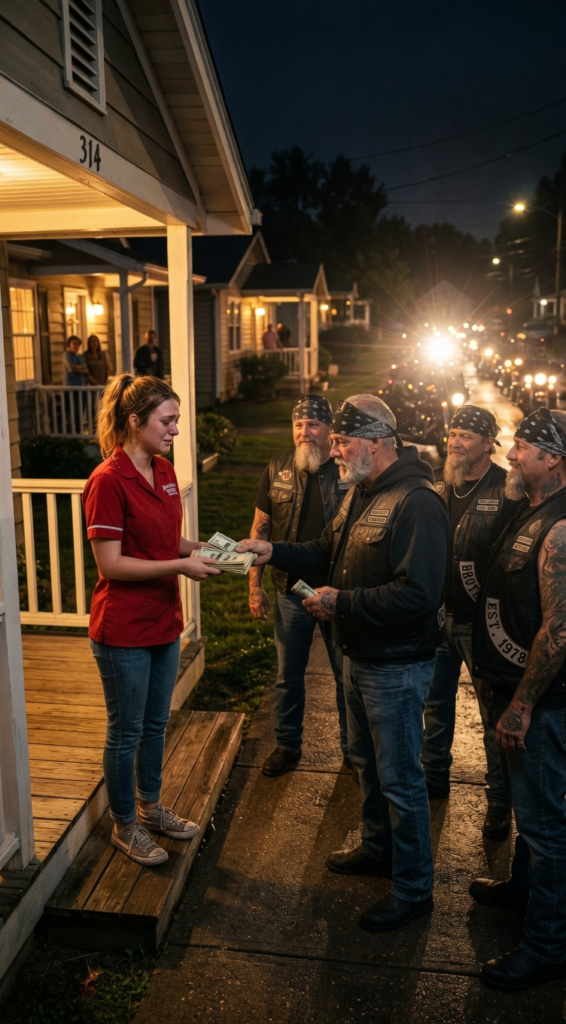
Headlights appeared—one, then many.
Motorcycles. Dozens. Then more.
Engines rolled down the street like distant thunder growing closer.
They stopped in front of her house.
The first rider stepped off.
“Ma’am,” he said. “Are you Maren Calloway?”
“Yes.”
“My name’s Wyatt Rourke. My brother stopped at your diner this morning.”
“Cole?” she whispered.
Wyatt nodded.
“He told us what you did.”
Behind him, riders stepped forward—one with groceries, another with an envelope.
“He also said you lost your job for it,” Wyatt added.
“It was my choice,” Maren said. “I didn’t expect anything back.”
“That’s why we’re here,” Wyatt replied. “You shouldn’t be punished for doing what’s right.”
They began placing things on her porch—cash, envelopes, small jars of coins.
“This is too much,” she whispered.
“It’s not,” Wyatt said. “It’s people doing their part.”
Her eyes filled.
“I don’t even know you.”
“You knew my brother was hungry.”
A rider added, “He said you treated him like he mattered.”
Wyatt nodded toward the envelope on the rail.
“Open it.”
Her hands shook as she tore it open.
She read.
Accepted.
A broken laugh escaped her. “I got in.”
The riders exchanged quiet smiles.
“I can’t afford it,” she said.
“Count later,” Wyatt told her. “Tonight, breathe.”
From inside, Gloria called, “What’s that noise?”
“Mama—come out.”
Gloria stepped outside, stunned by the sight.
“These are… friends,” Maren said.
“Ma’am,” Wyatt said gently, “your daughter did something kind. We just made sure the world answered properly.”
“I got in,” Maren told her mother, tears falling.
Gloria broke down. “Oh, baby…”
Wyatt spoke again.
“Cole said, ‘Tell her I’m still here because she didn’t let me disappear over thirty cents.’”
Maren closed her eyes.
The air smelled like rain—and something new.
The riders left as quietly as they came.
The street went still again.
But not the same still.
Maren stood there, holding her letter, her mother beside her, hope finally feeling real.
Inside, she placed the acceptance letter next to the bills.
For the first time, it didn’t feel impossible.
It felt like a beginning.
A NOTE FOR ANYONE STILL HOLDING ON
If you’re tired of doing the right thing in a world that rewards noise over kindness, remember this: your goodness isn’t wasted just because it hasn’t come back yet.
If you’ve ever counted coins and felt your dignity shrink beside your hunger, know that your worth is not measured in money.
If compassion has cost you something, understand that not all rules protect people—and you’re allowed to outgrow the ones that don’t.
If your dream feels too heavy, remember that persistence is often quiet—one shift, one step, one choice at a time.
If you’re afraid to open the door in front of you, know that fear often stands closest to change.
If you feel alone, remember that family can be chosen—and sometimes arrives when you least expect it.
If you’ve ever wondered whether your kindness mattered, trust that it travels farther than you can see.
If you’re caring for someone and feel exhausted, know that love still counts, even when it’s hard.
If life has taught you to expect less, consider that hope is not foolish—it’s strength.
And if you think, “That could never happen to me,” remember this:
Change often begins with something small.
Sometimes, just thirty cents.