My fiancé’s last mistake was kissing my forehead like a man trying to seal a lie into my skin.
I know that sounds dramatic, but betrayal has a way of changing the meaning of every ordinary gesture after the fact. A soft hand on your back becomes a redirection. A sweet smile becomes a mask. A question about your plans becomes a check-in on his own alibi. And a forehead kiss, the kind I used to think was tender, becomes a stamp of innocence from a man who already knows he is guilty.
The week before our wedding, Marcus Hale kept kissing my forehead.
Not once or twice. Constantly.
I would come into the kitchen with a folder full of vendor invoices pressed under my arm, and there he would be, leaning against the counter with his laptop open, looking up at me like I had just walked into a commercial for domestic happiness. He would smile that soft little smile and ask if I was excited. He would touch my elbow and ask if I had packed for the resort. He would come up behind me while I was checking the seating chart and press his lips to my hairline, then say something like, “We’re almost there, Claire.”
We’re almost there.
Like that sentence paid invoices.
Like it solved the argument with the florist, the missing RSVP from his uncle in Virginia, the final venue balance, the seating conflict between my divorced cousins, and the fact that my mother believed stress was simply a sign I had failed to organize properly.
I was thirty-one years old, living in Raleigh, North Carolina, working full-time as a project coordinator for a medical supply company, and I was tired in the specific way women get tired when they are expected to be calm, grateful, thin, organized, financially responsible, emotionally available, and still somehow glowing. My wedding was seven days away. My closet looked like a bridal emergency shelter. My car had three boxes of favors in the trunk. My phone buzzed every ten minutes with someone’s opinion about flowers, shoes, appetizers, playlists, hotel blocks, or whether eucalyptus was “too casual.”
And Marcus kept kissing my forehead.
Before that week, he had never been especially clingy. He was affectionate in private, sure, but not in a greeting-card way. Marcus was the type of man who would toss an arm around me while watching TV, kiss me quickly on his way out the door, text me a meme at lunch instead of something romantic. He was not a man who asked if I had texted my friends back with the concerned sweetness of someone auditioning for Husband of the Year.
That week, though, he became warm in a way that felt managed.
It was not love exactly. It was control wearing soft clothes.
He wanted me pointed in one direction long enough for something else to happen behind my back.
I did not know that yet. Not fully. But my body knew.
That is the part I keep coming back to now. My body knew before my pride was ready to admit it. My stomach tightened when he said certain things. My chest went cold when he answered too quickly. Something in me leaned back from his touch even as my face kept smiling, because sometimes the part of you trained to be polite is slower than the part of you built to survive.
Marcus was thirty, handsome in that loose, confident way that makes people assume a man has more money than he does. He had dark hair that never looked like he had tried too hard, a lean face, and a voice that could make excuses sound like strategy. He called himself a freelance brand strategist, which sounded impressive when we first met and increasingly suspicious as the months passed. He was always between projects. Always waiting on a client payment. Always about to lock something in. Always building momentum. He spoke about his career like a plane that was permanently taxiing and never quite taking off.
For most of the year before the wedding, I had been carrying more than my share.
More rent. More groceries. More utilities. More deposits.
I did it because I loved him. I did it because I told myself partnership meant sometimes one person was steadier for a while. I did it because I had grown up watching my father work long hours when my mother went back to school, then my mother do the same when my father’s company downsized. Marriage, in my mind, meant taking turns being strong.
Yes, I know.
Believe me, I know.
I have already had that argument with myself in at least twelve showers, three grocery store parking lots, one Target aisle, and during an entire oil change where the mechanic asked if I was okay because apparently silent tears while holding a coupon are not subtle.
My friends had planned a bachelorette weekend at a countryside resort two hours from Raleigh, out near the foothills, the kind of place that advertised itself with fireplaces, hiking trails, spa robes, and women laughing at salad in matching pajamas. The wedding was the following Saturday. This was supposed to be my final girls’ weekend before becoming Mrs. Claire Hale, a name I had practiced writing exactly once before feeling embarrassed even though I was alone.
The trip should have been easy to look forward to. My best friend Lauren had planned most of it, with help from Priya, Hannah, and my cousin Jess. There would be wine, a spa appointment I had not wanted to pay for but secretly needed, a ridiculous bride sash, one hike everyone would complain about, and a dinner where people said emotional things after two drinks and then pretended not to remember in the morning.
I almost canceled twice.
Not because I did not love them. I did. Those women had held me through layoffs, bad hair decisions, my father’s surgery, a year of panic attacks I called “being busy,” and the early Marcus days when he brought me flowers and made me feel chosen in a way I had been hungry for without admitting it.
But something about leaving Marcus alone that weekend sat wrong in my chest.
He had decided not to have a bachelor party, which sounded mature on paper. Responsible. Above nonsense. His explanation was that he needed the weekend to work and make up for the time he would take off during the wedding week.
“I’m not twenty-five anymore,” he told me, standing in the kitchen with his coffee. “I don’t need some dumb night out with guys acting like fools. I’d rather use the weekend to get ahead so I can actually be present for the wedding.”
Very adult.
Very responsible.
Very fake.
The weirdness had started in small ways. He stopped answering video calls unless I texted first. When I asked what he had eaten for lunch, he gave vague answers.
“Just grabbed something.”
“Nothing exciting.”
“I’m slammed.”
Marcus used to complain about overpriced sandwiches, send me pictures of weird coffee shop wall art, or call me from the car just to talk for five minutes. Suddenly his days became foggy. If I asked a follow-up, he would sound affectionate but slightly rushed, like I was adorable for caring and inconvenient for noticing.
He also kept bringing up the resort.
“You have to go, Claire.”
“Your friends worked hard on this.”
“Don’t cancel just because wedding stuff is stressful.”
“You deserve to enjoy yourself.”
Then, one night, he said the line that lodged in me like a splinter.
“Don’t make it weird by staying home.”
Don’t make it weird.
Why would it be weird for a bride to stay home the week before her wedding unless someone really needed her gone?
On Thursday night, the evening before I was supposed to leave, I stood in our bedroom trying to zip a duffel bag that did not need to be as heavy as it was. I had packed three outfits for two days because bachelorette weekends require women to prepare for several emotional climates: cute brunch, casual hike, fake-relaxed dinner, emergency crying in bathroom, and one backup dress in case everybody else looked hotter than expected.
Marcus came up behind me while I was kneeling on the floor, sat on the edge of the bed, and watched me fight with the zipper.
“You’re bringing half the closet.”
“I’m preparing for weather, photos, and regret.”
He laughed, but the laugh was a touch too loud.
Then he leaned forward, wrapped his arms around my waist from behind, and rested his chin on my shoulder.
The gesture should have comforted me. Instead, my whole body stiffened before I could stop it.
“I want you to have fun,” he said. “Stop worrying about me.”
It would have been cute if it did not sound exactly like a man auditioning for a jury.
I forced a laugh. “I’m not worrying.”
“Good,” he said, too fast.
Then he kissed my cheek like we had landed something important.
I looked at us in the dresser mirror: me in leggings and an oversized shirt, hair clipped messily, eyes tired; Marcus behind me, handsome and gentle-looking, arms around me; our wedding clothes hanging in garment bags on the closet door. From the outside, we looked like a couple on the edge of a happy life.
Inside my own body, something was knocking softly from the basement.
On Friday morning, my friends filled the group chat with voice notes while I drove toward the resort. Hannah complained that she had forgotten mascara. Priya sent a video of herself wearing the bride squad sash she had sworn she would not wear in public. Lauren sent a photo of the resort sign with the caption: If there is no hot tub, we riot.
I laughed when I heard it, but I kept staring at the highway like maybe my body knew something my brain was refusing to sign for.
I told myself I was being unfair. I told myself stress makes everything suspicious. I told myself weddings make people weird. I told myself not every strange vibe is betrayal. Sometimes a man is just distracted. Sometimes he is anxious. Sometimes your nervous system is a rude little alarm that goes off because someone breathed too hard in another room.
Still, when I pulled into the resort parking lot and my friends ran toward me holding plastic cups of champagne, cheering like I had returned from war instead of I-40 traffic, I felt split down the middle.
Half of me smiled and let them pull me into the noise.
Half of me stayed back home, staring at our front door in my mind like it already knew more than I did.
That first night at the resort should have been easy. Fire pit. Cheap wine hidden in expensive glasses. A cheese board we all pretended counted as dinner because nobody wanted to admit we needed fries. Someone brought a question game that started sentimental and somehow turned into soft public humiliation. Everybody was warm and loud and emotional in the way women get when they are happy for you and secretly relieved it is not their turn to make decisions about napkin colors.
I laughed where I was supposed to laugh. I made the little bride speech. I let them put a ridiculous veil on me for photos. I even posted a picture of myself in front of the fire, smiling with a plastic crown tilted on my head, because sometimes you perform happiness for the record before you know the record is about to become evidence.
Marcus commented almost immediately.
Most beautiful bride in the world.
Heart emoji. Ring emoji. Fire emoji.
Hannah squealed when she saw it.
“He is so obsessed with you.”
I looked at the comment and felt nothing but a drag under my ribs, like my brain had one hand on the emergency brake.
Lauren noticed first.
She always does, and I hate that for me.
She sat beside me with a drink and bumped my shoulder.
“Why do you look like you’re about to either cry or commit tax fraud?”
“I’m just tired.”
She raised one eyebrow, deeply annoying and entirely earned.
“Wedding tired, or Claire pretending something isn’t wrong tired?”
“Wedding stress.”
“Lazy answer.”
“My mother keeps asking if eucalyptus is too casual.”
“Still not it.”
“Too many opinions about flowers.”
“All true, none of it central.”
I took a sip of wine that tasted like regret wearing a fruit costume.
“I don’t know,” I said finally. “Something feels off.”
“With Marcus?”
I shrugged, which was cowardly because of course I meant Marcus.
“Maybe I’m being unfair.”
“Maybe,” Lauren said. “Or maybe you’re not.”
I hated that she did not comfort me with certainty. That would have been easier. I wanted someone to say, “No, he loves you, you’re just stressed,” and hand me permission to ignore myself for one more week.
Lauren did not give fake permission. She had survived her own disaster at twenty-seven, a boyfriend who drained her savings and called it shared struggle, and she had come out the other side with clear eyes and a very low tolerance for men who made women feel dramatic for asking basic questions.
“Do you want to call him?” she asked.
“No.”
“Do you want me to call him?”
“Absolutely not.”
She nodded. “Then we drink water and watch everyone else embarrass themselves.”
That was love.
We stayed up too late. Saturday morning, I woke with the dry mouth, puffy face, low-grade headache combination that makes you feel like your own body has filed a complaint. I stood in the bathroom staring at myself. Mascara shadow under my eyes. Hair doing something hateful. From downstairs came the muffled sound of my friends hunting coffee like survivalists.
I should have gone down. I should have eaten toast, made jokes, taken group pictures in matching pajamas, and let the weekend carry me forward.
Instead, I sat on the edge of the tub because one stupid thought hit me so hard I almost said it out loud.
I want to go home and cook dinner with him.
Not for him. With him.
Not because cooking was my job or because I believed domestic effort could repair emotional uncertainty. I just suddenly needed to see Marcus being ordinary. I needed to watch him stand in our kitchen complaining about work, reaching for a spoon, opening the refrigerator, kissing me absently on his way past. I needed proof that my instincts were wrong.
I tried to talk myself out of it for maybe thirty minutes.
I paced around the room. I brushed my teeth twice. I opened the group chat and typed, Headed down soon, then deleted it. I told myself if I left now, I would look insane. If I drove home and found nothing, I would have to admit I had let anxiety drag me two hours across the state because Marcus kissed my forehead too much.
But the longer I ignored the feeling, the worse it got. It changed from nerves into certainty so quietly I almost missed the moment. One second I was embarrassed by my own suspicion. The next, I knew I needed to get in my car.
I went downstairs and told everyone I had a headache and wanted to pick up medicine in town.
Hannah offered to come with me.
I said no too quickly, then smiled too hard, which probably made me look exactly as normal as a raccoon in a church.
Lauren followed me outside anyway.
She leaned against my car before I could open the driver’s door.
“Something is wrong.”
Not a question. A fact.
I almost told her then. Almost said, I think my fiancé is lying to me, and I feel stupid, and I don’t know why my body is screaming.
Instead, I said, “I just need air.”
She studied me.
“Text me when you get wherever you’re going.”
“I’m going to the pharmacy.”
“Claire.”
“I’ll text you.”
She stepped aside reluctantly.
“If you need me, I’m coming.”
I nodded, got into the car, and drove away before courage could leak out of me.
The drive back to Raleigh felt longer than it should have. I kept switching between anger and embarrassment, which is a nasty combination because you feel dramatic and justified at the same time. Every few minutes, I decided I was ridiculous. Then I remembered Marcus saying, Don’t make it weird by staying home, and my stomach tightened all over again.
By the time I reached our neighborhood, my hands were cold on the wheel even though the heat was on.
Our street looked ordinary. Saturday sunlight. Kids’ bikes in driveways. A dog barking behind a fence. The neighbor across from us washing his car with headphones on. Ordinary life has terrible timing.
Then I saw the car in our driveway.
Not mine. Not his. Not anybody I knew.
A dark green sedan sat slightly crooked, right where my car usually parked when I was home. Marcus’s car was in the garage, which meant he was home, which meant his “working all day downtown” story had died before I even turned off the engine.
I pulled up half a block away and sat there with the car running.
I stared at the sedan like a reasonable explanation might float down from the sky and land on the hood.
Delivery. Friend. Neighbor. Emergency. Surprise.
Pick a lie.
Pick anything.
My heart was pounding so hard it made my throat hurt.
Instead of going inside, I called him.
He answered on the second ring, voice bright and easy.
“Hey, baby.”
I looked at the garage. I looked at the strange car.
“Hey,” I said. “Where are you?”
“At the office,” he said without even a pause.
That was the moment something inside me went cold.
Not cracked. Not shattered. Cold.
Like my body was done bargaining and had moved on without waiting for my permission.
I kept him on the phone longer than I needed to because I wanted to hear whether guilt changed his breathing.
It did not.
That was somehow the worst part. He sounded cheerful, distracted, mildly annoyed in the way people act when they are pretending to be busy and need you to support the costume.
“How’s work?” I asked.
“Brutal,” he said. “I’m drowning in edits.”
“Have you eaten?”
He laughed. “Not yet. Poor overworked me.”
My fingers hurt from gripping the steering wheel.
“Maybe I’ll come by later with food.”
He answered way too fast.
“Don’t. I’ll probably be here late, and I’m all over the place today. You should be relaxing.”
There it was again.
That little shove away from the door.
“Right,” I said. “Of course.”
“I love you,” he said.
Then, quickly, “I miss you already.”
I looked at the house we shared, at the unfamiliar car in our driveway, at the closed garage door hiding his car like a secret everyone could see.
“Love you too,” I said, and hated myself for how automatic it sounded.
When we hung up, he sent three messages in under a minute.
A heart.
A kissing face.
Miss you already.
A stranger might have cried into her coffee reading that. I was sitting outside the house while he lied to me from inside it.
I stayed in the car another minute, maybe five. Time becomes slippery when humiliation enters the room. My first impulse was to march up to the front door and force whatever was happening to look me in the face. My second was to drive straight through the garage and let insurance sort out the rest.
Instead, I did neither, which proves that even at my messiest, some shred of self-preservation survived.
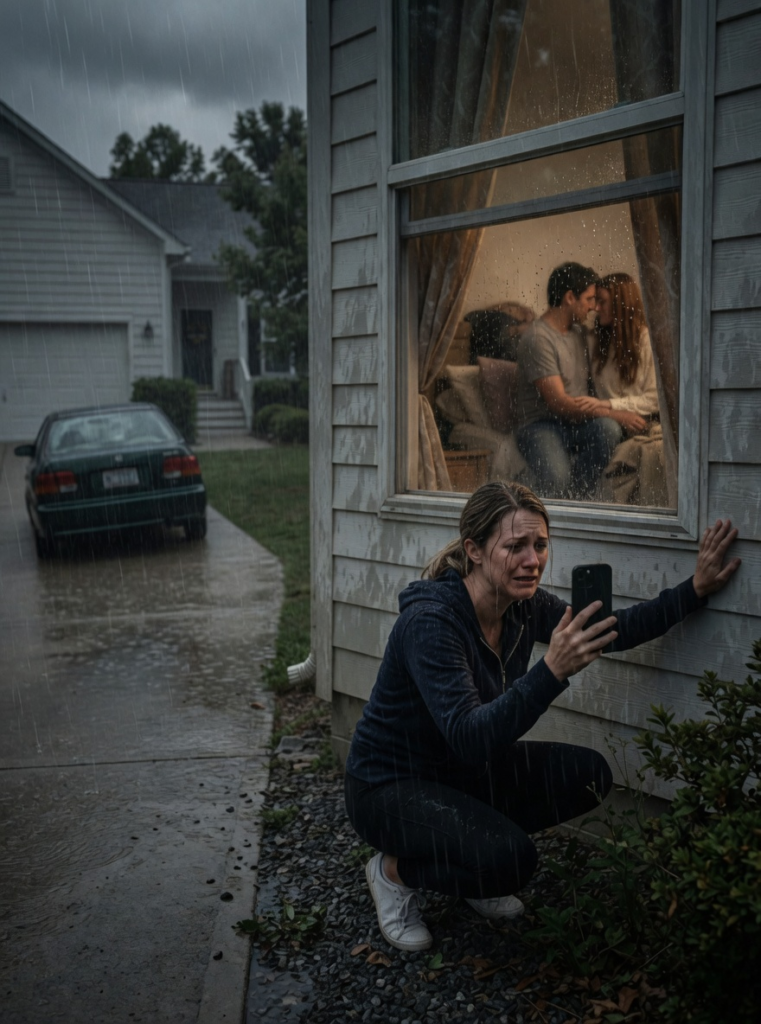
I got out quietly and moved along the side of the house.
We had a narrow path leading toward the backyard, half gravel, half dead leaves, and I remember hearing every tiny sound my shoes made, like the entire world had become a microphone.
The curtains in our bedroom were partly closed. Not enough to see clearly from where I stood, but enough to let voices slip through the cracked window.
His voice first.
Low. Amused. Intimate.
Then a woman laughing.
My knees did something I thought only happened in books. They actually weakened, went watery and unreliable, and I had to press one hand against the siding to stay upright.
I pulled out my phone and hit record.
Not because I had some brilliant revenge plan. Because when your life cracks in half, you suddenly want receipts. You want proof that later, when someone tries to call it a misunderstanding or a breakdown or an overreaction, you will have something besides your own wrecked face and shaking hands.
I could not see them clearly through the gap in the curtain. Only blur, movement, shape, enough to turn my stomach.
But I could hear.
His laugh. Her voice. The rustle of bedding. Him saying something low and smug that I did not fully catch, then her laughing again.
Enough.
More than enough.
At one point she said, “I can’t believe we’re doing this here.”
And he answered, “She won’t be back until Sunday.”
She.
Not Claire.
Not my fiancée.
She.
Like I was a scheduling obstacle. Like my absence was an unlocked door.
The room where it was happening was our bedroom. The same room where wedding garment bags hung from the closet. The same room where half the wedding favors sat in labeled boxes because apparently irony likes props. The same bed where he had wrapped his arms around me Thursday night and told me to have fun.
I should tell you that I did not burst in dramatically.
I did not kick the door.
I did not scream.
Part of that was shock. Part of it was pride. Part of it was the horrible understanding that if I walked in too soon, he would instantly shift from guilty man to manager of my emotions. He would start explaining, pleading, grabbing my wrists, trying to make the scene bigger than the choice. He would turn my reaction into the story.
He was good at that. I already knew it, even if I had never said it plainly before.
Then came the sound I will spare you the details of, because it does not need detail to be disgusting. Intimacy obvious and undeniable.
I stopped recording.
I backed away so fast I nearly slipped.
My body took over after that. I returned to my car, locked the doors like someone might chase me, and sat with both hands over my mouth because I thought I might throw up. I stared at my reflection in the rearview mirror and thought, This cannot be happening in my own driveway.
Not because I thought I was special.
Because it felt absurd.
Of all the places for your life to fall apart, why does it have to be the driveway where you used to unload groceries together?
I drove back to the resort on emotional autopilot. I do not remember half the turns. I remember crying so hard at one red light that I missed the green and the driver behind me honked. I remember going completely blank for ten miles. I remember thinking, If I got hit right now, at least I would not have to decide what comes next.
That was not because I wanted to die.
I did not.
It was because I wanted not to think for five full minutes.
When I got back to the resort, everyone was outside on the lawn doing some stupid cup game that involved shouting and betrayal, which felt thematically rude. I parked badly, like insult-to-driver’s-license badly, walked inside, grabbed a bottle of wine from the kitchen counter, went into the nearest bathroom, locked the door, and sat on the floor in my nice little weekend outfit drinking directly from the neck like I had been cast in a cautionary ad about women who ignore their instincts.
That was where Lauren found me.
She knocked once. Twice. Then said my name in the tone people use when they already know the answer is bad.
I opened the door, and the second I saw her face, I lost it.
Not graceful tears. Not a cinematic drop rolling down one cheek. Ugly, breathless, humiliating crying. Words came out in scraps. Mucus became part of the experience.
She took the bottle, set it on the sink, pulled me up, and got me into one of the bedrooms away from everybody else.
It took forever to explain because every time I got to the part where I called him and he said he was at the office, I wanted to scream. When I finally played her the recording, she went so still that it scared me. Her face became calm in a way I had only seen when she was about to do something absolutely necessary and possibly illegal-looking.
When the audio ended, she placed my phone carefully on the bed.
“I will help you bury him.”
“Not literally,” I said automatically, because apparently trauma had not destroyed my concern for legal clarity.
“Obviously not literally,” she said. “Emotionally. Socially. Financially, if possible.”
That was friendship in its purest form.
For an hour or two, maybe more, I swung between fury and collapse. I wanted to call him and ruin his life. I wanted never to hear his voice again. I wanted to go back and throw every wedding item into the yard. I wanted to disappear and let him explain to everybody why the bride evaporated.
Lauren let me spiral because she knows interrupting the first wave is useless.
Then she asked the only question that mattered.
“What hurts most right now?”
I expected myself to say the cheating. Or the bed. Or the lie. Or the fact that he pushed me out of the house for it.
Instead, I said, “He gets to choose the story if I confront him wrong.”
And there it was.
Because if I stormed in, he would pivot. Marcus always pivoted. Suddenly, it would be about the fight, the misunderstanding, my timing, my reaction, my invasion of privacy, my anger, my tone. The betrayal would still exist, but now it would be inside a mess he helped create and then narrate.
I did not want to become one more woman standing in a room full of people being told she was overreacting to the thing he forced her to witness.
That was when the cancellation idea took shape.
Not as a brilliant revenge plan. Not elegant. Not strategic in the glamorous way people imagine after the fact. It was survival.
I wanted one thing, maybe the only thing still available to me.
Control over my own exit.
I did not need his confession to know what happened. I did not need a confrontation to validate the car, the call, the voices, the recording. What I needed was to stop him from dressing himself in my forgiveness before I had even finished bleeding.
So I said it.
“I’m not marrying him.”
Lauren nodded like she had known that from the moment she heard the audio.
“Okay,” she said. “Then we think.”
The next morning, after maybe two hours of sleep and ten years of emotional aging, I checked out early. I told the others I had a family thing come up, which was technically true if you count discovering your fiancé is a lying idiot as a family event.
Lauren came with me. I did not ask her to. She packed her things, told Hannah to handle the group, and climbed into my passenger seat with snacks, water, and the grim determination of a woman escorting a witness to trial.
“I’m not leaving you alone right now,” she said.
“I’m fine.”
“You drank wine on a bathroom floor.”
“That was cultural.”
“Drive.”
I did not go home. I could not. The thought of walking back into that bedroom made my skin crawl. I stayed at Lauren’s apartment instead, sleeping in borrowed clothes on her couch, eating dry cereal at her kitchen counter, and answering Marcus’s messages with the bland politeness of a hostage negotiating for time.
He texted like nothing had happened.
That part still gets me.
He asked if my headache was better. He said he missed me. He said his parents wanted to know what time we were arriving at the venue on the wedding day. He said he might stay with them the night before the ceremony to make logistics easier and “build anticipation.”
Build anticipation.
Sir, what you built was a crater.
I responded carefully because by then I understood that the closer we got to the wedding, the more dangerous honesty would become if I was not ready to pull the trigger on everything. I said I was emotional, tired, and wanted to preserve the surprise of the day.
He ate that up.
Of course he did.
Nothing flatters a liar like being mistaken for loved.
Meanwhile, Lauren drove by the house once while I sat in her living room chewing my thumbnail down to nothing. She called from a block away.
“Same car.”
I closed my eyes.
“In the driveway?”
“Yep.”
“You’re sure?”
“Claire.”
“Right.”
Same car.
Again.
Again should not have shocked me, but it did. Some naive little parasite inside me had still been hoping the first time was an isolated disaster, one stupid panic decision, one singular act of idiocy. Not an active arrangement with repeat parking habits.
But there it was.
Same driveway. Same disrespect. Same man.
The next day, I went back to the house alone because I needed clothes, documents, and whatever was left of my self-respect that might have been trapped under wedding stationery. Lauren hated that I went alone, but I needed one private hour to see the place before it stopped being mine.
Marcus was supposed to be meeting a client. I did not believe him, but his car was gone when I arrived. The unfamiliar sedan was gone too.
The house was spotless in the suspicious, overcorrected way guilty people clean. The bed was made too neatly. The counters were wiped. There was one scented candle burning in the living room that I had never bought.
White tea and cedarwood, according to the label.
I stared at it so hard I thought I might set it on fire with my mind.
I packed what mattered: work clothes, passport, birth certificate, laptop, external drives, jewelry from my grandmother, the small ugly mug I liked because Marcus once said it looked depressed. I am petty enough to rescue objects out of spite.
I left anything replaceable, anything contaminated, anything I could not carry without feeling like I was helping the past move into my future.
Then I sat at the kitchen table and looked around the house we had built one budget spreadsheet at a time.
The couch I paid more toward. The dishes I chose. The framed print above the hallway table that he swore he loved and probably never noticed. The stack of thank-you cards we had not yet written for shower gifts. The magnetic meal planner on the fridge where I had written, in my own stupid handwriting, “Wedding week!!!” with three exclamation points.
It all felt fake now.
Not because none of it had happened. That would have been easier.
Betrayal does something crueler than erasing happiness. It coats the happiness in suspicion until you cannot touch it without feeling stupid.
Marcus came home while I was still there.
I heard the key in the door and every muscle in my body locked.
I had thought I might be ready if this happened.
I was not.
He walked in carrying coffee, talking before he fully saw me.
“Hey, I thought you were staying with—”
Then he stopped.
He read the room wrong immediately. You could see it happening. He knew something was off, but he thought it was regular wedding tension. Maybe an argument. Maybe nerves. Maybe I had found a text he forgot to delete, but not the whole truth.
He actually tried to kiss my cheek.
I turned away.
He blinked.
“What’s going on?”
This is where people expect the dramatic confrontation. The slap. The scream. The recording played through speakers. The woman emerging from the closet wrapped in a sheet. The cheater stammering while the bride destroys him line by line.
Real life is often meaner and weirder than fiction.
I looked at Marcus and understood in one sick flash that if I started, I would either say too much or not enough. There would be no middle ground. He would grab the scene and turn it into an emotional hostage situation. He would apologize for the wrong things. He would cry before I did. He would make me manage his panic.
I could not afford his version of chaos on top of mine.
So I did not confront him.
Not fully. Not yet.
“I’m overwhelmed,” I said.
Concern flooded his face.
“About the wedding?”
“About everything.”
“Baby, that’s normal.”
I almost laughed.
Baby. Normal.
Two words with no right to exist in his mouth.
“I don’t want to talk right now.”
“Are you mad?”
“Yes.”
He looked genuinely confused, which was almost impressive.
“Is this about your mom?”
That nearly took me out.
Imagine being betrayed so thoroughly and still being forced to admire the stupidity of his guesses.
“It’s not about my mom.”
He stepped closer.
“Then talk to me.”
“I said I don’t want to.”
He reached for me, and I stepped back.
His face shifted into wounded softness. I hated that. Hurt can be real even in guilty people, and seeing it can trigger old habits: comforting, clarifying, taking responsibility for the emotional temperature in the room.
I had done that for years without calling it what it was.
Not this time.
Marcus started apologizing. Not for cheating, obviously. For being distracted. For work stress. For not being present enough. For adding pressure during planning.
It was unbelievable.
He was apologizing around the betrayal like a man trying not to mention the elephant because maybe if he complimented the curtains, it would leave.
I let him talk just long enough to confirm what I already knew.
He thought he still had time.
Time to manage me. Time to smooth this down. Time to walk into the wedding and marry me under a version of reality he preferred.
When he finally paused, I said, “I need space until the wedding.”
His eyes widened.
“Space?”
“I might stay with family.”
“Are we okay?”
“We’ll see.”
That answer haunted him for approximately zero seconds because he wanted it to mean pre-ceremony nerves, not doom. He nodded slowly, relieved to categorize me.
“Okay. If that helps you feel centered, I support it.”
Centered.
What a word.
He left that evening to stay with his parents, exactly as planned, carrying a duffel bag and giving me a cheerful little wave like I was not standing in the doorway holding back the urge to tell him that if hell exists, I hope it has seating charts, fake vows, and a scented candle he hates.
Once he was gone, I called my grandmother.
Her name was Ruth Bennett, and she was the only person in my family I trusted not to turn pain into a lecture about appearances. She had buried a husband, survived breast cancer, sold a house she loved because stairs had become “an arrogant design choice,” and once told a pastor that forgiveness was not the same thing as letting a fool borrow your car twice.
She lived three hours away in Wilmington, near the coast, in a small blue house with a screened porch and a guest room that always smelled like lavender and old books.
She listened without interrupting.
Really listened.
No gasps for attention. No “Are you sure?” No immediate pivot into her own opinions.
When I finished, all she said was, “Come here if you need to disappear for a while.”
That almost made me cry harder than the cheating itself. Kindness, when you are humiliated, hits like a crack in the dam.
“I might,” I said.
“The room is ready whether you arrive with two bags or none.”
Then came the practical ugliness.
I drafted an email canceling the wedding.
Do you know how surreal it is to type a sentence explaining that your marriage will not be taking place because the groom has been sleeping with someone else in your home while telling you he loves you? It feels fake even as you type it, like you are writing a messy cousin’s crisis and somehow your own name keeps appearing in the details.
I kept it simple because I was too tired to be poetic.
I wrote that I had discovered infidelity, that the wedding would not be taking place, and that I would not be discussing details that day.
I saved it in drafts.
I did not send it yet.
Not to his side. Not to mine. Not until the timing protected me.
That night, I called my mother.
I had avoided it because I knew she would begin with logistics. My mother, Elaine, was not heartless. She loved me. But she loved through presentation, through problem-solving, through worrying what people would think because in her mind, reputation was not vanity. It was armor.
When I told her, she went quiet.
Then she asked, “Are you sure?”
I almost threw my phone.
“Mom.”
“I’m not saying I don’t believe you. I just—”
“I recorded him.”
Silence.
“What?”
I sent the audio. Then the photos Lauren had taken of the strange car in the driveway on two separate days. Not courtroom drama, maybe. But real life does not need a jury when your daughter is sending you audio of her fiancé lying from inside the house.
She called back ten minutes later.
Her voice was different. Smaller.
“Oh, Claire.”
“Don’t ask me to hear him out.”
“I won’t.”
“Don’t ask me to think about embarrassment.”
“I won’t.”
She paused.
“Your father needs to know.”
My father, Mark Bennett, was not a man fluent in emotional territory. He loved by changing oil, checking locks, showing up early, and standing beside you at awkward events. When he called after listening to the audio, his anger was quiet, clipped, and careful.
Worse than shouting.
“You do not owe him a performance of forgiveness,” he said.
That sentence helped more than he probably knew.
The next six days before the wedding turned into a creepy little theater production where only one person knew the show had already been canceled.
Marcus kept texting sweet things, asking about flowers, guest arrival times, whether we should freeze the top tier of the cake like “people say you’re supposed to.” He sent heart emojis every night like routine could cover rot.
There is something deeply unsettling about being lied to by someone who still expects affection in return. It makes every normal exchange feel infected.
I played along just enough to keep him calm.
Not because I enjoyed it. God, no. Half the time I had to put my phone down and walk around the room afterward like I had swallowed bleach.
But if I pulled away too hard too soon, he would sense it, and then I would have to deal with confrontation before I was ready. I had already decided I was not spending the final days before this disaster comforting the man who caused it.
My inbox looked like a woman’s dream wedding had been taken hostage by spreadsheets. Vendor emails. Balance reminders. Guest questions. Hair appointment confirmations. Seating chart updates. Final head count. Menu corrections.
I handled what I could with a numb kind of efficiency.
The venue balance was still partially unpaid because we had scheduled the final payment close to the wedding date. That was not part of a master plan at first. I had simply been overwhelmed, waiting on one more paycheck, juggling deposits and bills because I had been carrying too much of the financial load for too long.
But once I realized the timing, I did not rush to fix it.
Let consequences find the right doorstep for once.
On Friday night, the night before the wedding, I packed one suitcase and drove to my grandmother’s house. The drive was long enough to feel like I was peeling myself out of a life layer by layer. My phone kept lighting up: friends checking in, my cousin asking where I would be getting ready, Marcus sending a selfie from his parents’ guest room with the caption Last night before forever.
I muted everything except Lauren, my parents, and my grandmother.
Ruth opened her door in slippers and a robe. She did not say anything dramatic. She looked at my face, took the suitcase from my hand, and said, “Kitchen.”
She made tea even though I did not want tea. Older women believe hot liquids can do things therapy only dreams of.
I sat at her kitchen table beneath a too-bright light and finally said it cleanly without choking around it.
“He cheated in our home while I was away because he pushed me to go.”
She pressed her lips together, nodded once, and asked, “Do you want to stay hidden or make a statement?”
That was why I adored her.
No moralizing. No soft-focus nonsense about healing.
Hidden or statement.
Your move.
“Both,” I said.
One week after I discovered the truth, on the Saturday morning that was supposed to be my wedding day, while Marcus was getting dressed and people were steaming tablecloths and pretending romance was just logistics plus flowers, I sat in my grandmother’s living room wearing leggings and one of her old sweatshirts.
The draft email was open on my laptop.
My hands did not shake.
I sent it to my side of the guest list first, then to select mutual guests, leaving out the handful of contacts who might warn him too early.
Petty?
Maybe.
Efficient?
Absolutely.
The message was short.
I have discovered infidelity. The wedding will not be taking place today. I ask for privacy and will not be answering calls while I process this. Thank you for understanding.
Then I turned off my location, ignored the first wave of calls, and sat beside my grandmother while my phone lit up like an electrical fire.
Marcus.
Mom.
Dad.
Lauren.
Unknown number.
Marcus again.
His mother.
Marcus.
Marcus.
Marcus.
I answered only Lauren.
Her voice was hushed and electric.
“It’s chaos.”
I closed my eyes.
“Tell me.”
According to Lauren, the unraveling started small, then turned all at once. At first, people only noticed I was not there. Not panic. Not suspicion. Just mild wedding-day annoyance. Everyone assumed the bride was in some side room being sprayed, pinned, powdered, zipped, and emotionally overmanaged by a cluster of women with bobby pins.
Marcus was apparently calm too, walking around, greeting people, checking his phone, smiling for relatives.
Liars do best when they think they still control timing.
Then my email started reaching people.
Guests from my side stopped murmuring and began showing each other their screens. An aunt gasped loudly enough to turn heads. Someone asked a bridesmaid if it was real. Someone else went to find my mother.
Lauren said you could watch the room change like a temperature drop before a storm.
Not explosive at first.
Worse.
Public and creeping.
Marcus began calling me over and over.
No answer.
Then texting.
Where are you?
What is this?
Please answer me.
Then: We can explain this.
We can fix this.
We.
Fascinating pronoun from a man so recently committed to solo decisions.
His father tried to tell people there had been an emergency and the ceremony would be delayed. Meanwhile, the event manager—who still deserves a civic award for professionalism under absurdity—began asking practical questions about the remaining balance, cancellation terms, and who exactly was taking responsibility for expenses already triggered that day.
That was where humiliation became financial.
The venue had not been fully paid. I had delayed the final chunk because money had been bleeding out of me for months. Suddenly, there they were in formal clothes, negotiating payment for a wedding collapsing in real time.
Marcus’s father stepped in and put his name down to cover what had to be covered to avoid an even bigger scene in the lobby.
Lauren said that was the moment his father stopped defending him with his face.
Pride vanished first. Then confusion. Then something that looked like recognition.
Maybe seeing stupidity become invoices is what finally makes some parents understand consequences.
By noon, everyone knew. By one, Marcus’s side was calling mine. By two, the wedding party had dissolved into clusters of gossip, anger, support, and awkward logistical retreat.
By three, I finally turned my phone back on fully and watched the messages flood in.
They moved through predictable stages.
Confusion.
Pleading.
Anger.
Self-pity.
Please talk to me.
This isn’t what it looks like.
You blindsided me.
How could you do this publicly?
We could have handled this privately.
I made a mistake.
I love you.
Please let me explain.
Explain what? The driveway? The phone call? The woman in my bed? The fact that he had enough confidence to push me out of the house for the weekend and lie to my face while I stared at his car in the garage?
I did not answer him that day.
Or the next.
Or the one after.
My parents went to the house to collect the rest of my things. I gave them a list over the phone, room by room, because there is no part of heartbreak more humiliating than having to remember where you stored your passport while your father silently processes the man he almost welcomed into the family.
They packed documents, work clothes, jewelry, shoes, kitchen items I wanted because I had paid for them and spite is a renewable resource.
Marcus was there when they arrived.
According to my father, he looked awful: pale, unshaven, wearing clothes that looked slept in. He kept asking where I was. Kept saying he needed to talk to me. Kept trying to frame the whole thing as “something that got out of hand,” which is a very interesting way to describe your own choices once consequences stop letting you narrate them as accidents.
My father told him plainly that nobody had forced him to cheat, nobody had forced him to lie, and nobody had forced him to turn our shared home into whatever disgusting little setup he had been running.
My mother, who had started the week asking whether I was sure, apparently looked at him and said, “You don’t get to ask for grace from the person you humiliated.”
That was a nice surprise.
I had left one note on the kitchen table before going to my grandmother’s.
I know. Don’t contact me.
Beside it, I left printed photos of the other woman’s car in the driveway on more than one day.
My father said Marcus stared at them for a long time without speaking.
Good.
Let him enjoy the stillness.
The first few weeks after the wedding that wasn’t felt less like a clean break and more like living inside the smoke after something burned down. Everyone had opinions. That was inevitable. Some people were fully on my side without qualification. Some did that awful balanced-take thing where they condemned cheating in theory but gently suggested maybe public humiliation had been a lot. A few mutual friends clearly wanted to remain in good standing with both of us, which translated into them speaking like bored diplomats while I was still trying not to cry in grocery stores.
I moved into a small apartment on the other side of town because I could not stand the idea of staying in that house. Not even if, legally and financially, I might have had grounds to dig in for a while.
I did not want to win square footage.
I wanted my nervous system back.
The apartment had thin walls, unreliable water pressure, and one window that looked onto a parking lot with exactly one tragic tree trying its best.
It was perfect.
Not glamorous. Not triumphant.
Just mine.
Money was tighter than I wanted to admit. Weddings are basically a bonfire you feed with your checking account. Even with some refunds, a lot of what I spent was gone. I picked up extra shifts at work. I stopped ordering takeout. I learned how many dinners a woman can make out of eggs, rice, and spite.
Meanwhile, through the underground tunnel system known as mutual acquaintances, I heard Marcus had to move out because he could not afford the rent without me. That did not give me joy exactly, but it did give me a very human, very imperfect sense of balance.
Actions.
Consequences.
Revolutionary concept.
His parents did not cut him off, but they were not celebrating him either. He stayed with them for a while, and from what I heard, the atmosphere was tense enough to qualify as weather. They helped him practically, because parents often do, but they stopped defending him publicly.
His mother sent one message that tried very hard to sound neutral and landed somewhere around carefully disappointed. She said she was sorry for the pain caused and hoped someday there could be peace.
I appreciated the apology and ignored the hope.
Peace is not the same thing as access.
My own family surprised me in mixed ways. My father became unexpectedly protective without being overbearing, which moved me because he is not a man who thrives in emotional territory. He brought me groceries once and acted like he was only dropping off a cooler because he “had extra chicken.”
My mother kept circling back to presentation, not because she cared more about image than me exactly, but because image was the language she used when she did not know what to do with pain. She worried about who knew what. She worried about how people would frame it. She worried that my silence left room for rumors.
I finally told her that anyone concerned about the reputation of a canceled wedding was welcome to marry Marcus themselves.
That bought me forty-eight blessed hours of quiet.
Later, when the worst settled, she got better. Not perfect. Just better. Less worried about appearances. More worried about whether I was eating and sleeping.
The hardest part was not the rage. Rage is active. Useful sometimes. It gets you through packing boxes, changing passwords, canceling subscriptions, calling utility companies in a normal voice while your entire inner life sits on the floor.
The harder part came afterward, in the administrative afterlife of a relationship: shared accounts, wedding deposits, refunds, subscriptions, insurance, address changes, relatives asking what to do with gifts, strangers asking if you are excited because they did not get the update.
Marcus tried reaching out through people more than once. Mutual friends. His mother once. A cousin who should have minded her own business. It was always the same request wrapped in different paper.
He wanted to explain.
He wanted one conversation.
He wanted closure.
He wanted me to hear his side.
I shut it down every time.
Not because I was strong every second. Sometimes I was furious. Sometimes I was shaking. Sometimes I wanted to answer just to ask if he genuinely believed the problem was that I had not heard enough. But I had already lived through enough of his version of events.
Getting over it was not a straight line. Some mornings I felt almost normal. Then I would hear a certain laugh in a restaurant or smell his laundry soap on a stranger in an elevator, and my whole body would tense like it expected impact.
Lauren said that was normal.
She was right.
I did not miss Marcus in the way people assumed. I missed the version of my life that had not been contaminated yet. I missed certainty. I missed feeling stupid only in harmless ways.
About four months later, I got careless.
Not emotionally.
Logistically.
I had settled into routines, the kind that make you think danger has gotten bored and moved on. Same coffee shop near work twice a week, same table if it was open, same blueberry muffin I kept pretending I would stop ordering because it tasted like sugar wearing a disguise. I had not seen Marcus in months. I had stopped imagining him around every corner.
That was my mistake.
I walked into the coffee shop on a Thursday and saw him near the window.
My first thought was not fear or anger.
It was calculation.
He had not been there before. Not once in the three months I had been coming here. That meant either this was a miserable coincidence or he had figured out my pattern.
Neither option made me feel safe.
I stopped mid-step hard enough for the woman behind me to bump my shoulder.
Marcus stood immediately. Not rushing toward me. Just enough to signal intent. He looked thinner, tired, not ruined, not broken, not dramatically transformed by guilt in some satisfying way. Just worn around the edges, which annoyingly made him look more sympathetic.
Men have an unfair relationship with damage. They get one good week of bad sleep, and suddenly they look like poems to people who should know better.
“I’m not here to cause a scene,” he said.
I laughed once.
“That’s generous.”
He asked if we could sit for five minutes.
I should have walked out. I know that. But part of me wanted to hear what kind of nonsense could survive four months in his head and still come out dressed as explanation. Also, if I am being honest, there was ego in it. Curiosity. The almost anthropological urge to study the creature that thought I might still be available for conversation after everything.
So I sat.
I kept my bag on my lap like I was prepared to flee a minor fire.
He noticed.
Good.
He started talking too fast, the way people do when they know they have a narrow window and a terrible case. He said he was not there to pressure me. He said he just needed me to hear the truth from him once, which was funny because I had, in a way, through a partially closed curtain.
According to Marcus, it had not been an emotional affair. Not a relationship. Not ongoing in the serious sense. It was physical, he said. Isolated. Stupid. Meaningless. A woman he knew through freelance work. Someone with a “reputation for discreet situations.”
I did not ask her name.
I did not want it.
Knowing who she was would not change what he had done. She was not the person who had promised me forever. He was. She owed me nothing. He owed me everything.
He used that phrase—discreet situations—like he was discussing weather patterns instead of admitting he had been sleeping around in the lead-up to our wedding.
He said he had gotten in his head about marriage, permanence, choosing one person forever. He said he panicked and wanted to get “curiosity out of his system” before the wedding.
That phrase was so rotten and selfish I felt the air go thin around me. Not because it shocked me by then, but because he still expected language like curiosity to make it smaller, like what he had done was a pathetic bachelor impulse instead of deliberate betrayal.
I let him talk.
That was probably my mistake.
Silence encourages men like him. They start mistaking your restraint for openness.
He said he never stopped loving me. Said it was never about replacing me. Said the wedding was real to him. Said he planned to end it and commit fully and bury the whole thing.
Which, wow.
How lucky I was almost allowed to marry into a secret cleanup operation.
When I finally spoke, my voice surprised even me.
Calm. Flat.
“So your defense is that you intended to lie forever?”
He flinched. Only for a second.
“No. My defense is that it was ugly and stupid and didn’t mean what it looked like.”
That sentence sat between us like spoiled milk.
“Was it only once?” I asked.
He hesitated.
Tiny pause.
That was answer enough.
I smiled without joy and looked down at my coffee, because apparently even then, part of me preferred my humiliation in manageable servings.
He said my name in that soft tone he used when he wanted me to reenter a dynamic where he explained and I softened.
I cut him off.
“Don’t talk to me like I’m still your person.”
His eyes did that wounded thing. I hated that too because hurt can be real even in guilty people, and seeing it can trigger old habits. Comforting. Clarifying. Taking responsibility for the emotional temperature in the room.
I had done that for years without calling it what it was.
Not this time.
He said he was trying to take responsibility.
I said, “No, you’re trying to survive your own image of yourself.”
That shut him up.
For a moment.
Then he pivoted. I should have expected it. He said I could have confronted him privately. I could have come inside that day. I could have called him before canceling the wedding. He did not say it angrily at first. He said it sadly, as if mourning my lost opportunity to behave better around his betrayal.
“You didn’t have to destroy everything,” he said.
I laughed.
Not because it was funny.
Because the nerve of that sentence deserved sound.
“You destroyed it,” I said. “I just refused to help you hide it.”
He rubbed his face. Then came the next pivot.
His parents.
How devastated they had been. How humiliating the venue scene was for them. How his father had to cover costs.
There it was: widen the circle of pain until the person you hurt starts feeling responsible for everyone except herself.
I did feel something. Not guilt exactly. Sadness with edges. I knew the fallout reached beyond him. I was not a monster.
But consequences do not become injustice just because they spread.
I stood.
“I’m leaving.”
“Claire, wait. One more minute.”
I should not have given it.
I did.
He said something so outrageous that the entire conversation almost became worth it just for the story.
“If you could find a way to move past how it happened,” he said carefully, “I would be willing to forgive the way you handled the cancellation.”
Forgive me.
I sat back down slowly because my legs needed a moment to process the audacity before transporting me away from it. I stared at him like I had discovered a species evolution had meant to phase out.
He saw my face and backtracked quickly.
“That’s not what I mean.”
“It is exactly what you mean.”
“We both hurt each other.”
“No.”
“We both acted in anger.”
“No.”
“Neither of us was at our best.”
“Marcus.”
My voice was quiet, which made him stop.
“There is no version of this where my reaction belongs in the same moral category as your betrayal.”
That was the moment the final bit of affection burned off. Not dramatically. No collapse. No screaming.
Just gone.
Any lingering softness I had for the man I thought he used to be died there under the smell of coffee and blueberry syrup.
Then he mentioned money.
Specifically, the portion of wedding expenses I had personally fronted. His parents had been “on him” about it, not in a punishing way, he claimed, but in that disappointed family way where nobody yells and everyone suffers. His mother had apparently said that whatever else he had done, leaving me financially worse off was indefensible. His father had said something about being a man and taking responsibility for measurable damage.
So here Marcus was, offering to pay me back for what I had personally spent.
I could hear the discomfort in his voice. This was not generosity. This was his family forcing him to act like an adult, probably with the threat of losing their remaining support if he did not. Which meant the repayment was not about me. It was about him salvaging his relationship with people whose approval still mattered to him.
But here is the thing about motivation: I did not need his to be pure.
I needed the money.
I looked at him for a long moment.
Then I said, “I’m not promising you anything. But paying back what I put in would be a start if you actually want to show accountability.”
The relief in his face hit me so hard I almost felt sorry for him.
Almost.
He heard hope where there was strategy. He heard maybe. He heard the old me, the one who left room, the one who understood context, the one who could be moved by effort.
Meanwhile, I sat there thinking, You really did all this and still think money buys emotional leverage. Incredible.
We left with a narrow agreement. He would transfer the amount I had directly covered, in parts if necessary. I would unblock him only long enough to coordinate logistics. Nothing else was promised, but he left acting like the door had cracked open.
That was his interpretation.
Not mine.
Lauren called it emotional collections work.
My grandmother called it getting your money back from a fool.
I preferred my grandmother’s version.
Over the next two months, Marcus became the most determined payer I had ever seen. Amazing what motivation can do. He took extra work, borrowed money from someone, cut expenses, and sent long messages framed like accountability but always drifting toward sentiment.
He would confirm a transfer amount, then add something about missing my laugh. He would ask if I received the payment, then mention he had driven past the old apartment and thought of me. He would act almost respectful for three messages, then slip and sound hopeful, as if every transaction was also a stitch closing the wound.
I kept my responses minimal.
Received.
Noted.
Send by Friday.
Confirmed.
Dry enough to discourage romance, polite enough not to threaten the payment stream.
If that sounds cynical, fine. I call it post-betrayal literacy.
Some nights, after reading his messages, I felt weirdly hollow. Not tempted. Just tired. There is something exhausting about keeping a liar close enough to settle an account without letting him back into your life. It is like carrying a box with broken glass in it. You can do it. You just cannot relax your grip.
Around the middle of that period, he sent a longer message saying he knew he had no right to ask for anything, but paying me back had made him realize how much he had taken for granted. He said losing me had clarified everything. He said he was ashamed of the man he had been and was trying to become someone worthy of even speaking to me again.
That almost got me.
Not romantically.
Intellectually.
There is always a tiny dangerous part of you that wants pain to have produced wisdom. You want your suffering to at least force growth in the person who caused it. Otherwise, it feels wasteful on top of cruel.
But growth is not my reward to monitor. Shame is not transformation just because it uses reflective language.
I did not answer the speech.
I sent the outstanding balance figure again.
He replied, Okay.
Then, ten minutes later: You used to know how to hurt me with one sentence.
I stared at that and thought, No, remembering is the problem.
Then I locked my phone and cried in my kitchen for ten minutes because nostalgia ambushes like a coward.
Afterward, I washed my face, called Lauren, and let her remind me that a memory is not a payment and regret is not repair.
The first substantial transfer came through two days later. When I saw it land in my account, I had to sit down. Relief, vindication, disgust, power, sadness—all of it moved through me at once. Money does not heal betrayal, obviously. But recovering something tangible after months of swallowing losses felt like closing my hand around a piece of myself he did not get to keep.
He texted right after.
Did it arrive?
I answered, Yes.
Then he wrote, I meant what I said. I want to make this right in every way I can.
I looked at the message and thought, No, you want the story to end with your redemption because the version where I simply leave is unbearable to you.
I did not text that.
I wrote, Send the timeline for the rest.
He replied with hearts.
I stared at them for a long second, then put the phone across the room like it had become sticky.
The next six weeks became a strange kind of business relationship. The world assumes the worst part of a breakup is the rupture: the cheating, the canceled wedding, the public shame, the crying on bathroom floors. But there is another stage after that, quieter and sometimes more dangerous, where the crisis is over and you are left negotiating with residue: emails, objects, deposits, shared subscriptions, accounts, explanations, the boring little administrative ghosts of a life that no longer exists.
Marcus sent the second transfer after taking out a loan, which he made sure I knew because apparently men cannot suffer financially without wanting applause for the narrative arc. He told me the interest rate was bad. He told me he was picking up work wherever he could. He told me he understood if I did not care, but wanted me to know he was serious.
Again, performance humility.
Again, the need to be seen trying.
Sometimes he slipped in little memories. A song lyric. A reference to a trip we took to Asheville. A random sentence like, I drove past that diner you used to love.
They were bait.
Not even subtle bait.
Emotional fishing with expired worms.
I ignored every single one.
That does not mean I never got angry enough to answer in my head. I absolutely did. I just got better at keeping the sharpest parts of me offline. There is no medal for restraint, which is unfortunate because by then I had earned at least bronze.
When I wanted to lash out, I wrote things in my notes app and deleted them. When I wanted to ask if the other woman also got a speech about curiosity, I called Lauren. When I wanted to know if he ever lay awake thinking about the exact moment he traded a future for an ego itch, I went for a walk and let myself be mad without making it interactive.
Work helped. Not because labor is healing or whatever inspirational nonsense gets printed on mugs. Because routine gives pain less room to improvise. I had deadlines, irritated clients, a supervisor who communicated exclusively through urgency, and enough daily friction to keep me from dissolving into self-mythology. I did not want to become the woman who could only talk about the wedding that did not happen. I wanted to be the woman who went through that and still remembered how to answer emails, buy detergent, and laugh at dumb things in line at the pharmacy.
My father took me to dinner one evening, just the two of us, at a neighborhood restaurant with sticky menus and terrible lighting. Our relationship had always relied on side-by-side affection rather than explicit emotional discussion, so this felt strangely formal, like two people negotiating a treaty neither knew how to write.
After a long silence, he asked, “Is keeping contact open for the money messing with your head?”
I looked down at my plate.
“Yes.”
He nodded.
“But losing that money messed with your life too.”
“Exactly.”
He took a sip of water.
“Just make sure you know the price of every conversation.”
I thought about that for days.
Every exchange cost something. Focus. Energy. Emotional drag. Even when I was in control, even when I kept it dry and transactional, access is never free, especially for someone who has already used it badly.
After that, I became stricter. Fewer words. No warmth. No punctuation that could be misread as softness. Efficient. Almost cold.
It worked.
He noticed.
One night, he texted, It feels like you talk to me like I’m a utility company.
I laughed so suddenly I scared myself.
Yes.
Exactly.
That was the relationship now.
A reluctant service provider resolving a debt.
I did not answer that part. I wrote, Remaining amount due Friday.
He sent it the next morning.
There were still moments of weakness, but not in the direction he probably imagined. I never seriously considered taking him back. The temptation was not Marcus.
It was amnesia.
I wanted the whole year erased. I wanted to be the version of myself still worried about appetizers, still building a seating chart, still believing a forehead kiss meant tenderness. I wanted not to carry the story in my body.
That was what people misunderstood.
Sometimes you do not miss the person.
You miss not knowing.
The final payment date kept shifting. First he said Tuesday. Then Friday. Then the following week because one client payment had not cleared. He apologized excessively, which made me want to mail him a dictionary with the word consequences highlighted.
Eventually, he pinned down a Tuesday afternoon.
He said once it was done, maybe we could have one real conversation with everything finally on the table.
He used the word closure, which I have come to believe is emotional glitter. People throw it everywhere because it sounds meaningful and makes a mess.
I told him we would discuss next steps after the payment cleared.
There were no next steps.
Not really.
But by then, I knew better than to announce the ending before the money landed. Practicality is not romance, but it is a loyal friend once you finally let it drive.
The final transfer arrived on a Tuesday afternoon while I was at my desk pretending to care about a spreadsheet.
My phone buzzed.
I glanced down.
There it was.
The remaining amount.
Complete.
Ugly in origin, beautiful in effect.
For a second, I just stared at the screen because anticipation had stretched the moment so long I had stopped trusting it would happen. Then my whole body loosened in one sharp, strange wave.
Not joy.
More like the release of a muscle I had not realized I had been clenching for months.
Marcus texted almost immediately.
It’s done.
Then another message.
Can we talk now? Really talk?
There it was.
The thing he had been paying toward in his own mind all along.
Not the debt.
Access. Narrative. A final hearing where he could present his better self and maybe convince both of us that effort had changed the meaning of what happened.
I set the phone down and went to the bathroom because I wanted to answer from a place not fueled entirely by adrenaline.
Look at me, behaving like a person with an impulse filter.
In the mirror, I looked ordinary. Tired. A little older around the eyes than I had been before the wedding year. Lipstick half gone. Hair fighting humidity. Just a woman in an office bathroom about to close a door that had already been closed in her heart for a long time.
That steadied me more than any speech could have.
I returned to my desk and typed the message I had been drafting in my head for weeks.
I told Marcus I had agreed to stay in contact for one reason only: repayment. I told him that was complete now, and so was any obligation between us. I said he had mistaken access for hope and persistence for change. I said loving me would have required honesty before damage, not regret after consequences. I said I did not want another explanation, another apology, or another attempt to resize what he had done into something survivable for his conscience. I told him I was not interested in being the woman who helped him feel like he was not that kind of man. He would have to decide how to live with himself without my assistance.
Then I added the only sentence that felt truly mine.
A woman should fight for a man worth keeping, and you proved you were not.
I read it twice. Took out one line that sounded too polished. Made another line meaner. Changed it back.
When I finally hit send, my hand was steady.
He answered faster than expected.
Please don’t do this.
Then another.
I know I don’t deserve much, but after everything, after paying it all back, I thought maybe there was at least a chance to start a real conversation.
After paying it all back.
As if restitution had become romantic currency. As if he had purchased the right to be reconsidered.
I did not answer.
I blocked his number again, then his email, then every other route I knew he might use.
Thoroughly. Calmly.
No dramatic music.
No tears.
Click. Confirm. Done.
It was one of the least cinematic moments of my life, which is probably why it mattered.
A week later, I used part of the money to replace things I had been patching together since the breakup. A decent mattress. A real kitchen table. Groceries without mental math. I put the rest into savings and felt lighter.
Not healed.
Closer.
Months passed. My apartment became less temporary. The tragic parking-lot tree outside my window survived a storm and produced a handful of stubborn leaves, which I took personally. Lauren helped me hang curtains. My father fixed the cabinet hinge without asking if I needed him to. My mother learned, slowly, not to begin every conversation with what people were saying. My grandmother sent handwritten notes that were half affection and half battle strategy.
One read: Never confuse loneliness with evidence you made the wrong choice.
I taped that one inside my closet.
There were still bad days. Anniversaries that should have been. A song in the grocery store. A wedding invitation from someone else that made my throat tighten. But the bad days became days, not homes. I stopped living inside them.
I started going out again, not bravely at first, more like a deer testing whether the road was still trying to kill it. Coffee with coworkers. Dinner with friends. A weekend at my grandmother’s where we sat on her porch and watched rain move across the street like a curtain.
Eventually, I could tell the story without feeling like I was stepping barefoot onto broken glass.
Not because it stopped hurting.
Because it became mine to tell.
That mattered.
Marcus had wanted privacy because privacy would have protected his version. I had chosen exposure because exposure protected mine.
People can call that revenge if they want. Maybe part of it was. I am not interested in pretending I reached sainthood through heartbreak. I wanted him embarrassed. I wanted his parents to know. I wanted the room where he expected a bride to become the room where his choices arrived first.
But revenge was not what saved me.
Control did.
The right to leave without being managed. The right to refuse a conversation. The right to recover money without offering warmth. The right to block a man who thought repayment bought hope.
He did not lose me because I canceled the wedding publicly.
He lost me when he decided I was easier to lie to than worth telling the truth.
Sometimes I still think about that Saturday morning at the resort, standing in the bathroom with mascara under my eyes, arguing with my own instincts. I wish I could go back to that woman and tell her she was not dramatic. She was not paranoid. She was not ruining something good by checking.
Her body knew.
Her mind just needed time to catch up.
I would tell her to get in the car sooner. I would tell her to record everything. I would tell her not to be ashamed of needing proof. I would tell her that the life waiting after the humiliation would be smaller at first, yes, but cleaner. Safer. Hers.
And if she asked whether the heartbreak would end, I would tell her the truth.
Not all at once.
Not neatly.
But one day, she would wake up in an apartment with a decent mattress, a real kitchen table, and sunlight falling through curtains she chose herself. She would make coffee. She would check her bank account and feel no dread. Her phone would stay quiet because she had made it quiet. She would look out at one tragic little tree trying its best in a parking lot and realize she was trying too.
And that would be enough.
Not glamorous.
Not cinematic.
Enough.
THE END.