THE DAY A MOTHER-IN-LAW SHAVED A CHILD’S GOLDEN CURLS—AND WHAT CAME AT SUNDAY DINNER LEFT A WHOLE FAMILY SILENT
Leo had the kind of golden curls that didn’t just sit on his head but seemed to glow softly whenever sunlight touched them during his small, fast, innocent movements around the world.
Every time he ran across the kindergarten playground, teachers paused for half a second, not because they meant to stare, but because something about him looked almost unreal in the morning light.
To me, those curls were not just hair, they were memories of his infancy, of sleepless nights, of tiny fingers gripping mine, of survival disguised as something beautiful and fragile.
To my mother-in-law Brenda, however, they were an insult, a mistake in her eyes, something she believed made my son look weak, soft, and unacceptable for how she thought boys should appear.
She never shouted her opinions, but she never needed to, because every sentence she spoke about Leo carried the weight of judgment carefully wrapped in a polite grandmother’s smile.
“He looks like a little girl,” she would say whenever she saw him, tilting her head slightly as if she were inspecting something broken that no one else had noticed yet.
“Boys shouldn’t have hair like that,” she would add, every single time, as if repetition could turn her belief into truth if she said it enough in front of the right people.
My husband Mark always shut it down immediately, his voice calm but firm, reminding her each time that Leo’s appearance was not a topic open for discussion or correction.
“Mom, Leo’s hair is not up for discussion,” he would say, and for a moment Brenda would smile that tight, controlled smile that never reached her eyes but always promised future consequences.
I never liked that smile because it didn’t mean acceptance, it meant patience, the kind of patience someone uses when they are waiting for a moment nobody else is prepared for.
That Thursday began like any other ordinary weekday, the kind that feels forgettable until something happens that permanently divides your life into before and after without warning.
I dropped Leo off at kindergarten at exactly 8:15 in the morning, kissed the top of his soft golden curls, and watched him run toward his classroom without looking back once.
I remember the way his curls bounced slightly with each step, like they had their own rhythm, like they were part of his personality rather than something separate from him.
At home, I went back to my kitchen table where my laptop was waiting, while my daughter Lily slept peacefully in the next room, unaware of how quickly an ordinary day could collapse.
At noon sharp, my phone rang, and I saw the school’s number, which immediately made my stomach tighten in a way I couldn’t explain even before I answered the call.
The secretary’s voice was polite but uncertain, and she told me that my mother-in-law had picked Leo up an hour earlier, claiming there was a family emergency that required immediate attention.
For a few seconds I couldn’t speak at all, because nothing about that made sense, nothing had been communicated, nothing had been arranged between any of us for such a situation.
I thanked her automatically, hung up the phone slowly, and immediately called Brenda, feeling a cold pressure building inside my chest as the first unanswered ring echoed in my ear.

No answer came, only voicemail, and I called again, and again, each time feeling the silence stretch further as if something invisible was deliberately refusing to respond.
An hour passed, then another, and I sat by the front window staring at the driveway so intensely my eyes began to ache, waiting for a car that should not have been gone this long.
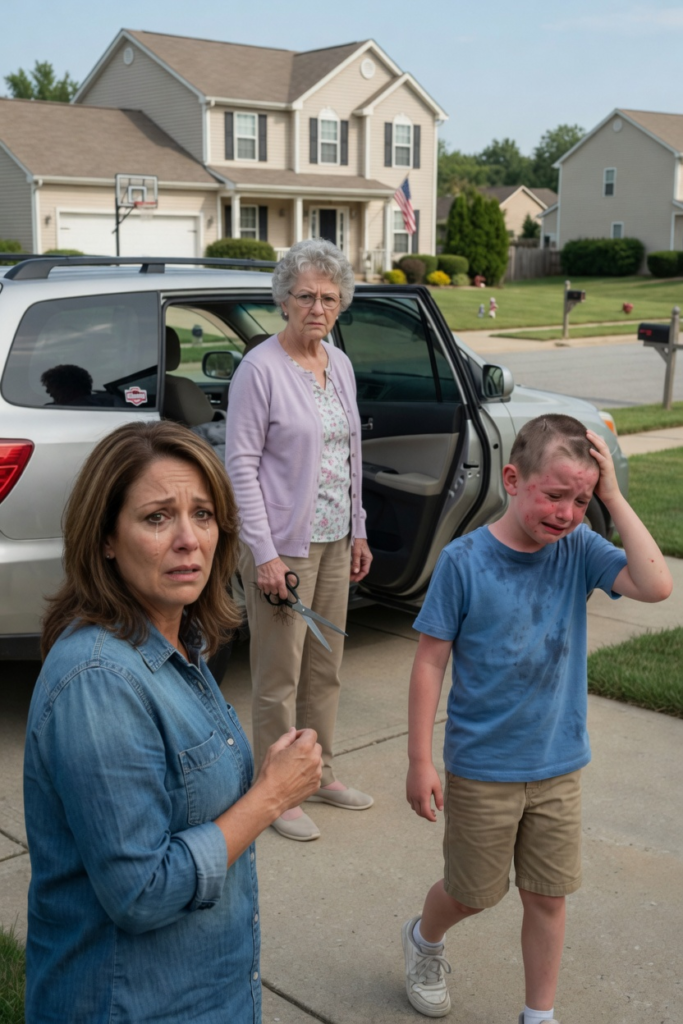
When Brenda’s car finally appeared, I was already outside before the engine fully stopped, my entire body moving before my thoughts could catch up to what I was about to see.
Leo stepped out of the back seat first, and the moment I saw his face, I knew something irreversible had already happened, something that could not be undone by apology.
He was crying silently, holding something small and golden in his clenched fist, and even before I saw his head properly, I already understood what that object represented.
One of his curls, carefully cut, still intact in his hand, while the rest of his hair had been transformed into something jagged, uneven, and disturbingly rough to look at.
His head had been shaved unevenly, as if done in frustration rather than care, with visible patches that made it look less like a haircut and more like punishment.
I stood frozen for a moment that felt much longer than it actually was, unable to reconcile the child in front of me with the child I had dropped off that morning.
“Leo… sweetheart… what happened to your hair?” I asked, though part of me already knew the answer before he even opened his mouth to speak.
His eyes were swollen, red, and full of confusion mixed with fear, and his voice broke as he answered in the simplest words that shattered everything around us.
“Grandma cut it, Mommy,” he said, and that sentence hung in the air like something too heavy for reality to carry properly without breaking apart.
Brenda stepped out of the car slowly, calm, composed, and almost satisfied, as if she had just completed a task she believed was long overdue and entirely justified.
“There,” she said, brushing her hands together lightly, as if removing invisible dust, “now he looks like a real boy,” and she smiled as if expecting agreement.
I don’t remember everything I said in that driveway, but I remember the rising sound of my voice, the disbelief, and the way Leo flinched at every sharp word.
I remember Brenda insisting I was being overly dramatic, as if the violation of my child’s body was a matter of taste rather than trust being destroyed instantly.
I remember carrying Leo inside, sitting him on the couch, and holding him tightly while he cried into my shoulder, still gripping that one curl like it was alive.
When Mark came home two hours later, everything changed again, because the moment he saw our son’s head, he stopped completely in the doorway without saying a single word.
He walked slowly toward Leo, knelt in front of him, and touched the uneven patches of hair with a gentleness that made it clear he understood something deeply wrong had occurred.
“Dad,” Leo sobbed suddenly, his small voice breaking through everything, “why did Grandma cut my promise?” and that sentence froze the entire room in a way nothing else had.
Mark’s face changed instantly, and he looked at me with a kind of silent understanding that carried both anger and calculation, as if something inside him had already been decided.
He pulled Leo into his arms and held him firmly, whispering reassurance that everything would be handled, everything would be made right, and no one would ever touch him like that again.
That night, after the children were asleep, I found Mark at the kitchen table surrounded by papers, notes, and a laptop open to what looked like carefully organized preparation.
He was writing down names, timelines, school policies, and every detail that could possibly matter later, as if he was building something precise and unavoidable rather than emotional.
When I asked him what he was doing, he finally looked up briefly and said only two words that carried more weight than any explanation could have possibly contained.
“Getting ready,” he said, and then went back to writing, leaving the room filled with a silence that felt heavier than the events of the entire day combined together.
Two days later, Brenda called as if nothing had happened, her voice bright and casual, inviting us all to Sunday dinner at her house as though time had reset itself.
She spoke about roast beef and family traditions, about gathering together, and about how it would be nice to “put everything behind us” without acknowledging anything that actually happened.
I was ready to refuse immediately, but Mark calmly took the phone from me and agreed to attend, his voice steady in a way that made me more uneasy than reassurance.
After he hung up, he told me only one thing, asking me to prepare a short video containing everything from Lily’s hospital visits to Leo’s hair and everything in between.
That was the moment I realized Sunday dinner was not about forgiveness or reconciliation, but about something far more deliberate, something carefully prepared and impossible to ignore once revealed.
On Saturday, I began compiling clips, each one carrying memories I had never thought would be used in a moment like this, while Mark worked in silence beside me.
And by the time Sunday arrived, nothing about that dinner would ever resemble a family gathering again, because some truths, once prepared properly, do not stay hidden when finally served.
Sunday arrived with an unsettling calm that felt almost insulting, as if the world itself had no idea that something irreversible was already in motion beneath the surface of a normal family dinner.
The drive to Brenda’s house was silent, except for the faint sound of the video file on my phone, carefully edited clips that felt heavier with every passing second of waiting.
Leo sat in the back seat, unusually quiet, his small hand still occasionally touching the uneven stubble where his golden curls used to live, as if checking whether it was real.
Mark drove without speaking much, but his focus was absolute, the kind of controlled silence that doesn’t come from peace, but from certainty about something already decided long ago.
When we arrived, Brenda greeted us at the door with her usual proud smile, as if she were hosting a celebration instead of walking into the consequences of her own actions.
The house smelled like roasted meat and polished furniture, but something about the atmosphere felt wrong, like a stage carefully prepared for an audience that didn’t yet know the script.
She hugged Leo briefly, but he flinched slightly, and I noticed how quickly her eyes dismissed the reaction, as if children’s discomfort was simply noise to ignore.
“Come in, come in,” she said cheerfully, guiding us toward the dining table already set perfectly, every plate aligned like she was presenting control itself.
Relatives began arriving shortly after, laughing, talking, unaware that the center of their evening was not dinner, but a truth carefully waiting to be released.
Mark placed his laptop on the dining table without a word, and the room slowly shifted as people noticed the unusual silence forming around him.
Brenda noticed it too, but she misread it completely, assuming it was some kind of reconciliation gesture, her confidence growing instead of shrinking.
“Before we eat,” Mark said calmly, his voice steady but sharp enough to cut through conversation instantly, “there’s something everyone needs to see.”
He connected the laptop to the television, and the room went quiet in a way that felt almost physical, like the air itself had tightened in anticipation.
The first image appeared: Leo on the morning of kindergarten, smiling, running, golden curls shining in sunlight that now felt like a memory stolen too soon.
Then came the school call, the confusion, the unanswered messages, the growing panic, all unfolding in silence while every person in the room watched without interruption.
Brenda shifted uncomfortably for the first time, but she still didn’t fully understand what was happening, still believing she was in control of the narrative.
The video continued, showing Leo’s return, his tears, the curl in his hand, the uneven cut, the moment innocence was physically altered without consent or explanation.
A few relatives gasped quietly, their expressions changing from curiosity to discomfort, as the reality of what they were watching became impossible to soften or ignore.

Then the screen showed Leo’s voice, recorded softly at home, asking why his “promise” had been cut, and the room went completely still.
Mark finally stood up, not raising his voice, not showing anger outwardly, but speaking with a precision that made every word feel like a formal declaration.
“This was done without consent,” he said, looking directly at Brenda, “by someone who believed control mattered more than a child’s dignity.”
Brenda tried to laugh it off at first, insisting it was just hair, just a simple haircut, something that shouldn’t be turned into “drama” or “overreaction.”
But Mark didn’t stop, calmly presenting printed records, school policy, legal boundaries, and documentation of unauthorized removal from school custody without parental permission.
The words “unauthorized” and “violation” hung in the air heavier than any accusation, because they were not emotional, they were factual and irreversible.
Leo sat beside me, watching quietly, no longer confused, only observing as the adults around him finally began to understand what had been taken from him.
Brenda’s expression slowly changed, her confidence cracking for the first time, as she realized this was no longer about opinions on hair or upbringing.
“This isn’t about hair,” Mark said quietly, stepping closer, “this is about trust, boundaries, and what happens when someone decides they know better than a child’s parents.”
The room remained frozen, forks untouched, conversations dead, as the full weight of the situation settled into every person present like something impossible to undo.
And in that silence, Leo reached for my hand, no longer crying, but finally safe in a room where the truth had been spoken out loud and could not be erased again.