THE NIGHT MY DAUGHTER WHISPERED SIX WORDS… AND EXPOSED THE MONSTER INSIDE OUR HOME
Daniel Ashford thought he understood sacrifice.
He thought working eighteen-hour days was love.
He thought million-dollar contracts were protection.
He thought paying every bill on time made him a responsible father.
Then one whispered sentence from his seven-year-old daughter destroyed that illusion forever.
“Daddy… I wrote everything down so I wouldn’t forget.”
That sentence is now exploding across parenting forums, grief communities, and social media platforms because it exposes a terrifying truth millions of people refuse to confront.
Some children are not abandoned by strangers.
They are abandoned slowly by the people who believe they are protecting them.
Daniel Ashford returned home from Chicago expecting hugs, laughter, and sleepy smiles.
Instead, he walked into a nightmare hidden behind polished floors, expensive walls, and the illusion of a successful family.
The first warning sign was almost invisible.
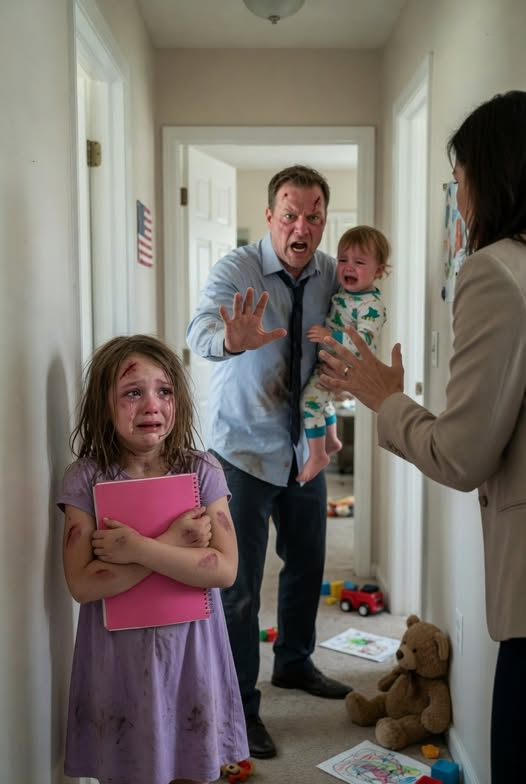
His daughter Lily didn’t run toward him.
Parents online say that detail alone shattered them emotionally because children instinctively run toward safety.
When they stop doing that, something deep inside them has already changed.
The kitchen was dim.
The overhead light buzzed weakly like it was exhausted from witnessing too much.
There was a burned smell in the air.
A snapped blue crayon lay near Lily’s foot like evidence from a crime scene nobody wanted to investigate.
Daniel noticed her immediately.
Too thin.
Too quiet.
Too careful.
Seven-year-olds are supposed to move recklessly through life.
Lily stood perfectly still like a child trained not to make mistakes.
That detail sparked outrage online because thousands of adults admitted they recognized that behavior instantly.
Not from movies.
From childhood.

Then Daniel saw Kate Morrison standing over her.
Kate was his late wife Emily’s sister.
The woman he trusted after grief destroyed his ability to think clearly.
People across social media are now debating one painful question.
How many dangerous people gain access to children because grieving families are too emotionally exhausted to notice the warning signs?
Kate reportedly told Lily something horrifying moments before Daniel walked in.
“If you tell him, he’ll send you away too.”
That single sentence changed the entire story.
Because abusive people rarely begin with violence.
They begin with isolation.
Experts in trauma communities say fear becomes most powerful when children believe truth itself is dangerous.
Once silence feels safer than honesty, control becomes easy.
Daniel dropped his suitcase.
Kate spun around instantly.
Lily flinched before Kate even moved.
That flinch has become one of the most discussed moments online.
Parents say the reaction chilled them because fear responses develop through repetition.
Children do not flinch automatically around safe adults.
But Daniel still wanted explanations.
Like many parents facing uncomfortable truths, his brain searched desperately for alternatives.
Misunderstanding.
Stress.
Grief.
Anything except abuse.
Then he heard his son coughing upstairs.
Not normal coughing.
Weak coughing.
Dry coughing.
The kind that instantly tells a parent something is wrong.
He ran upstairs and found two-year-old Owen sitting alone in his crib.
No milk.
No blanket.
A soaked diaper hanging beneath his pajamas.
When Daniel picked him up, he realized something even more terrifying.
The boy felt too light.
That detail detonated emotionally across parenting groups online.
Because neglect does not always arrive dramatically.
Sometimes it arrives quietly.
Gradually.
Until someone finally notices a child shrinking.
Daniel reportedly described the moment as the instant his entire reality collapsed.
He suddenly understood that success had blinded him.
Millions of people are now sharing the story because it touches a cultural nerve society avoids discussing openly.
Providing financially is not the same as being emotionally present.
The internet exploded into fierce debate within hours.
Some defended Daniel fiercely.
Others condemned him brutally.
One viral comment with over two million views read:
“He gave them everything except himself.”
Another commenter wrote:
“This is what happens when wealthy parents outsource love.”
That sentence alone triggered massive arguments online.
Because the story forces people to confront uncomfortable realities about modern parenting, ambition, grief, childcare, and emotional absence.
Daniel believed he was building security for his children.
But according to thousands discussing the case, children measure safety differently.
Not in salaries.
Not in square footage.
Not in expensive schools.
Children measure safety through presence.
Through tone of voice.
Through eye contact.
Through knowing someone notices when they become afraid.
And according to people analyzing every detail of the story, Lily had stopped believing anyone noticed a long time ago.
The moment Daniel saw bruises on her wrist, the atmosphere reportedly changed completely.
He stopped looking confused.
He started looking dangerous.
Readers say that emotional transition became one of the most gripping parts of the entire account.
Not because he exploded.
Because he didn’t.
He became quiet.
Parents who experienced trauma themselves say they recognized that silence instantly.
Real rage often becomes cold before it becomes loud.
Kate allegedly tried controlling the situation immediately.
“She’s lying for attention.”
That sentence caused another wave of outrage online because survivors say it reflects one of the oldest manipulations in abusive environments.
Discredit the child first.
Control the narrative before the truth surfaces.
But then something happened that changed everything.
Lily looked toward the hallway closet.
Just once.
Quickly.
Fearfully.
Daniel noticed.
Kate noticed.
And suddenly the room stopped feeling like a misunderstanding.
It felt like a countdown.
That was when Lily whispered the six words now spreading everywhere online.
“Daddy… I wrote everything down.”
Not screamed.
Not cried.
Whispered.
People cannot stop discussing why that detail hurts so deeply.
Because children who document abuse are not behaving like children anymore.
They are surviving like witnesses.
Social media users compared the moment to courtroom testimony trapped inside a child’s body.
A little girl writing secret records because she feared adults would not believe her.
That realization devastated readers worldwide.
Then Kate lunged toward the closet.
Not toward Daniel.
Not toward the children.
Toward whatever Lily had hidden.
That action alone convinced many people online the truth inside that closet had to be catastrophic.
According to people close to the situation, Daniel reached the closet first.
And what he found reportedly changed the trajectory of the entire family forever.
Inside was a small pink backpack.
Hidden beneath winter coats and shoe boxes.
Inside the backpack were notebooks.
Dozens of pages written in uneven child handwriting.
Dates.
Descriptions.
Punishments.
Threats.
One sentence allegedly appeared repeatedly across multiple pages.
“Don’t make Aunt Kate angry today.”
Another line reportedly shattered readers emotionally.
“Owen cried because he was hungry again.”
People online described needing to stop reading after that sentence.
Because hunger is not abstract when described by a child trying to protect her little brother.
But the notebook reportedly became even darker.
Lily allegedly documented punishments involving locked closets, withheld meals, insults, screaming, and threats that their father would stop loving them if they caused problems.
One page reportedly read:
“Daddy works because we are bad.”
That sentence triggered an avalanche of reactions online.
Psychologists commenting on the viral story say emotionally abused children often internalize adult neglect as personal failure.
Instead of blaming the adults who disappear, they blame themselves for needing too much.
And suddenly the internet stopped debating whether Daniel was a victim.
People started asking whether emotional absence itself can become a form of negligence.
The discussion exploded beyond the story.
Millions began sharing their own childhood experiences.
Children raised by exhausted single parents.
Children cared for by resentful relatives.
Children who learned early that survival depended on silence.
Some posts became heartbreakingly personal.
“I used to clean the house before my mom came home because I thought tired adults loved quiet children more.”
Another viral response read:
“I never got hit. But I spent my entire childhood terrified of making adults angry.”
The story evolved into something larger than one family.
It became a mirror.
And many people did not like what they saw reflected back.
Commentators began arguing over whether society romanticizes overwork while ignoring emotional abandonment happening behind closed doors every day.
Some defended ambitious parents fiercely.
Others accused modern culture of rewarding financial success while children quietly raise themselves emotionally.
The controversy intensified when details emerged about how often Daniel traveled for work after Emily’s death.

Sources close to the family claim he convinced himself staying busy prevented grief from consuming him.
But according to people analyzing the story online, work did not heal his grief.
It distracted him from it.
Meanwhile, his children were left alone with someone who allegedly weaponized their vulnerability.
Kate Morrison quickly became one of the most hated figures online.
Comment sections exploded with rage.
Thousands demanded criminal charges immediately.
Others focused on a darker issue.
How many abusive caretakers appear perfectly trustworthy because they understand exactly how to perform kindness publicly?
Neighbors reportedly described Kate as “helpful,” “patient,” and “devoted.”
That detail terrified readers even more.
Because predators rarely introduce themselves honestly.
They often arrive disguised as support.
Especially during grief.
Especially when families are desperate.
Especially when exhausted parents want badly to believe someone else can be trusted completely.
The emotional center of the story, however, remains Lily herself.
Not because she was helpless.
Because she was brave.
That distinction matters deeply to many readers.
Despite fear, despite threats, despite isolation, a seven-year-old girl created evidence because she understood something critical.
Truth disappears when nobody records it.
That realization has sparked enormous discussions about how children process trauma privately.
Experts now flooding social media discussions say abused children often become hyperaware observers.
They notice patterns adults ignore.
They remember details because survival requires memory.
Lily reportedly wrote dates beside incidents because she feared nobody would believe her otherwise.
Imagine that psychologically for a moment.
A child too young to ride roller coasters believed she needed documented evidence to prove suffering existed inside her own home.
Readers called that realization soul-crushing.
The story became even more emotional when additional details surfaced about Owen.
Sources claim Lily often hid food for her younger brother inside the bedroom they shared.
Crackers.
Fruit snacks.
Pieces of bread wrapped in napkins.
One notebook entry reportedly read:
“Owen says he’s hungry when Aunt Kate is mad.”
That sentence spread rapidly across platforms because it exposed the heartbreaking reality of children parenting each other during unsafe situations.
Many adults admitted the story unlocked memories they had buried for years.
Older siblings protecting younger siblings.
Children learning silence to avoid conflict.
Tiny acts of survival hidden from adults too distracted to notice.
One trauma therapist wrote online:
“The most heartbreaking caregivers are often children.”
That statement alone generated millions of reactions.
The debate eventually shifted toward a broader social question.
Why do people assume children are safe simply because a household appears wealthy and stable externally?
Daniel Ashford lived in a beautiful home.
The children attended good schools.
There was food in the kitchen.
Staff members moved through the property daily.
Yet according to the notebooks, terror still existed there.
The story shattered the stereotype that abuse always looks chaotic publicly.
Sometimes abuse hides inside polished homes where nobody wants to believe anything ugly could exist.
Many readers say that realization disturbed them more than any single accusation.
Because it forced them to reconsider families they personally know.
Teachers began commenting online.
Nannies.
Doctors.
Former foster children.
One elementary school counselor wrote something now being shared everywhere:
“The quiet children worry me most.”
That line alone triggered thousands of emotional responses.
People confessed they were once the quiet child.
The careful child.
The child who never wanted attention because attention often brought danger.
Meanwhile, public sympathy toward Daniel became increasingly complicated.
Some saw him as a grieving widower manipulated during emotional devastation.
Others argued wealth gave him resources many struggling parents never have, making his absence harder to excuse.
One controversial post asked bluntly:
“How many signs did those children show before someone finally looked closely enough?”
That question ignited furious arguments.
Because beneath the viral outrage lies a deeply uncomfortable truth.
Children often communicate distress long before adults recognize it.
Through behavior.
Through silence.
Through shrinking emotionally inside their own homes.
But adults frequently miss those signals because life moves too fast.
Work.
Bills.
Stress.
Grief.
Phones.
Meetings.
Deadlines.
And somewhere inside all that noise, children quietly adapt to emotional loneliness.
The story also triggered enormous debate about family trust.
Many readers admitted they automatically trust relatives around children without questioning warning signs carefully enough.
Others shared stories about abusive grandparents, cousins, step-parents, and family friends protected for years because “family would never do that.”
But according to survivors responding online, family absolutely can do that.
And sometimes family gains easier access precisely because trust arrives automatically.
Daniel reportedly contacted authorities immediately after reading the notebooks.
Medical examinations allegedly confirmed signs of neglect.
Investigators reportedly interviewed household staff members separately.
Rumors continue spreading online regarding possible criminal charges, though official details remain limited publicly.
Still, the internet remains fixated less on the legal outcome and more on the emotional implications.
Because this story does not feel distant.
It feels possible.
That is why people cannot stop sharing it.
It reaches directly into one of society’s deepest fears.
The fear that children can suffer silently nearby while adults convince themselves everything is fine.
Some readers say the most devastating moment remains Daniel realizing Lily no longer knew which version of her father would walk through the door.
That detail haunted millions emotionally.
Children should never have to calculate adult safety.
They should never study moods like survival maps.
Yet trauma experts say many children become emotional detectives early in life.
Listening carefully.
Watching constantly.
Adapting instantly.
Lily reportedly watched her father carefully after he found the notebooks because she still wasn’t sure whether truth would protect her or destroy her.
That emotional uncertainty became one of the story’s most heartbreaking elements.
Imagine being seven years old and unsure whether telling the truth will save your family or ruin it forever.
The story’s explosive popularity also reflects a growing cultural exhaustion with fake perfection online.
Beautiful homes.
Perfect family photos.
Carefully curated happiness.
People increasingly suspect many polished lives hide emotional fractures nobody discusses publicly.
Daniel Ashford represented success externally.
But internally, according to many readers, his family was emotionally collapsing unnoticed.
One viral commentator summarized public reaction brutally:
“He built a mansion while his children lived emotionally abandoned inside it.”
That sentence divided the internet instantly.
Some called it unfair.
Others called it accurate.
But everyone kept sharing the story.
Because controversy fuels attention.
And emotionally charged family stories spread faster than almost anything online.
Especially when they force readers into self-examination.
Thousands of parents admitted the story frightened them personally.
Not because they abuse their children.
Because they suddenly wondered whether they truly know what happens emotionally inside their homes every day.
One father wrote:
“I asked my daughter tonight if she feels safe telling me the truth. I realized I never actually asked before.”
That post alone received millions of interactions.
The conversation eventually expanded into grief itself.
After Emily’s death, Daniel reportedly stopped functioning emotionally and replaced connection with productivity.
Many widowed readers said they recognized that coping mechanism immediately.
Staying busy feels safer than feeling pain.
But according to therapists now discussing the viral story publicly, unresolved grief can unintentionally disconnect parents emotionally from surviving children.
Not because they stop loving them.
Because surviving becomes mechanical.
And children notice emotional distance far more quickly than adults realize.
Perhaps that explains why Lily wrote everything down instead of speaking immediately.
Maybe she no longer believed adults truly listened unless evidence existed physically in front of them.
That possibility devastated readers worldwide.
A child documenting suffering because conversation no longer felt reliable.
People continue debating what disturbed them most about the story.
The bruises.
The hunger.
The manipulation.
The emotional neglect.
But many agree the most horrifying detail was simpler than all of those.
Lily expected nobody to notice unless she proved it carefully.
That expectation did not emerge overnight.
It developed slowly.
Painfully.
Over time.
And according to millions reacting online, that reality reveals the true tragedy at the center of the story.
Not just abuse.
Isolation.
The feeling of being emotionally alone inside a house full of adults.
Daniel Ashford reportedly canceled all future travel indefinitely.
Sources claim he has withdrawn from several major business commitments to focus entirely on his children.
Online reactions to that decision remain sharply divided.
Some praise him for finally waking up.
Others argue the damage cannot simply disappear through guilt-driven parenting afterward.
That debate continues raging everywhere.
Can parents recover lost emotional trust after children stop feeling safe?
Therapists responding publicly say rebuilding trust requires consistency, patience, honesty, and time.
Sometimes years.
Especially when children learned survival before security.
Still, many readers remain hopeful for Lily and Owen because the story ended with something rare in trauma narratives.
Belief.
Daniel believed his daughter immediately once the evidence surfaced.
Survivors online say that detail matters enormously.
Many abused children spend years being doubted, dismissed, minimized, or silenced before adults finally acknowledge reality.
Lily, at least eventually, was heard.
But millions remain haunted by one impossible question.
What if Daniel had returned home one week later?
Or one month later?
Or never noticed the fear behind Lily’s silence at all?
That question continues spreading because nobody truly wants to answer it.
The story has now become more than viral drama.
More than outrage bait.
More than emotional storytelling.
It became a warning.
A warning about grief.
About emotional absence.
About the danger of assuming children are automatically safe because adults appear respectable publicly.
And most importantly, it became a warning about silence.
Children rarely announce trauma dramatically.
Sometimes they whisper.
Sometimes they flinch.
Sometimes they hide notebooks inside closets and pray someone finally opens the door before it is too late.