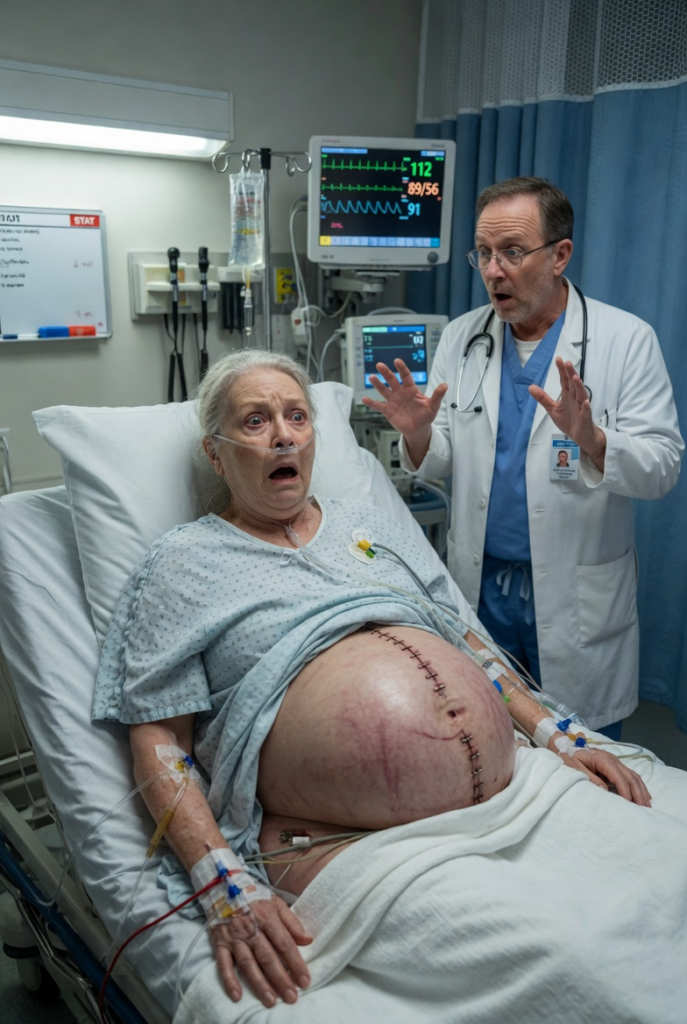
For a few seconds, no one in the room moved, and the machines beside Margaret sounded louder than they had before.
She looked from one white coat to another, trying to understand the silence gathering around her like a cold sheet.
The young doctor lowered his eyes, then looked at the older physician beside him, as if asking permission to speak.
Margaret tightened both hands around the metal rail of the bed, feeling the child inside her shift, or believing she did.
“What do you mean?” she asked, but her voice sounded smaller than she expected, almost like someone else’s.
The older doctor pulled the curtain farther around the bed, though there was no one nearby who could hear clearly.
His face was kind, and that frightened her more than if he had looked careless, hurried, or annoyed.
“Mrs. Hale,” he said softly, “we need to run another scan before we do anything else.”
Margaret stared at him, waiting for words like normal, safe, baby, soon, anything that belonged to the life she had imagined.
Instead, the doctor only touched the edge of her chart and avoided looking at her stomach for too long.
Behind the curtain, a nurse adjusted a tray, and the small metallic sound made Margaret flinch without knowing why.
She remembered folding tiny yellow clothes at home, smoothing each sleeve like it already contained a small arm.
She remembered telling the empty nursery that Grandma was coming late to motherhood, but love had waited patiently.
Now the same sentence returned in her mind, only slower, as if each word had lost its place.
The nurse named Ellen came closer and placed one warm hand over Margaret’s knuckles, not on her belly.
That small difference struck Margaret harder than any medical word could have, because everyone had touched her belly for months.
Her sister Ruth stood near the doorway, still wearing her raincoat, water dripping from the hem onto the clean hospital floor.
Ruth had driven too fast through the morning storm, worried and silent, pretending not to be afraid for both of them.
When their eyes met, Ruth gave the smallest smile, the kind people use when they are already bracing for bad news.
Margaret hated that smile because she had seen it years ago, outside clinics, after another doctor said there was no hope.
“No,” Margaret whispered, though no one had accused her of anything, and no one had yet taken anything away.
The scan room was colder than the delivery room, with pale blue walls and a humming light overhead.
They moved her carefully, too carefully, and every careful movement felt like another secret being protected from her.
The gel on her skin was cold, and Margaret stared at the ceiling tiles while the probe pressed gently over her abdomen.
She waited for the familiar flicker on the screen, the small curled shape she had expected to see again.
But the doctor’s face changed before she saw anything, and the nurse’s hand tightened around hers for one brief second.
Margaret turned her head toward the monitor and saw shadows she could not read, shapes that refused to become a child.
“Where is the heartbeat?” she asked, because that was the only question that seemed large enough to hold her fear.
No one answered immediately, and that silence did what no answer could have done; it told her something had already broken.
The young doctor swallowed, his jaw working once, and Margaret suddenly realized he was not being cruel.
He was young enough to remind her of the son she never had, and terrified enough to remind her of herself.
“We are not seeing what your previous records suggested,” he said, choosing every word as if each one could cut her.
Margaret blinked at him, then at Ruth, then at the smooth curve of her own belly beneath the sheet.
“That is my baby,” she said, not loudly, but firmly enough that everyone in the room stopped breathing for a moment.
The older doctor nodded, not agreeing, not denying, simply honoring the truth of what she had carried inside her mind.
“I understand why you believe that,” he said, and those words wounded her more deeply than a direct refusal.
Believe, he had said, as if motherhood had become an opinion, as if love could be mistaken for a symptom.
Margaret closed her eyes and heard another voice, from many years earlier, a specialist with gray eyebrows and dry hands.
“At your age later, it would be dangerous to keep hoping,” he had said, sliding papers across a desk.
She had gone home that day and put away the baby names written in an old church envelope.
Then, after decades of silence, two bold lines had appeared, and hope had returned like a visitor who knew the house.
“How many scans did you have?” the older doctor asked Ruth, because Margaret seemed unable to answer.
“Three,” Ruth said quietly. “At a small clinic near her town. The doctor said everything was unusual, but possible.”
Margaret opened her eyes quickly, because Ruth’s voice carried something she had not heard before: doubt softened by guilt.
“You never believed it,” Margaret said, and Ruth looked down at her wet shoes instead of answering.
The room seemed to stretch around them, the machines, the gloves, the screen, all waiting for one honest sentence.
“I wanted to,” Ruth finally said. “I wanted to because you were happy for the first time in years.”
Margaret’s mouth trembled, but she did not cry; crying would have made the room too real too quickly.
The doctor explained carefully that some conditions could imitate pregnancy, even causing positive tests and a growing abdomen.
He did not say the worst words all at once, perhaps because Ruth had gripped the chair until her fingers whitened.
There was a mass, he said, and fluid, and signs that Margaret’s body had been under strain for months.
They needed surgery soon, not later, because waiting could turn danger into something harder to repair.
Margaret listened, but part of her stayed in the nursery at home, beside the little wooden crib Ruth had found secondhand.
She saw the blanket folded there, pale blue though she had never learned whether the baby was a boy.
She saw the tiny socks, still joined by plastic thread, waiting with a patience that suddenly felt unbearable.

“No,” she said again, but this time the word did not sound like denial; it sounded like someone closing a door.
The older doctor gave her time, and that kindness left her with no one to fight except herself.
Ruth sat beside the bed after they returned to the room, still wearing the raincoat because she had forgotten to remove it.
Neither sister spoke for a long while, and the rain tapped against the hospital window with a steady, ordinary rhythm.
Margaret watched a droplet slide down the glass, catching light, dividing, then disappearing into the wet trail below.
“I talked to it every morning,” she said at last, not looking at Ruth, because shame had entered the room too.
Ruth reached for her hand, but Margaret pulled away, then regretted it as soon as she saw Ruth’s face.
“I know,” Ruth whispered. “I heard you once in the kitchen, telling the baby about Mom’s apple cake.”
Margaret almost laughed, but the sound caught painfully in her throat and turned into a small breath instead.
For nine months, she had been the center of gentle attention, the woman who had received a miracle too late.
Neighbors had brought soup, church ladies had knitted hats, and even strangers had smiled when they saw her belly.
Now she imagined those same faces learning the truth, lowering their voices, rearranging pity into something she could not bear.
She wanted the doctors to be wrong, not because she distrusted them, but because being wrong would save everything.
It would save the nursery, the whispered names, the birthday she had already marked secretly on next year’s calendar.
It would save her from becoming a foolish old woman who mistook illness for a child.
Ruth seemed to know exactly where Margaret’s mind had gone, because she leaned forward and spoke more firmly.
“You were not foolish,” she said. “You were lonely, and something in your body gave you the answer you wanted most.”
Margaret turned toward her then, sharply, because compassion sometimes hurts when it stands too close to truth.
“I wanted to be chosen,” Margaret said, surprising herself with the plainness of it.
The words hung between them, small and heavy, with nothing dramatic around them, only rain and hospital air.
Ruth’s eyes filled, but she wiped them quickly, as if tears would make Margaret feel responsible for one more thing.
“You were chosen by us,” Ruth said. “By me. I should have said that more.”
Margaret looked at her sister’s hand, older now, spotted and trembling, still reaching across the blanket.
For years, she had thought motherhood was the only doorway into a kind of love that stayed.
She had not noticed Ruth standing outside that doorway all along, carrying groceries, calling every Sunday, fixing loose cabinet handles.
But that did not make the empty crib easier to face, and it did not turn truth into comfort.
A nurse entered with forms on a clipboard, and the soft click of her pen sounded final in the quiet room.
The surgery consent lay across Margaret’s knees, full of sentences that seemed to belong to someone else’s life.
The doctor explained the risks gently, including words Margaret heard only in pieces: bleeding, anesthesia, emergency, survival, delay.
He said there was still time to call another physician, to ask questions, to refuse until she felt ready.
But his eyes told her what his professional caution would not say plainly: waiting was also a choice.
Margaret stared at the signature line and felt time slow until even the rain seemed to pause between drops.
In that stretched moment, she could choose the softer lie, close the folder, and keep her hands over her belly.
She could demand another scan, another doctor, another hour inside the dream where a child still waited.
Or she could choose the hard truth, sign her name, and let the hospital remove what her heart had named.
Her hand moved to her abdomen, and for one last second she waited for a movement.
There was only her own breath, uneven and tired, rising beneath her palm like an answer she did not want.
Margaret looked at Ruth, then at the doctor, then at the pen lying across the clipboard.
“My baby,” she whispered, and everyone in the room let her say it without correction.
Then she picked up the pen with fingers that shook so badly Ruth had to steady the paper.
The first letter of her name came out crooked, almost unrecognizable, but she kept writing until the signature was complete.
When she finished, she placed the pen down carefully, as if a louder sound might make her change her mind.
“Bring the blue blanket from the nursery,” Margaret said to Ruth, her voice thin but clear.
Ruth frowned, not understanding at first, then nodded slowly when she saw Margaret’s eyes.
“I don’t know what I will need it for,” Margaret said. “But I know I cannot come home to it waiting.”
The nurse turned away for a moment, pretending to adjust the curtain, giving the sisters a privacy made of silence.
Outside the room, footsteps passed, a cart squeaked, someone laughed softly at the nurses’ station, and life continued without asking permission.
Margaret lay back against the pillow and felt the weight of her choice settle over her, not as peace, but as truth.
The orderlies came for her a little later, and Ruth walked beside the bed until the hallway doors stopped her.
Before they rolled Margaret through, Ruth bent close and pressed her cheek against her sister’s hand.
Margaret did not say goodbye, because the word carried too much fear and sounded too close to d!3.
Instead, she looked at the bright ceiling lights passing one by one above her and whispered something only she could hear.
“I wanted you,” she said, to the dream, to the body, to the life she had almost believed into being.
And as the doors opened, Margaret understood that the surgery was not the hardest part waiting ahead.

The hardest part would be waking up afterward and deciding what kind of mother love becomes when there is no child.
When Margaret woke, the first thing she noticed was not pain, but the absence of the weight she had carried.
Her hands moved before her eyes fully opened, searching under the blanket with a quiet panic no nurse could measure.
Her stomach was flatter, bandaged, unfamiliar, and for one breath she felt as if the room had tilted away from her.
Then Ruth’s voice came from the chair beside the bed, rough from waiting and not sleeping.
“You’re here,” Ruth whispered, leaning forward so quickly the book on her lap fell closed.
Margaret turned her head slowly and saw her sister wearing the same raincoat over her shoulders like a blanket.
It had dried stiff at the sleeves, and somehow that small, ordinary detail made Margaret’s eyes fill first.
“How long?” she asked, because she was not ready to ask anything larger.
“A few hours,” Ruth said. “The doctor said the surgery went as well as it could.”
Margaret closed her eyes, not from relief exactly, but because relief felt too close to betrayal.
If she was relieved, did that mean she had accepted there had never been a child?
If she mourned, did that mean she still wanted to keep believing what almost cost her life?
The questions settled heavily between her ribs, beside the ache the medication could not reach.
Ruth stood, poured water into a paper cup, and held the straw to Margaret’s lips without speaking.
Margaret drank two small sips, then turned away when the hospital water tasted too clean, too real.
“Did they find out what it was?” she asked, staring at the window where late afternoon light had softened.
Ruth’s hand tightened around the cup, and that was enough to tell Margaret there was more truth waiting.
“The doctor wants to explain when you feel stronger,” Ruth said, gently, but Margaret shook her head.
“I signed the paper because I chose truth,” Margaret whispered. “Do not protect me from it now.”
Ruth sat down again, folding both hands together like a child trying not to break something.
“It was a large growth,” she said carefully. “And fluid. Your body had been reacting for months.”
Margaret listened without blinking, each sentence landing where hope had once made a home.
“The clinic should have sent you here sooner,” Ruth added. “They should have questioned the scans.”
Margaret looked at her then, and a tired sadness moved through her face.
“I questioned nothing,” she said. “I wanted their answer so badly that I stopped asking my own questions.”
Ruth opened her mouth, then closed it, because there was no simple kindness that could erase that.
For three days, Margaret stayed in the hospital, healing slowly while the world outside returned to normal speed.
Nurses came and went, cheerful but careful, never mentioning babies unless another room’s cry slipped through the walls.
Each cry reached Margaret like a thread pulled tight inside her chest, thin but impossible to ignore.
Once, she asked Ellen to close the door, then apologized so many times Ellen finally touched her shoulder.
“You do not have to be brave about every sound,” Ellen said, and Margaret remembered the sentence.
On the fourth morning, the older doctor brought a folder and sat down instead of standing over her.
That choice mattered; it made the truth feel less like a verdict and more like something shared.
He explained the test results, the delay, the strain on her heart, and the danger she had escaped narrowly.
He also explained that the small clinic had documented uncertain findings but written reassuring notes afterward.
Margaret stared at the papers, recognizing the clinic letterhead and the doctor’s familiar looping signature.
Beside one scan, someone had written, “Probable unusual late pregnancy,” as if hope could replace evidence.
Ruth made a small sound, almost anger, almost grief, and pressed a fist against her mouth.
Margaret only touched the page with one finger, tracing the ink that had carried her through nine months.
“So it was not just my imagination,” she said. “Someone helped me believe.”
The doctor’s face softened, but he did not look away from her.
“Yes,” he said. “And you also wanted to believe. Both things can be true.”
That sentence became the final door Margaret had been avoiding.
For months, she had wanted one villain large enough to hold all her shame and sorrow.
The careless clinic doctor, the misleading notes, her own loneliness, her family’s silence, all had played a part.
No single truth erased another, and that was the heaviest truth of all.
Margaret folded the paper carefully and placed it back into the folder with both hands.
“I want to file a complaint,” she said, her voice weak but steady.
Ruth looked up quickly, surprised, then nodded before Margaret could doubt herself.
“Not for revenge,” Margaret added. “For the next woman who walks in wanting good news too much.”
When she finally returned home, the house smelled of lemon cleaner and closed rooms.
Ruth had come ahead the night before, washing dishes, taking out flowers, removing cards from the mantel.