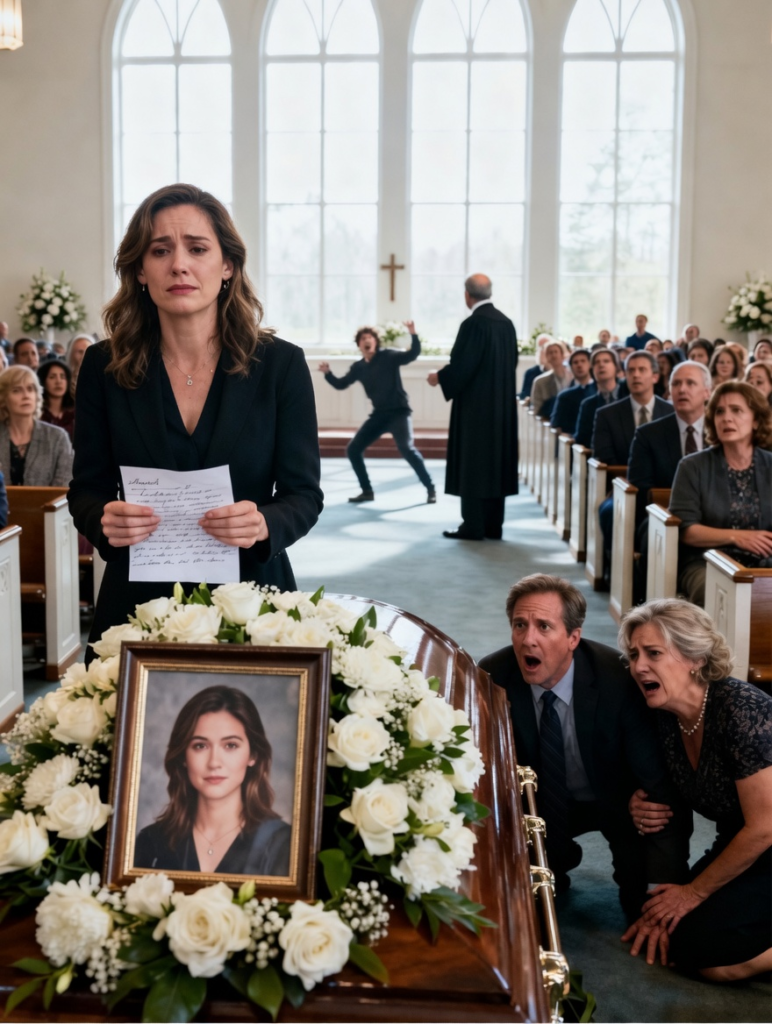
When My Younger Sister Was Taken To The Emergency Room In The Middle Of The Night, I Called My Parents Again And Again. No One Answered. They Didn’t Get To See Her One Last Time… And A Week Later, At The Funeral, Her Final Letter Named Someone Out Loud, Leaving Everyone In Silence.
Part 1
The first lie I told that night was, “They’re on their way.”
I said it to a resident in blue scrubs outside a curtained trauma bay at Memorial Hermann, and the second the words left my mouth, I hated how easy they sounded. Like I’d practiced them. Like I’d been covering for my parents my whole life and my mouth had memorized the shape.
Two hours earlier, my sister Eve had been on the kitchen floor of my apartment with one cheek pressed to the cold linoleum, her fingers hooked around the leg of a chair like she was trying not to float away. I was twenty-four, halfway through nursing school, and working enough long shifts as a patient care tech to know the difference between dramatic pain and dangerous pain. Eve wasn’t being dramatic. She was gray around the mouth, damp with sweat, and making these tiny broken noises every time her abdomen tightened.
“Food poisoning?” I asked, already knowing it wasn’t that.
She shook her head hard enough to make her ponytail slide loose. “It started this morning. I thought it would stop.”
“Why didn’t you tell me this morning?”
She squeezed her eyes shut. “Because Mom said if I came over here again this week, I was being manipulative.”
That was Eve. Nineteen years old, doubled over, still editing herself so other people could feel comfortable.
I grabbed my keys. “We’re going.”
She tried to say I should call first. She tried to say maybe we should wait. I didn’t let her finish. I slipped my arm under hers, felt how hot her skin was, and got her to the car.
I still remember every red light I ran in flashes. The dashboard clock changing from 11:41 to 11:42. The smell of old fries from the paper bag under my passenger seat. The way Eve folded inward, one hand flat over the right side of her stomach, breathing through her teeth. When I hit the railroad tracks, she made a sound that was somehow worse than a scream. It was small. Torn. The sound of somebody losing the strength to perform pain and just having it.
At the ER, the fluorescent lights were brutal. White, hard, unforgiving. There’s no softness in an emergency room at midnight, only angles and plastic and the smell of antiseptic. A baby was crying somewhere down the hall. A man in work boots was arguing with registration about his insurance card. The triage nurse took one look at Eve and called for a wheelchair before I finished saying her name.
I handled the check-in desk while they rolled her back. Name. Date of birth. Allergies. Insurance. Emergency contact.
I put down our mother’s number first. Then our father’s.
Then I called both.
Mom rang until voicemail. Dad went straight there, like his phone was on silent or he’d looked at the screen and decided not to bother. I called again. And again. Then I FaceTimed. Then I texted the family group chat: Call me now.
Nothing.
I sat in one of those hard molded chairs that always feel colder than the room and looked down at the dark specks on my jeans. Blood. Not much. Just enough to make my stomach turn. Eve had thrown up in the car, and there’d been a streak of pink in it I hadn’t let myself think too hard about.
After twenty minutes, a resident with tired eyes and a soft voice asked if I was June.
I stood so fast my chair legs scraped. “Yes. How is she?”
He took me a few steps away, which was answer enough.
“We strongly suspect a ruptured appendix,” he said. “Her white count is high, she’s showing signs of infection, and we need to get her to surgery as quickly as possible.”
I heard words the way you hear rain through a window. Sepsis risk. Perforation. Consent. Critical.
“Her parents?” he asked.
That was when I lied.
“They’re on their way.”
He nodded like that solved something and handed me a clipboard.
They let me see her for maybe two minutes before they took her upstairs.
Her hair was damp and stuck to her forehead. There was oxygen tubing under her nose and tape against the back of her hand where the IV went in. She looked younger than nineteen. Younger than she’d looked at sixteen, honestly. Pain strips people down fast. All the jokes, all the eye-rolls, all the borrowed lip gloss and cheap bracelets and little acts of defiance. Gone. Just skin and fear.
I took her hand, and her fingers moved weakly around mine.
“Hey,” I said, because I didn’t know what else to do with my voice.
She opened her eyes halfway. “Did they answer?”
I shook my head. “No. But I’m here.”
She stared at me for a second, and I felt something pass across her face that I didn’t have a name for yet. Not surprise. Not even disappointment. More like confirmation.
Then she whispered, “My backpack. Side pocket.”
“For what?”
Her mouth moved again, but the nurse stepped in then, all efficiency and apologies, and I had to move away.
I stood in the hallway and called our parents again. Twelfth time. Thirteenth. Fourteenth.
This time I left a voicemail, and hearing my own voice made me sound like a stranger. Too calm. Dry. Almost bored, if you didn’t know better.
“Mom. Dad. This is not drama. This is not one of your lectures. Eve is in the ER. She’s going into emergency surgery. Call me now.”
Then the waiting started.
There are things your brain keeps when the bigger thing is too large to hold. I remember the vending machine being out of blue Gatorade. I remember a janitor apologizing because his mop bucket squeaked too close to my shoes. I remember an infomercial playing on the mounted TV about an air fryer with a digital timer, bright and cheerful and obscene.
At 3:57 a.m., the surgeon came out.
He didn’t sit down. Doctors who have good news sit down sometimes.
“She arrested in recovery,” he said quietly. “We were able to get her back briefly, but the infection had spread further than we hoped. We did everything we could.”
The wall caught me before the floor did. That’s what I remember. My palm flat against cinder block painted beige, my mouth open and nothing coming out, the sound in my ears like someone had filled my head with water.
They asked if I wanted a chaplain. I said no.
They asked if family was coming. I said yes.
That was the second lie.
When I finally opened Eve’s backpack, my hands were shaking too hard to hold anything steady. There were gum wrappers, a charger, a paperback with a bent cover, and in the side pocket, exactly where she’d said, a folded envelope with two words written on the front in her careful blocky handwriting.
For June.
Inside were four pages of college-ruled paper.
I read the first line and had to stop because the letters started swimming. I looked down at the last page instead, maybe because I needed something smaller to survive. At the bottom, written darker than the rest, pressed so hard it nearly tore the paper, was one sentence.
If they act innocent, read this out loud.
I sat there under the hospital lights with my dead sister’s letter in my lap and a chill climbing all the way into my teeth. What had Eve known that mattered enough to leave behind like that?
Part 2
My mother called at 7:03 a.m.
I know the exact time because I had been staring at the digital clock over the nurses’ station while the sky outside the waiting room windows turned from black to that ugly Houston pre-dawn gray. My phone started vibrating in my hand before it ever rang. Mom. I looked at her name for a full second before answering.
“June?” she said, bright and breathless in that polished church-lady voice she used when casseroles were involved. “Honey, I just saw your calls. The signal was terrible where we were. What happened?”
There were waves in the background.
Waves.
I didn’t say hello. “She died.”
On the other end, there was silence so sharp it almost felt staged, like even her shock needed a second to hit its mark. Then she made a sound that might’ve been grief, except there was something else tangled in it. Fear. Calculation. The first cold gust of what will people say.
“What do you mean she died?” my father asked a second later, his voice suddenly there, flat and efficient. “What hospital? What time? Who signed paperwork?”
“Memorial Hermann.”
“How long has she been there?”
“Since midnight.”
He swore under his breath. My mother started crying harder.
I gripped the phone. “I called fourteen times.”
“June, slow down,” he said, already irritated by my tone instead of horrified by the sentence. “We were in Galveston.”
“For what?”
A beat. Too small for most people to notice. I noticed.
“We needed a night away,” he said.
I looked at the white tile floor, at my sneakers, at a little streak of dried mud near the edge of the registration desk. Needed a night away. While their nineteen-year-old daughter died in a hospital two hours north.
They got there close to ten.
My mother came in first in linen pants and a cream sweater tied over her shoulders, hair blown smooth, diamond studs still in. She looked like she’d stepped out of a beach rental ad and into a tragedy she hadn’t dressed for. My father followed in jeans, loafers, and the blue button-down he wore when he wanted people to take him seriously without feeling threatened. He smelled faintly like aftershave and hotel soap.
Mom saw me and opened her arms.
I stepped back before I even thought about it.
Her face changed. Just for a second. A crack in the glaze. Then the performance came back. “Where is she?”
I told them. They went to view the body together. I stayed in the hallway because I couldn’t do it twice.
When Dad came back out, his eyes were red but dry. He asked for the funeral home contact list and whether the hospital had started the death certificate. Mom sat down in the waiting room chair beside me and kept dabbing under her eyes with a tissue she never actually used. There was no mascara on it when she was done.
“We had no service,” she said softly, like that was the thing she needed absolution for. “If I’d known—”
“You had fourteen chances to know.”
Her jaw tightened. “This is not fair.”
I turned and looked at her. “Fair?”
For a second I saw it—the impulse to scold me. To tell me not to raise my voice. To say this wasn’t the time. My mother had always loved timing more than truth. If you said the right thing in the wrong room, she’d act like the room was the real problem.
By noon, the calls had started. Church people. Neighbors. My aunt in Dallas who only ever reached out during funerals and Christmas. My parents moved through it like they were back in familiar territory: logistics, arrangements, controlled tones, the right amount of visible suffering. Dad called the funeral home. Mom chose flowers. Somebody from church said the women’s ministry would organize meals.
I drove behind them back to Cypress and spent the whole ride gripping the steering wheel too hard, the envelope on the passenger seat beside me like it had a pulse.
From the outside, our family house looked exactly like it always had. Red brick, white trim, wreath on the front door, mums in matching black planters. The same neat suburban house that made people say things like, They have it together. The same house where nobody ever yelled loud enough for the neighbors to hear, which is not the same thing as peace.
We had rules in that house. Some were spoken, most weren’t. My mother controlled image. My father controlled silence. I was the problem child because I asked questions out loud. Eve was the easy one because she made everything softer.
When I left for nursing school at eighteen, Eve was thirteen with crooked bangs and a talent for making our mother laugh right before she turned mean. She became the buffer after I moved out. The translator. The one who took on everybody’s weather so nobody had to admit there was a storm.
People called her sunshine. They didn’t know sunshine burns itself up for a living.
That afternoon the house filled with casserole dishes and lilies and voices lowered into artificial tenderness. I carried trays from the kitchen to the dining room and watched my mother slip into mourning like it was one of her nicer cardigans. She hugged long enough. She pressed hands. She said, “We’re leaning on the Lord,” in the right places.
Nobody said, We missed her calls.
Nobody said, June was alone at the hospital.
Late that night, after the last pound cake and the last prayer and the last pair of sympathetic shoes had gone quiet in the driveway, I took Eve’s letter into the guest bathroom and locked the door.
The vanity light buzzed faintly. I sat on the closed toilet lid and read past the first page this time.
She wrote about being tired.
Tired of keeping peace. Tired of knowing things. Tired of pretending our mother’s smile meant safety and our father’s silence meant wisdom. Her handwriting stayed neat for most of it, but every few paragraphs the letters leaned harder, darker, as if the truth had weight and her pen could feel it.
Then I hit the name.
Ross Halloran.
I read it again.
Ross was my father’s business partner. He was also one of those men churches love: expensive watch, generous donor, easy laugh, wife who chaired committees, daughters in monogrammed dresses. He was always around when I was growing up. Holiday drop-ins. Barbecues. “Client dinners.” He brought bourbon for my father and those giant fruit baskets nobody actually wanted.
I stared at his name until the page blurred.
From downstairs, I heard my mother’s voice carrying from the kitchen. Low. Urgent. Then my father saying, “Not tonight.”
I went back to the letter and found the line beneath his name.
Dad told me to stay out of grown people’s mess.
My skin went cold.
The house smelled like coffee, waxy flowers, and the beef casserole Mrs. Roper had dropped off three hours earlier. Somewhere downstairs, ice clinked in a glass. I looked at Ross Halloran’s name one more time and felt the first spark catch. Whatever Eve had left me, it was bigger than one bad night, and the whole house was already soaked in it.
Part 3
I took the letter to Starbucks because I needed neutral ground.
Not my apartment with Eve’s sweatshirt still hanging over one kitchen chair. Not my parents’ house with its polished countertops and weaponized sympathy. Somewhere loud enough that I wouldn’t hear my own pulse the whole time. Somewhere that smelled like espresso and burned sugar instead of lilies.
Tasha got there five minutes late, as usual, with her giant tote bag, square tortoiseshell glasses, and a patience I did not deserve that week.
“What happened?” she asked before she sat down.
I slid the envelope across the table.
Tasha and I had been friends since sophomore year of high school, back when she wore combat boots with prom dresses just to annoy adults. She worked as a paralegal now at a probate law office downtown and had the kind of brain that naturally started labeling things evidence, timeline, motive.
She read all four pages without interrupting me once. That alone scared me.
When she got to the bottom, she laid the pages down carefully, lining the corners up like she didn’t want to bruise them.
“This isn’t a revenge note,” she said.
“What is it, then?”
Her eyes lifted to mine. “It’s a witness statement.”
I looked around the coffee shop as if somebody else might have heard that and object. A guy in scrubs was scrolling his phone by the window. A woman in workout clothes was unwrapping a banana. Life kept going with an offensively normal rhythm.
“I keep thinking maybe grief is making it look bigger,” I said. “Maybe she was upset. Maybe she misunderstood something.”
“Did Eve usually misunderstand people?”
“No.”
“Did she dramatize?”
I almost laughed. “She was the one who smoothed everything over.”
“Then trust who she was.” Tasha tapped the second page. “And make copies. Scan it. Email yourself a copy. Do not hand over the original to anyone.”
The practicalness of that hit me harder than comfort would’ve. Comfort let you collapse. Instructions made you stand back up.
I wrapped both hands around my coffee cup and stared into the dark surface. “I don’t even know what I’m looking for. Affair? Money? Some church scandal? Why would she tell me to read it out loud at the funeral?”
“Because your family lives off what stays unspoken,” Tasha said. “Public is the one room they can’t control.”
I should’ve been shocked by that. Instead I felt relief, which was uglier.
On the drive back to Cypress, I started remembering things I’d filed away as small and weird because it was easier than calling them wrong.
Ross showing up on a Sunday afternoon when Dad wasn’t home and Mom saying he was “just dropping off paperwork,” except there had been laughter in the kitchen and the kind of silence that follows bodies moving apart fast.
Eve texting me one night, Do you think people can lie by acting normal?
The time I’d come by unexpectedly and found my father in the backyard staring at the fence with a whiskey glass in his hand while Ross’s truck sat in the driveway. Dad had looked at me like I was the problem for arriving.
At the house, my mother met me in the foyer with a legal pad full of funeral notes and red-rimmed eyes that somehow still matched her lipstick.
“We need to decide what you’re wearing Saturday,” she said.
That was her first sentence.
Not I’m glad you came. Not have you eaten. Not I miss her too. What are you wearing.
I stepped around her and headed for the stairs. “I’m going to Eve’s room.”
“Not right now.”
I turned. “Why?”
“She wouldn’t want people going through her things.”
“She left me a letter.”
My mother’s face went still. Not frozen. Still. Like a pond when something dangerous moves underneath it.
“What letter?”
“Nothing you need to worry about.”
That landed. I watched it land.
“June,” she said, voice tightening around my name, “this week is not about old grievances.”
I laughed then, one sharp, ugly sound. “That’s convenient.”
She started toward me, all gentleness threaded tight with control. “Your sister is gone. We need to stay united.”
Unified was my mother’s favorite word when she meant obedient.
I went upstairs anyway.
Eve’s room still looked like a nineteen-year-old had only stepped out for ten minutes. Half-open mascara on the desk. A chipped mug with dried pens inside. Hoodie on the bedpost. The little vanilla body spray she used too much sitting on her dresser beside a Polaroid of us from last summer, sweaty and squinting at the county fair.
I sat on the edge of her bed and opened the top drawer of her desk.
Ticket stubs. Hair ties. A receipt for gas. A folded church bulletin with doodles in the margins. Nothing. But the room itself felt changed now that I knew she’d been carrying something alone. Every object looked like it might be evidence if I just stared hard enough.
By evening, the house had filled again. Men from church in loafers and grief faces. Women with foil pans and stories about Eve as a child. I helped refill the coffee station because it was easier than screaming.
Then the doorbell rang, and the entire current of the room shifted before I even saw him.
Ross Halloran stood in the foyer in a navy suit with his wife beside him, both holding expressions of polished sorrow. His wife, Dana, had a cream silk scarf tied at her neck and the kind of posture expensive women wear like armor. Ross had gone gray at the temples in a way some people would call distinguished. I had the sudden irrational urge to throw something at his face just to see if he’d still look so composed with coffee down his tie.
My father crossed the room fast. Too fast.
“Ross. Dana. Thank you for coming.”
Ross hugged him. One solid clap on the back. His eyes moved over Dad’s shoulder and landed, for the briefest second, on my mother.
She was standing by the dining room archway holding a stack of paper plates.
I have never believed more in instinct than I did in that second. Something went through the room that had nothing to do with grief. It was quick and sour and familiar, like the smell of milk just before it turns.
My mother looked down too late.
Dana kept one hand lightly on Ross’s arm as if she belonged there and had every right to. Maybe she thought she did. Maybe she was just better at acting than the rest of us.
Ross started toward me with condolences already forming on his mouth.
I stepped back before he could touch me.
His eyes narrowed, barely, then smoothed out again.
Across the room, my mother set the paper plates down too hard, and one of them slid off the stack onto the floor.
That was when I knew Eve hadn’t died carrying one secret. She had died carrying enough truth to blow open an entire room, and Ross Halloran had just walked straight into it.
Part 4
The night before the funeral, I slept in my childhood bedroom for the first time in six years.
Slept is generous. I lay on top of the comforter with my shoes off and my phone plugged in beside me, listening to the house breathe. Old houses don’t really breathe, but family houses do. They settle. They creak. They hold on to footsteps and arguments and the kind of silence that has edges.
Around midnight, I heard voices downstairs.
At first I thought it was the TV, but then I recognized my mother’s whisper, sharp enough to cut. I slipped out of bed and opened my bedroom door.
The hall was dark except for the little amber night-light near the linen closet that my mother had kept there since I was ten. I moved barefoot to the top of the stairs and stopped where the banister shadow covered me.
My parents were in the kitchen.
Only the under-cabinet light was on, casting everything in that soft yellow glow that makes even ugly conversations look warm from a distance.
“This has gone too far,” my mother said. “She’s punishing me.”
My father had both hands braced on the counter. “Then maybe stop talking like you’re the victim.”
I nearly laughed at the irony of hearing him say that after a lifetime of silence, but the laugh died fast.
“She had no right to leave something like that,” Mom snapped.
“She was nineteen,” Dad said. “And scared.”
“She was dramatic.”
There it was. The family word for any feeling that disrupted the furniture.
Dad dragged a hand down his face. “You should never have let Ross come around so much.”
My mother made a sound of disbelief. “I let him? Mark, don’t rewrite this now. You’re the one who needed him every time the books got tight.”
Books.
The back of my neck prickled.
My father lowered his voice, but not enough. “Keep it down.”
“No. I’m done keeping it down. Eve should have stayed out of it.”
I gripped the banister so hard the wood bit my palm.
My father looked toward the staircase then, maybe feeling something shift. I stepped back into darkness before he could see me and waited until their voices dropped to a blur again. My whole body felt awake in the worst possible way, like every nerve had been plugged into a live socket.
I went back to my room and locked the door.
Then I read the letter all the way through.
Not skimming this time. Not stopping when it hurt. Line by line. The full weight of my sister’s last act.
She wrote that the first time she noticed something was wrong, our mother had come in from the garage smelling like Ross’s cologne instead of her own perfume. She wrote about seeing them kiss in the pantry one afternoon when she came home early. She wrote that when she told Dad, he didn’t even look surprised. He just sat at the kitchen table with his reading glasses halfway down his nose and said, Stay out of grown people’s mess.
She wrote that Ross had started showing up on weekends when “client dinners” ran late. That once, in the garage, she heard him tell Mom, If June ever sees the books, she’ll burn the whole house down.
That sentence sat on the page like a lit match.
There was more. So much more. About Mom smiling for church photos fifteen minutes after screaming at Eve for “making faces.” About Dad disappearing into work whenever conflict required a spine. About how lonely it was to know the truth in a house where truth counted as betrayal.
Then, halfway through the third page, one line gutted me.
I came to your apartment because I was tired of being useful to people who don’t love me correctly.
I had to put the letter down.
The room smelled faintly like dust and the strawberry lip balm Eve used in high school. My throat felt packed with gravel. I thought about her showing up at my place three days earlier with a backpack and a shrug, saying Mom needed “space,” and me letting that explanation pass because we were all so used to translating damage into smaller words.
At seven the next morning, the house kicked into funeral mode.
Coffee brewing. Shower running. Garment bags zipping. My mother in the mirror drawing on the face she wore for public pain. My father on the phone with somebody from church about flowers and parking and how many people they expected.
Nobody mentioned the kitchen conversation.
Nobody knocked on my door to ask whether I’d slept.
At ten, I took the letter and drove to a twenty-four-hour copy shop off Barker Cypress.
The place smelled like toner, stale carpet, and overheated plastic. A college kid with a lip ring was behind the counter eating Cheetos out of a cup. He didn’t look up when I walked in.
I fed Eve’s pages into the copier one by one and watched the bright scanning bar move under her handwriting. Her words became duplicates with every mechanical slide. Evidence multiplied. Grief turned portable.
I made eight copies.
One for me. One for Tasha. One for the pastor. One for Ross’s wife if she asked. One for the church board because I knew exactly which deacon’s wife would call it a prayer concern by sunset. Extras because I was done being outnumbered.
I slid the copies into a manila envelope and tucked the original inside my bag between my wallet and a pack of tissues.
When I got back to the house, my mother was in the foyer fastening pearl earrings.
She looked at my purse. “Please tell me you’re not planning to do anything impulsive.”
“What would count as impulsive?” I asked. “Telling the truth before or after the casseroles?”
Her mouth went tight. “Today is about honoring Eve.”
“No,” I said. “Today is about who she really was.”
For the first time all week, something like fear crossed her face without getting cleaned up fast enough.
She stepped closer, voice dropping. “Do not make a scene in that church.”
I thought of the hospital chair. The blood on my jeans. Fourteen unanswered calls.
Then I looked at my mother’s pearls, her pressed black dress, her careful face, and realized I was past the point of wanting peace more than honesty.
I slid the manila envelope deeper into my tote and headed for the door. By then I wasn’t deciding whether to tell the truth anymore. I was only deciding how loud it needed to be.
Part 5
Our church always smelled like coffee, lemon polish, and old hymnals.
Even on funerals.
Maybe especially on funerals.
By the time we got there, the parking lot was already filling with dark cars and low voices. Men in black jackets stood around with paper cups and solemn faces. Women hugged in the entrance under the stained-glass window of Jesus with one hand lifted toward heaven. It was the kind of place built to make grief look respectable.
Eve’s framed senior photo sat at the front near the white lilies, the one where her braces were finally off and she’d smiled like she was surprised by her own face. Somebody had chosen soft piano music. The air-conditioning was too cold. The fabric of my dress stuck lightly behind my knees every time I sat down.
My mother took the seat to my left in the front pew. My father sat on my right. Tasha was two rows behind us, close enough that I could feel her there without turning around.
People came by in waves.
“She was such a light.”
“We’re praying for your family.”
“God’s timing is hard to understand.”
I nodded at all the right places and thought, God didn’t miss fourteen calls. My parents did.
Then I saw Ross and Dana Halloran walk in together.
Dana wore dark green instead of black, which somehow made her stand out more. Ross had his arm low at her back, guiding her down the aisle with that expensive, practiced gentleness men like him use in public. My father stood to greet them. My mother did not.
Ross’s eyes flicked toward me once and away. Dana followed the glance, then looked at my mother. Something small sharpened in her face.
Good, I thought. Maybe I’m not the only one who’s been paying attention.
The service started with music, then a prayer, then the pastor talking about Eve’s sweetness, her bright spirit, her generous heart. None of that was false. It was just incomplete. The kind of incomplete that becomes a lie if you leave it alone long enough.
I kept one hand inside my tote, fingertips resting on the folded copy of the letter.
When the pastor finished his remarks, he said, “The microphone is open now for family if anyone would like to share.”
My mother shifted beside me. I could feel it. The inhale. The heel adjustment. The readiness.
I stood first.
For one half second, the world narrowed to the sound of my own pulse and the soft thud of my shoes on church carpet.
At the pulpit, I adjusted the microphone because my hands needed something to do.
The room went very still.
I looked at Eve’s photo. Then at the rows of people. Then at my parents.
“I didn’t bring a prepared speech,” I said. My voice sounded strange at first, like it belonged to somebody calmer than me. “I’m here to read what my sister left for me before she went to the hospital.”
“June,” my mother said sharply from the front pew. “Not now.”
It was amazing how quickly a lifetime can condense into one decision.
For the first time in my adult life, I ignored her in public.
I unfolded the pages.
The paper shook once, then steadied.
“If you’re hearing this,” I read, “it means I either ran out of courage or ran out of time.”
A current went through the room. Tiny movement. Fabric shifting. The awareness people have when they realize they are no longer at a normal funeral.
I kept going.
Eve’s words filled the sanctuary in my voice. She wrote about being tired of carrying grown-ups’ lies. About how heavy it was to know things and still be expected to smile in family photos. About how our mother cared more about appearances than truth, and how our father treated silence like wisdom when really it was cowardice with nicer clothes on.
I saw my father go rigid.
My mother whispered my name again, this time with warning in it.
I read louder.
“When I told Dad what I saw, he said to stay out of grown people’s mess.”
Someone near the middle rows let out a breath too hard.
Dana Halloran’s head turned, slowly, toward Ross.
My eyes dropped to the next paragraph, and for just one second, I understood exactly why Eve had wanted this done in public. Because truth inside a family turns into debate. Truth inside a church becomes witness.
“Mom thinks nobody sees what she’s doing with Ross Halloran,” I read.
The name hit the room like broken glass.
Dana stood up so fast the pew creaked.
Ross’s face drained, not all at once, but in visible stages, as if blood were reconsidering its loyalty to him. My mother rose halfway and hissed, “That is a lie.”
I didn’t stop.
“But I saw enough,” I read, “and Dad knows enough.”
My father was on his feet now. “June.”
I stepped back from the edge of the pulpit before he could reach me.
Tasha was there before he got a full stride in, not touching him, not making a scene, just appearing beside the front pew with that particular stillness some women have when they’re done being polite.
The pastor said my name, softer than my father had, but he didn’t take the microphone from me.
Maybe some part of him knew that if he did, it would only confirm everything.
I read the next line, and my own throat tightened around it.
“I’m tired of being the wall holding up everybody else’s house.”
That one landed differently. Not scandal. Not gossip. Recognition. Enough people in that room had spent years pretending around somebody they loved. Enough people knew exactly what it felt like to be useful while disappearing.
Dana took one step into the aisle without looking away from Ross.
I finished the letter clean. No shaking. No stumbling. I gave Eve her full voice. Every line she had trusted me to carry.
At the bottom, I read her last instruction exactly as she’d written it.
“If they act innocent, read this out loud.”
Then I lowered the paper.
Silence.
Not church silence. Not respectful silence. The other kind. The kind that comes right after a structure cracks and everybody is listening to see if the rest of it will follow.
My mother moved first. “You humiliated this family.”
Ross said, “This is outrageous.”
Dana turned to him so fast her scarf slipped loose at one end. “What did she mean by doing?” she asked.
“No,” Ross said, too quickly.
Then Dana looked at me.
Not at my mother. Not at my father. At me.
And in a voice sharp enough to cut through every flower and prayer in that room, she asked, “What money was she talking about?”
My fingers tightened around the pages, because suddenly the affair didn’t look like the whole fire anymore. It looked like smoke, and somewhere underneath it, something bigger had already started burning.
Part 6
The service never really ended. It broke apart.
That’s the best way I can describe it. It didn’t conclude with a prayer and people filing out in orderly grief. It split at the seams. Clusters formed. Voices rose. The sanctuary turned into a room full of people trying to decide whether to stay Christian or get honest.
Dana Halloran didn’t wait for Ross to answer her inside the church. She followed him into the aisle.
“What money?” she said again.
Ross lowered his voice, which is what guilty men do when they think volume is the problem. “Dana, not here.”
“Here is perfect.”
The pastor stepped down from the platform and tried that gentle hand-out gesture preachers use when they want conflict to remember there are casseroles outside. It didn’t work.
My mother was suddenly beside me, nails digging into my wrist just hard enough to hurt.
“You selfish little—”
I looked down at her hand.
Maybe it was the hospital. Maybe it was the letter. Maybe it was simply that death had burned away the last layer of fear I used to wear around her. Whatever it was, I peeled her fingers off me one by one.
“Don’t touch me,” I said.
She looked stunned. Not by the words. By the fact that I’d said them where people could hear.
My father came up on my other side, face red, jaw locked. “You do not know the whole story.”
“I know I called you fourteen times.”
“That has nothing to do with—”
“It has everything to do with this.”
Outside in the parking lot, the late-morning heat hit like a wall. Texas grief always has bad timing with weather. The sun was bright, the wind was warm, and my sister was still dead. It made the whole day feel crueler.
People gathered in little islands between cars. Heads close. Eyes sharp. Church gossip moves fast, but righteous gossip moves like lightning.
Dana cornered Ross by a black SUV near the curb. I couldn’t hear every word, only pieces carried by the wind.
“Don’t lie to me.”
“…not what you think.”
“Books. What books?”
My father started toward them, and Dana shoved his hand away before he even touched her elbow.
That image stayed with me. Her green dress. His outstretched hand. The refusal.
My mother came after me again by the side entrance, away from the crowd but not far enough that she’d lose witnesses if she needed them.
“You chose your sister’s funeral to attack me.”
“No,” I said. “I chose your audience.”
Her whole face twisted. Grief, rage, embarrassment, some final desperate wish to get me back under control.
“You have always judged me.”
I laughed, and this time it came out mean. “I wanted you to answer the phone.”
For the first time, she didn’t have a response ready.
Tasha steered me toward my car before anybody else could get close enough to grab at me with scripture or family values. We drove to my apartment in silence except for the air conditioner rattling and my own breathing, which kept coming too fast.
Inside, the place still held Eve everywhere. Her mug by the sink. Her phone charger plugged into the wall by the couch. A pair of socks of hers balled under my coffee table because she always kicked them off halfway through movies.
Tasha set the envelope on my kitchen counter and went straight for plates. “Have you eaten?”
“No.”
“Then today’s menu is trauma pizza.”
We ordered pepperoni because Eve always stole the little curled slices off the top first, and somehow that felt like a terrible idea and the only possible one at the same time.
About twenty minutes later, my phone lit up with an unknown number.
I let it ring once before answering.
“This is Dana Halloran.”
Her voice had changed since church. Less public steel. More exhaustion.
I sat down slowly. “Okay.”
“I need to ask you something, and I need you to answer me honestly.” A breath. “Did your sister say anything else about money?”
I looked at Tasha. She was already reaching for a pen.
“Only one line,” I said. “That Ross told my mom if I ever saw the books, I’d burn the house down.”
Dana went quiet long enough that I thought the call had dropped.
Then she said, “Can you meet me?”
An hour later we were in a diner off I-10 where the booths were red vinyl and the coffee tasted like punishment. Dana arrived wearing giant sunglasses and no wedding ring.
She slid into the booth across from us and pulled a folded stack of papers out of her tote.
“I thought he was having an affair,” she said without preamble. “I did not know he was stupid enough to mix it with business.”
She spread the papers across the table.
Credit card statements. Expense reports. Transfer summaries. Halloran Development. Mark Benson Consulting. Church capital fund reimbursements. A Galveston beach rental charged as a client retreat. Spa services billed under hospitality.
My stomach dropped lower with every page.
“Where did you get these?” Tasha asked.
“Ross syncs everything to the home printer because he thinks women don’t look at paperwork.” Dana’s mouth went thin. “I look at paperwork.”
One transfer in particular had a note attached: emergency bridge. Another: donor outreach. The dates lined up with weekends Ross had been “around” more.
“This isn’t clean,” Tasha said quietly.
“No,” Dana replied. “It isn’t.”
I stared at the numbers until they stopped feeling like money and started feeling like motive. The affair had been ugly. The affair had been betrayal. But this—this was structure. This was reason to protect, deny, ignore, bury.
I thought of Eve in the garage. Eve in the pantry doorway. Eve overhearing more than anybody realized.
And suddenly my sister’s letter looked different.
Not smaller. Sharper.
Back at my apartment, Tasha spread the statements across my kitchen table between two cold slices of pizza and tapped one transfer with her nail. “The affair was the match,” she said, “but whatever sits underneath these numbers is the pile of dry wood.”
I looked at Eve’s backpack on the chair by the wall and felt a fresh wave of dread rise cold through my chest. If she had known this much, what else had she been carrying while everybody called her dramatic?
Part 7
Three days after the funeral, I tried to wash the blood out of Eve’s backpack.
I don’t know why that was the task my brain chose. Grief makes you weirdly domestic sometimes. You can’t process death, but you can scrub canvas over a sink and pretend that counts as control.
The backpack was black nylon with one busted zipper pull and a little silver keychain shaped like a moon hanging off the strap. Eve had bought it at a school bookstore because it looked “less depressing” than the standard ones. I turned it inside out at the kitchen sink, picked lint out of the seams, sprayed stain remover on the dark patches, and found my fingers catching on something stiff in the lining of the side pocket.
At first I thought it was cardboard.
Then I felt the edge of a phone.
My pulse went wild.
I took a seam ripper from my junk drawer and carefully opened the inside lining of the pocket. A cracked iPhone slid out wrapped in one of Eve’s fuzzy socks.
I sat down hard at the table.
That was why she’d said side pocket.
The letter had been the first thing. This was the second.
The phone was dead, of course. I plugged it in with the charger from her nightstand and waited while the black screen slowly bloomed to life. When the passcode came up, I tried her birthday first. Wrong. Then mine.
The screen opened.
I cried then. Not loud. Just sudden and hot, because of course she’d used my birthday. Of course.
The home screen photo was us in a gas station mirror from last summer, both of us making disgusted faces because the fluorescent lighting made everybody look haunted. Seeing her alive like that for one stupid second almost undid me.
I started with Messages.
There were dozens of threads. Me. Friends. Group chats full of memes and screenshots. Mom. Dad.
The thread with my mother was a minefield of normal things wrapped around bruises. Grocery lists. Bible verses. What time are you home? Then long gaps. Then sudden sparks.
Three weeks before Eve died:
I’m not crazy. I saw what I saw.
Mom: Stop snooping and focus on school.
Two weeks before:
My stomach hurts again.
Mom: You always feel worse when you’re upset.
Six days before:
Can I stay with June a few nights?
Mom: Running away does not make you mature.
I scrolled until my hands started sweating.
Then I found the thread from the night she died.
10:17 p.m.
Eve: It hurts really bad.
10:18 p.m.
Eve: I think I need a hospital
10:19 p.m.
Mom: We are out of town.
10:19 p.m.
Eve: June can drive me but please call
10:22 p.m.
Mom: Do not start with this tonight.
The kitchen around me went silent in a way I can’t really explain. The refrigerator was still humming. A car still passed outside. But something inside me went completely still.
I kept reading.
10:41 p.m.
Eve: I’m not starting anything
10:41 p.m.
Eve: I can’t stand up straight
No answer.
11:08 p.m.
Eve: Please call. June says ER.
No answer.
There was a screenshot saved in Photos a few minutes later, maybe because Eve had known she needed proof. In the screenshot, my mother’s message sat there in blue and gray like poison in a pretty bottle.
If this is about Ross again, delete my number for the weekend.
I set the phone down and pressed the heels of my hands into my eyes until stars burst.
Tasha came over that night with Thai takeout and one look at my face told her everything.
I handed her the phone without speaking.
She sat cross-legged on my couch, braid falling over one shoulder, and read in total silence. When she got to the screenshot, her mouth opened a little and stayed that way.
“She saw it,” I said. My voice sounded scraped raw. “She knew Eve was sick, and she thought it was blackmail or drama or both.”
Tasha locked the phone and put it down very gently. “There’s more on here.”
There was.
Voice memos.
Most were short. Whispered. Recorded in bathrooms, parked cars, once from what sounded like Eve’s closet with hangers clicking softly in the background.
“I’m recording this because if I don’t, they’ll say I’m confused.”
“That was Ross in the garage again.”
“Dad told me to let adults handle adult things, which is his favorite way of making cowardice sound mature.”
“My stomach hurts all the time now. Mom says anxiety can mimic pain. I think pain can also mimic being ignored.”
I had to pause that one and get up and walk to the sink because I thought I might throw up.
The oldest memo was from almost two months earlier. Eve’s voice was quieter in it, like she still half-expected someone to rescue the story before it became this one.
“If anything happens,” she whispered, “June will know what to do. She’s the only one who doesn’t ask me to smile first.”
After Tasha left, I sat alone at the table with the phone plugged in beside me, glowing faintly in the dark kitchen. At 11:08 p.m., forty-nine minutes before I drove Eve to the ER, my mother’s phone had lit up with my sister begging for help. And when I opened the next screenshot and saw that final message about Ross, I understood with sick clarity exactly how alone Eve had been that night.
Part 8
My father asked to meet at a diner off Highway 290, the kind of place with laminated menus, cracked sugar dispensers, and waitresses who call everyone sweetheart whether they like you or not.
He texted: We need to talk like adults.
I almost didn’t go just because of that sentence.
But there are some truths you need to hear with your own ears before you can bury them properly. So I went.
He was already in a booth when I got there, coffee in front of him, jacket folded beside him, looking like every respectable middle-aged man who has ever mistaken composure for innocence. He stood when he saw me. I didn’t hug him.
“You look tired,” he said.
I sat down. “You look like you slept.”
His mouth flattened. He slid a menu toward me. I left it there.
For a minute we let the waitress pour water neither of us touched.
Then he leaned forward, lowering his voice. “This has gone too far.”
I laughed softly. “That phrase again.”
“Your mother made mistakes.”
“Plural. That’s something.”
He ignored that. “Ross and your mother—” He stopped, swallowed. “It was wrong. I know that.”
I waited.
He rubbed at the table edge with his thumb. “My business took a hit last year. Bigger than I let on. Ross helped keep things afloat.”
“So you traded your spine for accounts payable?”
His jaw flexed. “Watch your mouth.”
“No.”
That landed between us like a thrown plate.
He stared at me a long time, maybe waiting for the old version of me to blink first. She didn’t show up.
Finally he said, “I knew there was…something. I also knew that if it blew up publicly, we would lose the company, the house, everything. I was trying to contain the damage.”
I thought about Eve on my kitchen floor, sweating through her T-shirt while he contained damage in a beach house.
“She texted Mom that she needed a hospital,” I said. “She said it hurt so bad she couldn’t stand up straight.”
His eyes shifted. Tiny. Almost nothing. It was enough.
“She was often upset,” he said carefully. “Your mother thought—”
“Do not finish that sentence.”
He sat back.
For the first time since the funeral, he looked older to me. Not because guilt had transformed him. Because once you see the structure of a person’s weakness, it stops looking like authority and starts looking like decay.
“The trip to Galveston,” I said. “What was it really?”
He exhaled through his nose. “Ross wanted to discuss next steps before the church finance meeting.”
I felt my whole face go cold. “So while Eve was texting that she needed a hospital, the three of you were workshopping a scandal response?”
“It was not like that.”
“It was exactly like that.”
The waitress appeared to ask if we wanted pie. Neither of us answered fast enough, and she retreated with the expression of someone who knew family when she saw it and wanted no part of ours.
Dad reached into his jacket and pulled out an envelope. Thick. White. He set it on the table and nudged it toward me.
“What is that?”
“Money.”
I stared at him.
“For the scholarship,” he said. “Your mother said you were trying to start something in Eve’s name. Let me help.”
The ugliness of it almost impressed me. Not because it was a bribe disguised as support. Because he seemed to think I might still be the sort of daughter who would be relieved by a check.
“I don’t want your money.”
“June, be reasonable.”
“I am being reasonable.” I pushed the envelope back without touching it. “You don’t get to buy language after you tried to bury it.”
His face hardened. “You are destroying this family.”
I stood up. “There wasn’t enough family left to destroy.”
He grabbed the envelope before it slid off the table. “If you walk away now, don’t expect to come back and rewrite everything from your point of view.”
I leaned down, close enough to smell coffee and aftershave and the stale fear underneath both. “It’s not my point of view,” I said. “It’s what happened.”
I left him there with the untouched pie menu and the envelope and his precious idea of containment.
That afternoon I went back to the house because I still had a key and I wanted the rest of Eve’s things before my mother could curate them into a safer version. The place was quiet. No church women. No casseroles. Just the air-conditioning and the distant tick of the grandfather clock in the hallway.
Eve’s closet was almost empty now. My mother had already boxed up some clothes for donation, which made me furious in a way I couldn’t fully explain. Even in death, they were editing.
I pulled down the last plastic storage bin from the top shelf and found an accordion folder underneath, wedged behind old SAT prep books and a broken lamp.
The tab read EVE COLLEGE.
My stomach dropped before I even opened it.
Inside were statements for her savings account, scholarship letters, and one printed transaction sheet from the bank. I sat cross-legged on the carpet and read until the words started shaking.
Over the previous eight months, the account had been drained in pieces. Not huge amounts at once. Enough to avoid notice if the person you were stealing from was nineteen and trusted her parents. Transfers labeled temporary family need. Reallocation. Emergency bridge. The receiving account matched one on the statements Dana had shown me.
My father hadn’t just protected a lie. He had taken Eve’s future and fed it into the same machine.
At the bottom of the folder was a sticky note in Eve’s handwriting.
I asked Dad where it went. He said family money is still family money.
I sat there on the floor of my sister’s emptying closet with the folder in my lap and the late sunlight striping the carpet, and something inside me finally stopped hoping either of my parents had a lower bottom than this. My father had pushed that envelope toward me like it was generosity. In the back of Eve’s closet, I found the thing he’d hoped I never would.
Part 9
My mother came to my apartment on a Thursday night wearing no lipstick.
That’s how I knew she was losing control.
Lorraine Benson without lipstick looked unfinished in a way that almost made me pity her. Almost. Her hair was still blown out, but not freshly. Her cardigan had one button wrong. She carried her purse tucked too tightly under her arm, like she expected somebody might try to take it.
I had just gotten home from a twelve-hour shift and still smelled faintly like hand sanitizer and hospital cafeteria coffee. I opened the door, saw her face, and considered closing it again.
Instead I said, “You have five minutes.”
She flinched, just a little. “May I come in?”
“No.”
So we stood there in the hallway under the buzzing apartment light while somebody down the corridor fried onions and a dog barked behind another door.
My mother looked past me into the apartment, probably seeing Eve everywhere the way I still did. The folded blanket on the couch. The vanilla body spray on the shelf. The scholarship draft papers on the table.
“Your father told me you found some documents,” she said carefully.
“He lies badly. You should know.”
Her mouth tightened. “You think you understand everything because you have pieces.”
“I understand enough.”
“You never did like me.”
It was almost funny, how quickly she dragged the knife toward the old wound instead of the fresh one.
“This isn’t about being liked,” I said. “This is about you choosing yourself over your daughter. Repeatedly.”
A pulse jumped in her cheek.
“You have no idea what this family demanded of me.”
I looked at her then, really looked. The chipped edge of one manicured nail. The faint lines cut deep around her mouth. The exhaustion she couldn’t powder over anymore. There was a story there, probably. Sacrifices. Resentments. A marriage built on bargain after bargain until there was nothing left but debt and image.
But grief had burned away my appetite for excuses.
“You’re right,” I said. “I don’t know everything. I know Eve texted that she needed a hospital. I know you replied, Do not start with this tonight.”
She inhaled sharply.
I went on before she could build a softer version. “I know you told her to delete your number for the weekend if it was about Ross again. I know you saw my calls and didn’t pick up.”
For one suspended second, her whole face changed. Not into innocence. Into nakedness. The kind that happens when a person realizes the lock is broken and the door is already open.
Then she said it.
“I thought she was trying to corner me.”
No tears. No trembling. Just flat truth, finally stripped of decorations.
I stared at her.
“She’d been threatening to tell you,” Mom said. “She kept acting like she held some terrible power over all of us. Ross’s wife was there. We were in the middle of—” She stopped, caught herself, but it was too late. “I looked at the phone and I thought, not tonight. Just not tonight. I was going to call back.”
The hallway felt suddenly too narrow for air.
“You turned the phone face down,” I said.
She didn’t answer.
Which was answer enough.
That image entered me like a blade. My name on the screen. Eve’s name. The calls stacking. My mother’s hand turning the phone over so she could go back to wine or lies or whatever mattered more in that moment than a child in pain.
“Say it,” I said.
“June—”
“Say what you did.”
Her chin lifted, old reflex, old pride. “I made one terrible choice.”
“No,” I said quietly. “You made a pattern. That night was just the first time somebody died from it.”
For the first time all evening, her composure cracked. “Do you think I don’t suffer? Do you think I sleep?”
I felt something in me go very cold and very calm.
“I don’t actually care how you sleep.”
The words landed so hard she stepped back.
Good.
She looked at the scholarship papers on my table again. “You’re using her against me.”
I almost smiled at the perversity of that. “No. I’m making sure at least one thing with her name on it helps somebody.”
“She was my daughter.”
“And you let her think she was a nuisance.”
My mother swallowed. Her eyes went to the floor for half a second, then back up with one last reach for control.
“If you do this scholarship, if you keep repeating this story, there will be no coming back from it.”
“There already isn’t.”
She stood there another moment, maybe waiting for me to soften. Maybe waiting for the old family script to kick in and put me back where I belonged: apologizing for my tone while they apologized for nothing.
Instead I opened the door wider and said, “Your five minutes are up.”
Something old and furious flashed through her eyes. “After everything I did for you girls—”
I cut her off. “Get out.”
She left without another word.
When the stairwell door shut behind her, the sound echoed all the way down the hall.
I closed my apartment door and leaned against it, shaking. Not because I doubted myself. Because certainty has its own aftershock.
Then I went to the kitchen table, sat down under the warm pool of light from the hanging lamp, and finished the application for the Eve Benson Nursing Scholarship. Tasha had already lined up the nonprofit paperwork. One of the surgeons from Memorial Hermann had sent an anonymous donation after hearing the story through hospital grapevine channels. We had enough to help one student the first year. That was enough to begin.
Outside, a siren rose and faded into Houston traffic.
Inside, the apartment still smelled faintly like vanilla and printer paper.
My mother had finally told the truth in her own ugly voice: she had seen the calls, seen the names, and turned the phone face down anyway. I stared at Eve’s name at the top of the scholarship form until the letters steadied, and for the first time since the funeral, I felt relief arrive without asking permission.
Part 10
The fallout moved faster than grief and slower than gossip.
Gossip starts before lunch. Consequences take paperwork.
Within three days of the funeral, Ross Halloran was off the church finance committee. By the next week, Dana had filed for legal separation. By the end of the month, somebody on the church board had apparently decided the numbers deserved a closer look, because my father’s business partner stopped returning calls and then started returning them through attorneys.
My mother stopped posting on Facebook.
No more pumpkin-porch photos. No Easter table settings. No filtered selfies captioned grateful through the storm. Their silence online was louder than most people’s shouting.
I heard pieces through other people because that’s how small suburban disasters spread. Mrs. Roper told Tasha’s aunt that Ross was “taking a sabbatical.” A deacon’s wife told my cousin in Dallas that my father was “under a lot of spiritual attack.” A woman from church texted me that she was praying for restoration, which was a nice church word for please put the scandal back in the box.
I did not answer.
Instead, I worked.
I picked up extra shifts. I finished clinical hours. I learned how to insert a Foley without bruising dignity, how to smile at scared patients without promising what medicine couldn’t give, how to go home after twelve hours of other people’s emergencies and sit quietly with my own.
For a while, sleep came in broken pieces. I’d wake up thinking I heard my phone vibrate. Or I’d smell antiseptic somewhere random and be back in that waiting room with the vending machine and the air fryer infomercial and the blue Gatorade slot sitting empty like a joke.
But the body wants to live, even after grief tries to teach it otherwise.
Little by little, things got less sharp.
Not easier. Just less likely to cut when I touched them.
Tasha and I launched the scholarship with a community college nursing department because Eve had been talking about healthcare before everything got messy. She said she wanted a job where people either told the truth or bled if they didn’t. Very Eve. Very nineteen.
We kept the first ceremony small. A classroom with beige walls, fluorescent lights, and folding chairs that squeaked when people crossed their legs. Nothing elegant. Nothing church-polished. Just real.
I wore a navy dress because black no longer felt like the only honest color.
On the front table sat a little acrylic sign with Eve’s name on it and a framed photo of her laughing, not the senior portrait from the funeral. This one had been taken at my apartment two months before she died. Her hair was up in a messy knot, she had mascara smudged under one eye, and she was pointing a wooden spoon at me because I’d burned garlic bread.
That was the face I wanted remembered. Not polished. Alive.
The first recipient was a woman named Marisol who was thirty-one, had two kids, and cried when she realized the scholarship would cover her final semester fees. She kept saying, “I can breathe now,” like breathing had become expensive.
When they asked if I wanted to say a few words, I stood up holding a notecard I never looked at.
“My sister knew what it was like to be unheard,” I said. “This scholarship is for students who plan to hear people the first time.”
My voice held. Barely.
Afterward, people came up with soft smiles and practical questions and stories about who they hoped to become. It was the first time since Eve died that hearing her name in public didn’t feel like reopening a wound. It felt like building a bridge out of the wreckage.
A surgeon from Memorial Hermann came quietly near the end, shook my hand, and said he was glad something good existed in her name. He never confirmed he was the anonymous donor, and I never asked. Some kindnesses don’t need signatures.
That night, back at my apartment, I lined up the leftover cupcakes in my fridge and laughed because Eve would have called them “sad little church desserts” even though this wasn’t church and they were honestly pretty good.
Then my phone buzzed.
Dad.
A voicemail.
I almost deleted it without listening. Then I thought of all the voices I had ignored in my head and hit play.
“June,” he said, and my stomach tightened at the sound of him. He sounded tired. Smaller. “We’re selling the house. There are some of Eve’s things here. Your mother thinks they should stay packed. I thought you might want them. If you’re going to come, come this week. One last time.”
One last time.
I sat at my kitchen table in the glow from the stove light with Eve’s scholarship program beside my elbow and listened to the message twice.
The old house. The red brick. The hall night-light. Her room. All the places where truth had sat in corners waiting for someone to stop calling it rude.
I looked over at Eve’s backpack hanging on the chair.
The first scholarship check had gone out that morning, and for the first time since that night, saying her name in public hadn’t felt like bleeding. Then my father asked me to come back to the house one last time, and I knew endings liked to test you before they settled.
Part 11
The house looked smaller when I came back.
Not physically, maybe. The same brick. The same white trim. The same crape myrtle in the yard shedding pink petals onto the driveway. But without the illusion of family holding it up, the place had shrunk into what it always was: drywall, mortgage, staging.
A FOR SALE sign stood by the curb.
I parked behind my father’s Silverado and sat in my car for a minute with the engine off, looking at the front door. I could still picture Eve at fifteen leaning out of that doorway with wet hair, yelling that Mom was timing the shower. I could picture myself at eighteen hauling boxes to college and pretending freedom didn’t feel like guilt with nicer packaging.
I went inside anyway.
The entryway smelled like cardboard and Pine-Sol. Half the framed photos were gone from the walls, leaving pale rectangles where sunlight hadn’t hit. The console table by the stairs was bare except for a bowl with two loose keys in it.
My mother stood in the dining room beside three taped boxes.
She had lost weight. Not the flattering kind people congratulate. The hollow kind. Her pearls were gone. So was the fixed smile. She looked at me like she wanted to cross the room and didn’t trust the ground.
“Hello, June.”
I nodded. “I’m here for Eve’s things.”
My father came in from the kitchen carrying a folder. He looked older than I remembered from the diner, as if consequences had a way of drawing the actual map under his face. No jacket this time. No business voice. Just a man in shirtsleeves standing in an emptied house.
“We separated the boxes,” he said. “These are hers.”
I looked at the boxes. Eve’s handwriting was still on one of them from when she’d packed for college orientation stuff: books, misc, do not let mom reorganize. The sight of that nearly buckled me.
Mom folded her hands together. “We’ve been talking about what to say.”
That phrase almost made me laugh. Of course they had been talking about what to say. Even now.
I cut her off gently. “Then don’t.”
A muscle flickered in Dad’s jaw. “June, we know we failed her.”
I waited.
He swallowed. “And we failed you.”
My mother’s eyes filled suddenly, violently, as if tears had been building pressure behind a wall. “I would do anything to take that night back.”
I thought of the hallway outside my apartment. Her voice saying, I thought she was trying to corner me. I thought of the screenshot. The face-down phone.
“You can’t,” I said.
“I know that,” she whispered.
“No,” I said, looking at her directly. “I don’t think you do.”
Silence spread through the room.
The grandfather clock was gone, but I still heard it in memory.
Dad set the folder on the table. “There’s paperwork here. Final statements. We thought maybe you should have them.”
I didn’t touch it yet.
My mother took one step closer. “I know you may never forgive us.”
There it was. The thing everybody had been circling all along. Forgiveness. As if the right spiritual vocabulary could turn a collapse into a lesson.
I kept my voice calm because calm hurt more.
“You’re right,” I said. “I won’t.”
Mom closed her eyes.
Dad looked at me like he had expected pain and gotten a verdict instead.
“I’m not saying that to be cruel,” I went on. “I’m saying it because it’s true. Eve is dead. She died after asking for help from people who were supposed to answer. You don’t get to use time or apologies or religion to turn that into something softer. I can build a life. I can stop carrying this. But I am not forgiving you.”
My father sat down slowly in one of the folding chairs by the wall, all the authority leaking out of him at once.
My mother pressed her hand over her mouth and nodded, once, like even she could hear there was nothing to argue with.
I picked up the folder then, slid it under my arm, and reached for the nearest box.
At the door, my father said my name.
I turned.
For one strange second, he looked almost like the man I used to want a father from. Not the one I had. The other imaginary one children invent because reality is too expensive.
“I did love her,” he said.
I believed he believed that.
It changed nothing.
“Not correctly,” I said, and went out.
I drove first to the cemetery.
The grass was bright from a morning watering cycle, and the air held that wet-earth smell that always reminds me of spring whether I want it to or not. Eve’s stone was simple. Her name. Her dates. A small etched moon because I’d insisted on it.
I sat on the grass with one of her boxes open beside me.
Inside were things that could break you for their ordinariness: a hoodie, two bracelets, her old sketchbook, the vanilla body spray, a spiral notebook full of half-finished class notes and grocery lists and one doodle of me with angry eyebrows.
I laughed and cried at the same time, which felt about right.
Then I took out her letter.
The original. Creased now. Softer at the folds. Still heavy.
I read the last page in the sunlight with no microphone, no audience, no perfume and politics in the pews. Just me and the stone and a breeze moving through the cemetery trees.
If they act innocent, read this out loud.
“I did,” I said.
My voice sounded small out there, but steady.
“I did, Eve.”
I sat there a long time after that, not waiting for a sign, not trying to turn grief into wisdom. Just being with what was left.
By the time I got back to my car, the sun was lower and my phone had two missed calls from an unknown number I did not return. I drove past the highway turnoff to Cypress without slowing. I did not go to whatever townhouse or rental or reduced little life my parents were moving into. I did not help them carry boxes. I did not translate their regret into redemption.
That night Tasha came over with takeout and paper plates, and we ate on my couch with the scholarship folder open on the coffee table. Marisol had texted a photo of her new scrubs. I pinned it to the fridge.
Before bed, I put Eve’s letter back into a cedar box in my closet. I traced her name once with my thumb and closed the lid.
People like to talk about forgiveness as if it’s the only clean ending. It isn’t. Sometimes the clean ending is a closed door. Sometimes it’s refusing to become the wall that holds up other people’s lies. Sometimes it’s building a good life anyway and not inviting the people who taught you silence to decorate it.
I didn’t forgive my parents.
I buried my sister, told the truth, built something in her name, and walked away.
A year later, when the anniversary came, I turned my phone off before dark, sprayed a little of Eve’s cheap vanilla perfume into the warm air by my apartment window, and let the scent drift out over Houston.
Then I went back inside to the life I had made without them, and I never looked back.
THE END!