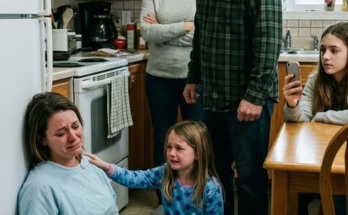
For three years, Daniel let the world believe he had rescued his wife.
He liked that version because it made him look generous. He had married a quiet woman with no parents nearby, no dramatic friends, and no habit of correcting him in public.
To Daniel, that meant she had nowhere to go.

His mother, Evelyn, believed the same thing. She wore silk robes before noon, drank tea she never brewed herself, and treated kindness like a weakness to be trained out of a woman.
Their house was enormous, polished, and cold.
Marble floors. Tall windows. A chandelier that glittered above the kitchen island as if beauty could excuse anything that happened underneath it. Guests praised the place, and Daniel accepted every compliment like he had built it himself.
He had not.
The deed carried his wife’s maiden name above his. The bank called her first. The safe in the study held papers Daniel mocked but never bothered to read.
That was how he survived so long.
He mistook silence for ignorance.
At first, his temper came disguised as stress. A slammed cabinet. A cruel joke. A hand gripping her wrist too tightly when she answered him in a tone he disliked.
Then came the first slap.
He cried afterward. He swore it would never happen again. Evelyn told her it was best not to embarrass a husband by making him apologize twice for the same mistake.
That was when the tiny recorder appeared under the kitchen sink.
It was no bigger than a thumb. She placed it behind a basket of cleaning cloths and checked it when she could. Six months passed. The red light kept blinking.
Daniel never noticed.
He noticed coffee brands, dinner temperatures, the crease of napkins, and whether his wife smiled quickly enough when his mother entered the room.
He noticed anything that gave him permission to be cruel.
The argument that changed everything began with a grocery bag on the counter.
Rain beat against the tall windows that evening, turning the glass black and silver. The kitchen smelled faintly of roasted beans, dish soap, and Daniel’s whiskey when he pulled the coffee tin from the bag.
He stared at the label.
His wife knew before he spoke that he had found the wrong thing.
“It was the only brand they had,” she said.
Daniel turned slowly, as if she had confessed to a crime.
Evelyn sat at the island in her silk robe, stirring tea she had not made herself. Her eyes sharpened with the private pleasure of watching trouble arrive.
Daniel lifted the tin.
“This is what you bought?”
“It’s coffee,” his wife said.
The first slap snapped her face sideways.
The second landed so hard her wedding ring cut the inside of her cheek when her hand flew up too late. Pain flashed white behind her eyes.
The third came before she could taste the blood.
All because she had bought the wrong brand of coffee.
Daniel stood over her in the marble kitchen, breathing like a man who had won something. His shoulders rose and fell. His mouth curled with the satisfaction of being obeyed by fear.
Evelyn sighed.
“Look at her,” she said. “Still staring like a wounded animal.”
The wife did not cry.
Her bare feet were cold against the marble. Her cheek burned. Inside her mouth, the taste of copper spread slowly and bitterly beneath her tongue.
Daniel grabbed her chin.
“Answer me when I speak.”
She looked at him. Calmly. Too calmly, maybe.
“It was coffee,” she said.
His eyes narrowed.
“It was disrespect.”
Then came the fourth slap.
The sound cracked through the house, not loud the way violence sounds in movies, but clean and sharp and final. The chandelier glittered above them like nothing ugly could happen beneath it.
Evelyn smiled into her cup.
“A wife must be corrected early, Daniel. Your father understood that.”
That sentence mattered.
It did not come from anger. It came from permission. From inheritance. From a family that had practiced cruelty long enough to call it tradition.
Daniel leaned closer.
She could smell the whiskey on him, sour and warm, mixed with the copper in her mouth and the rain-wet air leaking around the window frame.
“Tomorrow morning, I want breakfast ready,” he said. “A real one. No attitude. No cold face. No pretending you’re better than this family.”
Better than this family.
She almost laughed.
For three years, they had mocked her plain dresses. They had mocked her small office, her quiet hours, and her habit of locking documents in the study safe.
They never asked what kind of documents.
They never asked why the bank called her, not Daniel.
They never wondered why the deed to the house had her maiden name printed above his.
That night, she washed the blood from her mouth.
The bathroom light was too bright. It showed everything. The swelling along her cheekbone. The purple heat blooming beneath the skin. The little split inside her cheek where the ring had cut her.
Her hands did not shake.
From the bedroom, Daniel’s laughter drifted through the half-open door. He was on the phone, voice lazy with victory.
“Yeah,” he said. “She learned her lesson. By morning she’ll be begging.”
She looked at herself in the mirror.
The woman staring back looked bruised, but not broken. Exhausted, but not surprised. Quiet, but no longer undecided.
She opened the cabinet beneath the sink.
Behind the folded cloths, the tiny recorder waited exactly where she had left it. The red light blinked steadily.
Six months of evidence lived inside that machine.
The first slap. The apologies. The threats. Evelyn’s advice. Daniel’s voice teaching her that violence was not a mistake in that house.
It was policy.
She touched her cheek once.
Then she made three calls.
The first was to her lawyer.
He did not sound shocked. Good lawyers rarely do. He listened without interrupting while she described the incident, the recorder, the deed, and the conversation Daniel had just had in the bedroom.
“Do not confront him tonight,” he said. “Do not warn him. Keep everything exactly as it is until morning.”
She said she understood.
The second call was to the bank.
That conversation was shorter. The officer knew her voice immediately. He had always known who signed what, who owned what, and who had quietly protected the family accounts while Daniel played master of a house that did not belong to him.
“We can be there in the morning,” he said.
The third call was to Daniel’s biggest mistake.
For a long moment before dialing, she stood in the dark hallway with the phone in her hand. Rage moved through her, but it had gone cold. Cold was safer.
Cold could plan.
She did not sleep.
Instead, she cooked.
By dawn, the kitchen smelled of butter, black coffee, warm bread, roasted herbs, and sausage browning in a cast-iron pan. Rain softened into a gray drizzle at the windows.
She moved quietly from stove to table.
Silver trays. Crystal glasses. Polished forks. Linen napkins folded with care. She made the kind of breakfast Daniel believed he deserved from a wife he thought he had finally trained.
Every dish had a purpose.
Not to apologize.
To keep him smiling long enough to walk into the room without suspicion.
Evelyn came down first.
She paused at the dining room entrance and took in the feast. Her face relaxed into satisfaction, as though the bruising on another woman’s cheek had produced the proper domestic result.
“Well,” Evelyn said, smoothing the sleeve of her robe. “Maybe you can learn.”
The wife said nothing.
That silence pleased Evelyn even more.
She sat near the side of the table, lifting her tea cup with a small victorious smile. She did not see the leather file beside the lawyer’s plate because he had not been seated yet.
She did not see the bank folder beneath a folded napkin.
She did not notice the extra place set at the far end.
Daniel came downstairs last.
His hair was damp from the shower. His robe hung open at the throat. He looked rested, entitled, and pleased with himself before he even reached the dining room.
Then he smelled breakfast.
He smiled.
It was the smile of a man who believed fear had become obedience.
He stepped into the room, looked at the trays, the bread, the coffee, the polished glasses, and then at his wife’s bruised face.
“It’s good that you’ve finally come to your senses!” he said.
The words landed exactly where she expected them to.
Then Daniel saw the guests seated at the table.
Her lawyer sat with his hands folded beside a leather file. The bank officer placed a document folder near his plate. At the far end sat the one person Daniel never expected her to call.
The room changed.
Not loudly. Not with shouting. It changed the way a lock changes when the key turns.
Daniel’s smile faltered first.
Evelyn’s spoon stopped halfway to her mouth. The crystal water glass near her hand caught the morning light and shook against the table as her fingers trembled.
The bank officer looked down at the folder.
The lawyer did not blink.
No one reached for the food.
Nobody moved.
For the first time since the night before, Daniel seemed to understand that the breakfast had not been made for forgiveness.
It had been made for witnesses.
The lawyer opened the leather file.
Inside were copies of the deed, bank records, photographs of injuries, written notes, and a small device sealed in a clear evidence bag.
The recorder.
Daniel’s face lost color.
Evelyn looked at it, then at her son, then at the bruised woman sitting at the head of the table. Her silk robe suddenly looked less like elegance and more like costume.
The recording began with Daniel’s voice.
“Answer me when I speak.”
Then came the slap.
No one in that room needed imagination after that.
The sound filled the dining room, clean and sharp and final. The same chandelier that had glittered above the violence now glittered above the proof.
Evelyn’s own voice followed.
“A wife must be corrected early, Daniel. Your father understood that.”
The bank officer closed his eyes briefly.
The lawyer wrote something down.
Daniel reached for anger because anger was the only tool he had ever trusted. But it did not fit the room anymore.
“Turn that off,” he said.
His wife looked at him.
“No.”
It was the smallest word she had said all morning.
It was also the first one he could not slap out of her.
The person at the far end of the table finally spoke. Their presence was the call Daniel had never imagined she would make, the mistake he thought had stayed buried safely outside the walls of that house.
Daniel gripped the back of a chair.
The breakfast sat untouched between them. Steam rose from the coffee. Butter melted into the bread. The house smelled warm and expensive and ruined.
In the weeks that followed, the documents did what shouting never could.
The house remained in her name. The accounts Daniel believed he controlled were frozen and reviewed. The recorder became part of a larger file.
Daniel tried to explain.
Then he tried to deny.
Then he tried to blame his mother, the whiskey, the stress, the marriage, and finally the woman he had hit for making him look bad.
None of it changed the sound on the recording.
Evelyn stopped wearing silk to meetings.
She learned that advice given over tea can sound very different when played back in a room full of people who understand evidence.
The wife moved through the process slowly, carefully, and with the kind of restraint nobody in that family had ever respected because they had confused it with weakness.
But restraint had saved her.
It had kept her alive long enough to document the truth. It had kept her quiet long enough for Daniel to reveal himself. It had kept her steady long enough to turn a breakfast table into the first place he could not control.
She did not become cruel.
She became free.
Months later, she still remembered the kitchen smell from that night: rain, whiskey, copper. She remembered the cold marble under her feet and the chandelier pretending nothing ugly could happen beneath it.
But she also remembered the morning after.
Butter. Coffee. Warm bread. Gray light on silver trays. A lawyer’s open file. A bank officer’s quiet judgment. Daniel standing in the doorway as his confidence drained out of his face like water.
The world had called her quiet.
Daniel had called her corrected.
But that morning proved what he should have known from the beginning: silence is not surrender, and a woman who does not shake may already be holding the keys.