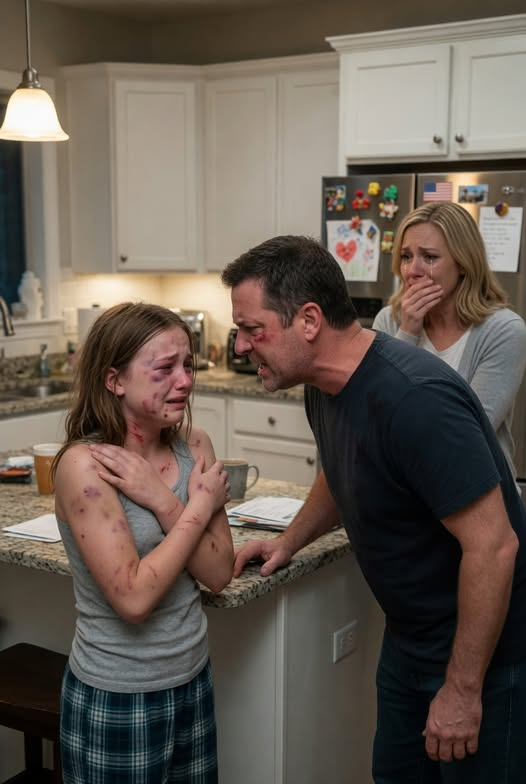
The Doctor Saw the Bruises My Mother Tried to Hide… and One Quiet 911 Call Destroyed the Man Everyone Else Called a Hero
The first thing people need to understand is this:
My stepfather never hit me because he was angry.
He hit me because he enjoyed watching fear crawl across my face.
That is what makes this story harder for people online to accept.
Society loves the idea that monsters look monstrous.
But men like Richard Holloway survive because they smile too easily in public.
Because they shake hands firmly.
Because they volunteer at church barbecues.

Because neighbors describe them as “great family men” while someone inside their home quietly learns how to survive another night.
For sixteen years, I believed silence was the price of staying alive.
Then one emergency room doctor looked at the bruises around my neck and realized the truth my mother kept trying to bury.
That single phone call shattered everything.
And when the truth exploded online later, millions of people argued over the same terrifying question:
How many children are still trapped inside homes that look completely normal from the outside?
My name is Lily Holloway.
And this is the story my mother begged me never to tell.
People online eventually called it “The Staircase Lie.”
Because every time Richard hurt me badly enough to leave visible injuries, my mother repeated the same sentence like it was a religious ritual.
“She fell down the stairs.”
The first time I remember hearing it, I was eight years old.
Richard had slammed my head against a bathroom sink because I forgot to fold towels correctly.
Blood poured from my eyebrow onto my pajamas while my mother wrapped ice inside a dish towel with shaking hands.
At the urgent care clinic, she smiled nervously and told the receptionist I slipped after taking a bath.
I still remember the receptionist glancing at me strangely.
Even then, adults knew something looked wrong.
But nobody pushed hard enough to stop it.
That became the pattern of my childhood.
Teachers noticed bruises.
Neighbors heard shouting.
Friends asked why I flinched whenever someone moved too fast near me.
But every explanation somehow sounded believable enough.
Richard understood exactly how far he could go without destroying the illusion.
That is the part people online debated endlessly later.
Was my mother a victim?
Or was she an accomplice?
Millions of comments flooded every platform once my story spread.
Some people defended her.
Others called her more horrifying than Richard himself.
Because she watched everything happen.
And she stayed.
I wish I could tell people the answer is simple.
It isn’t.
Fear changes people.
Fear turns intelligent women into shadows who whisper apologies instead of calling police.
Fear teaches children to study footsteps like weather patterns.
Fear becomes the wallpaper inside the house.
You stop noticing it because it surrounds you every second.
Richard controlled every room he entered.
He smelled like whiskey, sawdust, sweat, and stale cigarettes.
When he came home angry, the entire house changed temperature.
Even the dog hid.
Especially the dog.
One night he kicked our Labrador so hard the animal limped for weeks.
Then he laughed while eating dinner.
That laugh still follows me in nightmares.
It sounded normal.
That was the terrifying part.
It sounded like every other man laughing during every other ordinary dinner.
People think evil announces itself dramatically.
Most of the time, it sounds casual.
Richard loved humiliating me in front of other people.
At family gatherings, he mocked my clothes.
He called me stupid.
He joked that I was “too sensitive.”
Everyone laughed awkwardly because confronting him felt uncomfortable.
And people will do almost anything to avoid discomfort.
That realization changed how millions of readers reacted when my story eventually exploded across social media.
Because suddenly strangers began remembering moments they ignored in their own lives.
The nervous child at a birthday party.
The bruised coworker who kept changing explanations.
The woman whose smile disappeared whenever her husband entered the room.
My story became bigger than me.
It became a mirror.
And people hated what they saw inside it.
The night Richard broke my arm began like many other nights.
Rain hammered the windows.
The television blasted political arguments from the living room.
My mother smoked cigarettes near the back door while pretending not to cry.
I washed dishes quietly, trying to disappear into routine.
Richard had lost another construction contract earlier that afternoon.
That usually meant somebody would suffer.
He stumbled through the front door around nine o’clock.
I knew immediately how drunk he was by the sound of his boots.
Heavy.
Uneven.
Dangerous.
He threw his keys across the kitchen counter hard enough to crack a ceramic bowl.
Then he stared at me.
Not speaking.
Just staring.
That silence frightened me more than screaming.
“Look at me when I’m talking to you,” he suddenly snapped.
I turned too slowly.
His fist slammed into my cheek.
Pain exploded through my face.
I crashed sideways into the counter while dishes shattered onto the floor.
Richard laughed.
Actually laughed.
“You still conscious?” he asked.
My mother appeared in the hallway wearing an oversized gray sweater.
Her mascara had already smeared beneath her eyes.
“Richard, stop,” she whispered.
Not yelled.
Whispered.
That tiny detail still destroys people when I tell this story publicly.
Because abuse survivors recognize that voice instantly.
The exhausted voice of someone who stopped believing resistance changes anything.
Richard smirked at her.
“You hear your mother?” he sneered.
“She thinks I’m too hard on you.”
Then he grabbed my wrist.
I tried pulling away.
That made him angrier.
His fingers tightened.
He twisted violently.
Then came the sound.
CRACK.
Not like movies.
Real bones breaking sound wet and horrifying.
My scream echoed through the kitchen while my forearm bent unnaturally sideways.
For one second, even Richard looked shocked.
Then the mask returned.
Cold.
Controlled.
Calculating.
My mother grabbed her purse instead of holding me.
“We’re going to the hospital,” she said flatly.
“And you fell down the stairs.”
Richard leaned close enough for me to smell bourbon on his breath.
“Tell the story right,” he whispered.
But something had changed inside me that night.
Because Richard didn’t know I had already started documenting everything months earlier.
That revelation later became the detail social media users discussed obsessively.
How does a sixteen-year-old secretly collect evidence against the man terrorizing her?
The answer is heartbreakingly simple.
Survival teaches children skills nobody should ever need.
Seven months before my arm broke, one of my teachers assigned a photography project.
Most students photographed sunsets.
Pets.
Football games.
I photographed bruises.
At first, I didn’t even know why.
Maybe I just needed proof that the violence was real.
Abuse distorts reality.
Eventually victims begin doubting themselves.
Maybe it wasn’t that bad.
Maybe I deserved it.
Maybe I am too dramatic.
So I started recording everything.
Photos hidden inside cloud folders.
Voice recordings captured through my cracked cellphone.
Dates.
Threats.
Pictures of broken furniture.
Pictures of bruises turning from purple to yellow.
Pictures of fingerprints around my throat.
Every file became another silent scream.
I never truly believed anyone would save me.
But part of me wanted evidence left behind if Richard finally killed me.
That sentence horrifies people online every time they read it.
Because children should never think that way.
Yet millions quietly admitted they once did.
The hospital smelled like antiseptic and coffee.
Rainwater dripped from my shoes onto the emergency room floor.
My mother kept squeezing my shoulder too tightly while repeating instructions under her breath.
“Stairs.
You slipped.
Don’t make this worse.”
The nurse barely looked up initially.
Probably another busy night.
Another injured teenager.
Another exhausted parent.
But then the doctor entered.
Dr. Michael Reyes.
I will remember his face forever.
Not because he looked heroic.
Because he looked careful.
Observant.
Human.
He examined my arm quietly while asking routine questions.
Then his expression shifted.
He noticed bruises hidden beneath my sleeves.
Then the fading marks around my throat.
Then the way I flinched whenever my mother moved suddenly.
He asked her to step outside during the X-ray.
That was the first moment all night I could breathe properly.
When we were finally alone, he lowered his voice.
“Did somebody hurt you?” he asked.
I froze.
Nobody had ever asked directly before.
Not like that.
Not while looking me in the eyes.
I opened my mouth.
Nothing came out.
Because fear rewires your body.
The truth can feel physically dangerous.
Dr. Reyes nodded slowly.
Then he said something that changed my life forever.
“You are not in trouble.
But I need you to understand something.
What’s happening to you is not normal.”
I started crying immediately.
Not dramatic sobbing.
Just silent tears sliding down my face while years of terror collapsed inside me.
He quietly stepped outside the room afterward.
Then he called 911.
That moment became legendary online later.
People called him “The Doctor Who Refused To Look Away.”
Thousands tagged emergency room workers while sharing my story.
Some medical professionals admitted they still think about the children they failed to save.
Others revealed how often abuse hides behind ordinary excuses.
Sports injuries.
Falling downstairs.
Walking into doors.
The internet exploded into arguments about mandatory reporting laws.
About broken systems.
About how society rewards silence until silence becomes deadly.
Meanwhile, back inside that hospital room, I had no idea my entire life was about to explode.
Police arrived within minutes.
My mother panicked instantly.
I watched the color drain from her face when officers entered the hallway.
She kept insisting there had been a misunderstanding.
She repeated the staircase story again.
Again.
Again.
But lies become fragile once evidence enters the room.
The officers photographed my injuries.
They asked separate questions.
My mother’s timeline kept changing.
Then one officer noticed bruises in different healing stages.
That changed everything.
Because one accident cannot explain months of violence.
Eventually a female officer sat beside me while my mother argued with police near the nurses’ station.
She handed me bottled water.
Then she asked quietly:
“Do you feel safe going home tonight?”
No child should need time to answer that question.
But I did.
Because home was the only world I understood.
Terrifying.
But familiar.
Finally, I whispered:
“No.”
That one word destroyed Richard Holloway’s carefully constructed image forever.
Police drove to our house immediately afterward.
What they found shocked even experienced officers.
Broken picture frames.
Holes punched through doors.
Blood stains on basement concrete.
Empty whiskey bottles scattered beneath the kitchen sink.
And hidden inside my bedroom closet?
A locked metal box containing seven months of evidence.
Photos.
Audio recordings.
Videos.
Handwritten journal entries.
Copies stored on flash drives.
I had documented almost everything.
One recording later spread across social media after portions became public during court proceedings.
In the audio, Richard could be heard laughing while threatening me.
That laugh haunted the internet.
People described listening to it while feeling physically sick.
Because evil rarely sounds cinematic.
Sometimes it sounds ordinary.
That is what terrified people most.
Richard was arrested before sunrise.
Neighbors watched from porches while police led him outside in handcuffs.
And this is where the story triggered massive national debate.
Because several neighbors later admitted they suspected abuse for years.
But nobody intervened.
One woman confessed she heard screaming almost every weekend.
Another admitted she once saw bruises on my neck.
A former teacher revealed she reported concerns, but child services never followed up properly.
Suddenly the internet wasn’t only angry at Richard.
People became furious at everyone who looked away.
Comment sections turned into war zones.
Some argued outsiders should never interfere in family matters.
Others insisted silence enables monsters.
Survivors flooded platforms with personal stories.
Millions.
The hashtag connected to my case trended for nearly two weeks.
And every hour, more people shared horrifying memories they buried for years.
Teachers.
Doctors.
Neighbors.
Family friends.
Everyone suddenly questioned whether they ignored warning signs before.
Meanwhile, my mother disappeared.
That revelation shocked the public almost as much as the abuse itself.
After police removed Richard from the house, my mother refused to speak to investigators for nearly three days.
Then she vanished to stay with relatives outside the city.
Social media exploded again.
Coward.
Victim.
Monster.
Brainwashed.
People couldn’t agree.
Neither could I.
Part of me hated her.
Part of me still wanted my mother.
Trauma creates emotional contradictions outsiders rarely understand.
The same person who failed you may also be the person you desperately needed to save you.
That psychological conflict sparked endless discussion online among therapists, survivors, and legal experts.
Many viewers admitted my story forced them to rethink how abuse traps entire families.
Not just individuals.
Richard’s trial became national news after leaked courtroom footage spread across social media.
People couldn’t stop watching.
Not because they enjoyed violence.
Because they wanted justice.
At least that’s what everyone claimed.
But there is another truth nobody likes admitting.
Public outrage can become entertainment.
That realization disturbed me deeply once my case went viral.
Suddenly strangers debated my trauma like a television series.
Reaction videos.
Podcasts.
TikTok breakdowns.
YouTubers analyzing my facial expressions during testimony.
People cried while watching clips of me speaking in court.
Then advertisements played seconds later.
The internet transforms pain into content astonishingly fast.
Still, some good emerged from the chaos.
Hotline organizations reported dramatic increases in calls after media coverage intensified.
Teachers requested additional training.
Hospitals reviewed reporting procedures.
One emergency room nurse posted a message that later spread everywhere online.
“We believe you even when you cannot speak.”
Millions shared it.
Richard tried denying everything initially.
He claimed I fabricated abuse because I hated discipline.
He accused me of manipulating evidence.
He even suggested my mother invented stories after their marriage deteriorated.
But evidence destroys performance eventually.
Especially digital evidence.
Jurors listened to recordings.
They viewed photographs.
They heard neighbors testify about screaming.
They watched police body camera footage from the night of his arrest.
Then came the most devastating moment.
Dr. Reyes testified.
The courtroom reportedly became completely silent while he described examining my injuries.
He explained how abuse victims often display hypervigilance.
Flinching.
Avoiding eye contact.
Monitoring adult reactions constantly.
Then he described the bruises around my throat.
The prosecution displayed photographs on courtroom screens.
Some jurors cried.
One reporter later wrote that even Richard stopped looking confident afterward.
Online audiences reacted intensely once news outlets summarized the testimony.
Millions commented the same thing repeatedly:
“He knew exactly what he was doing.”
And they were right.
That is what separates cruelty from rage.
Control.
Richard enjoyed control.
During sentencing, prosecutors revealed something even darker.
Two previous girlfriends had accused him of violence years earlier.
Neither case resulted in serious charges.
One woman later released a statement saying she spent decades blaming herself.
Another admitted she watched coverage of my case while shaking uncontrollably.
Because predators rarely begin with one victim.
That revelation ignited another social media firestorm.
People demanded harsher penalties for repeat domestic violence offenders.
Others argued the justice system repeatedly ignores warning signs until children suffer publicly visible injuries.
Again, millions debated.
Again, survivors spoke.
Again, society briefly paid attention.
Richard Holloway received twenty-three years in prison.
When the judge announced the sentence, reporters described him looking stunned for the first time.
Not angry.
Not defiant.
Just stunned.
As though consequences were something that only happened to other people.
The courtroom erupted afterward.
Some cried.
Some applauded despite warnings from court officers.
Outside, cameras surrounded everyone connected to the case.
And then something happened that nobody expected.
My mother approached me.
For several seconds neither of us spoke.
She looked smaller somehow.
Older.
Broken.
Finally she whispered:
“I’m sorry.”
That sentence should have healed something.
Instead it made me furious.
Because apologies arrive too late for stolen childhoods.
People online argued viciously after media outlets reported our interaction.
Some insisted forgiveness was necessary.
Others said mothers who protect abusers deserve permanent condemnation.
I understand both reactions.
That’s the uncomfortable truth.
Real life rarely provides clean emotional endings.
My mother eventually testified against Richard during later civil proceedings.
Therapists later explained she showed signs of severe coercive control and long-term trauma.
That explanation helped me understand her.
But understanding someone is not identical to excusing them.
The internet struggles with that distinction constantly.
Everything becomes simplified into heroes and villains.
But abuse destroys simplicity.
After the trial, I entered foster care briefly before moving in with my aunt.
I started therapy three times a week.
At first I hated it.
Talking felt dangerous.
Silence had protected me for too long.
But slowly, painfully, I began rebuilding myself.
The hardest part surprised me.
It wasn’t nightmares.
It wasn’t panic attacks.
It was kindness.
Healthy people terrified me.
A teacher placing a hand gently on my shoulder could trigger panic instantly.
Someone raising their voice during ordinary conversation made my chest tighten.
Trauma teaches your nervous system that danger hides everywhere.
Millions of survivors responded emotionally when I discussed that publicly years later.
Because they understood immediately.
The body remembers what the mind desperately tries forgetting.
As my story spread wider online, journalists kept requesting interviews.
At first I refused almost all of them.
I didn’t want to become “the abused girl from the staircase story.”
But eventually I realized silence protects abusers more than survivors.
So I started speaking publicly.
The response overwhelmed everyone.
Videos discussing my case reached tens of millions of views.
Comment sections filled with survivors revealing secrets they carried for decades.
Some messages devastated me.
“I wish someone called 911 for me.”
“I’m still trapped.”
“My mother said the same thing.”
“She told everyone I fell downstairs too.”
One particular message still breaks my heart.
A teenage girl wrote:
“I showed your story to my teacher today.
She finally believed me.”
That was the moment I understood why this story spread so explosively.
Not because people enjoy tragedy.
Because hidden pain recognizes itself.
And once enough people start speaking simultaneously, silence becomes impossible to maintain.
Critics also emerged.
Some accused media outlets of sensationalizing abuse.
Others claimed public attention encouraged false accusations.
A few even defended Richard directly online.
That part shocked many readers initially.
It didn’t shock me.
Abusers survive partly because society constantly searches for excuses to protect powerful personalities.
Charisma blinds people.
Confidence manipulates perception.
A smiling man with community connections often receives more sympathy than a frightened child.
That reality enraged social media users repeatedly throughout coverage of my case.
Because many recognized similar patterns inside their own communities.
The deeper conversations became even more uncomfortable.
Why do people distrust victims so instinctively?
Why are children expected to prove suffering perfectly?
Why do adults ignore obvious warning signs until violence becomes catastrophic?
The debates stretched across podcasts, news panels, classrooms, and dinner tables.
Some called it a cultural reckoning.
Others called it performative outrage.
Maybe both were true.
Years later, Dr. Reyes and I reunited publicly during a domestic violence awareness event.
A photo from that meeting spread everywhere online.
People described it as “the image that restored their faith in humanity.”
I think that reaction reveals how desperate society feels for examples of courage.
Because courage is contagious.
One person deciding not to look away can alter an entire life.
Dr. Reyes later admitted he nearly doubted himself before contacting authorities.
That revelation stunned audiences.
Even trained professionals second-guess instincts sometimes.
He said something during that interview that millions later reposted.
“If you think something is wrong with a child, you should rather be temporarily embarrassed than permanently silent.”
That sentence became another viral quote connected to my story.
Teachers printed it.
Hospitals shared it.
Survivors tattooed it.
Meanwhile, Richard continued insisting he was the real victim.
Even from prison.
That detail infuriated the internet repeatedly.
Because genuine accountability remains rare among abusive personalities.
According to prison correspondence later leaked publicly, Richard blamed alcohol.
Stress.
Financial problems.
Me.
Everyone except himself.
People often ask whether I hate him.
The honest answer surprises them.
Hatred requires emotional energy.
For years, Richard occupied every corner of my thoughts.
I refuse to give him that power anymore.
What I feel instead is something colder.
Recognition.
Recognition that evil frequently appears ordinary.
Recognition that silence feeds violence.
Recognition that entire communities sometimes cooperate unconsciously to protect dangerous men because confronting truth feels inconvenient.
That final realization created the strongest reaction online.
Because readers started asking themselves painful questions.
Who did I ignore?
Who needed help while I stayed comfortable?
Which smiles fooled me?
That discomfort is exactly why this story spread so aggressively across social platforms.
People could not stop arguing about it because the implications felt personal.
Nobody wants to believe monsters can hide behind ordinary family photographs.
But they do.
Every day.
Sometimes people ask whether I regret documenting everything.
Never.
Those files saved my life.
And they exposed a man who likely would have continued hurting others indefinitely.
Technology became my witness when adults failed me.
That truth sparked enormous online discussion about how teenagers secretly record abuse today.
Experts debated privacy laws.
Evidence rules.
Digital safety.
But survivors responded more simply.
Many said hidden recordings finally proved they were telling the truth.
The internet eventually moved on to newer scandals.
It always does.
But echoes of my story remained.
Schools added training programs.
Emergency rooms reviewed procedures.
Parents discussed warning signs differently.
And somewhere tonight, another frightened child may hear adults arguing downstairs while wondering whether anyone will ever notice the truth.
That possibility is why I continue telling this story.
Not for attention.
Not for revenge.
For recognition.
Because abuse survives through secrecy.
The moment somebody speaks honestly, the illusion begins cracking.
Richard Holloway built his life around one assumption.
That nobody would believe the frightened girl over the charming man.
For years, he was correct.
Then one doctor looked carefully at bruises everyone else ignored.
One doctor chose courage over convenience.
One quiet 911 call destroyed the lie protecting a violent man.
And millions of people watching from around the world suddenly realized something terrifying.
The scariest monsters are not always strangers.
Sometimes they are the people invited to neighborhood cookouts.
Sometimes they stand smiling in family photographs.
Sometimes they teach Little League.
Sometimes they shake your hand while someone beside them silently prays for rescue.
That is why stories like mine spread so fast online.
Not because they feel distant.
Because they feel dangerously familiar.
And maybe that discomfort is necessary.
Maybe society only changes after enough people become too horrified to keep pretending abuse hides somewhere else.
Maybe the next frightened child gets saved because millions finally stopped looking away.
If that happens, then every painful word was worth speaking aloud.
Because silence nearly killed me.
But one person paying attention saved my life.