“You used to be useful when you brought money home. Now you’re just an embarrassment.”
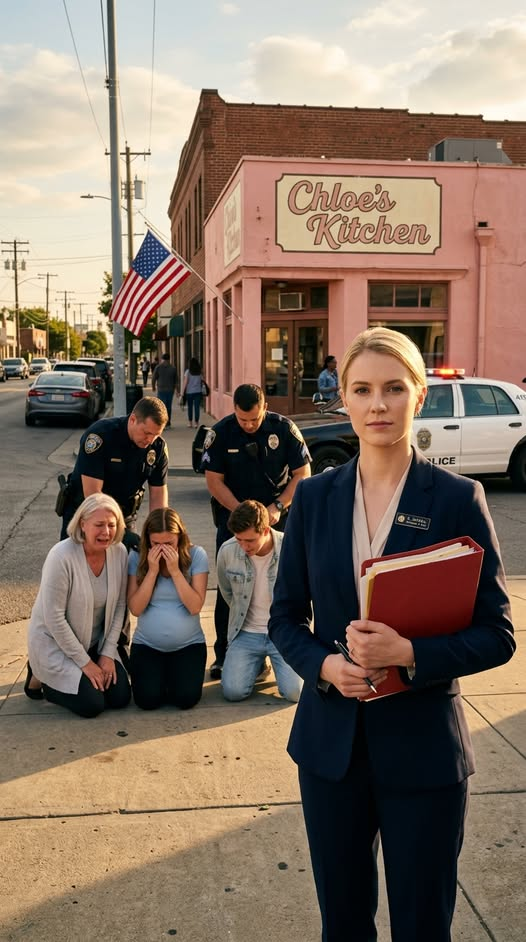
That is what my pregnant sister-in-law, Chloe, said while standing in the center of the bakery I built from scratch.
For a second, the entire room went quiet. Not a peaceful quiet. Not a stunned quiet. The kind of quiet that descends after someone says the ugly truth out loud, and everyone else in the room realizes that pretending is no longer an option.
I looked at my brother, Julian, first. He was standing near the pastry display with his hands shoved deep into his expensive cashmere coat, staring at the checkered floor like the tiles might suddenly swallow him whole and rescue him from my gaze. Two years ago, he was sobbing onto my shoulder in the sterile back room of a police precinct, begging me to save his life. Now, he could not even look me in the eye.
Then I looked at my mother, Evelyn. The woman who used to braid my hair before school, who wept outside the courthouse when the judge handed down my sentence, who promised during every supervised prison visit that my “ultimate sacrifice” would never be forgotten. She was standing by the espresso machine, holding two hundred dollars in cash, extending it toward me like she was paying a stray dog to leave her porch.
My father, Arthur, sat at one of the corner café tables, his eyes fixed on a muted television mounted on the wall.
And then there was Chloe. She stood with one hand resting protectively over her pregnant belly, wearing the custom linen apron I had designed for myself, smiling with the smug satisfaction of a woman who believed she had already won the war.
I laughed. It came out dry, sharp, and strange.
Chloe frowned, her perfectly manicured eyebrows knitting together. “What’s funny, Harper?”
I looked around the place I had poured my soul into. The Hearth & Vine. I had signed the lease when the building was just exposed brick and rat droppings. I spent three years sleeping on an air mattress in the upstairs apartment, waking at 3:00 AM to knead dough until my knuckles bled. I built this business. The rustic wooden counters, the smell of rising yeast and cinnamon, the framed local awards on the wall—they were mine.
For two brutal years in a state penitentiary, the memory of the smell of this bakery was the only thing that kept me from losing my mind. Now, I understood the devastating reality. I was not coming home. I was returning to a crime scene.
“What’s funny,” I said slowly, making sure my voice carried over the hum of the commercial refrigerators, “is that all of you really thought I would stay the exact same woman who walked into a prison cell to save you.”
My mother’s face tightened. “Harper, please, do not start making a scene. We have customers arriving in an hour.”
“My name is Harper,” I said coldly. “You only call me sweetheart when you want me to bleed for you.”
Chloe rolled her eyes and picked up a bottle of commercial sanitizing spray. She actually spritzed it into the air between us. “Oh, here we go with the victim act. You need to leave. You’re tracking dirt into my shop.”
Her shop. The words hit me like a physical blow, but I didn’t let it show. I turned my full attention to her. She stopped smiling.
“You are wearing my apron,” I said, my voice dangerously level. “You are standing in a bakery you did not build, carrying a child whose father you allowed me to go to prison for.”
Her face went pale, then hardened into a mask of pure defense. “You confessed to the police.”
“Yes,” I said. “I did.”
The atmosphere in the room shifted. Julian finally looked up. I held his gaze, refusing to let him look away.
“I confessed because my parents got on their knees and begged me,” I said, my voice ringing clear and steady. “I confessed because all of you convinced me that Julian’s future as a medical student was too bright to be ruined by a felony DUI. I confessed because my own mother looked me in the eye and said, ‘Julian’s hands are meant to be a surgeon’s, Harper. He is going to save lives. You just bake bread. You can survive a few years inside. He cannot.’”
My voice did not rise. That made it infinitely worse for them.
“I spent two years in a concrete box learning exactly what family means when you are the designated sacrifice.”
My mother started crying. Before prison, those tears would have destroyed me. They would have made me apologize for making her feel guilty. Not anymore. Prison teaches you how to read the architecture of a lie. It teaches you how to stop confusing someone else’s manipulative tears with your own responsibility.
“We did what we had to do to protect Julian’s residency match,” my mother whispered, clutching the cash.
“No,” I corrected her. “You did what was easiest.”
Chloe stepped forward, pointing toward the heavy glass door. “Get out. I mean it. If you don’t leave my property, I will call the police.”
I looked at her belly, then at her face. “I pray that baby is healthy. And I pray it never learns how effortlessly its parents can destroy someone who loved them.”
I walked to the counter, picked up the two hundred dollars my mother had placed there, and tore the bills straight down the middle. I let the pieces flutter to the flour-dusted floor.
My father finally stood up. “Harper, you need to calm down.”
There it was. A woman can lose two years of her life, her business, her home, her reputation, and her freedom, and still, a man will tell her to lower her voice so the people who robbed her can feel comfortable.
I turned to the door, but before I walked out, a memory from the night of the crash flashed through my mind like a strobe light. A memory I had buried out of trauma and misplaced loyalty.
I remembered sitting in the back of the police cruiser, watching my father lean into Julian’s wrecked car. I remembered seeing my father slip something small and black into his coat pocket before the tow truck arrived.
I looked back at Arthur. He blinked, shifting his weight nervously.
“I came here hoping I had paid the debt for this family,” I said softly. “Now I see I was only the down payment. But Dad… I finally remember what you took from the dashboard.”
My father’s face drained of all color.
I pushed the heavy glass door open and stepped out into the biting morning air, leaving them in absolute silence. The war hadn’t ended. It had just begun.
I had nowhere to go. That was the first, brutally practical truth of my new freedom.
My upstairs apartment was occupied by Julian and Chloe. My savings had been vaporized by trial fees and prison commissary expenses. My criminal record followed me like a heavy, suffocating shadow. The prison release packet in my duffel bag contained state paperwork, one change of clothes, and the address of a halfway house I was too proud to call.
Pride dies very fast on a cold sidewalk.
I sat on a bus bench three blocks away from the bakery and stared at my outdated phone. For two years, I had imagined calling my best friend, Sarah, the exact second I was released. But I remembered how she had stopped answering my letters after my first six months inside. I thought she had abandoned me. I thought she believed I was a criminal.
My thumb hovered over her name. I dialed anyway. She answered on the second ring.
“Hello?”
For a second, the lump in my throat was so thick I couldn’t breathe. “Sarah,” I whispered. “It’s me.”
Total silence. Then, a sharp, ragged inhale.
“Harper?”
“Yes.”
“Oh my God. Oh my God, where are you?”
I looked down the street toward the bakery that had stolen my youth. “Bus stop on 4th and Elm.”
“Are you with your family? Harper, do not go near them!”
I let out a broken laugh. “No. I’m alone.”
“Stay right there. Don’t move. I’m coming.”
Twenty minutes later, Sarah’s battered blue Honda screeched to a halt at the curb. She practically threw herself out of the driver’s seat and wrapped me in a hug so fierce it nearly cracked my ribs. I froze at first—in prison, physical touch is rarely safe—but then my body remembered her. I gripped her jacket and sobbed until I couldn’t breathe.
She didn’t ask a single question until we were in her apartment, a hot mug of tea in my hands.
“What did they do to you today?” she asked, her eyes dark with anger.
I told her everything. The apron. The money. Chloe’s threats. My mother’s justification about Julian’s medical career.
Sarah gripped the edge of her kitchen table so hard her knuckles turned white. “I knew it,” she hissed. “Harper, Julian came to see me right after your sentencing. He told me you were deeply ashamed. He said you explicitly requested no visitors, no letters, nothing. He said contact from the outside was making you suicidal.”
My chest tightened, a cold vice gripping my heart.
“I wrote anyway,” Sarah continued, her voice breaking. “The first five letters came back marked Return to Sender. I thought you really didn’t want me.”
I closed my eyes. Of course. They didn’t just steal my future; they systematically isolated me from anyone who might have reminded me that I was still a human being with worth.
“Sarah,” I said, opening my eyes. “I need to make a phone call.”
I pulled a folded, slightly crumpled business card from my pocket. It belonged to Eleanor Vance. Eleanor was a brilliant, sharp-tongued attorney who ran a legal aid workshop I had attended during my last six months inside. When I told her my story, she hadn’t judged me. She had just asked one question: “If you didn’t do it, why are you sitting in this chair?”
I dialed her number. She answered immediately.
“Harper,” Eleanor’s crisp voice came through the speaker. “You’re out. Did you go home?”
“Yes. It was a mistake.”
“Did they say anything about the business?”
“Chloe called it her property,” I said, a wave of nausea washing over me.
“I was afraid of that,” Eleanor sighed. “Harper, I pulled the commercial property and LLC records yesterday in anticipation of your release. The bakery was transferred out of your name fourteen months ago. Your parents and Julian filed a quitclaim deed and corporate restructuring documents. The stated consideration was ten dollars.”
Sarah gasped out loud. “Ten dollars?”
“It gets worse,” Eleanor said grimly. “There is a notarized affidavit on file signed by your parents. It claims that you verbally agreed to surrender all shares of the business to Julian because you were—and I quote—’facing severe legal consequences, deeply ashamed of your criminal actions, and financially irresponsible.’”
The air left my lungs. The lie they begged me to carry to save my brother’s medical career had become the exact weapon they used to legally rob me of my life’s work.
“They forged my intent,” I whispered.
“Yes, they did,” Eleanor said. “But Harper, to fight this, we have to reopen your criminal conviction. We have to prove you weren’t driving. And to do that, we need a miracle.”
I looked at Sarah, my heart pounding a frantic rhythm against my ribs.
“Eleanor,” I said softly. “I don’t need a miracle. I need a subpoena. My father has a safe in his home office.”
“What’s in the safe, Harper?”
“The dashcam memory card from the night of the crash.”
There was a long pause on the line. When Eleanor finally spoke, her voice was absolute ice.
“Harper. Don’t unpack your bags. We are going to war.”
The war began with paper.
Two days after my release, Eleanor filed a flurry of legal motions that hit my family like a tactical airstrike. She filed a petition to reopen my criminal case based on newly discovered evidence of witness tampering and obstruction. Simultaneously, she filed a civil injunction challenging the transfer of The Hearth & Vine as fraudulent, placing an immediate freeze on all of the bakery’s business accounts.
Julian could not pull a dime from the business. Chloe could not pay her vendors. The empire they had stolen from me was suddenly locked behind a vault of litigation.
While the legal system ground into motion, I needed to survive. Eleanor secured me a low-level administrative job at her nonprofit legal clinic. The pay was barely enough to cover groceries, and the office printer jammed every ten minutes, but I loved it. For the first time in two years, I was surrounded by people who saw me as an asset, not a sacrifice.
But my family did not go quietly into the night.
A week after the accounts were frozen, a knock echoed through Sarah’s apartment. I looked through the peephole. It was my mother, Evelyn. She was standing in the dim hallway, clutching a pristine white bakery box tied with baker’s twine—the exact packaging I had designed for The Hearth & Vine.
I opened the door, leaving the heavy brass chain engaged.
Evelyn’s face crumpled the second she saw me. “Harper, please. Just let me in. Let me see my daughter.”
Her tears still knew all the old, hidden roads inside my heart. They tried to reach the places where a daughter’s duty lived. But prison had burned those roads to ash.
“We can talk right here,” I said, my voice devoid of emotion.
“I brought your favorites,” she said, lifting the bakery box with trembling hands. “The almond croissants. Julian baked them this morning.”
Before my conviction, food was my mother’s ultimate apology language. It allowed her to comfort me without ever having to admit she was wrong.
“I’m not hungry, Mom.”
Her tears spilled over. “Harper, Julian is losing his mind. The stress is destroying Chloe. Julian’s surgical residency match interviews are next month! If this criminal investigation goes public, the medical board will drop him. His entire life will be over!”
There it was. The golden child’s future. The only thing that had ever mattered.
“Julian should have lost his medical career two years ago when he drove drunk and put a man in the ICU,” I stated flatly.
Evelyn gasped, pressing a hand to her mouth. “How can you be so cruel? We thought you were strong enough to handle the prison time! We thought you would understand!”
That sentence almost made my knees buckle. Not because it was surprising, but because it was the absolute truth of my entire existence. I could handle it. I was the strong daughter. The workhorse. The one without a prestigious degree. The one who worked hundred-hour weeks to pay the mortgage so everyone else could stay fragile and comfortable.
“I did handle prison,” I said, staring directly into my mother’s terrified eyes. “Now it is time for you to handle the truth.”
“You are destroying this family over a bakery!” she sobbed.
“I didn’t destroy this family,” I replied quietly. “I just stopped being the wall that hid the rot.”
I closed the door, the latch clicking with a sense of brutal finality. I slid down to the floor, pulling my knees to my chest, and shook until Sarah wrapped a heavy blanket around my shoulders.
I felt like I had gnawed off my own leg to escape a bear trap. But at least I was finally free of the steel jaws.
The next morning, Eleanor called me while I was organizing case files at the clinic.
“I got the subpoena approved by the judge,” Eleanor said, her voice thrumming with adrenaline. “The police impound report from the night of the crash listed a dashcam mount on the windshield of Julian’s car, but the camera itself was missing. I just served your father with a court order to produce the contents of his home safe, or face immediate arrest for obstruction of justice.”
“Did he surrender it?” I asked, my breath catching in my throat.
“He tried to claim he didn’t have it. I had the police execute a search warrant at 6:00 AM.” Eleanor paused, letting the weight of the moment settle. “They found the SD card, Harper. We are going to court.”
The Los Angeles courtroom smelled like floor polish, old paper, and palpable fear.
I sat beside Eleanor at the plaintiff’s table, wearing a sharp navy blazer Sarah had helped me pick out. Across the aisle sat Julian, Chloe, and my parents. They were flanked by a high-priced defense attorney who looked like he charged by the minute. Julian was sweating through his suit. Chloe sat with her arms crossed tightly over her pregnant belly, glaring at me with a hatred so pure it practically radiated heat.
The judge, a stern-faced woman named Honorable Davis, did not look amused. Judges rarely enjoy discovering that a felony conviction was built upon a coordinated family conspiracy.
Eleanor stood up and addressed the court. “Your Honor, two years ago, Harper Evans confessed to vehicular assault. That confession was extracted under severe emotional duress by her family to protect her brother, Julian Evans, a medical student. Today, we present physical evidence that proves Harper Evans was not behind the wheel.”
The defense attorney immediately objected. “Your Honor, memories fade, and this is a blatant attempt to leverage a property dispute by reopening a closed criminal matter!”
Eleanor didn’t argue. She simply pressed a button on her laptop.
The large monitor in the center of the courtroom flickered to life. The video was dark at first, illuminated only by the headlights of Julian’s car. The audio was crystal clear.
“Julian, slow down! You’re drunk!” It was Chloe’s voice, shrill and panicked.
“I’m fine, babe, shut up!” Julian’s voice slurred heavily.
Then came the horrific, crunching sound of metal colliding with metal. The dashcam violently shook as the car spun and crashed into the concrete barrier.
For ten agonizing seconds, there was only the sound of heavy, panicked breathing.
Then, Julian’s face leaned into the frame as he unbuckled his seatbelt. He was clearly in the driver’s seat.
“Oh my god. Oh my god, I hit him,” Julian panicked, tears streaming down his face. “Chloe, my medical license. My residency. I’m ruined. I’m going to jail.”
“Call your dad!” Chloe shrieked from the passenger side. “Call him now!”
The video cut out.
The courtroom was as silent as a graveyard.
I looked at my father. He was staring at the floor, his face pale, looking like a man who had just watched his own execution. He had held that memory card in his safe for two entire years. He had possessed the absolute power to set me free every single day I woke up in a concrete cell, and he had chosen to let me rot so his son could wear a white doctor’s coat.
The betrayal was so deep it bypassed anger and settled into a cold, terrifying numbness.
Judge Davis took off her glasses and stared at the defense table. Her voice was lethal. “Mr. Evans. You allowed your sister to serve two years in a state penitentiary for a crime you committed?”
Julian opened his mouth, but no sound came out.
“Your Honor,” Eleanor interjected smoothly. “We also have the fraudulent property transfer documents. The family used the very conviction they fabricated to legally declare my client unfit to own her business, thereby stealing her commercial bakery.”
The judge slammed her gavel down. The sound cracked through the room like a gunshot.
“The conviction of Harper Evans is hereby vacated,” the judge ordered, her voice booming. “I am ordering the District Attorney’s office to immediately detain Julian Evans on charges of vehicular assault, perjury, and filing a false police report. Furthermore, Arthur and Evelyn Evans are to be investigated for felony fraud and obstruction of justice regarding the property transfer.”
Two bailiffs stepped forward, moving toward Julian with handcuffs drawn.
Chloe screamed. My mother collapsed into her chair, sobbing hysterically.
As the bailiff clamped the steel cuffs around Julian’s wrists, he turned his head and locked eyes with me. His face contorted with a mixture of terror and venom.
He mouthed three words to me before they dragged him away.
You ruined us.
I sat at the table, my hands perfectly steady.
No, I thought. I just survived you.
The collapse of my family’s empire was absolute and merciless.
Julian’s medical career evaporated the second the handcuffs clicked. He took a plea deal to avoid a lengthy trial, resulting in a three-year prison sentence and the permanent revocation of his medical school standing. Chloe received probation for her role in the cover-up, left to raise her child while her husband sat in a cell much like the one they had condemned me to.
My parents avoided jail time by cooperating with the state, but the public record of their perjury and fraud was permanent. Their social standing, the only thing Evelyn truly cared about, was reduced to ash.
The civil case regarding The Hearth & Vine settled rapidly. The fraudulent transfer was voided. The bakery was legally returned to me, along with a massive financial settlement for the damages and lost revenue during my incarceration.
But I didn’t keep the bakery.
The day the keys were handed back to me, I walked into the shop. The smell of yeast and cinnamon was still there, but the magic was gone. The walls felt like a monument to my own naivety. I realized that a building cannot love you back, and a business cannot act as a shield against people who view your heart as collateral damage.
I sold the bakery to a local culinary group for a premium price.
With the money, I rented a beautiful, sunlit apartment overlooking the ocean. I bought a velvet sofa in deep emerald green, simply because no one else was around to tell me to buy beige. I filled the space with plants, books, and the quiet, profound peace of a life strictly governed by my own choices.
At thirty-two, using the funds from the bakery sale, I enrolled in law school.
It was brutally hard. I lived on black coffee, highlighters, and sheer, unadulterated spite. My cleared record allowed me to pass the character and fitness reviews, but my past still followed me into rooms where people wondered if I truly belonged. I belonged anyway. I had learned the law in a prison library; I wasn’t going to let a lecture hall intimidate me.
Three years later, the day I passed the bar exam, Sarah showed up at my apartment with two bottles of expensive champagne. Eleanor, who was now my official mentor, sent a massive floral arrangement.
My phone buzzed. It was a text from an unknown number, but I knew exactly who it was.
I am so proud of you, Harper. I am so sorry for everything. Please, can we have coffee? — Mom.
I stared at the screen. A few years ago, that text would have sent me into a spiral of guilt and longing. Now, I just felt a profound, untouchable calm.
I replied: I forgive you for what you did, Evelyn. But forgiveness does not require access. Do not contact me again.
I blocked the number, set the phone face down on the marble counter, and poured myself a glass of champagne.
At thirty-six, I opened my own criminal defense and civil rights firm. My office wasn’t fancy, but it was mine. On the wall behind my heavy oak desk, I hung a small, simple framed quote: Love is not a legal defense for erasing yourself.
When clients sat in my office—terrified young women taking the fall for abusive boyfriends, or sons pressured to confess for their fathers—they would look at that quote and ask what it meant.
I would smile, a sharp, empathetic smile, and say, “I learned it the hard way. Now, let’s look at your paperwork.”
My family had believed I would come home from prison grateful for whatever scraps of affection they threw my way. They believed the word felon would keep me small, compliant, and easy to erase. They believed they could steal my business, my youth, and my future, all while I was too broken to fight back.
They were wrong.
I lost two years of my life. I did not lose myself. The daughter they so easily sacrificed became the woman who dragged the truth into the light, took back her name, and became an architect of rescue for others.
I am Harper Evans. I am not the shame of the family. I am not the strong one they could afford to spend.
I am the woman who came back, told the truth, and finally stopped paying for crimes that were never mine.
If you want more stories like this, or if you’d like to share your thoughts about what you would have done in my situation, I’d love to hear from you. Your perspective helps these stories reach more people, so don’t be shy about commenting or sharing.