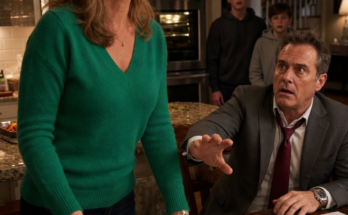
My father sold the billion-dollar biotech company I built, handed the money to my spoiled brother, and fired me in front of the buyer. Then my mother tossed a fifty-dollar bill at my feet. “For the cab,” she said. “Try not to beg.” I didn’t scream. I just typed one line of code on the screen. The billionaire stood up—and suddenly, everyone realized they had just stolen from the wrong woman.
The day my father sold my company, he smiled like he had cured death. Then he fired me in front of the billionaire buyer, my golden-child brother, and a room full of lawyers who suddenly forgot how to breathe.
“Effective immediately,” my father said, sliding the termination letter across the glass table. “You are no longer Chief Science Officer of Vireon Labs.”
Vireon Labs. My lab. My nights. My patents. My blood in glass vials and coffee stains on trial reports. Seven years of building a biotech platform that could reprogram immune cells without destroying healthy tissue, and my father had sold it for one billion dollars like it was an old family car.
Across the table, my brother Adrian leaned back in my chair.
Not a chair like mine.
My chair.
He wore a navy suit, a watch worth more than my first grant, and the same lazy smile he used when we were children and he broke my microscope, then told our parents I had cried because I was unstable.
“You’ll land on your feet, Clara,” Adrian said. “You’re clever.”
My father laughed softly. “Clever people still need discipline.”
The buyer, Roman Vale, billionaire founder of Vale Capital, watched me without blinking. He was famous for buying impossible science and turning it into empires. His silver hair, black suit, and dead-calm face made him look less like a man and more like a verdict.
On the table lay the purchase agreement. Beside it, a new executive appointment letter.
Adrian ValeTran, Interim CEO.
My mother sat near the window, diamonds flashing on her fingers. She had not looked at me once. Not when Father announced the sale. Not when Adrian received the billion-dollar proceeds through a family trust. Not when my access badge stopped working on my phone.
Finally, she opened her purse.
A single fifty-dollar bill landed at my feet.
“For the cab,” she said. “Try not to beg outside the building. It embarrasses us.”
Adrian chuckled. Someone from legal stared at the table.
I bent down slowly, picked up the bill, and folded it once.
Then twice.
Then I placed it beside the purchase agreement.
“Keep it,” I said quietly. “You’ll need change.”
My father’s smile hardened. “Security will escort you out.”
I looked at Roman Vale. “Before they do, may I ask one question?”
“No,” Father snapped.
Roman raised one hand. “Let her speak.”
I turned my laptop toward the wall screen. One line of code glowed in the deployment console.
Not loud. Not dramatic.
Just one silent question.
who_signed_root_transfer()
The room went still.
Roman stood up.
And for the first time that day, my father looked afraid.
Part 2
“What is that?” Adrian asked, but his voice cracked on the last word.
I did not answer him. I watched Roman Vale instead. Billionaires did not stand for sentiment. They stood when numbers moved, laws shifted, or empires caught fire.
Roman stepped closer to the screen. “Run it.”
My father slammed his palm on the table. “This meeting is over.”
Roman did not look at him. “Sit down, Victor.”
My father sat.
That was the first crack.
I typed one command. The room screen filled with access logs, cryptographic signatures, and transfer histories. To most people, it looked like rain made of numbers. To Roman’s technical counsel, it looked like a gun pointed at the deal.
Adrian laughed too loudly. “Clara always does this. Makes things look complicated. It’s emotional theater.”
“Then you won’t mind if I explain,” I said.
His smile faded.
“When Vireon was founded, my father provided seed money and office space. Adrian provided motivational posts on social media. I provided the platform, the cell-targeting engine, and the adaptive delivery code. The investors wanted protection, so I created a founder’s technical covenant.”
Roman’s lawyer leaned forward. “Where is that covenant?”
“In the original IP escrow. Signed, notarized, filed with Series A documents.”
Father’s face had gone gray.
My mother whispered, “Victor?”
I kept going. “No sale, license, merger, or majority transfer involving the core platform is valid unless the Root Author signs the technical transfer.”
Roman looked at me. “You’re the Root Author.”
“Yes.”
Adrian shot up. “That’s insane. Dad owns the company.”
“Dad owned shares,” I said. “Not the locked technology.”
Father’s voice turned cold. “You were a child when we started. I signed everything for you.”
“I was twenty-six.”
“You were unstable.”
“I was exhausted because I was saving your company.”
Roman’s technical counsel spoke into his phone. “Pull the escrow package now.”
Adrian’s smugness twisted into anger. “You think some nerd clause stops a billion-dollar acquisition?”
“No,” I said. “Fraud stops it.”
The room went silent again.
I clicked another file. A video appeared. My father, three weeks earlier, in the executive lab. Adrian beside him. They were talking to our compliance director, Nadia.
Father’s voice filled the room.
“Clone Clara’s key. Backdate the authorization. Vale won’t check until after closing.”
Adrian laughed on the video. “By then she’ll be gone.”
My mother covered her mouth. Not in horror. In calculation.
Father stood so fast his chair hit the wall. “That recording is illegal.”
“No,” I said. “It came from the lab’s regulated audit camera. You installed it to monitor me.”
Roman’s eyes turned glacial. “You represented that the transfer chain was clean.”
Father pointed at me. “She is vindictive. She has always hated this family.”
I finally smiled. It felt strange on my face. “No, Dad. I loved this family so much I kept waiting for it to become one.”
That landed harder than shouting.
Adrian grabbed the fifty-dollar bill from the table and threw it at me. “You’re still nothing without us.”
I caught it against my chest.
Then I opened the final file.
A list of patients enrolled in our compassionate-use trial appeared on screen. Names redacted. Dates clear. Treatment batches matched to code commits.
Roman’s jaw tightened. “What am I looking at?”
“The platform Adrian claimed he could run,” I said. “He ordered engineers to remove my safety lockouts last month to accelerate valuation.”
Adrian went pale.
I looked at him. “You targeted the wrong sister.”
Part 3
Roman turned to Adrian with the calm of a man closing a coffin. “Did you alter clinical safety systems before acquisition?”
Adrian swallowed. “I optimized timelines.”
“Answer the question.”
Father stepped in. “My son acted under my authority.”
“Then both of you acted stupidly,” Roman said.
His lawyers were already moving. Phones out. Laptops open. The room, once staged for my public execution, became a crime scene with catered coffee.
I tapped the screen again. “The altered build never reached patients. I intercepted it, quarantined it, and filed a sealed incident report with the FDA liaison, the board’s independent director, and the escrow trustee.”
My father stared at me. “You reported your own company?”
“I protected my patients.”
“Our company,” he hissed.
“My patients,” I repeated.
Roman’s counsel checked her laptop. Her expression changed. “Mr. Vale, she’s telling the truth. The escrow trustee has already issued a conditional freeze. The sale cannot close without Dr. Tran’s signature. Also, the board received her incident report forty-eight hours ago.”
Father looked around the room, searching for loyalty and finding only witnesses.
Adrian tried one last smile. “Clara, come on. We’re family. Tell them this is a misunderstanding. We can give you a role. Senior something.”
I looked at him, then at the fifty-dollar bill still in my hand.
“You gave me cab money after stealing my life.”
My mother finally spoke. “Clara, don’t be dramatic.”
I turned to her. “You watched him break me for years because Adrian made you feel rich and I made you feel small.”
Her face hardened. “You ungrateful little—”
Roman cut her off. “Mrs. Tran, stop talking.”
She did.
The buyer looked at me. “Dr. Tran, what do you want?”
My father barked, “She wants revenge.”
“No,” I said. “Revenge is emotional. I want compliance.”
Roman almost smiled.
I placed a folder on the table. “Terms. One: the sale is void unless renegotiated with the rightful IP holder. Two: Victor Tran and Adrian Tran resign from all positions immediately. Three: all proceeds are frozen pending fraud review. Four: the board appoints an independent ethics chair. Five: patient trials continue under my authority, with Vale funding them at the original valuation plus a safety reserve.”
Adrian laughed weakly. “You think you can demand that?”
Roman took the folder.
He read for thirty seconds.
Then he signed.
My father’s mouth opened, but no sound came out.
Roman slid the folder back to me. “Vale Capital accepts, pending board ratification. Effective now, I recognize Dr. Clara Tran as controlling technical authority and incoming CEO.”
The room erupted.
Father shouted about lawyers. Adrian shouted about betrayal. My mother cried, not because she was sorry, but because the money was running away from her.
Security entered again.
This time, they did not come for me.
As they escorted my father and brother out, Adrian twisted toward me. “You’ll regret this.”
I unfolded the fifty-dollar bill and tucked it into his jacket pocket.
“For the cab,” I said. “Try not to beg outside the building.”
Six months later, Vireon reopened under a new name: Aster Cell Therapeutics. Our first trial expansion saved twenty-three patients from relapse in the preliminary cohort. Roman became chairman. I became CEO.
My father settled under fraud charges and lost the family estate. Adrian was banned from serving as an officer in any biotech company. My mother moved into a condo paid for by selling her diamonds.
On the wall of my office, framed beside my first patent, hangs one thing.
A photocopy of a fifty-dollar bill.
Not as a trophy.
As a receipt.

PART 4
The first board meeting without my father felt like standing on the deck of a ship after the pirates had been thrown overboard. The same ship, the same sea, but the wind had changed. Roman sat at the head of the polished table, his presence a silent weight that kept the old-guard directors from fidgeting too openly. I took the CEO chair, still warm from my father’s ghost, and watched the faces around me calculate their next loyalties.
Three directors resigned within a week. I sent them fruit baskets. The compliance director, Nadia, asked for a private meeting. The same Nadia from the video, who had looked at my father with a frown but never said no.
She sat across from me in my new office, hands clasped tight. “I didn’t report the key cloning because your father told me you’d authorized it verbally. I should have checked.”
“You should have,” I said.
She flinched.
“But you also kept meticulous audit logs that proved the backdating. I need a chief compliance officer who knows how to document sins, even when she’s too afraid to stop them. You’re on probation, not the street.”
Her eyes filled. “Thank you, Dr. Tran.”
“Don’t thank me yet. You’re going to spend the next year building a whistleblower system so transparent it hurts. If my own brother tries to steal my passwords again, a janitor in the basement will get a real-time alert.”
She almost smiled. I didn’t. Trust would be earned in drops, not waves.
Outside those walls, the media had found the story. A leak from the buyer’s legal team, maybe, or a disgruntled former board member. Headlines bloomed like poison flowers: “Billion-Dollar Betrayal: Daughter Ousts Father in Biotech Coup,” “The Fifty-Dollar CEO,” “Family Feud Imperils Cancer Trials.” Adrian gave interviews from a rented penthouse, telling anyone who would listen that I had orchestrated a “hostile emotional takeover” and that the altered safety systems were never a risk. He wore a new suit and the same old smirk.
I did not respond. Instead, I visited the patients.
The compassionate-use trial had twenty-three names, each one a life suspended between hope and goodbye. I met them in the clinic wing with the new lead researcher, a soft-spoken immunologist named Dr. Eliza Carter. We reviewed charts, adjusted protocols, and I watched a twelve-year-old boy named Marcus draw a picture of a T-cell as a superhero with a sword. His mother whispered that they had run out of options before Aster Cell Therapeutics opened the trial.
“Your platform saved my son,” she said, gripping my hand. “Whatever they say about you, you’re the reason he’s still here.”
That night, I went back to my apartment—a modest one-bedroom I’d kept even when Vireon’s valuation soared—and I cried for the first time since the boardroom. Not for my father. Not for my mother. For the twelve-year-old boy who didn’t know he had just written the only press release that mattered.
PART 5
Adrian sued me three months after the boardroom execution.
The lawsuit, filed in Delaware Chancery Court, alleged defamation, tortious interference, and breach of fiduciary duty. He claimed I had manipulated the audit system to fabricate the video, that the safety lockout removal was a standard code optimization, and that I had conspired with Roman Vale to steal the family’s legacy. My father joined as a co-plaintiff, his signature sharp and angry on the legal documents. My mother supplied a sworn affidavit that I had “a lifelong pattern of instability and resentment.”
Their lawyer was a shark named Katherine Harlow, a woman who charged two thousand dollars an hour and smiled like a knife finding its sheath. The discovery requests were brutal. They demanded my personal emails, my therapy records from graduate school, my notes from every board meeting I’d ever attended. They deposed former employees, digging for any sign that I had been difficult, emotional, difficult to work with.
“They’re trying to paint you as the unstable daughter,” my lawyer, a woman named Grace Okonkwo, said during prep. “Classic gaslighting strategy dressed up in a subpoena. The good news? Truth is a complete defense.”
“The truth requires someone to believe it,” I said.
“Then we’ll make them believe.”
The deposition was held in a conference room overlooking a gray March sky. Adrian wore a charcoal suit and kept his hands folded on the table, a portrait of wronged innocence. Harlow asked me questions for seven hours. Did I resent my brother’s relationship with our parents? Had I ever been diagnosed with anxiety? Did I keep the fifty-dollar bill as a “prop” to humiliate my mother? I answered each question with data, context, and the calm of a woman who had rebuilt a clinical platform while her family plotted behind her back.
On the seventh hour, Harlow tried a different tack. She projected the video of my father ordering the key cloning, froze it on his face, and asked, “Dr. Tran, isn’t it true that you edited this footage to remove segments where you gave consent?”
I leaned toward the microphone. “The footage is a complete, timestamped export from the lab’s regulated audit camera. The camera system was installed by my father to monitor my work hours. It cannot be edited locally, and the original file matches the escrow trustee’s copy, the FDA liaison’s copy, and the backup on an independent server. If you’re claiming it’s edited, you’re also claiming a conspiracy involving a federal regulator. Is that your case?”
Harlow’s smile flickered. Adrian’s hands tightened. Grace Okonkwo slid a document across the table: an FDA letter confirming the integrity of the audit file.
That was the moment Katherine Harlow realized she had been hired to polish a lie.
The lawsuit collapsed three weeks later, withdrawn with prejudice after Roman Vale’s legal team threatened sanctions for frivolous litigation. The court ordered Adrian and my father to pay my legal fees. The bill was just under four hundred thousand dollars. I framed the invoice and hung it next to the photocopied fifty-dollar bill.
PART 6
With the legal noise behind me, Aster Cell Therapeutics entered its growth phase. Roman’s funding flowed into expanded trials, new hires, and a licensing partnership with a major pharmaceutical company that wanted our cell-targeting engine for autoimmune diseases. My days started at five a.m. and ended well past midnight, but the exhaustion felt clean, like muscle ache after a workout instead of the bone-deep drain of watching your life get stolen in slow motion.
Dr. Eliza Carter became my closest ally. She had worked at three biotech startups and had a talent for spotting scientific talent that had been overlooked by the old boys’ network. Together we built a research team that was sixty percent women and forty percent people who had been told, at some point in their careers, that they didn’t fit the profile of a scientist. They wrote beautiful code, ran elegant experiments, and did not flinch when I set impossible deadlines.
One evening, Eliza found me in the lab at ten p.m., staring at a chromatogram. “You know,” she said, handing me a cup of terrible coffee, “you don’t have to personally save every patient.”
“I’m not trying to.”
“Then what are you doing?”
I looked at the chromatogram, a smear of peaks that represented a new delivery vector for solid tumors. “Proving that the platform works better without fear. My father built Vireon on the idea that pressure creates diamonds. He squeezed everyone—scientists, patients, even me—until they cracked. I want Aster to prove that you can innovate without terrorizing the people doing the work.”
Eliza sat down next to me. “That’s a beautiful mission statement. It’s also a recipe for burnout if you don’t sleep.”
I laughed, the first genuine laugh in months. “Are you my mother?”
“No. I’m your chief scientific officer, and I’m telling you to go home. I’ll run the overnight gels.”
I went home. I slept seven hours. In the morning, I received an email that made my stomach drop: my mother had been hospitalized after a fall. Her new condo had marble stairs and no handrail. The fall broke her hip and her pride.
I did not visit. I sent a card with a single sentence: “I hope you recover fully.” I wrote it in my own hand, signed my name, and mailed it without a return address. Because even after everything, I could not turn off the part of my brain that remembered her reading me bedtime stories before Adrian was born, before the money warped her into someone who threw fifties at her daughter’s feet.
Growth is not forgiveness. It’s just the slow, painful recognition that people are broken in ways that have nothing to do with you.
PART 7
A year after the boardroom coup, I was invited to give the keynote at a major biotech conference in San Francisco. The topic was “Ethical Innovation in the Age of Billion-Dollar Science,” and the organizers had no idea how close I lived to that headline. I almost declined. Public speaking still made my hands sweat. But Grace Okonkwo, who had become a trusted advisor, told me, “If you don’t tell your story, Adrian will keep telling his.”
So I stood on a stage in front of two thousand people, wearing a blazer I bought on clearance and the fifty-dollar bill tucked into my pocket like a talisman, and I told the truth.
I talked about the myth of the lone genius founder and how it’s usually a cover for the people who do the actual work. I talked about safety lockouts as moral commitments, not regulatory annoyances. I talked about the moment my father fired me and how, instead of screaming, I typed one line of code that unmasked a fraud. I held up the fifty-dollar bill, scanned it onto the giant screen behind me, and said, “This was my severance package. I kept it to remember what happens when you let other people write the terms of your worth.”
The audience stood up. Not politely. Not briefly. They stood and clapped until the sound filled my chest, a pressure that wasn’t pain. Afterward, a young woman in a lab coat waited by the stage door. She had dark circles under her eyes and a tremor in her hands.
“Dr. Tran,” she said, “I’m a postdoc at a company where my PI takes credit for my work. My family tells me I should be grateful just to have the job. I watched your talk and I realized—I don’t have to wait until I’m fired to stand up.”
I gave her my email address. Two months later, she joined Aster Cell Therapeutics as a senior scientist. Her name was Priya. She filed three patents in her first year, all in her own name.
That’s the thing about stories. You think you’re just surviving, but you’re actually building a door that other people can walk through.
PART 8
Adrian’s final attack came not through the courts but through the code.
One morning, Eliza burst into my office with her laptop open, her face pale. “Someone tried to push a malicious update to the patient dosing algorithm. A backdoor that would have randomized titration schedules. If it had gone live, we’d have overdoses in the trial within a week.”
My blood turned cold. “Where did it originate?”
“A contractor account that was supposed to be deactivated six months ago. It was reactivated by an admin credential… Clara, the credential belongs to Adrian. He must have kept a backdoor from before the boardroom.”
Of course he had. Adrian never planned for failure; he only planned for revenge.
I activated the incident response protocol. Within an hour, our security team isolated the malicious code, purged the contractor account, and traced the access trail. The digital fingerprints led directly to a laptop registered to my brother’s new “consulting firm,” a shell company he’d set up after the lawsuit failed. The attempted sabotage violated his court-ordered ban from biotech officer roles and opened him up to federal charges under the Computer Fraud and Abuse Act.
I could have called the FBI immediately. Instead, I called Roman.
“He just tried to poison your investment,” I said.
Roman’s voice was ice. “What do you need?”
“Your legal team, a forensics report, and your agreement that we pursue this to the full extent of federal law.”
“You’ll have it within the hour. Clara—this is the right call.”
“I know.”
I hung up and sat in silence. This was the line my brother had crossed. Not greed, not lies, not even betrayal of family. He had tried to hurt patients to hurt me. The boy who broke my microscope had grown into a man willing to break lives.
That evening, FBI agents arrested Adrian at his penthouse. The news showed footage of him in handcuffs, his smirk finally wiped clean. My father put out a statement calling it a “misunderstanding.” My mother said nothing at all.
I slept better that night than I had in years.
PART 9
One morning, two years after I became CEO of Aster Cell Therapeutics, I stood in the clinic observation room and watched the first solid-tumor patient receive our new delivery vector. She was a forty-seven-year-old teacher named Sarah who had been told six months ago to get her affairs in order. The infusion took forty minutes. When it was done, she looked at the nurse and said, “That’s it?” like she’d been expecting lightning.
Nine weeks later, her scans showed a partial response. The tumor had shrunk. Not a cure—not yet—but a door opening. The media covered it, of course, but I didn’t do interviews. I sent Sarah a handwritten letter instead, on thick paper with no letterhead, just my name at the bottom.
Roman retired from the board that year, handing me full control. At his farewell dinner, he raised a glass and said, “I’ve bought a lot of companies, Dr. Tran. You’re the only CEO who made me feel like the junior partner.”
I laughed. “You signed my terms in thirty seconds. That’s not a junior partner.”
“I signed because I recognized something in that boardroom. You weren’t fighting for revenge. You were fighting for the work. That’s rarer than you think.”
After dinner, he handed me a small box. Inside was a framed, original sketch of a T-cell with a sword—the drawing Marcus had made in the hospital. “His mother sent it to me after the trial expansion news broke. Said she wanted the investors to know what they were really funding.”
I hung the sketch in my office, right beside the fifty-dollar bill and the legal fees invoice.
My mother wrote me a letter a few months later, her handwriting shaky and unfamiliar. She apologized, not in the grand, cinematic way but in the small, halting sentences of someone learning to speak truth for the first time. She said she had been afraid of being poor again, afraid of losing the status that made her feel safe, and that fear had made her cruel. She did not ask for forgiveness. She asked if we could have coffee.
I met her at a quiet café. We sat for an hour, mostly silent, and when we parted she pressed something into my hand. A fifty-dollar bill, crisp and new.
“For the coffee this time,” she said, and her eyes were wet. “I know it doesn’t fix anything.”
I folded the bill and tucked it into my pocket. “No,” I said. “But it’s a start.”
Back at Aster, I walked the labs. Priya was leading a team designing the next-generation targeting algorithm. Eliza was mentoring a new cohort of scientists who had been overlooked by bigger companies. The fluorescent lights hummed the same frequency they always had, but the air felt different—lighter, as if the building itself had exhaled.
I went to my office, closed the door, and looked at the wall. Three framed objects: a child’s drawing of a superhero T-cell, a bill for four hundred thousand dollars, and a photocopied fifty. They told a story that didn’t need many words. It was a story about a woman who had been counted out, bought off, and buried—and who had typed one line of code that changed everything.
Not because she wanted to burn the house down.
Because she had built the house, and it was time to live in it.
I sat down, opened my laptop, and began writing the next chapter. Not for the press, not for the board, not even for the patients who would one day benefit from the science I had protected. I wrote it for the twenty-six-year-old who had once cried in a lab at three a.m., convinced she was the problem.
She wasn’t the problem.
She was the solution.
And the invoice was paid in full.