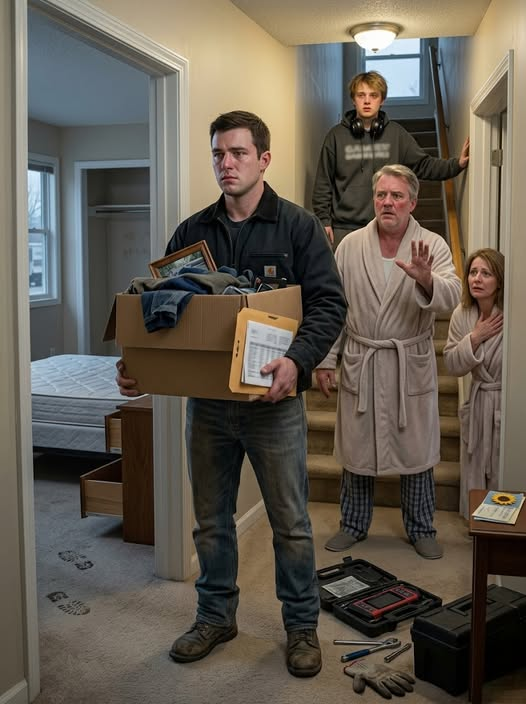
My father stood in our kitchen, pointed toward the stairs, and said, “Move out if you don’t like it,” like he was daring me to survive without the house I had been paying for since I was twenty-one. My mother folded her arms beside him while my younger brother laughed from the living room, wearing a headset I probably helped fund. They thought I would argue, apologize, and send the usual $800 on the first. Instead, I looked at them and said, “Okay.” What they didn’t know was that I had already signed a lease—and their mortgage was due tomorrow.
“Move out if you don’t like it,” my father said, standing in the kitchen with one hand wrapped around a coffee mug I had helped pay for and the other pointing toward the stairs like he was some kind of king dismissing a servant.
I remember that moment more clearly than I remember some birthdays. The cheap yellow light over the stove. The smell of burnt toast because Jake had put bread in the toaster and walked away to answer a Discord notification. The pile of dishes in the sink that somehow became my problem if I left one coffee mug on the counter. My mother stood near the fridge with her arms folded, wearing the expression she always used when she wanted me to believe she was disappointed for my own good. Behind them, from the living room, I could hear my younger brother laughing into his headset, shouting at strangers online while the rest of us discussed how much more money I apparently owed for the privilege of being treated like a tenant in my own childhood home.
I was twenty-five years old, a diesel mechanic, and I had been paying my parents eight hundred dollars a month in “rent” since I was twenty-one. That was before the laundry fee, the driveway fee, the garage storage fee, the food contributions, and the little surprise bills my mother liked to tape to the fridge with a magnet shaped like a sunflower. I worked full-time, sometimes sixty hours a week, in one of the busiest diesel shops in the city. I came home smelling like oil, brake dust, and metal. My hands were always cut somewhere. My back hurt in a way most twenty-five-year-olds probably don’t understand yet. But I paid. Every month, on time, no excuses.
Jake paid nothing.
Jake was twenty, taking two community college classes he barely attended, and apparently “working on his future.” His future involved a PS5, a gaming chair that cost more than my first toolbox, a streaming setup in the room that used to be my dad’s office, and a sleep schedule that could only make sense to vampires or unemployed raccoons. My mother made his meals. My father paid for his internet upgrades. I paid rent. That was the family system. Jake was potential. I was income.
So when I finally asked why my rent had gone up again, Dad gave me that famous line.
“If you don’t like it, move out.”
I looked at him for a long second.
He looked almost proud of himself, like he had delivered a final argument no one could answer. My mother nodded beside him, her lips pressed into that thin little line that meant she was already preparing the guilt speech if I dared to respond. Jake laughed in the next room, loud and careless, probably unaware that the life he knew was about to run face-first into reality.
I said, “Okay.”
Dad blinked. “Okay what?”
“Okay,” I said again. “I’ll move out.”
My mother’s face changed first. Not all the way into panic. Not yet. Just a flicker. A crack in the mask. My dad scoffed because he still thought this was a bluff, still thought I was the same tired son who would argue, get guilted, apologize for having feelings, and transfer money on the first of the month like always.
He didn’t know I had already signed the lease.
He didn’t know I had already moved half my things.
He didn’t know the mortgage payment due the next morning depended entirely on the eight hundred dollars he had spent years pretending was just my fair contribution to the household.
I picked up my work jacket from the back of the chair, looked at both of them, and said, “Expect a future where you’re homeless.”
Then I walked upstairs and started packing the last box.
My name is Mike Reynolds, and if you had asked me five years ago whether I would ever become the kind of man who moved out of his parents’ house overnight and watched their entire financial structure collapse behind him, I would have said no. I was not raised to be dramatic. I was raised to be useful. There is a difference, and it took me years to understand how dangerous that difference can be.
I grew up in a working-class suburb outside the city, in a three-bedroom house with a two-car garage, a patchy lawn, and parents who believed appearances mattered more than truth as long as the neighbors could see the lawn mowed and the porch swept. My father, Carl Reynolds, worked in sales for a regional building-supply company. He liked to call himself an accounts executive, which sounded better than driving around trying to convince contractors to buy siding, insulation, and roofing materials from him. My mother, Denise, had worked part-time at a doctor’s office when I was little, then stopped when Jake started school because, as she put it, “the boys need me home.”
What that meant in practice was Jake needed her home.
I was the older one, the responsible one, the one who could make his own sandwich, wash his own clothes, wake himself up, and figure things out. Jake was the baby. Jake was sensitive. Jake was creative. Jake needed encouragement. Jake needed patience. Jake needed space. Jake needed quieter mornings because he got overwhelmed before school. Jake needed better headphones because cheap ones hurt his ears. Jake needed the bigger bedroom because he had more stuff. Jake needed rides because he didn’t like the bus. Jake needed money because he had big ideas.
I needed to stop complaining.
That was the first lesson I learned in that house. Not from one lecture, but from a thousand little moments. If Jake forgot to take out the trash, I got told to help him. If I forgot, I got told I was disrespectful. If Jake failed a test, Mom said the teacher wasn’t connecting with his learning style. If I got a B, Dad asked why it wasn’t an A. If Jake cried, the whole house rearranged itself around his mood. If I got quiet, someone told me not to sulk.
I was seventeen when I discovered engines made more sense than people.
It happened in high school auto shop. Some kids took the class because they thought it would be easy. Some took it because they liked cars. I took it because the first time I watched Mr. Herrera break down a diesel engine on the shop table, something clicked in my head. There was a rhythm to it. Intake, compression, power, exhaust. Cause and effect. Pressure, timing, fuel, air. If something failed, there was a reason. You could diagnose it. Test it. Trace the fault. Fix it. Engines did not sigh at you and say you were selfish for asking why they were leaking oil.
I was good at it.
Not just decent. Good. My hands understood parts before I had names for all of them. I could hear a bad injector in the way a truck idled. I could feel misalignment before the numbers proved it. Mr. Herrera saw it too. He told me I should consider diesel technology after graduation. “There’s money in it,” he said. “Real money. And if you’re this sharp now, you can go far.”
For the first time, an adult was not telling me what I should be. He was telling me what I already was.
My parents hated it.
Not openly at first. My mother said trade school was “a solid backup.” My father said, “You’re smart enough for college, Mike.” That sounded like praise until I understood what he meant: trades were for people who did not have options. He wanted me in a button-down shirt, behind a desk, earning money that looked respectable at dinner parties. He wanted to introduce me as “my son, the engineer,” or “my son, the manager,” not “my son, the mechanic,” even though mechanics were the reason his sales clients’ fleets kept moving.
When I told them I had enrolled in a diesel technology program instead of applying to a four-year college, they acted like I had announced plans to live under a bridge and sell stolen hubcaps.
Dad stared at the brochure in my hand. “Trade school?”
“Yes.”
“You’re serious.”
“Yes.”
“You want to spend your life covered in grease?”
“I want to work on engines.”
Mom sat at the kitchen table, looking wounded. “We just thought you had bigger dreams.”
Bigger dreams.
I was eighteen. I did not have the language yet to say that their definition of bigger was mostly about what impressed other people. So I just said, “This is what I want.”
Dad shook his head. “Don’t come crying to us when you realize you made the wrong choice.”
I didn’t.
I started as an apprentice at one of the biggest diesel shops in the city. The work was hard, dirty, and occasionally miserable. In summer, the shop baked like an oven. In winter, cold came up through the concrete floor and settled into your bones. Customers were impatient. Dispatchers lied about timelines. Trucks came in with problems nobody wanted to touch and left because somebody like me figured them out. I learned fast because I had to. I showed up early, stayed late, bought used tools when I couldn’t afford new ones, and listened to the old mechanics who had forgotten more than most people ever learned.
By twenty-one, I was making decent money. Not rich. Not flashy. But enough that I could have moved out if I had been thinking clearly.
My parents talked me out of it.
“Family should stick together,” Mom said one night after dinner.
“You can save more at home,” Dad added. “Apartments are a waste of money.”
That sounded reasonable. I was tired. I was working a lot. My old bedroom was still there, even if it was the smallest one. I figured staying a little longer would help me build savings. I figured they wanted me around because they loved me.
Then Dad said, “Of course, now that you’re making real money, you should contribute.”
I nodded. “Sure. How much?”
“Eight hundred a month.”
I remember thinking it was high. Our mortgage, from what little I knew then, couldn’t have been much more than that. But I told myself it was fair. I was an adult. Adults paid rent. I used electricity, water, food, internet. I parked in the driveway. I had tools in the garage. I wanted to be responsible.
So I paid.
Jake, then sixteen, paid nothing, obviously. He was still in high school. Fine.
Then Jake turned eighteen and graduated by what I can only describe as divine intervention and several exhausted teachers lowering their standards. He enrolled in community college, two classes a semester, fully funded by Mom and Dad. He did not get a job. He did not pay rent. He did not help around the house in any meaningful way. Instead, he announced he was “serious about content creation.”
Content creation meant streaming video games to twelve people, three of whom were probably bots and one of whom was our cousin Tyler watching ironically.
When I asked why Jake didn’t have to contribute, Mom looked at me like I had slapped her.
“He’s focusing on school.”
“He goes twice a week.”
“Everyone’s path is different.”
Dad gave me a look over his dinner plate. “Don’t be jealous of your brother.”
That became the answer to everything.
If I pointed out that Jake slept until noon, I was jealous.
If I said he should do his own laundry, I was jealous.
If I asked why he got the master bedroom after my parents moved downstairs “for their backs” while I stayed in the small room with a closet barely wide enough for work uniforms, I was jealous.
If I asked why the old office became Jake’s gaming room while my tools had to be crammed into one corner of the garage, I was jealous.
Jealousy is a useful accusation because it lets people ignore evidence.
The rent was only the beginning.
One Saturday, Mom taped a note to the fridge.
Mike — starting this month, laundry/water/electric fee: $30.
I took the paper down. “What is this?”
Mom was at the counter slicing apples for Jake, who was twenty years old and fully capable of using a knife unless the apple was part of a family system.
“Utilities are expensive,” she said. “You do a lot of work clothes.”
“I do my laundry once a week.”
“Yes, but those clothes are greasy. They take extra water.”
I stared at her. “That’s not how washing machines work.”
Dad walked in and said, “It’s thirty bucks. Don’t make everything a fight.”
Then came the driveway fee.
Fifty dollars a month because my truck took up space.
Jake’s car, which he barely drove except to get energy drinks and fast food, stayed in the driveway for free because “he’s younger and needs the closer spot.” My truck, which I used to get to the job that funded half the household, was apparently a luxury item.
Then the garage storage fee.
Forty dollars a month because my tools took up room.
I laughed when Dad told me. I thought he was joking.
He wasn’t.
“You have a lot of equipment,” he said.
“Those are work tools.”
“Exactly. Work tools. You make money with them. Think of it as business storage.”
“Jake has an entire gaming room.”
“That’s different.”
Everything with Jake was different.
Food got worse.
Mom started itemizing groceries like she was running a prison commissary. She would tape little lists to the fridge. Milk: Mike’s portion $4.50. Eggs: Mike’s portion $2.00. Dinner ingredients: Mike’s share $8.75. Meanwhile, Jake had a snack cabinet labeled with his name, stocked with organic chips, protein drinks, jerky, and imported candy because he had developed “dietary preferences” after watching some YouTuber talk about optimizing focus. If I touched anything in that cabinet, Mom acted like I had stolen from a child.
One night, I bought a box of protein bars and left them on the top shelf of the pantry. By morning, half were gone.
“Jake was hungry,” Mom said when I asked.
“He has his own cabinet.”
“You should hide your food better if you don’t want to share with family.”
Share with family.
I almost admired the way she said it without choking on the hypocrisy.
Family dinners became theater. If I was invited to participate—and yes, sometimes I felt like I needed permission even though I paid rent—Mom and Dad spent most of the meal celebrating Jake’s latest nothing. Jake was considering launching a podcast. Jake had found a promising crypto project. Jake had gained fifty new followers. Jake had purchased an online influencer course using money Dad called an “investment.” Jake had a really interesting take on entrepreneurship after watching a twenty-minute video by a guy wearing sunglasses indoors.
I could come home after rebuilding a Cummins engine that three other mechanics had failed to diagnose, saving a trucking company thousands in downtime, and Mom would say, “That’s nice, honey. Jake, tell your brother about your stream overlay.”
I won mechanic of the month three times in a row at the shop.
Dad said, “Good. Stable work is important.”
Jake hit one thousand YouTube subscribers.
Mom ordered a cake.
There were balloons.
I am not exaggerating.
I walked in after a sixteen-hour shift, hands sore, shirt stiff with sweat and oil, carrying a thank-you letter from a customer and a five-hundred-dollar cash tip in my pocket. For one stupid second, seeing the decorations, I thought maybe they had remembered. Maybe Mom had noticed the plaque. Maybe Dad had heard me mention the big job.
Then Jake stumbled into the kitchen wearing a headset around his neck and said, “Dude, I’m basically going viral.”
Mom clapped. Dad bought him a new microphone. I ate cake I paid for and said congratulations because that was easier than explaining why I wanted to put my fist through the wall.
The breaking point came because of my tools.
Any mechanic will tell you tools are not just stuff. They are your livelihood. Your accuracy. Your speed. Your reputation. A cheap tool that slips can cost skin. A missing socket can waste an hour. A bad diagnostic scanner can make you misread a fault code and chase ghosts through an engine all afternoon. Good tools are expensive because they need to be.
I had recently invested eight thousand dollars in a professional tool set. Snap-on ratchets, sockets, torque wrenches, specialty diesel tools, electrical testing equipment, diagnostic gear. Most stayed at the shop, locked up. But I kept a home toolbox for side jobs and personal work. It was not my biggest set, but it was still worth around two thousand dollars. Everything had a place. Foam inserts. Labels. Clean drawers. My diagnostic scanner alone was worth twelve hundred.
I kept it in the garage because Dad had charged me for the privilege.
One Friday night, I worked a double shift. Sixteen hours. A fleet customer had trucks due back on the road by morning, and one transmission rebuild turned into a chain of problems that refused to die. By the end, my hands were shaking from fatigue and caffeine. My shirt was soaked. My lower back felt like someone had tightened a ratchet strap around my spine. All I wanted was a shower and sleep.
I pulled into the driveway around eleven and saw light spilling from the garage.
At first, I thought Dad was in there. Then I heard music. Bass-heavy, sloppy, too loud.
I opened the garage door and stopped.
My toolbox was on its side.
Tools were scattered across the concrete like someone had dumped them from a bucket. Sockets rolled under Dad’s old shelving unit. A ratchet lay in a puddle of beer. Precision instruments were mixed with bottle caps and crushed cans. In the center of the garage, Jake and three of his friends had set up a folding table for beer pong. My diagnostic scanner—my twelve-hundred-dollar scanner—was wedged under the garage door as a stopper.
For a moment, my brain simply refused to accept the image.
Then Jake turned, drunk and grinning. “Yo, Mike. We needed space for the table. Hope you don’t mind.”
Hope you don’t mind.
I walked over, picked up the scanner, and saw the cracked screen.
Something inside me went quiet.
Not calm. Quiet. Dangerous.
“What did you do?”
Jake blinked. “Chill. They’re just tools.”
One of his friends laughed.
Another, a skinny guy in a Supreme hoodie, stumbled sideways and knocked beer across my electrical testing kit.
I moved before I fully thought. I grabbed Jake by the front of his shirt and pulled him toward me.
“Do you have any idea how much this costs?”
His grin vanished. “Get off me.”
“How much?”
He shoved at my hands. “Dad will buy you new ones if they’re so precious.”
Dad will buy you new ones.
I let him go because if I held on longer, I was going to do something I could not undo.
Instead, I pulled out my phone and started taking pictures. The cracked scanner. Beer on the testing equipment. Missing sockets. Damaged ratchets. The overturned toolbox. Beer cans everywhere. Jake’s drunk face. His friends.
Jake sobered fast. “What are you doing?”
“Documenting everything before I call the cops.”
“You wouldn’t dare. We’re family.”
That was when my parents came home.
Mom saw me with my phone and Jake looking upset and immediately chose her role.
“What are you doing to your brother?”
I pointed at the toolbox. “Look at my tools.”
Dad stepped around her and surveyed the scene with the annoyance of a man who did not want to deal with anything complicated. “They were just having fun.”
“My scanner is cracked.”
“Well,” Mom said, “maybe if you paid for a proper storage space instead of leaving expensive things where people can bump into them—”
“I pay a garage storage fee.”
Dad frowned. “Don’t get smart.”
I looked at them. Really looked.
Jake behind them, smirking because he knew exactly how this would go. Mom fussing over him like I had attacked a toddler. Dad already framing my anger as the problem. My tools destroyed. My work dismissed. My money expected. My exhaustion invisible.
And suddenly, I was done.
“You’re right,” I said quietly.
Mom blinked. “What?”
“You’re right. I should find a better place to keep my things.”
Relief flickered across her face. She thought I was surrendering.
I went upstairs, locked my door, opened my laptop, and built the spreadsheet.
Every payment for four years.
Rent: $800 per month.
Laundry fee.
Driveway fee.
Garage storage.
Food contributions.
Household expenses they claimed were temporary.
Random emergencies.
Money transferred early because Jake needed upgraded internet, or Mom needed to cover a bill, or Dad said the account was short until payday.
By two in the morning, the total sat in front of me.
Nearly sixty thousand dollars.
Sixty thousand.
Not counting destroyed tools.
Not counting food Jake stole, gas he never replaced, emotional wear and tear I had no way to bill.
Then Jake texted.
Hey bro sorry about the tools and stuff. Dad says he’ll give you $200 to replace anything that broke. We good?
I stared at the message for a long time.
Then I screenshotted it and added it to the folder.
We were not good.
The next morning, I called Chris, a buddy from work whose cousin managed rental units. He knew of a garage apartment becoming available. Small, one bedroom, nothing fancy, but clean, private, with secure storage space below. Rent was lower than what I was paying my parents when all their fake fees were included.
I toured it that afternoon.
The kitchen was tiny. The bathroom had old tile. The bedroom barely fit a queen mattress. The garage below had a reinforced lock, concrete floor, and enough room for my tools, workbench, and truck parts.
I signed the lease before I left.
Then I started moving out quietly.
Important documents first. Birth certificate. Social Security card. Vehicle title. Bank records. Work certifications. Then the tools that survived Jake’s party. Then clothes I did not need immediately. Then sentimental things: a photo of me with my first rebuilt engine, a watch my grandfather had given me, a box of old school stuff I had not looked at in years but did not want Mom sorting through later. Every day, a few things left. Nobody noticed. That may have hurt most of all. I was removing my life from the house piece by piece, and the people who claimed I owed them everything did not notice because none of my things mattered unless they were in their way.
I opened a new bank account at a different bank.
Redirected my direct deposit.
Canceled automatic transfers.
Stopped giving Mom cash for groceries.
Stopped paying the extra fees.
I checked their mortgage after spotting Mom’s banking screen one day when she asked me to transfer rent early “for Jake’s new streaming microphone.” Their balance was low. Less than a thousand dollars. The mortgage payment amount matched my rent exactly.
Not close.
Exactly.
For four years, my rent had not been helping with the mortgage.
It was the mortgage.
My parents had not been paying for the roof over our heads. I had. And somehow, I was the one being treated like a burden.
I circled July 31st on my calendar.
The mortgage was due August 1st.
I took the day off work, rented a small U-Haul the night before, and parked it around the corner. At five in the morning, I started carrying out the last boxes. My bed. Work clothes. A few remaining tools. A battered nightstand. The room looked strangely clean without me in it, like it had never belonged to anyone.
I almost made it out without being seen.
Then Jake stumbled into the hallway, hair wrecked, eyes red from staying up all night streaming.
“What the heck are you doing?”
I kept walking.
He looked into my room. Empty walls. Bare mattress frame. Open drawers.
“Mom! Dad! Mike’s trying to leave!”
Trying.
That word was funny.
My parents came rushing upstairs. Dad in his bathrobe. Mom clutching the railing like she had caught me burglarizing the house instead of leaving it.
“What is the meaning of this?” Dad demanded.
“I’m moving out.”
“Like hell you are.”
I set the box down and pulled out my phone. “Actually, I am.”
Mom’s eyes filled instantly. “After everything we’ve done for you?”
I opened the spreadsheet. “Let’s talk about everything.”
I read the totals.
Rent. Fees. Food. Storage. Parking. Utilities. Random household expenses. Nearly sixty thousand dollars.
Mom’s tears turned real when she realized where the conversation was headed.
Dad’s face changed from red to pale when I said, “And I know my rent has been paying the entire mortgage.”
Silence.
Jake looked from them to me. “Wait, what?”
I almost laughed. Even he hadn’t known. That was how deep the fantasy went. He thought life was free because he was special. He did not know his kingdom had been funded by the brother he mocked.
“You can’t do this,” Mom whispered. “The mortgage is due tomorrow.”
“Then Jake can pay it.”
Jake stepped back like I had thrown something at him. “I don’t have that kind of money.”
“Then he can sell his gaming setup.”
Dad pointed at me. “You have responsibilities to this family.”
“No. I had payments. They’re over.”
I pulled out a manila envelope and dropped it on the hallway table. “Documentation of the tool damage. Photos, texts, receipts. Estimated replacement cost is thirty-five hundred dollars. Pay me back or I file small claims.”
Jake’s face twisted. “You can’t sue me. I’m your brother.”
“Watch me.”
Dad moved in front of the stairs. “You’re not leaving until we sort this out.”
I am six-two, broad from years of hauling parts, tools, and my own exhaustion. Dad is five-ten and had not seen the inside of a gym since before dial-up internet. I looked at him and waited.
He moved.
Mom slid down onto the top step, crying. “Please. We don’t have the money.”
“Then maybe you should have saved some of mine.”
I carried the last box downstairs.
Dad shouted after me about duty. Mom sobbed. Jake threatened to “make me regret this” from a safe distance near his bedroom door. I loaded the truck, left the house key on the kitchen counter, and drove away.
For six hours, nothing.
Then the texts started.
Dad began with authority.
Get back here right now.
You’re making a huge mistake.
No son of mine acts this way.
Answer your phone.
Mom tried guilt.
Please don’t do this to us.
We’re your parents.
We gave you a home.
I can’t believe you’d abandon your family over money.
Jake contributed his usual emotional intelligence.
You’re dead when I find you.
Hope you’re happy breaking up the family.
Then, by late afternoon, the tone changed.
Reality had started knocking.
Mom: The mortgage is tomorrow. Please call me.
Dad: We need to fix this as a family.
Jake: Come on man don’t do this.
Jake: I’ll pay you back for the tools.
Jake: Mom and Dad are freaking out.
Jake: This isn’t funny anymore.
I sat in my new apartment eating takeout on a couch nobody else had stained, in a room nobody could enter without permission, and watched the messages roll in.
I did not respond.
August 1st arrived like a storm.
The mortgage payment bounced.
Then everything else started unraveling because my parents’ finances had been a house of cards built on my monthly transfer. Jake’s premium internet package. His streaming subscriptions. Mom’s gym membership. Dad’s golf club dues. Credit cards. Utilities. Phone plans. All of it had been timed around my rent. Without it, there was no cushion. No backup. No savings. No reality.
The internet cut out during one of Jake’s streams.
I did not see it live, but my cousin Tyler sent me a screen recording because family tragedy apparently travels fastest through petty relatives. Jake was mid-rant about “haters” when the video started pixelating. His voice distorted. Chat messages rolled by from his handful of viewers.
Lag.
Bro?
F in chat.
Then the stream died.
I laughed so hard I had to sit down.
By the end of the first week, Dad had shown up at my workplace. Security escorted him out before he got past reception. Mom called my boss and tried to convince him to give her my new address because she was “worried for her son.” My boss, who knew more than enough by then, told her company policy did not allow sharing employee information and suggested she respect boundaries. Jake’s friends messaged me offering to pool money for the tools if I would “drop the legal stuff.” Too late.
Then our old pastor called.
“Mike,” he said gently, “your mother is very upset.”
“I imagine.”
“Families go through hard seasons.”
“Yes.”
“Sometimes forgiveness means helping even when people don’t deserve it.”
“Are you offering to pay their mortgage?”
He went quiet.
“I’m sorry?”
“Or are you offering to house Jake? Help them with bills? Replace my tools?”
“That’s not exactly—”
“Then don’t volunteer my money.”
He sighed like I was the one missing the moral lesson.
I hung up.
The family turned on itself exactly as I knew it would.
Dad blamed Mom for spoiling Jake. Mom blamed Dad for not managing finances better. Jake blamed both of them for not having a backup plan. All three blamed me because blaming me was their family hobby.
But blame did not pay bills.
Jake got a job at Walmart.
I wish I could say I felt nothing, but that would be a lie. I felt something very close to joy when Tyler told me. Not because retail work is shameful. It is not. I respect anybody who works for their money. But Jake had spent years treating my labor like it was beneath him while enjoying the lifestyle it paid for. Watching him wear a blue vest and complain about standing for six hours was, I admit, deeply satisfying.
Week one, he got written up for being on his phone.
Week two, he complained on Instagram that customers were “aggressively demanding” because one elderly woman asked him to help load groceries in the rain.
Week three, he tried to revive his stream by asking followers for donations. He made two hundred forty-seven dollars and posted like he had launched a startup.
Mom got a job too.
Also Walmart.
Different shift, which made the universe feel almost too perfect.
The same woman who had itemized my egg consumption and defended Jake’s snack cabinet was now standing under fluorescent lights asking customers if they needed help finding laundry detergent. Again, retail work is honest work. That was never the joke. The joke was that she had spent years acting like my trade job made me less impressive while she raised a son who treated employment like a personal attack.
Dad took it hardest.
He had always liked playing provider. He liked his golf club, his sales dinners, the way neighbors thought he was stable. When he had to sell his golf clubs to cover part of a late mortgage payment, something in him cracked. His country club buddies stopped calling. His sales commissions dipped because stress made him sloppy. He started delivering pizzas at night to keep up with expenses, and I heard through Tyler that he came home exhausted, angry, and silent.
I did not celebrate that part as much.
Dad working two jobs felt less funny than Jake discovering labor. Maybe because I remembered being a kid and admiring him. Maybe because disappointment is heavier when it attaches to someone you once wanted to become.
But I did not step in.
That was my victory. Not the collapse. Not the job. Not the missed payments.
The victory was not fixing it.
Small claims court happened in September.
I brought photos, receipts, screenshots, repair estimates, and statements from two of Jake’s friends who had, to their credit, admitted the damage. Jake showed up with Dad and tried to argue that the tools were in a shared family space and therefore I had assumed the risk. The judge asked if he had permission to use them. Jake said no. The judge asked if he had been drinking. Jake mumbled. The judge asked if the scanner was broken before the party. Jake tried to say he didn’t know. Then I showed the timestamped photo from two days earlier where the scanner was intact.
Judgment in my favor.
Thirty-five hundred dollars.
Jake looked like someone had told him gravity was no longer optional.
He ended up on a payment plan. The first payment came late. The second came on time after the court sent a warning notice. Amazing what official consequences can do when family guilt stops blocking the road.
By October, my parents listed the house.
Not because they wanted to. Because the mortgage company had made it clear their options were narrowing. They sold before foreclosure, barely. The equity was less than they expected because they had refinanced more than once. They moved into a two-bedroom apartment across town.
All three of them.
Jake had to share space with Dad.
Mom called it “temporary.”
Tyler called it “the basement kingdom downsizing to a studio expansion pack.”
I bought him dinner for that one.
Around the same time, I got promoted to lead mechanic. Significant pay raise. Company truck. Better schedule. More responsibility. My boss said I had earned it years ago but wanted to make sure I was ready for leadership. I was. I had spent years managing chaos at home. A diesel shop was easy by comparison. Engines at least followed laws of physics.
News of the promotion reached my family.
Of course it did.
Dad texted first.
Proud of you. Maybe we can talk about pooling resources as a family and rebuilding.
Pooling resources.
I stared at the message for a long time.
Then I sent him a screenshot of my spreadsheet showing nearly sixty thousand dollars in payments, followed by a photo of my cracked diagnostic scanner.
I added: Lose my number.
Then I blocked him.
Mom tried from a different number two days later.
Honey, we all made mistakes. Jake is struggling. Your father is exhausted. We need each other.
I blocked that number too.
Jake messaged me on Instagram.
Must be nice acting like you’re better than everyone.
I replied once: It is.
Then I blocked him.
The first few months alone were strange.
Quiet is not always peaceful at first. Sometimes quiet is where your brain finally starts processing what noise helped you avoid. I would come home from work, set my keys on the counter, and wait for someone to ask for money. No one did. I would buy groceries and instinctively calculate what portion Mom might charge me. No list appeared. I would put my tools away and check the lock twice. Then three times. Then I would remind myself that nobody in that apartment had the right to touch them.
My new place was small, but everything in it belonged to me. The couch was mine. The fridge was mine. The garage space was mine. The silence was mine. I ate dinner at odd hours. I left a coffee mug on the table overnight just because I could. I washed laundry without paying a fee to my own mother. I parked my truck without being told I was taking up space. I bought protein bars and found the box exactly where I left it.
Healing, I learned, sometimes looks boring from the outside.
Bills paid.
Locks changed.
Tools organized.
Phone silent.
I started saving faster than I expected. Without the rent, fake fees, grocery charges, surprise household expenses, and constant family bleeding, my account grew. I replaced the damaged tools. Upgraded my toolbox. Took on side jobs because I had secure space to work. Built a real budget. Started investing more seriously. Planned a vacation, my first real one in years.
I also started therapy after my boss suggested it in the most mechanic way possible.
“You’ve been through some family engine failure,” he said. “Might want a specialist.”
He was not wrong.
My therapist helped me name what had happened. Financial exploitation. Parentification. Scapegoating. Favoritism. Emotional blackmail. Words I had thought belonged in articles, not my life.
“Your parents made you responsible for stability,” she said in one session, “while protecting your brother from responsibility entirely.”
“He’s younger.”
“He’s twenty.”
I laughed. “Yeah.”
“And you were twenty-one when they made you pay the mortgage.”
I sat with that for a moment.
She continued, “Sometimes families call something contribution when it is actually dependency.”
That one stayed with me.
The final update from Tyler came around Thanksgiving.
Family meeting, he texted. They’re discussing pooling resources to survive the apartment. Jake is expected to pay one-third of rent.
I replied: Historic moment.
Tyler: He called in sick to Walmart three times last week because streaming is his real job.
I laughed, but not as hard as I would have a few months earlier.
At some point, their misery stopped being entertainment and became background noise. That was progress too. Revenge is loud at first. Peace is quieter. Eventually, you stop needing updates because the best proof you escaped is that their chaos no longer sets your schedule.
Thanksgiving came.
For the first time in my life, I did not go home.
I went to Chris’s place instead. His wife made turkey. His kids ran around the living room. Nobody asked me for money. Nobody compared me to Jake. Nobody charged me for mashed potatoes. After dinner, Chris and I sat in the garage drinking beer while his old pickup sat half-disassembled in front of us.
He raised his bottle. “To moving out.”
I tapped mine against his. “To not paying other people’s mortgages.”
He laughed. “That too.”
Later that night, back in my apartment, I stood in the garage and looked at my tools. Everything clean. Everything in place. The new diagnostic scanner sat in its case, screen perfect, protected, mine. I ran my hand over the top of the toolbox and thought about the kid I had been at eighteen, choosing trade school while my parents acted like I had lowered myself. I thought about twenty-one-year-old me agreeing to rent because I wanted to be fair. I thought about every early morning, every long shift, every time I came home exhausted and found no dinner left because Mom “didn’t know when I’d be home.”
I thought about Dad saying, “Move out if you don’t like it.”
So I did.
And the world did not end.
Their world changed, yes. It had to. It was built on my back. Once I stepped away, the structure showed its cracks. But mine? Mine got steadier. Cleaner. Honest.
I do not know if Jake will grow up. Maybe Walmart will teach him. Maybe not. I do not know if Mom will ever understand the difference between loving a child and making one child pay for another child’s comfort. I do not know if Dad will ever admit he was not the provider he pretended to be. Maybe they will blame me forever because blaming me is easier than looking at themselves.
That is their future.
Mine smells like diesel, coffee, steel, and freedom.
I am still a mechanic. Still come home tired. Still get grease under my nails no matter how hard I scrub. Still spend more money on tools than most people think is sane. Still take pride in fixing things other people gave up on.
But I do not fix people who break me to keep themselves comfortable.
I do not pay rent where I am treated like a burden.
I do not fund golden boys, fake dreams, or family systems built on double standards.
And I definitely do not leave my diagnostic scanner where Jake can reach it.
Sometimes people tell you to leave because they are sure you won’t.
Sometimes they dare you to choose yourself because they have mistaken your patience for dependence.
Sometimes the most powerful thing you can say is not a speech, not a threat, not an argument.
It is just, “Okay.”
Then you pack your tools, close the door, and let the people who used you find out exactly what you were holding together.
THE END.