Billionaire Slapped an ER Nurse, But Twelve Hours Later Generals Arrived With the Truth That Ruined Him
The slap cracked across the emergency room so loudly that every monitor seemed to pause.
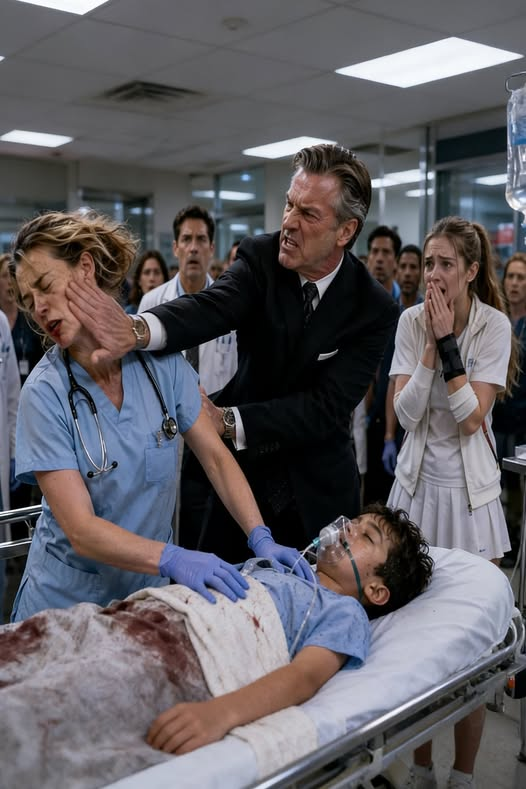
Nurse Nora Whitaker did not scream. She did not stumble. She simply turned her face back toward Benjamin Hale, the billionaire whose bleeding teenage son lay ten feet away, and said in a voice cold enough to silence the room, “Security can remove him, or I can save his son. Choose fast.”
For one frozen second, nobody moved.
Not the young resident holding a blood pressure cuff.
Not the respiratory therapist standing beside the ventilator.
Not Dr. Michael Torres, the attending physician, whose gloved hands were already red from trying to control the boy’s internal bleeding.
And not Benjamin Hale.
He stood in the middle of St. Mercy Regional Hospital’s trauma bay in Denver, Colorado, wearing a charcoal suit that cost more than most nurses made in two months. His silver hair was perfectly combed despite the chaos. His blue eyes burned with the kind of fury that came from a man who had spent his entire life watching people obey before he finished speaking.
“My son is not dying in this dump,” Hale snarled.
Nora’s cheek burned, but her hands were steady.
“He will if you keep blocking the team.”
Benjamin looked at her as if she were furniture that had suddenly spoken.
His son, Caleb Hale, seventeen years old, had been pulled from the crushed passenger side of a black Maybach after a high-speed collision near Cherry Creek. He had a collapsed lung, a deep abdominal injury, and a pressure dropping so fast it felt like the whole room was racing against a clock nobody could see.
Benjamin had arrived five minutes after the ambulance, surrounded by private security, lawyers, and a hospital board member who had clearly been dragged out of a fundraiser.
He had demanded a private room.
He had demanded a different doctor.
He had demanded “the best.”
Then he had seen Nora cutting through Caleb’s blood-soaked shirt with trauma shears, and he had exploded.
“You are not touching my son,” he had snapped.
Nora had not looked up.
“Sir, step back.”
“You’re a nurse.”
“Yes.”
“You people take orders.”
That was when she raised her eyes.
There were things in Nora Whitaker’s eyes that did not belong in an ordinary emergency room.
Things Benjamin Hale did not understand.
Desert dust.
Rotor wash.
Night vision green.
Young soldiers whispering for their mothers while mortar fire shook the sand around them.
But Benjamin only saw a woman in navy scrubs with her blonde hair twisted into a tight bun, a hospital badge clipped to her chest, and a calmness that offended him.
“I said step back,” Nora repeated.
Benjamin Hale stepped forward instead.
Then he slapped her.
A gasp tore through the trauma bay.
Nora’s head turned with the force, but her body did not move.
For half a breath, the old part of her awakened.
The part trained to disarm a panicked man twice her size.
The part trained to make a threat stop breathing before the threat understood it had made a mistake.
But Caleb moaned on the gurney.
So Nora swallowed the fire in her throat and chose the boy.
“Dr. Torres,” she said, “left chest is silent. Pressure is crashing. Prep for tube thoracostomy.”
Dr. Torres blinked once, then snapped back into motion.
“On it.”
Benjamin’s hand was still half-raised.
Nora pointed to the red line painted on the floor.
“Behind that line. Now.”
“You think you can order me around?”
“No,” Nora said. “I think your son has about ninety seconds before hypoxia starts damaging his brain.”
That did it.
For the first time since he entered the ER, Benjamin Hale looked at Caleb instead of himself.
His boy’s lips had gone pale.
His chest barely moved.
The billionaire stepped back.
Nora moved in.
Everything became speed.
“Need suction.”
“Pressure’s sixty over forty.”
“Get two units O-neg in here.”
“Call OR.”
“Page vascular.”
Nora leaned over Caleb, her voice lowering.
“Caleb, my name is Nora. I know you’re scared. You listen to me, okay? We’re going to keep you here.”
His eyelids fluttered.
“Dad?”
“He’s here,” Nora said. “But you stay with me.”
Benjamin watched from behind the red line, breathing hard, one hand trembling at his side.
Nora placed pressure where it mattered. She anticipated every order before Dr. Torres said it. She saw the rhythm shift before the monitor screamed. She caught the tiny changes that separated a living patient from a lost one.
The resident, Dr. Patel, stared at her for half a second too long.
Nora snapped, “Don’t admire. Move.”
He moved.
Twelve minutes later, Caleb Hale was alive enough to reach surgery.
Barely.
As they rolled him toward the elevators, Benjamin rushed forward.
Nora blocked him with one arm.
“Family waits outside surgical intake.”
“I’m going with him.”
“You’re not sterile, you’re not calm, and you’re not useful.”
Benjamin’s face turned dark.
“You have no idea who I am.”
Nora met his stare.
“And you have no idea who I am.”
The words landed strangely.
Dr. Torres noticed.
So did hospital administrator Diane Mercer, who had arrived in heels and pearls, pale with panic because the man yelling in her ER had donated twenty-five million dollars to the new cardiac wing.
Benjamin leaned closer to Nora.
“By sunrise, you won’t have a job.”
Nora’s cheek still showed the red mark of his hand.
She did not touch it.
“By sunrise,” she said quietly, “you may be grateful I did mine.”
Then she turned and walked back into the blood-bright trauma bay.
Diane Mercer found Nora in the supply room twenty minutes later.
Nora was restocking chest tubes.
Not crying.
Not shaking.
Restocking.
That made Diane even more uncomfortable.
“Nora,” she said softly, closing the door behind her.
Nora did not turn.
“If this is about the incident report, I already filed one.”
Diane winced.
“The situation is delicate.”
Nora laughed once.
It was not a warm sound.
“A man assaulted a nurse in the ER while his child was dying. That’s not delicate. That’s criminal.”
Diane folded her hands.
“Benjamin Hale is under extraordinary stress.”
“So was Caleb. He didn’t hit anyone.”
“Nora.”
Now Nora turned.
Diane had been the hospital administrator for six years. She understood donors, lawsuits, reputation, and the quiet ways powerful men made problems disappear.
But standing in front of Nora, she suddenly felt like she was speaking to someone who had already survived worse than anything this hospital could threaten.
“Benjamin Hale is one of our largest benefactors,” Diane said. “His foundation funds half our pediatric surgical program.”
“Then maybe his foundation should learn not to assault staff.”
Diane lowered her voice.
“He is demanding your immediate suspension.”
Nora looked at her for a long moment.
Then she nodded.
“Of course he is.”
“I don’t want to do that.”
“But you will.”
Diane’s silence answered.
Nora put the supply pack down.
The room hummed with fluorescent light.
Outside, the ER continued its endless American rhythm: sirens, phones, rolling carts, crying families, nurses calling orders over the noise.
Nora took off her badge and looked at it.
NORA WHITAKER, RN
EMERGENCY DEPARTMENT
That badge told such a small piece of the truth.
It did not mention Kandahar.
It did not mention the classified evacuation near the Syrian border.
It did not mention a winter night in Alaska when she had kept four men alive in a crashed helicopter for eleven hours using a penlight, a pocketknife, and stubbornness that bordered on holy.
It did not mention the Silver Star recommendation that vanished into classified channels.
It did not mention the two generals who still sent her Christmas cards under fake return addresses.
And it definitely did not mention why Nora Whitaker had left elite military medicine behind and chosen to work nights in a civilian ER where nobody saluted her and nobody knew her name.
“I’m placing you on administrative leave pending review,” Diane said.
Nora clipped the badge back onto her scrub top.
“No.”
Diane blinked.
“Nora—”
“You can review anything you want. But I’m finishing my shift.”
“That may not be possible.”
Nora stepped closer.
“Caleb Hale is in surgery because I kept working after his father hit me. There are thirty-seven patients still in this department. Three are waiting for beds. One is detoxing. One is septic. Room twelve has a little girl with a fever her mother can’t pay to treat. So unless you are physically removing me, I’m finishing my shift.”
Diane stared at her.
“You’re making this harder.”
“No,” Nora said. “I’m making this honest.”
Diane’s phone buzzed.
She glanced down.
Her face tightened.
“What?” Nora asked.
Diane hesitated.
Then turned the phone around.
A video was already spreading online.
Someone in the ER waiting area had recorded through the glass.
The clip showed Benjamin Hale striking Nora.
It showed Nora not reacting.
It showed Caleb being rolled away alive.
The caption read:
BILLIONAIRE BENJAMIN HALE SLAPS ER NURSE WHO SAVED HIS SON.
The view count was already climbing.
Nora closed her eyes for half a second.
Not because she feared Benjamin Hale.
Because public attention never came alone.
It brought reporters.
Lawyers.
Questions.
And eventually, if enough people looked closely, it brought the past.
The past was the one place Nora never wanted to stand again.
At 2:17 a.m., Benjamin Hale stood in the surgical waiting room with a glass of untouched water in his hand.
His lawyers had arrived.
His public relations director had arrived.
Two members of the hospital board had arrived.
His wife had not.
Marissa Hale was in Milan, according to Benjamin’s assistant, though the truth was uglier. She had stopped flying home for emergencies two years ago, after Benjamin’s affairs became too humiliating to deny and his temper too public to excuse.
Caleb was their only child.
Benjamin loved him.
That was the worst part.
He loved Caleb deeply, fiercely, possessively.
But Benjamin Hale had never learned the difference between love and control.
So when the trauma surgeon finally emerged, mask hanging around his neck, Benjamin was already moving toward him.
“Is he alive?”
Dr. Elaine Rhodes, the lead surgeon, looked exhausted.
“Yes.”
Benjamin exhaled sharply.
“For now,” she added.
His face changed.
Dr. Rhodes continued, “Your son suffered severe internal bleeding and blunt-force trauma. We controlled the hemorrhage. He is being transferred to ICU. The next twenty-four hours matter.”
Benjamin looked through the glass doors toward the hallway.
“The nurse.”
Dr. Rhodes stiffened.
“What about her?”
“She knew what she was doing.”
“Yes,” Dr. Rhodes said. “She did.”
“Who is she?”
“A nurse.”
Benjamin’s eyes narrowed.
“Don’t be cute with me.”
“I’m not.”
“She moved like—”
He stopped.
He had noticed.
In the trauma bay, when everyone else had panicked around his money and his rage, Nora Whitaker had moved like a commander.
Dr. Rhodes removed her gloves slowly.
“Mr. Hale, I’m going to say something you should hear clearly. Your son is alive because that nurse stayed calm after you assaulted her.”
Benjamin’s jaw tightened.
“My attorneys will handle that.”
“No,” Dr. Rhodes said. “The police may handle that.”
His lawyers shifted behind him.
The PR director whispered, “Benjamin.”
He ignored her.
“I want her gone.”
Dr. Rhodes looked at him as if he had just said something small and foul.
“Then you want the wrong thing.”
Benjamin turned away before she could say more.
His phone had been buzzing nonstop.
News alerts.
Board members.
Donors.
Enemies pretending concern.
The video had gone viral.
The first headline called him “Billionaire ER Bully.”
The second called him “Hospital Donor Who Hit Nurse.”
The third asked why the Denver Police Department had not announced an arrest.
Benjamin’s face hardened.
He had killed worse stories than this.
He had buried investigations.
He had purchased silence from executives, journalists, politicians, and former friends.
A nurse was nothing.
A video was manageable.
Public anger burned hot, then died when fed the right apology.
He turned to his chief attorney, Martin Voss.
“Make this disappear.”
Martin was an elegant man with silver glasses and no visible conscience.
“We’ll issue a statement about emotional distress. Offer a private apology. Quiet settlement. Hospital cooperation.”
Benjamin nodded.
“And the nurse?”
“We’ll dig.”
“For what?”
Martin’s mouth curled.
“Everyone has something.”
Benjamin looked back toward the hallway.
For the first time that night, he felt a small, cold unease.
Nora Whitaker had not looked afraid when he threatened her job.
She had looked disappointed.
As if Benjamin Hale were merely the latest version of a man she had already defeated somewhere worse.
Nora finished her shift at 7:04 a.m.
By then, she had treated a construction worker with a crushed hand, calmed a homeless veteran through a panic attack, restarted an IV on a dehydrated toddler, and helped pronounce a seventy-nine-year-old woman whose daughter arrived ten minutes too late.
Then she changed out of her scrubs, put on jeans, a gray hoodie, and an old leather jacket, and walked out through the employee exit into the thin gold light of a Colorado morning.
Reporters waited at the front entrance.
Nora avoided them.
She crossed the staff parking lot with her head down and keys in hand.
Halfway to her truck, a black SUV pulled up beside her.
She stopped.
The rear window lowered.
A man in his late sixties looked out at her with tired eyes and a face that belonged on memorial walls and command portraits.
Major General Thomas Rourke.
Retired, officially.
Never fully retired, in practice.
Nora stared at him.
“No.”
He sighed.
“Good morning to you too, Whitaker.”
She looked around the parking lot.
“You cannot be here.”
“I was in town.”
“No, you weren’t.”
“Fine. I was nearby.”
“That’s also a lie.”
Rourke smiled faintly.
“You always were hard to brief.”
Nora walked closer, anger rising.
“Who called you?”
“Enough people.”
“General—”
“Tom,” he corrected.
She ignored that.
“This is a hospital incident. It has nothing to do with you.”
The smile disappeared.
“A billionaire with defense contracts assaulted a former classified military medical asset in a public ER, then sent lawyers digging into her sealed background before breakfast. That has something to do with me.”
Nora’s stomach tightened.
“They’re digging?”
“Already.”
She looked away.
Across the lot, a nurse smoked beside a dumpster. A delivery truck backed toward the kitchen entrance. Ordinary life kept moving, unaware that Nora’s carefully built quiet had just cracked down the middle.
“I’m not going back into that world,” Nora said.
“Nobody is asking you to.”
“They always say that first.”
Rourke opened the SUV door.
“Get in.”
“No.”
“Nora.”
“No.”
The old general studied her.
He had seen Nora at twenty-six, hands inside a wounded captain’s chest cavity while bullets snapped against the wall above her head.
He had seen her carry blood bags through smoke.
He had seen her refuse evacuation until every patient left before her.
And he had seen her in a military hospital afterward, sitting alone beside a window, looking more broken by survival than by injury.
“You saved a boy last night,” he said.
“I did my job.”
“And now powerful people are going to punish you for embarrassing them.”
“I can handle Benjamin Hale.”
“I know.” His voice softened. “But you shouldn’t have to handle him alone.”
Nora looked at the SUV.
There was another figure inside, half-hidden.
A woman in uniform.
Two stars on her shoulder.
Nora felt the world tilt.
“Is that Alicia?”
Major General Alicia Morrow leaned forward.
“Hello, Nora.”
For the first time since the slap, Nora looked shaken.
“You’re active command.”
“Yes.”
“You came here in uniform?”
“Yes.”
“Are you insane?”
Morrow smiled.
“Frequently accused. Never convicted.”
Nora stepped back.
“No. Whatever you’re planning, no.”
Rourke said, “We’re not planning anything. We’re responding.”
“To what?”
“To twelve years of sealed truth being weaponized by a man who thinks money outranks service.”
Nora’s eyes flashed.
“I don’t need medals dragged out to prove I deserve basic human respect.”
Morrow’s expression turned grave.
“No. You don’t. But Hale isn’t stopping at your job.”
Nora said nothing.
Rourke handed her a tablet.
On the screen was a message from an unknown sender to Martin Voss, Benjamin’s attorney.
Find everything on Nora Whitaker. Military record, discharge, psych, classified rumors. If she has PTSD, use it. If she has discipline issues, leak it. Need her discredited before noon.
Nora’s face went still.
That stillness was worse than rage.
Morrow’s voice was quiet.
“The FBI has already been watching Hale.”
Nora looked up.
“For what?”
“Defense procurement fraud. Witness intimidation. Illegal pressure on federal medical contractors. Last night may connect him to obstruction.”
Nora almost laughed.
“So he slapped the wrong nurse.”
Rourke shook his head.
“No. He slapped a nurse. That was enough.”
Nora looked toward the hospital.
Inside, Caleb Hale was fighting for his life.
Outside, Caleb’s father was building a war because he had been told no.
She handed the tablet back.
“What do you want from me?”
“Permission,” Morrow said.
“For what?”
“To tell enough truth to stop him from burying you.”
Nora’s throat tightened.
“Enough truth becomes all truth.”
“Not if we control the release.”
Nora looked at both generals.
These were not just officers from her past.
They were keepers of the version of her life America never got to know.
The version sealed behind black ink and national security language.
The version that had cost her sleep, friends, and a marriage that ended before it had properly begun.
Finally, she said, “No operations. No classified details. No patient information. No turning me into a hero poster.”
Rourke nodded.
“Agreed.”
Morrow added, “But if Hale tries to call you unstable, unqualified, or dangerous, we answer.”
Nora stared at the sunrise.
Twelve hours ago, Benjamin Hale had believed she was powerless.
Now generals were sitting in her parking lot.
And Nora hated that part of her wanted him to see them.
At 10:36 a.m., Benjamin Hale held a crisis meeting in the executive conference room of St. Mercy Regional.
Diane Mercer sat at one end of the table, pale and sleepless.
Martin Voss sat beside Benjamin with a folder full of preliminary dirt.
Three board members joined by video.
The PR director, Claire Benton, stood near a screen showing the statement they planned to release.
Benjamin Hale deeply regrets the incident that occurred during an emotionally devastating family emergency. He has requested a private opportunity to apologize to the staff member involved. We ask for privacy as his son remains in critical condition.
“It makes me sound weak,” Benjamin said.
Claire exhaled.
“It makes you sound human.”
“I don’t pay you for insults.”
“You pay me to keep you from becoming a national villain by lunch.”
Martin tapped the folder.
“We have another angle.”
Diane stiffened.
“What angle?”
Martin opened the folder.
“Nora Whitaker. Age thirty-eight. Emergency RN. Prior military medical service. Discharged seven years ago. Records partially sealed.”
Benjamin leaned back.
“Sealed why?”
“Unclear.”
Claire frowned.
“Do not go after the nurse.”
Martin ignored her.
“There are references to behavioral health review after an overseas incident. We don’t have details yet, but it could support a narrative of instability.”
Diane’s voice hardened.
“She was assaulted.”
Martin turned to her.
“She was involved in an incident during which Mr. Hale’s minor son was receiving emergency care.”
Diane looked disgusted.
“You mean she saved his life.”
Benjamin’s eyes cut toward her.
“Careful, Diane.”
Something in the room shifted.
Diane Mercer had bent for donors for years. She had smiled through humiliations, budget threats, charity dinners where men like Benjamin called nurses “labor units” after two glasses of wine.
But she had watched Nora Whitaker take a slap and keep saving a child.
Now she heard Benjamin’s warning and felt, perhaps for the first time in years, the true cost of cowardice.
She stood.
“Nora Whitaker will not be suspended.”
Benjamin slowly turned his head.
“What did you say?”
Diane’s fingers trembled, but her voice did not.
“She will remain on paid leave only if she requests it. The hospital will cooperate with law enforcement. We will not retaliate against an employee for being assaulted.”
Martin smiled thinly.
“That sounds noble. It also sounds expensive.”
Diane looked at him.
“So does a wrongful termination lawsuit with a viral video attached.”
Benjamin stood.
“This hospital exists because men like me write checks.”
“No,” Diane said. “This hospital exists because people like Nora Whitaker stay awake all night saving strangers.”
The room went silent.
Benjamin’s face flushed.
Before he could speak, the conference room door opened.
A security guard stepped in, nervous.
“Ms. Mercer?”
“What is it?”
“There are federal agents downstairs.”
Martin’s expression changed.
Benjamin’s did not.
“Tell them to wait.”
The guard swallowed.
“They’re with two generals.”
Claire whispered, “Oh my God.”
Benjamin stared at the guard.
“What generals?”
The answer came from behind him.
“These generals.”
Major General Alicia Morrow entered first, in dress uniform.
Major General Thomas Rourke followed in a dark civilian suit, though he somehow looked more military than anyone in uniform.
Behind them came two FBI agents.
The conference room transformed.
No one knew where to look.
Benjamin Hale had built his life on hierarchy, and suddenly a bigger one had entered the room.
Morrow’s gaze moved across the table and stopped on Benjamin.
“Mr. Hale.”
Benjamin recovered quickly.
“General. I don’t believe we’ve met.”
“No,” Morrow said. “But I know your type.”
Martin stood.
“This is a private hospital administrative meeting.”
FBI Special Agent Carla Nguyen held up a badge.
“Not anymore.”
Benjamin’s mouth tightened.
“On what authority?”
Agent Nguyen placed a folder on the table.
“Federal investigation into witness intimidation, attempted retaliation against protected medical personnel, and matters related to ongoing defense contract inquiries.”
Martin went very still.
Rourke looked at him.
“You should sit down.”
Martin sat.
Benjamin laughed once.
It was controlled, but not convincing.
“This is absurd. I had a family emergency. I lost my temper.”
Morrow’s eyes were cold.
“You assaulted a nurse while she was saving your son.”
“I intend to apologize.”
“After ordering your attorney to dig for sealed psychological records?”
Benjamin’s face changed by a fraction.
Agent Nguyen opened the folder.
“We have communications from your office this morning.”
Martin said quickly, “We deny any improper—”
Nguyen cut him off.
“Counselor, speak again without knowing what we have, and you may create a second problem for your client.”
Rourke looked at Diane.
“Ms. Mercer, is Nurse Whitaker being disciplined?”
Diane looked at Benjamin.
Then at the generals.
“No.”
“Was there pressure to discipline her?”
Diane inhaled.
“Yes.”
Benjamin slammed a hand on the table.
“This is a setup.”
Morrow stepped closer.
“No, Mr. Hale. A setup is when a powerful man creates a false narrative to crush someone before she can tell the truth.”
Rourke placed a second folder on the table.
“This is a statement from the Department of Defense confirming that Nora Whitaker served with distinction in multiple high-risk medical assignments and that attempts to access or misrepresent sealed portions of her record may trigger federal review.”
Benjamin stared at the folder.
“Served with distinction,” he repeated.
Morrow said, “That is the public version.”
“And the private version?”
Rourke’s face did not move.
“You are not cleared for the private version.”
The sentence landed like a door locking.
Claire Benton, the PR director, slowly sat down.
She had spent years managing rich men who thought every room could be bought.
This was the first time she had seen Benjamin Hale look genuinely uncertain.
Agent Nguyen turned to Diane.
“We’ll need hospital surveillance footage, incident reports, staff statements, and any communications regarding disciplinary action against Nurse Whitaker.”
Diane nodded.
“You’ll have everything.”
Benjamin snapped, “Diane.”
She looked at him.
“No.”
It was only one word.
But it was the first brick falling from the empire.
Nora watched the generals arrive on a news livestream from her kitchen table.
Her small house sat on a quiet street west of Denver, with a cracked driveway, a faded American flag, and a maple tree she kept meaning to trim.
The house was modest because Nora liked things she could fix herself.
She had bought it after leaving the military, after spending six months sleeping badly in short-term apartments, after deciding she needed walls that did not belong to the government.
On the table beside her laptop sat black coffee, untouched toast, and a shoebox of letters she had not opened in years.
When the camera caught Alicia Morrow stepping into St. Mercy, Nora closed the laptop.
Then she opened it again.
Then she closed it.
“Damn it,” she whispered.
Her phone rang.
DR. TORRES.
She answered.
“Is Caleb alive?”
A pause.
Then Dr. Torres said, “Nice to hear your priorities are intact.”
“Michael.”
“He’s alive. Critical but stable. Woke briefly. Asked for water and his dad.”
Nora shut her eyes.
“Good.”
“You okay?”
“No.”
“Fair.”
She could hear hospital noise behind him.
“You saw?” he asked.
“Yes.”
“Generals, Nora?”
“I know.”
“Plural?”
“I know.”
“Anything you want to tell me?”
“No.”
“Anything I need to know as your friend?”
Nora leaned back.
Outside, a neighbor’s dog barked at nothing.
“Before I worked at St. Mercy, I did trauma medicine in places where names didn’t go on paperwork.”
“That is both more and less than I expected.”
“I’m sorry.”
“For what?”
“For bringing it to the hospital.”
Michael’s voice sharpened.
“You didn’t bring anything. Hale brought his hand. Hale brought his ego. Hale brought his lawyers.”
Nora rubbed her eyes.
“I hate this.”
“I know.”
“No, you don’t.”
He paused.
“Maybe not.”
That was why she liked Michael Torres. He did not pretend knowledge he did not have.
He said, “Diane refused to suspend you.”
Nora opened her eyes.
“She did?”
“In a room full of Hale’s people.”
Nora felt something unexpected twist in her chest.
Respect.
And guilt.
“Good for her,” she said.
“Yeah. I thought so too.”
Another pause.
Then Michael said, “The FBI wants to speak with you.”
“I figured.”
“You want me there?”
“No.”
“Nora.”
“I said no.”
His voice softened.
“You don’t have to do every hard thing alone.”
Nora looked at the shoebox.
On top was a photograph.
Six people in dusty uniforms outside a field hospital.
Three were dead now.
One was missing a leg.
One was a general.
And one was Nora, smiling like she still believed survival was simple.
“I learned alone,” she said quietly.
Michael said, “Then maybe it’s time to unlearn.”
She did not answer.
Because that sounded dangerous.
And because part of her wanted it.
Caleb Hale woke again at 1:12 p.m.
The ICU room was dim, filled with soft beeps and filtered light.
Benjamin sat beside the bed, still in yesterday’s suit, tie loosened. For once, no lawyer stood beside him. No assistant. No guard.
Just a father watching a boy breathe through pain.
Caleb’s eyes opened slightly.
“Dad?”
Benjamin leaned forward.
“I’m here.”
“It hurts.”
“I know.”
“What happened?”
“You were in an accident.”
Caleb blinked slowly.
“The nurse.”
Benjamin froze.
Caleb’s voice was hoarse.
“She said stay with me.”
Benjamin swallowed.
“Yes.”
“She nice?”
The question hit harder than it should have.
Benjamin saw the slap again.
The sound.
The stillness.
The red mark on Nora’s cheek.
“She helped you,” he said.
Caleb closed his eyes.
“You yelled.”
Benjamin looked down.
“You were badly hurt.”
“You always yell.”
The words were barely audible.
But Benjamin heard them.
For a moment, he was not a billionaire.
He was not a donor.
He was not a man whose name appeared on buildings.
He was a father sitting beside a hospital bed while his son, drugged and wounded, told the truth no one else was allowed to say.
Benjamin touched Caleb’s hand.
“I was scared.”
Caleb whispered, “Me too.”
Then he drifted away again.
Benjamin sat motionless.
Outside the ICU, cameras waited.
Federal agents waited.
Consequences waited.
For the first time in years, Benjamin Hale wondered if money could only delay judgment, not erase it.
Then Martin Voss called.
Benjamin let it ring.
By 4:00 p.m., the story had become national news.
Cable panels shouted.
Former nurses posted their own stories of being assaulted by patients and families.
Veterans’ groups began asking who Nora Whitaker was.
A blurry photo surfaced of Nora in uniform, kneeling beside a stretcher under the open ramp of a military aircraft.
No one knew where it came from.
No one knew the full story.
But America loved a mystery.
And it loved a fall.
Benjamin Hale’s companies began losing value before the markets closed.
Three senators called for review of his defense contracts.
St. Mercy’s nurses gathered outside the hospital during shift change, not protesting loudly, but standing in a line.
Some held signs.
HANDS THAT HEAL SHOULD NOT BE HIT.
PROTECT NURSES.
SHE SAVED HIS SON.
Diane Mercer stood with them.
That image went viral too.
Nora saw it and cried for the first time.
Not much.
Just once.
A single break in the armor.
Then she wiped her face because the doorbell rang.
She opened the door to find Agent Carla Nguyen on the porch.
Beside her stood General Morrow.
Nora sighed.
“I should’ve moved to Montana.”
Morrow said, “You’d still answer the door.”
“No, I wouldn’t.”
Agent Nguyen smiled politely.
“May we come in?”
Nora stepped aside.
Her house was clean but lived in. Books on emergency medicine, military history, and woodworking filled one shelf. A half-repaired lamp sat on the counter. Running shoes by the door. No family photos except the shoebox on the table.
Agent Nguyen noticed everything.
Good agents always did.
Nora poured coffee because hospitality had been beaten into her by a grandmother from Iowa who believed even bad news deserved a mug.
Nguyen opened a recorder.
“With your permission?”
Nora nodded.
The questions began.
What happened when Benjamin entered the ER?
What did he say?
Did he interfere with treatment?
Did anyone from hospital administration pressure her afterward?
Had anyone contacted her with threats?
Had she authorized release of military records?
Nora answered carefully.
She did not dramatize.
She did not minimize.
She gave facts the way she gave trauma reports: clean, specific, useful.
When Nguyen asked about Benjamin’s attorney seeking sealed records, Nora’s jaw tightened.
“No one has permission to access those.”
“Are you concerned about what they might find?”
Nora looked at Morrow.
Morrow gave nothing away.
“Yes,” Nora said.
Agent Nguyen waited.
Nora continued, “Not because I did anything wrong. Because classified service creates empty spaces, and people with money love filling empty spaces with lies.”
Nguyen nodded.
“General Morrow has provided limited confirmation of your service.”
“I know.”
“Do you object?”
Nora was quiet.
“I object to needing it.”
Morrow looked down.
Agent Nguyen turned off the recorder after an hour.
“Thank you.”
“Is Hale going to be arrested?”
Nguyen’s expression stayed neutral.
“For the assault? That depends on local authorities and prosecutorial decisions. For the broader investigation? I can’t discuss details.”
Nora almost smiled.
“That means yes, but not today.”
Nguyen stood.
“It means I can’t discuss details.”
After the agent stepped outside to make a call, Morrow remained in the kitchen.
Nora leaned against the counter.
“You shouldn’t have come.”
“Yes, I should have.”
“You know what they’ll do now. Reporters will dig. People will invent things. Someone will find half a file and call me a killer, a fraud, a secret assassin, a crisis actor, whatever pays better.”
Morrow’s face softened.
“You saved lives, Nora.”
“I lost lives too.”
“We all did.”
“No,” Nora said. “Not like I did.”
The room went very still.
Morrow looked at the shoebox.
“Do you still blame yourself for Arman Ridge?”
Nora’s eyes sharpened.
“Don’t.”
“Nora—”
“I said don’t.”
Morrow took the warning, but did not retreat completely.
“You kept twelve people alive for nine hours under fire.”
“Four died.”
“Four were dead before extraction.”
“They were breathing when I reached them.”
“That is not the same thing.”
Nora turned away.
Outside, a car slowed in front of the house.
Probably a reporter.
Maybe a neighbor.
Maybe just someone lost.
That was what public exposure did. It made every passing shadow feel intentional.
Morrow said, “Hale will use whatever pain he finds.”
Nora laughed bitterly.
“Then he’ll have plenty.”
“But pain is not guilt.”
Nora looked at her.
Morrow’s voice lowered.
“And silence is not peace.”
For years, Nora had believed silence was the closest thing to peace she deserved.
Now silence had been mistaken for weakness by a man with a violent hand.
That mistake was about to cost him everything.
Benjamin Hale finally watched the full ER video at 6:45 p.m.
Not the clipped version online.
The hospital security footage.
No shaky phone.
No crowd noise.
Just clear, unforgiving truth.
He watched himself enter like an invading force.
He watched Nora working.
He watched himself get in the way.
He watched Caleb’s oxygen drop while he argued.
He watched Nora warn him.
He watched his hand rise.
The slap looked worse from a distance.
Less emotional.
More deliberate.
Then he watched Nora turn back to his son.
No retaliation.
No collapse.
No performance.
Just discipline.
He watched her save Caleb.
When the video ended, Benjamin sat alone in a private hospital office and felt something close to nausea.
Martin Voss stood near the window.
“We should not let this version leak.”
Benjamin looked up slowly.
“Did you send someone after her military records?”
Martin adjusted his glasses.
“We initiated background review.”
“I asked if you sent someone after sealed records.”
“We explored available channels.”
“Illegal channels?”
Martin hesitated.
That hesitation was answer enough.
Benjamin stood.
“You idiot.”
Martin’s eyebrows rose.
“You asked me to make this disappear.”
“I asked you to handle a PR problem.”
“No,” Martin said coolly. “You asked me to destroy a woman before noon.”
Benjamin went still.
Martin had served him for eighteen years.
He knew where bodies were buried.
Not literal bodies.
Benjamin had always maintained that line.
But careers.
Companies.
Witnesses.
Whistleblowers.
People who had stood in his way and then found themselves ruined, audited, sued, exposed, abandoned.
Martin knew it all.
Benjamin lowered his voice.
“Be careful.”
Martin smiled.
“Now you understand the problem.”
The door opened.
Claire Benton entered without knocking.
“Benjamin, you need to see this.”
She turned on the office television.
A press conference was beginning outside the hospital.
Diane Mercer stood at a podium.
Beside her stood General Morrow, General Rourke, Agent Nguyen, and Dr. Elaine Rhodes.
Nora was not there.
Benjamin focused on that absence.
Claire whispered, “Smart.”
Diane began.
“Last night, a member of our emergency department was assaulted while providing lifesaving care to a critically injured patient. St. Mercy Regional Hospital condemns violence against healthcare workers in any form.”
Reporters shouted questions.
Diane continued.
“The nurse involved acted with extraordinary professionalism. She completed her duties under pressure, and the patient survived initial emergency intervention because of the coordinated work of our trauma team.”
Then General Morrow stepped forward.
Benjamin felt the room tighten around him.
Morrow spoke clearly.
“Nora Whitaker is a former military medical professional whose service record includes distinguished performance in high-risk environments. Due to the nature of some assignments, portions of her record remain protected. Any attempt to misrepresent sealed service history as misconduct is false and will be addressed through appropriate channels.”
A reporter called, “General, was she special operations?”
Morrow replied, “I will not discuss classified assignments.”
Another reporter asked, “Is it true she saved American soldiers overseas?”
Rourke stepped to the microphone.
“It is true that Americans are alive today because Nora Whitaker refused to quit under conditions most people cannot imagine.”
Benjamin closed his eyes.
Claire said softly, “It’s over.”
He opened them.
“No.”
On the screen, Agent Nguyen spoke next.
“The FBI is cooperating with local authorities and reviewing related matters. We encourage anyone with information regarding attempts to intimidate, retaliate against, or unlawfully access records related to medical personnel to contact our office.”
Martin turned pale.
Benjamin noticed.
So did Claire.
On the television, Dr. Rhodes took the microphone.
“I operated on Caleb Hale. I will not discuss his private medical details. But I will say this: the first minutes mattered. Nurse Whitaker made those minutes count.”
Then Diane returned.
“We stand with our staff.”
The press conference ended.
The office was silent.
Benjamin looked at Martin.
“What did you do?”
Martin’s phone buzzed.
He checked it.
Then all color left his face.
“Federal subpoena,” he said.
Claire took one step back from both men.
Benjamin understood then.
The slap had started the fire.
But Martin’s search had poured gasoline into rooms Benjamin had forgotten were full of smoke.
At 9:00 p.m., Nora returned to St. Mercy.
Not for a shift.
For Caleb.
She entered through a staff hallway, wearing plain clothes and a visitor badge Diane had arranged quietly.
Diane met her near the ICU doors.
“You don’t have to do this.”
“I know.”
“He asked for you.”
Nora looked through the glass.
Caleb lay pale and still under tubes and blankets, a boy trapped beneath machines.
Benjamin sat beside him.
Nora stopped walking.
Diane said, “I can ask him to leave.”
“No.”
“Nora.”
“No,” she repeated. “His son asked for me. I’m not making this about him.”
Diane studied her.
“I owe you an apology.”
Nora looked surprised.
“For what?”
“For almost choosing money over you.”
“You didn’t.”
“I almost did.”
Nora nodded.
“Almost matters. But so does what you did after.”
Diane’s eyes filled.
“I’m trying to become the kind of administrator my nurses thought I already was.”
“That’s a good start.”
Diane laughed through a breath.
Then she opened the ICU door.
Benjamin stood when Nora entered.
He looked older than he had twelve hours before.
Power could preserve a man’s skin, tailor his suits, polish his shoes, and put his name on marble.
But it could not hide the moment he realized people had stopped fearing him.
Nora walked past him to Caleb’s bedside.
The boy’s eyes opened slightly.
“Hey,” Nora said softly.
Caleb’s lips moved.
“Are you the nurse?”
“Yes.”
“You told me to stay.”
“You listened.”
A faint smile.
“Dad says you saved me.”
Nora glanced at Benjamin.
Then back at Caleb.
“A lot of people saved you.”
“But you were there.”
“I was there.”
Caleb swallowed.
“My dad hit you?”
The room changed.
Benjamin looked like he might step forward, then stopped himself.
Nora took Caleb’s hand carefully, avoiding the IV.
“Yes.”
Caleb’s eyes filled with shame that did not belong to him.
“I’m sorry.”
Nora’s chest tightened.
“Oh, honey. That is not your apology to carry.”
Benjamin flinched.
Caleb turned his face slightly toward his father.
“Dad.”
Benjamin’s voice was rough.
“I know.”
“No,” Caleb whispered. “Say it.”
Nora looked away.
This was not for her to watch.
But she stayed because Caleb’s fingers tightened around hers.
Benjamin Hale stood beside his son’s hospital bed, stripped of cameras, lawyers, and audience.
He looked at Nora.
For once, he did not perform regret.
He simply faced it.
“I am sorry,” he said. “I assaulted you. I interfered while you were saving my child. I threatened your job because I was ashamed and afraid and arrogant. There is no excuse.”
Nora held his gaze.
“No,” she said. “There isn’t.”
Benjamin nodded.
“I know.”
“Do you?”
His jaw tightened, but he did not argue.
“I’m beginning to.”
Nora studied him.
The apology was real.
That did not erase the harm.
Real remorse was not a receipt you handed someone in exchange for forgiveness.
It was only the first payment on a debt.
Caleb whispered, “Dad, don’t be like Grandpa.”
Benjamin closed his eyes.
There it was.
The old family curse.
The Hale men had built companies, towers, foundations, and graves of silence. Benjamin’s father had broken people with money and called it discipline. Benjamin had hated him, then become him in better suits.
He opened his eyes.
“I don’t want to be.”
Nora said quietly, “Then stop buying your way around consequences.”
Benjamin looked at her.
That sentence did what no headline had done.
It gave him a path, and it made the path brutal.
The arrest came at 6:20 the next morning.
Not Benjamin’s.
Martin Voss was taken into federal custody outside his downtown office on charges connected to illegal access attempts, obstruction, and evidence tampering in the broader Hale defense investigation.
Cameras caught him trying to hide his face with a leather briefcase.
By noon, three Hale Aerospace executives had resigned.
By evening, two had agreed to cooperate.
Benjamin Hale was not arrested that day.
That frustrated the internet.
But investigations did not move at internet speed.
They moved like winter rivers, slow on the surface, violent underneath.
What did happen quickly was civil.
St. Mercy announced a new zero-tolerance workplace violence policy.
Benjamin Hale resigned from the hospital board.
The Hale Foundation’s pediatric funds were moved into an independent trust with no family control.
Nora refused a settlement offer.
Instead, through an attorney recommended by General Morrow, she demanded three things.
A public apology.
Permanent funding for ER security and staff assault prevention.
And full legal protection for any St. Mercy employee who reported violence from donors, executives, or VIP patients.
Benjamin signed.
People said Nora should have taken millions.
Nora said she had enough to pay her mortgage and sleep at night.
Most people did not understand that as wealth.
She did.
Three weeks later, Caleb Hale left the ICU.
Nora was back on shift when he was transferred to step-down.
The bruise on her cheek had faded.
The story had not.
Reporters still called.
Podcasts still speculated.
A congresswoman mentioned Nora during a hearing on healthcare worker safety.
Veterans found ways to send quiet thanks.
One envelope arrived with no return address.
Inside was a photograph from Arman Ridge.
Nora almost threw it away.
Then she saw the note on the back.
You counted the four we lost. I count the twelve who came home. I was one of them.
— Captain James Ellis
Nora sat in the break room for ten minutes holding that photo.
Then she put it in her locker.
Not the shoebox.
The locker.
A place for things still alive.
That afternoon, Benjamin Hale appeared at the ER security desk.
He wore no entourage.
No lawyer.
No PR director.
Just a dark coat and a visitor badge.
Security called Nora.
She almost said no.
Then she saw Caleb beside him, moving slowly with a cane and the stubborn pride of a teenage boy who hated looking weak.
Nora stepped into the hallway.
Caleb smiled.
“Hey.”
“Look at you,” she said. “Walking around like trouble.”
He grinned.
Benjamin stood behind him, quiet.
Caleb held out an envelope.
“My physical therapist said I should practice stairs, but I wanted to practice this instead.”
Nora took the envelope.
Inside was a handwritten note.
Thank you for telling me to stay. I’m trying to.
— Caleb
Nora swallowed.
“Best discharge summary I’ve ever received.”
Caleb looked embarrassed.
“My dad has something too.”
Benjamin handed her a folder.
Nora did not take it.
“What is that?”
“Proof,” he said.
“Of what?”
“That the security fund, legal defense fund, and independent pediatric trust are fully executed. Diane has copies. So do your attorneys.”
Nora took the folder but did not open it.
“Good.”
Benjamin nodded.
“I also gave a statement to the FBI.”
Nora looked up.
His face was pale but steady.
“About Martin?”
“About Martin. About me. About the contracts. About all of it.”
Caleb stared at his father, surprised.
Benjamin looked at his son.
“I should have done it years ago.”
Caleb’s eyes filled, but he blinked hard.
Teenage boys often treated tears like enemy witnesses.
Nora softened.
“That must have cost you.”
Benjamin looked around the ER.
At the nurses.
At the stretchers.
At the controlled chaos of people trying to keep strangers alive.
“Yes,” he said. “It did.”
For the first time, Nora believed he understood that cost was not the same as injustice.
Some losses were bills finally coming due.
He turned to leave, then stopped.
“Ms. Whitaker.”
“Nora.”
He nodded once.
“Nora. I don’t expect forgiveness.”
“Good.”
A faint, painful smile crossed his face.
“But I am grateful.”
Nora looked at Caleb.
Then at Benjamin.
“Be better when nobody is recording.”
Benjamin absorbed that.
Then he left with his son.
Six months later, St. Mercy Regional opened the Whitaker Staff Safety Center.
Nora hated the name.
Diane insisted.
The center provided legal support, counseling, de-escalation training, and immediate reporting systems for healthcare workers assaulted on the job.
Nora refused to give the opening speech.
So Diane gave it.
Dr. Torres cried and denied it.
General Morrow attended in civilian clothes.
General Rourke sent flowers and a note that read, You still take orders poorly.
Nora pinned it in the break room.
Benjamin Hale did not attend.
By then, he was under federal indictment for conspiracy and fraud connected to defense contracts. His cooperation reduced some damage, but not all. His companies survived only after the board removed him. His name came down from three buildings, including the cardiac wing at St. Mercy.
The new name was simple.
The Emergency Care Wing.
No billionaire.
No ego.
Just the work.
Caleb visited Nora once a month during rehab appointments. He brought terrible vending machine coffee and asked questions about medicine.
Eventually, he told her he wanted to become a nurse.
Benjamin cried when he found out.
Caleb pretended not to notice.
Nora noticed everything.
One snowy evening, after a twelve-hour shift, Nora stepped outside the ambulance bay and found Michael Torres waiting with two paper cups of hot chocolate.
“No coffee?” she asked.
“You look like your soul has filed a complaint.”
“Accurate.”
He handed her a cup.
They stood together watching snow soften the parking lot.
After a while, Michael said, “You ever miss it?”
“What?”
“The old life.”
Nora watched an ambulance pull in, lights flashing silently through the snow.
“No.”
Then she reconsidered.
“Sometimes I miss who I was before I understood the cost.”
Michael nodded.
“And now?”
Nora looked back through the ER doors.
A young nurse laughed at the desk.
A security officer helped an elderly man find his wife.
Diane Mercer walked past carrying blankets because administrators who wanted respect could start by being useful.
Inside, the work waited.
Messy.
Human.
Unclassified.
“I think now I get to choose what my service means,” Nora said.
Michael smiled.
“That sounds like healing.”
Nora rolled her eyes.
“Don’t make it inspirational.”
“Too late.”
She laughed.
It surprised her.
Not because it happened.
Because it felt easy.
The ambulance doors opened.
A paramedic called out, “We need a nurse!”
Nora handed Michael her cup.
“Hold this.”
Then she walked back into the ER.
Not as a hidden hero.
Not as a headline.
Not as a victim of a billionaire’s rage.
As Nurse Nora Whitaker.
Steady hands.
Clear eyes.
Still here.
THE END