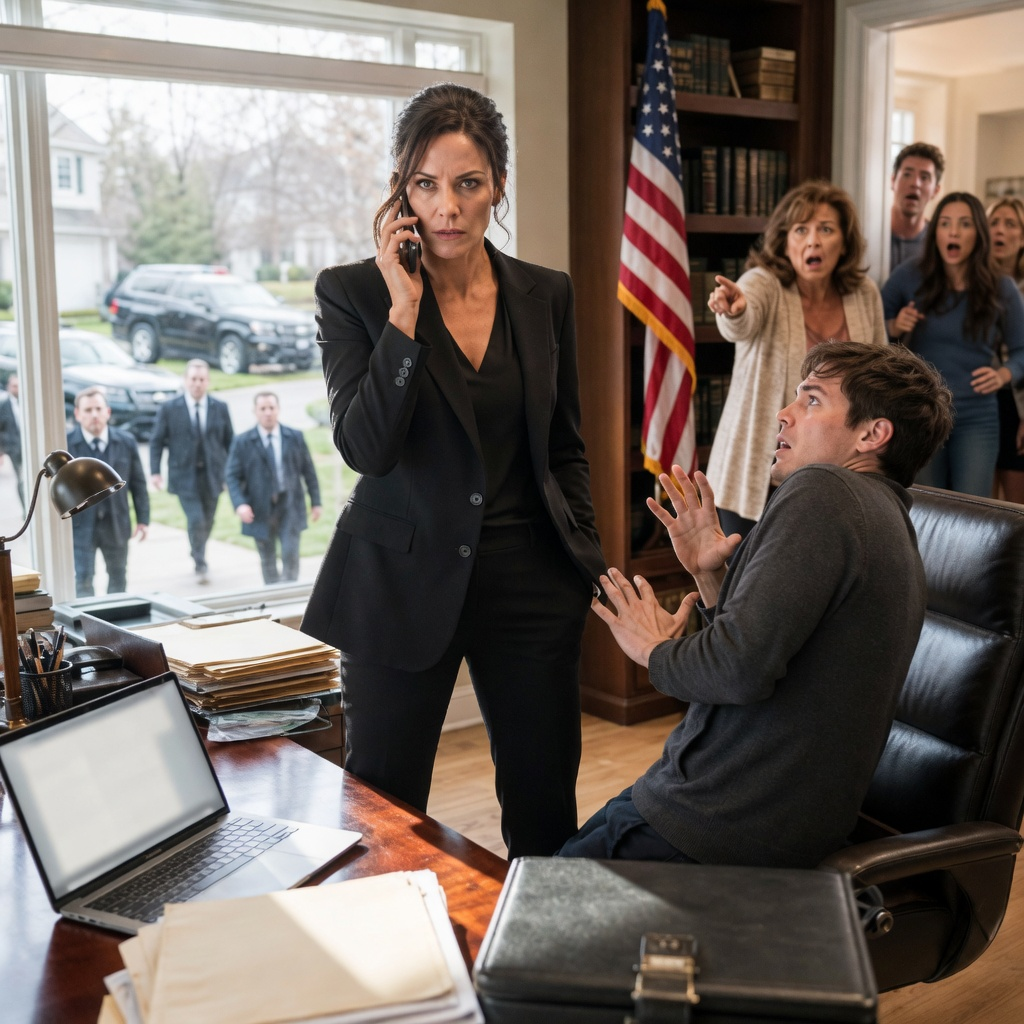
“Relax, It’s Just Your Work Stuff,” My Brother Laughed, Scrolling Through My Files. “There’s No Way This Is Actually Federal.” I Dialed My Supervisor Without Saying A Word. The Agents Surrounded Our House By Morning.
### Part 1
The drive back to my parents’ house felt longer than the map said it should.
It was only supposed to be six hours from my apartment to the suburb outside Columbus where I grew up, but the road stretched like it had been pulled thin. The sky was gray in that flat Midwestern way, no real storm, just a dull ceiling of clouds pressing down on the interstate. My coffee had gone cold in the cup holder. My hands stayed fixed at ten and two, because some habits come from training and some come from fear, and by then I wasn’t sure which was which.
My mother had called at 5:18 that morning.
I remembered the exact time because the first thing I saw when my phone lit up was the number, and the second thing I saw was the clock. In my line of work, details stick even when you don’t ask them to. Her voice had been too controlled, which was worse than crying.
“Your father had a stroke,” she said.
For a second, the whole room around me went silent. Not quiet. Silent. The hum of my refrigerator, the heater clicking on, the traffic outside my window, all of it disappeared under the weight of that sentence.
I asked the questions you ask when you’re trying not to panic. Which hospital? Was he conscious? Could he speak? Did the doctors say ischemic or hemorrhagic? My mother didn’t know half the answers. She kept saying, “They’re doing tests,” like the words themselves could hold him together.
I called my supervisor next.
He didn’t waste time with sympathy dressed up as procedure. He knew me too well for that. He told me to take emergency leave, then told me the part neither of us liked.
“You still need to remain reachable.”
I already knew.
For eight months, I had been embedded in a joint cybercrime task force targeting a financial fraud network that had laundered more than forty million dollars through shell companies, fake nonprofits, burner accounts, and people who thought unencrypted messaging apps made them invisible. We were three weeks from arrests. Three weeks from turning years of arrogance into court dates.
My supervisor met me in the secure room before I left. Fluorescent lights buzzed overhead. The room smelled like paper, dust, and burnt coffee. He slid a government-issued encrypted laptop across the table, along with a hard case that locked with a physical key.
“Critical developments only,” he said. “You know the drill.”
“I know the drill.”
His eyes stayed on mine for a second longer than usual. “Family emergency doesn’t make this less sensitive.”
“I know.”
I did know. That was the problem. I always knew.
When I pulled into my parents’ driveway, the porch light was on even though it was barely late afternoon. Their house looked exactly the same as it had when I was seventeen and desperate to leave it. White siding, brick steps, two ceramic planters my mother changed with the seasons. In one window, I could see the soft yellow glow of the living room lamp.
My brother’s car was already there.
That made my shoulders tighten before I even turned off the engine.
He was twenty-nine, worked remotely doing freelance graphic design, and had the gift of making every situation sound like it was happening to him personally. We were siblings in the legal and biological sense, but not in the warm movie sense. We showed up at Christmas. We sent each other birthday texts. We didn’t call just to talk.
He opened the front door before I reached it.
“You made it,” he said, holding a paper cup of coffee like a prop.
“Where’s Mom?”
“Upstairs. She’s packing a bag for the hospital.” He looked past me toward my car. “You bring work with you?”
There was something too casual in the question.
I shifted the hard case behind my leg. “I brought what I needed.”
He smirked. “Mysterious.”
I stepped around him into the house. It smelled like lemon cleaner, microwaved soup, and my mother’s lavender hand soap. Everything felt too normal. A basket of folded towels sat on the stairs. My father’s reading glasses lay open on the side table. His slippers were still parked under his recliner, toes pointed toward the television like he had only gotten up for a minute.
My mother came downstairs with red eyes and a canvas overnight bag in her hand. When she saw me, she folded into my arms.
For a moment, I stopped being an investigator. I was just her daughter in the hallway of the house where I grew up, holding a woman who suddenly sounded smaller than she used to.
“He knew me,” she whispered. “At the hospital. He knew my name.”
“That’s good,” I said. “That’s very good.”
But over her shoulder, I saw my brother looking at the black hard case in my hand.
His eyes stayed on the lock.
And for reasons I couldn’t explain yet, the tiny metal click it made when I set it down in the guest room sounded much louder than it should have.
### Part 2
My old bedroom had stopped being mine years ago.
My mother called it the guest room now, which meant she had erased most of the evidence that I had ever lived there and replaced it with things no guest had asked for. Beige curtains. A framed watercolor of a lighthouse. A glass bowl full of decorative shells, even though we lived nowhere near an ocean. The desk by the window was the same one I had used in high school, but she had painted it white and put a little ceramic lamp on it with a shade that gave off soft, useless light.
I set the hard case on the floor beside the desk, not on the bed, not on the dresser, not anywhere casual. I unlocked it, removed the laptop, checked the seals, powered it on, connected through the secure VPN, and sent the required check-in message.
Arrived at family residence. Device secured. Available for critical contact only.
Then I shut it down, placed it back in the case, locked the case, and slid the key onto the ring I kept clipped inside my jacket.
Normal people would have called that excessive.
Normal people had the luxury of not knowing how many disasters start with somebody thinking a boundary is dramatic.
At the hospital, my father looked smaller than I had ever seen him.
He had always been broad-shouldered, not tall exactly, but solid, the kind of man who filled a doorway without trying. Now he lay against white pillows beneath a pale blue blanket, his right hand resting on top like something that had been placed there by someone else. The room smelled like antiseptic, plastic tubing, and weak coffee from the nurses’ station.
His left eye opened when I touched his arm.
“Hey, Dad,” I said.
His mouth moved slowly. “There she is.”
That almost broke me.
I sat beside him while my mother spoke to the doctor in the hallway. My brother stood by the window, scrolling on his phone. Outside, a helicopter lifted from the roof in a hard chop of sound that rattled the glass.
Dad looked at me, then toward my brother, then back at me. “Work let you go?”
“For two weeks.”
“Important case?”
“Dad.”
He smiled faintly. “Just asking.”
My father had always introduced me as “the one who catches hackers,” like that explained everything. At Fourth of July cookouts, at Thanksgiving, to neighbors standing in the driveway, he would say it with pride and a laugh. The one who catches hackers. As if I chased teenagers in hoodies through glowing green computer screens.
He didn’t mean harm by it. Most people don’t.
That evening, after we got home, my mother fell asleep on the couch with one hand still curled around a hospital bracelet she had forgotten to remove from her wrist. My brother ordered takeout without asking anyone what they wanted. I ate half a container of noodles at the kitchen counter while listening for my phone.
At 10:37 p.m., it buzzed.
I went upstairs, locked the guest room door, and opened the laptop.
The update from the task force was brief but tense. One shell entity had attempted to move money earlier than expected. Not enough to prove they knew anything. Enough to make everyone pay attention.
I read the message twice. Then a third time.
A sound came from the hallway.
Not loud. Just the soft settling of a floorboard.
I froze.
There was a gap under the guest room door. A thin line of light from the hall. I watched it, waiting for a shadow to pass.
Nothing.
“Mom?” I called.
No answer.
I shut the laptop, disconnected, and listened. The house had its nighttime voice now: refrigerator hum, furnace breathing through vents, pipes ticking behind the walls. Then I heard the faint squeak of my brother’s door closing across the hall.
Maybe he had gone to the bathroom. Maybe he had been checking on Mom. Maybe my nerves were turning every normal sound into a threat.
I locked the laptop away anyway.
The next two days passed in a blur of hospital visits, doctors’ updates, insurance forms, and microwaved meals. My father’s speech improved by inches. My mother carried a notebook and wrote everything down in tight little letters. My brother came and went, appearing with coffee at useful moments and disappearing when anything required sustained attention.
On the third night, I came downstairs for water and found him at the kitchen table with my mother.
They stopped talking when I entered.
That alone was strange. My brother never stopped talking voluntarily.
“What?” I said.
“Nothing,” my mother said too quickly.
My brother leaned back in his chair. “Mom was just saying you’ve been locking yourself in that room like a spy.”
I opened the cabinet and took down a glass. “I’m working.”
“I thought you were on leave.”
“I am.”
He smiled like he had found a contradiction. “Doesn’t sound like leave.”
I filled the glass from the tap. The water ran cold over my fingers. “Some responsibilities don’t pause.”
My mother rubbed her forehead. “We’re all under stress.”
I looked at my brother. He had crumbs on his shirt, his phone face down beside his elbow, and an expression I had seen since childhood. The one he wore when he had decided rules were silly because they inconvenienced him.
I went back upstairs with my water.
At the guest room door, I stopped.
The doorknob was not turned. Nothing was broken. Nothing was visibly wrong.
But the tiny scratch on the brass lock plate was new.
My stomach tightened before my mind had a name for it, and all I could think was one question.
Who in that house had already tried the door?
### Part 3
I did not accuse anyone the next morning.
Accusations are satisfying in movies because the person accused always reacts in a way that reveals the truth. In real life, people lie, deflect, cry, laugh, get offended, or become so insulted by the idea of accountability that the original issue vanishes under the performance.
So I watched.
I watched my mother stir sugar into coffee she forgot to drink. I watched my brother pick at a bagel while complaining about a client who wanted “corporate clean” but also “edgy and disruptive.” I watched the way his eyes moved when I walked through the kitchen with my jacket on and the key ring clipped inside it.
“You going to the hospital?” he asked.
“Yes.”
“How long?”
I turned slightly. “Why?”
He lifted both hands. “Conversation, Agent Serious.”
My mother sighed. “Please don’t start.”
“I’m not starting.” He bit into the bagel. “I’m just asking a normal question.”
“I’ll be back when I’m back,” I said.
At the hospital, my father was sitting up straighter. A physical therapist had him squeezing a yellow foam block. His face pinched with effort every time his fingers closed around it. Sunlight came through the blinds in white stripes across his blanket.
“Your brother helping your mom?” he asked.
“In his way.”
Dad gave a little breath that might have been a laugh. “That means no.”
I smiled despite myself.
For most of my life, my brother had been treated like weather. Inconvenient, unpredictable, but nobody’s fault. When he forgot to pick me up from debate practice, he was overwhelmed. When he borrowed money and didn’t repay it, he was going through a hard time. When he took my car in college without asking and returned it with an empty tank, I was told not to be dramatic because nothing bad had happened.
Nothing bad happened.
That phrase can rot a family from the inside.
I stayed with Dad through lunch. My supervisor called once, but I let it go to secure voicemail because I was standing beside my father while he tried to lift a plastic cup without spilling water down his hospital gown. The job mattered. So did this.
When I checked the message from the hospital parking lot, my supervisor’s tone was clipped.
Call when secure.
I drove to the far edge of the parking structure where there were no people nearby, locked my doors, and called from my personal phone.
“We’ve seen noise around two peripheral accounts,” he said. “Could be unrelated.”
“Could be?”
“That’s why I said noise.”
In our work, noise could mean coincidence, panic, an innocent transfer, or the first tremor before the ground split open.
“What do you need from me?”
“Review the updated structural memo tonight. Don’t download anything local. Eyes only. We may shift part of the timeline.”
My pulse sharpened. “How much shift?”
“Don’t know yet.”
He paused, then said, “Everything okay at home?”
I thought about the scratch on the lock plate.
“Yes,” I said. “Managing.”
The lie tasted metallic.
When I got back to the house, the driveway was empty except for my brother’s car. My mother had stayed at the hospital. I found the house quiet, curtains half-open, the living room smelling faintly of cold pizza and dust warmed by afternoon sun.
I went straight upstairs.
The guest room door was closed.
I knew I had closed it. I knew I had locked it.
Still, the moment my fingers touched the knob, something in my chest dropped.
It turned.
Unlocked.
For one second, I stood there like my body had forgotten the next step.
Then I pushed the door open.
The room looked ordinary at first glance. Bed made. Curtains still. Ceramic shells in their stupid glass bowl. My hard case sat beside the desk exactly where I had left it.
Except it was angled differently.
Not much. Maybe two inches. Maybe less.
I closed the door behind me and locked it. Then I crouched beside the case.
The physical lock was engaged.
No scratches. No broken hinge. Nothing obvious.
But the zipper pull on the outer pocket had been moved to the left. I always left it to the right.
Always.
I opened the case, checked the laptop, and powered it on without connecting. The login screen appeared. No alerts. No failed attempt warning. That should have calmed me.
It didn’t.
I shut it back down and checked the room. The small desk drawer was open by half an inch. Inside, the notepad I had used to write hospital information was slightly askew. I flipped through it. Nothing missing. Mostly medication schedules, doctor names, room numbers, and one line where my mother had asked me to write “ask about speech therapy.”
Then I saw the indentation on the page underneath.
I held the notepad under the lamp and tilted it.
Someone had written on the page above hard enough to leave a ghost behind.
Not words. Numbers.
Six digits.
I didn’t recognize them, but my mouth went dry anyway.
Downstairs, the front door opened.
My brother called out, “You home?”
I stood in the guest room holding that notepad under the pale yellow light, and for the first time since I arrived, fear felt personal instead of professional.
Because someone had been in my room, and whoever it was had found something they thought mattered.
### Part 4
I tore the indented page out of the notepad and folded it into my back pocket.
Then I did something that felt ridiculous and necessary at the same time. I took a photo of the hard case, the desk, the door, the lock plate, and the room exactly as it was. Not because I planned to report it yet, but because evidence has a way of becoming memory if you don’t capture it early, and memory is too easy for people to argue with.
My brother knocked once.
Before I answered, he opened the door.
Or tried to.
The lock caught.
“Why is this locked?” he called.
I stayed very still. “Because I locked it.”
A pause.
Then he gave a short laugh. “Okay, weird.”
“What do you need?”
“Mom said to ask if you want dinner.”
“She’s at the hospital.”
“She texted me.”
I opened the door only as far as the chain of my own body allowed. He stood in the hall with his phone in one hand and a grocery bag in the other. His hair was damp from a shower, and he smelled like cheap citrus body wash. His eyes flicked past my shoulder into the room.
Just once.
“I’ll make something later,” I said.
He leaned slightly, trying to see around me. “You doing top secret stuff?”
“No.”
“Then why are you acting like I’m trying to steal nuclear codes?”
I looked at him.
His smile faltered.
“You tried my door,” I said.
“What?”
“The lock plate is scratched.”
He rolled his eyes too fast. “Seriously?”
“Yes.”
“I didn’t try your door.”
“Okay.”
That answer bothered him more than an argument would have. He shifted the grocery bag to his other hand. “You always do this.”
“Do what?”
“Make everything into a courtroom.”
I almost laughed. Not because it was funny, but because the line was so old it had grooves in it. Anytime I wanted accuracy, I was prosecuting. Anytime I wanted boundaries, I was cold. Anytime I said no, I was making things difficult.
“I’m not in a courtroom,” I said. “I’m in a hallway asking you not to enter my room.”
“It used to be your room.”
“Now it’s the room I’m staying in.”
“That’s not the same as private property.”
“It is for the next two weeks.”
His jaw tightened. “Whatever.”
He walked away, and I heard the stairs creak under him, one irritated step at a time.
I wanted badly to believe that was the end of it.
That evening, I waited until my mother came home before I connected to the secure VPN. She looked exhausted enough to sleep standing up, with mascara smudged under one eye and a hospital sticker still clinging to her sweater.
“Your father asked for chili,” she said, as if that alone proved he would recover.
“That’s good.”
“It is.” She hung her purse on the chair and rubbed both temples. “Your brother said you two argued.”
“He opened my door.”
She looked toward the staircase. “He said he knocked.”
“He tried the knob.”
“Maybe he forgot you were working.”
I stared at her.
She knew that look. She had been avoiding that look since I was twelve.
“What?” she said, defensive already.
“I need you to understand something. My room is off-limits. The laptop is off-limits. The case is off-limits. Not because I’m being dramatic. Because it is federal equipment tied to an active investigation.”
Her face changed at the word federal, but only slightly.
“I know your work is important.”
“No, Mom. I need you to hear the full sentence. If someone accesses that laptop without authorization, it is not a family disagreement. It is a security incident.”
My brother appeared at the bottom of the stairs like he had been summoned.
“Oh my God,” he said. “You’re really giving a speech.”
“I’m giving a warning.”
He looked at our mother. “She thinks I’m trying to hack the FBI.”
“I didn’t say that.”
“You implied it.”
“I said don’t touch my things.”
He laughed, but there was an edge under it. “You know what’s funny? For somebody who catches hackers, you’re weirdly paranoid about your own family.”
The room went quiet.
Outside, a car passed slowly, headlights sliding across the front curtains.
My mother said his name in that soft warning voice parents use when they’re trying to stop one child from saying the thing that will make the other one leave.
He ignored it.
“What, I’m not allowed to be curious? You show up with a black case like a spy movie, lock yourself upstairs, whisper into calls, and then act shocked that people wonder.”
“Wondering is free,” I said. “Touching is not.”
His face flushed.
I went upstairs before I said more. My hands were steady, but my pulse wasn’t.
Behind the locked door, I reviewed the updated structural memo. Names, entities, transaction paths, possible arrest timing, internal assignments. Nothing I hadn’t seen before, but arranged in a way that showed the network’s shape more clearly than any single evidence file. The kind of document that could do damage if it landed in the wrong hands.
At 12:11 a.m., while the house had gone dark and silent, a notification flashed on the secure channel.
Possible compromise of one peripheral contact. Status unconfirmed. Maintain readiness.
I read it twice.
Then a sound came from outside the window.
Not inside the hall this time.
Outside.
A faint crunch of gravel near the side of the house.
I turned off the lamp and stood in the dark, staring at my own reflection in the black glass, suddenly unsure whether the danger had started with my brother at all.
### Part 5
I did not sleep much after that.
Every old house has noises, but once your mind attaches meaning to them, the walls become informants and liars at the same time. The furnace knocked. A branch scraped the gutter. Somewhere outside, a dog barked twice, then stopped. I stood near the window in the dark guest room, not close enough to be visible from outside, and watched the narrow strip of side yard where moonlight touched the gravel path.
Nothing moved.
Still, something about the sound had been wrong.
My parents’ neighborhood was not the kind of place where people wandered between houses after midnight. It was tidy lawns, porch flags, basketball hoops over garage doors, and retirees who knew when someone parked on the wrong side of the street. If someone had been near the side of the house, they either had a reason or thought nobody would notice.
At 2:04 a.m., my personal phone buzzed.
Unknown number.
I didn’t answer.
A text came through ten seconds later.
You home?
No name. No context.
I stared at it until my eyes started to burn.
Then another message appeared.
Wrong number sorry
That did not make me feel better.
I took screenshots, powered the phone down, then powered it back up and checked the number against nothing I was authorized to access from my parents’ house. I couldn’t run it through work systems. Not casually. Not because I was nervous. Not because I wanted comfort.
Rules matter most when they inconvenience you.
At dawn, the kitchen smelled like toast and old coffee. My brother was already there, which was unusual. He sat with his laptop open, headphones around his neck, a graphic tablet beside a plate with one bite of scrambled egg left on it.
“You look terrible,” he said.
“Thanks.”
“Sleep okay?”
“No.”
He tapped his stylus against the table. Tap. Tap. Tap. “Maybe you should try relaxing.”
I poured coffee. “Maybe.”
My mother came in wearing one of my father’s old Ohio State sweatshirts. Her face was pale but calmer. “Hospital called. They want to keep him another few days, but they’re optimistic about rehab.”
For a moment, the air softened.
“That’s good,” I said.
My brother nodded. “Yeah. That’s good.”
We sat together in the quiet that followed. The refrigerator hummed. My mother buttered toast she didn’t eat. My brother pushed the egg around his plate with his fork.
Then my mother looked at me.
“Could you stay longer than two weeks if needed?”
The question landed heavy.
“I don’t know.”
Her expression tightened. “You don’t know, or you won’t?”
“I mean I don’t know. My leave is two weeks. After that, it depends on work.”
My brother snorted.
I looked at him. “Something to add?”
“Just wild that your job gets more consideration than Dad.”
My coffee tasted suddenly bitter.
“That’s not fair,” my mother said, but softly, not like she meant to stop him.
He leaned back. “Is it not? She’s been upstairs with that laptop every night like the world ends if she misses an email.”
I set the mug down carefully. “You don’t know what you’re talking about.”
“That’s the thing. Nobody knows because you act like explaining your life would kill you.”
I almost told him.
Not everything. Never everything. But enough. Enough to make him understand that the laptop was not a symbol, not an accessory, not a way for me to feel important in our childhood home.
But the whole point of confidential work is that your need to be understood does not outrank the obligation to protect what you know.
So I said nothing.
And somehow, saying nothing made me look guilty.
After breakfast, we went to the hospital. Dad was awake, cranky, and trying to negotiate with a nurse about walking to the bathroom without assistance. That was more reassuring than any doctor’s update. My mother cried in the hallway out of relief this time.
My brother stayed for twenty minutes, then said he had a client call.
Before he left, he bent down near Dad’s bed.
“Need anything from home?”
Dad looked at him, then at me. “Bring my blue robe.”
“I’ll get it,” I said.
My brother smiled too brightly. “I’m already going.”
“No,” I said. “I’ll get it later.”
His smile stayed, but the warmth left it.
On the drive back from the hospital that afternoon, I stopped at a hardware store and bought a small portable door alarm. The cashier, a teenager with purple nail polish and a nose ring, scanned it without interest. To her, it was a ten-dollar security gadget. To me, it was a line drawn in plastic and adhesive.
I installed it on the guest room door while my mother was still at the hospital and my brother was supposedly on a call downstairs.
Then I checked the hard case.
Still locked.
Laptop inside.
No visible issue.
I should have felt better.
Instead, while kneeling on the carpet, I noticed something tucked beneath the edge of the bed frame. A corner of white paper.
I pulled it out.
It was a receipt from a convenience store two miles away.
Time stamp: 1:47 a.m.
Not mine. Not my mother’s.
On the back, someone had written six digits in black ink.
The same six digits I had seen pressed into my notepad.
I heard footsteps on the stairs, and for one sharp second, I understood that someone in that house was keeping track of more than family drama.
### Part 6
I folded the receipt and slipped it into my pocket before the footsteps reached the top of the stairs.
The door alarm was already installed, a small white rectangle near the frame. I had not armed it yet. My brother appeared in the doorway, leaning against the jamb like he owned the angle of every room in the house.
“What’s that?”
“Door alarm.”
He laughed once. “You’re kidding.”
“No.”
“Do you hear yourself?”
“Yes.”
He looked past me, eyes moving to the hard case beside the desk. “You seriously think someone’s going to break into your room?”
“I think people ignore locked doors.”
His face hardened. “So we’re doing this again.”
“We never stopped doing this.”
He crossed his arms. “Mom’s worried about you.”
“That’s convenient.”
“What does that mean?”
“It means when people don’t like a boundary, they often call it concern.”
He opened his mouth, then shut it. For a second, I thought he might say something honest. Instead, he nodded toward the alarm.
“Fine. Protect your precious little secrets.”
I stepped closer to the door. “Did you go out last night?”
His expression barely changed, but I saw the delay. Half a second. Maybe less.
“No.”
“There’s a receipt from 1:47 a.m.”
He shrugged. “Could be old.”
“It was under my bed.”
Now he changed.
Not enough for my mother to notice. Enough for me.
His eyes moved left, not toward the receipt but toward the case. Then back to my face.
“You’re searching the room now?” he said.
“I’m observing the room I’m staying in.”
“You sound insane.”
“Maybe.”
That made him blink.
I didn’t care if he thought I was insane. I cared that he had lied. Or that he was protecting someone else. Or that somebody else had entered the room while we were sleeping.
All three options were bad.
That evening, my mother brought my father’s blue robe back from the hospital because, as she said with weary affection, he had complained about every hospital blanket like they were personally insulting him. She came upstairs to hand me a stack of clean towels and noticed the door alarm.
Her face folded in disappointment.
Not anger. Disappointment.
Somehow, that hurt more.
“Is this really necessary?” she asked.
“Yes.”
“This is your family home.”
“That’s why it bothers me that it’s necessary.”
She set the towels on the bed. “Your brother feels like you don’t trust him.”
“I don’t.”
The honesty landed between us with a dull thud.
My mother sat on the edge of the bed. The mattress dipped. She looked tired in a way makeup couldn’t hide. “He’s immature. He pushes buttons. But he’s not dangerous.”
“Those aren’t opposites.”
She rubbed her palms over her knees. “You two have always done this. You make things strict, he makes jokes, then both of you dig in.”
“This isn’t childhood.”
“No, it’s worse. Your father is in the hospital, and I need both my children.”
The sentence had a hook in it.
I felt it catch.
“I’m here,” I said.
“Are you?”
The room went very still.
From downstairs came the faint sound of my brother’s video game, muted explosions and artificial music.
My mother looked toward the sound, then back at me. “I don’t understand your work. I know that. Maybe I never have. But right now I need peace in this house.”
“I can’t give you peace by pretending risk isn’t risk.”
Her eyes filled. “You sound like a manual.”
I almost said, And you sound like someone who wants comfort more than truth.
But my father was in a hospital bed trying to relearn his own hand, and my mother was running on fear and vending machine coffee. So I swallowed the sentence.
Later that night, I worked with the door alarm armed and a chair angled under the knob, even though I knew the chair was more symbolic than structural. The updated memo was worse than before. Two accounts had gone cold. One contact had stopped using all previously monitored channels. The task force chat had the clipped tone of people trying not to call a thing a thing before proof arrived.
At 1:32 a.m., I disconnected.
At 1:41 a.m., a soft vibration came through the floorboards.
Not footsteps.
A phone.
I opened my door slowly, disarmed the alarm, and stepped into the hallway.
The house was dark except for a blue glow beneath my brother’s door. I moved closer without making the floor creak, years of training turning a childhood hallway into an approach route.
His voice came through the door, low and irritated.
“No, I told you, I haven’t gotten into it yet.”
A pause.
Then he said, “Because she locks it up now.”
My blood went cold.
Another pause.
“I know the hint. I just need a minute alone with it.”
I stood there barefoot in the hallway, my father’s old house silent around me, and realized my brother wasn’t just being curious.
Someone was waiting for him to get inside.
### Part 7
I stepped back from my brother’s door before the floor betrayed me.
Every instinct I had wanted to force it open. Turn on the hallway light. Demand the phone. Demand the name. Demand the truth.
But instinct and training are not the same.
Training said: Do not alert a subject before you know the scope.
Subject.
The word made my stomach twist because it belonged in interview rooms and search warrants, not beside the family photos on the upstairs wall.
I returned to the guest room, locked the door, and sat on the edge of the bed without turning on the light. The room smelled faintly of detergent and the dust that lives in old curtains. My hands were cold.
I needed to call my supervisor.
I also needed to be careful.
If my brother was talking to someone connected to the case, then anything I did openly might accelerate whatever was already in motion. If he was just talking big to some friend, then calling it in would still trigger consequences. Maybe necessary consequences. But consequences all the same.
At 1:56 a.m., my phone buzzed.
A secure message from my supervisor.
Need immediate confirmation: has any unauthorized person had potential access to work device since your arrival?
I read it once.
Then again.
The timing felt like a hand closing around the back of my neck.
I typed: Potential attempted access suspected. No confirmed device access. Family member may be discussing device with unknown third party. Request call.
The reply came fast.
Do not engage. Call now from secure line if possible.
I used the secure voice app on my government phone and kept my voice low.
My supervisor answered on the first ring.
“Tell me.”
So I did. Not everything emotional. Not the years of family friction. Not the way my mother looked at me like I was choosing my job over my father. Only facts. Scratch on lock plate. Door found unlocked. Receipt with repeated six-digit number. Brother denying late-night movement. Overheard statement: “I haven’t gotten into it yet,” and “I know the hint.”
My supervisor was quiet for three seconds.
“What six digits?”
I read them from the receipt.
I heard typing.
Then silence.
Then his voice changed.
“Where did you get that?”
“Receipt found under my bed. Same digits were indented on notepad in room.”
“Do not repeat those numbers to anyone else.”
I stopped breathing for a moment. “They mean something?”
“They may correspond to an internal reference tied to one of the shell entities.”
My mouth went dry.
“How would my brother have that?”
“We don’t know.”
That sentence did not comfort me.
He continued, “We have reason to believe one peripheral associate may be attempting to identify our timeline. We don’t know if your family member is being manipulated, compromised, or coincidental.”
“My brother is a lot of things,” I said, voice flatter than I felt. “Coincidental isn’t usually one of them.”
“Can you secure the laptop?”
“It’s locked in the case.”
“Keep it that way. Do not open it unless instructed. Do not confront him. Do not let him access your phone or keys. If there is any confirmed breach, call immediately.”
I looked toward the door.
Behind it, the house was silent again.
“What if he tries tonight?”
“Then you call.”
The line ended.
I sat there holding the phone until the screen went dark.
At 6:30 a.m., my mother knocked softly. The alarm chirped when I opened the door, making her flinch.
“Sorry,” I said.
She held out coffee. “Peace offering.”
I took it. The cup was warm against my palm.
Her eyes moved around the room, taking in the chair under the knob, the case beside the desk, my jacket hung over the back of the chair with the key ring hidden inside the inner pocket.
“You didn’t sleep,” she said.
“Not much.”
She stepped inside. “Your father wants you to bring his razor today. He says hospital razors make him look like a fugitive.”
Despite everything, I smiled.
Then my mother’s gaze landed on the small wastebasket near the desk.
Her face changed.
I turned.
Inside the basket, on top of a crumpled tissue, was a torn strip of paper I had not put there.
I picked it up.
It was the edge of a printed screenshot. Not from my work laptop. The paper was cheap, home-printer quality, the ink slightly streaked.
Only a fragment remained, but I recognized the formatting immediately.
Case header.
Internal communication stamp.
My pulse struck once, hard.
My mother whispered, “What is that?”
I didn’t answer.
Because the question was no longer whether my brother was trying to get in.
The question was how he had already gotten something out.
### Part 8
I told my mother to go downstairs.
She did not move.
Her eyes were fixed on the torn paper in my hand, and I watched the slow arrival of understanding cross her face. Not full understanding. Not yet. Just enough to make fear replace disappointment.
“What is that?” she asked again.
“A problem.”
“Did he—”
“Downstairs, Mom.”
My voice came out sharper than I intended. She stepped back like I had touched something hot to her skin.
“I’m your mother,” she said.
“And right now I need you to listen to me.”
For once, she did.
When the door closed behind her, I photographed the fragment, bagged it in a clean sandwich bag from my suitcase, and called my supervisor. The conversation lasted less than two minutes.
His instruction was simple.
Do not touch the laptop. Maintain location. Agents en route. Keep everyone in the house if safe to do so.
The clock on the nightstand read 6:43 a.m.
Not 3 a.m. Not yet.
But something had already started.
I went downstairs and found my brother at the kitchen table, hair messy, hoodie pulled up, scrolling through his phone while eating cereal from a mixing bowl because all the regular bowls were in the dishwasher.
My mother stood near the sink, rigid.
My brother looked from her to me. “What?”
“Put your phone on the table,” I said.
He laughed around a mouthful of cereal. “Excuse me?”
“Put your phone on the table.”
“No.”
My mother whispered his name.
He looked at her, then back at me. “What did you tell her?”
I stepped closer. “I’m not going to ask again.”
“You’re not law enforcement in this house.”
That sentence told me more than he meant it to.
I kept my voice level. “Actually, I am law enforcement everywhere. What changes is whether you force me to act like it.”
His face went red. “This is insane.”
“Phone.”
“No.”
His hand shifted, thumb moving fast across the screen.
I crossed the room and took the phone.
Not politely. Not violently. Precisely.
He stood so fast the chair scraped backward and hit the wall. “Give it back.”
“No.”
“You can’t do that.”
“You can file a complaint later.”
He reached for it, and I stepped back, putting the kitchen island between us. His expression twisted into something ugly, not because he wanted to hurt me, but because he had reached the border of a world where charm did nothing.
My mother started crying. Quietly at first, one hand over her mouth.
“Please,” she said. “Both of you.”
I looked at my brother. “Who were you talking to last night?”
His eyes flashed.
There it was.
Not confusion. Not innocence.
Calculation.
“Nobody.”
“Wrong answer.”
He let out a bitter laugh. “You’ve been waiting for this your whole life, haven’t you?”
“For what?”
“To treat me like a criminal.”
The word hung there.
Outside, a delivery truck rolled past, its brakes squealing at the corner. The smell of burnt toast drifted from the toaster where my mother had forgotten bread was still inside.
“I heard you,” I said.
He stopped.
“I heard you tell someone you hadn’t gotten into it yet. I heard you say you knew the hint.”
My mother turned toward him slowly.
My brother swallowed.
For the first time, he looked less angry than scared.
“That was a joke.”
“With who?”
“A friend.”
“Name.”
He looked at the phone in my hand.
“Name.”
His voice dropped. “Derek.”
The kitchen seemed to tilt.
Derek.
I knew the name. Not as a primary subject. Not even as a formal target. But I had seen it in association charts, attached by thin lines to people who were attached by thicker lines to people who moved money through charity accounts and dead companies.
My mother said, “Who is Derek?”
My brother looked at her like he wanted her to rescue him and realized too late she didn’t know where the water was.
“He’s just a guy from a forum,” he said. “He likes government leak stuff. It’s not a big deal.”
I looked at the phone.
Notifications were stacked on the lock screen. One from a messaging app. One preview showed only three words.
Did you send—
My breath narrowed.
“Password,” I said.
“No.”
“Password.”
He stared at me, then at our mother, then at the front window as if escape might be sitting on the lawn.
My mother’s voice cracked. “Give her the password.”
He gave it.
I opened the phone and found the thread.
There were jokes. Memes. Screenshots of news articles. Complaints about me being “federal drama in human form.” Then, at 12:08 a.m., a photo.
Not the torn printed fragment.
A photo taken of my laptop screen.
The structural memo was visible.
Not all of it.
Enough.
I felt something inside me go very quiet.
The message beneath it said: Told you she’s doing real fed stuff lol.
Derek had replied four minutes later.
Delete this.
Then, another message.
Too late.
At that exact moment, three black SUVs turned slowly onto our street.
My brother followed my eyes to the window, and all the color drained from his face as he realized the joke had arrived at our front door.
### Part 9
The vehicles did not use sirens.
That somehow made it worse.
They slid to the curb in a clean, controlled line, engines low, tires whispering over wet pavement. Morning light sat pale on the roofs of neighboring houses. Across the street, Mrs. Hanley’s porch flag moved in a weak breeze. A sprinkler clicked somewhere down the block like nothing important was happening.
My brother stared through the kitchen window.
“What did you do?” he whispered.
I almost laughed. The question was so perfectly backwards it felt rehearsed by every careless person in history.
“I made the call,” I said.
The doorbell rang.
My mother flinched.
I handed my brother’s phone to the first agent who entered. He wore a gray jacket, no visible drama, no raised voice. The second agent went upstairs for the laptop and case. The third stayed near the kitchen entrance with the stillness of someone who had already mapped every exit.
I knew two of them. One from my field office, one from the joint task force. The third introduced himself only by last name.
My brother looked smaller with federal agents in our kitchen.
Not innocent. Not guilty. Smaller.
There’s a difference.
The kitchen still smelled like burnt toast. My mother stood by the sink with both hands pressed flat to the counter. Her wedding ring clicked softly against the laminate because her fingers were trembling.
An agent turned to my brother.
“Do you understand that you are not under arrest at this moment?”
“At this moment?” my brother said.
His voice cracked on moment.
The agent did not soften. “Do you understand?”
My brother looked at me.
I said nothing.
“Yes,” he said.
They sat him at the kitchen table. The same table where we had eaten birthday cake, where my father had helped me with math homework, where my brother had once carved his initials underneath with a steak knife and somehow blamed me. Now there was a digital recorder in the center of it.
The agent asked direct questions.
When did you access the room?
How did you obtain the device?
Did you open the case?
Did anyone instruct you to photograph the screen?
Who is Derek?
Did Derek ask for specific information?
At first, my brother acted offended.
He said he was curious. He said everyone was overreacting. He said he didn’t know it was real. He said the words “just a screenshot” three times, and each time the air in the room got colder.
Then the agent showed him the message.
Delete this.
Too late.
My brother stopped talking.
For a moment, the only sound was my mother’s breathing.
Finally, he said, “I thought he was joking.”
“About what?” the agent asked.
“He said government people always pretend stuff is important so regular people won’t ask questions.”
The agent’s expression did not change. “And that persuaded you to access a locked government device?”
My brother’s mouth opened, then closed.
“He said if it was fake, it wouldn’t matter,” my brother whispered. “And if it was real, it would prove he was right.”
My mother made a sound like something had broken inside her.
I stood in the hallway, not in the kitchen. I had been told I could not participate in the interview, and I understood why. My closeness to the incident made me contaminated as a witness in one sense and compromised as a sister in another. So I stood where I could see the edge of my brother’s shoulder and the reflection of my mother’s face in the microwave door.
She looked old.
Not elderly. Just suddenly older than she had been that morning.
Upstairs, the second agent came down with the hard case sealed in an evidence bag. Seeing it like that made my throat close. My equipment. My responsibility. My lapse, even if the violation had been someone else’s choice.
The joint task force agent, a woman I had worked with for months, pulled me into the living room.
Her voice was low. “The screenshot was forwarded.”
I knew it before she said it. My body had known.
“To who?”
“Two numbers initially. One is associated with the Derek contact. The second connects to a known associate inside the network.”
I looked toward the kitchen.
“How long?”
“Four minutes from receipt to first forward. Eleven minutes to the known associate.”
Eleven minutes.
Eight months of careful work had traveled through my brother’s boredom in eleven minutes.
“How much damage?” I asked.
“We don’t know. Possibly significant. Two peripheral subjects may have gone dark because of it. We’re moving containment now.”
I nodded because nodding was easier than speaking.
She looked at me with professional sympathy, which is a particular kind of pain. “You did the right thing calling.”
“I should have called sooner.”
“You called when you had confirmation.”
I thought of the scratch on the lock plate. The receipt. The overheard call. My mother asking for peace.
“Confirmation is expensive,” I said.
She didn’t disagree.
In the kitchen, my brother began to cry.
Not loud. Not dramatically. Just one hand over his eyes, shoulders shaking, as the world finally became real around him.
And the worst part was, I believed him when he said he hadn’t meant harm.
But as I watched agents bag his devices on my mother’s kitchen table, I understood something colder than anger.
Harm had never needed his permission to exist.
### Part 10
They did not arrest my brother that morning.
People who haven’t lived around federal procedure often expect handcuffs immediately, like consequences are always theatrical. Real consequences are quieter. They come with forms, device imaging, warnings delivered in precise legal language, and agents who do not raise their voices because they don’t have to.
My brother was formally interviewed for hours.
By noon, the burnt toast smell had faded, replaced by coffee gone stale in the pot. My mother had stopped crying and started moving around the kitchen in strange little loops, wiping counters that were already clean, opening the refrigerator, closing it again, touching the back of a chair as if checking that furniture still obeyed physics.
I wanted to go to the hospital.
I also couldn’t leave.
One agent stayed in the living room with me while another finished upstairs. The television was off. Sunlight came through the front blinds in narrow bars, striping the carpet and the agent’s shoes. On the wall behind him hung framed family photos: Dad holding a fish, Mom at Niagara Falls, my brother and me as kids in Halloween costumes. I was a witch. He was a pirate. He had stolen candy from my plastic pumpkin that night and told everyone I lost it.
I remembered my mother laughing.
Not cruelly. Just indulgently.
Boys will be boys had many costumes.
At 1:18 p.m., my supervisor called.
I took it in the laundry room because it was the only place where I could shut a door and not see my brother’s face.
“I’m placing you on administrative status pending security review,” he said.
“I understand.”
“You will not access the case until cleared.”
“I understand.”
“You are to provide a full written timeline.”
“I’ll have it by tonight.”
A pause.
His voice softened by half an inch. “How’s your father?”
That almost undid me.
“Improving.”
“Good.”
Then he was my supervisor again. “We’ll keep you updated where possible.”
Where possible meant almost nothing.
After the agents left, the house felt gutted.
My brother sat at the kitchen table with no phone, no laptop, no tablet, no headphones. Without devices, he looked stranded. His hands kept moving toward pockets that had nothing in them.
My mother sat across from him.
I stood near the doorway.
For a long time, nobody spoke.
Then my brother said, “I didn’t know.”
His voice was raw.
I looked at him. “You knew it was locked.”
He swallowed.
“You knew it was a work computer. You knew I told everyone not to go into my room. You knew it was important enough that I brought it here in a government case. You knew all of that.”
“I didn’t know what was on it.”
“That’s why you weren’t supposed to open it.”
My mother closed her eyes.
He rubbed both hands over his face. “Derek made it sound like—”
“Derek didn’t open the case.”
He flinched.
Good.
Not because I wanted to hurt him, but because accuracy should hurt when it finally lands.
“How did you get in?” I asked.
He looked at the table.
“My key ring,” I said. “You took my key ring.”
He nodded.
“When?”
“The second night. When you were in the shower.”
The answer moved through me slowly.
That meant he had planned. Not deeply, maybe. Not like a criminal mastermind. But enough to wait. Enough to steal access. Enough to return the keys. Enough to pretend offense when I noticed the lock.
“And the password?”
He shifted.
“Don’t make me ask twice.”
He stared at a scratch in the table. “You used Buckley.”
Our childhood dog.
The shame of it burned because it was true.
I had changed the password structure a dozen times over six years, but the hint system on that device still connected to an old recovery prompt I should have updated. He had known me well enough to exploit something sentimental and shallow enough to think that made it clever.
“The secondary authentication?” I asked.
His face went pale again. “There was a tutorial.”
My mother whispered, “A tutorial?”
He looked miserable. “I didn’t think it would work.”
“But you tried anyway,” I said.
He nodded.
Every sentence was a brick. By the end of it, something had been built between us that I could not see over.
My mother finally spoke.
“She told you not to touch it.”
He nodded again, crying silently now.
“She told both of us.”
That was the first time my mother included herself.
It should have felt good.
It didn’t.
My father called from the hospital at 4:03 p.m., annoyed that nobody had visited yet. My mother answered and lied badly, saying the morning had gotten complicated. He asked to speak to me.
“You okay?” he said.
I looked at my brother at the table, at my mother wiping tears with the heel of her hand, at the empty space where the hard case had been.
“Working on it,” I said.
Dad was quiet for a moment. “That’s the honest one.”
After I hung up, my brother looked at me like he wanted permission to breathe.
I did not give it.
Because by then, the agents were gone, the laptop was gone, and the first wave of fear had turned into something heavier.
Now all we could do was wait to find out how much of my life had been damaged by eleven minutes of his.
### Part 11
Waiting is not passive when your career is under review.
It feels like standing under a ceiling you know has cracked, listening for the first sound of collapse.
For the next three days, I lived in two worlds that refused to speak to each other. In one, my father was learning how to button his shirt again with a therapist standing patiently beside him. In the other, a federal task force was trying to determine whether eight months of work had been compromised because my brother wanted to impress a man from a conspiracy forum.
At the hospital, I was useful.
I translated doctor-speak for my mother. I wrote down medication schedules. I argued with insurance representatives who used warm voices to deliver cold information. I helped my father lift soup to his mouth without spilling. I found the good vending machine on the third floor, the one that still had pretzels after 8 p.m.
At home, I was a liability.
I had no access to the case. No laptop. No secure updates beyond brief calls that told me just enough to keep me awake and not enough to let me help.
Possible asset movement confirmed.
Peripheral subjects under observation.
Timeline under reassessment.
Damage unknown.
Damage unknown.
Damage unknown.
My brother moved through the house like a ghost with poor manners. Without his devices, he drifted from room to room, stopping at windows, opening cabinets, sitting down and standing up again. Sometimes I found him at the kitchen table staring at nothing. Sometimes I heard him crying in the bathroom with the fan running.
The first day, I felt nothing for him.
The second day, I felt anger.
The third day, inconveniently, I felt pity.
Not forgiveness. Pity.
They are not the same thing.
That third evening, after we came home from the hospital, my mother made grilled cheese sandwiches because it was the only thing she said she could handle. Butter hissed in the pan. The kitchen windows fogged slightly at the edges. Rain tapped against the glass.
My brother sat across from me.
“I wrote down everything,” he said.
I looked up.
“For them. The agents. Every message with Derek I could remember. Every call. Every time he asked about you.”
My fork stopped halfway to the plate.
“How often did he ask about me?”
My brother swallowed. “More than I said.”
My mother turned from the stove.
I kept my voice level. “Start talking.”
He rubbed the heel of his hand against one eye. “At first it was just jokes. I posted something months ago about my sister being a fed and never telling us anything. Derek replied. We started talking. He said people like you always hide behind secrecy. That if regular people saw what government investigators actually did, they’d be shocked.”
“How long ago?”
“Maybe five months.”
Five months.
The task force had been active for eight.
My skin prickled.
“What did you tell him?”
“Nothing specific. I didn’t know anything specific. I said you worked cybercrime. I said you were in Columbus because Dad had a stroke. I said you brought some locked case and acted like nobody could breathe near it.”
My mother whispered his name, horrified.
He looked at her. “I didn’t think—”
“Stop saying that,” she snapped.
Both of us stared.
My mother stood over the stove, spatula in her hand, tears in her eyes, and for the first time in my life, she looked at my brother without softening the edges.
“Stop saying you didn’t think like that explains it,” she said. “You are almost thirty years old.”
His face crumpled.
The grilled cheese burned.
The smell filled the kitchen, sharp and black.
My mother turned off the stove and dropped the spatula into the pan with a clatter.
I pushed back from the table.
“Did Derek ever mention names?”
My brother hesitated.
That hesitation was an answer.
“What name?”
“I don’t remember exactly.”
“Yes, you do.”
Rain ticked harder against the window.
He closed his eyes. “Kessler. Or Kesler. Something like that.”
For a moment, I couldn’t hear the rain anymore.
Kessler was not peripheral.
Kessler was one of the men whose name sat close to the center of the chart. Not the face of the network, not the loudest, but the one who made things move cleanly enough that others stayed rich and uncharged.
My mother whispered, “Is that bad?”
I looked at my brother.
He looked back and saw the answer before I spoke.
“That name should not have been in your mouth,” I said.
His tears stopped.
Sometimes fear dries everything.
That night, at 3:02 a.m., headlights swept across my bedroom wall.
I opened my eyes before the engine sound reached me.
Three vehicles stopped outside.
Not the same agents as before.
More of them.
And when the knock came, heavy and controlled against the front door, I knew the first visit had only been the warning shot.
### Part 12
My mother answered the door in her robe.
I was already halfway down the stairs.
The house was dark except for the porch light and the blue-white wash of headlights through the front windows. Rain slicked the street outside, turning every reflection long and distorted. The agents on the porch wore jackets beaded with water. Behind them, more agents stood near the vehicles, faces unreadable in the early morning dark.
One of them asked for me by title and last name.
Not my first name.
That told me what kind of night it was.
My mother stepped aside, shaking. “Is he being arrested?”
The lead agent did not answer immediately. He looked at me.
“We need to speak with everyone in the residence. Separately.”
My brother appeared at the top of the stairs in sweatpants and a T-shirt, hair flattened on one side from sleep. For a split second he looked twelve years old again, caught sneaking snacks after midnight.
Then he saw the agents.
His hand went to the railing.
“What happened?”
No one answered him either.
They placed us in separate rooms. My mother in the living room. My brother in the kitchen. Me in the dining room, where my father’s empty chair sat at the head of the table like an accusation.
An agent I had never met sat across from me. Another stood near the doorway. Rain clicked against the window behind them.
The seated agent opened a folder.
“We have confirmation that the image sent from your brother’s device reached a subject of the investigation.”
My throat tightened.
“Kessler?”
His eyes flicked up.
That was answer enough.
“He moved assets?” I asked.
“We’re not discussing operational details with you while your status remains under review.”
The words were correct.
They still hurt.
He continued, “We are executing authorized collection related to your brother’s communications and possible third-party contact with this residence.”
“Third-party contact?”
He slid a printed image across the table.
A still from a neighborhood security camera.
Grainy. Dark. Timestamped 1:49 a.m. from two nights before.
A man stood near the side of my parents’ house.
Hood up. Face mostly turned away.
In his hand was something small and rectangular.
My breath went cold.
The gravel.
The sound outside my window.
“We believe this individual may have attempted to retrieve or place an item,” the agent said.
“Did he get inside?”
“No indication.”
“Do you know who he is?”
“We’re working on that.”
The phrase working on that can carry a lot of weight depending on who says it. From him, it meant they knew more than he was giving me.
“What do you need from me?” I asked.
“A complete written supplement covering any exterior sounds, unknown messages, observations of your brother’s behavior, and any possible compromise of personal devices.”
I nodded.
My mind had already begun assembling the timeline.
He studied me. “You understand why your role is complicated.”
“Yes.”
“Your actions after discovery appear consistent with containment. The question under review is device security before discovery.”
There it was.
The clean blade.
“I understand,” I said.
But I wanted to say: I was in my father’s hospital room. I was trying to hold my mother together. I locked the case. I locked the door. I followed procedure in a house where people thought procedure was an insult.
None of that changed the review.
In the kitchen, my brother’s voice rose.
“I didn’t meet anyone!”
The agent across from me paused.
My mother began crying in the living room. Not loudly. Just a broken, repeated sound that seemed to come from somewhere below words.
I stared at the printed image.
The figure outside the house had one shoe turned slightly inward.
A small detail. Meaningless, maybe.
But my brother’s friend Derek had posted photos online. I remembered from the association file, not because Derek mattered then, but because his social media had been careless enough to preserve. In one photo, standing beside a car at a tailgate, his left shoe turned inward the same way.
Not proof.
A thread.
“Derek,” I said.
The agent’s face gave away nothing.
“You already know,” I said.
He slid the image back into the folder. “We are exploring that possibility.”
At 4:21 a.m., they took my brother out to one of the vehicles. Not in handcuffs. Not yet. But escorted, one agent on each side, his face gray under the porch light.
My mother tried to follow.
I stopped her.
“He needs a lawyer,” I said.
“He needs his sister,” she sobbed.
“No,” I said, and the word surprised both of us. “Right now he needs a lawyer.”
She stared at me like I had slapped her.
But it was the truest kindness I had left to give.
The SUVs pulled away into the rain, their taillights disappearing down the street.
My mother stood in the doorway barefoot, crying into the cold air.
And I understood then that federal agents had not surrounded our house because my brother opened a file.
They had come because someone outside our family had been waiting for him to do it.
### Part 13
My father found out more than we wanted him to.
Nobody told him at first, not directly. We said there had been an incident. We said my brother had made a mistake. We said federal agents were involved, which is a sentence that cannot be made gentle no matter how you wrap it.
Dad listened from his hospital bed, his face pale but alert.
His right hand lay curled on the blanket. His left hand gripped the rail.
“What kind of mistake?” he asked.
My mother looked at me.
For once, she did not answer for him.
I pulled the chair close to his bed. The room smelled like disinfectant and chicken broth. Outside the window, rainwater traced uneven lines down the glass.
“He accessed my work laptop without permission,” I said. “He shared information from it with someone he shouldn’t have. That person was connected to an investigation.”
Dad closed his eyes.
For a second, I thought he might be too tired to process it.
Then he said, “Your locked case?”
I nodded.
His jaw moved once.
My father was not a loud angry man. His anger had always been quiet, which made it worse. When he opened his eyes, they were wet.
“I taught him better than that,” he said.
My mother made a small sound.
Dad turned his head toward her. “We both should have.”
That sentence landed harder than any shouting could have.
The next days were filled with procedures. Lawyers. Interviews. Device returns for some, device retention for others. My brother was not charged immediately, but the possibility sat over him like weather that never broke. He was formally warned about potential violations involving unauthorized access, mishandling sensitive information, and obstruction if he withheld anything.
The outside man was identified as Derek.
Derek was not a mastermind. That almost made it worse. He was a useful idiot with access to worse people, the kind of man who liked feeling close to secrets without understanding that secrets can eat you alive. He had been feeding information upward, maybe for money, maybe for attention, maybe because conspiracy fantasies had made reality feel like a game.
Kessler moved assets within hours of receiving the image.
Two peripheral subjects went dark.
One account emptied.
The arrests were delayed.
Four months.
That was the number I kept returning to.
Four months of surveillance rebuilt. Four months of warrants adjusted. Four months of interviews delayed, records preserved, new channels identified. Four months because my brother stood in front of a locked case and decided the lock was a puzzle instead of a warning.
My security review took eleven days.
Eleven days of waking before sunrise with my chest tight. Eleven days of checking my phone like it might bite me. Eleven days of sitting beside my father, helping him practice speech exercises, while a separate part of my life waited behind doors I was no longer allowed to open.
The final finding cleared me of misconduct.
There was a notation in my file about the security lapse. There had to be. I hated it. I accepted it. Both things were true.
My supervisor told me my immediate reporting, containment, evidence preservation, and cooperation had prevented wider damage.
“You did your job,” he said.
I thanked him.
But relief did not arrive.
Relief requires the belief that something is over. This wasn’t over. It had only changed shape.
My father came home on a Thursday afternoon. The house had been rearranged for him: rugs removed, shower chair installed, pill organizer on the counter, his recliner shifted closer to the hallway. Sunlight filled the living room in warm rectangles. For a moment, it almost looked peaceful.
My brother came home the same day, released after another interview, silent and hollow-eyed.
The first thing Dad did when he saw him was not yell.
He looked at him for a long time.
Then he said, “You broke something that wasn’t yours to touch.”
My brother cried.
Dad did not comfort him.
Neither did I.
That evening, my mother made soup. Nobody ate much. Spoons clicked against bowls. The refrigerator hummed. Outside, a neighbor mowed his lawn, the sound ordinary and cruel.
After dinner, my brother found me on the back porch.
The air smelled like wet grass and the faint smoke of someone’s grill. He stood beside the railing with his hands in his pockets.
“I’m sorry,” he said.
I watched a moth throw itself against the porch light again and again.
“I believe you.”
His shoulders dropped slightly, like he thought that was the door opening.
Then I said, “That doesn’t fix it.”
He looked at me.
I kept my voice calm because anger would have given him somewhere to hide.
“You didn’t just hurt me. You damaged an investigation. You put other people’s work at risk. You may have warned people who stole from victims who still don’t know if they’ll get anything back. You made my father’s medical emergency part of a federal incident. You made Mom watch agents take you out of her kitchen. Sorry matters, but it does not erase.”
He wiped his face with his sleeve. “What do you want me to do?”
“Tell the truth. Get a lawyer. Cooperate. Grow up.”
He nodded, crying harder now.
“And don’t ask me to make you feel better.”
That was the part he had not expected.
He looked wounded.
I let him.
Because for once, his wound was not my assignment.
### Part 14
I drove back to my apartment two weeks after I arrived.
My father was home, slower but stubborn. My mother knew the medication schedule by heart. My brother had legal appointments, no devices except a monitored phone, and the stunned expression of a man discovering that adulthood had been waiting for him all along.
I packed my suitcase in the guest room.
The lighthouse painting watched me from the wall. The decorative shells sat in their glass bowl, absurd as ever. The desk by the window was empty now. No hard case. No laptop. Just a faint rectangular mark in the dust where responsibility had sat.
My mother came to the doorway.
She did not enter without asking.
That was new.
“Can I come in?” she said.
“Yes.”
She stepped inside with two folded towels in her hands, then seemed to realize I didn’t need them. She placed them on the bed anyway.
“I owe you an apology,” she said.
I closed the suitcase slowly.
“You gave one already.”
“Not the right one.”
I waited.
She looked around the room like she was seeing it differently. “I kept treating your job like it was a mood. Like you were being intense because that’s just how you are. I didn’t understand that you carry things you’re not allowed to explain.”
My throat tightened.
She continued, “When you told me the room was off-limits, I should have believed you. Not because I understood. Because you said it.”
That sentence touched a place in me I had kept carefully armored.
“I needed that earlier,” I said.
“I know.”
She wiped under one eye. “I think I spent too many years making peace easy for your brother and calling it love.”
I sat on the edge of the bed.
“That’s honest.”
“It’s ugly.”
“Honest things often are.”
She gave a wet laugh.
Then she surprised me by saying, “I’m not asking you to forgive him quickly.”
I looked up.
She swallowed. “Or at all, if that’s where you land.”
The old version of my mother would have asked for unity. For grace. For me to be the bigger person because I had always been more capable of carrying weight.
This version looked tired enough to be real.
“I don’t hate him,” I said.
“I know.”
“But I don’t trust him.”
She nodded. “I know that too.”
Downstairs, my father was in his recliner watching a baseball game with the volume too low to follow. When I hugged him goodbye, he held on longer than usual.
“You did right,” he said.
My eyes burned.
“I’m not sure it feels like that.”
“Right doesn’t always feel good.”
That sounded like something he had earned the hard way.
My brother walked me to the car.
The afternoon was clear, almost aggressively bright. The blacktop shimmered slightly. Somewhere nearby, somebody was trimming hedges with an electric buzz that came and went in bursts.
He stopped beside my driver’s door.
“I’m sorry,” he said.
No explanation this time. No Derek. No boredom. No I didn’t know. Just the two words.
“I know.”
He nodded.
I opened the door.
“Will you ever trust me again?” he asked.
There it was. The question people ask when they want a future discounted before they’ve paid the present.
I looked at him across the roof of my car.
“I don’t know.”
His face fell.
I did not soften it.
“But if that changes, it won’t be because you asked. It’ll be because your choices change long enough to become evidence.”
He stared at the driveway.
For once, he didn’t argue.
The drive home was quiet. The radio stayed off. Fields rolled past under clean blue sky. At a rest stop outside Dayton, I bought coffee that tasted like cardboard and stood beside my car while trucks groaned in and out of parking spaces.
My phone buzzed.
A message from my supervisor.
Report Monday. Limited duty pending final reassignment. We’ll brief you in person.
I put the phone away.
The case was delayed. My name had a notation. My family had a fracture running through it that no apology could sand smooth. But my father was alive. My brother was not beyond reach, though he was far beyond excuses. My mother had learned that peace built on denial is only silence wearing perfume.
When I reached my apartment, the sun was low. The hallway smelled like someone’s dinner, garlic and onions drifting under doors. I unlocked my place, stepped inside, and stood for a moment in the stillness.
Then I locked the door behind me.
The sound was small.
The meaning wasn’t.
### Part 15
Four months is a long time when you are measuring damage.
It is even longer when you are watching other people repair what your family helped break.
I returned to limited duty first, then full status after additional review. Nobody was cruel to me. That almost made it harder. Cruelty would have given me something to push against. Professional kindness gave me space to sit with what had happened.
Some colleagues didn’t mention it. Some gave me careful nods in hallways. One analyst left coffee on my desk the first morning back without saying a word. My supervisor handed me work that mattered but did not place me near the most sensitive pieces of the original operation until the review was fully closed.
I understood.
I hated understanding.
The task force rebuilt around the leak. They mapped new accounts, tracked altered transfers, found the paths Kessler thought he had hidden by moving too fast. Criminal networks often mistake motion for intelligence. They panic, shuffle money, burn phones, abandon old habits, and in doing so reveal the seams they had spent years hiding.
The delay cost us.
But it did not destroy us.
At home, things changed in uneven ways.
My mother called every Sunday. At first she overcorrected, asking if every question about work was allowed before asking it. “Can I ask whether you’re busy?” she said once, so nervous I almost cried. Over time, we found a better rhythm. She asked about my week. I gave answers with edges but no classified center. She learned not to pry at what I could not offer.
My father improved slowly. Speech therapy frustrated him. Physical therapy made him swear under his breath in creative combinations. He called me after one appointment just to say he had walked the full length of the parallel bars without help.
“That’s huge,” I said.
“Felt huge,” he said. Then, after a pause, “Your brother drove me.”
That was new too.
My brother started showing up where he said he would. He took Dad to appointments. He helped install railings in the bathroom. He met with his lawyer. He cooperated with investigators. He got quiet in ways that were not performative.
He also called me once in late October.
I almost didn’t answer.
When I did, he said, “I’m not calling to talk about the case.”
I waited.
“I just wanted to ask how you are.”
That was all.
No pressure. No apology shaped like a request. No attempt to make me reassure him. We spoke for nine minutes about Dad’s therapy, Mom’s new obsession with low-sodium recipes, and the fact that my apartment heater sounded like it was haunted.
When we hung up, I sat at my kitchen table for a long time.
Repair, I was learning, is not a dramatic bridge built in one emotional scene. It is a series of small boards placed over a gap. Some hold. Some don’t. You don’t cross until there are enough.
Seven months after the night agents came to the house, my supervisor walked into my office just after 8 a.m. and placed a file on my desk.
The morning light came through the east window at an angle, turning the dust in the air gold. I remember that because I remember everything about that moment. The coffee cooling by my keyboard. The hum of the printer down the hall. The faint squeak of his shoes on the floor.
“We got them,” he said.
I looked at the file.
“All primary subjects charged,” he added. “Including Kessler.”
For a second, I did not touch it.
Eight months of work. Eleven minutes of damage. Four months of delay. Seven months of consequence.
And there it was.
Not clean. Not perfect. Not the way it should have happened.
But held.
I opened the file.
The names were there. The charges. The asset seizures. The sealed pieces now unsealed enough for me to see the shape of what we had saved.
My supervisor stood quietly.
Finally, I said, “The foundation held.”
He nodded. “Because it was built right.”
I thought of the locked case. The scratch on the door. The receipt under the bed. My mother’s face in the microwave reflection. My brother crying at the kitchen table. My father saying right doesn’t always feel good.
That evening, I drove home with the radio off again, but the silence was different.
Not peaceful exactly.
Earned.
### Part 16
People want stories like this to end with punishment.
I understand that. I used to want clean endings too. A door slamming. A verdict read. A guilty person led away while everyone else exhales.
Real life is messier and more demanding.
Derek was charged. Kessler was charged. The primary subjects in the fraud network were charged. Assets were frozen. Victims were notified in stages. Press releases used language scrubbed clean of the hundreds of hours behind it. Words like coordinated operation and multi-agency effort made everything sound smooth.
It had not been smooth.
My brother’s outcome was less theatrical. He cooperated early and fully. He had been manipulated, but not innocently. He had accessed what was not his, photographed what he did not understand, and sent it where it could do harm. His lawyer negotiated. The final consequences were serious enough to scare him and structured enough to let him keep rebuilding his life if he actually chose to.
I won’t list every legal detail.
Some parts are not mine to parade.
What matters is this: he did not walk away untouched.
More importantly, nobody in our family pretended he had.
That was the real change.
At Thanksgiving, my father sat at the head of the table with a cane hooked over his chair and corrected my mother’s gravy technique like a man determined to be irritating for many more years. My brother arrived early, helped set the table, and did not make one joke about my job. When my mother asked if I wanted to put my coat in the guest room, she said, “I won’t let anyone go in there.”
She meant it lightly.
She also meant it.
During dinner, my father lifted his glass of water.
“To being here,” he said.
That was all.
No speech about family overcoming. No demand that wounds become wisdom before dessert. Just being here.
After dinner, my brother found me on the porch again. Cold air smelled like leaves and chimney smoke. Across the street, Christmas lights had already gone up on one house, blinking too fast in red and green.
“I know I keep saying sorry,” he said.
“You do.”
“I’m trying to make it mean something.”
“I’ve noticed.”
He looked at me, surprised.
I let him have that much.
Then I said, “I’m still not there.”
“I know.”
And this time, he sounded like he really did.
We stood quietly.
A car moved slowly down the street. Somewhere inside, Mom laughed at something Dad said. The sound came through the door soft and warm, a reminder that life keeps making ordinary noises around extraordinary fractures.
“I used to think you were just intense,” my brother said.
“I am intense.”
He gave a small smile. “Yeah. But not for no reason.”
That was the closest he had come to understanding without asking me to explain myself into exhaustion.
I looked out at the dark yard.
“When you see a lock,” I said, “you need to understand it as information.”
He nodded slowly.
“It’s telling you something isn’t yours.”
“I know that now.”
“I hope so.”
He didn’t argue. That mattered.
When I left that night, my mother hugged me in the driveway. My father waved from the porch, cane in one hand, blanket over his shoulders. My brother stood beside him, not forgiven into innocence, not exiled into villainy. Just accountable. Still there. Changed enough that I could see the outline of a better man, but not enough that I owed him the old trust.
On the drive back, I thought about integrity.
Not the dramatic kind people imagine when they picture heroes making impossible choices under bright lights. The smaller kind. The kind that happens when nobody is watching. When a door is closed. When a case is locked. When curiosity whispers that no one will know.
Integrity is what you do before consequence enters the room.
My brother learned that late.
I learned something too.
I learned that loving someone does not mean translating their carelessness into innocence. I learned that family peace is worthless if it requires the responsible person to keep absorbing the cost. I learned that a boundary is not a wall built from anger. Sometimes it is the only honest map of where harm has already been.
The case closed.
My father lived.
My mother changed.
My brother began the long work of becoming someone whose apology had evidence behind it.
And me?
I still lock my door.
Not because I expect betrayal behind every handle.
Because some habits are fear, some are training, and some are wisdom earned in the dark, at 3 a.m., when headlights slide across your childhood walls and the whole house finally understands what a locked case was trying to say.
THE END!