He knew this because his secretary, Dolores, had calculated it on the day of his twentieth anniversary at the court and written it on a card with a blue pen and left it on his desk. Four thousand three hundred. He had looked at it for a moment and then put it in the top drawer, where he kept the things he didn’t know exactly what to do with.
In twenty-two years he had developed what his ex-wife called, not without admiration, the marble face. The ability to listen to anything — anything — without his expression revealing the inner work. It was, he had once explained to a younger judge, not coldness but discipline. The courtroom needed to be a place where truth could be spoken without the judge’s expression directing it. A witness who saw sympathy responded differently from a witness who saw skepticism. The marble face was a service to justice.
He had held it through four thousand three hundred cases.
He held it for exactly four minutes and seventeen seconds of case four thousand three hundred and one.
The case was a guardianship.
This too was part of the work — not just the criminal cases people imagined when they thought of courtrooms, but these: the cases that arrived from the cracks between institutions, from the spaces no system had been designed to fill. A family the state needed to place into some category. Two children who had lost both parents within six months, the father in February and the mother in August, and the court had to determine what happened now.
The older brother was named Marcos. Sixteen years old. The younger was named Tomás. Eight.
The files said there were no available relatives. A grandmother in the north who was seventy-three and had health problems. An uncle who had indicated, through his lawyer, that his current situation did not permit it. The foster system had been identified as the next step.
Judge Varela had read the file that morning with his coffee.
He had thought: routine case.
Two — What the File Didn’t Say
The file didn’t say that Marcos had been working since he was fourteen.
Not illegally — his mother knew, had signed the forms, had driven Marcos to and from afternoon shifts when she could still drive. A distribution warehouse on the edge of the city, four hours on Thursday afternoons, eight hours on Saturdays. The money was to contribute, which was the word his mother used to describe the precariousness of their situation in a way that wouldn’t make Marcos feel the weight of it for what it was.
The file didn’t say that Marcos had learned to cook when his mother got sick.
Not because no one else could — there were neighbors who offered, there was the social worker who came twice a week — but because Tomás ate for Marcos. For no one else. It was something Marcos had discovered the way you discover these things when you are the older brother of a seven-year-old watching his world disappear — by observing, adjusting, finding what worked and doing it systematically until it always worked.
Mac and cheese, Tuesdays and Thursdays. Rice with chicken, Fridays. French omelette on Saturday mornings, with grated cheese, because Tomás said grated cheese was different from sliced cheese and he was right, it was.
The file said none of this.
Files rarely say the things that matter.
The file didn’t say that Tomás had stopped talking for three weeks after their mother died.
Not completely — he answered direct questions, said yes and no, said whether or not he was hungry. But conversation — the continuous flow of observations and questions and comments about the world that is the native language of an eight-year-old — had simply stopped.
Marcos had sat with him every night for those three weeks. Not saying anything special, not trying to force anything. Just sitting. Sometimes with the television on, sometimes reading aloud from the dinosaur book Tomás had received for his birthday in May and which, for reasons neither of them could articulate, remained the right book for this moment.
The triceratops, Marcos explained in a quiet voice, had three horns. The brachiosaurus was so tall it could look through the windows of a four-story building. The ankylosaurus had a tail like a club that could break a tyrannosaurus’s bones.
Tomás listened.
At the end of the third week, Tomás had said, without preamble, in the middle of the stegosaurus chapter:
— Are you going to go too?
Marcos had closed the book.
— No, — he said.
— How do you know?
Marcos had thought about this with the seriousness it deserved.
— Because I’m not going to go, — he said finally. — And I know that’s not an answer. But it’s what I have.
Tomás had considered this for a moment.
— Okay, — he said.
And he had started talking again.
Three — The Courtroom
The guardianship lawyer’s name was Patricia Sánchez.
Forty-two years old, twelve years of family law experience, the kind of person who had chosen this specialty over more lucrative options for reasons she rarely explained to anyone but which were visible in the way she prepared each case. She had spoken with Marcos three times before the hearing. The first time she had come prepared to find what she found in most of these situations — a frightened teenager with vague answers and unrealistic expectations.
She had found Marcos.
After the second conversation she had called her supervisor and said, without exaggeration, that she had a case that was going to be different.
— Different how? — her supervisor had asked.
— I don’t know yet, — Patricia had said. — But different.
The room was the usual size for guardianship hearings — not the large courtroom, but one of the side rooms, dark wood panels, overhead lighting that had never been updated since the eighties and gave everything a slightly timeless quality. There were seats for the public, which in these types of hearings was usually occupied by no one or by social workers with folders.
Today there were some people Marcos didn’t recognize. A young woman in the second row with long hair. Two people who looked like journalists, though Marcos didn’t know why there would be journalists here.
Tomás was beside him, Tomás’s hand in his, squeezing.
Marcos squeezed back.
— Are you scared? — Tomás whispered.
— Yes, — Marcos whispered.
Tomás considered this.
— Me too, — he said. — But you’re here.
— I’m here.
— Good.
Judge Varela entered and everyone rose and then sat and the proceedings began the way proceedings begin — with formal language that exists to create a framework, to establish that what happens here carries weight, that the words spoken will be recorded and have consequences.
Marcos listened with the part of his mind that could listen.
The other part was with Tomás, monitoring — the temperature of Tomás’s hand, the quality of his breathing, the small indicators Marcos had learned to read over the past months. Tomás was scared but contained. This was what Marcos needed him to be.
Patricia spoke first. She presented the case with the precision Marcos had come to appreciate — without drama, without embellishment, with the facts organized in a way that made their own argument without needing to be underlined. The parents. The dates. The current situation. The options the system had available.
The judge listened with the marble face.
Then Patricia said:
— The older of the two minors has requested the opportunity to address the court directly.
The judge looked at Marcos.
Marcos stood.
Four — The Podium
There are things you can’t fully prepare for.
Marcos knew this — he had talked with Patricia for hours, had practiced what he was going to say, had organized his thoughts with the same care he brought to organizing Tomás’s school schedule, the warehouse shifts. He had thought through the objections that might be raised and the answers he had for them. He had prepared.
And then Tomás stood up with him.
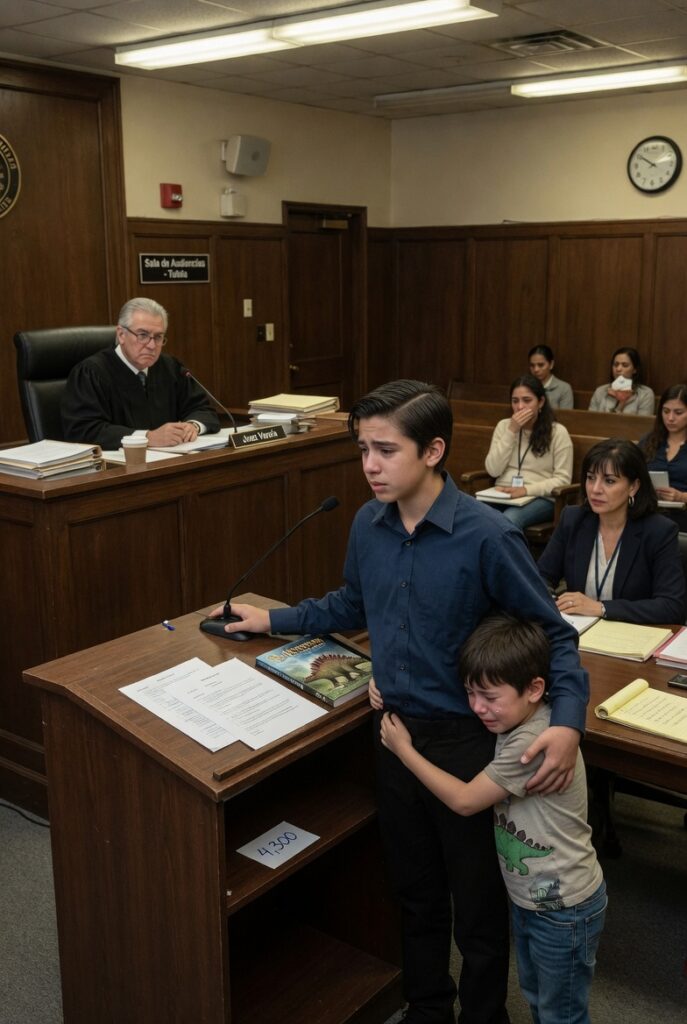
This was not in the plan. Marcos looked at him and Tomás looked at him, and in that exchange of glances Marcos understood that trying to make Tomás stay seated in this specific moment was not something that could be done without too high a cost, and so Tomás walked with him to the podium and stood beside him, and when Marcos began to speak Tomás put his arms around his waist and his face against his side and began to cry — not dramatically, not for the room, but the way an eight-year-old cries when he can no longer hold back — silently, with his whole body, as if crying from somewhere very deep inside himself.
Marcos put a hand on Tomás’s back.
And he began to speak.
— I don’t know how to do this correctly, — Marcos said. His voice was unsteady but present. — I don’t know the legal words. Patricia explained some of them to me but I’m not a lawyer and I’m sixteen years old and what I know is this.
Judge Varela said nothing.
The room was very quiet.
— I know the system says we need an adult. I know there are rules about who can be a guardian and that sixteen years isn’t enough on any piece of paper. I’m not here to say the rules are wrong. I’m here to say there’s something the papers can’t say.
Tomás trembled slightly against him. Marcos pressed his hand more firmly against his brother’s back.
— Tomás eats when I cook. Not always, but when I cook. He eats mac and cheese on Tuesdays and Thursdays, and rice with chicken on Fridays, and French omelette on Saturday mornings with the grated cheese because he says it’s different from sliced cheese and he’s right, it is. He eats when I’m there. That’s not in any file.
A pause.
— When our mother died, Tomás didn’t speak for three weeks. Not to anyone. He started talking again when I sat with him at night with the dinosaur book and read to him about the triceratops and the brachiosaurus. Not because I’m special. But because I’m his. That’s not in any file either.
Marcos breathed.
— I know I can’t be his legal guardian. I know I’m not old enough at sixteen for that. But there’s a foster family Patricia has found who says they can take me too, and I have a job and I would contribute, and what I’m asking this court — what I’m asking you, Your Honor — is not to separate us. Not because I can replace what we lost. But because we are what we have.
The room.
The silence.
Tomás’s hand squeezing harder.
And then Marcos said, in the voice of someone who has prepared this phrase and is also discovering it in the moment of speaking it, of someone who believes it with every part of himself he has built over the last eight months:
— I have no parents. But I can take care of him.
Five — The Room After the Words
In the second row, the young woman with long hair had her hand over her mouth.
She was not a journalist. She was Sofía Andrade, twenty-six years old, a social work student in her final year of placement, who had come to this hearing as part of her training and found herself doing something she had not done in any previous hearing: crying.
She didn’t try to stop. She was simply there, hand over her mouth, watching a sixteen-year-old boy standing at a podium with his little brother clinging to him, saying the simplest and truest words she had heard in that building.
Judge Varela did not have the marble face.
This was what everyone in the room would remember afterward — not what the judge said, not the resolution, not the legal details of what came next — but the moment when the judge’s face did something. Not much. A long blink. A tightening in the jaw. The kind of adjustment a face makes when it is processing something that exceeds its usual category.
Four thousand three hundred cases.
Four minutes and seventeen seconds.
Then Judge Varela said:
— We’ll take a recess.
Six — The Hallway
In the hallway, Marcos leaned against the wall and held Tomás.
Tomás had stopped crying. He was exhausted with the particular exhaustion of children who have cried completely — not the exhaustion of sleep, but the exhaustion of having emptied something that needed to be emptied.
— How did it go? — Tomás asked.
— I think well.
— Did you do well?
Marcos thought about this.
— I said what was true.
— Is that enough?
— I don’t know, — said Marcos. — Sometimes it’s enough and sometimes it’s not. But it’s what I had.
Tomás nodded against his chest.
Patricia arrived down the hallway with an expression Marcos had learned to read — contained, professional, but with something underneath that wasn’t containment.
— The judge has asked for additional documentation, — she said. — About the employment history, the foster family’s situation, Tomás’s academic records. It’s a good sign.
— How good? — asked Marcos.
Patricia looked at him for a moment.
— Good enough that I’m here instead of having sent my assistant, — she said.
Marcos understood what that meant.
It wasn’t certainty. But it was something.
Sofía Andrade found them in the hallway twenty minutes later.
Marcos didn’t know her. She introduced herself — her name, her studies, that she had been in the room — and then didn’t know exactly what to say, because there were no words that wouldn’t be insufficient, and so she simply said:
— What you said in there. It was true.
Marcos looked at her.
— I know, — he said.
— I’m saying it because… — Sofía stopped. — I work with a lot of cases. In placement. And many times people say what they think the judges want to hear. And what you said… it wasn’t like that.
Marcos said nothing.
— I wanted you to know that, — said Sofía. — That’s all.
Tomás looked up at her from Marcos’s waist.
— Did you cry too? — Tomás asked.
Sofía smiled, slightly, in spite of herself.
— Yes, — she said.
— Marcos was scared too, — said Tomás with the particular generosity of children. — But he said it anyway.
Seven — The Resolution
The hearing resumed an hour later.
Judge Varela spoke for eleven minutes.
Marcos would remember some fragments:
…exceptional circumstances which the court considers relevant…
…demonstrable history of care and responsibility…
…in the best interests of the younger minor…
…joint placement arrangement approved with monthly supervision…
…review in six months…
What he would remember more clearly than any specific phrase was the moment the judge paused before the final resolution and looked at him — not with the marble face, but with something Marcos couldn’t fully name but recognized, the kind of look an adult gives when they have seen something they didn’t expect to see and have decided not to ignore it.
— Marcos Fuentes, — the judge said. — The court has heard what you said. The court has considered it with the seriousness it deserves.
A pause.
— Continue.
That was all. Only that.
But Marcos understood what it meant, which was: I saw you. What you said, how you said it, the truth of it — I saw it, and it mattered, and this outcome is different from what it would have been if you hadn’t come here and said the simple and true things you said.
Tomás didn’t understand legal language.
But Tomás saw Marcos’s face when the judge finished speaking.
— Good? — he whispered.
— Good, — Marcos whispered.
Tomás exhaled against him the long breath of someone who has been holding something for a very long time.
— Good, — he said.
Epilogue — Six Months Later
The review was in February.
Judge Varela was the same judge — Marcos had learned this wasn’t always the case, that continuity was a matter of luck, and so he had come to understand it as such.
The records were good. The social worker who visited monthly had submitted reports that Patricia described as the best I’ve seen in this type of situation. Tomás’s grades at school had improved. Marcos had kept his job and added a few hours on Sundays. The foster family — the Herreras, Elena and Bernardo, two people Marcos had come to respect with the sober gratitude of someone who has learned not to take kindness for granted — had submitted their own report.
The hearing lasted twenty minutes.
At the end, Judge Varela approved the continuation.
When Marcos and Tomás walked out into the hallway, Tomás said:
— Is it permanent now?
— More permanent, — said Marcos. — Things get reviewed.
— But more permanent.
— Yes.
Tomás walked in silence for a moment.
— Can I ask you something? — he said.
— Always.
— When you said the thing about the grated cheese. That I’m the one who eats when you cook. Why did you say that?
Marcos thought.
— Because it was true, — he said. — And because the truth was more than I had.
Tomás nodded with the gravity of someone processing a philosophy.
— Grated cheese really is different, — he said finally.
— I know.
— I just wanted to confirm it.
Marcos laughed. A real laugh, surprised, the kind you don’t calculate but that simply happens to you.
They walked outside.
It was a cold February day, the sky that specific white that comes before rain, and the streets had the quiet of a weekday morning. Tomás put his hand in Marcos’s — not because he needed to be held but because he wanted to be, which was a difference Marcos had learned to recognize and to value.
They walked.
Nowhere in particular. Just walked, the two of them, in the February cold, in the city where they had lost what they had lost and had found, in the most unlikely place and form, that they still had something.
Each other.
Which was, in the end, what it had always been.