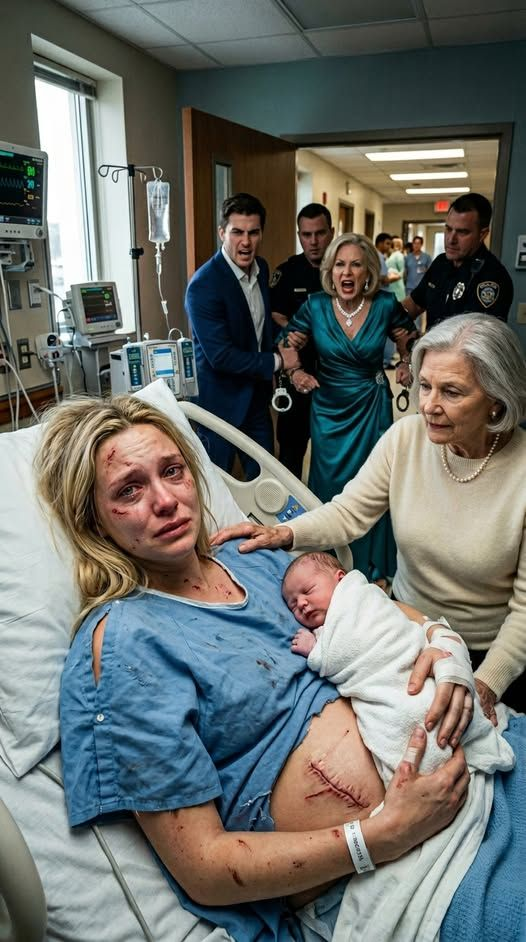
“Was three hundred thousand a month not enough?”
My grandmother asked it from the doorway of my hospital room while I was holding my newborn daughter against my chest. I was wearing the same faded gray sweatshirt I had slept in for two nights, having convinced myself that physical comfort was a luxury we could no longer afford.
For a second, I thought the exhaustion had finally broken my mind.
I had been awake for nearly forty hours, drifting in and out of a shallow, medicated haze between nurse checks, feeding attempts, the hum of blood pressure cuffs, and the tiny, startled sounds my daughter made whenever the plastic hospital bassinet squeaked. The room smelled of antiseptic, warm plastic, and sour milk. Rain tapped softly against the windowpane. A muted television on the wall played a cooking segment no one was watching. The hospital billing envelope lay folded face down on the side table beneath a magazine because I had looked at it three times already, and each time, my heart had hammered wildly in my throat.
My daughter, Chloe, slept on my chest. One tiny fist was tucked beneath her chin, her entire body no heavier than a promise.
My grandmother, Margaret Harrington, did not look at her first. She looked at me.
She took in the old sweatshirt, the frayed cuff around my wrist, the stretched leggings with washed-out knees, the cheap overnight bag I had packed myself because Liam said hospital extras were “where places like this really get you.” She looked at the generic lip balm by my water cup, the declined lactation upgrade form peeking out of a folder, the way I had shifted the bill beneath the magazine as if paper could hide a mounting debt.
Then she stepped fully into the room and asked again, her voice slower, sharper.
“Was three hundred thousand a month not enough?”
I stared at her. My throat felt like sandpaper. My body felt as though it had been split open and sewn back together wrong. There was a deep, hollow ache low in my abdomen, a soreness radiating through my hips, a profound tenderness in places I did not have the energy to name. My hair was matted against the back of my neck. My baby’s cheek was a warm anchor against my skin.
“Grandma,” I whispered, “what are you talking about?”
Margaret Harrington was not a woman who startled easily. She had built Harrington Storage Group from a regional warehouse business into a private holding empire that owned industrial properties, medical buildings, cold-storage facilities, and massive land parcels across three states. She had sat across the table from ruthless bankers, union negotiators, governors, and men who genuinely believed wealth made them immune to consequences. She did not raise her voice because she never needed to. She had that old-money gift of making absolute stillness feel like a loaded weapon.
But in that hospital room, something in her face shifted. It wasn’t shock. It was structure. I saw it happen in real-time. Her expression went dead calm in a way that frightened me far more than any screaming match ever could. Anger would have meant she was merely reacting. This absolute zero meant she was already arranging facts into a firing squad.
“I have wired three hundred thousand dollars on the first business day of every month since your wedding,” she said evenly. “I assumed you were choosing to live simply. I assumed you were saving, investing, building something prudent. I did not assume this.”
Her eyes darted across the room again, resting briefly on the hidden hospital bill.
Three hundred thousand dollars. Every month. Since my wedding.
Chloe shifted against me and made a soft, mewling sound. I placed one trembling hand on her fragile back because some primal, animal part of me believed that if I held her firmly enough, the earth could not open up and swallow us.
“I never received a single dollar,” I said.
There are moments when your life does not explode in a ball of fire. It simply shifts one inch to the left, and suddenly, nothing ever lines up again.
My grandmother did not gasp. She did not rush to the bed. She did not say my name in a voice soaked with pity. She simply opened her designer handbag, pulled out her phone, and dialed.
“Susan,” she said when the line connected. “I need you at St. Jude’s right now. Bring everything you can pull in the next hour. No, not tomorrow. Now.”
She listened for perhaps three seconds.
“Yes,” she said. “The Sterling account.”
Another pause.
“All of it.”
Then she hung up.
I looked down at Chloe. Her face was impossibly small. There was a paper bracelet around her wrist with her name printed in stark black ink: Chloe Grace Sterling. Mine had Clara Sterling on it, though for the first time since my wedding day, that name felt less like a shared life and more like a barcode someone had slapped on me without my consent.
“Grandma,” I choked out, “what account?”
Margaret came to the side of the bed and pulled the vinyl chair closer, but she did not sit immediately. She looked at Chloe then, properly, and the glacial severity in her face fractured just enough for a profound, aching love to shine through.
“She is beautiful,” she whispered.
I nodded because if I tried to speak, I might make a sound that would wake the baby and shatter whatever fragile reality I was still clinging to. Only then did my grandmother sit.
“Clara,” she said, her voice dropping into a register of deadly serious business, “when you married Liam, I established a household support transfer. Not a trust, which in hindsight was a catastrophic mistake on my part. A monthly transfer to an account designated specifically for household use. The purpose was simple: mortgage, staff if needed, medical expenses, childcare, savings, investments, freedom. I wanted you to never have to ask anyone’s permission to protect your own life.”
My fingers dug into the thin hospital blanket wrapped around Chloe. “Liam said cash flow was tight.”
My grandmother’s eyes hardened into polished flint. “Did he.”
“He said his deals were delayed. He said we needed to be incredibly careful until the next quarter closed. He said I needed to stop thinking like a single person and understand how capital moved.”
Margaret said nothing, but the silence radiating from her seemed to sharpen the very air in the room. I kept talking, because once the truth begins moving, it violently drags everything else out into the light.
“I picked up overnight inventory shifts. At a pharmacy chain downtown. Just twice a week at first, then sometimes three. I stopped last week because my doctor told me my blood pressure was dangerously high. I thought we desperately needed the money.”
My grandmother closed her eyes. When she opened them, she looked older. Not weaker. Older in the way a mountain looks old—weathered, immovable, enduring.
“How much access did you have to this household account?”
I swallowed hard. “I had a debit card.”
“A login?”
“At first.”
“At first?”
“Liam changed the password because there was some kind of security breach. He said he would reset it for me when things settled down at the firm.”
“When was that?”
I looked toward the rain-streaked window, trying to count backward through months of swollen ankles, meticulous budget spreadsheets, and the thousand little humiliations I had packaged and sold to myself as marital discipline. “Maybe a year ago.”
My grandmother’s mouth formed a thin, white line. “Notifications?”
“They went to his phone. He said it was easier because he handled all the auto-pay.”
“Statements?”
“He said they were all digital.”
“Did you ask?”
“Sometimes.”
“And?”
“He would say he had it completely covered.”
I heard exactly how foolish it sounded. I heard the pathetic narrative forming outside my body, the exact story people might tell if they wanted to keep things simple: Wealthy, naive granddaughter too lazy to check her own bank statements. Handsome husband takes advantage. Powerful grandmother swoops in to rescue her. But betrayal does not feel simple when you are locked inside it. It feels like trying to breathe in a windowless room where someone has slowly, methodically lowered the ceiling one inch every month while convincingly telling you the pressure is just what adulthood feels like.
I wanted to defend myself before she could accuse me. “I know how this sounds,” I said, my voice cracking.
My grandmother leaned forward, her presence engulfing the space. “Do not do that.”
“What?”
“Take responsibility for the architecture of someone else’s deception just because you are embarrassed you lived inside it.”
My eyes burned with hot, humiliating tears. “I should have known.”
“Perhaps,” she said softly. “But he knew you trusted him. That matters.”
It was the very first mercy anyone had given me that entire day. I had not realized how close I was to starving for it.
Forty minutes after my grandmother called Susan, the door swung open.
Liam walked into the room carrying a massive bouquet of expensive flowers. And Patricia Sterling, his mother, walked in right behind him.
Forty minutes after my grandmother made her phone call, the heavy hospital door swung open.
My husband, Liam, walked into the room carrying a massive bouquet of expensive white lilies. His mother, Patricia, followed closely behind him. Liam was handsome in that specific, polished way that makes people forgive too quickly. He wore a fitted navy cashmere sweater over a crisp collared shirt, tailored trousers, and the heavy luxury watch he claimed a grateful client had gifted him. He looked incredibly rested. That detail alone made my stomach turn.
Patricia wore cream, as she always did when she wanted to project an aura of maternal wealth. A camel hair coat hung elegantly over one arm, and she carried a pale blue designer gift bag tied with intricate silver ribbon. They entered smiling, radiating warmth, fully expecting to walk into a room they controlled.
Then, Liam saw my grandmother.
His perfect smile held for exactly one beat too long. That was the first time I understood my husband’s face as a mechanism—a tool that calculated variables, adjusted, and seamlessly settled into a mask of deep, respectful concern.
“Margaret,” Patricia said, her voice dripping with practiced charm. “What a lovely surprise.”
My grandmother did not glance at her. She locked eyes with Liam.
“Where is my granddaughter’s money?”
No greeting. No soft entry. Liam slowly set the flowers on the windowsill, buying himself two seconds. “I’m sorry,” he said, furrowing his brow. “I’m not entirely sure which funds you’re referring to.”
“Do not insult my intelligence and waste your own time in the exact same sentence,” Margaret replied smoothly.
Liam’s jaw shifted. “Things are vastly more complicated than that. There were massive tax obligations. Timing issues with liquidity. Reinvestment decisions to protect our portfolio. It was all for the household.”
“The household,” I repeated, my voice raspy and thin. “I was counting grocery money, Liam. I worked overnight inventory shifts on concrete floors with swollen feet because I thought we couldn’t breathe financially. I cried over this hospital bill for two hours. And you’re telling me it was for the household?”
Patricia moved forward, her voice dripping with condescending honey. “Clara, sweetheart, you just had a baby. This is absolutely not the time to process complex financial structures with a brain full of raging hormones.”
Margaret slowly turned her head. “If your name appears anywhere on any of that money, Patricia, absolute silence would be the wisest choice currently available to you.”
Patricia froze. The designer bag swung slightly from her wrist, suddenly looking utterly absurd.
Margaret looked back at me. “Clara and the baby are leaving with me tonight.”
“That is absolutely not necessary,” Liam argued, his voice dropping an octave as control slipped from his fingers. He took a step toward the bed. “Clara—”
“Don’t,” I commanded.
He stopped dead. By evening, I left the hospital not with the man who vowed to protect me, but with the woman who actually would. But as I sat awake in my grandmother’s guest room at 4:00 AM, holding my sleeping daughter, the true horror finally washed over me. They hadn’t just taken money. As I would soon discover, they had systematically manufactured my exhaustion, and the paper trail they left behind was worse than any nightmare.
Susan Vance arrived at my grandmother’s estate at exactly 8:15 AM.
She was sixty-two years old, narrow-framed, and possessed eyes that resembled broken glass. She had been my grandmother’s lead attorney for two decades, a terrifying woman who could completely silence a boardroom simply by opening a manila folder. She washed her hands meticulously before touching Chloe’s blanket, told me my baby was exquisite, and then sat down at the massive mahogany dining table.
“Start at the very beginning, Clara,” Susan said, clicking her pen. “And do not attempt to improve it.”
So, I told her everything. I told her about the joint account Liam demanded. The suddenly changed passwords. The rerouted notifications to his phone. The declined credit cards at the grocery store. I described the grueling overnight shifts I took at a pharmacy warehouse at thirty-six weeks pregnant, desperate to pay the electric bill.
Margaret sat at the head of the table, her face carved from granite. Susan interrupted only to ruthlessly pin down the structure of the abuse, asking rapid-fire questions about access, logins, and lifestyle changes. When I finally finished, Susan opened the incredibly thick folder she had brought with her.
“I pulled the emergency asset preservation requests last night,” Susan said, sliding the first crisp sheet of paper toward me.
It showed thirty incoming transfers from Harrington Family Holdings. All exactly three hundred thousand dollars. All routed directly to an account labeled Sterling Household Operating.
“Within forty-eight to seventy-two hours of each incoming transfer,” Susan continued, tapping the paper, “massive amounts were moved out. First to Liam’s personal offshore brokerage account. Then to an opaque entity called Sterling Strategic Advisory LLC. Liam is the sole controller.”
I stared at the numbers. Three hundred thousand in. Two hundred sixty-five thousand out. Over and over. A multi-million-dollar theft operating on a meticulous calendar.
Susan turned another page. “There is also a secondary benefit stream. Patricia Sterling was listed as an authorized user on a premium black card paid directly from the brokerage side. Five-star hotels, luxury spas, high-end retail, and a recurring monthly ‘consulting retainer’ paid to a shell entity.”
My blood ran cold. I thought of Patricia sipping my coffee, telling me that “idle women overthink,” while wearing diamonds bought with money meant to feed my child.
“Then there is this,” Susan said, pulling out a printed transcript recovered from a smart speaker in Patricia’s kitchen.
I read the highlighted lines. Patricia: She still thinks tight means temporary. Liam: She trusts the process as long as I say it calmly. Liam: That is exactly why we keep her tired. Not panicked. Just tired.
The pain in my chest turned to absolute zero. They had engineered my reality with the sociopathic precision of forensic accountants. They knew exactly how physically exhausted I needed to be to stop asking questions.
Susan looked at me. “Liam signed an eleven-million-dollar term sheet with a massive private capital group two weeks ago. If we file this lawsuit now, it will detonate a nuclear bomb inside his professional life. He will lose everything. Do we proceed?”
I looked at the transcript one last time, my grief hardening into unbreakable steel.
“Send it,” I whispered.
My voice did not shake. Susan nodded sharply, gathering her papers.
My grandmother read the draft notice before it went out to the courts and the banks. She took a heavy gold pen and crossed out one specific sentence. The sentence read: These unfortunate circumstances require immediate clarification before closing.
Margaret drew a thick, clean line through the word unfortunate.
“Nothing about this was unfortunate,” she stated coldly. “It was engineered.”
Susan removed the word.
The first panicked call from Liam came just before dinner. I watched his name vibrate on my phone screen while Chloe slept peacefully in the crook of my arm. Then another call. Then a rambling voicemail.
Clara, please pick up. Your grandmother doesn’t understand how these complex structures work. This is being wildly distorted by her lawyers. I was protecting our capital. I was trying to build a legacy for us.
Texts flooded in next.
You are highly emotional and exhausted from the birth.
You are letting Margaret weaponize a totally normal marriage.
Think about Chloe’s future.
We can fix this privately.
Privately. That word made a dark, bitter smile touch my lips for the first time all day. Privacy had always been Liam’s favorite hiding place.
I did not answer.
Within three days, the private capital group paused the second close of his massive deal. Within five days, they formally requested heavily expanded financial disclosures. Within a week, Liam was calling me frantically from unfamiliar burner numbers. I blocked every single one.
The temporary preservation order came through fast enough to completely freeze his accounts before he could move the offshore funds. Susan’s legal team worked like elite surgeons. Forensic accountants ruthlessly traced the flows. Brutal subpoenas went out to every bank. Institutions became suddenly and incredibly cooperative once the words fraud, newborn, and household support appeared in the same aggressive filings. Margaret’s home office resembled a military war room: massive printers running constantly, junior attorneys moving in and out, Susan marking thousands of documents with colored tabs, and my grandmother sitting at the end of the table, bottle-feeding Chloe with one hand while reviewing damning bank records with the other.
Liam did panic. But not publicly.
Publicly, he attempted to play the victim. His high-priced defense attorneys sent flowery letters about “marital misunderstandings,” “complex household tax structures,” and my “severe postpartum vulnerability.” They suggested mediation. They suggested that litigation would permanently traumatize Chloe. They suggested I lacked the mental capacity to understand what was happening so soon after childbirth.
That last suggestion made Susan smile. It was a terrifying smile.
“I was sincerely hoping they’d be stupid enough to put that in writing,” she purred.
Then, Liam made the catastrophic mistake that permanently ended the life he still arrogantly thought he could salvage. A week and a half after we filed, he attended an elite charity finance dinner in Manhattan.
He should have stayed home. He should have kept his mouth shut. But Liam’s ultimate survival strategy had always been total narrative control. So, he talked.
He told powerful people over cocktails that I was suffering from a severe, clinical postpartum psychotic episode. He said my overbearing grandmother had manipulated me while I was medically vulnerable. He said I had kidnapped his daughter and spiraled into manic paranoia over ordinary financial planning. He painted himself as the tragic, long-suffering husband trying to protect his capital and his family from my emotional volatility.
He picked the wrong room.
A prominent woman from the hospital foundation board was there. So was a managing partner from a firm that had once considered co-investing with him. So was a wealthy widower who had played tennis with my grandfather for thirty years and still sent my grandmother handwritten notes every Christmas.
By 9:00 AM the next morning, every single word he spoke had reached Susan. By noon, a massive defamation suit was added to our complaint. By 3:00 PM, amended, highly detailed filings were sent directly to the parties who were already reviewing whether Liam Sterling could be trusted as a steward of millions of dollars.
That was the real, spectacular collapse. Not the marital one. The collapse that mattered to Liam was purely professional.
The eleven-million-dollar term sheet died immediately. Then the exclusive gala invitations stopped. Then the receptionist who had always eagerly answered his calls began forwarding him straight to voicemail because the partners were “in meetings.” A senior associate abruptly left his firm. A massive family office withdrew entirely from co-investment discussions. Men who once laughed too loudly at Liam’s jokes began speaking about him in the cautious, radioactive past tense. Reputation in high finance is not about morality; it is strictly about risk management. Liam had become an unacceptable risk.
On a freezing Thursday morning, Patricia arrived at my grandmother’s wrought-iron security gate. She wore her signature cream coat, oversized dark sunglasses, and a look of sorrow arranged so meticulously it might have been applied with a makeup brush.
My grandmother watched her on the security monitors and refused to open the gate.
Arthur, the house manager, told us she was buzzing incessantly. My grandmother stood up from the library sofa. I did too.
“No,” Margaret said firmly. “You stay here.”
“I want to hear,” I insisted.
She looked at me, assessing my strength. “Then listen from the hall.”
The heavy front door opened. The freezing air slipped inside. Patricia’s voice floated in, trembling just perfectly enough.
“Margaret, please. This witch hunt has gone too far.”
My grandmother said absolutely nothing.
“We are family now,” Patricia pleaded. “There has clearly been a massive misunderstanding. Clara is just exhausted. Liam is totally devastated. We all want what is best for the baby.”
“If that were even remotely true,” my grandmother said, her voice like cracking ice, “you would have left her mother enough money to buy groceries.”
Silence. Then Patricia’s voice sharpened, the velvet stripping away to reveal the razor wire underneath. “You have no idea what Liam was building for them.”
“I know exactly what he was stealing.”
“You are single-handedly destroying your granddaughter’s marriage!”
“No,” Margaret said softly. “I arrived long after he finished.”
The door slammed shut. My grandmother returned to the library and found me weeping silently. “She sounded so sure,” I whispered.
“People often sound the most sure when certainty is the absolute last asset they have left to spend,” Margaret replied.
By the time Chloe was four months old, Liam’s lawyers realized they were bleeding to death in the water. They sent over a massive settlement offer to wrap everything up neatly. Susan reviewed it and laughed out loud.
The offer proposed returning some of the money, but demanded the entire settlement, all records of his offshore accounts, and the details of his mother’s complicity be sealed permanently under a strict NDA. He wanted to buy his reputation back.
Susan looked at Margaret. “They want a secret settlement.”
My grandmother’s eyes narrowed into dark slits. “Counter with reality,” she commanded. And reality was about to tear Liam Sterling limb from limb.
Reality was brutal, absolute, and unyielding.
Our counter-demand: Full restitution of every single misappropriated dollar traced to both Liam and Patricia. Punitive penalties. All of my exorbitant legal fees covered. A massive, untouchable trust established for Chloe under strict independent control. A highly public, legally binding correction of his defamatory statements about my mental health. Zero independent unsupervised access to Chloe until a court-appointed custody evaluator completed a rigorous review. Full, unredacted cooperation with all federal financial investigations. And the permanent relinquishment of any future claim over Harrington money.
Liam refused immediately.
Then, Susan casually submitted three more boxes of devastating forensic documents to the court. Liam reconsidered very quickly.
Patricia’s portion was much harder to nail down. She had been careful not to sign everything. She had floated near the stolen money, benefited immensely from it, encouraged it, and spoken carelessly in recorded conversations, but proving direct theft was tricky. Susan aggressively built the case around active participation, unjust enrichment, and civil conspiracy. Patricia’s attorneys tried to paint her as a frail, elderly mother completely unaware of her son’s complex business structures.
My grandmother read that specific line in the brief aloud. “Elderly,” she scoffed.
Susan looked up from her laptop. “She’s sixty-four, Margaret.”
“Then she is more than old enough to know that Cartier jewelry is not a consulting fee.”
Patricia ultimately broke and settled privately just days before her scheduled deposition. She was forced to return what could be strictly documented, humiliatingly liquidated several pieces of her high-end jewelry to cover the rest, and signed a legally binding statement admitting she had received “improper benefits” from funds intended for my household. It wasn’t an apology. But it was a legal admission with enough sharp teeth to ensure she would never cross us again.
The final global settlement was signed when Chloe was seven months old.
By then, I had moved into a charming, small white house three streets away from my grandmother’s estate. It had a narrow porch, a stubborn front door, a tiny fenced backyard, and beautiful morning light in the kitchen that made even cheap coffee feel ceremonial. My grandmother bought it through a trust—structured correctly this time, with me as the sole beneficiary and independent counsel meticulously reviewing every single document. Susan had insisted I hire my own separate attorney for that purchase.
“Love is absolutely not a substitute for clean legal structure,” Susan had told me. I signed every page myself.
The first night in that house, I put Chloe to sleep in a beautiful crib by the window and stood in my kitchen looking at my banking app on my phone. My own login. My own password. My own notifications. Money I could actually see. Bills I could easily pay. Numbers that did not move a single inch unless I moved them.
I bought a good winter coat that week. Not wildly extravagant. Just incredibly warm, well-made, and beautiful in a quiet way. When the cashier rang it up, my hand shook. I almost put it back. Liam’s condescending voice echoed loudly in my mind: Do we really need that right now? Cash flow is tight. Think like a married person.
I paid for it. Then I walked out to the parking lot, sat in the driver’s seat of my car, and cried until I couldn’t breathe. Then I laughed at myself for crying. Then I drove home wearing the coat. Freedom is not always dramatic fireworks. Sometimes it is simply buying something you need without asking permission from a ghost.
Liam’s supervised visits continued twice a month. He was always gentle with Chloe, playing the part of the devoted father perfectly for the social worker taking notes. I watched through the one-way glass, making sure I never forgot the monster hiding behind the charming smile.
The public correction came as part of the final settlement. Liam was legally forced to issue a formal statement to the exact people who had heard his vicious rumors, acknowledging that he had made wildly inaccurate statements about my mental health and that those statements were completely inappropriate. It was bloodless, drafted by lawyers, and entirely insufficient for the pain it caused, but it was still incredibly satisfying.
The first time I read it, I felt strangely hollow. Then, two hours later, while washing baby bottles in my sink, I began shaking violently. Not from rage. From a massive, overwhelming release.
He had intentionally used my postpartum body against me. My profound exhaustion. My milk-stained shirts. My shaking hands. My new motherhood. He had tried to weaponize the natural vulnerability of giving birth to prove I could not be trusted with my own reality. The correction didn’t magically undo that trauma, but it drove a small, official stake through the heart of his lie.
My grandmother came over every Saturday morning. One morning, when Chloe was ten months old, we sat in my kitchen while the baby crawled under the table, trying to eat a board book.
Margaret watched her for a long time. “I should have structured it differently,” she said softly.
I knew exactly what she meant. The transfers. The lack of oversight. The assumption that my marriage was safe simply because I had entered it willingly.
“You thought you were helping,” I said.
She looked at me, her eyes heavy. “I thought I was giving you freedom. What I actually gave the wrong man was total access. I trusted your marriage because you did. Then I let that trust substitute for inspection. You paid a terrible price for that. I am so sorry, Clara.”
My throat tightened. “I didn’t see it either.”
She nodded once. “That is exactly why it worked.” We sat quietly for a moment before Margaret added, “We will never confuse trust with a lack of oversight again.”
“No,” I agreed.
That became the absolute pillar of my new life. Not suspicion, but structure. Not isolation, but access with iron-clad boundaries. Not shame, but review. I thought I had finally found peace, that the nightmare was truly over. But the next morning, while looking through the boxes of old maternity clothes I had brought from the townhouse, I found the faded gray sweatshirt I had worn in the hospital. I pulled it out, and a small, folded piece of paper dropped from the pocket—a receipt I didn’t recognize. And as I unfolded it, I realized Liam had left one final, ticking time bomb behind.
It was a receipt from a private investigator, dated three months before Chloe was born. Liam hadn’t just been stealing money; he had been having me followed to ensure I wasn’t secretly visiting banks or lawyers. The depth of his paranoia was staggering. I stared at the paper, feeling a brief flash of the old terror, before I did something that proved I was finally free: I laughed, struck a match, and burned it in the kitchen sink. His paranoia didn’t matter anymore. He was a ghost, and I was alive.
When Chloe turned one, I hosted a beautiful, small birthday party in my backyard.
My grandmother came. Susan came, because at that point she had evolved into part attorney, part protective aunt, and part emotional demolition expert. Arthur brought a massive cake because he firmly believed professional bakery frosting was vastly superior to homemade and refused any debate on the subject. A few new friends from the medical nonprofit where I had started working part-time came with their toddlers.
I did not invite Liam. His court-mandated visitation fell on the following weekend. I did not invite Patricia. She had the audacity to send a gift through her attorney—a silver rattle engraved with Chloe’s initials. I returned it immediately through Susan with a typed note: No gifts outside agreed legal channels. Susan said it was beautifully cold. I told her I had excellent teachers.
The party was wonderfully simple. Bright balloons tied to the porch railing. A homemade banner that leaned slightly to the left. Chloe wore a yellow sundress and smashed vanilla cake into her hair with the intense seriousness of a CEO managing a hostile takeover. Everyone laughed. I took dozens of pictures. For once, I did not spend a single second thinking about how things looked to Liam’s pretentious world. No positioning. No strategic appearance. Just sunlight, cake, a happy baby, and a life no one was secretly starving to death.
As Chloe grew, I built language carefully for her.
“Your dad and I live in different homes.”
“Some adults make choices that hurt trust.”
“Money is something grown-ups must always be honest about.”
“Questions are always allowed.”
That last one mattered the most. Questions are allowed. I wove it into every aspect of our life. If she asked why the sky changed color, we looked it up. If she asked why a bill arrived in the mail, I explained it in simple terms. If she asked why Grandma Margaret had a lawyer at Sunday lunch sometimes, I said, “Because Grandma believes important things should be written clearly.” If she asked why I meticulously checked bank statements every Friday, I said, “Because taking care of our money is part of taking care of ourselves.”
By the time Chloe was three, she loved sitting on the counter while I paid bills, pretending to help.
“Numbers day?” she would ask brightly.
“Numbers day,” I would reply.
I loved that she would grow up seeing money not as a dark mystery, not as a source of shame, not as something a man explained around her, but as vital information she had the absolute right to understand and control.
Liam changed too, though not in the dramatic way people expect from movies. He did not become a cartoon villain forever, cackling in the shadows. He did not become fully redeemed, either. He simply became smaller. That is what actual consequences did to him. They violently shrank the distance between his curated image and his pathetic reality. His elite firm pushed him out quietly. He eventually landed at a much smaller advisory group years later, after the restrictions, settlements, and massive reputation damage made him toxic to elite clients. He still wore good suits. He still spoke carefully. But the room no longer bent toward him the way it once had.
Our custody arrangement eventually stabilized into limited unsupervised time once the evaluators were completely satisfied Chloe was emotionally safe. Susan and I argued about that. My grandmother argued even harder. But I learned to accept legal outcomes I did not like without ever surrendering my vigilance. He never again had access to my accounts. He never again had access to Harrington money. He never again stepped foot inside my home.
Years later, Chloe found that faded gray sweatshirt in a storage box in the attic. She was seven, all knobby knees and endless questions, with Margaret’s sharp eyebrows and Liam’s innate ability to sound incredibly charming when asking for something she knew might be denied.
“Mom,” she said, holding it up by the frayed sleeves, “why do you still have this? It’s so old.”
I looked at the sweatshirt. Faded, unbelievably soft, the cuff completely frayed. The exact one I wore in the hospital. The one my grandmother saw when the grand lie finally ended.
“I wore that the day you were born,” I said softly.
Chloe’s face changed, a look of quiet awe. “Can I keep it?”
I almost said no. It felt too heavy. Too full of dark memory. Then I realized that objects magically become lighter when you allow them to belong to love instead of pain.
“Sure,” I smiled.
She pressed the soft fabric to her face. “It smells like a box.”
I laughed out loud. “It probably does.”
That night, after she went to bed, I sat alone in the quiet kitchen and thought about the broken woman in that hospital room. The one who had desperately moved the bill under a magazine. The one who truly thought she had to earn softness through grueling sacrifice. The one who had not yet learned the vital lesson that love without total transparency is just control with better manners.
I wanted to reach back through time and tell her she was not weak. I wanted to tell her the tiny baby on her chest would grow up strong, funny, and incredibly loud. I wanted to tell her she would eventually learn to read every number, sign every page, ask every hard question, and still remain entirely capable of love.
Some people think revenge is watching the person who hurt you fall. There was some of that, yes. Liam lost his status. Patricia lost her access. Their names became cautionary tales in rooms where they once expected a warm welcome. But the absolute best revenge was so much quieter.
It was my own front door. My own secure accounts. My daughter learning that questions are allowed. It was the life Liam could no longer manage because I had permanently stopped mistaking his control for care.
And if Chloe asks me one day what betrayal really looked like, I will not begin with the stolen money. I will begin with the trust. I will tell her betrayal looked like a man praising my strength while secretly using it as a budget line. It looked like calm answers to direct questions. It looked like being kept just tired enough not to run.
Then I will tell her what rescue looked like. A grandmother who did not panic. A lawyer who said, “Start at the beginning.” A bank account with only my name on it.
And finally, I will tell her what healing looked like. Not forgetting. Not blindly forgiving. Healing looked like learning to see in full, blinding light, and never again apologizing for asking where the money went.