I Gave My Father My Left Kidney, Spent Nine Weeks Recovering Alone, Then Watched My Mother Toast My Sister as “The One Who Saved Him” — But When Dad Slipped Me a Napkin Under the Thanksgiving Table, I Finally Understood Why He Had Stayed Silent
I gave Dad my left kidney. Recovery took nine weeks. At dinner, Mom toasted: “To your sister — who saved Dad with her fundraiser.” Twenty-two relatives clinked glasses. No one looked at me. I stood up.
Dad grabbed my wrist. He slid a napkin across the table. It read: “We received a report from…” I’m Captain Olivia Reed, 31 years old. Nine weeks ago, I donated my left kidney to my own father and saved his life.
But on Thanksgiving night, at the party celebrating his recovery, my mother tapped her champagne glass, looked straight at my sister, and announced to Natalie, “My wonderful daughter, the one who saved her father’s life with her fundraising campaign.” 22 relatives clapped in unison.
Not one of them looked at me. I sat there with a fresh 15-centimeter scar burning in my side, nine weeks of unpaid medical bills, an empty bank account, and a body that will never be the same.
Meanwhile, my own mother acted as if my donation never happened. Just as I was about to walk out, an old hand gripped my wrist under the table.
It was my father. He slipped a napkin into my hand.
The word scribbled on it changed everything. And when my mother and sister finally found out the truth a few weeks later, our family didn’t just fall apart. It exploded.
Let me take you back 31 years to the moment I first started feeling like a ghost in my own home. I figured out I was a ghost when I was 12.
It wasn’t a sudden haunting. It was a slow eraser. My mother, Claire, started cropping me out of the family Christmas cards.
At first, I thought it was a mistake, a bad angle, or a printer’s error. Then I realized the truth.
I was growing up to look exactly like Aunt Julie, the younger sister my mother hated with a cold, quiet venom. Every time she looked at me, she saw a dead woman’s jawline and eyes.
She couldn’t kill the memory, so she decided to kill the girl standing in front of her. My father, Kenneth, saw it happening.
He saw me fading, but he chose silence. He chose the piece of my mother’s approval over the soul of his youngest child.
By 18, I’d had enough of being a phantom. I signed the enlistment papers on my birthday.
No one drove me to the Greyhound station. No one waved goodbye. I sat on that bus with one duffel bag and a hollow chest.
Heading toward a world where if you don’t exist, you die. In the army, they tell you your life depends on the person to your left.
At the Reed house, if you exist, my mother makes it her mission to destroy you. By 31, the gap between us wasn’t just emotional, it was mathematical.
My sister Natalie, the golden child, sat in a corner office as vice president of Reed Medical. She pulled in a cool 185,000 a year.
She drove a Lexus that smelled like new leather and unearned privilege. My mother called her the family’s legacy.
I was an army captain making 36 grand. I lived in a studio apartment where the walls were so thin I could hear my neighbor’s alarm clock.
My deployments were the perfect excuse for them. They never had to invite me to company galas or summer retreats.
I was away on duty. I learned to set a perimeter. I stopped calling. I stopped waiting for the invite.
Then came the night of July 20th. It was the 27th anniversary of Reed Medical, a high society gala with two hundred elite guests.
I of course didn’t have an invitation. At 9:45 p.m., I was sitting on my thrift-store couch eating cold pasta out of a plastic container after a double shift at the Veteran Support Fund.
My phone buzzed. It was my cousin Julie.
“Olivia, you need to get to Presbyterian now,” she whispered. “Your Dad collapsed on stage. It looks bad.”
The soldier in me took over. I didn’t cry. I didn’t panic. I dropped my fork, grabbed the keys to my beat-up Ford F150, and floored it into the Chicago blizzard.
The wind was screaming off the lake, turning the city into a white blur. But I drove like I was back in a Humvee in the desert.
My hands were steady on the wheel. My heart rate stayed at 60.
10:31 p.m. Presbyterian Hospital.
The sliding glass doors hissed open. My combat boots were caked in slush, leaving muddy gray puddles on the pristine white tile floors.
I saw them in the VIP lounge. It looked like a fashion shoot, not a tragedy.
Natalie was leaning back in a designer chair, her eyes glued to an iPad. She was checking stock prices.
My mother sat next to her, smoothing the wrinkles out of her silk evening gown. There were no tears, no smeared mascara, just a woman maintaining her brand.
When she looked up and saw me walking toward them, her jaw tightened. She didn’t see a daughter who had just braved a storm to be with her dying father.
She saw a problem. She saw a crack in her perfect polished narrative.
“What are you doing here, Olivia?” she asked, her voice as sharp as a scalpel. “You weren’t on the guest list.”
I stopped five feet from her, the smell of the cold and the engine oil from my truck clinging to me. I looked at the VIP lounge door, then back at her.
“I’m here for my father,” I said.
She stood up, her silk dress rustling like a snake in the grass. She didn’t move to hug me. She moved to block the path to the ICU.
“He’s resting,” she said coldly. “And frankly, your presence is just going to complicate things. We have a reputation to maintain, and you look like you just crawled out of a trench.”
I stared at her through the sights of a sniper. My father was dying behind that door, and she was worried about the mud on my boots.
This wasn’t a family. It was a battlefield. And I was just realizing that the war had finally started.
The air in the waiting room was dead, stale. It smelled like industrial-strength bleach and the kind of bad news that doesn’t wash off.
The doctor stepped out of the ICU, his face a gray mask of exhaustion. He didn’t look at me.
He looked at Claire, who was sitting there like she was waiting for a table at a five-star steakhouse.
“Acute Stage 4 renal failure,” the doctor said. He held the medical chart like it was a death warrant. “Kenneth’s kidneys are shot. We’ve got an eight-week window. If he doesn’t get a transplant by then, he’s on dialysis for the rest of his life. Period.”
The silence that followed was heavy. The kind of silence that rings in your ears.
The doctor cleared his throat, looking between us. “We need to test for a match. Immediate family first.”
Claire didn’t even blink. She just tilted her chin up, her pearls catching the harsh fluorescent light.
“We will do whatever it takes,” she said, her voice loud and performative.
She put a hand on Natalie’s shoulder, but her eyes slid right past me like I was a piece of cheap furniture. She had already decided I wasn’t part of the we.
I was crossed off the list before the ink was even dry. I waited until nearly midnight.
The hospital was quiet, just the hum of the vending machines and the rhythmic hollow thump-thump of my own heart. I slipped into the recovery room.
My father looked small under the white sheets. His arms a roadmap of IV lines and bruised skin.
When his eyes fluttered open, they weren’t full of relief. They were full of something else. Something that tasted like salt.
“I thought you weren’t coming,” he rasped. The words were dry, broken glass in his throat. “Your mother said you were on duty. Said you didn’t want any part of this family anymore.”
My jaw hit the floor. I felt the heat rise in my neck, my teeth grinding together so hard it hurt.
That was her game. She was poisoning the well while the man was still thirsty.
She wanted him to believe his soldier daughter was too cold to care. I reached out, grabbing his wrinkled, paper-thin hand.
“I’m here,” I said. My voice was a low growl. “I’m going to get tested tonight.”
One week later, the results hit the kitchen table like a brick. Type O positive, a 98% tissue match. I was the golden ticket, the perfect donor.
I brought the envelope to the house, expecting, I don’t know, maybe a thank you, maybe a look that didn’t feel like a slap.
Instead, I got a morgue. Natalie sat across from me, picking at her $100 manicure, her eyes fixed on anything but me.
“I was going to do it, really,” Natalie said, her voice a thin, shaky whine. “But I’m actually taking a pregnancy test this week. My doctor said any major surgery right now could, you know, complicate things.”
She was lying. I knew it. She knew I knew it. She’d let our father die before she’d let a surgeon leave a mark on her perfectly tanned stomach.
I ignored her. I looked straight at my mother, who was busy stacking porcelain tea sets as if this were just another Tuesday.
“I’m the match,” I said. “The best chance he’s got. Why are you acting like I’m the enemy here?”
Claire stopped. She didn’t look at me. She just stared at a teacup.
“The thing is, Olivia,” she said, her voice dripping with a fake honeyed concern that made my skin crawl, “you’ve never actually finished anything difficult in your life. I’m just terrified you’ll get halfway through and quit like you always do.”
I stood there frozen. I’d humped a 60-pound ruck through the Afghan heat. I’d led a platoon through mortar fire. I’d stayed awake for 72 hours straight to keep my people alive.
And here she was, a woman who had never broken a sweat in a gym, telling me I didn’t have the grit to lie on a table and let a doctor take a piece of me.
She wasn’t worried about me quitting. She was worried about me winning.
That night, my phone buzzed on the nightstand. 2:00 a.m.
“If you’re sure about this,” my father’s voice was a ghost of its former self, thinned out by the pain and the morphine. “Let’s do it, Olivia. I trust you.”
I took a breath, the cold air of my studio apartment filling my lungs. I looked at the shadow of my uniform hanging in the closet.
The mission was clear. The order was received.
“Copy that, Dad,” I whispered to the empty room. “Order acknowledged.”
The cursor blinked, a tiny rhythmic heartbeat of digital static on my cracked laptop screen. I typed the name Natalie Reed Pierce.
I hit enter. My sister had called me an hour ago, her voice dripping with that fake sugary concern she usually reserved for stockholders.
She said she was organizing a small fundraiser to support the family during my father’s crisis. She told me to stay focused on my health and leave the logistics to her.
My gut, trained by three tours and a decade of military discipline, did a slow, nauseating roll. The search results hit me like a flashbang.
There she was. Natalie, high-resolution, smiling in a navy Dior suit that probably cost more than my truck.
The headline on the Reed Medical screamed, “The Natalie Reed Pierce Kidney Health Initiative, a daughter’s courageous fight to save her father.”
I scrolled down. There were photos of her at a gala, photos of her looking thoughtfully at a medical chart, and a three-paragraph mission statement about legacy and sacrifice.
My name was nowhere. My blood type was nowhere. The fact that I was the one going under the knife in less than 48 hours was not even a footnote.
Natalie was not just stealing credit. She was harvesting my organ to fuel her campaign for the CEO seat.
She had turned my surgery into a corporate PR stunt and a massive charity tax write-off for the family business. I sat in the dark of my studio apartment, the only sound the hum of a cheap refrigerator, and watched my sister turn my sacrifice into her own personal ladder.
August 18th arrived with the sky the color of a bruised lung. I drove to Presbyterian Hospital for my mandatory pre-op psychological evaluation.
I sat in a chair that smelled like industrial cleaner and ancient regret. Across from me sat Amy Brennan.
She was a social worker who looked like she had seen every lie a human being could invent. She did not look at me with pity. She looked at me like a puzzle she could not solve.
She flipped through my file for a long minute, the sound of the paper crisp and loud in the sterile silence. Finally, she looked up.
Her eyes were full of a strange, guarded hesitation. “Captain Reed,” she began.
She stopped, then tried again. “Are you being coerced into this procedure? Specifically, are you using this donation as a way to mitigate or distract from any unresolved psychological issues from your time in service?”
I did not move. I did not blink. I leaned forward. My spine a straight line of cold steel.
My voice came out low, a desert wind across gravel. “Who told you that I was psychologically unstable?”
Amy Brennan sighed. She looked at the door, then pushed a manila folder toward me.
It was a formal memo from the day before. My mother, Claire Reed, had requested a private meeting with the ethics committee.
She had walked into this hospital, put on her grieving-wife performance, and systematically tried to dismantle my life. She told them I was unstable.
She told them my military service had left me with severe, untreated PTSD and that I was only donating a kidney to seek attention or fill a void left by the war. She had begged the hospital to cancel the surgery.
She did not do it because she loved me. She did it because she could not stand the thought of me being the hero.
She would rather watch my father die of total organ failure than allow the daughter she hated to save him. I closed my eyes for a second.
The air in the room was cold, but the sweat running down my back was colder. I realized then that I was not just fighting for my father’s life.
I was in a total war against the woman who gave me mine.
“I have my military medical records right here,” I said, my voice steady. “They show three clean bills of health. They show a commendation for leadership under fire. They do not show a single day of instability.”
Amy Brennan watched me. She saw the way I held myself. She saw the lack of tremor in my hands.
She took a red pen and drew a thick, aggressive line through my mother’s accusations.
“The committee does not operate on rumors, Captain. Not even when they come from the wife of the patient,” she said.
She picked up a heavy rubber stamp and slammed it onto my file.
Approved.
I stood up. I did not say thank you. I did not smile. I walked out of that office and headed toward the surgical wing.
My boots clicked on the white tile. A rhythmic military cadence. One, two. One, two.
The hospital staff was moving around me, but I did not see them. I was back in the headspace of a mission.
I was checking my perimeter. I was identifying the targets.
Claire and Natalie thought they were playing a family game of chess. They did not realize they had just invited a sniper to a knife fight.
I reached the double doors of the operating room. A nurse approached me with a gown and a thin blue cap.
I took them. I looked at my reflection in the glass of the door. I did not look like a daughter anymore.
I looked like an operative about to walk into a hot zone. The war had moved from the boardroom to the operating table, and I was going to win it, one incision at a time.
September 15th, pre-op. The hospital gown was thin, paper-like, and smelled of industrial laundry detergent.
It did nothing to block the chill of the surgical wing. I sat on the edge of the gurney, my back straight, heels locked.
Habit.
Even in a hospital, a captain doesn’t slouch. The door swung open at 5:45 a.m.
Natalie walked in first, her heels clicking a sharp, expensive rhythm on the linoleum. She looked perfect, not a hair out of place.
No sign of the grief she’d been selling on her website. She didn’t ask how I felt. She didn’t touch my hand.
Instead, she pulled out her iPhone, flipped the camera to selfie mode, and pouted for the lens.
“Hold still, Liv,” she muttered, adjusting her angle so the edge of my hospital bed and the IV pole were framed perfectly in the background.
Click.
She checked the shot, satisfied with her devoted sister performance for the Reed Medical Facebook page. Claire stood by the door, checking her gold Cartier watch.
She didn’t step inside the perimeter of the room. She looked at me like I was a flight delay, something inconvenient she just had to endure.
“Good luck,” Claire said.
The words were cold, hollow. She didn’t wait for a response. She turned and pulled Natalie out of the room.
The visit lasted exactly 30 seconds. I lay back and stared at the white ceiling tiles.
I’ve gone into hot zones with more backup than this. I’ve had brothers in arms hold a perimeter for me while the world was screaming in fire.
Here, I was giving away a piece of my body to save the man they claimed to love, and I was completely alone.
I woke up at 2:17 p.m. The first thing I felt was the fire.
It felt like someone had shoved a lit road flare under my left rib cage and twisted it. Sharp, hot, relentless.
Every shallow breath felt like a serrated blade moving through my side. My throat was a desert, dry, gummy.
I reached for the call button. My arm felt like it weighed 1,000 pounds. I pressed it.
Nothing happened. Not at first. I lay there in the recovery room, the silence thick enough to choke on.
No family, no Natalie pretending to care now that the cameras were off. No Claire, just me and the rhythmic mocking tick of the wall clock.
One hour. Two. Four.
I kept my eyes on that clock. In the army, you learn to embrace the suck. You learn that pain is just information.
I told myself they were with my father. I told myself Kenneth was the priority.
I used my discipline like a shield, blocking the realization that was trying to break through. I wouldn’t cry. Soldiers don’t leak.
At 8:00 p.m., the door creaked. It wasn’t Claire. It was a nurse named Beth.
She was older, with tired eyes and a kind mouth. She moved efficiently, checking my vitals and the drainage tube in my side.
She wouldn’t look me in the eye.
“How’s my Dad?” I rasped. My voice sounded like a stranger’s. “Are they still in the waiting room?”
Beth paused. She bit her lip, her hand lingering on the IV bag. She looked at me then, and the pity in her eyes hit me harder than the surgical pain.
“Your father is stable,” Beth said softly. “He’s been out of surgery since 3:00 p.m. He’s doing well, Olivia.”
“And my mother? Natalie?”
Beth hesitated. She looked at the door, then back at me.
“They’re in the VIP suite right next door. They’ve been there for five hours. I told them you were awake. They said they didn’t want to disturb your rest.”
The truth was a cold punch to the gut. They were 30 feet away, five hours, a single door between us, and they chose not to open it.
Claire hadn’t even bothered to walk across the hall to see if her daughter had survived the surgery she’d tried to sabotage.
“Thank you, Beth,” I said.
I turned my head away so she wouldn’t see the mask slip.
2:50 a.m. The hospital was a tomb. The only sound was the distant hum of the HVAC system.
Then I heard it. A faint rhythmic squeak, the sound of rubber on linoleum.
The door pushed open slowly. A wheelchair rolled into the dim light of my room.
It was my father.
He was pale, hooked up to his own array of tubes and bags, but he was moving the wheels himself. He looked fragile, like a man made of glass, but his eyes were wide and wet.
He rolled right up to the side of my bed. He reached out, his hand trembling, and gripped mine.
His skin was cold, but the grip was desperate.
“I see you, Olivia,” he whispered. His voice was a broken thread. “I’ve always seen you.”
Tears were tracking through the deep wrinkles on his face. He wasn’t the president of Reed Medical in that moment. He was just a man realizing he’d spent 30 years being a coward.
“They’re trying to erase you,” he gasped, his breath hitching. “Claire, Natalie, they think they can just take what they want and leave you in the dark, but I won’t let them.”
He squeezed my hand harder, pulling me closer.
“I’m going to give you everything, Olivia. Everything they think they’ve already won. Use it. Use it to fix the mess I made. Burn it all down if you have to.”
I looked at him, the man who had stayed silent while my mother cropped me out of the family’s life. He was finally giving me an order.
And for the first time in 31 years, it was an order I wanted to follow. The mission had changed.
I wasn’t just a donor anymore. I was a weapon.
Nine weeks. That was the sentence. I was locked in my own studio apartment, a space so cramped I could practically reach the kitchen sink from my bed without standing up.
No lifting anything heavier than a gallon of milk. No driving my Ford F150.
Just me, the chemical smell of generic rubbing alcohol, and a fever that wouldn’t quit. It peaked at 101.2°.
The infection was deep, a hot, throbbing pulse in my side that felt like a debt collector knocking from the inside of my ribs. Claire and Natalie had insisted on the surgery at a high-end private hospital.
The best for Kenneth, they told the board. They forgot to mention one detail.
The facility was completely out of network for Tricare. My military insurance didn’t cover a single cent of the private recovery suite or the specialist surgeons they’d handpicked for the photo op.
The bill started hitting the floor like heavy white snow. I sat on the linoleum floor of my kitchen, sorting the damage.
The paper felt sharp against my fingers. $11,230.
That was the number. That was what it cost to save a man who had spent 30 years watching me get erased.
My savings account was a graveyard. Every cent of my hazard pay from three tours in the desert.
Money I’d earned while being shot at in places that didn’t have names was gone. I looked at my phone.
The banking app icon was a blur of blue, but the number next to my balance was bright, screaming red, overdrawn.
I sat there sweating through a cheap gray T-shirt and realized I was being bled dry. I picked up a glossy magazine from the coffee table.
Natalie was on the cover of a local business journal. She was holding a giant ceremonial cardboard check for $83,200.
She was smiling at the mayor, her hair windswept and perfect, her teeth white enough to blind someone. The article called her a selfless visionary and the heart of Reed Medical.
I dug into the public financial filings for the company on my laptop. I didn’t need a finance degree to see the play.
The $83,000 Natalie raised was funneled through the company’s matching gift portal. Because of the way they’d structured the donation, the family corporation was set to enjoy a $41,600 tax deduction.
My kidney wasn’t a gift to my father. It was a tax shelter for the business.
They’d cut a piece of my body out and used it to balance their books. My stomach turned.
I reached for the bottle of cheap generic antibiotics on the counter. The plastic cap clicked, a small lonely sound in the quiet room.
I had to call the hospital’s billing office. My hand was shaking, not from the fever, but from the pure raw humiliation of it.
Me, an army captain who had led a platoon through the mud, was now a person who had to lower her voice and beg a clerk named Brenda to let her pay $200 a month.
“I’m good for it,” I said, my voice cracking. “I just need a little time.”
Brenda didn’t care about my service. She didn’t care about the scar. She just wanted the numbers to match.
I hung up and leaned my head against the cold refrigerator door. I wasn’t even sure I’d have rent money by the end of the month.
I was the woman who saved the billionaire, and I was three days away from an eviction notice.
Clink.
The sound of the mail slot was like a gunshot. I crawled across the floor, my incision screaming at me to stop.
I reached the door and saw a plain white envelope. No stamp, no return address.
I tore it open. Inside was a check for $2,000. It was drawn from my father’s personal account, not the company’s.
Along with the check was a small yellow sticky note with his handwriting. Shaky but deliberate.
“I know this isn’t enough,” the note said. “I’m sorry. I can’t do more without her noticing the ledger. Not yet. Just wait for it. Thanksgiving.”
I stared at the check. $2,000 wouldn’t even cover the interest on the debt I owed. But that wasn’t the point.
The point was the signal. My father was finally awake. He wasn’t just breathing.
He was planning. He was telling me to hold my position. He was telling me that the battlefield was being prepared.
I looked at the red numbers on my banking app one last time. Then I turned the phone off.
I went back to the bed and lay down, staring at the ceiling. The fever was still there, but the despair was gone.
In the army, you learn that the hardest part of any mission isn’t the fight. It’s the waiting.
You sit in the dark. You check your gear, and you wait for the order to move.
My father had given me the date. November 23rd, Thanksgiving.
I touched the bandage on my side. The pain was still sharp, but now it had a purpose.
I wasn’t a victim sitting in a studio apartment anymore. I was a soldier in a foxhole, waiting for the sun to come up.
I closed my eyes and listened to the sound of the city outside. The sirens, the wind, the noise of a world that didn’t know a war was coming.
“I’m waiting, Dad,” I whispered. “I’m holding the line.”
November 23rd, Ashford Hall. The air in the VIP lounge smelled like expensive perfume, roasted turkey, and old lies.
I stood at the entrance, pulling my shoulders back. I was wearing a navy silk dress with a deep slit on the left side.
It wasn’t for style. It was for the scar.
That 15-centimeter jagged line of red tissue was my only medal from this war, and I was going to make sure it was visible.
I walked to the reception desk to find my name card. I found it.
Table 18.
Table 18 was tucked in the far corner of the ballroom, right next to the kitchen doors. It was the exile zone.
I was squeezed between three toddlers with sticky fingers and two distant cousins who looked like they were just here for the free booze.
At the head of the room, on a literal pedestal, sat the royalty: my mother Claire, my sister Natalie, and my father Kenneth.
They looked like a goddamn greeting card. Natalie was wearing a dress that probably cost more than my Ford F150.
Claire was beaming, her eyes sweeping the room, making sure every one of our 22 relatives saw her as the matriarch of the century.
Not one of them looked toward Table 18. I was a ghost again, a ghost with a hole in her side.
At 6:42 p.m., the silver hit the crystal.
Clink, clink, clink.
The room went dead silent. Claire stood up, her hand gripped tight around a glass of vintage champagne.
She took a breath, her eyes welling up with practiced Hollywood-style tears.
“Family,” she started, her voice echoing off the vaulted ceilings. “We all know the nightmare we’ve lived through these past few months. Watching Kenneth fade away was the hardest thing I’ve ever endured.”
She paused for effect, letting a single tear roll down her cheek.
“But in that darkness, a leader emerged. Someone with the strength and the compassion to guide this family back to the light.”
I felt my heart hammer against my ribs. I looked at the scar on my side.
This was it. She was finally going to say it.
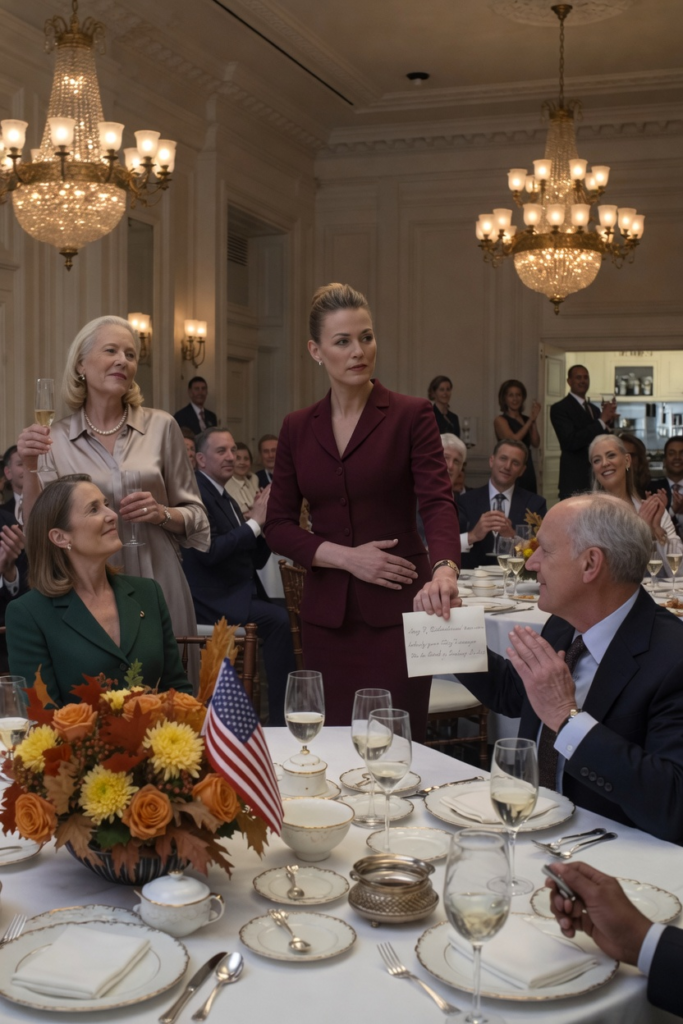
“To Natalie,” Claire announced, her voice booming with pride. “My wonderful daughter, the one who truly saved her father’s life with her tireless fundraising and her unwavering spirit.”
The room erupted. 22 crystal glasses flew into the air.
The applause was deafening. A wall of sound that hit me like a physical blow.
Natalie sat there ducking her head with a fake modest smile that made me want to vomit. The taste of iron filled my mouth.
I had bitten through my lip. They were doing it.
They were actually doing it in front of everyone. They were stripping the truth from my bones.
They were stealing my sacrifice and gift wrapping it for the golden child. Natalie hadn’t given a single drop of blood.
She’d given a few PR interviews and pocketed the tax write-offs. I was the one who went under the knife.
I was the one with the empty bank account and the infection that almost killed me. I looked at them.
Natalie was basking in the glory of an organ she didn’t own. Claire was looking at her like she was a saint.
I put my hands on the table. My knuckles were white.
I was done. I was going to walk out of this ballroom, get in my truck, and never look back at these vampires again.
I started to stand up. Suddenly, a hand shot out from under the heavy linen tablecloth.
It grabbed my wrist with a strength that shouldn’t have been possible for a man who just had major surgery. I froze.
I looked down. It was my father.
He had excused himself to the restroom minutes ago, but he hadn’t left. He had circled around the back of the room, staying out of Claire’s line of sight.
He was crouching by Table 18, hidden by the long white cloth. His face was pale, and his eyes were bloodshot, but they were burning.
He didn’t say a word. He just pressed a folded-up cloth napkin into my palm and gave my wrist one final desperate squeeze.
Then he disappeared, slipping away toward the kitchen before Claire could look his way. My heart felt like it was going to burst through my chest.
I sat back down. Slowly, I lowered my hands beneath the table out of the radar of the room.
The napkin was rough against my fingers. I unfolded it.
The handwriting was shaky, written in a hurry with a smuggled pen, but every word was a bullet.
Medical power of attorney: yours.
$2.3 million insurance.
You are the sole beneficiary.
51% voting shares.
Transferred to you in September.
They have no idea.
Use it.
Burn the whole house down.
I looked up from the napkin. Across the room, Natalie was laughing, sipping her champagne, acting like she owned the world.
Claire was looking at her with that smug, superior grin. I didn’t feel the pain in my side anymore.
I didn’t feel the cold. I reached for my water glass. My hand was as steady as a rock.
The Reeds thought they were celebrating a recovery. They didn’t realize they were sitting on a pile of dynamite.
And I just found the detonator.
“Copy that, Dad,” I whispered into my glass. “Mission accepted.”
November 25th, two days after the Ashford Hall disaster, the Chicago sky was a flat, miserable sheet of slate.
I drove my Ford through the slush to a glass tower downtown. No music, just the heater humming and the ghost of a scar itching under my coat.
Russell Walsh’s office smelled like black coffee and the kind of expensive paper that ends lives. Walsh didn’t do small talk.
He was a shark in a charcoal suit. The kind of guy who’d find a loophole in the Ten Commandments.
He didn’t offer me a seat. He just slid three heavy manila folders across the polished mahogany desk.
“Your father’s been busy,” Walsh said. His voice was a dry rasp.
I opened the first folder. Notary stamps, red ink, ironclad, medical power of attorney.
I wasn’t just a donor anymore. I was the one who decided if Kenneth Reed lived, died, or got moved to a different facility.
Claire was legally locked out of the room.
The second folder was the payoff. A life insurance policy for $2.3 million.
I scanned the beneficiary line. My name sat there alone. Claire had been scrubbed.
My mother, a woman who measured love and net worth, had just been declared bankrupt in the eyes of my father’s ghost.
But the third folder, that was the armor-piercing round. 51% voting control of Reed Medical.
In the eyes of the law, I owned the company. I owned the board. I owned the legacy Claire had spent 30 years building on the backs of everyone else.
“He left a letter,” Walsh added, sliding a smaller envelope over the mahogany. “Read it, then we talk.”
I walked over to the floor-to-ceiling window. Below me, the city looked like an ant farm.
I tore the envelope. The paper was thin, the handwriting shaky. A man writing against a ticking clock.
It finally made sense. 34 years of being a phantom.
When I was 12, my jawline changed. My eyes sharpened.
I stopped looking like a child and started looking like a memory. I was a carbon copy of Aunt Julie, Claire’s younger sister, who died in a car wreck when she was 20.
Claire didn’t just lose her sister. She hated her.
Julie was the one everyone loved. The one Claire could never outshine.
My mother couldn’t handle a ghost walking in her hallways. So at 12, she packed me off to a cold boarding school in New England.
No hugs, no explanations, just a suitcase and a bus ticket. She spent two decades trying to erase my face because it reminded her she was second best.
My father knew. He admitted it in the letter.
He’d watched her destroy me to keep the peace at home. He chose a quiet house over a daughter’s heart.
He called himself a coward. But now he was handing me the rifle and the coordinates.
He was giving me the power to finish what his silence had started. I folded the letter.
My heart rate sat at a dead 60. No tears, just a cold, hard clarity.
The girl who wanted a mother’s love was dead. The captain was all that was left.
November 29th.
The first mine went off. I was at my studio apartment sitting on the floor cleaning my boots.
My phone buzzed. Claire had tried to pull the quarterly interest from the insurance policy to pay for her country club dues.
The company told her access denied.
December 1st. The second mine.
Natalie was at the Reed Medical Headquarters running an audit for her CEO bid. She hit the wall of the 51%.
My phone didn’t just buzz, it screamed. The caller ID said, “Mom.”
I didn’t answer. I went to the kitchen, took a ham sandwich out of the fridge, and sat at my small table.
I hit the speakerphone button on the third call. Claire didn’t say hello.
She didn’t ask how my incision was healing. She just ranted.
Her voice was a high-pitched screech that distorted the phone’s tiny speaker.
“You backwoods little grunt,” she hissed. The sound of her pacing on a hardwood floor came through the line.
“You think you can just walk in and take what we built? You’re a soldier, Olivia. You’re meant to follow orders, not give them. Give the shares back to Natalie, or I will make sure the board destroys you before you can even take a seat.”
I took a bite of the sandwich. I chewed slowly. I didn’t say a word.
I just listened to her unravel. She sounded like a frantic animal caught in a trap of its own making.
“Are you even listening to me?” she screamed. “You’re playing martyr, but you’re just a thief. You’re a mistake Kenneth made when he was high on morphine. I’ll have you in court for a decade.”
I reached over and tapped the red button.
Beep.
Silence.
The apartment was quiet. I finished my sandwich, wiped the crumbs onto a plate, and stood up.
I walked over to my desk and picked up the phone again. I didn’t call her back. I didn’t call Natalie.
I opened a message thread with Walsh.
Walsh, I typed. Schedule the emergency board meeting for Monday. Tell them the new owner is coming in.
I hit send. Then I walked to the bathroom and looked in the mirror.
I saw Aunt Julie’s jawline. I saw the eyes that Claire hated.
But for the first time, I didn’t feel like a ghost. I looked at the phone as the confirmation chime rang out.
“Time to take out the trash,” I whispered to the empty room.
December 16th, 2:00 sharp. The Chicago wind was rattling the double-pane glass on the 44th floor of the Reed Medical tower.
But inside, the air was dead, stale. It smelled like expensive floor wax, bitter espresso, and the kind of high-stakes fear that doesn’t wash off.
This was the sanctum, the place where my mother had spent three decades spinning lies into gold. I wore the navy suit.
It was stiff, the heavy fabric pulling against my left side. I’d left the top button of my silk blouse undone.
I didn’t need a necklace. I had the scar.
A 15-centimeter jagged, angry reminder of raised pink tissue that ran from my rib to my hip. It was my only medal from this war, and I wanted them to see it every time they looked me in the eye.
Walsh was already inside. He was standing by the floor-to-ceiling windows, his hands buried in the pockets of a charcoal overcoat, watching the traffic crawl along the Magnificent Mile.
He didn’t look like a lawyer. He looked like an executioner waiting for the signal.
Claire was at the head of the table. She looked like a queen in a cream-colored power suit, her fingers drumming a frantic staccato beat on the polished oak.
Natalie sat to her right, her eyes locked on an iPad, her jaw set so tight I could see the muscles pulsing in her neck.
They were surrounded by the board of directors, seven sharks in gray suits who had built this empire on the idea that the Reeds were the gold standard of American healthcare.
I didn’t knock. I didn’t wait to be announced.
I pushed the heavy oak doors open and walked in. The click of my boots was the only sound in the room, a steady military cadence.
I didn’t look at the men. I walked straight to the head of the table and stopped behind Claire’s chair.
“Get up,” I said. My voice was a flat desert wind. No heat, no anger, just a command.
Claire’s head snapped back. Her eyes were bloodshot. The whites yellowed by a week of stress.
“You have no standing here, Olivia. This is a private executive session. Security is already on—”
Walsh didn’t let her finish. He stepped away from the window and dropped a heavy notarized packet on the table.
The sound hit the room like a hammer.
“51% voting interest, Claire,” Walsh said, his voice a dry rasp. “Effective as of September 15th. The captain isn’t a guest. She’s the chair.”
I watched the color slide out of Claire’s face. It was a slow, agonizing drain, like water disappearing down a rusted pipe.
Her mouth opened, then snapped shut. She looked at the board members, then at the packet.
She stood up. Her legs were shaky, her hand grasping the edge of the table for support.
She moved to a side chair, her eyes burning with a venom that could have etched the glass. I took the seat.
The leather was cold.
“Item one,” I said.
I pulled a glossy magazine from my folder and tossed it onto the glass centerpiece. There was Natalie smiling on the cover holding that giant cardboard check for $83,000.
The Natalie Reed Pierce Kidney Health Initiative, a heartwarming story about a daughter’s sacrifice.
Natalie finally looked up. Her eyes were hard, but I could see the sweat ringing her hairline.
“Except Natalie didn’t give a damn thing,” I said.
I leaned forward, my elbows on the table, my eyes locked on hers.
“I’m the one who went under the knife. I’m the one who spent nine weeks in a studio apartment eating generic antibiotics because the hospital you picked for the PR didn’t take my military insurance. I’m the one sitting here with an $11,000 debt while you were taking selfies with the mayor.”
The board members shifted. These were men who lived for the bottom line, but even they knew the difference between a leader and a vulture.
“The $83,000 you raised,” I continued, “matched by the company, you didn’t save Dad’s life. You used my kidney as a tax shelter. You leveraged a family tragedy into a $41,000 corporate write-off.”
“That’s just smart business,” Natalie barked.
She stood up, her face a blotchy red. “You wouldn’t understand. You’ve spent 10 years playing soldier in the dirt while I kept this company afloat. You don’t know the first thing about legacy.”
Claire saw her opening. She leaned in, her pearls rattling.
“You’re delusional, Olivia. This is exactly what I warned the committee about. You’re unstable. The PTSD. It’s finally caught up to you. You’re having an episode. You’re trying to burn down your own family because you’re jealous of your sister’s success.”
The room went dead. The unstable soldier card.
Claire was smiling now, a thin, triumphant smirk. She thought she’d won.
I didn’t blink. I just looked at Walsh.
He reached into his leather briefcase and pulled out a single sheet of paper. It had the Presbyterian Hospital seal at the top.
At the bottom, a heavy red stamp, the silver bullet. I slid it across the table.
It hissed over the polished surface and stopped in front of the board’s lead counsel.
“Read it,” I said.
The lawyer cleared his throat. He looked at Claire, then at the paper.
His hands began to tremble.
“This is a transcript from the ethics committee inquiry, August 18th. An emergency meeting requested by Mrs. Claire Reed. She requested the immediate cancellation of the transplant surgery, citing the mental instability of the donor, Olivia Reed. When informed that a cancellation at that stage would result in the inevitable death of the patient, Mrs. Reed responded…”
The lawyer stopped. He looked like he wanted to be anywhere else.
“Read it,” I commanded.
“‘Then that is his fate,’” he whispered. “‘I will not have that girl back in my house as a hero. I’d rather lose him than let her win.’”
The silence that followed was a vacuum. The board members looked at Claire, and for the first time in 30 years, they saw her without the filter.
They saw the woman who was willing to commit murder by omission just to spite the daughter she couldn’t erase. Claire’s mouth was working, but no words came out.
She looked like a ghost. Natalie had shrunk into her chair.
The PR campaign, the golden child, it was all gone, melted away by a single red stamp.
I stood up. I walked around the table until I was inches from Claire. She was trembling.
“You weren’t worried about me quitting,” I said, my voice like a serrated blade. “You were worried about me being visible.”
“Well, look at me now, Claire. Everyone is watching.”
I turned to the board.
“This meeting is adjourned. Natalie, you have three hours to clear your office. Claire, you’re banned from the building.”
I turned and walked toward the door.
One, two. One, two.
I reached the handle and stopped.
“And Claire,” I didn’t look back. “I’m moving Dad to a private facility in the morning. I’m the only one on the authorized list. You wanted him gone. Now he is. To you, he’s officially dead.”
I pushed the doors open and walked into the hall. Behind me, I heard the first jagged, pathetic sob break from her throat.
It wasn’t a mother’s cry. It was the sound of a legacy turning to ash.
I didn’t stop. The mission was only halfway done.
The boardroom was still, the kind of stillness that comes after a gunshot. I leaned forward, my palms flat on the cold oak table.
I didn’t look at the lawyers. I didn’t look at the board members.
I looked straight at the woman who had spent 31 years trying to turn me into a shadow.
“Effective immediately,” I said. My voice was a low, steady rumble. “Claire Reed is removed from her position as chief financial officer. Security is already in the hall. They will escort her to her office to collect her personal belongings. Anything company owned stays behind. Everything.”
Claire’s face went from a deathly white to a mottled, ugly purple. She slammed her fist onto the table, her heavy gold rings clacking against the wood.
“You can’t do this. You’re a child playing with fire. I built this. I am the heart of Reed Medical.”
I didn’t blink. I didn’t even breathe harder. I just looked at the board members.
Five out of seven hands went up. The vote was a formality. A firing squad with paper instead of lead.
“The board has spoken, Claire,” I said.
I turned my head slightly toward my sister. Natalie was trembling, her expensive iPad clutched to her chest like a shield.
“And you, Natalie, you have two choices. You can accept a demotion to mid-level manager, half the salary, no corporate car. You report to a supervisor who doesn’t share your last name, or you can clear your desk by 5:00. Choose now.”
Natalie opened her mouth, but nothing came out. She looked at our mother, then back at me.
For the first time in her life, the golden child realized that the gold was just cheap spray paint. The dominoes started falling before the sun went down.
By 6:00, Claire was being marched out of the building by two security guards who looked like they were enjoying it. By 8:00, she arrived at the family estate only to find the locks had been changed.
Kenneth, my father, had finally found his spine. He’d had his lawyer deliver the separation papers to the front gate.
He was done being a victim of her peace.
The leak happened shortly after. The ethics committee report hit the local business wires.
When Natalie’s husband, a man who lived and died by his family’s honor, read the transcript of how his wife and mother-in-law had tried to let Kenneth die just to spite me, he didn’t scream.
He didn’t argue. He just called a locksmith and a divorce attorney.
The perfect American marriage was dead before the first snow of the season.
December 30th.
The wind was whipping off Lake Michigan, turning the city into a freezer. I was sitting in my studio apartment, drinking a cup of bitter black coffee.
The radiator was clanking, a rhythmic, lonely sound. Then came the knock.
Heavy, desperate.
I opened the door.
Natalie was standing there. She looked like hell.
No Dior coat, no designer heels. Her hair was a matted mess, and she smelled like a bottle of cheap gin and three days of regret.
She stumbled inside, her knees buckling as she hit my thrift-store sofa. She started to sob, not the quiet, pretty sob she used for the cameras, but a jagged, ugly sound.
“She used me, Olivia,” Natalie gasped, her fingers digging into the worn fabric of the couch. “Mom, she turned me into a doll, a puppet. I didn’t even know who I was anymore. I just wanted her to love me. Why? Why did you still do it? Why did you give him your kidney when you knew she’d try to bury you?”
I didn’t move. I stayed leaning against the kitchen counter, my arms crossed.
I felt the pull of the scar in my side. Natalie reached out, her hand trembling, trying to grab my sleeve.
“I’ve lost everything. The house, the job, the marriage. Please, you’re the only one left.”
I stepped back just an inch. The perimeter was established.
“I didn’t do it for her,” I said. My voice was ice. “I did it because he’s my father.”
“My character isn’t a reaction to her cruelty, Natalie. It’s a choice I made in the dirt while people were shooting at me. My soul isn’t for sale, and it’s not for rent.”
Natalie buried her face in her hands, her shoulders shaking.
“I’m so sorry. Please, can we just… Can we be sisters again?”
I looked at her. I saw the girl who had let me sit at the kid’s table.
I saw the woman who had stolen my sacrifice for a tax write-off. I felt a strange, hollow kind of peace.
“I forgive you, Natalie,” I said.
The words were heavy, like stones being dropped into a well.
“I really do. I won’t carry the weight of hating you anymore. It’s too much gear to hump.”
She looked up, a spark of hope in her bloodshot eyes.
“Does that mean—”
“No.”
I cut her off. My eyes were locked on hers.
“Discipline is discipline. You don’t get to burn a bridge and then act surprised when you’re standing in the water. You chose your side a long time ago. I forgive you, but I don’t trust you, and I don’t want you in my life.”
I walked to the door and opened it. The cold air rushed in sharp and honest.
“You’re not my sister anymore,” I said. “You’re just someone I used to know.”
Natalie stood up. She looked at me, realizing there was no crack in the armor, no way back in.
She walked past me, her head down into the dark, snowy Chicago night. I shut the door.
I turned the deadbolt.
Click.
The apartment was quiet again, just the radiator and the wind. I went back to my coffee.
It was cold, but I drank it anyway. The mission was almost over.
The swamp was drained. The trash was out. And for the first time in 31 years, I could breathe without feeling like I was taking up someone else’s air.
I looked at the phone on the counter. One more chapter, one more order to give.
Sunday morning. The smell of coffee filled my studio apartment.
Not the expensive, overroasted sludge they served in the executive lounge at Reed Medical, but the strong, dark, $5-a-bag stuff I brewed myself.
I sat at my small wooden table, the one with the chipped corner, and opened my banking app. The red overdrawn alert was gone.
In its place was a balance that would have made the old Olivia dizzy. I didn’t feel rich. I felt equipped.
I tapped the screen, authorizing the final payment to Presbyterian Hospital.
$11,230.
Every cent of the debt I’d carried like a rucksack full of stones was gone. I watched the confirmation check mark appear.
It felt better than any commendation I’d ever received in the service. I’d made my first move as chairman of the board three weeks ago.
I didn’t take Claire’s office. I didn’t want the leather chairs or the view of the lake.
I hired a guy named Marcus to be the CEO, a man with a solid track record and a soul that hadn’t been bleached white by corporate greed.
I told him to run the business. I told him to make it honest.
I stayed on as chair just to keep the sights aligned. Then I did what the Reeds never could.
I established the Rear Guard Fund. It’s a $50,000 annual grant for living donors who find themselves outside the safety net.
My first check went to a woman named Maria. She’d given a lobe of her liver to save her seven-year-old son, and three weeks later, her landlord had slapped an eviction notice on her door because she couldn’t pull a shift at the diner.
I signed that check personally. It didn’t feel like charity. It felt like an extraction.
I was pulling a comrade out of a ditch. I was doing the rear guard work that no one had done for me.
The news from the old empire came in fragments like static on a long-range radio. Claire was gone.
She was living in a one-bedroom rental in a retirement community outside of Ocala, Florida. No country club, no Cartier watches, just a dusty unit with thin walls and the biting realization that the world didn’t stop turning just because she wasn’t at the center of it.
I heard she spent her days writing letters to lawyers who wouldn’t call her back, still trying to claw her way into a legacy that had already burned to ash.
Natalie was worse off. The divorce was getting ugly.
Her husband was a man of old-school principles, and the transcript from the ethics committee had been the final nail in the coffin of their perfect suburban life.
She’d been stripped of her alimony because of a morality clause in her prenup. Now she was working as a mid-level manager for a rival firm, reporting to a boss 10 years younger than her, and living on a salary that didn’t cover her former dry-cleaning bill.
The golden child was finally learning how the rest of the world survived.
Then there was Dad.
Every Sunday after I finish my coffee, I drive down to a small greasy spoon diner in Lincoln Park. He doesn’t come in a limo anymore.
He drives himself. We sit in a vinyl booth that smells like maple syrup and old cigarettes.
It’s awkward.
The silence between us is thick with 30 years of things that weren’t said. He’s still pale, and he moves a little slower now.
But the man I see across from me is finally real. We don’t talk about the company. We don’t talk about Claire.
We talk about the weather or a book he’s reading or the way the Chicago wind bites through a coat. It’s a slow process, like clearing a minefield one inch at a time.
It’s full of scars, but at least those scars are honest. He’s the only one left who knows where I came from.
And for now, that’s enough.
Last Tuesday, I was leaving the Reed Medical Tower after a quarterly review when a young woman stopped me in the lobby. Her name was Sarah.
She worked in accounting. She was shaking, her eyes red-rimmed. She’d heard the stories everyone had.
“My brother,” she whispered, looking around to see if anyone was watching. “He needs a transplant. My parents, they told me I have to do it. They said it’s my job because I’m the strong one. But they’re already talking about who gets his apartment if he doesn’t make it. I feel like I’m being harvested, Captain.”
I didn’t give her a pep talk. I didn’t tell her it was a noble sacrifice.
I reached out and grabbed her hand. Then I pulled up the sleeve of my blazer and shifted the waistband of my slacks just enough.
I let her see it. The jagged pink line of the scar.
“Look at this,” I said, my voice low and hard. “This isn’t a mark of shame. It’s a map of what I survived. You are not a harvest, Sarah. You are a human being. If you give that piece of yourself, you make damn sure they see you. You make sure the world knows what it cost. And if they choose to stay blind, you walk away and you never look back.”
I saw the light come back into her eyes. Not the fake polished light of a PR campaign, but the cold, steady glow of someone finding their feet.
“Don’t let them erase you,” I told her. “Force them to open their eyes.”
This afternoon, I sat in my Ford F150, watching the sun dip below the Chicago skyline. The glass of the windshield reflected my face.
Older, sharper, but finally mine. The scar in my side started to throb.
It always does when the temperature drops below 40. It’s a permanent reminder that I gave away a piece of myself to save a man who didn’t deserve it.
But in return, I found the one thing Claire Reed could never steal. I found my command.
I’m not a ghost at Table 18 anymore. I’m not a footnote in someone else’s success story.
I’m a soldier. I am a survivor. And I am finally the commander of my own life.
I put the truck in gear and pulled out into the traffic. The mission was over. The homefront was secure.
I drove into the sunset and for the first time in 31 years, I didn’t look in the rearview mirror.