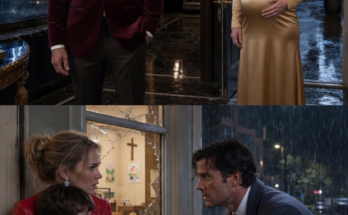
The billionaire told his pregnant wife, “I never loved you”… and she ran away in the rain after hearing him say that, then hid their son for four years – until a photograph forced this powerful man to face the truth…..
The night Damon Vale told his wife he had never loved her, Nora was six weeks pregnant and three steps from the door that would save her life.
Rain slammed against the tall windows of the Gold Coast mansion as if Lake Michigan itself had risen in the dark and come to accuse him. The house remained cruelly perfect around them: black marble floors polished like still water, walnut walls, crystal fixtures, oil portraits of dead Vale men who had built fortunes by smiling at judges and frightening everyone else.
Damon stood near the window in a black shirt with his sleeves rolled to his forearms, one hand in his pocket, his reflection cut in half by lightning.
He did not look angry.
That hurt worse.
Anger would have meant something in him was still alive.
“I never loved you,” he said.
Nora did not move.
The words did not strike all at once. They entered her carefully, almost politely, and then spread through her chest like freezing water.
For three years she had slept beside that man. She had learned the weight of his silences, the difference between a business call and a call that meant blood, the way his jaw tightened when a room contained a threat nobody else had noticed yet. She knew Damon Vale was not an ordinary husband. His last name opened boardrooms, closed mouths, and made dangerous men choose disappearance over argument.
But she had also seen him sit beside her bed for two nights when she had pneumonia, refusing to leave even after she told him he looked ridiculous sleeping in a chair. She had felt him pull her close in the middle of the night, as if darkness gave him permission to be tender. She had heard him say her name in his sleep like it was the last honest thing left in him.
Now he was standing in front of her, erasing all of it with four words.
“Say something,” he ordered.
His voice was less steady than his face.
Nora almost laughed, not because anything was funny, but because there were too many things she could say and none of them would save her.
She could tell him she had loved him even after every woman with sense had warned her that nobody survived intact beside a man like Damon Vale. She could tell him she had endured charity dinners with corrupt aldermen, midnight phone calls, armed men at the gates, locked doors, coded conversations, and the sickening knowledge that kindness in his world was treated like a weakness to be punished.
She could tell him that very morning Dr. Elaine Brooks had confirmed the pregnancy.
Six weeks.
A child.
Their child.
But she said nothing.
There was a kind of pain that made women scream. There was another kind that made them dangerously quiet.
Nora took her camel coat from the back of a chair.
Damon watched her more closely. He had always possessed that cursed gift: he noticed every gesture, every breath, every small shift in a room, except the one thing that mattered before he lost it.
“Where are you going?” he asked.
Nora reached the door. Her fingers touched the cold brass handle. For one second, she wanted to turn around, take his hand, place it over her stomach, and tell him he had not destroyed only her. He had just rejected a life too small to defend itself.
Then she remembered the exact way he had said it.
I never loved you.
No tremor.
No mercy.
She kept her back straight.
“Somewhere you don’t have to pretend.”
She opened the door and walked into the storm.
Rain soaked her in seconds. Behind her, the door closed with a soft, expensive click, leaving Damon locked inside his kingdom of glass, money, weapons, and secrets.
He expected her to come back.
Everyone came back to Damon Vale eventually: employees who quit in anger, partners who betrayed him and begged for mercy, politicians who swore they were done taking his calls until the next election bill arrived, women who mistook his coldness for mystery and his power for safety.
In his world, he was gravity.
But Nora walked down the long stone drive with one hand pressed lightly against her abdomen and did not look back.
By dawn, she had sold her phone for cash at a pawnshop near Pilsen, traded her wedding ring for a used car with a cracked heater, and crossed the state line under the name Nora Ellis before Damon’s men understood that this time, gravity had failed.
She drove north until Chicago’s steel and glass disappeared behind her. She kept going past Milwaukee, past sleeping gas stations and shuttered farm stands, past small towns where church signs promised mercy in white plastic letters. When nausea hit, she pulled into a rest stop and gripped the steering wheel until it passed. When she cried, she did it quietly, because crying too hard made her stomach twist and she was already terrified of losing the only person who had left that mansion with her.
The town she chose was Copper Harbor, Michigan, a place at the tip of the Keweenaw Peninsula where the lake looked endless and cold enough to keep secrets. It had a main street with cedar-sided shops, a little diner that smelled like coffee and fried potatoes, a harbor full of battered boats, and a daycare behind a church that needed an assistant willing to accept low pay, long hours, and no questions.
It was not glamorous.
That was why Nora trusted it.
Part 2: The room she rented sat above the daycare, with slanted ceilings and windows that rattled whenever the wind came off the lake. In winter, cold seeped through the walls like a patient animal. In spring, the roof smelled faintly of damp wood. The first night, Nora sat on a borrowed bed, listening to a family laugh through the wall, a dog barking somewhere down the street, and a woman downstairs singing off-key while washing dishes.
Only then did she cry.
Not only for Damon.
Not only for herself.
She cried for the child who would one day ask about his father and for the answer she would have to build carefully, so truth would not become poison.
Months passed, and survival became a schedule.
Nora worked mornings at the daycare, afternoons at the diner, and evenings sewing buttons and hemming pants for fishermen’s wives who called her “honey” without meaning anything by it. Her belly grew beneath thrift-store sweaters. Her hands became dry from washing paint off tables and wiping soup from small faces. She learned to stretch one chicken into four meals, to smile without inviting questions, and to say, “I’m okay,” with a firmness that ended conversations.
When her son was born during a thunderstorm in late November, she named him Eli.
Eli Ellis.
Not Vale.
He arrived with dark hair, solemn eyes, and a frown so serious the nurse laughed and said he looked like he had been disappointed by the world before he’d even properly entered it.
Nora held him against her chest, feeling his tiny breath warm her skin, and something inside her took a shape stronger than grief.
“You are not a secret,” she whispered into his hair. “You are mine.”
Four years changed Nora into a woman Damon would not have recognized.
The Nora from Chicago wore silk dresses to private dinners and smiled beneath chandeliers while men calculated power over wine. The Nora of Copper Harbor wore jeans, boots, and her hair twisted up with a pencil. She could calm a screaming toddler, change a tire in sleet, and tell when a parent was lying about having eaten breakfast.
She never spoke of Damon.
When people asked about Eli’s father, she said, “He’s not in our lives.”
It was enough truth.
Eli grew quiet, watchful, and sweet in a way that sometimes broke her heart. He did not throw tantrums often. He did not demand answers. He studied people the way Damon used to study rooms, noticing changes in tone, exits, tension, false laughter, and the exact moment a grown-up’s smile stopped being real.