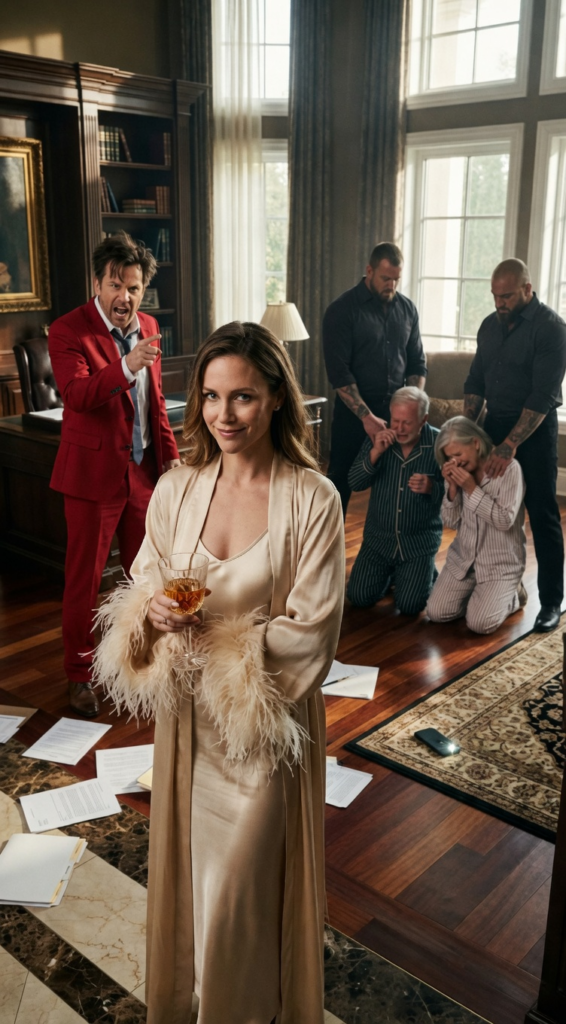
WE RAISED YOU, SO WHAT’S YOURS IS OURS.”
My mother’s voice, a shrill and grating sound I hadn’t heard in eight years, sliced through the crisp afternoon air, crackling over the intercom of my security gate.
I stood in the expansive, sunlit kitchen of my Brentwood estate, staring at the high-resolution tablet mounted to the marble wall. Through the camera lens, Helen Vance glared directly into the fish-eye aperture. She was clutching a designer suitcase, the leather pristine, her posture rigid with an entitlement that made my blood run cold. Pacing nervously behind her was my father, Richard Vance, wringing his hands beside the idling engine of a massive moving truck.
A visceral, violent memory clawed its way up my throat. I wasn’t twenty-six anymore, standing in a multi-million-dollar home funded by my own fintech company. I was eighteen again. The biting chill of a Chicago winter whipped through my thin jacket. I could still feel the humiliating weight of the black plastic trash bags holding everything I owned, dumped unceremoniously on the icy driveway. I could still hear the muffled laughter of my older brother, Kevin Vance, echoing from the top-floor balcony—the sprawling suite he had demanded, the very reason I had been cast out into the freezing streets with nothing but two hundred dollars and a worthless high school diploma.
Grow up, Audrey. Kevin needs the space. You’ll figure it out, my mother had said, before deadbolting the door.
I swallowed the ghost of that scared teenager, forcing myself back to the present. I had figured it out. I had built an empire from the dirt up, and I had fortified my life. My estate wasn’t just a home; it was a sanctuary. Every inch was protected by biometric locks, motion-tracking smart cameras, and a private security service. I valued safety above all else, precisely because I knew what it felt like to have none.
I walked down the winding, manicured driveway, my heart hammering a chaotic rhythm against my ribs. The gravel crunched beneath my shoes, a steady, grounding sound. When I reached the imposing wrought-iron gates, Helen didn’t offer a smile, let alone an apology or a warm greeting.
Instead, she scoffed, her eyes raking over the manicured lawns before settling on me. “Unlock this gate, Audrey. We’ve been driving for hours, and your father’s back is killing him. We need to get settled into the master suite.”
I froze, my hand hovering inches from the manual override switch. “The master suite? What are you talking about? You haven’t called me in eight years. You kicked me out so Kevin could have the top floor.”
Helen rolled her eyes, her lips thinning into a vicious line, her voice dripping with venom. “That was years ago, grow up. We raised you, Audrey. We gave you life. So what’s yours is ours. Now, let us in.”
A cold dread coiled in my gut, but it wasn’t born of fear. It was the terrifying realization that they hadn’t changed at all; only their target had. I reluctantly keyed in the code for the pedestrian gate—refusing to let the moving truck breach the perimeter—intending to tell them to turn around. But as the iron hinges groaned open, I noticed my father. Richard was nervously clutching a heavy, scuffed leather briefcase to his chest, retreating a few steps away from the noise of the street.
He had his cell phone pressed tight against his ear, and through the quiet hum of the afternoon, I caught his frantic whisper: “We’re in the perimeter. She’s resisting, but she’ll break. Tell Kevin we are setting up the groundwork tonight.”
Once inside the perimeter, the illusion of a happy family reunion evaporated instantly. Helen didn’t even glance at the beautiful, detached guest cottage I had explicitly pointed out to her. Instead, she bypassed it entirely, stalking up the limestone steps and marching straight into the main house. Her heels clicked sharply against the hardwood, a rhythmic invasion of my quiet sanctuary.
I followed them inside, watching as she dragged her suitcase up the floating glass spiral staircase, making a beeline for the south wing. My wing.
When she reached the double doors of my master suite and grasped the handle, it wouldn’t budge. She rattled it, her frustration mounting, until her eyes landed on the sleek, black biometric fingerprint scanner mounted on the doorframe. She spun around, her face twisted in an ugly, mottled rage.
“What is the meaning of this?” she hissed, gesturing wildly at the scanner. “You lock your own parents out? Kevin is currently sleeping in a cramped, moldy apartment because of your selfishness, and you are hoarding this giant mansion! You owe us a roof over our heads!”
I stood at the bottom of the stairs, looking up at the woman who had birthed me. The remnants of a daughter’s ingrained submission finally dissolved. I felt no fear, only a clinical, icy detachment.
“You raised me until my eighteenth birthday, then threw me out with two hundred dollars,” I said, my voice dangerously even. “You didn’t buy a single brick of this house. I did. If you don’t like the guest cottage, you can find a hotel.”
Richard stepped forward, lingering on the landing. His voice trembled, adopting that pathetic, coercive tone he always used when he wanted something without fighting for it. “Audrey, please. Don’t speak to your mother that way. We are a family. We just want to be close to you… and help you manage your massive assets. It’s too much responsibility for a young woman alone. We saw your company’s valuation in Forbes. You need guidance.”
The mention of my corporate valuation felt like a physical violation. Why do they care about my company’s numbers? Why the master suite? Why are they really here? The gaslighting washed over me—the tearful reminders that Helen had endured a grueling labor for me, that they had fed me for eighteen years—but the words bounced off my armor. I firmly locked down the main house, forcing them to take their luggage back out to the guest cottage.
The rest of the evening was a tense, silent standoff. I locked myself in my home office, double-checking my firewall and my company’s accounts. The air in the house felt heavy, contaminated.
That night, I lay awake in my bed, staring at the shadows playing across the ceiling, unable to shake a deep, suffocating sense of unease. My mind raced with my father’s whispered words at the gate. Setting up the groundwork. At exactly 3:15 AM, the silence of my bedroom was shattered. My phone, resting on the mahogany nightstand, began a rapid, silent vibration. The screen illuminated the dark room with a harsh, red glow. It was a critical alert from my smart-home security app:
Motion detected in Home Office. Biometric bypass attempt failed. Manual lock tampering detected.
I didn’t turn on the lights. I slipped out of bed, the marble floor cold against my bare feet, and crept down the dark, cavernous hallway. The house smelled faintly of expensive cedar and the sterile ozone of the air conditioning, but beneath it, I could practically smell their desperation.
When I reached the landing, I saw a sliver of pale light bleeding out from the slightly cracked door of my home office. I held my breath, pressing my back against the wall, and peered through the narrow gap.
Inside, the scene was chaotic. Helen and Richard were frantically rummaging through my heavy steel filing cabinets, having somehow jimmied the mechanical backup lock. My mother was holding a stack of my corporate financial statements, using the harsh flashlight of her phone to illuminate the pages while snapping rapid photos.
“Did you find her digital signature stamp?” Richard whispered frantically, his hands trembling as he sifted through a drawer of personal stationary.
“Not yet, but I have the blank quitclaim deeds right here,” Helen sneered, her voice hushed but dripping with a venomous urgency. She held up three crisp, legal documents. “If we can’t find her digital stamp, we’ll force her to sign them tomorrow. We’ll tell her it’s just a routine tax exemption form for the estate. She’s naive enough to trust family. Once the deed is in our names, we sell the house, pay off Kevin’s debts, and he can finally have the life he deserves.”
Richard paused, looking physically sick but morally vacant. “Are you sure about this, Helen? Kevin is in debt for $1.2 million. Those crypto guys… they’re not businessmen. They’re dangerous. If we don’t get them the money, they said they’ll kill him. They’ll take our house, too.”
“Which is exactly why we need this estate!” Helen hissed, slamming a drawer shut. “Who cares about her? She succeeded without us once. She can do it again. Kevin needs us.”
I stood in the shadows, my blood turning to absolute ice. This wasn’t a boundary-stomping visit from toxic relatives. This was an active, calculated heist. They were committing conspiracy to commit grand larceny, identity theft, and extortion, all to shield their golden child from the violent consequences of his own illegal gambling.
If I walked in there right now, the confrontation would be explosive. They were desperate animals backed into a corner; they might flee, or worse, they might try to physically coerce me into signing.
I stepped back, silencing my breathing, and quietly slipped back to my bedroom. I didn’t shed a single tear. The betrayal was absolute, but it was also liberating. It severed the final, fraying thread of familial obligation I hadn’t realized I was still holding onto.
I opened my laptop, the screen lighting up my determined reflection. I opened my encrypted messaging app and typed a message to my elite corporate attorney: “I need an emergency asset protection trust set up tonight. Move everything liquid into the holding company. And pull the strings with the precinct captain. I have a robbery in progress.” Next, I accessed my security dashboard and remotely activated the hidden micro-cameras with audio recording in the office, preparing a folder of fake financial documents to feed their boundless greed.
The next morning, the smell of freshly brewed coffee wafted through the kitchen. Helen stood by the marble island, pouring a cup with a sweet, exaggerated smile that didn’t reach her predatory eyes. As I sat down, she slid a thick stack of papers across the counter.
“Sweetheart,” she cooed, tapping the top page. “Your father and I want to invest in your business. We just need you to sign this quick ‘asset management consent form’ so we can transfer some family funds to you…”
“Oh, mom. That is incredibly generous of you,” I said, keeping my expression perfectly placid. I picked up the stack of papers—the quitclaim deeds cleverly buried beneath two pages of dense, fabricated legal jargon—and tapped them against the counter. “But we shouldn’t rush something this important. Let’s have a proper family dinner tonight to celebrate. In fact, I have a surprise. I’ve invited Kevin.”
Helen’s sweet smile faltered for a fraction of a second, her eyes darting to Richard, who suddenly looked as if he might vomit into his coffee mug. “Kevin? But… he’s so busy, darling. Are you sure?”
“Positive,” I smiled warmly. “I texted him this morning. I told him I was preparing a life-changing financial gift for him. He said he wouldn’t miss it for the world.”
The hook was set. Over the next eight hours, I played the dutiful, naive daughter. I hired a private chef to prepare a lavish five-course meal. I set the grand dining room table with the fine china. And behind the scenes, I finalized my trap.
At 7:00 PM sharp, the front gate buzzed. Kevin strutted through the front doors a few minutes later, looking disheveled but deeply smug. He wore a designer jacket that he clearly couldn’t afford, his eyes immediately scanning the opulent surroundings with a hungry, entitled gleam. He expected a bailout. He expected me to lay my hard-earned empire at his feet because our parents had demanded it.
“Nice place, Aud,” Kevin smirked, not offering a hug, taking a seat at the head of the long mahogany table. “Mom said you were finally ready to share the wealth.”
“Something like that,” I replied smoothly, taking my seat directly across from him. Helen and Richard sat on either side, tense as coiled springs, their eyes locked on the beautifully wrapped velvet box resting in the center of the table.
“Before we eat,” I began, my voice carrying clearly through the high-ceilinged room. “I wanted to present my gift. Kevin, go ahead. Open it.”
Kevin eagerly reached forward, tearing the velvet ribbon away with greedy hands. He flipped open the lid, expecting signed deeds, bearer bonds, or a certified check. His smug grin vanished instantly.
He pulled out a thick stack of printed papers. On top was a crystal-clear, high-resolution photograph of Helen and Richard in my office at 3:00 AM, holding the blank quitclaim deeds under the harsh flashlight of a cell phone. Beneath that was a fifty-page transcript of their conversation, and beneath that, a stamped copy of a formal criminal complaint.
“What… what is this?” Kevin stammered, his face draining of color as he looked frantically from the photos to his parents.
I sat calmly, my hands folded perfectly in my lap, and took a slow sip of my sparkling water. “It’s a federal and state case for identity theft, conspiracy to commit grand larceny, and attempted forgery,” I said, my voice dropping to an ice-cold whisper.
Helen jumped out of her chair, the wood scraping violently against the floor. Her face contorted with an ugly, unhinged rage. “You ungrateful, selfish bitch! We are your parents! You would put us in jail for protecting your brother? You owe us your life!”
“I owe you nothing,” I replied softly. I picked up my phone and pressed a single button.
The massive smart screen on the dining room wall illuminated instantly. The crystal-clear audio recording from my office filled the room, Helen’s venomous hiss echoing off the walls: ‘Who cares about her? She succeeded without us once. She can do it again. Kevin needs us.’
Richard collapsed back into his chair, burying his face in his trembling hands. “It’s over,” he whispered, sounding utterly broken.
Helen lunged across the heavy mahogany table, her manicured hands clawing desperately toward the evidence box in Kevin’s hands. But before she could reach it, the heavy double doors of the dining room swung violently open.
Two armed police officers stepped inside, the metallic jingle of handcuffs cutting through the heavy silence. Helen froze mid-lunge, her eyes wide with sudden, primal terror.
But it wasn’t my parents’ reaction that broke the silence. It was Kevin. He leaped to his feet, throwing the box at his mother, screaming, “What did you do? If you don’t get the money, the creditors are going to find me! You ruined everything!”
Justice, I learned, isn’t just a gavel striking a block in a courtroom. It is the slow, systemic restructuring of reality.
Six months later, the crisp autumn wind whipped through my hair as I stood on the sidewalk across from a house I hadn’t seen in nearly a decade. It was my childhood home in Chicago. I watched with quiet, profound detachment as a worker hammered a heavy wooden “FORECLOSURE / SOLD” sign into the dry, dying front lawn.
Helen and Richard had been arrested that night in my dining room and formally charged. Because of the irrefutable, high-definition video and physical evidence I provided, the judge viewed them as a significant flight risk and set their bail at a staggering sum. They couldn’t afford it. To pay for their elite criminal defense attorneys and to desperately cover Kevin’s predatory crypto debts to keep him from being hospitalized by his loan sharks, they were forced to liquidate everything. Their retirement accounts, their cars, and finally, their precious home—the very house with the top floor they had kicked me out to protect.
They had built their lives on the foundation of my exclusion, and now, that foundation had crumbled to dust.
As I watched the worker pack up his tools, my phone vibrated in my coat pocket. I pulled it out. New Voicemail: Kevin Vance.
I pressed play, lifting the phone to my ear.
“Audrey… please,” Kevin’s voice was a ragged, pathetic sob. The smugness was entirely gone, replaced by the crushing reality of a minimum-wage existence. “I’m begging you. They’re evicting me tomorrow. My studio is… it’s awful, Aud. Just pay my rent for a few months. You have so much. Mom and Dad are gone, you’re all I have left…”
I listened for exactly five seconds. I heard the desperation, the fear, the realization that his golden-child status meant nothing in the real world. I felt the familiar tug of familial programming trying to resurface, trying to make me feel responsible for his survival.
I pressed delete.
I felt no anger. I felt no hatred. And most importantly, I felt absolutely no guilt. I turned away from the foreclosed house and walked back to my waiting car, feeling a profound, expansive sense of lightness. The heavy, rusted chains of my past had finally snapped.
Therapy had been brutal but necessary. For months, I sat on a velvet couch and unpacked the years of emotional abuse, finally internalizing the truth I had always suspected: my worth was never defined by my family’s validation. They were fundamentally broken people, incapable of unconditional love.
But I could build something unbroken. I had recently launched a massive charitable foundation, funded by my company’s profits, dedicated entirely to at-risk youth who were ejected from their homes at eighteen. I was turning the darkest moment of my life into a beacon of absolute hope for others.
That evening, the grand ballroom of the Beverly Hills Hotel was bathed in warm, golden light. It was the inaugural charity gala for my youth foundation. The room was packed with investors, philanthropists, and dozens of the young adults my foundation had already helped place in secure housing and university programs.
As I walked off the stage after delivering my keynote speech, the applause roaring in my ears like a physical wave, I felt an intense, burning pride. I had survived them. I had won.
I stepped into the quiet corridor behind the stage to catch my breath. My personal assistant, Clara, approached me, her face pale and tense. She was holding a stark white, sealed envelope.
“Audrey,” Clara said softly, hesitating before handing it to me. “A courier just dropped this off at the front desk. It’s marked confidential… and the return address is a state penitentiary.”
I took the envelope from Clara, my fingers brushing the cheap, coarse paper. The return address was stamped in black ink: Valley State Prison for Women. I didn’t open it immediately. I waited until the gala concluded, until I was back in the absolute safety of my Brentwood estate. I sat in my plush reading chair by the large stone fireplace, the flames crackling and throwing dancing shadows across the room.
I sliced the envelope open with a silver letter opener.
The handwriting was erratic, desperate. It was a three-page letter from Helen. It was a masterclass in manipulation, filled with tear-stained pleas for forgiveness, fabricated remorse, and hollow apologies. She spoke of the terrible food, the cold cells, how she missed her “brilliant daughter.” But true to her nature, the mask slipped on the final page. The entire letter was a preamble to a request: she needed me to hire a new, high-powered appellate lawyer. She needed my money.
I read the final sentence calmly. I didn’t cry. My hands didn’t shake. I realized, with a profound sense of clarity, that I felt absolutely nothing for the woman who birthed me. She was a stranger, an echo of a life I no longer inhabited.
I leaned forward and dropped the pages into the roaring fire. I watched the paper curl, blacken, and turn to ash, floating up the chimney. I was letting go of the toxic past completely.
One year later.
The warm California breeze swept across the expansive terrace of my estate, carrying the scent of blooming jasmine and roasted garlic. I sat at the head of a beautifully lit, long outdoor dining table. The scene was vastly different from the sterile, terrifying family dinner two years prior.
Tonight, the table was filled with laughter, the clinking of wine glasses, and the overlapping stories of vibrant, brilliant people. I looked around at the faces illuminated by the string lights: my lead developer, who had become a brother to me; my attorney, who had protected me when my blood family tried to destroy me; the board members of my foundation; and three of the brilliant young women my foundation had put through college.
This was my chosen family. A family built on mutual respect, loyalty, and actual love, rather than the arbitrary accident of genetics.
I picked up my glass of Pinot Noir and tapped it gently with a silver spoon. The table quieted, turning their smiling faces toward me.
“I won’t make a long speech,” I said, a genuine, easy smile on my face. “But looking around this table tonight… I just wanted to say thank you. To the family we choose, and to building our own foundations.”
“Hear, hear!” my attorney cheered, raising his glass.
The table erupted in agreement, glasses clinking in a joyful symphony.
Later, as the guests began to move inside for dessert, I lingered outside. I walked over to the edge of the stone balcony, leaning against the cool railing, and looked out over the sprawling, glittering lights of Los Angeles stretching toward the horizon.
I took a deep breath of the night air. They tried to steal my future because they couldn’t fix their own past, I thought, a quiet sense of triumph settling in my bones. But you can’t steal what you didn’t build. I built this life, brick by brick, and no one can ever take it away from me.
As I turned to step back into the warmth and light of my home, my smartwatch vibrated on my wrist. I glanced down. A brief notification flashed across the small screen from my perimeter security app: Unidentified individual loitering near the front pedestrian gate.
I pulled up the live camera feed on the watch face and zoomed in.
Standing on the sidewalk, bathed in the harsh yellow glow of the streetlamp, was Kevin. He looked older, entirely disheveled, the designer clothes replaced by faded, ill-fitting garments. He was staring up at the grand gates of my estate, his face a complex map of longing, envy, and deep, unfixable regret. He stood there like a ghost haunting a castle he could never enter.
I stared at the screen for a long moment. A younger Audrey might have felt a twinge of pity. The Audrey of today felt only the cool, smooth surface of an impenetrable boundary.
I smiled faintly. I tapped the screen, sending an automated alert to my 24/7 security patrol to disperse the trespasser.
Without looking back, I stepped inside, sliding the heavy glass doors shut and locking out the ghosts of my past forever.